Marrying Out: Jewish Men, Intermarriage, and Fatherhood

Posted in Books, Judaism, Media Archive, Monographs, Religion, United States on 2014-08-18 02:27Z by Steven

Marrying Out: Jewish Men, Intermarriage, and Fatherhood

Indiana University Press
2014-08-01
286 pages
31 b&w illus.
6 x 9
Paper ISBN: 978-0-253-01319-4

Keren R. McGinity, Author-Educator
Love & Tradition: intermarriage insights for a Jewish future

When American Jewish men intermarry, goes the common assumption, they and their families are “lost” to the Jewish religion. In this provocative book, Keren R. McGinity shows that it is not necessarily so. She looks at intermarriage and parenthood through the eyes of a post-World War II cohort of Jewish men and discovers what intermarriage has meant to them and their families. She finds that these husbands strive to bring up their children as Jewish without losing their heritage. Marrying Out argues that the “gendered ethnicity” of intermarried Jewish men, growing out of their religious and cultural background, enables them to raise Jewish children. McGinity’s book is a major breakthrough in understanding Jewish men’s experiences as husbands and fathers, how Christian women navigate their roles and identities while married to them, and what needs to change for American Jewry to flourish. Marrying Out is a must read for Jewish men and all the women who love them.

Tags: , ,

Mixed Mondays Film Series at the Brooklyn Historical Society

Posted in Canada, Communications/Media Studies, Gay & Lesbian, Live Events, Media Archive, Passing, Social Science, United Kingdom, United States, Videos, Women on 2014-08-18 02:25Z by Steven

Mixed Mondays Film Series at the Brooklyn Historical Society

Crossing Borders, Bridging Generatons
Brooklyn Historical Society
128 Pierrepont Street
Brooklyn, New York 11201
Mondays, 2014-08-04 through  2014-08-18, 18:30 EDT (Local Time)

Hosted by and post-screening discussion with:

Erica Chito Childs, Professor of Sociology (author of Navigating Interracial Borders and Fade to Black and White: Interracial Images in Popular Culture)
City University of New York

This series is co-sponsored by MixedRaceStudies.org.

August 18: Toasted Marshmallows (2014)

Come watch the first public screening of the documentary Toasted Marshmallows in the U.S.! Follow filmmakers Marcelitte Failla and Anoushka Ratnarajah on a journey across Canada and the U.S. as they document the experiences of other mixed-race identified women, delve into their own cultural and ethnic histories, and tell stories about color, passing, privilege, ancestry, and belonging. An extended preview of the film will be followed by a dialogue with the filmmakers and Erica Chito-Childs.

August 11: My Beautiful Laundrette (1985):

British-born, half-Pakistani playwright and novelist Hanif Kureishi won an Oscar nomination for his 1985 screenplay for My Beautiful Laundrette, a richly layered film about Pakistani immigrant life in Thatcherite London.

Come watch the protagonist, Omar, navigate mixed-income and mixed-race arrangements in his family and develop an unlikely, yet beautiful, queer relationship with Johnny (Daniel Day Lewis). Set against the backdrop of anti-immigrant racism and fascism, the story of Omar’s laundrette presents an electrifying set of possibilities around class, race, sexuality, belonging, and love.

August 4: Imitation of Life (1959):

The Mixed Monday film series launches with a 1959 Lana Turner classic—Imitation of Lifewhich explores the story of an African-American woman and her light-skinned, mixed-race daughter who passes for white. Come munch on popcorn, watch the film and discuss the history and cultural context around mixed families, race relations and popular culture.

Tags: , , ,

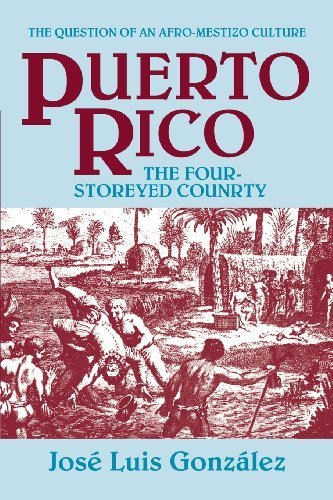
Puerto Rico: The Four-Storeyed Country

Posted in Anthropology, Books, Caribbean/Latin America, History, Media Archive, Monographs on 2014-08-18 01:14Z by Steven

Puerto Rico: The Four-Storeyed Country

Markus Wiener Publishers
2013-08-26
154 pages
Paperback ISBN: 1558760725; ISBN-13: 9781558760721

José Luis González (1926-1996)

In this work, González dismantles the myth of a dominant Spanish and racially white national culture in Puerto Rican history. He claims that the national identity is primarily Mestizo (mixed race) with a significant contribution from Africa. González calls the African slaves and Mestizo peasantry the first Puerto Ricans because they were the first inhabitants who had to make the island their home. Having witnessed successful uprisings in neighboring Haiti, the Spanish authorities encouraged white immigrants to settle in Puerto Rico in an attempt to “whiten” the population, then thought to be tilting dangerously to the advantage of the Afro-Antilleans. These immigrants became the small but influential class of landowners and, later, urban professionals.

According to the author’s grand metaphor, Afro-Antilleans and Mestizos constitute the first “storey,” or tier, of the “Puerto Rican house” of the title, landowners the second, urban professionals the third, and the managerial class the fourth.

Table of Contents

  • Introduction
  • Puerto Rico: The Four-Storeyed Country
  • Literature and National Identity in Puerto Rico
  • “Plebeyism” and Art in Today’s Puerto Rico
  • The “Lamento Borincano”: A Sociological Interpretation
  • On Puerto Rican Literature of the 1950s
  • Bernardo Vega: A Fighter and His People
  • The Writer in Exile
  • Bibliographical Note
  • Glossary of Names
Tags: , ,

What is the Black German Experience? A Review of the Black German Cultural Society of New Jersey 2nd Annual Convention

Posted in Articles, Europe, Live Events, Media Archive, My Articles/Point of View/Activities, United States on 2014-08-18 00:35Z by Steven

What is the Black German Experience? A Review of the Black German Cultural Society of New Jersey 2nd Annual Convention

MixedRaceStudies.org
2012-08-17

Steven F. Riley

All photographs ©2012, Steven F. Riley

I received more than a few raised eyebrows after describing the recent trip my wife and I took to attend the Black German Cultural Society of New Jersey’s Second Annual Convention at Barnard College in New York. If you are tempted to believe that being both Black and German is an oxymoron; think again. African and German interactions go back as far as at least 1600. A fact that is unknown to most, Germany played a significant role during the American Civil Rights Movement as described in Maria Höhn and Martin Klimke’s book Breath of Freedom: The Civil Rights Struggle, African American GIs, and Germany. Although Black Germans, or rather Afro-Germans, consist of less than 1% of the German population (exact numbers are difficult to determine because German demographics do not track race), they are a growing and vocal segment within Germany and beyond.

Panel Session I: Teaching the Black German Experience – Roundtable Discussion, (Professor Priscilla Layne, Professor Peggy Piesche, Noah Sow and Professor Sara Lennox.) (2012-08-10)

I had the opportunity to experience a bit of this Afro-German experience at the screening of Mo Asumang’s autobiographical film Roots Germania at the BGCSNJ inaugural convention last year here in Washington, D.C. What I saw made me want to learn more.

BGCSNJ President, Rosemarie Peña (2012-08-10) Professor and BGCSNJ Trustee Leroy T. Hopkins (2012-08-11)

This year’s convention ran from August 10 to August 11, 2012 in Barnard’s Diana Center with the exception of the spoken word performances held at the Geothe-Institut’s Wyoming Building in lower Manhattan. I attended most of the sessions which consisted of five panels; a keynote address by Yara Colette Lemke Muniz de Faria; live readings by authors Olumide Popoola and Philipp Kabo Köpsell; a movie screening of the films “Hope in My Heart: The May Ayim Story” and “Audre Lorde—The Berlin Years 1984-1992;” a dinner banquet; and finally a live performance by author, artist, media personality, musician, playwright, actress, scholar and human rights activist Noah Sow’s band, Noiseaux at the Blue Note.

Olumide Popoola and Professor Peggy Piesche pay close attention during Panel Session II: Historical and Popular Cultures of Blacks in Germany. (2012-08-11)

It is very important to note that the term “Afro-German” is a socio-political term that includes all Germans (or German identified) individuals of African descent. Although most Afro-Germans are what we in the United States might refer to as, “of mixed-parentage” (usually a “white” mother and “black” father), no distinction is made within the Afro-German diaspora between individuals of so-called “mixed” and “non-mixed” parentage. I heard the term “biracial/multiracial” no more than five times during the entire conference. I theorize that this social taxonomy is derived from the desire not to fragment an already tiny group within German society and also create internalized marginalization within an already marginalized group. A further defining of this group identity was made by Noah Sow, near the end of the first panel, “Teaching the Black German Experience,” when she emphasized that the most appropriate terminology, should be the German term, Afrodeutsche, rather than Afro- or Black- German. During her introduction of the keynote speaker, BGCSNJ president Rosemarie Peña obliged, by referring to herself as Afrodeutsche. Time will tell if this label will stick.

Witnessing Our Histories–Reclaiming the Black German Experience. From presentation by Professor Tina Campt. (2012-08-11)

The highlight of the conference was Yara Colette Lemke Muniz de Faria’s keynote address, “In their Best Interest… Afro-German Children in Postwar German Children’s Homes” which explored the plight of so-called “War/Brown/Occupation Babies”—the children born of the union between white German women and Black American GIs after World War II. She described the systematic removal of Afro-German children from their birth families into substandard orphanages or foster homes, where many faced emotional and physical abuse. Her keynote touched on the story of Ika Hügel-Marshall, who describes her saga in her autobiography, Invisible Woman: Growing Up Black in Germany.

Also of note were the two touching presentations by Vera Ingrid Grant, “Ruby Road: An Excerpt from Paper Girl,” and Debra Abell, “Sauerkraut and Black-Eyed Peas” within the panel “Telling Our Stories – Black German Life Writing” which both explored the life experiences of growing up in the United States as children of a white German mother and black American soldier. Lastly, Jamele Watkins’s, “Performing Bruce Norris’ Clybourne Park in Germany” within the panel “ Historical and Popular Cultures of Blacks in Germany” explored the representation of blacks within theatrical presentations in Germany and discussed the controversial continued use of blackface by white German actors to represent black people.

Vera Ingrid Grant, “Ruby Road: An Excerpt from Paper Girl” (2012-08-11) Debra Abell, “Sauerkraut and Black-Eyed Peas” (2012-08-11)

One slight disappointment was the poor sound, poor ventilation, poor visibility and poor lighting of the Goethe Institut’s Wyoming Building that was used as a venue for the artist performances (who traveled all the way from Europe). Were they trying to recreate a German U-boat aesthetic? Barnard’s Diana Center Event Oval on Lower Level 1—which was used for all of the panels—would have sufficed nicely. If a smaller venue was needed, the Glicker-Milstein Black Box Theatre on Lower Level 2 would have fit the bill also. I looked forward to what appeared to be an excellent documentary, “Audre Lorde—The Berlin Years 1984-1992,” on the life of American feminist scholar and poet Audre Lorde (1934-1992), who allegedly was the inspiration encouraging Black-German women to “call themselves ‘Afro-German’ and to record ‘their-story’.” Like Lorde, who’s life was sadly cut short due to cancer, the film screening was also sadly cut short about a third of the way in due to a defective DVD.

Philipp Kabo Köpsell ponders his forthcoming anthology while waiting for a turkey burger. (2012-08-11)

Like any excellent conference, the personal interactions can be as fulfilling as the sessions. The BGCSNJ Second Annual Convention was no exception. My Friday and Saturday morning chats at our hotel with Millersville University Professor of German Literature, Leroy T. Hopkins provided me with an insight into the joys and challenges of teaching German literature as a person of color and to students of color. With a declining interest in the German language by students nationwide (largely due to an increased interest in Chinese and Arabic languages), Hopkins is hopeful that Afro-German authors like Köpsell, Popoola and others will publish their works in German to provide more contemporary reading materials for university classrooms.

On an ironic note, I had the pleasure of having a one-on-one conversation over lunch on Saturday with author and spoken word author Philipp Kabo Köpsell about the necessity to write about the Afro-German experience in English. He and others are working on a book project tentatively titled, “Witnessed.”

This conference would not have been possible without the dedicated work of BGCSNJ president Rosemarie Peña and her fellow staff. Rosemarie is a woman who found out—through documentation in 1994 that she “wasn’t who she thought she was” and discovered that her biological father was black, possibly an African American soldier, and her mother was white and a German national. On Wednesday, she reported to me by phone that they are planning for the third annual convention next August.

If you are the least bit interested in the Afrodeutsche experience, I would highly encourage anyone to make plans to attend next year.

©2012, Steven F. Riley

Tags: , , , , , , , , , , , , , , , , , , , , , , ,

The Leftovers

Posted in Articles, Asian Diaspora, Book/Video Reviews, Media Archive, United States on 2014-08-18 00:32Z by Steven

The Leftovers

Sunday Book Review
The New York Times
2014-08-15

Alexander Chee

‘Everything I Never Told You,’ by Celeste Ng

Celeste Ng’s debut novel, “Everything I Never Told You,” is a literary thriller that begins with some stock elements: a missing girl, a lake, a local bad boy who was one of the last to see her and won’t say what he knows. The year is 1977, the setting, a quiet all-American town in Ohio, where everyone knows one another and nothing like this has ever happened before.

This is familiar territory, but Ng returns to it to spin an unfamiliar tale, with a very different kind of girl from the ones we’ve been asked to follow before. If we know this story, we haven’t seen it yet in American fiction, not until now.

The missing girl is Lydia Lee, apple of her father’s eye, her mother’s favorite daughter. A blue-eyed Amerasian Susan Dey, the most white-looking of her siblings in her mixed-race Chinese and white family, she is also so serious, so driven, so good and responsible, she seems the least likely to go missing…

Read the entire review here.

Tags: , , ,

“No, I meant where are you really from?” on being black and German

Posted in Anthropology, Articles, Europe, Media Archive on 2014-08-18 00:18Z by Steven

“No, I meant where are you really from?” on being black and German

Media Diversified
2014-08-15

Ella Achola
School of Oriental and African Studies, London

“No, I meant where are you really from?” is a micro-aggression I am all too familiar with when my simple answer of “Berlin” is perceived as insufficient to a query that blatantly illustrates how my brown self is read as out of reach of possible German citizenship. It is usually asked with a slight sense of exasperation, perhaps a hint of irritation, at the fact that I had oh-so-obviously not caught on to what I was really being asked. That I may not want to answer such a question within the first three minutes of a conversation with someone I have never met before does not come to mind.

In 1986, May Ayim and Katharina Oguntoye engaged in a conversation that was long overdue. They opened up the debate about being black and German, two characteristics, which were and still are often read as inherently oppositional.[1] Be it a question about our fluency in the German language or someone yelling “N****rs out!” micro-aggressions and racism are still very much reality for the 500,000 black Germans today. One example involves a pub in the Berlin borough of Kreuzberg where the owner recently banned all black people from his premises in a supposed effort to curb the dealing of drugs…

…It is this lack of understanding that I find most frustrating. Whilst explaining to a white German man that it annoys me to be asked where I ‘really come from’, he responds that it is mere curiosity and not intended to be harmful. Telling a white German woman that I find it offensive for her to use the old terminology of Negerkuss (n****r kiss) in reference to a type of sweet now called Schokokuss (chocolate kiss), she insists I should reclaim the word. That I might not want to suppress my feelings and cater to their curiosity or reclaim such a term appears irrelevant.

My feelings also seem irrelevant as I watch the film ‘Serial (Bad) Weddings’ in a tiny town in Germany, a movie that attempts to highlight racism and encourage critical awareness. ‘Serial (Bad) Weddings’ is a French film that features two (racist) Catholic parents who lament the fact that their four daughters all choose to marry non-white men, a Jew, Chinese, Arab and Ivorian to be precise. The (white) audience loved it, laughing at every (racist) joke and assured that their everyday racism is not that serious of an issue after all. In the midst of their laughter, the film made me uncomfortable. As the product of an interracial marriage I cannot laugh when the white French mother cries at the thought of ‘mixed-race’ children. Having been asked whether I was the au-pair of my white niece, I cannot laugh at how this same white woman has nightmares of being identified as the nanny of these two brown children now part of her family…

…With time I learned that there is no one way to be black and a woman, and that being black and German is in no way a contradiction in terms. In fact, I have acquired the power to create a combination of the traits that is unique to me. I can be black, a woman and German and all three characteristics can define me equally…

Read the entire article here.

Tags: , , ,

Are There Really Just Five Racial Groups?

Posted in Articles, Census/Demographics, Media Archive, Politics/Public Policy, United States on 2014-08-17 22:47Z by Steven

Are There Really Just Five Racial Groups?

Slate
2012-05-17

Brian Palmer, Chief Explainer

How the government developed its racial-classification system.

For the first time in history, more than half of American children under the age of 1 are members of a minority group, according to figures released Wednesday by the Census Bureau. Everyone is familiar with the federal government’s classification of race and ethnicity—white, black or African-American, Hispanic, Asian, American Indian or Alaska Native, and Native Hawaiian or other Pacific Islander. Why did we settle on these particular groupings?

Because they track discrimination. Officials from the Office of Management and Budget, which is responsible for maintaining the nation’s racial-classification system, have always admitted that the categories have no scientific or anthropological basis. They were designed in the 1970s to help track compliance with civil rights laws, and are meant to identify groups that are vulnerable to discrimination. There are other considerations, as well. The geographic nature of the categories—aside from Hispanic, which has always been the most nebulous because of its linguistic basis—are supposed to make it reasonably easy for Americans to identify their own backgrounds. Individual federal agencies may choose to split up the OMB categories for more detailed data. The Census Bureau, for example, breaks “Asian” into several subgroups, such as Asian Indian, Chinese, and Filipino.

Our modern racial-classification system is far from the first in U.S. history. The federal government asked about race indirectly (are you a slave or a free man?) in the inaugural census from 1790—although more for the purposes of the “Three-Fifths Compromise” than to prevent discrimination. In addition, early American law limited citizenship to whites, so the census had to distinguish between whites and everyone else. (African-Americans became eligible for citizenship in 1868, Native Americans in 1924, and Asian-Americans in 1954.) As people of different backgrounds intermarried and interbred, the government’s attempts to delineate people by race became increasingly tortured. For example, the 1890 census categories were white, black, mulatto, quadroon, octoroon, Chinese, Japanese, and Indian. (Census takers carried detailed instructions on how to explain the groupings.) Race categories continued to vary for most of the 20th century. The 1920 census listed the races as “White, Black, Mulatto, Indian, Chinese, Japanese, Filipino, Hindu, Korean, and Other.” The 1960 census used different terminology, listing “White, Negro, American Indian, Japanese, Chinese, Filipino, and Other.”…

Read the entire article here.

Tags: ,

Your Face in Mine, A Novel

Posted in Books, Media Archive, Novels, Passing, United States on 2014-08-15 06:22Z by Steven

Your Face in Mine, A Novel

Riverhead Books (an imprint of Penguin Press)
2014-08-14
384 pages
Hardcover ISBN: 9781594488344
ePub ISBN: 9780698168817

Jess Row

An award-winning writer delivers a poignant and provocative novel of identity, race and the search for belonging in the age of globalization.

One afternoon, not long after Kelly Thorndike has moved back to his hometown of Baltimore, an African American man he doesn’t recognize calls out to him. To Kelly’s shock, the man identifies himself as Martin, who was one of Kelly’s closest friends in high school—and, before his disappearance nearly twenty years before, skinny, white, and Jewish. Martin then tells an astonishing story: After years of immersing himself in black culture, he’s had a plastic surgeon perform “racial reassignment surgery”—altering his hair, skin, and physiognomy to allow him to pass as African American. Unknown to his family or childhood friends, Martin has been living a new life ever since.

Now, however, Martin feels he can no longer keep his new identity a secret; he wants Kelly to help him ignite a controversy that will help sell racial reassignment surgery to the world. Kelly, still recovering from the death of his wife and child and looking for a way to begin anew, agrees, and things quickly begin to spiral out of control.

Inventive and thought-provoking, Your Face in Mine is a brilliant novel about cultural and racial alienation and the nature of belonging in a world where identity can be a stigma or a lucrative brand.

Tags: ,

“Only the News They Want to Print”: Mainstream Media and Critical Mixed-Race Studies

Posted in Articles, Census/Demographics, Communications/Media Studies, Media Archive, United States on 2014-08-15 06:17Z by Steven

“Only the News They Want to Print”: Mainstream Media and Critical Mixed-Race Studies

Journal of Critical Mixed Race Studies
Volume 1, Number 1 (2014-01-30)
pages 162-182
ISSN: 2325-4521

Rainier Spencer, Associate Vice Provost for Academic Affairs; Professor of Afro-American Studies
University of Nevada, Las Vegas

This essay lauds the publication of the Journal of Critical Mixed Race Studies, then turns immediately to argue that the journal must focus itself on actively becoming the authoritative voice on mixed-race matters, while also speaking out against naive colorblindness and premature declarations of postraciality. This is crucial because the public receives its information on mixed-race identity from the mainstream media, which has a long historical record of inaccurate and damaging reporting on mixed race. Using the recent “Race Remixed” series in the New York Times as a contemporary example of this problem, the essay argues that it is imperative that mainstream media writers seek out and use scholarly input in the publication of their articles.

With the publication of this inaugural issue of the Journal of Critical Mixed Race Studies, the field of study demarcated by the journal’s title takes a major leap forward both materially and symbolically. The material leap has to do with the fact that there is now an academic publication devoted expressly to the field of critical mixed-race studies, a single source to go to for the latest in mixed-race research. Even though the journal certainly cannot publish everything in this field, and scholars will still find themselves combing through libraries and the Internet for newly published work, my hope is that this journal will nonetheless become the unquestioned touchstone of mixed-race scholarship. The symbolic leap, on the other hand, while related to the material one, has to do with the intangible satisfaction that attends to having “made it,” so to speak. While there is no difference between the good scholarly work done immediately prior to the launching of the journal and the good scholarly work we find in the pages of this issue, there is nevertheless a gratifying sense that “we”—those of us who work and publish in this area—now have a journal to call home. The importance of this should not be minimized…

…One crucial observation to make about mixed-race identity work over the past twenty years is that even though there has been phenomenal growth and change in the work itself, non-scholarly reporting on mixed race has not kept pace with those advancements. While scholarly studies of mixed race have proliferated, creating both the academic field and now this journal, and while mixed-race identity work has become more and more sophisticated, the quality of media coverage has remained ossified. In fact, mainstream media analysis of mixed-race identity in the United States is generally no different whether one reads an article from 1994, 2000, 2006, or 2012. Given its outsize impact on the general public, the dominant media in the United States is in fact a hegemonic entity. Its coverage of mixed-race identity has crucial effects on attitudes, opinions, and even public policy; therefore, the accuracy of its reporting is critical. For this reason, dominant media representation of multiraciality will be my main focus in this article as I consider the challenges it presents to critical mixed-race studies…

…The specific details being reported aside, the deeper structural problem with mainstream media stories on the alleged postracial power of mixed-race identity or the supposed significance of changing racial demographics is that the information presented is often one-sided, simplistic, geared to a tabloid sensibility, and does not reflect the multiform ways that edifices of power have race embedded within them, whether visible or not. It is a matter of sensationalism taking precedence over serious analysis. David Roediger identifies this tendency of providing sensationalism without substance, noting that “often multiracial identities and immigration take center stage as examples of factors making race obsolete” and that “we are often told popularly that race and racism are on predictable tracks to extinction. But we are seldom told clear or consistent stories about why white supremacy will give way and how race will become a ‘social virus’ of the past.” Roediger’s words highlight the importance of unmasking this postracial aspiration for what it is: an effort to provide comfort to a nation that is unwilling to do the hard work required to deal effectively with centuries of entrenched racism and the resultant consequences…

Read the entire article here.

Tags: , , ,

The Politics of Multi-Racial Identity

Posted in Articles, Media Archive, Philosophy on 2014-08-15 06:03Z by Steven

The Politics of Multi-Racial Identity

Mixed Roots Stories
2014-07-23

Marley-Vincent Lindsey, Guest Blogger

Race-thinking has two distinct aspects: the real, and the conceptual. Both of these are important in the development of the racial politics of identity. These politics surround both what we know to be true about race (the real) and what we are taught corresponds to that reality (the conceptual). What these aspects have in common is their role as signifiers in the categorization of people both for the state and the individual. Stuart Hall suggested that the entire construction of race was an exercise in turning the body into a text, something that is neat and well defined, in order that we might better understand it. Skin color, and the physical associations based on that color, become signifiers that we use to organize and categorize groups of people in a way that is convenient for a plurality of the population. If this idea is taken with some merit, then we can say that a whole series of problems in discussions of race are problems of language. When we argue about stereotypes, negative or positive, we are arguing about how accurately we have read people in the context of the state. The confirmation of stereotypes represents a successful unification of the real with the conceptual.

The need to categorize is not exclusive to race-thinking; it is how we make sense of information. Without classifications and groupings, we are left with a variety of data that have little meaning behind them. Yet, if we look at race-thinking as a series of signs within language, then the importance of categorization is open to another set of problems. These are problems of relative identity. The French philosopher, Jacques Derrida, perceived language as a series of signs that were ultimately relative. Particular words gained their significance only when defined in relation with their antithesis: “open” only really means something when compared with “closed”, “up” with “down”, and so on. “White” and “Black” is another example of these antithetical pairs. A long history is associated with these colors, and their applications. As one example, Augustine in the 5th century CE used the concept of light—another synonym for white—and the fall from light to denote those who maintained piety, and those who fell into sin, respectively.

“White” and “Black” as historical terms gained power within the conceptual that has never been fully developed. This history is also what complicated issues that made the line between them less distinct. And here, Multi Racial identities become actively political. To have someone who physically embodied White and Black is to actively challenge not simply the hierarchy, but the categorizations themselves. This was the reasoning behind legal prohibitions of miscegenation, as well as social de-valuations of Multi Racial Subjects. As Frank Furedi noted, in ”How Sociology Imagined Mixed Race”: “The research agenda of the emerging race relations industry was dominated by the imperative of damage limitation”. This policy began with the interactions of the Americas with Europe, and continued up to policing commercials for Cheerios. It relied on lines that could be imposed and enforced to the point that policing boundaries became subconscious. Edward Said’s process of Orientalizing the East is another way of formulating the creation of this category. Orientalism is a way of creating such conceptual categories, where lines are very clearly defined in the subconscious, although they may be difficult to articulate—we might recall Justice Stewart on pornography: “I shall not today attempt further to define the kinds of material I understand to be embraced with that shorthand description; and perhaps I could never succeed in intelligibly doing so. But I know it when I see it”…

Read part 1 of 4 here.
Read part 2 of 4 here.
Read part 3 of 4 here.
Read part 4 of 4 here.

Tags: ,