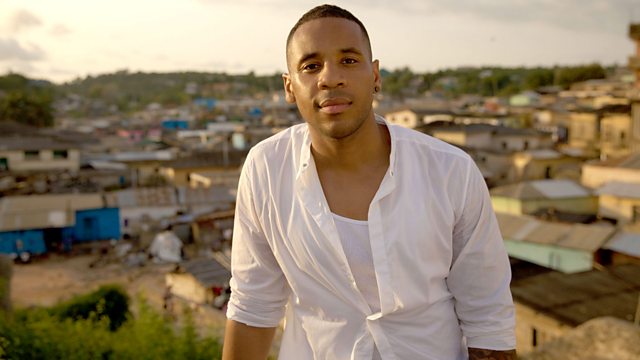
Who Do You Think You Are? [with Reggie Yates]

Posted in Africa, Autobiography, Biography, History, Identity Development/Psychology, Media Archive, United Kingdom, Videos on 2014-10-19 21:55Z by Steven

Who Do You Think You Are? Reggie Yates [with Reggie Yates]

Who Do You Think You Are?
BBC One
Series 11: Episode 8 of 10
Running Time: 00:59:09
First Aired: 2014-09-25

Presenter and DJ Reggie Yates grew up knowing very little about his father’s side of the family. Reggie sets out on the trail of his grandfather, Harry Philip Yates. His journey takes him to Ghana, where he unravels a complex family history where Ghanaian culture and British colonialism collide.

[Features Fordham University history professor Carina Ray.]

For more information, click here.

Tags: , , , , , ,

Passing For White

Posted in Articles, Media Archive, Passing, United States on 2014-10-19 21:40Z by Steven

Passing For White

South Florida Sun-Sentinel
Fort Lauderdale, Florida
2003-11-01

David Crary
The Associated Press

America is more diverse than ever and racial pride is strong, yet a new movie and book are highlighting a phenomenon that seems like a relic of the segregationist past — black people passing as white.

The film, The Human Stain, is an adaptation of Philip Roth’s novel about a classics professor, played by Anthony Hopkins, who conceals his racial background.

The book, Passing: When People Can’t Be Who They Are, by Brooke Kroeger, includes a sympathetic profile of a black man who passed as a white Jew during the 1980s and ’90s.

Kroeger, a New York University journalism professor who spent four years researching her book, said passing has a profound resonance for many black Americans.

“Over and over, I’d hear personal stories about members of their family who didn’t return for reunions, who led clandestine lives,” she said.

“Traditionally, the attitude toward passing was you accepted it, you never exposed a passer. Post-1960s, when people are so proud of their racial and ethnic identities, it seems more like cultural treason, yet still people don’t give passers up.”

Paul Johnston, a retired X-ray technician, knows of passing firsthand. His parents, Albert and Thyra Johnston, passed as white along with Paul and his three older siblings while the family lived in two New Hampshire towns during the 1930s and ’40s. Albert was a physician in the community.

The truth of the Johnstons’ background came out in 1941, when Albert was rejected as a Navy officer. But despite the family’s fears, townspeople in Keene, N.H., were generally receptive to them even after the news spread, and the Johnstons’ experience was movingly depicted in a 1949 film, Lost Boundaries.

Paul Johnston, 68, is now married to a woman of Irish descent who has nine children from a previous marriage.

“Some of the kids were pretty prejudiced, but they grew to like me,” he said in a telephone interview. “They thought it was quite fascinating that something like this [his family’s passing] would happen.”

Johnston, who says some of his relatives continue to pass for white, lives in a predominantly white town on Cape Cod.

“Almost nobody knows of my background, not because I’ve kept it a secret, just because I haven’t talked about it much except to a few people in my church,” he said. “I don’t think it would make any difference to people, but you never can tell.”…

…In The Human Stain, Roth’s fictional protagonist, Coleman Silk, was loosely modeled on the late Anatole Broyard, for many years a prominent literary critic for The New York Times

Read the entire article here.

Tags: , , , , , , , , , ,

The Whiteness Project will make you wince. Because white people can be rather awful

Posted in Articles, Book/Video Reviews, Media Archive, Social Science, United States on 2014-10-19 21:23Z by Steven

The Whiteness Project will make you wince. Because white people can be rather awful

The Guardian
2014-10-15

Steven W. Thrasher, Weekly Columnist

You’ve never seen privilege quite like this: ‘You can’t even talk about fried chicken or Kool-Aid without wondering if someone’s going to get offended’

White and black Americans see race from radically different perspectives, to the point that the white, world-saving New York Times columnist Nicholas Kristof has rung the alarm that “whites just don’t get it”. As someone who is half black and half white, I can certainly attest to the truth of that.

So I had misgivings about director Whitney Dow’s The Whiteness Project, the new interactive documentary launched over the weekend by POV. “I made this project for white people, not for people of color,” Dow told me on Tuesday, because “if white people are going to participate in changing the racial dynamic, we need to deal with our own shit first.

Dow, who is white, has been making smart films about race with his black filmmaking partner Marco Williams since 2002’s Two Towns of Jasper. But it was still hard to believe that white people talking about whiteness could do anything more than produce the gazing of blue eyes at pale navels.

After all, Dow’s project sounds a lot like “whiteness studies”, which is an actual field of academia I’ve recently encountered. The field is often credited with having its intellectual origins in a WEB Du Bois meditation, but more recently evolved to the point that it simply allowed white scholars to talk more about … well, white people…

Read the entire article here.

Tags: , , ,

Does Diversity Breed Intolerance?

Posted in Articles, Census/Demographics, Media Archive, Politics/Public Policy, Social Science, United States on 2014-10-17 19:38Z by Steven

Does Diversity Breed Intolerance?

BU Today
Boston University, Boston, Massachusetts
2014-09-25

Rich Barlow, Staff Writer
Telephone: 617-358-3877

Some whites fear impending minority status, research says

“Diversity” is said to be the sun of our civic solar system, shining bright harmony everywhere from society at large to university campuses. Katherine Levine Einstein is certainly an apostle of this view. The College of Arts & Sciences assistant professor of political science studies racially segregated areas and finds that separation polarizes and paralyzes those places’ politics.

But Boston’s commuter rail system shakes her faith.

Harvard colleague Ryan Enos surveyed white subjects about their views on Mexican immigration levels, asking, among other things, if they favored allowing noncriminal, employed illegal immigrants to remain in the country. Enos sought responses twice: once before exposing the whites to more Hispanic commuters on train platforms and once after. Support for immigration and allowing the undocumented to stay plunged in the “after” follow-up from what it had been in the “before” survey.

In addition to the Harvard research, two Northwestern University studies fuel Einstein’s pessimism. One found that as whites learned that they will become a minority, they grew more conservative and Republican-leaning. The other reported that whites who were aware of their future minority status became more negative towards nonwhites and preferred hanging out with their own race…

Marilyn Halter (GRS’86), a CAS history professor, sees a fundamental flaw in the Northwestern methodology. “I have found no evidence whatsoever of backsliding on racial tolerance in the marketplace, whether from the marketers or the consumer side of the equation,” says Halter, whose 2000 book Shopping for Identity: The Marketing of Ethnicity is about how American businesses have tailored their products to immigrant consumers in recent decades.

She also argues that the growth of mixed-race Americans—more than nine million checked two or more race categories on the 2010 US Census, up 32 percent from 2000, she says—means “it will be increasingly irrelevant to divide up the electorate into white, black, and brown.”

“Future projections about the impact of a minority white nation don’t take into account the changing meaning of whiteness,” she says. “I know that the research is attempting to measure how people react to the idea of a future white minority, but the very concept is so oversimplified and inaccurate, I think it invalidates the findings.…I do not think that greater diversity leads to more intolerance.”…

Read the entire article here.

Tags: , , , , , ,

I’m more than someone who’s of mixed race

Posted in Articles, Asian Diaspora, Identity Development/Psychology, Media Archive, United States on 2014-10-17 19:01Z by Steven

I’m more than someone who’s of mixed race

The Appleton Post-Crescent
Appleton, Wisconsin
2014-10-08

Mia Sato, Post-Crescent Community Columnist

Identity can be tough to sort out sometimes, but it doesn’t change some things about me

My life is defined by numerical classifications. I’m 19 years old, a second-year college student, the eldest of four children. I have a zip code, a GPA, 16 credits on my fall semester schedule, with 60 more to complete before I graduate. Each of these numbers reflects some aspect of my existence, and each number is grounds for people to make a judgment.

For as long as I can remember, I have been identified as “half” Japanese and “half” white American. On government forms, my pen would meander, hovering over the White and Asian boxes equally, unsure of which to check. Sometimes, I’d check both and was asked to pick one. Sometimes, I’d check one or the other and consider if it was the correct choice. Sometimes, I’d check neither and let my mother complete the rest for me.

I’ve learned that racial identity is more than a choice between clear-cut, straightforward options for children with parents of mixed heritage. It’s at times alienating, divisive and difficult to make sense of…

Read the entire article here.

Tags: , ,

Drury professor honored for research on mixed-race families

Posted in Articles, Campus Life, History, Media Archive, Slavery, United Kingdom, United States on 2014-10-16 21:34Z by Steven

Drury professor honored for research on mixed-race families

Springfield News-Leader
Springfield, Missouri
2014-10-12

Kaleigh Jurgensmeyer
Drury University

Dan Livesay, assistant history professor at Drury University, has been named the Sherman Emerging Scholar for 2014. Livesay will travel to the University of North Carolina-Wilmington next week to deliver a public lecture about his research, speak in a graduate class and share his expertise with other scholars.

The Sherman Emerging Scholar award is a national award presented by UNC-Wilmington annually to a promising young scholar. It gives the winner a platform to discuss perspectives, research and approaches to modern issues and theories in history, politics and international affairs.

Livesay’s lecture, titled “Race and the Making of Family in the Atlantic World,” will relate his research about mixed-race families in the 18th century to modern-day debates about race and family in the United States. Growing racial complexities and family belonging were important issues then as now.

“Because I was selected by a committee of historians working on lots of different periods of time and topics, it was very encouraging to discover that my particular research had something of a broad appeal,” Livesay says. “As academics, we can sometimes feel that we are only talking to a very narrow group of people about our research, and so I’m thrilled that I can present it to people from all different walks of life and intellectual interests.”

In total, Livesay spent 10 years researching, writing and revising his work, which is now in the process of being published in book form by UNC Press

Read the entire article here.

Tags: , , , , ,

Divergence or Convergence in the U.S. and Brazil: Understanding Race Relations Through White Family Reactions to Black-White Interracial Couples

Posted in Articles, Brazil, Caribbean/Latin America, Media Archive, Social Science, United States on 2014-10-16 19:25Z by Steven

Divergence or Convergence in the U.S. and Brazil: Understanding Race Relations Through White Family Reactions to Black-White Interracial Couples

Qualitative Sociology
March 2014, Volume 37, Issue 1
pages 93-115
DOI: 10.1007/s11133-013-9268-2

Chinyere Osuji, Assistant Professor of Sociology
Rutgers, The State University of New Jersey, Camden

Different approaches to race mixture in the U.S. and Brazil have led to the notion that they are polar opposites in terms of race relations. However, the end of de jure segregation in the U.S., the acknowledgement of racial inequality, and subsequent implementation of affirmative action in Brazil have called into question the extent to which these societies are vastly different. By examining race mixture as a lived reality, this study offers a novel approach to understanding racial boundaries in these two contexts. I analyze 87 interviews with individuals in black-white couples in Los Angeles and Rio de Janeiro to examine the cultural repertoires and discursive traditions they draw on to understand white families’ reactions to black spouses. I find that U.S. couples employ “color-blindness” to understand opposition to Blacks marrying into the family. Brazilian couples perceive overt racism and the use of humor from white family members. Nevertheless, couples with black males experienced more hostility in both sites. In addition, white male autonomy was related to the lower hostility that black female-white male couples experienced in both societies. By examining contemporary race mixture as a lived reality, this study complicates simplistic understandings of race relations as similar or different in these two societies. Furthermore, with the increase of multiracial families in both societies, it reveals the family as an important site for redrawing and policing racial boundaries.

Tags: , , , , ,

Racial ‘Boundary-policing’: Perceptions of Black-White Interracial Couples in Los Angeles and Rio de Janeiro

Posted in Articles, Brazil, Caribbean/Latin America, Media Archive, Social Science, United States on 2014-10-16 18:15Z by Steven

Racial ‘Boundary-policing’: Perceptions of Black-White Interracial Couples in Los Angeles and Rio de Janeiro

Du Bois Review: Social Science Research on Race
Volume 10 / Issue 01 / Spring 2013
pages 179-203
DOI: 10.1017/S1742058X13000118

Chinyere K. Osuji, Assistant Professor of Sociology
Rutgers, The State University of New Jersey, Camden

As people who cross racial boundaries in the family formation process, the experiences of interracial couples can actually reveal the nature of racial boundaries within and across societies. I draw on in-depth qualitative interviews with eighty-seven respondents in interracial Black and White couples in Los Angeles and Rio de Janeiro to compare perceptions of public stigmatization by outsiders, a term I call “boundary-policing.” I find that couples in Los Angeles perceive gendered, Black individuals as perpetrators of this boundary-policing. In Rio de Janeiro, couples perceive regionalized and classed, White perpetrators. These findings suggest that in the United States and Brazil, racial boundaries are intertwined with class and gender boundaries to shape negotiation of boundary-policing in the two contexts. This analysis builds on previous studies of ethnoracial boundaries by showing how individuals reinforce and negotiate them through interpersonal relations. It demonstrates the similarities and differences in the negotiation and reinforcement of racial boundaries in the two sites.

Tags: , , , , , ,

Hapa changes name to Association of Multiracial People at Tufts to reflect new goals

Posted in Arts, Asian Diaspora, Campus Life, Media Archive, United States on 2014-10-16 18:11Z by Steven

Hapa changes name to Association of Multiracial People at Tufts to reflect new goals

The Tufts Daily
Medford, Massachusetts
2014-10-14

Yuki Zaninovich, Contributing Writer

For the Association of Multiracial People at Tufts (AMPT), there is a lot in a name. AMPT, formerly known as Tufts Hapa, aims to create a community for students who identify as persons of mixed heritage. Though the name change may seem subtle to some, it now better reflects the target demographic of the group, according to Co-President Zoe Uvin.

According to Uvin, a senior, “hapa” means “half” in Native Hawaiian and is often used to refer to people who identify as a mix of two races. However, this choice of terminology made it seem like the club had a limited scope of interest.

“The term ‘Hapa’ has the connotation of being half-Asian, so I think the name change definitely reflected our priorities much more,” Uvin said. “We’re an association, not a political group or movement of any kind, and we wanted any person who is multiracial, or feels that their family or community makes their identity multiracial, to feel welcomed to join us.”

The name change has been favorably received, according to treasurer Rachel Steindler, a sophomore…

Read the entire article here.

Tags: , , , , ,

Confronting whitening in an era of black consciousness: racial ideology and black-white interracial marriages in Rio de Janeiro

Posted in Articles, Brazil, Caribbean/Latin America, Media Archive, Social Science on 2014-10-15 19:39Z by Steven

Confronting whitening in an era of black consciousness: racial ideology and black-white interracial marriages in Rio de Janeiro

Ethnic and Racial Studies
Volume 36, Issue 10, 2013
Special Issue: Rethinking Race, Racism, Identity, and Ideology in Latin America
pages 1490-1506
DOI: 10.1080/01419870.2013.783926

Chinyere Osuji, Assistant Professor of Sociology
Rutgers, The State University of New Jersey, Camden

In Latin America, whitening is understood as a goal of darker-skinned individuals who marry whites to gain access to white social circles, increase their social status, and produce lighter offspring. However, in Brazil, increasing black consciousness and race-based policies are seemingly at odds with contemporary attempts to whiten. Drawing on qualitative interviews with forty-nine individuals in black–white couples, I examine how they make sense of whitening in their lives. I find that unlike in the past, respondents do not describe themselves engaged in whitening and either find it offensive or recognize admissions of whitening as stigmatized. Nevertheless, whitening is how friends, families and other outsiders give meaning to their relationships, depending on the gender of the respondent. In addition, I find evidence of some white women understanding their relationships as a way of darkening themselves. This study reveals a transformation in the meanings associated with whitening ideology in contemporary Brazil.

Read or purchase the article here.

Tags: , , ,