“Global Mixed Race,” the 3rd biennial Critical Mixed Race Studies Conference, was held at DePaul University in Chicago Nov 13-15, 2014.

Posted in Articles, Campus Life, Media Archive, United States on 2014-11-21 03:06Z by Steven

“Global Mixed Race,” the 3rd biennial Critical Mixed Race Studies Conference, was held at DePaul University in Chicago Nov 13-15, 2014.

News from the Critical Mixed Race Studies Conference
2014-11-18

Camilla Fojas, Vincent de Paul Professor of Latin American and Latino Studies
DePaul University


Photograph by Ken Tanabe

A big thank you to the over 600 people who attended Global Mixed Race. Videos of our keynotes and Live Performance showcase are forthcoming. Please visit us on Facebook to see event snapshots. High-resolution press photographs are available on request. Follow the archive of the event on Twitter #CMRS2014. Read a reflection from our Social Media Caucus organizer Sharon H. Chang. Watch Mixed Roots Stories top 3 highlights from each day.

The 2016 conference will be held Nov 10-12, 2016 at University of Southern California and will be hosted by Associate Professor Duncan Ryuken Williams, founder of the Hapa Japan Project (along with project co-director Velina Hasu Houston) and Director of USC Shinso Ito Center for Japanese Religions and Culture. We will continue to partner with Mixed Roots Stories to offer arts and cultural programming. We are moving forward with founding an association. Join our mailing list to stay informed. We anticipate organizing a symposium in 2015 in Ottawa, Ontario, Canada and a full CMRS conference on the United States east coast in 2018. We are currently seeking institutional partners in the United Kingdom or Japan to host a CMRS symposium in 2017. Please contact us at cmrs@depaul.edu if you would like to volunteer…

For more information, click here.
Tags: , , , , , , , , , ,

How a biracial woman grew up thinking she was white

Posted in Articles, Autobiography, Judaism, Media Archive, Religion, United States on 2014-11-20 17:59Z by Steven

How a biracial woman grew up thinking she was white

Vox
2014-11-19

Jenée Desmond-Harris

When Lacey Schwartz was accepted to Georgetown University, the school saw her photo and passed her name along to the black student association. The organization contacted her.

The only issue: Schwartz had grown up in a Jewish household in Woodstock New York, and had always — despite occasional questions about the source of her brown skin and curly hair — identified as white…

…Schwartz, who told Vox she now identifies as “black/biracial,” explaining, “I look at bi-racial as a category of being black,” said Little White Lie’s message is about more than just race…

Read the entire article here.

Tags: , ,

Who You Really Are

Posted in Articles, Health/Medicine/Genetics, Media Archive on 2014-11-20 01:46Z by Steven

Who You Really Are

GeneWatch
Council for Responsible Genetics
Volume 27, Issue 2 (May-July 2014)

Robert Pollack, Professor of Biological Sciences, Earth Institute Professor, Adjunct Professor of Religion, Lecturer in Psychiatry
Columbia University, New York, New York

Patricia Williams, James L. Dohr Professor of Law
Columbia University, New York, New York

“International Biosciences offer a broad range of DNA Testing services designed to provide indisputable answers to emotional questions….”
www.ibdna.com/regions/UK/EN/?page=blackAmericans

“Your story awaits – go find it…”
www.ancestry.com

“Welcome to you.”
www.23andMe.com

Oh the happy marketplace for genetic information! The hunt is on: From royal roots to hidden baby-daddies, to making sure you’re not accidentally related to any of those many, many Kardashians. The very definition of “ancestry” is freighted with social meaning. “Tracking” it tempts one to imaginary flights about inheritance, wealth, esteem, identity, purity of lineage – and correction! How we all long to be redeemed by such searches, released from the unfairly limited befoggery of what we actually know of ourselves. What bliss instead to follow our most deliciously arrogant, nakedly ambitious fantasies of some Mystery Me, some hitherto unspoken-of chromosomal configuration that will distinguish and redeem. Given that hunger, it isn’t hard to market DNA as a product, like cement, designed to fill in the gaps, and provide stick-um for the jigsaw puzzle of ourselves. Within that marketplace, the definition of DNA is not confined by science but rendered connotatively huge, larger than galaxies, unconfined, a universe of wildest imagination. Yearning. Cure. Immortality. Control. A golem created from the skeletons of the past to address anxiety about what will happen to the present body.

Yet the boring bottom line is that we are all doomed to be embarrassed by the vulgar commonality of our humanity. We are all alone, orphans, bastards, individuals, adopted, adapted, lost, sold down the river, rediscovered like Moses in the bulrushes. We are, not one of us, descendants of a pure untainted line…

Read the entire article here.

Tags: , , , ,

Go Stand Upon The Rock with Samuel Michael Lemon, Ed.D.

Posted in Audio, History, Live Events, Media Archive, Slavery, United States on 2014-11-20 00:20Z by Steven

Go Stand Upon The Rock with Samuel Michael Lemon, Ed.D.

Research at the National Archives and Beyond
BlogTalk Radio
Thursday, 2014-11-20, 21:00 EST (Friday, 2014-11-21, 02:00Z)

Bernice Bennett, Host

Go Stand Upon the Rock (2014) is a deeply moving Civil War-era novel based on stories handed down by Sam Lemon’s grandmother about the lives of her grandparents who were once runaway slaves from Virginia. It is a tale of unsettling plantation life, courageous women, dramatic Civil War battles, heroes, hoodoo, and the indomitable strength of the human spirit. The book is supported by historical and genealogical research, photographs, and documents from his doctoral dissertation. This is a compelling and emotionally engaging history that comes alive through the lives of real people and events.

Dr. Sam Lemon grew up in Media, Pennsylvania, where his maternal great-great grandparents arrived as runaway slaves during the Civil War. Given refuge and support by local Quakers, his ancestors prospered and became prominent members of the community. He is currently an assistant professor and the director of a graduate program at Neumann University in Pennsylvania, and formerly worked in the fields of social services, education, and public television at WHYY in Philadelphia.

For more information, click here.

Tags: , , , , , ,

Diversity Explosion: How New Racial Demographics are Remaking America

Posted in Asian Diaspora, Books, Census/Demographics, Latino Studies, Media Archive, Monographs, Politics/Public Policy, United States on 2014-11-19 23:47Z by Steven

Diversity Explosion: How New Racial Demographics are Remaking America

Brookings Institution Press
2014-11-19
212 pages
Hardcover ISBN: 9780815725589
Paperback ISBN: 9780815725596
Ebook ISBN: 9780815726357

William H. Frey, Senior Fellow
Metropolitan Policy Program
Brookings Institution, Washington, D.C.

At its optimistic best, America has embraced its identity as the world’s melting pot. Today it is on the cusp of becoming a country with no racial majority, and new minorities are poised to exert a profound impact on U.S. society, economy, and politics.

In April 2011 a New York Times headline announced, “Numbers of Children of Whites Falling Fast.” As it turns out, that year became the first time in American history that more minority babies than white babies were born. The concept of a “minority white” may instill fear among some Americans, but William H. Frey, the man behind the demographic research, points out that demography is destiny, and the fear of a more racially diverse nation will almost certainly dissipate over time.

Through a compelling narrative and eye-catching charts and maps, eminent demographer Frey interprets and expounds on the dramatic growth of minority populations in the United States. He finds that without these expanding groups, America could face a bleak future: this new generation of young minorities, who are having children at a faster rate than whites, is infusing our aging labor force with vitality and innovation.

In contrast with the labor force-age population of Japan, Germany, Italy, and the United Kingdom, the U.S. labor force-age population is set to grow 5 percent by 2030.

Diversity Explosion shares the good news about diversity in the coming decades, and the more globalized, multiracial country that U.S. is becoming.

Contents

  • Preface
  • 1. A Pivotal Period for Race in America
  • 2. Old versus Young: Cultural Generation Gaps
  • 3. America’s New Racial Map
  • 4. Hispanics Fan Out: Who Goes Where?
  • 5. Asians in America: The Newest Minority Surge
  • 6. The Great Migration of Blacks—In Reverse
  • 7. White Population Shifts—A Zero-Sum
  • 8. Melting Pot Cities and Suburbs
  • 9. Neighborhood Segregation: Toward a New Racial Paradigm
  • 10. Multiracial Marriages and Multiracial America
  • 11. Race and Politics: Expanding the Battleground
  • 12. America on the Cusp
  • Acknowledgments
  • Notes
  • Index

Tags: , , ,

What is a White Man?

Posted in Articles, Law, Media Archive, United States on 2014-11-19 23:20Z by Steven

What is a White Man?

The Independent
Volume 41 (1889-05-30)
pages 5-6
Source: The Charles Chesnutt Digital Archive

Charles W. Chesnutt, Esq.

The fiat having gone forth from the wise men of the South that the “all-pervading, all-conquering Anglo-Saxon race” must continue forever to exercise exclusive control and direction of the government of this so-called Republic, it becomes important to every citizen who values his birthright to know who are included in this grandiloquent term. It is of course perfectly obvious that the writer or speaker who used this expression—perhaps Mr. Grady of Georgia—did not say what he meant. It is not probable that he meant to exclude from full citizenship the Celts and Teutons and Gauls and Slavs who make up so large a proportion of our population; he hardly meant to exclude the Jews, for even the most ardent fireeater would hardly venture to advocate the disfranchisement of the thrifty race whose mortgages cover so large a portion of Southern soil. What the eloquent gentleman really meant by this high-sounding phrase was simply the white race; and the substance of the argument of that school of Southern writers to which he belongs, is simply that for the good of the country the Negro should have no voice in directing the government or public policy of the Southern States or of the nation.

But it is evident that where the intermingling of the races has made such progress as it has in this country, the line which separates the races must in many instances have been practically obliterated. And there has arisen in the United States a very large class of the population who are certainly not Negroes in an ethnological sense, and whose children will be no nearer Negroes than themselves. In view, therefore, of the very positive ground taken by the white leaders of the South, where most of these people reside, it becomes in the highest degree important to them to know what race they belong to. It ought to be also a matter of serious concern to the Southern white people; for if their zeal for good government is so great that they contemplate the practical overthrow of the Constitution and laws of the United States to secure it, they ought at least to be sure that no man entitled to it by their own argument, is robbed of a right so precious as that of free citizenship; the “all-pervading, all conquering Anglo-Saxon” ought to set as high a value on American citizenship as the all-conquering Roman placed upon the franchise of his State two thousand years ago. This discussion would of course be of little interest to the genuine Negro, who is entirely outside of the charmed circle, and must content himself with the acquisition of wealth, the pursuit of learning and such other privileges as his “best friends” may find it consistent with the welfare of the nation to allow him; but to every other good citizen the inquiry ought to be a momentous one. What is a white man?…

Read the entire article here.

Tags: , , , , ,

‘Empire of Sin,’ by Gary Krist

Posted in Articles, Book/Video Reviews, History, Louisiana, Media Archive, United States on 2014-11-19 20:25Z by Steven

‘Empire of Sin,’ by Gary Krist

The New York Times
Sunday Book Review
2014-11-06

Walter Isaacson, President and CEO
Aspen Institute

Empire of Sin: A Story of Sex, Jazz, Murder, and the Battle for Modern New Orleans By Gary Krist; Illustrated. 416 pp. Crown Publishers. $26.

When Tom Anderson’s saloon opened in 1901, at the entrance to the recently designated sin district known as Storyville on the edge of New Orleans’s French Quarter, people from all over town came to marvel at its opulence. Its cherrywood bar stretched half a block and was lit by a hundred electric lights. With Anderson’s encouragement, high-class brothels were soon flourishing down Basin Street. Josie Arlington, his business partner, had a four-story Victorian mansion with a domed cupola, mirrored parlor and Oriental statues. The exotic, mixed-race Lulu White built a brick palace that specialized in interracial sex and featured the jazz pioneer Jelly Roll Morton at the piano. Another octoroon (the appellation given to people considered to be one-eighth black), Willie V. Piazza, passed herself off as a countess and sported both a monocle and a diamond choker. Anderson, whose civic spirit earned him the title “the Mayor of Storyville,” published a Blue Book that contained photos and descriptions of the area’s better prostitutes, annotated with symbols (“w” for white, “c” for colored, “J” for Jewish and “oct.” for octoroon). It was all a vivid expression of the city’s tolerance and diversity…

…Through much of the 19th century, New Orleans had been racially progressive, especially for Creoles of color, most of them French-speaking Roman Catholics descended from families that had intermarried with Europeans. From the early 1870s onward, blacks could vote and serve on juries; marriage between different races was legal; and schools, lakefront beach areas and many neighborhoods were integrated. But the advent of Jim Crow laws after Reconstruction created a new dynamic. The reformers of the city’s elite took the lead in passing segregation laws as well as in cracking down on prostitution. In 1908, the State Legislature passed a bill that barred musical performances in saloons, prohibited blacks and whites from being served in the same establishment and excluded women from bars…

Read the entire review here.

Tags: , , , , ,

Is Parental Love Colorblind? Human Capital Accumulation within Mixed Families

Posted in Articles, Brazil, Caribbean/Latin America, Economics, Family/Parenting, Media Archive, Social Science on 2014-11-19 17:32Z by Steven

Is Parental Love Colorblind? Human Capital Accumulation within Mixed Families

The Review of Black Political Economy
2014-07-04
DOI: 10.1007/s12114-014-9190-1

Marcos A. Rangel, Assistant Professor
Sanford School of Public Policy
Duke University, Durham, North Carolina

Studies have shown that differences in wage-determinant skills between blacks and whites emerge during a child’s infancy, highlighting the roles of parental characteristics and investment decisions. Exploring the genetics of skin-color and models of intrahousehold allocations, I present evidence that, controlling for observed and unobserved parental characteristics, light-skinned children are more likely to receive investments in formal education than their dark-skinned siblings. Conscious parental decisions regarding human capital acquisition for their children seem to contribute for the persistence of earnings differentials and socio-economic stratification in Brazil.

Read or purchase the article here.

Tags: , , ,

Sesquicentennial Event Addresses Colorado Inequality

Posted in Articles, Asian Diaspora, History, Law, Media Archive, Slavery, United States on 2014-11-18 22:21Z by Steven

Sesquicentennial Event Addresses Colorado Inequality

Clarion: The University of Denver’s Newwspaper Since 1892
Denver, Colorado
2014-10-21

Carissa Cherpes

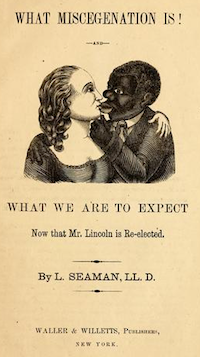
DU hosted a Sesquicentennial Conversation entitled Miscegenation Law, Marriage Equality, and the West 1864-2014 on Oct. 15 in the Sturm College of Law.

Over 50 students, faculty and others gathered to listen to three panelists lecture on how Miscegenation Laws and inequality affected our region throughout history. Miscegenation Laws banned marriages or relationships between mixed raced couples.

The three panelists were Rachel Moran, Ronald J. Stephens and Anna N. Martinez. The moderator was Bill Convery, who holds the position of Colorado State Historian

…Next to present was Moran. She described how Miscegenation Laws originated in the South when concern over mixed race slave children became an issue. The popular opinion was that “mixed race children were black,” and therefore could not be considered free or have rights.

She then went on to talk about California’s Miscegenation Laws, which targeted Asian immigrants. In California, the laws were designed to force Chinese, Japanese and Filipino immigrants to return to their native country.

Moran then discussed how the Colorado territory had Miscegenation Laws as well, but only after additional land was acquired from Mexico. Because the people living in the territory had different customs and laws, there was an invisible boundary where mixed race couples were more accepted. She concluded by explaining how it was not until the 1960s that the Supreme Court decided Miscegenation Laws were unfair

Read the entire article here.

Tags: , , , , , , , , , ,

MISC Shows Fourth Annual Identity Project

Posted in Articles, Arts, Campus Life, Media Archive, United States on 2014-11-18 21:42Z by Steven

MISC Shows Fourth Annual Identity Project

The Smith Sophian: The Independent Newspaper of Smith College
Northampton, Massachusetts
2014-11-13

Nicole Wong ’17, Arts Editor

The Identity Project is an annual photo exhibition in which students, faculty and staff of the Smith community are photographed and given the opportunity to define who they are in their own words. It is loosely based off of Kip Fulbeck’sHapa Project.”

The organization Multi-ethnic Interracial Smith College, hosted its fourth annual Identity Project on Oct. 25 in the Hearth Room at Unity House and in the Nolan Art Lounge in the Campus Center. The Identity Project was purposely held in conjunction with Otelia Cromwell Day on Nov. 6.

Fulbeck began the project in 2001, traveling the country, photographing over 1200 volunteer subjects who self-identified as hapa, defined for the project as mixed ethnic heritage with partial roots in Asian or Pacific Islander ancestry. Each individual was photographed in a similar minimalist style (directly head-on, unclothed from the shoulders up, and without jewelry, glasses, excess make-up or purposeful expression) after being photographed, participants identified their ethnicities in their own words, then handwrote their response to the question, “What are you?”…

Read the entire article here.

Tags: , , , , ,