Anomaly dir. by Jessica Chen Drammeh (review)

Posted in Articles, Autobiography, Book/Video Reviews, Media Archive, United States on 2014-12-17 18:25Z by Steven

Anomaly dir. by Jessica Chen Drammeh (review)

African Studies Review
Volume 57, Number 3, December 2014
pages 274-275

Manouchka Kelly Labouba, USC Provost’s PhD Fellow
Critical Studies School of Cinematic Arts
University of Southern California

Anomaly is a personal documentary featuring mixed-raced people who discuss the complexities and challenges of defining their identity across the different races and cultures they belong to. They talk about the limitations and prejudices of the mainstream approach to race, which makes individuals like them feel like misfits. The director, Jessica Chen Drammeh, is a biracial Asian-Caucasian woman. She introduces herself as “unidentified,” and calls herself an “anomaly,” because she is “difficult to classify,” as she does not fit into any of the six ethnic and racial categories officially recognized in the U.S. Hence, Drammeh and her participants explain how they have learned to deal with people’s preconceptions, reticence, and narrow-mindedness about their racial mixture. They explain how being of mixed-raced heritage ultimately renders them both invisible and hypervisible. They are invisible because their multiracial background tends to be unacknowledged, as they feel socially compelled to identify with one race only. Yet they are also hypervisible because their distinctness is so apparent. Eventually all of Drammeh’s subjects share how they have come to terms with their multiracial identity and developed a sense of pride about their genetic makeup, which they consider makes them culturally rich.

Although the documentary does not specifically focus on multiracial Americans of African descent, the film does feature one biracial Congolese-American, a young man named Pete [Shungu]. He is a saxophonist who plays jazzy melodies with a big uncombed Afro hairstyle. His parents separated when he was ten, and he grew up in New Jersey with his Caucasian mother. She appears in the film and talks about how she would dress up in a Congolese outfit, put a baby doll on her back, and come to Pete’s class to talk about the Congo and its customs. Pete was proud of her and loved that none of his friends had a problem with his white mother dressing in African clothes. His mother explains how she felt that it was important for her to understand the culture of Pete’s father, as well as for Pete and his brother to understand their own culture. In a poem titled “Third-Eye Identity,” Pete describes how being multiracial has helped him become more open-minded. He explains how “his roots extend far beyond the places he lived in,” making him a “complex individual, not just a category.” Yet because of the way race is perceived in society, denying his blackness and identifying only as multiracial would be unrealistic. Only in his senior year in college, having enrolled in a course on the subject of mixed-race heritage, is he finally comfortable identifying himself as multiracial.

In the 2010 U.S. Census more than 9 million Americans identified themselves as multiracial, making them one of the fastest-growing demographic groups in the country. Thus Drammeh’s documentary is a valuable contribution in what should be a national effort to perceive and acknowledge this segment of the population, as well as understand what these individuals experience as minorities. Many movies have thematized the moral barriers and societal challenges faced by interracial couples in America, such as Guess Who’s Coming to Dinner (dir. Stanley Kramer, 1967), Jungle Fever (dir. Spike Lee, 1991), Mississippi Masala (dir. Mira Nair, 1991), and the documentary The Loving Story (dir. Nancy Buirski, 2011), about Richard and Mildred Loving, whose Supreme Court ruling in 1967 put an end to antimiscegenation laws. However, few films have focused on how the offspring of such relationships are integrated in U.S. society. Though Drammeh’s documentary does not try to fill that void on its own, it does give an insight into what many have called “the changing face” of America.

However, Drammeh’s work unfortunately does not tackle its subject matter in the most effective manner. The film resembles more a student project on this assigned theme, rather than a documentary targeted at a broad audience. As a filmmaker, she chooses to intertwine extensive personal interviews with poems and songs by the participants, on the one hand, and with a few contributions by scholars, on the other. By doing so, she makes her movie slightly too personal and informal, which eventually diminishes…

Tags: , , , , , , ,

How America will look in 2060, in 7 graphs

Posted in Articles, Census/Demographics, Media Archive, United States on 2014-12-17 16:22Z by Steven

How America will look in 2060, in 7 graphs

The Washington Post
2014-12-16

Philip Bump

The Census Bureau recently released its 2014 population projections, gaming out the next 45 years of population growth and changes in the United States. For those of us who pay particular attention to the composition of the population (because we are single-mindedly obsessed with the composition of the electorate that results), this is a bonanza of things to pore over. So let’s pore.

Or, actually, let’s first detour. The data collected by the Bureau has changed substantially over time, at first documenting only the white and slave populations of the newly united states. In 1820, the government started collecting data on resident foreigners as immigration increased. By 1870, the Bureau counted whites, blacks, Chinese, Indian (Native American), and people of mixed black and white descent. In 1890, it broke out mixed-race Americans into more categories; in 1930, there were 10 different options.

Today there are five categories of race, per a 1997 directive: “American Indian or Alaska Native, Asian, Black or African American, Native Hawaiian or Other Pacific Islander, and White.” There’s an additional delineation of ethnicity: Hispanic or Latino, and not.

That background is useful because the Bureau’s projections through 2060 includes a look at foreign-born-versus-native-born residents and Hispanic-versus-non-Hispanic residents, which are not the same thing. But we get ahead of ourselves. Back to poring…

Read the entire article here.

Tags: , ,

New Projections Point to a Majority Minority Nation in 2044

Posted in Articles, Census/Demographics, Media Archive, United States on 2014-12-17 16:05Z by Steven

New Projections Point to a Majority Minority Nation in 2044

Brookings Instituion
Washington, D.C.
2014-12-12

William H. Frey, Senior Fellow
Metropolitan Policy Program

New population projections released this week by the Census Bureau indicate that the U.S. population will become “majority minority” in 2044. At that time, whites will make up 49.7 percent of the population compared with 25 percent for Hispanics, 12.7 percent for blacks, 7.9 percent for Asians and 3.7 for percent multiracial persons. This tipping point will result from two countervailing trends that are projected to continue between now and 2060:…

…These trends underscore the minority driven demographic transformation analyzed in my book Diversity Explosion: How New Racial Demographics are Remaking America, which outlines the challenges and opportunities associated with a nation whose youthful, growing minority population is juxtaposed against an aging, slow-growing, and soon to be declining, white population.

Read the entire article here.

Tags: , , ,

Caught in the Middle: Defensive Responses to IAT Feedback Among Whites, Blacks, and Biracial Black/Whites

Posted in Articles, Identity Development/Psychology, Media Archive, United States on 2014-12-16 21:48Z by Steven

Caught in the Middle: Defensive Responses to IAT Feedback Among Whites, Blacks, and Biracial Black/Whites

Social Psychological and Personality Science
Published online before print: 2014-12-15
DOI: 10.1177/1948550614561127

Jennifer L. Howell
Department of Psychology
University of Florida

Sarah E. Gaither, Provost’s Career Enhancement Postdoctoral Scholar
Center for the Study of Race, Politics, and Culture
University of Chicago, Chicago, Illinois

Kate A. Ratliff, Assistant Professor of Psychology
University of Florida

This study used archival data to examine how White, Black, and biracial Black/White people respond to implicit attitude feedback suggesting that they harbor racial bias that does not align with their self-reported attitudes. The results suggested that people are generally defensive in response to feedback indicating that their implicit attitudes differ from their explicit attitudes. Among monoracial White and Black individuals, this effect was particularly strong when they learned that they were implicitly more pro-White than they indicated explicitly. By contrast, biracial Black/White individuals were defensive about large discrepancies in either direction (more pro-Black or more pro-White implicit attitudes). These results pinpoint one distinct difference between monoracial and biracial populations and pave the way for future research to further explore how monoracial majority, minority, and biracial populations compare in other types of attitudes and responses to personal feedback.

Read or purchase the article here.

Tags: , , , , , , , ,

Genetic diversity of Sub-Saharan Africa revealed

Posted in Africa, Articles, Health/Medicine/Genetics, Media Archive on 2014-12-16 02:40Z by Steven

Genetic diversity of Sub-Saharan Africa revealed

BBC News
2014-12-04

Rebecca Morelle, Science Correspondent

Scientists have completed a comprehensive study of genetic diversity in Sub-Saharan Africa.

The African Genome Variation Project analysed the DNA of 1,800 people living across the continent.

The data is helping scientists to understand how susceptibility to disease varies across the region and has provided more insight into how populations have moved within Africa.

The research is published in the journal Nature.

Until now, most studies examining genetic risk factors for disease have focused on Europe. Little has been known about Africa, the most genetically diverse region in the world.

Dr Manj Sandhu, from the Wellcome Trust Sanger Institute and the University of Cambridge, said: “We originally set out to look at chronic diseases in Africa, and one strategy to understand the causes of those diseases is to look at the underlying genetic susceptibility.

“But to do that, you need a pretty good grasp of the variation in genomes across the region, but we realised that information wasn’t available.”…

Read the entire article here.

Tags: , , , ,

We Named Our Son Lincoln: A Testimony Against Racial Injustice

Posted in Articles, Media Archive, Politics/Public Policy, Social Science, United States on 2014-12-16 02:31Z by Steven

We Named Our Son Lincoln: A Testimony Against Racial Injustice

ChicagoNow: The Family Table
Chicago, Illinois
2014-12-08

Amy Negussie
Lincoln Park, Chicago

I have been debating writing about race & Ferguson the few weeks since the announcement was made that Darren Wilson was not indicted. Then came the further blow of the Eric Gardner case. As I read what others write, I struggle over whether there is anything that I can add. But if anyone might read this and listen really, listen to what I say I have to say write:

I married a black man. We named our son Lincoln David Negussie. Lincoln for Abraham Lincoln abolisher of slavery, David for my brother and my family meaning beloved, and Negussie for his African grandfather’s name meaning king.

Despite my own family’s multiracial aspect, I am guilty of racism, I am a part of the sinful racist system. Do I want to be? No…

…My hope and my prayer is that my multiracial son will be a part of uprooting injustice as his namesake was, and that in his day we will see an end to the epidemic of incarcerating (and even killing) black youth for petty crimes for which white youth often get slapped on the wrist…

Read the entire article here.

Tags: , , ,

‘Half Asian’? ‘Half White’? No — ‘Hapa’

Posted in Articles, Arts, Asian Diaspora, Identity Development/Psychology, Media Archive, United States on 2014-12-16 01:37Z by Steven

‘Half Asian’? ‘Half White’? No — ‘Hapa’

National Public Radio
Code Switch: Frontiers of Race, Culture and Ethnicity
2014-12-15

Alex Laughlin, Social Media Journalist
National Journal

She was tall and freckled, with long, dark hair — and we stood out in the same way. As I leaned in to say hi, she yelled over the din, “You’re hapa, aren’t you?” It was the last word I expected to hear in D.C., but I welcomed the refreshing respite from the constant and inevitable question: “What are you?”

What am I? This is what they’re really asking here: What is the particular racial mix that created you? Because YOU don’t fit into a single box in my mind, and that confuses me.

I’m half Korean and half white, and it’s usually easier to just leave it there. If I were to volunteer my identity though, I would tell you I’m hapa.

Hapa is a Hawaiian pidgin word used to describe mixed-race people — primarily, though not exclusively, those who are half white and half Asian. It’s short for hapalua, the Hawaiian word that literally means “half” — and it originated as a derogatory term toward mixed-race children of plantation guest workers from the Philippines, Korea, China and Japan, and the women they married in Hawaii in the early part of the 20th century

…Artist Kip Fulbeck lived in Hawaii for several years, and he remembers a more keen awareness of racial and cultural differences among nonwhites than on the mainland.

“If I’m living in Hawaii and playing pickup basketball,” he said, “they’ll say ‘Hapa haole, throw me the ball!’ or ‘Hey, buddhahead! Hey, kimchi!'”…

…In 2000, Fulbeck started taking photos of hapa people and inviting them to identify themselves in their own words. The collection of photographs grew into the Hapa Project, a multiracial identity project encompassing traveling exhibits, presentations and a published book: Part Asian, 100% Hapa. He has photographed thousands of people for the project, and the community surrounding it remains lively online…

Read the entire article here.

Tags: , , , , ,

‘I’m proud of my African heritage’

Posted in Africa, Articles, Asian Diaspora, Identity Development/Psychology, Media Archive on 2014-12-16 01:15Z by Steven

‘I’m proud of my African heritage’

The Korea Times
2014-12-14

Kim Se-jeong

Top award winner Park Ji-han says taekwondo changed him

When Park Ji-han was in his first year at elementary school, his classmates called him “African shala shala” because of his background and because he spoke Arabic.

Now, a decade later, the handsome youth’s nickname is “walking statue.” The high school sophomore stands about 179 centimeters tall, and he has chiseled features that could stare down any K-pop star or actors for that matter.

The change speaks volumes about how much Park, 17, went through as a young boy and how far he has come. He attributes this to taekwondo.

A student at Daekyeong Commercial High School in Seoul, he was recently named the grand winner in the 3rd Korea Multicultural Youth Awards organized by The Korea Times and the Ministry of Gender Equality and Family.

Park was born in 1997 to a Korean mother and Sudanese father. He lives with his parents and older brother in Itaewon in Seoul.

He began learning taekwondo when he was in the second grade.

“I had no friends in the first grade, but in the second grade I finally met a good friend, and I practiced taekwondo with him,” he told The Korea Times. Initially, he took up the martial art to defend himself as he was still scared of the boys who had mocked him…

Read the entire article here.

Tags: , , , , ,

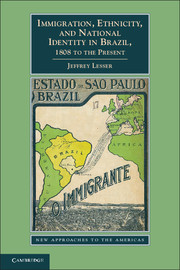
Immigration, Ethnicity, and National Identity in Brazil, 1808 to the Present

Posted in Books, Brazil, Caribbean/Latin America, History, Media Archive, Monographs, Slavery on 2014-12-15 18:32Z by Steven

Immigration, Ethnicity, and National Identity in Brazil, 1808 to the Present

Cambridge University Press
January 2013
219 pages
19 b/w illus. 1 map 19 tables
229 x 153 x 14 mm
Hardback ISBN: 9780521193627
Paperback ISBN: 9780521145350
eBook ISBN: 9781139602723

Jeffrey Lesser, Samuel Candler Dobbs Professor of History
Emory University, Atlanta, Georgia

Immigration, Ethnicity, and National Identity in Brazil, 1808 to the Present examines the immigration to Brazil of millions of Europeans, Asians, and Middle Easterners beginning in the nineteenth century. Jeffrey Lesser analyzes how these newcomers and their descendents adapted to their new country and how national identity was formed as they became Brazilians along with their children and grandchildren. Lesser argues that immigration cannot be divorced from broader patterns of Brazilian race relations, as most immigrants settled in the decades surrounding the final abolition of slavery in 1888 and their experiences were deeply conditioned by ideas of race and ethnicity formed long before their arrival. This broad exploration of the relationships between immigration, ethnicity, and nation allows for analysis of one of the most vexing areas of Brazilian study: identity.

  • Includes oral histories and primary documents so readers can get a sense of the voices of immigrants and those with whom immigrants interacted
  • Does not treat immigrants only as victims, unlike other immigration studies
  • Places immigrants within a broader context of racial and ethnic relations

Table of Contents

  • List of Figures, Tables, and Documents
  • Acknowledgments
  • Chapter 1: Creating Brazilians
  • Chapter 2: From Central Europe and Asia: Immigration Schemes, 1822–1870
  • Chapter 3: Mass Migrations, 1880–1920
  • Chapter 4: The Creation of Euro-Brazilian Identities
  • Chapter 5: How Arabs Became Jews, 1880–1940
  • Chapter 6: Asianizing Brazil: New Immigrants and New
  • Identities, 1900–1955
  • Epilogue: The Song Remains the Same
  • Historiographical Essay
  • Index
Tags: ,

Lewis Hamilton wins BBC Sports Personality of the Year 2014

Posted in Articles, Media Archive, United Kingdom on 2014-12-15 00:38Z by Steven

Lewis Hamilton wins BBC Sports Personality of the Year 2014

BBC News
2014-12-14

Lewis Hamilton has been voted the BBC Sports Personality of the Year 2014.

The 29-year-old Mercedes driver won his second Formula 1 world title this season and joined an exclusive club by becoming the fourth Briton to win the drivers’ championship at least twice.

Northern Irish golfer Rory McIlroy was runner-up, with athlete Jo Pavey third.

“I was sitting there saying Rory’s going to have it,” said Hamilton, who earned 34% of the vote. “I thought it had to be someone else.”

The Englishman won 209,920 of the 620,932 votes cast, with McIlroy getting 123,745 (20%) and Pavey 99,913 (16%)…

Read the entire article here.

Tags: , , , ,