ENLT 2513 Major Authors of American Literature: Race and Performance

Posted in Course Offerings, Literary/Artistic Criticism, Media Archive, Passing, United States on 2015-01-20 01:36Z by Steven

ENLT 2513 Major Authors of American Literature: Race and Performance

University of Virginia
Spring 2015

Sarah Ingle, Lecturer

This course will explore representations of race and performance in American literature and culture from the eighteenth century to the present. We will examine cultural phenomena such as blackface minstrel shows, stories of racial “passing,” and a variety of texts (plays, fiction, poetry, and non-fiction) that depict the complex relationship between race and identity in American culture. Authors will include Thomas Jefferson, Mark Twain, William Wells Brown, Herman Melville, Charles Chesnutt, James Weldon Johnson, Nella Larsen, Zitkala-Sa, Sui Sin Far, Onoto Watanna, David Henry Hwang, and Suzan Lori-Parks. Course requirements will include three essays, weekly informal reading responses, active class participation, and a final exam.

For more information, click here.

Tags: ,

The Dubious, Dangerous Science of Race Lives On, Says Scholar

Posted in Articles, Health/Medicine/Genetics, Interviews, Media Archive, Politics/Public Policy, Social Science, United States on 2015-01-19 20:14Z by Steven

The Dubious, Dangerous Science of Race Lives On, Says Scholar

Colorlines: News for Action
2011-09-23

Julianne Hing, Reporter/Blogger
Oakland, California

Back in the 19th century, scientists thought it was possible to determine a person’s race, and their corresponding levels of intelligence, based on the size of their skull. In the 20th century, mainstream scientists were convinced that intelligence was genetically determined, and therefore an inheritable trait; they helped spur the now disgraced eugenics movement.

In the 21st century, with racial science’s embarrassing history—and its disgraceful, deadly effects on people of color—seemingly long behind us, it’s easy to dismiss the science of yore as silly and antiquated. But Northwestern University law professor Dorothy Roberts argues this line of scientific inquiry is as alive as ever.

In her new book “Fatal Invention: How Science, Politics, and Big Business Re-create Race in the 21st Century,” Roberts says that scientists are still preoccupied with the problematic questions of whether racial stratification in society is the result of genetic differences. Is race something that’s written into our genetic code? Is there, say, a gene within black folks that makes them more predisposed to cancer and hypertension? Why not use DNA as a forensic tool to predict the race of an unknown suspect?

This obsession, she argues, has led us astray from focusing on the more pressing and legitimate causes of racial stratification: racial inequality that’s deeply embedded in the structures of society. We caught up with Roberts to talk about her new book, and some of the ridiculous, troubling ways this racial science is impacting everyday people’s lives.

You write in the intro that you took on this question looking into the biological reality of race as a personal challenge to yourself, to test your convictions that race is a political category. Can you say more about that?

What motivated me to write the book was that I noticed this revival of the idea that human beings are divided into biological races in genomic science and biotechnologies. I read the headlines, first, of studies that purported to prove that there was a deep structure based on race in the human genome, [of] the approval of race-specific medicine. And I went to a lecture at Northwestern’s medical school where a conservative commentator was invited to talk about race even though he was well-known for his views that biological race determines intelligence. So I was really alarmed that this idea was being resuscitated in new technologies and on the cutting edge of science, and even some liberals were embracing it as a way to address health inequities, without having any sense that there was a danger in this way of thinking about human beings.

So when I say it was a personal challenge it was because I was at first surprised that genomic science was going in that direction and also surprised in the number of people who I talked to who believe that race really is a natural division of human beings and who embrace genetic technologies for a test of identity. To me that really contradicted the political convictions I had, not only about the meaning of race but also the way to fight against racism in America…

Read the entire interview here.

Tags: , , , ,

“Funny—You Don’t Look Jewish!”: Racial, Ethnic, and Religious Identities of Children of Asian American and Jewish American Spouses

Posted in Articles, Asian Diaspora, Identity Development/Psychology, Judaism, Media Archive, Religion, Social Science, United States on 2015-01-19 02:09Z by Steven

“Funny—You Don’t Look Jewish!”: Racial, Ethnic, and Religious Identities of Children of Asian American and Jewish American Spouses

Journal of Jewish Identities
Issue 8, Number 1, January 2015
pages 129-148

Helen Kim, Associate Professor of Sociology
Whitman College, Walla Walla, Washington

Noah Leavitt, Research Associate
Department of Sociology
Whitman College, Walla Walla, Washington

Rachel Williams
Whitman College, Walla Walla, Washington

Who is a Jew? What does it mean to be Jewish? Often connected to these questions is the subject of intermarriage among Jewish Americans, a demographic reality that has long been understood as problematic and threatening to the Jewish people because of the supposed dilution, and possible extinction, of Jewish identity and community that will necessarily follow when a Jew marries a non-Jew. Often, the most pressing concern regarding intermarriage is its impact on the Jewish identity of the children and grandchildren of these relationships. Will the offspring of intermarriage identify as Jewish? If so, what does Jewish identity mean for these individuals? Furthermore, what impact does Jewish identification or non-identification mean for the continuity of the Jewish people?

Currently, the debate regarding the continuity of Jewish identity and peoplehood as it pertains to intermarried couples and their children is unresolved, especially within the realm of academic scholarship pertaining to this subject. Most notably, the Pew Research Center’s 2013 Portrait of Jewish Americans acknowledges that, according to its findings, support exists for both sides of the debate. In their discussion of the Pew survey, Gregory A. Smith and Alan Cooperman note that adult children of intermarriage are more likely to identify as religiously agnostic, atheist, or nothing in particular than those born to two Jewish parents. This difference may suggest the eventual erosion of Jewish religious identification as a result of intermarriage. Smith and Cooperman also note, however, an increase in Jewish identification in adulthood among offspring of intermarriage. Thus while intermarriage may be leading to a significant decrease in religious identification, it may be contributing to an increase in a different type of Jewish identification that is no less important.

Some scholars have argued that the debate and scholarship regarding intermarriage as assimilation and an erosion of Jewish authenticity stifles innovative ways to think about and encourage more nuanced conceptions of Jewish identity and, subsequently, Jewish belonging and community. These critiques often point to the importance of broadening our understanding of Jewish identity through frameworks and methods that complicate common notions of Jewish authenticity based in religiosity and descent.

Our exploratory qualitative study of adult children born to Asian American and Jewish American spouses adds to the debate regarding intermarriage and Jewish authenticity by investigating how Jewish identity is negotiated through the lenses of religion and race. We argue that multiraciality and Jewish identity are intrinsically connected for respondents in our sample. Our work derives from a larger project on intermarriage between Jewish Americans of any racial or ethnic background and Asian Americans of any ethnic or religious background.

More specifically, we seek to understand how children of mixed backgrounds experience and think about their Jewish identity in light of their position as children of intermarried spouses who are ethnically, religiously, and racially different. While our findings are not generalizable to a larger population, they do call into serious question the conceptualization and, for some, the strongly held belief that intermarriage between Jews and non-Jews necessarily results in an erosion of Jewish identity and community through children and subsequent generations. Rather, our interviews with children of multiracial intermarriages point to the maintenance of many traditional markers of Judaism and Jewish identity commonly associated with certain institutional affiliations at the same time that they challenge and offer newer understandings of Jewish authenticity through the lens of external and internal racial identification. Thus, our findings emphasize the importance of understanding these kinds of identity negotiations within a larger national landscape that is increasingly multiracial and multicultural. Put differently, the U.S. population, including its Jewish and Asian American populations, is becoming increasingly multiracial and multiethnic and is doing so, in large part, through intermarriage broadly construed. In this sense, our work highlights the importance of understanding how our respondents think about their identity, whether racial, ethnic, or religious, within a demographic landscape that is changing at a pace much faster than the debate regarding intermarriage fully acknowledges.

The data for this paper comes from qualitative in-depth interviews conducted in 2011 with twenty-two adult children, ages eighteen to twenty-five, of Jewish and Asian intermarriages, residing in the San Francisco Bay Area and in parts…

Tags: , , , , , , ,

A Jewish-Asian Couple’s Union Leads to a Scholarly Interest in Intermarriage

Posted in Articles, Asian Diaspora, Judaism, Media Archive, Religion, Social Science, United States on 2015-01-19 01:41Z by Steven

A Jewish-Asian Couple’s Union Leads to a Scholarly Interest in Intermarriage

The New York Times
2012-06-15

Samuel G. Freedman, Professor of Journalism
Columbia University, New York, New York

One weekend night 15 years ago, a group of graduate students at the University of Chicago decided to interrupt their research long enough for a dinner party. Helen K. Kim made a chocolate tart with ginger cream filling. Her classmate Noah S. Leavitt regarded it and scoffed, “Nice use of your time, making a fancy dessert with all the homework we have.”

Ms. Kim did not exactly swoon at that snarky version of a pickup line.

Over the next three weeks, though, Mr. Leavitt kept pursuing her in more polite fashion and they eventually went out for dinner and drinks. Very quickly, the two aspiring academics found themselves talking in candid detail about the recent and untimely deaths of their fathers.

From that encounter grew not only their own subsequent marriage but a joint scholarly interest in the very trend they embodied: intermarriage between Asian-Americans and American Jews. Their major research paper on the subject appeared in February, just three months before arguably the highest-profile example of the phenomenon, the wedding of Mark Zuckerberg, the Facebook founder, to his longtime girlfriend, Dr. Priscilla Chan…

Read the entire article here.

Tags: , , , , , ,

Beyond Zebra – presented at National Association of Social Workers 2014 National Conference

Posted in Media Archive, Papers/Presentations, Social Science, Social Work on 2015-01-19 01:16Z by Steven

Beyond Zebra – presented at National Association of Social Workers 2014 National Conference

Slideshare
2014-07-31

Carlos Hoyt

Read the presentation transcript here.

Tags: ,

The Newest Jews? Understanding Jewish American and Asian American Marriages

Posted in Articles, Asian Diaspora, Judaism, Media Archive, Religion, Social Science, United States on 2015-01-18 18:12Z by Steven

The Newest Jews? Understanding Jewish American and Asian American Marriages

Contemporary Jewry
July 2012, Volume 32, Issue 2
pages 135-166
DOI: 10.1007/s12397-012-9078-y

Helen K. Kim, Associate Professor of Sociology
Whitman College, Walla Walla, Washington

Noah Leavitt, Research Associate
Department of Sociology
Whitman College, Walla Walla, Washington

This paper investigates how racial, ethnic and religious identities intersect among couples where one spouse is Jewish American of any racial or ethnic descent and one spouse is Asian American of any religion or ethnic descent. While intermarriage is certainly not limited to these kinds of partnerships, there is reason to believe that these partnerships may become increasingly common when investigated along racial, ethnic, and religious dimensions. This study incorporates interviews with 31 intermarried couples residing in the Los Angeles, Orange County, San Francisco, Oakland, New York, and Philadelphia metropolitan areas. In particular, we highlight participants’ discussions of two main subjects: shared values within their partnerships and racial, ethnic, and religious identities of children, if present. Our paper expands the broader sociological literature on intermarriage as well as the specific literatures on intermarriage for Jewish Americans and intermarriage for Asian Americans.

Read or purchase the article here.

Tags: , , , , ,

China Dolls by Lisa See

Posted in Articles, Asian Diaspora, Book/Video Reviews, Media Archive, United States on 2015-01-18 03:09Z by Steven

China Dolls by Lisa See

Discover Nikkei
2015-01-15

Leslie Yamaguchi

Fans of best-selling author Lisa See will not be surprised by her diverse background, the source of the unique perspective readers inevitably find in each of her novels.

Born in Paris but raised and residing in Los Angeles for most of her life, she is part Chinese. Her great-great-grandfather came to the United States to work on the building of the transcontinental railroad, and her great-grandfather was the “godfather” or “patriarch” of Los Angeles’ Chinatown. About 400 members of her large Chinese American family currently live in the Los Angeles area.

Despite her appearance—red-haired and freckled—Lisa See has always been strongly influenced by her Chinese identity. In a recent interview, the author explained, “I don’t look at all Chinese, but I grew up in a very large Chinese-American family. My Chinese background influences everything in my life. It’s in how I raise my children, in what I eat, in how I remember the people in my family who’ve died. It’s in what I plant in my garden and how I decorate my house. I have a western doctor, but my main doctor is from China and practices traditional Chinese medicine.” Of course, her Chinese heritage is also an integral part of her writing.

See does not set out to educate her readers about Chinese culture; instead, she views her books as a reflection of her own personal journey, a journey in which her culture has played a significant role. “All writers are told to write what they know, and this is what I know. In many ways I straddle two cultures. I try to bring what I know from both cultures into my work. I have no way of knowing if this is true or not, but perhaps the American side of me is able to open a window into China and things Chinese for non-Chinese, while the Chinese side of me makes sure that what I’m writing is true to the Chinese culture without making it seem too ‘exotic’ or ‘foreign.’ In other words, what I really want people to get from my books is that all people on the planet share common life experiences—falling in love, getting married, having children, dying—and share common emotions—love, hate, greed, jealousy. These are the universals; the differences are in the particulars of customs and culture.”

Through these reflections about her writing, Lisa See captures the essence of her latest novel, China Dolls. Within the narrative, the author provides readers with a glimpse into the history of both her own Chinese American heritage as well as the Japanese American experience during World War II. The novel revolves around three Asian American women who meet at an audition at The Forbidden City, a nightclub and cabaret in San Francisco that featured Asian performers from the late 1930s to the 1950s. The three women—Grace Lee, Helen Fong, and Ruby Tom—share the role of narrators, creating a kind of symmetry within the novel which is itself divided into three sections—the Sun, the Moon, and the Truth…

Read the entire review here.

Tags: , ,

Slavery before Race: Europeans, Africans, and Indians at Long Island’s Sylvester Manor Plantation, 1651-1884

Posted in Anthropology, Books, History, Media Archive, Monographs, Slavery, United States on 2015-01-18 02:42Z by Steven

Slavery before Race: Europeans, Africans, and Indians at Long Island’s Sylvester Manor Plantation, 1651-1884

New York University Press
238 pages
April 2013
Hardback ISBN: 9780814785775
Paperback ISBN: 9781479802227

Katherine Howlett Hayes, Associate Professor of Anthropology
University of Minnesota

The study of slavery in the Americas generally assumes a basic racial hierarchy: Africans or those of African descent are usually the slaves, and white people usually the slaveholders. In this unique interdisciplinary work of historical archaeology, anthropologist Katherine Hayes draws on years of fieldwork on Shelter Island’s Sylvester Manor to demonstrate how racial identity was constructed and lived before plantation slavery was racialized by the legal codification of races.

Using the historic Sylvester Manor Plantation site turned archaeological dig as a case study, Hayes draws on artifacts and extensive archival material to present a rare picture of northern slavery on one of the North’s first plantations. The Manor was built in the mid-17th century by British settler Nathaniel Sylvester, whose family owned Shelter Island until the early 18th century and whose descendants still reside in the Manor House. There, as Hayes demonstrates, white settlers, enslaved Africans, and Native Americans worked side by side. While each group played distinct roles on the Manor and in the larger plantation economy of which Shelter Island was part, their close collaboration and cohabitation was essential for the Sylvester family’s economic and political power in the Atlantic Northeast. Through the lens of social memory and forgetting, this study addresses the significance of Sylvester Manor’s plantation history to American attitudes about diversity, Indian land politics, slavery and Jim Crow, in tension with idealized visions of white colonial community.

Contents

  • List of Figures and Table
  • Acknowledgments
  • Prologue
  • 1 Tracing a Racialized History
  • 2 Convergence
  • 3 Building and Destroying
  • 4 Objects of Interaction
  • 5 Forgetting to Remember, Remembering to Forget
  • 6 Unimagining Communities
  • Epilogue
  • Notes
  • Bibliography
  • Index
  • About the Author
Tags: , , , , , , ,

Implicit Attitude Generalization From Black to Black–White Biracial Group Members

Posted in Articles, Identity Development/Psychology, Media Archive, Social Science, United States on 2015-01-17 20:30Z by Steven

Implicit Attitude Generalization From Black to Black–White Biracial Group Members

Social Psychological and Personality
Published online before print: 2015-01-13
DOI: 10.1177/1948550614567686

Jacqueline M. Chen, Post-doctoral Scholar
Department of Psychology
University of California, Davis

Kate A. Ratliff, Assistant Professor of Psychology
University of Florida

We investigated whether Black–White biracial individuals are perceived as Black in the domain of evaluation. Previous research has documented that White perceivers’ negative evaluation of one Black person leads to a negative implicit evaluation of another Black person belonging to the same minimal group. We built upon this out-group transfer effect by investigating whether perceivers also transferred negative implicit attitudes from one Black person to a novel Black–White biracial person. In three experiments, participants learned about a Black individual who performed undesirable behaviors and were then introduced to a new group member. White perceivers formed negative attitudes toward the original individual and transferred these attitudes to the new group member if she was Black or Biracial, but not if she was White (Experiment 1) or Asian (Experiment 2). Experiment 3 demonstrated that only White participants exhibited transfer to the new Black and Biracial group members; Black participants did not.

Read or purchase the article here.

Tags: , , , ,

Living Color: Fathers Talk to Their Bi-Racial Sons

Posted in Articles, Arts, Family/Parenting, Media Archive, United States on 2015-01-17 20:11Z by Steven

Living Color: Fathers Talk to Their Bi-Racial Sons

NBC News
2015-01-14

Photographs by André Chung

Teaching lessons they never had to learn, fathers speak to their bi-racial sons about identity, perception, and dealing with law enforcement.


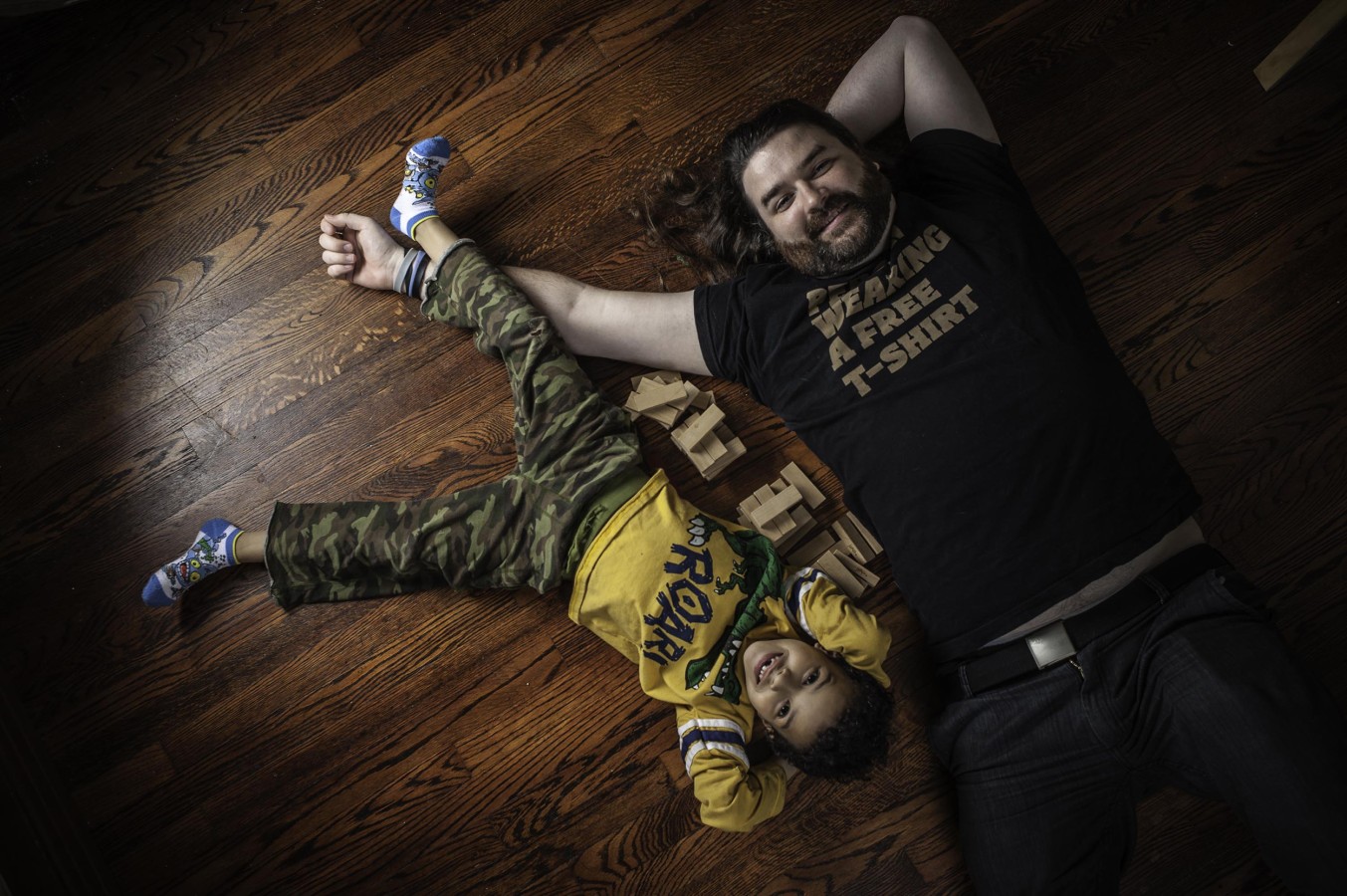
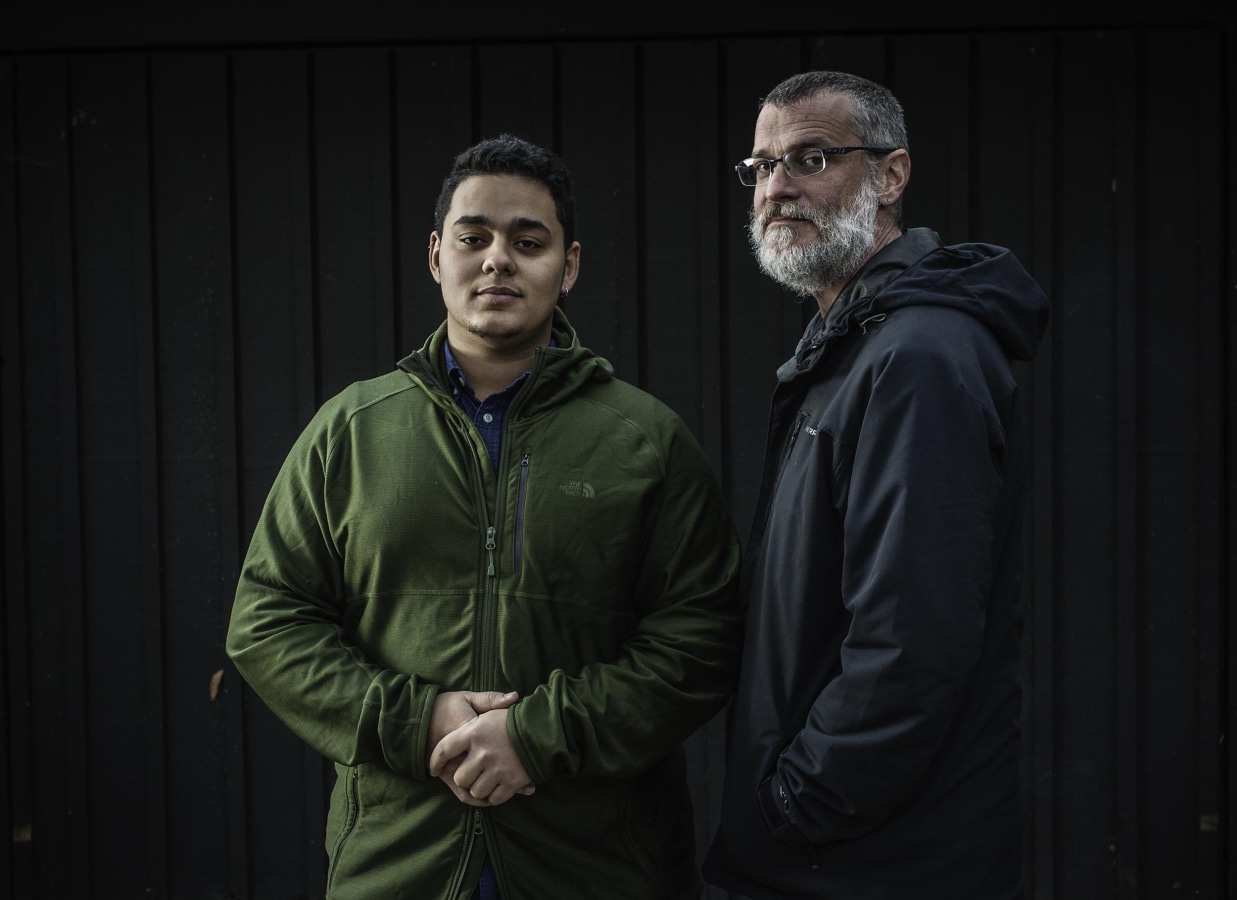
Mark Johnson-Lewis, 48, and his son, Tyler Lewis, 22, of Columbia, MD (André Chung/NBC News)

Mark: You’re black in this world, and it doesn’t matter what you think of who you are, you have to be conscious of how others are going to see you. And when you bump up against the law, it’s probably not going to be the best experience because of how others see you.

Tyler: I want to become a police officer and it’s kind of something that I struggle with being a black man. There needs to be a change in mindset of the way people view law enforcement. And there needs to be a change in the way law enforcement views the average American. You know, not as a black American, not as a white American, but as a person, as a human being…


Benjamin Jancewicz, 31, with his son, Arion, 6, of Baltimore, MD. (André Chung/NBC News)

Benjamin: Regardless of how light he is, he’s still going to be, you know, with a lot of other people doing a lot of other things. And he needs to be prepared. And that just really worries me because, you know, as much of a perspective as I do have coming from a– a [diverse] culture, I still know that my own skin tone allows me to get away with a lot of other stuff…

View the entire photo-essay here.

Tags: , ,