The Next Great Migration

Posted in Articles, Europe, Media Archive, United States on 2015-03-06 02:01Z by Steven

The Next Great Migration

The New York Times
2015-03-01

Thomas Chatterton Williams

PARIS — AT dinner last summer with my brother-in-law, a grandson of Jews who fled Algeria for France, the conversation turned to the rash of anti-Semitic incidents plaguing the country. At such times, the question inevitably arises in the minds of many Jews: “Where could we go?” He mentioned Tel Aviv, London and New York, but the location mattered less than the reassurance that departure remained an option. He’s not alone in this thinking: 7,000 French Jews emigrated in 2014.

Over the past year, as I watched with outrage at the dizzying spate of unpunished extrajudicial police killings of black men and women across America, I’ve wondered why more black Americans don’t think similarly. Why shouldn’t more of us weigh expatriation, even if only temporary, as a viable means of securing those lofty yet elusive ideals of life, liberty and the pursuit of happiness?

Blacks leaving America in search of equality is not new. The practice dates from at least antebellum Louisiana, when free mulattoes in New Orleans sent their children to France to live in accordance with their means and not their color. It continued after World War II, when a number of black G.I.s, artists and jazzmen shared Richard Wright’s sentiment that there is “more freedom in one square block of Paris than there is in the entire United States of America.”…

Read the entire article here.

Tags: , , ,

Being Mixed Race

Posted in Live Events, Media Archive, Social Science, United Kingdom, Women on 2015-03-06 01:45Z by Steven

Being Mixed Race

Women of the World Festival 2015
Blue Bar at Royal Festival Hall
Southbank Center
Belvedere Road, London
Saturday, 2015-03-07, 13:30-15:00Z

Building on the findings of the Being Mixed Race panel discussions during WOW 2013 and WOW 2014, this workshop expands on issues identified during the previous conversations and focuses specifically on issues of terminology, colourism, hair and parenting. Led by visual sociologist Emma Dabiri.

Emma Dabiri is researching a PhD in visual sociology at Goldsmiths, and works as a teaching fellow in the Africa Department at SOAS, University of London. As a commentator she is frequently invited to contribute to discussions relating to Africa and the African Diaspora on topics including futures, gender, feminism, identities, literature, film and the politics of beauty. She has published in a number of academic journals, as well as in the national press and is one of the BBC’s Expert Voices.

For more information, click here.

Tags: , ,

The Right Words to Say: On Being Read as White

Posted in Articles, Autobiography, Latino Studies, Media Archive, United States on 2015-03-06 01:25Z by Steven

The Right Words to Say: On Being Read as White

The Toast
2015-03-05

Dahlia Grossman-Heinz

When you meet me for the first time, you read me as if I were a book. Every idea you have about me and every word I say is part of that book.

When you look at me, you will think I am white. I already know this. When you shake my hand and meet me for the first time, you always already read me as white. You will hear me speak English without an accent and think I am white. You will hear or read my last name and think I am white. You read me wrong.

We all have crowded bookshelves in our heads crammed with texts for every person we know. They knock about in our skulls, falling off the shelves. We refer to them again and again, wearing the pages thin. When you read me wrong, everything that follows is askew.

I have strategies I use to tell you who I am. They have different rates of success, but I will employ them all whenever the situation allows. I mention my quinceañera. I tell the story of the first time my parents heard me speak English. I say words deliberately correctly in Spanish like guerrilla. I talk about Mexican music I like. I note that I am a bilingual Spanish speaker on my resume. I talk about Mexican movies I like. When I am with people, I answer phone calls from my mom and tell her I can’t talk, but I do it in Spanish. I keep her on the phone a little longer than I have to. Whenever the topic of family comes up, I say that most of mine lives in Mexico. I am prepared with these tactics when I have to tell you who I am, ready to fit them in between the pauses so that you might reread me. I’m better at it now than I used to be—I’ve been practicing a long time, figuring out the right words to say…

Read the entire article here.

Tags: ,

Imagining a future where racial reassignment surgery is the norm

Posted in Anthropology, Articles, Book/Video Reviews, Communications/Media Studies, Media Archive on 2015-03-06 00:32Z by Steven

Imagining a future where racial reassignment surgery is the norm

Quartz
2014-09-27

Marcia Alesan Dawkins, Communications Professor
University of Southern California, Annenberg

Jess Row’s haunting new novel, Your Face In Mine, is an invitation to the future, an era bound only by the limits of imagination, money, and technology. It’s a time when you can edit anything about yourself—your location, occupation, your status and even your race—if you are a part of the right network.

In the future Row casts, some of us have grown accustomed to the sights and sounds of diversity and the ideal that law and culture treat every person equally. While others are experiencing “racial dysphoria,” or significant discontent with the racial identities we’ve been assigned at birth or the stereotypical roles associated with those racial identities. Row’s novel argues that racial dysphoria stems from the failure of racial assimilation in our techno-driven world. It’s a sign that racism persists even as race no longer seems to matter. The future Row casts is eerily reminiscent of what many cultural critics call our “post-racial” present, a time in which real racism persists without any real racists to blame…

Read the entire article here.

Tags: , , , , ,

A clerical correspondent writes us from the Southern coast protesting against the rapid tendency to amalgamation…

Posted in Articles, Media Archive, Slavery on 2015-03-03 21:59Z by Steven

A clerical correspondent writes us from the Southern coast protesting against the rapid tendency to amalgamation…

Franklin Repository
1863-12-09
page 4, column 4

Source: Valley of the Shadow: Civil War Era Newspapers, University of Virginia Library

A clerical correspondent writes us from the Southern coast protesting against the rapid tendency to amalgamation. He says that he has been called upon to perform the marriage service repeatedly where the bride was mulatto, quadroon or octoroon, and he calls upon Congress to arrest this unnatural mingling of the races, which, to use his own language, “threatens the annihilation of the white race in the United States.”

We beg our correspondent to quiet his fears on the subject. He cites some half a dozen cases to vindicate his apprehensions; but not one of them presents the union of a northern man with the southern negress. All the happy grooms were either southerners or foreigners, and they have been adopting no novel social system. Slavery has never fastened its desolation on any land without carrying the social evil of amalgamation with it; and the crime has been peculiar to the chivalric and opulent rather than to the lowly. Had our correspondent cast a thought as to the origin of the mulatto, quadroon and octoroon brides of whom he speaks, he might have cherished a reasonable suspicion that amalgamation is not just dawning upon the world, but has blotted and blurred the whole social organization of the South ever since slavery came with its endless train of crime.

In the North, where the negro race is free and not the legitimate prey of a brutal master’s lust, amalgamation is very rare, and embraces only the most abandoned of both sexes; and we regard the destruction of Slavery as the only hope of dealing a death-blow to that unnatural evil. Slavery has been its parent, its shield, its apologist and stripped it of its hideous moral deformity by bringing virtuous wives and daughters and sensual sons in daily contact with it; and when its great foundation is destroyed, the whole structure of social pollution will fall with it. The remedy is not in Congress, but in the moral tone of the people, and that seems to be progressing well toward a better and brighter Nationality, free from the blistering stains of both legalized and lawless mingling of the distance races of the Continent.

Tags: , ,

Bio Science: Genetic Genealogy Testing and the Pursuit of African Ancestry

Posted in Articles, Health/Medicine/Genetics, Media Archive, Social Science on 2015-03-03 20:21Z by Steven

Bio Science: Genetic Genealogy Testing and the Pursuit of African Ancestry

Social Studies of Science
Volume 38, Number 5 (October 2008)
pages 759-783
DOI: 10.1177/0306312708091929

Alondra Nelson, Professor of Sociology and Gender Studies; Director, Institute for Research on Women, Gender, and Sexuality
Columbia University, New York, New York

This paper considers the extent to which the geneticization of `race’ and ethnicity is the prevailing outcome of genetic testing for genealogical purposes. The decoding of the human genome precipitated a change of paradigms in genetics research, from an emphasis on genetic similarity to a focus on molecular-level differences among individuals and groups. This shift from lumping to splitting spurred ongoing disagreements among scholars about the significance of `race’ and ethnicity in the genetics era. I characterize these divergent perspectives as `pragmatism’ and `naturalism’. Drawing upon ethnographic fieldwork and interviews, I argue that neither position fully accounts for how understandings of `race’ and ethnicity are being transformed with genetic genealogy testing. While there is some acquiescence to genetic thinking about ancestry, and by implication, `race’, among African-American and black British consumers of genetic genealogy testing, test-takers also adjudicate between sources of genealogical information and from these construct meaningful biographical narratives. Consumers engage in highly situated `objective’ and `affiliative’ self-fashioning, interpreting genetic test results in the context of their `genealogical aspirations’. I conclude that issues of site, scale, and subjectification must be attended to if scholars are to understand whether and to what extent social identities are being transformed by recent developments in genetic science.

Read or purchase the article here.

Tags: ,

Projections of the Size and Composition of the U.S. Population: 2014 to 2060: Population Estimates and Projections

Posted in Census/Demographics, Media Archive, Reports, United States on 2015-03-03 20:04Z by Steven

Projections of the Size and Composition of the U.S. Population: 2014 to 2060: Population Estimates and Projections

United States Census Bureau
March 2015
P25-1143
13 pages

Sandra L. Colby and Jennifer M. Ortman

INTRODUCTION

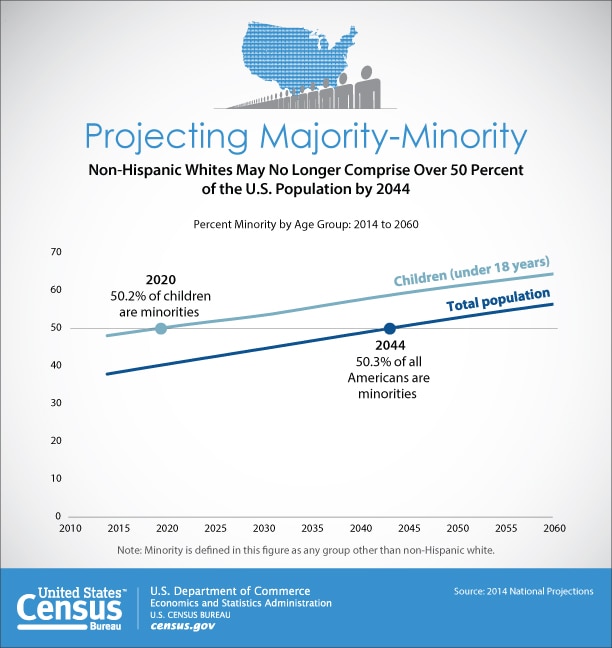
Between 2014 and 2060, the U.S. population is projected to increase from 319 million to 417 million, reaching 400 million in 2051. The U.S. population is projected to grow more slowly in future decades than in the recent past, as these projections assume that fertility rates will continue to decline and that there will be a modest decline in the overall rate of net international migration. By 2030, one in five Americans is projected to be 65 and over; by 2044, more than half of all Americans are projected to belong to a minority group (any group other than non-Hispanic White alone); and by 2060, nearly one in five of the nation’s total population is projected to be foreign born.

This report summarizes results from the U.S. Census Bureau’s 2014 National Projections, with a focus on changes in the age structure and shifts in the racial and ethnic composition of the population—both the total population as well as the native and foreign born…

…The Two or More Races population is projected to be the fastest growing over the next 46 years (see Table 2), with its population expected to triple in size (an increase of 226 percent). This group is projected to increase from 8 million to 26 million between 2014 and 2060. Its share of the total population is projected to increase from 2.5 percent…

Read the entire report here.

Tags: , , , , , ,

Yo No Sé Que Hablar — I Don’t Know What To Say

Posted in Articles, Autobiography, Latino Studies, Media Archive, United States on 2015-03-03 19:26Z by Steven

Yo No Sé Que Hablar — I Don’t Know What To Say

Teach. Run. Write. English Teacher Running from One Adventure to the Next
2015-03-02

Christina Torres

The man sitting behind me at the restaurant last month was speaking Spanish.

So was the park worker the other day, which was a surprise.

There was the couple wearing “Great Aloha Run” shirts, asking each other about rain, parece que va a llover. Their accents were wonderfully soft, elongated, melodic and tripping. Dominican, I think, like my friend Carolina’s.

When I lived in LA, hearing Spanish was a given. It was everywhere–on buses, at the bank, on signs and on my radio in the car. Even though I lacked fluency when I moved there, it was omnipresent.

Now, living in a state with under 10% of a Latino population (a huge increase from before), hearing Spanish is a rare treat, something that immediately makes my ears perk up. I remember each time like a small gem, holding it close as a reminder of home.

I love living in Hawai‘i–I really do. People see me and know I’m part Filipina, which almost never happened before. It’s an exciting rush–“yes! You see this part of me! You get me!”

Like I’m sure lots of mixed kids deal with, though, I always have a hard time trying to navigate both cultures. I love living here and being seen as Filipina, but now I miss part of my Latina culture. I miss speaking Spanish with people. I missing hearing mariachi on the radio when I would scroll through channels. I spent all of McFarland U.S.A crying. Not just crying, really, but sobbing. From the quince scene on, I was a mess. The hand-painted signs selling aguas de fruta and the casual mix of Spanglish made my heart ache for something that I still don’t know how to fill..

Read the entire article here.

Tags: , , ,

Mixed Race in Manchester – Intersections of Class and Mixed Race Identity

Posted in Articles, Economics, Identity Development/Psychology, Media Archive, United Kingdom on 2015-03-03 19:11Z by Steven

Mixed Race in Manchester – Intersections of Class and Mixed Race Identity

Musings of a Mixed Race Feminist: Random diatribes from a mixed race feminist scholar.
Tuesday, 2015-03-03

Donna J. Nicol, Associate Professor Women & Gender Studies
California State University, Fullerton

I spent the last three months of 2014 living in Manchester, England helping my mother-in-law through chemotherapy and navigating the National Health Services bureaucratic red tape to secure caregiver support and the like. While I wasn’t able to keep up with this blog, I did manage to work on my first novel and make note of how I was perceived differently than I normally am in the U.S. Now these perceptions draw on my specific interactions so my observations are certainly not generalizable to all but I found the comparisons revealing.

In the African and South Asian (think Pakistani, Bangladeshi, Indian) community of Longsight, being mixed race (as determined by skin color, hair texture and physical markers of mixed race identity) was not as common as in other parts of Manchester which were predominantly white. In Longsight, I felt like the odd person out and though I have traveled to England many times before (mostly London and Manchester), I was not cognizant of being one of the few mixed folks in the bunch until I stayed more than a week in the area. Home to mostly first generation immigrants to the U.K., Longsight appeared to demonstrate a kind of “racial insularity” that I had not experienced in other parts of the city. Mixed race couples were, in fact, quite rare to find…

Read the entire article here.

Tags: , , , , , ,

BLACK AND WHITE vs BLACK OR WHITE: Bioethics and Mixed Race Families

Posted in Articles, Book/Video Reviews, Communications/Media Studies, Media Archive, My Articles/Point of View/Activities on 2015-03-03 18:54Z by Steven

BLACK AND WHITE vs BLACK OR WHITE: Bioethics and Mixed Race Families

September Williams’ Bioethics Screen Reflections: Film, Television, and Media Critiques Relevant to Bioethics
2015-03-01

September Williams, MD

Black and White, screened at the 2014 Toronto Film Festival and later at the Mill Valley Film Festival, in October 2014. The same title was also used to discuss the film in various film trade publications. However, the film’s title changed by the time of its USA distribution date, January 30, 2015. The word ‘and’ was replaced with the word ‘or’. That is, the film title became Black or White. Use of the word ‘and’ better reflects the courage of writer-director Mike Bender [Binder] in broaching contemporary issues around race and class. The film only superficially reflects two entities fighting one another. Much more prominent in the story is a struggle for Black and White to save each other. Bender [Binder] dares to suggest, we might all be in this mess together, sinking or swimming. Ignoring antebellum period themes, it’s a new take…

…Obvious bioethical concerns in Black and White include concerns for the best surrogate for a child whose parents are no longer able to parent; the age of autonomous decision making for children and historical injustices inherent in racism and classicism. The role of grief, acute and prolonged, in the context of substance abuse stands out. In the end it is the lagging of social construction, far behind the science of the human genome, that keeps viewers watching.

Stephen [Steven] Riley wrote an analysis of stresses, those identifying as Mixed Race, felt in filling out Box 9 on the 2010 United States census. He describes people agonizing about accurately portraying their racial identity. Riley states “For those who desire to portray their ‘accurate racial’ identity, I have news for you — ‘racial accuracy’ is an oxymoron. ‘Race’ as a biological, or anthropological construct is an utter fallacy”…

Read the entire article here.

Tags: , , ,