Mary Seacole – International Woman

Posted in Articles, Biography, Europe, History, Media Archive, United Kingdom, Women on 2015-03-08 20:09Z by Steven

Mary Seacole – International Woman

The Huffington Post, United Kingdom
2015-03-04

Elizabeth Anionwu, Emeritus Professor of Nursing
University of West London

Later this year a memorial statue to Mary Seacole will be unveiled in the gardens of St Thomas’ hospital, overlooking the River Thames and the Houses of Parliament. Sir Hugh Taylor, Chairman of Guys & St Thomas’ NHS Foundation Trust, said: “Mary Seacole was a pathfinder for the generations of people from black and minority ethnic backgrounds who have served the NHS over the years and she remains a positive role model for the current generation. The Trust is proud to be hosting the statue, not least because it speaks to the diversity of our local population, our patients and the staff who work here.”

It was 160 years ago that Mary first set foot in the Crimea to feed and nurse British soldiers and she stayed there for the remaining 18 months of the conflict. Sir William Howard Russell, The Times newspaper’s Crimean War correspondent praised her efforts. In 1857 he wrote “I trust that England will not forget one who nursed her sick, who sought out her wounded to aid and succour them, and who performed the last offices for some of her illustrious dead.” He would have been sad to see that Mary was virtually forgotten for a century following her death in London on 14 May 1881. This was despite an obituary appearing in the pages of The Times!…

Read the entire article here.

Tags: , , ,

Land of the Cosmic Race

Posted in Anthropology, Book/Video Reviews, Caribbean/Latin America, Media Archive, Mexico, Social Science on 2015-03-08 01:34Z by Steven

Land of the Cosmic Race

Sociological Forum
Volume 30, Issue 1 (March 2015)
pages 248-251
DOI: 10.1111/socf.12157

Martha King
Graduate Center
City University of New York

Land of the Cosmic Race: Race Mixture, Racism, and Blackness in Mexico. Christina A. Sue. New York: University of Oxford Press, 2013.

In Land of the Cosmic Race: Race Mixture, Racism, and Blackness in Mexico, Christina A. Sue makes significant theoretical and empirical contributions to the field of racial and ethnic studies and to its growing subfield of comparative investigation. These contributions are more impressive because they stem from Sue’s dissertation and compose her first book. Her study is an ambitious ethnography exploring Mexicans’ negotiation of racial and national ideology at a micro level, as well as the themes of mestizaje (race mixture), racism, racial identity construction, and blackness in everyday discourse. Sue’s qualitative approach richly blends various sources: participant observation, interviews, and focus groups. Her fieldwork was conducted between 2003 and 2005 in Mexico’s urbanized Veracruz region, which lies on the coast southeast of Mexico City. As in comparable metropolitan areas in Mexico, the majority of residents are mestizo while a smaller proportion is indigenous. Veracruz, however, is unique because it is home to a higher proportion of people of African descent and its residents have more phenotypical variation. It was a major gateway for African slaves and has acted in recent years as an entry point for migrant black Cubans.

For much of Mexico’s colonial period, blacks outnumbered whites (p. 11). Finding segregation increasingly difficult to maintain because of race mixing, colonial authorities implemented a hierarchical caste system based on race, color, culture, and socioeconomic status with Spaniards at the top, then mixed-race individuals, Indians, and Africans at the bottom. During the postrevolutionary period, Mexican leaders and elites celebrated mestizo identity as the foundation of Mexican nationalism and distinction. This ideological turn was intended to cope with indigenous marginalization and social divisions and evade the period’s rampant scientific racism that would see Mexico as a less capable or worthy nation due to its black and indigenous population.

This postrevolutionary ideology is the foundation for Mexico’s contemporary national ideology. Sue describes contemporary national ideology as composed of three pillars. The first pillar is that of mestizaje, which upholds race mixture as positive and quintessentially Mexican (p. 15). The second pillar is nonracism, meaning Mexico is a country free of racism. Sue’s informants consistently confirm that because Mexico’s national identity is based on race mixture, then racism is inconceivable. The third pillar is nonblackness or the “minimization or erasure of blackness from Mexican national image, both as a separate racial category and as a component of the mestizo population” (p. 16). Sue argues persuasively that these three pillars are complementary in facilitating racial discrimination and the privileging of whiteness in Mexico.

Sue’s overarching question is how do individuals respond to, manage, and resolve the contradictions between Mexico’s national ideology and their daily experiences of white privilege and discrimination toward people of African descent (p. 5). Sue’s data persuasively show that mechanisms and discourse at the micro level play pivotal parts of reproducing ideology and social hierarchy in Mexico. Her work reminds us that elites do not, on their own, develop and maintain dominant ideologies. Instead, “the social force behind ideology lies in the popular realm” (p. 8)…

Read the entire review here.

Tags: , , ,

Identity Entrepreneurs

Posted in Articles, Law, Media Archive, United States on 2015-03-08 01:13Z by Steven

Identity Entrepreneurs

2015-03-05
87 pages

Nancy Leong, Associate Professor of Law
University of Denver Sturm College of Law

In my previous article Racial Capitalism, I examined the ways in which white individuals and predominantly white institutions derive value from non-white racial identity. This process results in part from our intense social and legal preoccupation with diversity. And it results in the commodification of non-white racial identity, with negative implications for both individuals and society.

This Article picks up where Racial Capitalism left off in three ways. As a foundation, it first expands the concept of racial capitalism to identity categories more generally, explaining that individual in-group members and predominantly in-group institutions—usually individuals or institutions that are white, male, straight, wealthy, and so on—can and do derive value from out-group identities.

Second, the Article turns from the overarching system of identity capitalism to the myriad ways that individual out-group members actively participate in that system. In particular, I examine how out-group members leverage their out-group status to derive social and economic value for themselves. I call such out-group participants identity entrepreneurs. Identity entrepreneurship is neither inherently good nor inherently bad. Rather, it is a complicated phenomenon with both positive and negative consequences.

Finally, the Article considers the appropriate response to identity entrepreneurship. We should design laws and policies to maximize both individual agency and access to information for out-group members. Such reforms would protect individual choice while making clear the consequences of identity entrepreneurship both for individual identity entrepreneurs and for the out-group as a whole. A range of legal doctrines interact with and influence identity entrepreneurship, including employment discrimination under Title VII, rights of privacy and publicity, and intellectual property. Modifying these doctrines to take account of identity entrepreneurship will further progress toward an egalitarian society in which in-group and out-group identities are valued equally.

Read the entire paper here.

Tags:

Obama, at Selma Memorial, Says, ‘We Know the March Is Not Over Yet’

Posted in Articles, Barack Obama, History, Law, Media Archive, Politics/Public Policy, United States on 2015-03-08 00:44Z by Steven

Obama, at Selma Memorial, Says, ‘We Know the March Is Not Over Yet’

The New York Times
2015-03-07

Peter Baker, Chief White House Correspondent

Richard Fausset


Doug Mills/The New York Times

SELMA, Ala. — As a new generation struggles over race and power in America, President Obama and a host of political figures from both parties came here on Saturday, to the site of one of the most searing days of the civil rights era, to reflect on how far the country has come and how far it still has to go.

Fifty years after peaceful protesters trying to cross a bridge were beaten by police officers with billy clubs, shocking the nation and leading to passage of the landmark Voting Rights Act of 1965, the nation’s first African-American president led a bipartisan, multiracial testimonial to the pioneers whose courage helped pave the way for his own election to the highest office of the land.

But coming just days after Mr. Obama’s Justice Department excoriated the police department of Ferguson, Mo., as a hotbed of racist oppression, even as it cleared a white officer in the killing of an unarmed black teenager, the anniversary seemed more than a commemoration of long-ago events on a black-and-white newsreel. Instead, it provided a moment to measure the country’s far narrower, and yet stubbornly persistent, divide in black-and-white reality…

Read the entire article here. Read President Obama’s transcript here.

Tags: , , ,

Urging Persistence on Racial Gains, Obama Recalls Sacrifice in Selma

Posted in Articles, Barack Obama, Law, Media Archive, Politics/Public Policy, United States, Videos on 2015-03-07 21:22Z by Steven

Urging Persistence on Racial Gains, Obama Recalls Sacrifice in Selma

The New York Times
2015-03-06

Peter Baker, Chief White House Correspondent

Julie Hirschfeld Davis, White House Correspondent

COLUMBIA, S.C. — For the nation’s first African-American president, it was a week of two documents that told the story of a country still grappling with its own history.

The first was a draft speech that President Obama was marking up with his distinctive left-hand scrawl to deliver in Selma, Ala., on Saturday to celebrate a half-century of civil rights gains. The second was a report he received accusing the police in Ferguson, Mo., of systematically discriminating against African-Americans.

More than once, Mr. Obama has credited the courage of protesters in Selma who were confronted by club-wielding state troopers 50 years ago for clearing the way for his own barrier-breaking election as president. But the path from Selma to the Oval Office has also led to Ferguson and back to Selma, a path littered with hope and progress and disappointment and setback…

Read the entire article here.

Tags: , , , , ,

Man Shot Dead by Police After Scuffle in Wisconsin

Posted in Articles, Law, Media Archive, United States, Videos on 2015-03-07 20:47Z by Steven

Man Shot Dead by Police After Scuffle in Wisconsin

The New York Times
2015-03-07

Ashley Southall

A 19-year-old Wisconsin man was shot and killed Friday by a police officer during a scuffle inside an apartment in Madison, police officials said. The shooting prompted protests that continued on Saturday and led officials to call for restraint while the shooting is investigated.

The shooting occurred Friday evening after the police received calls for a man who had committed battery and was jumping in and out of traffic, Michael C. Koval, the Madison chief of police, said. A police officer followed the man to an apartment and forced his way in after hearing a disturbance inside, the chief said. The man then assaulted the officer, who shot the man, according to Chief Koval, who spoke at a news conference in Madison Friday evening.

The officer immediately began rendering first aid, but the man died at a hospital, Chief Koval said. The authorities did not immediately release his name, but his mother identified him as Tony Robinson, an African-American who graduated from high school in 2014.

“My son has never been a violent person,” Andrea Irwin, who identified herself as Mr. Robinson’s mother, told WKOW, a Madison television station. “And to die in such a violent, violent way, it baffles me.”…

Read the entire article here.

Tags: , , , , , , , ,

Gordon Fox Pleads Guilty in Rhode Island Corruption Case

Posted in Articles, Gay & Lesbian, Law, Media Archive, Politics/Public Policy, United States on 2015-03-07 02:38Z by Steven

Gordon Fox Pleads Guilty in Rhode Island Corruption Case

The New York Times
2015-03-03

Richard Pérez-Peña

The climb took decades, but the fall was swift. Less than a year removed from his reign as speaker of the Rhode Island House, Gordon D. Fox pleaded guilty on Tuesday to taking bribes, wire fraud and filing a false tax return.

Mr. Fox, 53, took $52,500 in bribes to help a bar and restaurant get a liquor license and illegally diverted $108,000 in campaign funds to pay for personal expenses. He made the admissions in Federal District Court in Providence as part of a plea agreement that calls for a three-year prison sentence — though a judge will ultimately decide the penalty — and will almost certainly cost him his law license.

Outside the courthouse, when asked by reporters whether he felt remorse, Mr. Fox said, “Absolutely, absolutely, without question.”…

…Mr. Fox, a Democrat, was the first openly gay person and the first mixed-race person to lead either of the state’s legislative chambers, and he led the drive to legalize same-sex marriage in 2013.

He grew up as one of six children in a blue-collar family, with a black mother and a white father, and he liked to recall how he had worked in an ice cream shop to help pay his way through law school. He became a lawyer and part owner of a nightclub, and in 1992 he was elected to the House. He became the majority leader in 2002 and the speaker in 2010…

Read the entire article here.

Tags: , , , , , ,

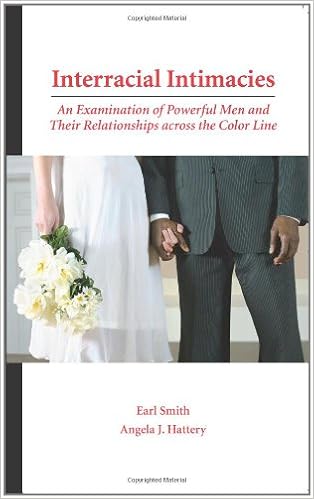
Interracial Intimacies: An Examination of Powerful Men and Their Relationships across the Color Line

Posted in Books, History, Law, Media Archive, Monographs, Politics/Public Policy, Social Science, United States on 2015-03-07 02:02Z by Steven

Interracial Intimacies: An Examination of Powerful Men and Their Relationships across the Color Line

Carolina Academic Press
2009
144 pages
Paper ISBN: 978-1-59460-496-6

Earl Smith, Professor Emeritus of Sociology
Wake Forest University, Winston-Salem, North Carolina

Angela J. Hattery, Professor and Director of Women and Gender Studies
George Mason University, Fairfax, Virginia

Unique among books on interracial relationships, this book examines the lives of high profile men who have produced public discourses on race and interracial relationships and who themselves, often contradictory to their rhetoric, were or continue to be involved in love relationships across the color line. The book opens with a discussion of the history of interracial couplings in the United States, including an examination of the relationship of Richard and Mildren Loving which led to the landmark case Loving v. Virginia in which the U.S. Supreme Court, in 1967, rendered unconstitutional all state laws that prohibited interracial marriage. Each of the subsequent chapters is devoted to an individual man or couple; we explore the lives of men about whom their interracial relationships are relatively well known, including Thomas Jefferson, Strom Thurmond, Clarence Thomas, Frederick Douglass, and William Cohen. We also explore a few figures about whom less is known about their intimate lives including George Washington and Richard Mentor Johnson.

Rather than simply focusing on the relationships exclusively, this book examines specifically the role that power plays in shaping the negotiation of intimate relationships, family forms, racial identity, hegemonic ideology and public policy among public figures who not only contributed to the public discourses on race and interracial unions, but also contributed to the racial ideologies that gained hegemony and dominated Americans’ beliefs about race and the laws and public policies that established second class citizenship for those identified as “Black.”

This book offers the interested reader a glimpse into the personal lives of famous and not so famous American men who clandestinely or in open view loved women across the color line. In some cases, these loving relationships mirrored the men’s beliefs about race and interracial unions—Richard Mentor Johnson, William Cohen—and in others these relationships were in seeming contradiction to the beliefs these men held and in fact developed about racial purity and segregation—Thomas Jefferson, Clarence Thomas, Strom Thurmond. These contradictions between the public and private lives of our country’s public servants offers a rich arena for exploration of race in the United States. In light of the recent election of the first African American president, Barack Obama, this book could not be more timely.

Tags: , , , , , , , , , , , ,

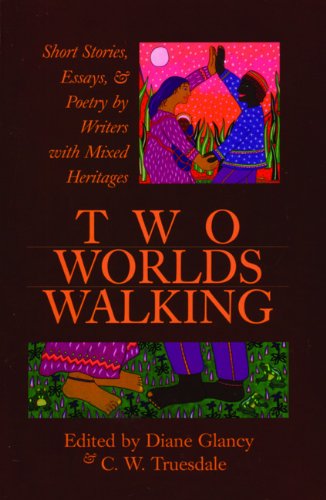
Two Worlds Walking: Short Stories, Essays, and Poetry by Writers of Mixed Heritages

Posted in Anthologies, Books, Media Archive, Poetry, United States on 2015-03-06 02:53Z by Steven

Two Worlds Walking: Short Stories, Essays, and Poetry by Writers of Mixed Heritages

New Rivers Press
January 1996
256 pages
ISBN-13: 978-0898231496

Edited by Diane Glaney & C. W. Truesdale

In this landmark collection, 42 writers — including Diane Glancy, Siv Cedering, and Lewis Turco — go beyond a simple idea of diversity to explore what it means to “walk in two worlds.” While many of the poems, short stories, essays, and memoirs in this anthology explore the tensions of being “mixed blood,” all of the pieces offer a surprising and resilient perspective on what it means to be “American” today.

Tags: , , , , , , , , , , , , , , , , , , , , , , , , , , , , , , , , , , , , , , , , , , , , , , ,

The Men Who Left Were White

Posted in Articles, Autobiography, History, Media Archive, United States on 2015-03-06 02:20Z by Steven

The Men Who Left Were White

Gawker
2014-04-12

Josie Duffy

There are three things you should know.

First: I’m not biracial.

“What are you?” people ask, and they expect me to say something thrilling and tribal. I answer, but still they press. “Where are your ancestors from?” people ask, and they want answers that aren’t San Antonio and Wheeling, West Virginia. But that’s all I got. My story is both simple and untold.

The bones of it, of me: I’m black, despite the skin that goes virtually translucent in the winter. Despite the thin unpredictable curls. My mom and dad are black, as are my grandparents. That’s all she wrote. That’s all there is, even as I write this sentence. My parents, usually liberal employers of nuance, have always been militant-clear about drawing that line. We aren’t biracial.

When I tell people I’m black, they find it unsatisfying. “That’s no fun,” one girl joked to me recently. “I thought you were going to have a story.”

Second: I’m 44% European, 49% African. Not exactly an equal split, but pretty damn close.

I hear the same sentence twice…

Read the entire article here.

Tags: ,