We Were Always Free: The Maddens of Culpeper County, Virginia, A 200-Year Family History

Posted in Books, History, Media Archive, Monographs, United States, Virginia on 2009-11-19 02:39Z by Steven

We Were Always Free: The Maddens of Culpeper County, Virginia, A 200-Year Family History

University of Virginia Press
1992
304 pages
6 1/8 x 9 1/4
52 b&w illustrations
Paper ISBN: 978-0-8139-2371-0

T. O. Madden, Jr. (1903-2000)

with

Ann L. Miller, Historian
Virginia Transportation Research Council

Foreword by Nell Irvin Painter

In August of 1758, in Spotsylvania County, Virginia, a poor Irish immigrant named Mary Madden bore a child, Sarah Madden, whose father was said to be a slave and the property of Colonel James Madison, father of the future president of the United States. This daughter, though born to a free mulatto, became indentured to the Madisons. There she worked as a seamstress to pay off the fine of her birth until she was thirty-one years old.

Sarah Madden bore ten children; when the term of her indenture was over, she and her youngest son, Willis, struck out for themselves—Sarah as a seamstress, laundress, and later, with Willis, a dairy farmer and tavern keeper.

Spanning two hundred years of American history, We Were Always Free tells its story with remarkable completeness. we can thank Sarah Madden and her descendants for keeping their family narrative alive—and for saving hundreds of important documents detailing their freedom, hardship, and daily work.

These documents came to light in 1949 when T. O. Madden Jr. discovered a hidebound trunk originally belonging to his great-grandfather Willis. Stored in the trunk were papers dating back to the mid-eighteenth century, freedom papers, papers of indenture, deeds of land, Sarah Madden’s laundry and seamstress record books, letters, traveling passes. The trunk even held a full set of business records from the nineteenth century when Madden’s Tavern flourished as a center of activity in Orange County and as a rest stop on the road to Fredericksburg.

From that day forward, T. O. Madden deeply researched his family, using census reports, other official sources, family, and friends. All have led to his ably reconstructed family history, and to his own remarkable story.

We Were Always Free is a unique and very American family saga.
Tags: , , , ,

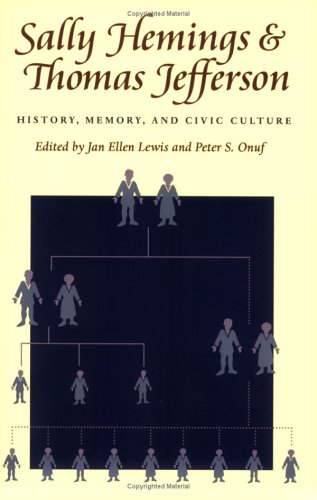
Sally Hemings and Thomas Jefferson: History, Memory, and Civic Culture

Posted in Anthologies, Books, History, Media Archive, Slavery, Social Science, United States, Virginia on 2009-11-19 02:19Z by Steven

Sally Hemings and Thomas Jefferson: History, Memory, and Civic Culture

University of Virginia Press
1999
325 pages
6 x 9
ISBN: 0-8139-1919-3

Edited by

Jan Ellen Lewis
Rutgers University

Peter S. Onuf
University of Virginia

The publication of DNA test results showing that Thomas Jefferson was probably the father of one of his slave Sally Hemings‘s children has sparked a broad but often superficial debate. The editors of this volume have assembled some of the most distinguished American historians, including three Pulitzer Prize winners, and other experts on Jefferson, his times, race, and slavery. Their essays reflect the deeper questions the relationship between Hemings and Jefferson has raised about American history and national culture.

The DNA tests would not have been conducted had there not already been strong historical evidence for the possibility of a relationship. As historians from Winthrop D. Jordan to Annette Gordon-Reed have argued, much more is at stake in this liaison than the mere question of paternity: historians must ask themselves if they are prepared to accept the full implications of our complicated racial history, a history powerfully shaped by the institution of slavery and by sex across the color line.

How, for example, does it change our understanding of American history to place Thomas Jefferson in his social context as a plantation owner who fathered white and black families both? What happens when we shift our focus from Jefferson and his white family to Sally Hemings and her children? How do we understand interracial sexual relationships in the early republic and in our own time? Can a renewed exploration of the contradiction between Jefferson’s life as a slaveholder and his libertarian views yield a clearer understanding of the great political principles he articulated so eloquently and that Americans cherish? Are there moral or political lessons to be learned from the lives of Thomas Jefferson and Sally Hemings and the way that historians and the public have attempted to explain their liaison?

Sally Hemings and Thomas Jefferson: History, Memory, and Civic Culture promises an open-ended discussion on the living legacy of slavery and race relations in our national culture.

Contributors:

Annette Gordon-Reed, New York Law School
Rhys Isaac, College of William and Mary
Winthrop D. Jordan, University of Mississippi
Jan Ellen Lewis, Rutgers University, Newark
Philip D. Morgan, Institute of Early American History and Culture
Peter S. Onuf, University of Virginia
Jack N. Rakove, Stanford University
Joshua Rothman, University of Virginia
Werner Sollors, Harvard University
Lucia Stanton, Thomas Jefferson Memorial Foundation
Dianne Swann-Wright, Thomas Jefferson Memorial Foundation
Clarence Walker, University of California at Davis
Gordon S. Wood, Brown University

Tags: , , , , , , , , , , , , , , , , , , ,

Mongrel Nation: The America Begotten by Thomas Jefferson and Sally Hemings

Posted in Books, History, Media Archive, Monographs, Slavery, Social Science, United States on 2009-11-19 02:02Z by Steven

Mongrel Nation: The America Begotten by Thomas Jefferson and Sally Hemings

University of Virginia Press
January 2009
144 pages
5 1/2x 81/4
Cloth ISBN 0-8139-2777-0

Clarence E. Walker, Professor of History
University of California, Davis

The debate over the affair between Thomas Jefferson and Sally Hemings rarely rises above the question of “Did they or didn’t they?” But lost in the argument over the existence of such a relationship are equally urgent questions about a history that is more complex, both sexually and culturally, than most of us realize. Mongrel Nation seeks to uncover this complexity, as well as the reasons it is so often obscured.

Clarence Walker contends that the relationship between Jefferson and Hemings must be seen not in isolation but in the broader context of interracial affairs within the plantation complex. Viewed from this perspective, the relationship was not unusual or aberrant but was fairly typical. For many, this is a disturbing realization, because it forces us to abandon the idea of American exceptionalism and reexamine slavery in America as part of a long, global history of slaveholders frequently crossing the color line.

More than many other societies—and despite our obvious mixed-race population—our nation has displayed particular reluctance to acknowledge this dynamic. In a country where, as early as 1662, interracial sex was already punishable by law, an understanding of the Hemings-Jefferson relationship has consistently met with resistance. From Jefferson’s time to our own, the general public denied—or remained oblivious to—the possibility of the affair. Historians, too, dismissed the idea, even when confronted with compelling arguments by fellow scholars. It took the DNA findings of 1998 to persuade many (although, to this day, doubters remain).

The refusal to admit the likelihood of this union between master and slave stems, of course, from Jefferson’s symbolic significance as a Founding Father. The president’s apologists, both before and after the DNA findings, have constructed an iconic Jefferson that tells us more about their own beliefs—and the often alarming demands of those beliefs—than it does about the interaction between slave owners and slaves. Much more than a search for the facts about two individuals, the debate over Jefferson and Hemings is emblematic of tensions in our society between competing conceptions both of race and of our nation.

Tags: , , , , , ,

The Politics of Bisexual/Biracial Identity: A study of Bisexual and Mixed Race Women of Asian/Pacific Islander Descent

Posted in Asian Diaspora, Dissertations, Gay & Lesbian, Identity Development/Psychology, Media Archive, Social Science, Women on 2009-11-19 00:27Z by Steven

The Politics of Bisexual/Biracial Identity: A study of Bisexual and Mixed Race Women of Asian/Pacific Islander Descent

San Diego State University
First Published: 1999
Reprint: 2006
120 pages
ISBN 1-23456-789-0

Beverly Yuen Thompson, Assistant Professor of Women’s Studies
Texas Woman’s College

The construction of certain behaviors and physical characteristics into an acceptable and recognized “identity” is a phenomenon that is meaningful to the specific location and historical moment. “Identities” may not travel well across certain places and historical epochs because of the intricate cultural meanings associated with them. The United States in the late twentieth century is one location in which certain identities are constructed and understood in relation to national history and to political and social issues of the historical era that created such locations. “Identities” in the U.S. have largely been based on membership in groups and classes in which people experience oppression or are denied opportunity because of that membership. For an identity to be understood as such, two factors are typically present: (1) the identity is forced upon the group in a manner which often reduces the group to stereotype and homogeneity for certain reasons such as to justify their (marginal) position in society; (2) the group members more or less accept the identity or label as significant to their self-understanding (and their position in society), although they may or may not accept the meanings that come along with the identity. Identities, therefore, are understood by both group members and non-group members as a legitimate self-label, though the ways in which either view the identity may diverge. Identities based on hegemonic cultural membership, such as white, male, heterosexual, or middle class, are often not employed as self descriptive terms unless one is differentiating one’s self from members of oppressed groups. Identities have largely been constructed in American society based on membership in recognized oppressed groups….

..Biracial identity challenges the construction of mutually exclusive racial categorizations by incorporating an understanding of miscegenation and racial mixing that produces individuals who have a diverse background of racial and ethnic characteristics. This racial mixing may stem from parents or grandparents from different racial and/or ethnic groups or from a cultural history in which racial intermixing was a common occurrence, such as the Caribbean or Hawaii. Biracial identity implies that individuals have an understanding of their diverse racial and ethnic backgrounds and believe that this is an important aspect of their identity and use this concept to describe their racial makeup.

Bisexuality and biraciality as occurrences and concepts involve more than our current construction and indeed it has been argued that they have been present throughout human history (e.g., Stonequist; Haeberle & Gindorf). However, our understanding of bisexuality and multiraciality is relatively recent and the construction of them as identities is arguably quite unique. In order to understand bisexual and biracial identities in their present construction, it is crucial to review briefly the historical, legal, political, economic and social processes that influenced their treatment and embodiment. Therefore in the remainder of this introduction I will review the historical construction of Asian American experiences within the U.S. I will also give an overview of the treatment of bisexuality and homosexuality in relation to the socio-political context of placing bisexuality and homosexuality together based on the premise that it was under “homosexuality” that bisexuals were persecuted. I will then compare and contrast the historical process in the creation of biracial and bisexual identities and the issues that arise when both these identities reside in the same subject…

Read the entire thesis here.

Tags:

Fence Sitters, Switch Hitters, and Bi-Bi Girls: An Exploration of “Hapa” and Bisexual Identities

Posted in Articles, Asian Diaspora, Gay & Lesbian, Identity Development/Psychology, Media Archive, United States, Women on 2009-11-18 21:36Z by Steven

Fence Sitters, Switch Hitters, and Bi-Bi Girls: An Exploration of “Hapa” and Bisexual Identities

Frontiers: A Journal of Women Studies
Vol. 21, No. 1/2 (2000)
Asian American Women
pp. 171-180.

Beverly Yuen Thompson, Assistant Professor of Women’s Studies
Texas Woman’s College

I had been wondering about taking part in a student theatre project about being Asian American, and I said to Tommy, “The thing is, I don’t feel as though I’ve really lived the . . . Asian American experience.” (Whatever I thought that was.)

Tommy kind of looked at me. And he said, “But, Claire, you are Asian American. So whatever experience you have lived, that is the Asian American experience.”

I have never forgotten that.

-Claire Huang Kinsley, “Questions People Have Asked Me. Questions I Have Asked Myself.”

Claire Huang Kinsley articulates a common sentiment among multiracial Asian Americans regarding their racial and ethnic identity. She describes the reaction that her mixed heritage has provoked from Asians and Anglos, both of whom frequently view her as the “other.” In response to these reactions, her faith in her racial identity has been shaken, and she feels unable to identify herself-fearful of being alienated for choosing either her Chinese or Anglo heritage, or both. Although she knows that she is mixed race, the question that still plagues her is whether or not she is included in the term “Asian American.”‘

When I first read Kinsley’s article, I was elated to find recognition of a biracial Asian American experience that resembled my own. I have a Chinese mother and an Anglo-American father, as does she, and I am constantly confronted with questions about my ethnic background from curious individuals. Like Kinsley, I also question my ability to call myself Asian American because of my mixed heritage. However, in addition to my mixed heritage, I am also bisexual, which brings with it additional complications and permutations around my identity formation and self-understanding. The process of identity formation, especially of multiple identities, is complex and lifelong, and my experiences have been no exception.

Though I have always understood that I was mixed race, a true understanding of what this meant in terms of my self-understanding and my relation to the dominant culture and Asian American communities did not develop until I was much older. My first exposure to the political side of identity politics came at the ages of fourteen and fifteen when I began to develop a feminist understanding of the world around me. Then, at seventeen, I first began to call myself bisexual after two years of questioning my sexuality and believing that the only options that were available were either a lesbian or straight identity. Finally at the age of nineteen I began to uncover the history of Asians in America through my college course work and developed a newfound understanding of my racial identity and its political implications. Yet, as is usually the case, this process was never as linear as it may sound…

Read the entire article here.

Tags: , ,

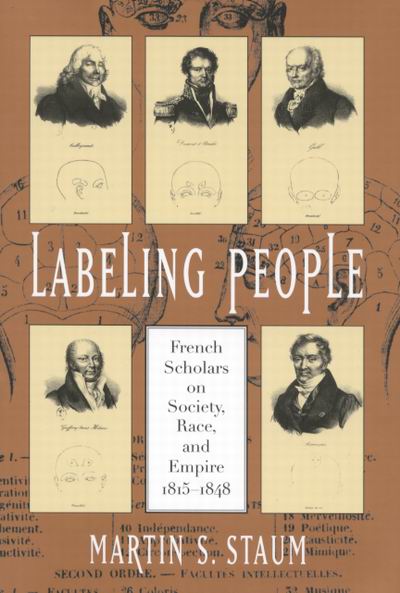
Labeling People: French Scholars on Society, Race, and Empire, 1815-1848

Posted in Books, Europe, History, Media Archive, Monographs, Social Science on 2009-11-18 18:58Z by Steven

Labeling People: French Scholars on Society, Race, and Empire, 1815-1848

McGill-Queen’s University Press
2003-08-20
264 pages
6 x 9
15 drawings
Cloth ISBN: (0773525807) 9780773525801

Martin S. Staum, Professor of History
University of Calgary

An examination of techniques used by scholarly societies to classify people that constructed the image of an inferior “Other” to promote social stability at home and a relationship of domination or paternalism with non-Europeans abroad.

Nineteenth-century French scholars, during a turbulent era of revolution and industrialization, ranked intelligence and character according to facial profile, skin colour, and head shape. They believed that such indicators could determine whether individuals were educable and peoples perfectible. In Labeling People Martin Staum examines the Paris societies of phrenology (reading intelligence and character by head shapes), geography, and ethnology and their techniques for classifying people. He shows how the work of these social scientists gave credence to the arrangement of “races” in a hierarchy, the domination of non-European peoples, and the limitation of opportunities for ill-favored individuals within France.

While previous studies have contrasted the relative optimism of middle-class social scientists before 1848 with a later period of concern for national decline and racial degeneration, Staum demonstrates that the earlier learned societies were also fearful of turmoil at home and interested in adventure abroad. Both geographers and ethnologists created concepts of fundamental “racial” inequality that prefigured the imperialist “associationist” discourse of the Third Republic, believing that European tutelage would guide “civilizable” peoples, and providing an open invitation to dominate and exploit the “uncivilizable.”

Tags: , , ,

Situating “Race” And Racisms In Space, Time, And Theory: Critical Essays for Activists and Scholars

Posted in Anthologies, Anthropology, Books, Media Archive, Social Science on 2009-11-18 03:28Z by Steven

Situating “Race” And Racisms In Space, Time, And Theory: Critical Essays for Activists and Scholars

McGill-Queen’s University Press
2005-04-27
256 pages
6 x 9
Paper: (0773528873) 9780773528871
Cloth: (0773528865) 9780773528864

Edited by

Jo-Anne Lee, Associate Professor of Women’s Studies
University of Victoria

John Sutton Lutz, Associate Professor of History
University of Victoria

A resource for anti-racist scholars and activists.

Grounded in real life and theoretically charged, the nine essays in this interdisciplinary collection explore how race, racisms, and racialization are changing and suggest strategies for reading their emerging forms and discourses. Race has historically been defined by visible difference, but the slippery nature and malleability of racisms and racialising processes challenge scholars and activists to remain vigilant, responsive, and critical in their analyses and actions.

This collection explores the strengths and weaknesses of postmodern social theory in the struggle against racism. Recognizing diversity as a conduit for resilience, endurance, and strength, the editors have tried to encourage coalition building by bringing together historians, sociologists, cultural theorists, and literary scholars in dialogue with artists and activists. Topics considered include nation formation, racialized states, cultural racism, multiculturalism, hyphenated and mixed-race identities, media and representation, and shifting identities.

Contributors include Jeannette Armstrong, director of the En’owkin International School of Writing in Penticton, Canada; Frances Henry, professor emirita at York University; Yasmin Jiwani, assistant professor in the Department of Communication Studies at Concordia University; Paul Maylam, chair of the Department of History at Rhodes University, South Africa; Minelle Mahtani, assistant professor in the Department of Geography and Planning, and the Program in Journalism, University of Toronto; Roy Miki, professor of contemporary literature in the English Department at Simon Fraser University; Roxana Ng, professor in the Department of Adult Education, Community Development and Counselling Psychology at the Ontario Institute of Secondary Education/University of Toronto; Ali Rattansi, retired professor of sociology at City University London; Ann Stoler, distinguished professor and chair, Department of Anthropology, New School University in New York; and Carol Tator, course coordinator in the Department of Anthropology, York University.

Table of Contents

Acknowledgments
Preface

Introduction: Toward a Critical Literacy of Racisms, Anti-Racisms?
and Racialization

Jo-Anne Lee and John Lutz

Deconstructing Race? Deconstructing Racism (with Postscript 2004)
A Conversation Between Jeannette Armstrong and Roxana Ng

On Being and not Being Brown/Black-British: Racism, Class, Sexuality?
and Ethnicity in Post-Imperial Britain (with Postscript 2004: The Politics of Longing and (Un)Belonging, Fear? and Loathing)

Ali Rattansi

Mixed Metaphors: Positioning ?Mixed Race? Identity
Minelle Mahtani

Turning In, Turning Out: The Shifting Formations of ?Japanese Canadian? from Uprooting to Redress
Roy Miki

Racist Visions for the Twenty-First Century: On the Banal Force of the French Radical Right
Ann Laura Stoler

Unravelling South Africa?s Racial Order: The Historiography of Racism, Segregation? and Apartheid
Paul Maylam

A Critical Discourse Analysis of the Globe and Mail Editorials on Employment Equity
Frances Henry and Carol Tator

Orientalizing ?War Talk?: Representations of the Gendered Muslim Body Post-9/11 in The Montreal Gazette
Yasmin Jiwani

Contributors
Index

Tags: , , , , , , , , , , ,

“Real” Indians and Others: Mixed-Blood Urban Native Peoples and Indigenous Nationhood

Posted in Books, Canada, Identity Development/Psychology, Media Archive, Monographs, Native Americans/First Nation, Social Science on 2009-11-18 03:08Z by Steven

“Real” Indians and Others: Mixed-Blood Urban Native Peoples and Indigenous Nationhood

University of Nebraska Press
2004
303 pages
Paperback ISBN: 978-0-8032-8037-3

Bonita Lawrence, Associate Professor
York University, Ontario, Canada

Mixed-blood urban Native peoples in Canada are profoundly affected by federal legislation that divides Aboriginal peoples into different legal categories. In this pathfinding book, Bonita Lawrence reveals the ways in which mixed-blood urban Natives understand their identities and struggle to survive in a world that, more often than not, fails to recognize them.

In “Real” Indians and Others Lawrence draws on the first-person accounts of thirty Toronto residents of Native heritage, as well as archival materials, sociological research, and her own urban Native heritage and experiences. She sheds light on the Canadian government’s efforts to define Native identity through the years by means of the Indian Act and shows how residential schooling, the loss of official Indian status, and adoption have affected Native identity. Lawrence looks at how Natives with “Indian status” react and respond to “nonstatus” Natives and how federally recognized Native peoples attempt to impose an identity on urban Natives.

Drawing on her interviews with urban Natives, she describes the devastating loss of community that has resulted from identity legislation and how urban Native peoples have wrestled with their past and current identities. Lawrence also addresses the future and explores the forms of nation building that can reconcile the differences in experiences and distinct agendas of urban and reserve-based Native communities.

Tags: , ,

Racial Union: Law, Intimacy, and the White State in Alabama, 1865-1954

Posted in Books, Law, Media Archive, Monographs, Politics/Public Policy, Social Science, United States on 2009-11-18 02:42Z by Steven

Racial Union: Law, Intimacy, and the White State in Alabama, 1865-1954

University of Michigan Press
2008
368 pages
6 x 9
Cloth: 978-0-472-09885-9
Paper: 978-0-472-06885-2
Ebook: 978-0-472-02287-8

Julie Novkov, Associate Professor of Political Science and Women’s Studies
State University of New York, Albany

Co-winner of the American Political Science Association’s 2009 Ralph J. Bunche Award for the best scholarly work in political science.

A stunning exploration of America’s attitudes on interracial marriage.

In November 2001, the state of Alabama opened a referendum on its long-standing constitutional prohibition against interracial marriage. A bill on the state ballot offered the opportunity to relegate the state’s anti-miscegenation law to the dustbin of history.  The measure passed, but the margin was alarmingly slim: more than half a million voters, 40 percent of those who went to the polls, voted to retain a racist and constitutionally untenable law.

Julie Novkov’s Racial Union explains how and why, nearly forty years after the height of the civil rights movement, Alabama struggled to repeal its prohibition against interracial marriage—the last state in the Union to do so. Novkov’s compelling history of Alabama’s battle over miscegenation shows how the fight shaped the meanings of race and state over ninety years. Novkov’s work tells us much about the sometimes parallel, sometimes convergent evolution of our concepts of race and state in the nation as a whole.

Tags: , ,

White Enough to Be American? Race Mixing, Indigenous People, and the Boundaries of State and Nation

Posted in Books, History, Identity Development/Psychology, Law, Media Archive, Monographs, Native Americans/First Nation, United States on 2009-11-17 19:45Z by Steven

White Enough to Be American? Race Mixing, Indigenous People, and the Boundaries of State and Nation

University of North Carolina Press
February 2008
256 pages
6.125 x 9.25, 7 illus., notes, bibl., index
Cloth ISBN:  978-0-8078-3143-4
Paper ISBN:  978-0-8078-5837-0

Lauren L. Basson, Assistant Professor of Politics and Government
Ben-Gurion University, Israel

Racial mixture posed a distinct threat to European American perceptions of the nation and state in the late nineteenth century, says Lauren Basson, as it exposed and disrupted the racial categories that organized political and social life in the United States. Offering a provocative conceptual approach to the study of citizenship, nationhood, and race, Basson explores how racial mixture challenged and sometimes changed the boundaries that defined what it meant to be American.

Drawing on government documents, press coverage, and firsthand accounts, Basson presents four fascinating case studies concerning indigenous people of “mixed” descent. She reveals how the ambiguous status of racially mixed people underscored the problematic nature of policies and practices based on clearly defined racial boundaries. Contributing to timely discussions about race, ethnicity, citizenship, and nationhood, Basson demonstrates how the challenges to the American political and legal systems posed by racial mixture helped lead to a new definition of what it meant to be American—one that relied on institutions of private property and white supremacy.

Read a review of the book by Daniel Lipson here.

Tags: , ,