White Teeth: A Novel

Posted in Books, Media Archive, Novels, United Kingdom on 2010-02-14 00:52Z by Steven

White Teeth: A Novel

Vintage an imprint of Random House
2001-06-12
464 pages
ISBN: 978-0-375-70386-7 (0-375-70386-1)

Zadie Smith

On New Year’s morning, 1975, Archie Jones sits in his car on a London road and waits for the exhaust fumes to fill his Cavalier Musketeer station wagon. Archie–working-class, ordinary, a failed marriage under his belt–is calling it quits, the deciding factor being the flip of a 20-pence coin. When the owner of a nearby halal butcher shop (annoyed that Archie’s car is blocking his delivery area) comes out and bangs on the window, he gives Archie another chance at life and sets in motion this richly imagined, uproariously funny novel.

Epic and intimate, hilarious and poignant, White Teeth is the story of two North London families–one headed by Archie, the other by Archie’s best friend, a Muslim Bengali named Samad Iqbal. Pals since they served together in World War II, Archie and Samad are a decidedly unlikely pair. Plodding Archie is typical in every way until he marries Clara, a beautiful, toothless Jamaican woman half his age, and the couple have a daughter named Irie (the Jamaican word for “no problem”). Samad–devoutly Muslim, hopelessly “foreign”–weds the feisty and always suspicious Alsana in a prearranged union. They have twin sons named Millat and Magid, one a pot-smoking punk-cum-militant Muslim and the other an insufferable science nerd. The riotous and tortured histories of the Joneses and the Iqbals are fundamentally intertwined, capturing an empire’s worth of cultural identity, history, and hope.

Zadie Smith’s dazzling first novel plays out its bounding, vibrant course in a Jamaican hair salon in North London, an Indian restaurant in Leicester Square, an Irish poolroom turned immigrant café, a liberal public school, a sleek science institute. A winning debut in every respect, White Teeth marks the arrival of a wondrously talented writer who takes on the big themes–faith, race, gender, history, and culture–and triumphs.

Tags: , ,

Unnatural Selections: Eugenics in American Modernism and the Harlem Renaissance

Posted in Books, History, Literary/Artistic Criticism, Media Archive, Monographs, Social Science, United States on 2010-02-14 00:26Z by Steven

Unnatural Selections: Eugenics in American Modernism and the Harlem Renaissance

University of North Carolina Press
April 2004
288 pages
6.125 x 9.25, 19 illus., 2 charts, notes, bibl., index
Cloth ISBN: 978-0-8078-2868-7
Paper ISBN: 978-0-8078-5531-7

Daylanne K. English, Associate Professor of English & Chair
Macalester College

Challenging conventional constructions of the Harlem Renaissance and American modernism, Daylanne English links writers from both movements to debates about eugenics in the Progressive Era. She argues that, in the 1920s, the form and content of writings by figures as disparate as W. E. B. Du Bois, T. S. Eliot, Gertrude Stein, and Nella Larsen were shaped by anxieties regarding immigration, migration, and intraracial breeding.

English’s interdisciplinary approach brings together the work of those canonical writers with relatively neglected literary, social scientific, and visual texts. She examines antilynching plays by Angelina Weld Grimké as well as the provocative writings of white female eugenics field workers. English also analyzes the Crisis magazine as a family album filtering uplift through eugenics by means of photographic documentation of an ever-improving black race.

English suggests that current scholarship often misreads early-twentieth-century visual, literary, and political culture by applying contemporary social and moral standards to the past. Du Bois, she argues, was actually more of a eugenicist than Eliot. Through such reconfiguration of the modern period, English creates an allegory for the American present: because eugenics was, in its time, widely accepted as a reasonable, progressive ideology, we need to consider the long-term implications of contemporary genetic engineering, fertility enhancement and control, and legislation promoting or discouraging family growth.

Tags: , , , , , , ,

Righteous Propagation: African Americans and the Politics of Racial Destiny after Reconstruction

Posted in Books, History, Media Archive, Monographs, Social Science, United States on 2010-02-13 00:09Z by Steven

Righteous Propagation: African Americans and the Politics of Racial Destiny after Reconstruction

University of North Carolina Press
December 2004
416 pages
6.125 x 9.25, 22 illus., notes, bibl., index
Cloth ISBN: 978-0-8078-2902-8
Paper ISBN  978-0-8078-5567-6

Michele Mitchell, Associate Professor of History
New York University

Between 1877 and 1930–years rife with tensions over citizenship, suffrage, immigration, and “the Negro problem”–African American activists promoted an array of strategies for progress and power built around “racial destiny,” the idea that black Americans formed a collective whose future existence would be determined by the actions of its members. In Righteous Propagation, Michele Mitchell examines the reproductive implications of racial destiny, demonstrating how it forcefully linked particular visions of gender, conduct, and sexuality to collective well-being.

Mitchell argues that while African Americans did not agree on specific ways to bolster their collective prospects, ideas about racial destiny and progress generally shifted from outward-looking remedies such as emigration to inward-focused debates about intraracial relationships, thereby politicizing the most private aspects of black life and spurring race activists to calcify gender roles, monitor intraracial sexual practices, and promote moral purity. Examining the ideas of well-known elite reformers such as Mary Church Terrell and W. E. B. DuBois, as well as unknown members of the working and aspiring classes, such as James Dubose and Josie Briggs Hall, Mitchell reinterprets black protest and politics and recasts the way we think about black sexuality and progress after Reconstruction.

Read the prologue here.

Table of Contents

  • Acknowledgments
  • Notes on Usage and Terminology
  • Prologue. To Better Our Condition One Way or Another: African Americans and the Concept of Racial Destiny
  • 1. A Great, Grand & All Important Question: African American Emigration to Liberia
  • 2. A Black Man’s Burden: Imperialism and Racial Manhood
  • 3. The Strongest, Most Intimate Hope of the Race: Sexuality, Reproduction, and Afro-American Vitality
  • 4. The Righteous Propagation of the Nation: Conduct, Conflict and Sexuality
  • 5. Making the Home Life Measure Up: Environment, Class and The Healthy Race Household
  • 6. The Colored Doll Is a Live One: Material Culture, Black Consciousness, and Cultivation of Interracial Desire
  • 7. A Burden of Responsibility: Gender, “Miscegenation,” and Race Type
  • 8. What a Pure, Healthy, Unified Race Can Accomplish: Collection Reproduction and the Sexual Politics of Black Nationalism
  • Epilogue. The Crossroads of Destiny
  • Notes
  • Bibliography
  • Index
Tags: , , , , ,

A Reappraisal of the Constitutionality of Miscegenation Statutes

Posted in Articles, Law, Media Archive, United States on 2010-02-12 23:19Z by Steven

A Reappraisal of the Constitutionality of Miscegenation Statutes

Cornell Law Quarterly
Volume 42, Issue 2 (Winter 1957)
pages 208-222

Andrew D. Weinberger, LL.B., D. HUM, Member of the New York Bar, New York City & Visiting Professor of Law
Nationzal University of Mexico

Today [in 1957], 21 States of the Union by statute forbid marriages on racial grounds. These statutes are neither uniform in the racial groups against whom the ban is applicable, nor in defining membership in the various ethnic groups. Thus, while in Utah white-Mongolian marriages are illegal and void, in North Carolina they are permitted. In Arkansas, where white-Negro marriages are void, a Negro is defined as “any person who has in his or her veins any Negro blood whatever.” In Florida, one ceases to be a Negro when he has less than “one-eighth of . . . African or Negro blood”; and in Oklahoma, anyone not of “African descent” is miraculously transmuted into a member of the white race.

The racial groups affected by such statutes include Mongolians, Malays, Hindus, Chinese, Japanese, Ethiopians, American Indians, Cherokees, Mestizos, Halfbreeds, and “the brown race.” The sole racial group (other than white persons) affected by all twenty-one statutes is the Negro…

Read the entire article here.

Tags: , ,

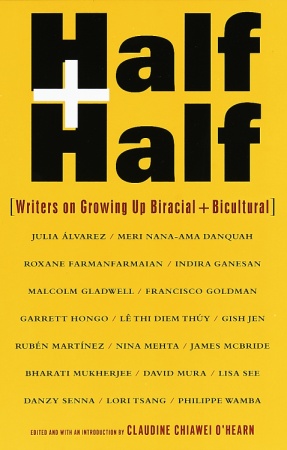
Half + Half: Writers on Growing Up Biracial and Bicultural

Posted in Anthologies, Autobiography, Books, Identity Development/Psychology, Media Archive on 2010-02-12 05:23Z by Steven

Half + Half: Writers on Growing Up Biracial and Bicultural

Pantheon an imprint of Random House
1998-06-09
288 pages
ISBN: 978-0-375-70011-8 (0-375-70011-0)

Edited by Claudine C. O’Hearn

As we approach the twenty-first century, biracialism and biculturalism are becoming increasingly common.  Skin color and place of birth are no longer reliable signifiers of one’s identity or origin.  Simple questions like What are you? and Where are you from? aren’t answered—they are discussed.  These eighteen essays, joined by a shared sense of duality, address the difficulties of not fitting into and the benefits of being part of two worlds.  Through the lens of personal experience, they offer a broader spectrum of meaning for race and culture.  And in the process, they map a new ethnic terrain that transcends racial and cultural division.

Table of Contents

  • Introduction by Claudine Chiawei O’Hearn
  • LOST IN PLACE by Garrett Hongo
  • THE MULATTO MILLENNIUM by Danzy Senna
  • THE DOUBLE HELIX by Roxane Farmanfarmaian
  • CALIFORNIA PALMS by le thi diem thuy
  • MORO LIKE ME by Francisco Goldman
  • THE ROAD FROM BALLYGUNGE by Bharati Mukherjee
  • REFLECTIONS ON MY DAUGHTER by David Mura
  • LIFE AS AN ALIEN by Meri Nana-Ama Danquah
  • LOST IN THE MIDDLE by Malcolm Gladwell
  • THE FUNERAL BANQUET by Lisa See
  • A WHITE WOMAN OF COLOR by Julia Alvarez
  • A MIDDLE PASSAGE by Philippe Wamba
  • FOOD AND THE IMMIGRANT by Indira Ganesan
  • WHAT COLOR IS JESUS? by James McBride
  • POSTCARDS FROM “HOME” by Lori Tsang
  • FROM HERE TO POLAND by Nina Mehta
  • TECHNICOLOR by Ruben Martinez
  • AN ETHNIC  TRUMP by Gish Jen
  • About the Authors
Tags: , , , , , , , , , , , , , , , , , , , ,

Multiracial Matrix: The Role of Race Ideology in the Enforcement of Anti-Discrimination Laws, a United States – Latin America Comparison

Posted in Articles, Caribbean/Latin America, Law, Media Archive, United States on 2010-02-11 02:53Z by Steven

Multiracial Matrix: The Role of Race Ideology in the Enforcement of Anti-Discrimination Laws, a United States – Latin America Comparison

Cornell Law Review
Volume 87, Number 5 (July 2002)
Cornell University Law School

Tanya Katerí Hernández, Professor of Law
Fordham University

This Article examines the role of race ideology in the enforcement of antidiscrimination laws.  Professor Hernández demonstrates the ways in which the U.S. race ideology is slowly starting to resemble the race ideology of much of Latin America.  The evolving U.S. race ideology is a multiracial matrix made up of four precepts: (1) racial mixture and diverse racial demography will resolve racial problems; (2) fluid racial classification schemes are an indicator of racial progress and the colorblind abolition of racial classifications an indicator of absolute racial harmony; (3) racism is solely a phenomenon of aberrant racist individuals; and (4) focusing on race is itself racist.  Because the multiracial matrix parallels much Latin American race discourse, Professor Hernández conducts a comparative analysis between U.S. and Latin American anti-discrimination law enforcement practices.  Professor Hernández concludes that the new race ideology bolsters the maintenance of race hierarchy in a racially diverse population.  Consequently, an uncritical embrace of the new race ideology will hinder the enforcement of antidiscrimination law in the United States.  Professor Hernández proposes that a greater focus on racism as a global issue that treats race as a political identity formation will assist in the recognition of the civil rights dangers of a multiracial matrix.

Read the entire article here.

Tags: , , ,

African Americans and National Identities in Central America

Posted in Anthropology, Caribbean/Latin America, History, Media Archive, Papers/Presentations, Social Science on 2010-02-10 21:41Z by Steven

African Americans and National Identities in Central America

Rina Cáceres, Professor of Diaspora Studies Program at the Centro de Investigationes Historicas de America Central
Universidad de Costa Rica

Lowell Gudmundson, Professor of Latin American Studies and History
Mount Holyoke University

Mauricio Meléndez

An interdisciplinary, multinational research program to reconceptualize and document, both visually and textually, the history of people of African descent in Central America.

Supported by the National Endowment for the Humanities Collaborative Research Program, Mount Holyoke College and The Center for Central American Historical Research at the Universidad de Costa Rica.

Our collaborative research project seeks to reassess the historical presence and contributions of peoples of African descent to the national histories and identities constructed in Central America over the past two centuries. In choosing a color for the cosmic race, modern nationalist thinkers in the region systematically emphasized the European and Indigenous origins of its peoples, in terms of both historical fact and group agency. Thus they radically discounted not only the importance, role, and presence of any African heritage but also as the centrality of racial or ethnic conflict within the historical experience of non-indigenous sectors of society…

Visit the project website here.

Tags: , , ,

Racial Boundary Formation at the Dawn of Jim Crow: The Determinants and Effects of Black/Mulatto Occupational Differences in the United States, 1880 (Working Paper)

Posted in History, Media Archive, Papers/Presentations, Social Science, United States on 2010-02-10 02:34Z by Steven

Racial Boundary Formation at the Dawn of Jim Crow: The Determinants and Effects of Black/Mulatto Occupational Differences in the United States, 1880 (Working Paper)

33 pages
Updated 2008-07-03

Aaron Gullickson, Assistant Professor of Sociology
University of Oregon

Much of the literature within sociology regarding mixed-race populations focuses on contemporary issues and dynamics, often overlooking a larger historical literature.  This article provides a historical perspective on these issues by exploiting regional variation in the United States in the degree of occupational differentiation between blacks and mulattoes in the 1880 Census, during a transitionary period from slavery to freedom.  The analysis reveals that the role of the mixed-race category as either a “buffer class” or a status threat depended upon the class composition of the white population.  Black/mulatto occupational differentiation was greatest in areas where whites had a high level of occupational prestige and thus little to fear from an elevated mulatto group. Furthermore, the effect of black/mulatto occupational differentiation on lynching varied by the occupational status of whites. In areas where whites were of relatively low status, black/mulatto differentiation increased the risk of lynching, while in areas where whites were of relatively high status, black/mulatto differentiation decreased the risk of lynching.

Read the entire paper here.

Tags:

Race and the Cherokee Nation: Sovereignty in the Nineteenth Century

Posted in Books, History, Media Archive, Monographs, Native Americans/First Nation, Social Science, United States on 2010-02-09 17:54Z by Steven

Race and the Cherokee Nation: Sovereignty in the Nineteenth Century

University of Pennsylvania Press
2007
200 pages
6 x 9, 7 illus.
Cloth ISBN 978-0-8122-4056-6

Fay A. Yarbrough, Associate Professor of History
University of Oklahoma

“We believe by blood only,” said a Cherokee resident of Oklahoma, speaking to reporters in 2007 after voting in favor of the Cherokee Nation constitutional amendment limiting its membership. In an election that made headlines around the world, a majority of Cherokee voters chose to eject from their tribe the descendants of the African American freedmen Cherokee Indians had once enslaved. Because of the unique sovereign status of Indian nations in the United States, legal membership in an Indian nation can have real economic benefits. In addition to money, the issues brought forth in this election have racial and cultural roots going back before the Civil War.

Race and the Cherokee Nation examines how leaders of the Cherokee Nation fostered a racial ideology through the regulation of interracial marriage. By defining and policing interracial sex, nineteenth-century Cherokee lawmakers preserved political sovereignty, delineated Cherokee identity, and established a social hierarchy. Moreover, Cherokee conceptions of race and what constituted interracial sex differed from those of blacks and whites. Moving beyond the usual black/white dichotomy, historian Fay A. Yarbrough places American Indian voices firmly at the center of the story, as well as contrasting African American conceptions and perspectives on interracial sex with those of Cherokee Indians.

For American Indians, nineteenth-century relationships produced offspring that pushed racial and citizenship boundaries. Those boundaries continue to have an impact on the way individuals identify themselves and what legal rights they can claim today.

Tags: , , ,

Legislating Women’s Sexuality: Cherokee Marriage Laws in the Nineteenth Century

Posted in Articles, History, Identity Development/Psychology, Law, Media Archive, Native Americans/First Nation, Social Science, United States, Women on 2010-02-09 17:42Z by Steven

Legislating Women’s Sexuality: Cherokee Marriage Laws in the Nineteenth Century

Journal of Social History
Volume 38, Number 2, Winter 2004
E-ISSN: 1527-1897 Print ISSN: 0022-4529
DOI: 10.1353/jsh.2004.0144

Fay A. Yarbrough, Associate Professor of History
University of Oklahoma

During the first half of the nineteenth century, the Cherokee Nation passed many laws to regulate marriage and sex. This essay first contemplates the gendered aspects of such laws by exploring the importance of Cherokee women’s marital choices and official response to those choices. In particular, Cherokee women’s choice of non-Cherokee marital partners, most frequently whites, and the concomitant introduction of outsiders into the Nation forced the Cherokee legislative branch to reformulate Cherokee women’s relationship to the production of new citizens in the Nation. Then the essay turns more explicitly to the laws’ racial implications and examines who could marry in the Cherokee Nation and why by first examining Cherokee laws regulating marriage with people of African descent. Cherokees increasingly excluded people of African descent from membership in the Nation through legislation prohibiting legal marriage between Cherokees and people of African descent. Lastly, this essay considers Cherokee legislative provisions to include whites as marriage partners and citizens in the Cherokee Nation. Ultimately, this essay finds that Cherokee officials were redefining Cherokee Indians racially and used marriage laws to write and reinforce this new definition.

Read or purchase the article here.

Tags: , , ,