Homelands and Waterways: The American Journey of the Bond Family, 1846-1926

Posted in Biography, Books, History, Media Archive, Monographs, Slavery, Social Science, United States on 2010-02-22 04:41Z by Steven

Homelands and Waterways: The American Journey of the Bond Family, 1846-1926

Vintage Press an imprint of Random House
1999
720 pages
Paperback ISBN: 978-0-679-75871-6 (0-679-75871-2)

Adele Logan Alexander, Professor of History
George Washington University
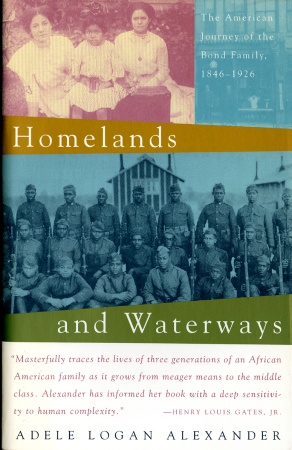
Winner for the top non-fiction prize of the Black Caucus of the American Library Association

This monumental history traces the rise of a resolute African American family (the author’s own) from privation to the middle class. In doing so, it explodes the stereotypes that have shaped and distorted our thinking about African Americans–both in slavery and in freedom.

Beginning with John Robert Bond, who emigrated from England to fight in the Union Army during the Civil War and married a recently freed slave, Alexander shows three generations of Bonds as they take chances and break new ground.

From Victorian England to antebellum Virginia, from Herman Melville‘s New England to the Jim Crow South, from urban race riots to the battlefields of World War I, this fascinating chronicle sheds new light on eighty crucial years in our nation’s troubled history. The Bond family’s rise from slavery, their interaction with prominent figures such as W. E. B. DuBois and Booker T. Washington, and their eventual, uneasy realization of the American dream shed a great deal of light on our nation’s troubled heritage.

See Adele Logan Alexander of speak about tracing her racial identity through her family roots in her book “Homelands and Waterways” in an interview on the Charlie Rose Show from 1999-10-26 here.

Tags: ,

Socially Embedded Identities: Theories, Typologies, and Processes of Racial Identity among Black/White Biracials

Posted in Articles, Identity Development/Psychology, Media Archive, Social Science, United States on 2010-02-22 02:20Z by Steven

Socially Embedded Identities: Theories, Typologies, and Processes of Racial Identity among Black/White Biracials

Sociological Quarterly
Volume 43 Issue 3, (2002)
Pages 335 – 356
DOI: 10.1111/j.1533-8525.2002.tb00052.x

David L. Brunsma, Professor of Sociology
Virginia Polytechnic Institute and State University

Kerry Ann Rockquemore, Associate Professor of Sociology
University of Illinois at Chicago

Current research on racial identity construction among biracial people derives primarily from small convenience samples and assumes that individuals with one black and one white parent have only two options for racial identity: “black” or “biracial.” Rockquemore’s (1999) taxonomy of racial identity options is used as a framework to synthesize existing research and to generate hypotheses that are explored using survey data from a sample of 177 biracial respondents. The findings support a multidimensional view of racial identity by illustrating that biracial people make various identity choices, albeit “choices” that are differentially available due to an individual’s structural iocation.

Read the entire article here.

Tags: , ,

Public Categories, Private Identities: Exploring Regional Differences in the Biracial Experience

Posted in Articles, Census/Demographics, Identity Development/Psychology, Media Archive, Social Science, United States on 2010-02-22 01:52Z by Steven

Public Categories, Private Identities: Exploring Regional Differences in the Biracial Experience

Social Science Research
Volume 35, Issue 3, September 2006
Pages 555-576

David L. Brunsma, Professor of Sociology
Virginia Polytechnic Institute and State University

Empirical research on multiraciality and the development of richer models of racial identity have increased in the last decade. Increased attention to such phenomena has lead to the “check all that apply” modification to the 2000 Census—an official recognition of an historical reality not before reflected on the United States’ Census. However, “identity” and “identification” are different phenomena. Using Place-level data from Census 2000 as well as data from the Survey of Biracial Experience (Rockquemore and Brunsma, 2001), this paper will reveal the geographic distribution of black–white biracial individuals via the Census and compare it to the geographic distribution of biracials’ racial self-understandings from survey methods. The findings illuminate the multifaceted relationship between public categorization and private racial identification. Finally, the implications for utilizing the new Census data for studying black–white and other mixed populations are considered.

Article Outline
1. Introduction
2. Research on mixed-race identity: the case of black–white biracials
3. Methodologies
3.1. Census 2000 data
3.2. The survey of biracial experience
3.3. Measurement of key variables
3.3.1. Biracial identity
3.3.2. Census 2000 identification (South and East samples only)
4. The distribution of mixed-race individuals: the census results
5. Geographic differences in the survey of biracial experience
6. Racial identification versus racial identity
7. A brief thought experiment
8. Discussion and conclusion
Acknowledgements
References

Read the entire article here.

Tags: ,

What Does “Black” Mean? Exploring the Epistemological Stranglehold of Racial Categorization

Posted in Articles, Census/Demographics, Identity Development/Psychology, Media Archive, Social Science, United States on 2010-02-22 00:17Z by Steven

What Does “Black” Mean? Exploring the Epistemological Stranglehold of Racial Categorization

Critical Sociology
Vol. 28, No. 1-2 (2002)
pages 101-121
DOI: 10.1177/08969205020280010801

David L. Brunsma, Professor of Sociology
Virginia Polytechnic Institute and State University

Kerry Ann Rockquemore, Associate Professor of Sociology
University of Illinois at Chicago

The “check all that apply” approach to race on the 2000 census has ignited a conceptual debate over the meaning and usefulness of racial categories. This debate is most intense over the category “black” because of the historically unique way that blackness has been defined. Though the lived reality of many people of color has changed over the past three decades, we question whether the construct black has mirrored these changes and if “black” remains a valid analytic or discursive unit today. While black racial group membership has historically been defined using the one-drop rule, we test the contemporary salience of this classification norm by examining racial identity construction among multiracial people. We find that that the one-drop rule has lost the power to determine racial identity, while the meaning of black is becoming increasingly multidimensional, varied, and contextually specific. Ultimately, we argue that social, cultural and economic changes in post-Civil Rights America necessitate a re-evaluation of the validity of black as social construct and re-assessment of its’ continued use in social science research.

Read the entire article here.

Tags: , , , ,

Obama gives hope to multiracial families

Posted in Articles, Media Archive, Social Science, United States on 2010-02-21 21:50Z by Steven

Obama gives hope to multiracial families

The Connecticut Record-Journal
2009-01-24

George Moore

Three-year-old George Garner used to introduce himself as ‘George Barack Obama’ when his mother took him to political events. For George, an energetic boy of a mixed racial background, Barack Obama’s presidency will serve as proof that he, too, can be president, said his mother, Jean Garner.

“I can tell this guy, ‘If you want to be president, go for it,'” she said in her Cheshire living room Thursday, as George bounced around with his Batman figurine.

Three years ago, Jean and Tim Garner, both white, adopted George, who is part Canadian, Native American and African-American. Garner said she hopes that Obama, the son of a white mother and a Kenyan father, will inspire more people to consider people for who they are, rather than what they look like.

Obama not only shows that a black man can become president, but that someone of a multiracial background can lead the country.

While Obama calls himself black, observers interviewed Friday said he has been so open about his parents and his upbringing that the entire nation is aware of his multiracial heritage. Sociologist Jenifer Bratter said Obama shatters stereotypes that people of mixed race have strained life experiences…

Read the entire article here.

Tags: , ,

Parallel Worlds: The Remarkable Gibbs-Hunts and the Enduring (In)significance of Melanin

Posted in Biography, Books, History, Media Archive, Monographs, United States on 2010-02-21 15:21Z by Steven

Parallel Worlds: The Remarkable Gibbs-Hunts and the Enduring (In)significance of Melanin

University of Virginia Press
February 2010
384 pages
6 1/8 x 9 1/4
40 b&w illustrations
Cloth ISBN: 978-0-8139-2887

Adele Logan Alexander, Professor of History
George Washington University

When William Henry Hunt married Ida Alexander Gibbs in the spring of 1904, their wedding was a glittering Washington social event that joined an Oberlin-educated diplomat’s daughter and a Wall Street veteran who could trace his lineage to Jamestown. Their union took place in a world of refinement and privilege, but both William and Ida had mixed-race backgrounds, and their country therefore placed severe restrictions on their lives because at that time, “one drop of colored blood” classified anyone as a Negro. This “stain” of melanin pushed the couple’s achievements to the margins of American society. Nonetheless, as William followed a career in the foreign service, Ida (whose grandfather was probably Richard Malcolm Johnson, a vice president of the United States) moved in intellectual and political circles that included the likes of Frederick Douglass, J. Pierpont Morgan, Booker T. Washington, Paul Laurence Dunbar, and Mary Church Terrell.

Born into slavery, William had an adventurous youth, including a brief career as a jockey and an interlude at Williams College; ultimately he succeeded Ida’s father as consul. The diplomat’s “expatriate” life provided him with a distinguished career and a stage on which to showcase his talents throughout the world, as well as an escape from racial stigmas back home. Free of the diplomatic hindrances her husband faced, Ida advocated openly against race and gender inequities, and was a major participant in W. E. B. Du Bois‘s post-World-War I Pan-African Congresses which took her to stimulating European capitals that were largely free of racial oppression.

In this, William and Ida’s unique dual biography, Adele Logan Alexander gracefully traces an extraordinary partnership with a historian’s skills and insights. She also presents a nuanced account of the complex impact of race in the early twentieth-century world.

Listen to National Public Radio‘s Michel Martin interview Adele Logan Alexander about the book on Tell Me More (on  2010-02-10) here.

Tags: , , , , ,

American Mestizo: Filipinos and Antimiscegenation Laws in California

Posted in Articles, Asian Diaspora, Law, Media Archive, United States on 2010-02-21 04:56Z by Steven

American Mestizo: Filipinos and Antimiscegenation Laws in California

University of California, Davis Law Review
Volume 33, Number 44 (2000)
pages 795-835

Leti Volpp, Professor of Law
University of California, Berkeley

This essay interprets the legal history of efforts to prohibit intermarriage between Filipino men and white women in the state of California in the 1920s and 30s. I do this through examining both public discourse and legal discourse, in the form of advisory opinions of the California State Attorney General and the Los Angeles County Counsel, litigation in Los Angles Superior Court and the California Court of Appeals, and state legislation.

Much scholarship examines antimiscegenation laws through the lens of presumptive heterosexuality, and gives enormous explanatory power to race in a way that ignores the role of class and gender. This paper argues that we need to examine the mutually constitutive nature of these forces in shaping antimiscegenation laws. Thus, I examine how the racial identity of Filipinos was shaped by assumptions about racialized sexuality, colonial relations between the United States and the Philippines, the importation of exploitable laborers without political rights, and the intertwining of gender and nationalism.

The question of whether Filipinos should be prohibited from marrying white women reached the California Court of Appeals in 1933 in the guise of the query as to whether Filipinos should be considered “Mongolian.” The state in 1880 and 1905 had prohibited the licensing of marriages between “Mongolians” and “white persons” and invalidated all such marriages. Subsequent legal challenges involving the right of Filipinos to marry whites betray enormous confusion as to whether Filipinos should be classified as “Mongolian,” or as a separate ethnological group, as “Malay.” This racial classification was put at issue in cases where Filipino/white couples sought to marry, and who therefore asserted that Filipinos were not “Mongolians”; in a case where a mother sought to stop her daughter’s marriage; in two cases where annulment of marriage was sought, one by a white woman, the other by a Filipino man; and in one case in which a prosecutor sought to void a marriage so a white wife could testify against her Filipino husband.

The positioning of Filipinos as “Mongolian,” or in opposition to “Mongolians” as the ethnologically different “Malay,” provides a narrative within which the contemporary identity of Filipinos is created. This history demonstrates that there is nothing natural or preordained about racial classification, and provides an example of how race is made.

Read the entire article here.

Tags: , , ,

The Chinese in the Caribbean

Posted in Anthologies, Asian Diaspora, Books, Caribbean/Latin America, History, Media Archive, Social Science on 2010-02-21 04:46Z by Steven

The Chinese in the Caribbean

Markus Wiener Publishers
November 2004
240 pages
Hardcover ISBN 10: 1-55876-314-7; ISBN 13: 978-1-55876-314-2
Paperback ISBN 10: 1-55876-315-5; ISBN 13: 978-1-55876-315-9

Edited by

Andrew R. Wilson, Professor
Strategy and Policy Department
United States Naval War College

The history of the Caribbean is a history of migrations. The peoples of the region came as conquerors and planters, slaves and indentured laborers from all parts of the globe. Each group contributed to the social fabric, culture, and commerce of the region. The Chinese diaspora has spread Chinese people and culture around the world, including to the Caribbean, where Chinese exist both as distinct ethnic groups within Caribbean societies and as shapers of unique Caribbean cultures.

The book describes not merely the arrival and experience of Chinese in the Caribbean but also the ways in which Chinese have adapted to and altered the region. Included are the histories of Chinese people in Cuba, Jamaica, Panama, and the British West Indies, and overcame, their slow rise to economic independence and success, their contribution to art, theater, cuisine, and literature, their roles in the region’s national revolutions, their place in post-colonial politics, and the subsequent remigrations of individuals, families, and entire communitites to North America.

Tags: , ,

Mestizaje and the Mexican Mestizo Self: No hay Sangre Negra, so there is no Blackness

Posted in Anthropology, Articles, Arts, Caribbean/Latin America, Law, Media Archive, Mexico, Social Science on 2010-02-21 02:19Z by Steven

Mestizaje and the Mexican Mestizo Self: No hay Sangre Negra, so there is no Blackness

Southern California Interdisciplinary Law Journal
Volume 15, Number 2 (Spring 2006)
Pages 199-234

Taunya Lovell Banks, Jacob A. France Professor of Equality Jurisprudence and Francis & Harriet Iglehart Research Professor of Law
University of Maryland School of Law

Many legal scholars who write about Mexican mestizaje omit references to Afromexicans, Mexico’s African roots, and contemporary anti-black sentiments in the Mexican and Mexican American communities. The reasons for the erasure or invisibility of Mexico’s African roots are complex. It argues that post-colonial officials and theorists in shaping Mexico’s national image were influenced two factors: the Spanish colonial legacy and the complex set of rules creating a race-like caste system with a distinct anti-black bias reinforced through art; and the negative images of Mexico and Mexicans articulated in the United States during the early nineteenth century. The post-colonial Mexican becomes mestiza/o, defined as European and Indian, with an emphasis on the European roots. Thus contemporary anti-black bias in Mexico is a vestige of Spanish colonialism and nationalism that must be acknowledged, but is often lost in the uncritical celebration of Latina/o mestizaje when advanced as a unifying principle that moves beyond the conventional binary (black-white) discussions of race. This uncritical and ahistorical invocation of mestizaje has serious implications for race relations in the United States given the growing presence and political power of Mexican Americans because substituting mestizaje for racial binarism when discussing race in the United States reinforces rather than diminishes notions of white racial superiority and dominance. Therefore legal scholars who write about Latina/o issues should replace their uncritical celebration of mestizaje with a focus on colonialism and capitalism, the twin isms that influenced ideological theories and racial formation from the late fifteenth through the twentieth century in the Americas.

Read the entire article here.

Tags: , , , ,

The African Presence in Mexico

Posted in Anthropology, Caribbean/Latin America, History, Identity Development/Psychology, Live Events, Media Archive, Mexico, Slavery, Social Science on 2010-02-21 01:56Z by Steven

The African Presence in Mexico

A Symposium Presented by
Callaloo – A Journal of African Diapora Arts and Letters and
The Center for Africana Studies, Johns Hopkins University
2008-10-22 through 2008-10-23
Texas A&M University, College Station, Texas

Sessions

For more details, click here.

Tags: , , , , , , , , , , , , , , , , , , , , , , , , , , ,