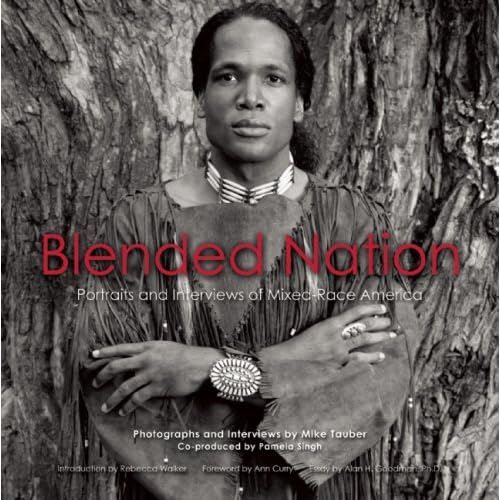
Blended Nation: Portraits and Interviews of Mixed-Race America

Posted in Arts, Books, Census/Demographics, Family/Parenting, Media Archive, Monographs, Social Science, United States on 2010-03-05 23:23Z by Steven

Blended Nation: Portraits and Interviews of Mixed-Race America

Channel Photographics
2009-08-11
140 pages
11 x 11 inches
Hardcover ISBN: 978-0-9773399-2-1

Mike Tauber

Pamela Singh

What are you? On the 2000 U.S. Census, for the first time, multiracial individuals were allowed to indicate more than one race. Nearly seven million Americans did so. Blended Nation: Portraits and Interviews of Mixed Race America features individuals from this rapidly growing demographic of mixed race Americans across the country who identify as more than one race.

Through words and images, Mike Tauber and Pamela Singh explore the concept of race in America through the prism of the very personal experiences of people of mixed race heritage. Ann Curry writes in her Foreword, “As dad would say, ‘You are the best of both worlds,’ and so are the people you see on these pages, who cannot but strengthen America’s dream, as they are living proof it comes true.”

Tags: , , ,

Lizzie Bright and the Buckminster Boy

Posted in Books, History, Media Archive, Novels, United States on 2010-03-05 18:12Z by Steven

Lizzie Bright and the Buckminster Boy

Clarion Books an Imprint of Houghton Mifflin Harcourt
2004-05-24
224 pages
Trim Size: 5.50 x 8.25
Hardcover ISBN-13/EAN: 9780618439294 ; $15.00
Hardcover ISBN-10: 0618439293

Gary D. Schmidt, Professor of English
Calvin College, Grand Rapids, Michigan

Winner of the Newbery Honor and Printz Honor.

It only takes a few hours for Turner Buckminster to start hating Phippsburg, Maine. No one in town will let him forget that he’s a minister’s son, even if he doesn’t act like one. But then he meets Lizzie Bright Griffin, a smart and sassy girl from a poor nearby island community founded by former slaves. Despite his father’s-and the town’s-disapproval of their friendship, Turner spends time with Lizzie, and it opens up a whole new world to him, filled with the mystery and wonder of Maine’s rocky coast. The two soon discover that the town elders, along with Turner’s father, want to force the people to leave Lizzie’s island so that Phippsburg can start a lucrative tourist trade there. Turner gets caught up in a spiral of disasters that alter his life-but also lead him to new levels of acceptance and maturity. This sensitively written historical novel, based on the true story of a community’s destruction, highlights a unique friendship during a time of change. Author’s note.

Read a book review by the 7th grade students at Bath Middle School in Bath, Maine here.

Tags: , , , , ,

Malaga Island: A Story Best Left Untold

Posted in Anthropology, Articles, History, Media Archive, Politics/Public Policy, Social Science, United States, Videos on 2010-03-05 16:51Z by Steven

Malaga Island: A Story Best Left Untold

WMPG-FM (Portland, Maine) and The Salt Institute
2009

Rob Rosenthal, Radio Producer

Kate Philbrick, Photographer

WMPG-FM, in collaboration with the Salt Institute for Documentary Studies, announces the premier of “Malaga Island: A Story Best Left Untold”, a radio and photo documentary recounting this infamous event and its impact on several generations of descendants. The documentary is produced by Kate Philbrick, photographer, and Rob Rosenthal, radio producer.

On July 1st, 1912, George Pease took a short boat ride over to Malaga Island, just off the coast of Phippsburg, Maine. Pease landed the boat then probably stood on the shell-covered beach at the north end of the island. What he found may have surprised him.

Pease went to Malaga that day as an agent of the state of Maine. It was his job to carry out the final steps of a state-sponsored eviction. Pease was there to clean out the island – to make sure everyone who lived there was gone and to burn down their houses. But there was no one there. Malaga was empty.

Malaga is a small island, about 40 acres. It’s covered with tall pine and spruce trees, the shores are rocky – it’s really a “textbook” Maine island. No one lives on Malaga today but, in 1912, there was a village of about 45 people. A few of the families had lived on the island for decades raising children and scraping a living from the ocean. Malaga was home.

The settlement was poor and families struggled – like most fishing communities on the Maine coast one hundred years ago. What made Malaga different was the people. Black, white, and mixed-race families lived on the island. And that set them apart. Far apart…

…And, descendants of the evicted islanders have largely remained silent, too. The local stigma of mixed-blood and “feeblemindedness” attached to the island and descendents is still present – even today. In fact, some say Malaga is a story best left untold…

Read the entire article here.
View a short video here.

Tags: , , , , ,

A Question of Blood, Race, and Politics

Posted in Anthropology, Articles, Health/Medicine/Genetics, Media Archive, Politics/Public Policy, United States on 2010-03-05 01:50Z by Steven

A Question of Blood, Race, and Politics

Journal of the History of Medicine and Allied Sciences
Volume 61, Number 4 (2006)
pages 456-491
DOI: 10.1093/jhmas/jrl003

Michael G. Kenny, Professor of Sociology and Anthropology
Simon Fraser University, Burnaby, British Columbia

This article explores the political and intellectual context of a controversy arising from a proposal made at the 1959 meetings of the American Society of Blood Banks to divide the blood supply by race. The authors, a group of blood-bankers and surgeons in New York, outlined difficulties in finding compatible blood for transfusion during open-heart surgery, which they attributed to prior sensitization of their patient, a Caucasian, by a previous transfusion from an African American donor. Examining the statistical distribution of blood-group antigens among the various races, they concluded that risk of adverse hemolytic reactions and the cost of testing could be reduced by establishing separate donor pools. The media reported the suggestion, which, given the political climate of the day, rapidly became a public issue involving geneticists, blood-bankers, physical anthropologists, and the African American medical community. Liberals condemned it, whereas eugenically inclined segregationists used the finding to support their views concerning evolutionary distance between the races and the dangers of miscegenation. Here we examine the contribution of comparative racial serology to this affair, the arguments and background of the main players, and the relevance of the debate to discussions about the role of “race” in post-genomic medicine.

Read or purchase the article here.

Tags: , ,

Two or Three Spectacular Mulatas and the Queer Pleasures of Overidentification

Posted in Articles, Arts, Gay & Lesbian, Literary/Artistic Criticism, Media Archive, United States, Women on 2010-03-05 01:18Z by Steven

Two or Three Spectacular Mulatas and the Queer Pleasures of Overidentification

Camera Obscura
Volume 23, Number 1 67 (2008)
pages 113-143
DOI: 10.1215/02705346-2007-026

Hiram Perez, Assistant professor of English
Vassar College, Poughkeepsie, New York

Building on feminist and queer scholarship on the relationship of film spectatorship to subjectivity, this essay conjectures subaltern spectatorships of the two US film adaptations of Fannie Hurst‘s 1933 novel Imitation of Life as a means of tracing the impossibly entangled discourses of race and sexuality, as well as of formulating “queer of color” as a kind of critical modality. Much like Harriet Beecher Stowe‘s Uncle Tom’s Cabin functions, according to Sigmund Freud, as a cultural artifact prized in the form of an idealized beating fantasy by the Victorian (white) child, Imitation of Life stages for black and queer of color spectators originary traumas, in particular the formative (and compounded) experiences of racial and sexual shame. This essay seeks to reconcile the dissonant emotions evoked by Imitation of Life by reading the overidentifications of subaltern spectators with the figure of the tragic mulatto as instances of queer pleasure, both self-shattering and subject forming. In so doing, the essay pays tribute to that tragic mulatto as a spectacular mulata and diva. The spectacular mulata diva summons queer subjectivities; furthermore, she betrays larger national and colonial secrets, locating the racially hybrid genealogies of the classic diva and the universalized subject of psychoanalysis, heretofore presumably white (European).

Read or purchase the article here.

Tags: , ,

Mixed-ethnic girls and boys as similarly powerless and powerful: embodiment of attractiveness and grotesqueness

Posted in Articles, Asian Diaspora, Identity Development/Psychology, Media Archive, Social Science on 2010-03-05 00:52Z by Steven

Mixed-ethnic girls and boys as similarly powerless and powerful: embodiment of attractiveness and grotesqueness

Discourse Studies
Volume 11, Number 3 (June 2009)
pages 329-352
DOI: 10.1177/1461445609102447

Laurel D. Kamada
Tohoku University, Japan

An ongoing study examining the discursive negotiation of ethnic and gendered embodied identities of adolescent girls in Japan with Japanese and `white’ mixed-parentage is extended to also investigate and compare boys . This study draws on Feminist Poststructuralist Discourse Analysis which views women and girls as `simultaneously positioned as relatively powerless within a range of dominant discourses on gender, but as relatively powerful within alternative and competing social discourses’ (Baxter, 2003: 39). Here, this is taken further by also giving voice to boys. Furthermore, ethnic discourses are examined alongside of gender discourses. Not only girls constructed the `idealized Other’, within discourses of femininity, but boys similarly viewed their bodies against a model of idealized masculinity within discourses of masculinities. The boys revealed a feminized, narcissistic body consciousness where they struggled to resist a `discourse of foreign grotesqueness’ and instead worked to embody themselves within a positive `discourse of foreign attractiveness’, as did the girls.

 Read or purchase the article here.

Tags: , , ,

Race representation in this year’s Common Book

Posted in Articles, Barack Obama, Live Events, Media Archive, Politics/Public Policy, Social Science, United States on 2010-03-04 05:03Z by Steven

Race representation in this year’s Common Book

University of Washington News Laboratory
Department of Communication
December 2009

Kaetlyn Cordingley
UW News Lab

Each year, First Year Programs chooses a book as a means to bind the incoming freshman class together. This year’s book was Barack Obama’s “Dreams from My Father.”

Coincidentally, on the same evening that President Obama addressed a sea of gray-clad cadets at Westpoint, three members of the UW faculty discussed Obama’s candor and his struggles with multiraciality in his autobiography with hundreds of UW freshmen who had read the book.

The book demands introspection from its readers and frames the “freshman experience” in a whole new way, said University of Washington faculty member Ralina Joseph Dec. 1.

Panelists were Communication Professor Dr. Joseph and Drs. Luis Fraga and Christopher Parker, of the Political Science Department.

The professors spoke candidly about their own experiences with multiculturalism and minority identification…

Read the entire article here.

Tags: , , , , , ,

Mixed: An Anthology of Short Fiction on the Multiracial Experience

Posted in Anthologies, Books, Media Archive, United States on 2010-03-04 04:38Z by Steven

Mixed: An Anthology of Short Fiction on the Multiracial Experience

W. W. Norton & Company
August 2006
336 pages
5.5 × 8.2 in
Paperback ISBN: 978-0-393-32786-1

Edited by Chandra Prasad

With an Introduction by Rebecca Walker

With a roster of acclaimed fiction writers, Mixed shatters expectations of what it means to be multiracial.

Globally, the number of multiracial people is exploding. In 10 US states, the percentage of multiracial residents who are of school age—between 5 and 17—is at least 25 percent. In California alone, it is estimated that 15 percent of all births are multiracial or multiethnic. Despite these numbers, mixed-race people have long struggled for a distinct place on the identity map. It was only as recently as 2000 that the U.S. Census Bureau began to allow citizens to check off as many racial categories as are applicable-White, African American, Asian, Hispanic, Native Hawaiian, American Indian, and Alaska Native. Previously, Americans were allowed to check off only one, leaving multiracial people invisible and unaccounted for.

Though multiracialism has recently become a popular aspect of many memoirs and novels, Mixed is the first of its kind: a fiction anthology with racial overlap as its compass. With original pieces by both established and emerging writers, Mixed explores the complexities of identity that come with being a multiracial person. Every story, crafted by authors who are themselves mixed-race, broaches multiracialism through character or theme. With contributors such as Cristina Garcia, Danzy Senna, Ruth Ozeki, Mat Johnson, Wayde Compton, Diana Abu-Jaber, Emily Raboteau, Mary Yukari Waters, and Peter Ho Davies, and an illuminating introduction by Rebecca Walker, Mixed gives narrative voice to the multiple identities of the rising generation.

Tags: , , , , , , , , , , ,

Reimagining The ‘Tragic Mulatto’ [Interview with Author Heidi W. Durrow]

Posted in Audio, Live Events, Media Archive, Social Science, United States, Women on 2010-03-03 00:30Z by Steven

Reimagining The ‘Tragic Mulatto’ [Interview with Author Heidi W. Durrow]

All Things Considered
National Public Radio
2010-03-02

Michele Norris, Host
All Things Considered

Like so many children of mixed marriages, the author Heidi Durrow has often felt like she’s had to straddle two worlds.

She is the daughter of a black serviceman and a white Danish mother.

Her own personal search for identity inspired her debut novel, The Girl Who Fell From The Sky. The story revolves around a girl who moves across the country to live with her grandmother after surviving a family tragedy.

The book has received breathless critical acclaim, and it was awarded the Bellwether Prize for fiction that addresses issues of social justice…

Read the entire story and an excerpt from the book here.  Listen to the interview here.

Tags: , , , ,

CU professor helps author come alive: New [Ralph] Ellison book on sale

Posted in Articles, Media Archive, United States on 2010-03-01 23:07Z by Steven

CU professor helps author come alive: New [Ralph] Ellison book on sale

CU Independent
University of Colorado
2010-02-07

Kaely Moore

Adam Bradley, a CU associate professor of English, and John Callahan, a professor of humanities at Lewis and Clark College, have come together after author Ralph Ellison’s death to produce unpublished work.

Ellison’s novel “Invisible Man” became a literary success after its release in 1952. From the time of its publication, to Ellison’s death in 1994, the author worked on putting out a second novel that he never finished…

…Bradley, who has a black father and a white mother, said that he didn’t have much of a connection with the black side of his family while growing up.

“When I read this book in college, it had a clarifying influence on me,” Bradley said. “I saw parts of myself in it in the search for identity, in the search for a father figure and all these sorts of things that are really quite personal, played out in a public work of fiction. It inspired me to understand what exactly my multiracial identity means.”…

…Bradley said the book centers around the relationship between two characters. One is a black jazzman turned preacher and the other is a child of indeterminate race whom the preacher raises as his own. The two travel around the country as a part of a revival sermon until the child strikes out on his own and disappears for years, emerging decades later as a white, racist senator.

The central plot of the book is about an attempt upon the senator’s life by the hands of his own estranged son, Bradley said, as the preacher races to Washington to try to save the man he knew years before…

Read the entire article here.

Tags: , , , ,