One of the Family: Metis Culture in Nineteenth-Century Northwestern Saskatchewan

Posted in Anthropology, Books, Canada, History, Identity Development/Psychology, Media Archive, Monographs, Religion on 2010-04-07 03:57Z by Steven

One of the Family: Metis Culture in Nineteenth-Century Northwestern Saskatchewan

University of British Columbia Press
2010-02-22
360 pages
Hardcover ISBN: 978-0-7748-1729-5

Brenda Macdougall, Chair in Métis Studies
University of Ottawa

One of the Family

In recent years there has been growing interest in the social and cultural attributes that define the Metis as both Aboriginal and a distinct people. The study of Metis identity formation has also become one of the most innovative ways to explore cultural encounters and change in North American history and anthropology.

In One of the Family, Brenda Macdougall draws on diverse written and oral sources and employs the concept of wahkootowin—the Cree term for a worldview that privileges family and values relatedness between all beings—to trace the emergence of a distinct Metis community at Île à la Crosse in northern Saskatchewan. Wahkootowin describes how relationships in the nineteenth century were supposed to work and helps to explain how the Metis negotiated with local economic and religious institutions while creating and nurturing—through marriage choices and living arrangements, adoption and the selection of godparents, economic decisions and employment—a society that emphasized family obligation and responsibility.

This path-breaking study showcases how one Metis community created a distinct identity rooted in Aboriginal values about family and shaped by the fur trade and the Roman Catholic Church. It also offers a model for future research and discussion that will appeal to anyone interested in the history of the fur trade or Metis culture and identity.

Table of Contents

  • List of Illustrations
  • Acknowledgments
  • Note on Methodology and Sources
  • Note on Writing Conventions
  • Introduction
  • Chapter One: “They are strongly attached to the country of rivers, lakes, and forests”: The Social Landscapes of the Northwest
  • Chapter Two: “The bond that connected one human being to another”: Social Construction of the Metis Family
  • Chapter Three: “To live in the land of my mother”: Residency and Patronymic Connections Across the Northwest
  • Chapter Four: “After a man has tasted of the comforts of married life this living alone comes pretty tough”: Family, Acculturation, and Roman Catholicism
  • Chapter Five: “The only men obtainable who know the country and Indians are all married”: Family, Labour, and the HBC
  • Chapter Six: “The HalfBreeds of this place always did and always will dance”: Competition, Freemen, and Contested Spaces
  • Chapter Seven: “I Thought it advisable to furnish him”: Freemen to Free Traders in the Northwest Fur Trade
  • Conclusion
  • Appendix
  • Glossary
  • Notes
  • Bibliography
  • Index of Names
  • Index of Subjects
Tags: , ,

The half-caste and the dream of secularism and freedom: Insights from East African Asian writing

Posted in Africa, Articles, Literary/Artistic Criticism, Media Archive on 2010-04-06 02:40Z by Steven

The half-caste and the dream of secularism and freedom: Insights from East African Asian writing

Scrutiny2
Volume 13, Issue 2 (September 2008)
pages 16 – 35
DOI: 10.1080/18125440802485987

Dan Ojwang, Senior Lecturer of African Literature
University of the Witwatersrand, Johannesburg, South Africa

Focusing on the work of Bahadur Tejani, Peter Nazareth and Moyez Vassanji, this article attempts to account for the popularity of tropes of miscegenation in the literature produced by East African writers of South Asian descent. The appearance of the figure of the half-caste in this body of writing is especially striking given the fact that miscegenation was much derided in colonial discourse and viewed in fear by traditionalists within the diaspora who saw in it a violation of the integrity of communal boundaries. This article argues that the invocation of miscegenation, and related ideas, was an attempt on the part of this group of writers to reconsider the meanings of citizenship and belonging along the broad lines of secular humanism. In some important sense, the halfcaste symbolized a quest for freedom from the authority of tradition and the naturalization of cultural difference during colonialism. 

Read or purchase the article here.

Tags: , , , , ,

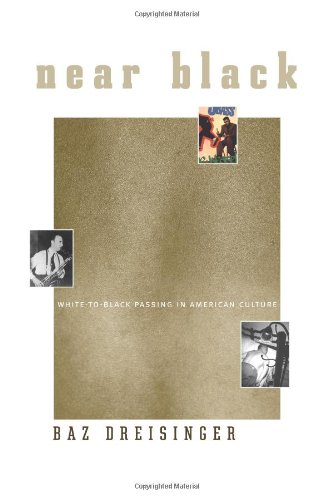
Near Black: White-to-Black Passing in American Culture

Posted in Books, History, Identity Development/Psychology, Literary/Artistic Criticism, Media Archive, Monographs, Passing on 2010-04-05 21:45Z by Steven

Near Black: White-to-Black Passing in American Culture

University of Massachusetts Press
November 2008
224 pages
paper ISBN 978-1-55849-675-0; cloth ISBN 978-1-55849-674-3

Baz Dreisinger, Associate Professor of English
John Jay College of Criminal Justice, City University of New York

A provocative look at the shifting contours of racial identity in America

In the United States, the notion of racial “passing” is usually associated with blacks and other minorities who seek to present themselves as part of the white majority. Yet as Baz Dreisinger demonstrates in this fascinating study, another form of this phenomenon also occurs, if less frequently, in American culture: cases in which legally white individuals are imagined, by themselves or by others, as passing for black.

In Near Black, Dreisinger explores the oft-ignored history of what she calls “reverse racial passing” by looking at a broad spectrum of short stories, novels, films, autobiographies, and pop-culture discourse that depict whites passing for black. The protagonists of these narratives, she shows, span centuries and cross contexts, from slavery to civil rights, jazz to rock to hip-hop. Tracing their role from the 1830s to the present day, Dreisinger argues that central to the enterprise of reverse passing are ideas about proximity. Because “blackness,” so to speak, is imagined as transmittable, proximity to blackness is invested with the power to turn whites black: those who are literally “near black” become metaphorically “near black.” While this concept first arose during Reconstruction in the context of white anxieties about miscegenation, it was revised by later white passers for whom proximity to blackness became an authenticating badge.

As Dreisinger shows, some white-to-black passers pass via self-identification. Jazz musician Mezz Mezzrow, for example, claimed that living among blacks and playing jazz had literally darkened his skin. Others are taken for black by a given community for a period of time. This was the experience of Jewish critic Waldo Frank during his travels with Jean Toomer, as well as that of disc jockey Hoss Allen, master of R&B slang at Nashville’s famed WLAC radio. For journalists John Howard Griffin and Grace Halsell, passing was a deliberate and fleeting experiment, while for Mark Twain’s fictional white slave in Pudd’nhead Wilson, it is a near-permanent and accidental occurrence.

Whether understood as a function of proximity or behavior, skin color or cultural heritage, self-definition or the perception of others, what all these variants of “reverse passing” demonstrate, according to Dreisinger, is that the lines defining racial identity in American culture are not only blurred but subject to change.

Tags: ,

Questions for Benjamin Todd Jealous: Race Matters

Posted in Articles, Media Archive, Politics/Public Policy, United States on 2010-04-05 20:05Z by Steven

Questions for Benjamin Todd Jealous: Race Matters

The New York Times
2009-07-30

Deborah Solomon

As the new head of the National Association for the Advancement of Colored People, can you tell us how your organization plans to respond to the case of Henry Louis Gates Jr., the Harvard professor who was recently arrested for disorderly conduct at his own home — charges that have since been dropped — after he reportedly chewed out a cop who suspected him of burglary?
Our local volunteers are already engaged with the Cambridge Police Department, as we are with police departments across this country. The next step is passing the End Racial Profiling Act in Congress. Racial profiling is a constant drumbeat in this country. It’s a form of humiliation that strikes like lightning on a daily basis, and that is part of what Professor Gates was responding to. It’s hard to be in your house, told you’re a burglary suspect and then when you are no longer a suspect, told you are the problem…

…As the son of a white father and a black mother, do you refer to yourself as black?
Yes, without qualification…

Read the entire article here.

Tags: , , , , , ,

Obama Census Choice: African-American

Posted in Articles, Barack Obama, Census/Demographics, Media Archive, Politics/Public Policy, United States on 2010-04-04 17:33Z by Steven

Obama Census Choice: African-American

The Huffington Post
2010-04-02

Mark S. Smith

WASHINGTON — He may be the world’s foremost mixed-race leader, but when it came to the official government head count, President Barack Obama gave only one answer to the question about his ethnic background: African-American.

The White House confirmed on Friday that Obama did not check multiple boxes on his U.S. Census form, or choose the option that allows him to elaborate on his racial heritage. He ticked the box that says “Black, African Am., or Negro.”…

…Obama the community activist and then politician always self-identified as African-American, and he now wears the mantle of America’s first black president with pride…

Read the entire article here.

Tags: ,

Who are the ‘Mixed’ ethnic group?

Posted in Articles, Census/Demographics, Media Archive, Social Science, United Kingdom on 2010-04-02 19:12Z by Steven

Who are the ‘Mixed’ ethnic group?

Office for National Statistics [United Kingdom]
May 2006

Ben Bradford

Introduction

The last fifty years have seen the emergence of some new, predominantly British-born, ethnic minorities. These are the children of inter-ethnic partnerships, primarily partnerships between people from the White British group and people from ethnic minority groups. They include the children of White and Black Caribbean parents, White and Asian parents and White and Black African parents, as well as a multitude of other Mixed identities.

The majority of people who have a Mixed ethnic identity have a White parent and were born in Britain. One of the key issues of interest about the Mixed ethnic groups concerns the extent to which they are more similar to the White group, or to the ethnic minority groups, from which they are drawn. For example, whether young people from the Mixed White and Black Caribbean group experience the relatively low unemployment of their White peers, or the much higher unemployment of their Black Caribbean peers.

This article profiles the four Mixed ethnic groups identified in the 2001 Census. These groups are necessarily abstractions from the multitude of actual Mixed ethnicities which exist in Britain today. The three specific groups identified in the Census—Mixed White and Black Caribbean, Mixed White and Black African and Mixed White and Asian—were designed to allow the greatest number of people possible to easily identify themselves. Those who did not identify with one of these Mixed ethnicities could use a write-in space to provide their own description of their ethnicity.

We look at the size of the groups, their demographic and socio-economic characteristics and we consider how they compare with other ethnic groups. This article is intended to complement similar analysis of the ‘Other’ ethnic groups already published by ONS. Together this work provides an overview of the characteristics of these less well known ethnicities.

Table of contents

Introduction
Executive Summary
1. The introduction of Mixed ethnic group categories on the Census
2. Who are the Mixed ethnic groups?
3. The size of the Mixed ethnic populations in England and Wales
4. Age profile of the Mixed ethnic groups
5. Country of Birth
6. Religion
7. Region of residence
8. Socio-economic occupational class
9. Economic Activity
10. Unemployment
11. Educational Attainment
References

Read the entire article here.

Tags: ,

“… But … But I am Brown.” The Ascribed Categories of Identity: Children and Young People of Mixed Parentage

Posted in Articles, Identity Development/Psychology, Media Archive, Social Work, United Kingdom on 2010-04-01 20:39Z by Steven

“… But … But I am Brown.” The Ascribed Categories of Identity: Children and Young People of Mixed Parentage

Child Care in Practice
Volume 13, Issue 2 (April 2007)
pages 83 – 94
DOI: 10.1080/13575270701201169

Annabel Goodyer, Principal Lecturer in Social Work
London South Bank University

Toyin Okitikpi

This paper explores the concept of the categorisation of social groups by looking at the issue of ascribed categories of identity for children and young people of mixed parentage. Our exploration of the knowledge-base in this area reveals that children and young people have clearly expressed views about their racial identity and that these views are broadly consistent across research studies. In essence, children and young people’s expressed views are that they are not mixed-race, black or white, but are in fact brown. The emerging sociology of childhood and the government’s current child participation agenda emphasise the centrality of children and young peoples’ perspectives on the provision of services that seek to support them. Through this perception, which places children and young people’s own understandings of their racial identity at the forefront of the analysis, we added fresh understandings to the existing data concerning ascribed categories of identity for children and young people of mixed parentage.

Read or purchase the article here.

Tags: ,

3 Questions: Melissa Nobles on the U.S. Census

Posted in Articles, Census/Demographics, Media Archive, Politics/Public Policy, United States, Women on 2010-04-01 17:55Z by Steven

3 Questions: Melissa Nobles on the U.S. Census

MIT News
Massachusetts Institute of Technology
2010-04-01

Melissa Nobles, Arthur and Ruth Sloan Professor of Political Science
Massachusetts Institute of Technology

As America’s decennial headcount gets under way, an MIT political scientist discusses the history of race and ethnicity in the U.S. Census

April 1 marks National Census Day, the official date of this year’s U.S. Census. To help put the census in context, MIT News spoke with Associate Professor of Political Science Melissa Nobles, whose teaching and research interests span the comparative study of racial and ethnic politics, and issues of retrospective justice. Her book, “Shades of Citizenship: Race and the Census in Modern Politics” (Stanford University Press, 2000), examined the political origins and consequences of racial categorization in demographic censuses in the United States and Brazil.

Q. You’ve noted in your book that the initial impetus for census-taking was political, and yet the earliest censuses also included racial categories. Why are race and ethnicity included in the U.S. Census?

A. Census-taking in the U.S. is as old as the Republic. The U.S. Constitution mandates that an “actual enumeration” be conducted every 10 years to allow for representational apportionment. The initial impetus for census taking was political. Yet the earliest censuses also included racial categories. The inclusion of these categories offers important insights into the centrality of racial and ethnic identifications in American political, economic and social life. This centrality continues to this day…

…The 1850 census first introduced the category “mulatto,” at the behest of a southern physician, in order to gather data about the presumed deleterious effects of “racial mixture.” Post-Civil War censuses, which continued to include the “mulatto” category, reflected the enduring preoccupation with “racial mixing.”..

Read the entire article here.

Tags: , ,

Biracial Identity Development and Recommendations in Therapy

Posted in Articles, Family/Parenting, Identity Development/Psychology, Media Archive, United States on 2010-04-01 17:13Z by Steven

Biracial Identity Development and Recommendations in Therapy

Psychiatry (Edgemont)
Volume 5, Number 11 (November 2008)
pages 37-44

Raushanah Hud-Aleem, DO
Department of Psychiatry
Boonshoft School of Medicine, Wright State University, Dayton, Ohio

Jacqueline Countryman, MD, Assistant Professor of Psychiatry
Department of Psychiatry
Boonshoft School of Medicine, Wright State University, Dayton, Ohio

Identity development is an important area with which therapists who work with children should be familiar. The number of biracial children in the United States is increasing, and although this may not be the reason that a child presents for therapy, it is an area that often should be explored. This article will review the similarities and differences between Black and White racial identity development in the United States and address special challenges for the biracial child. Recommendations for treatment in therapy are reviewed.

Read the entire article here.

Tags: , ,

Racial Identity and Academic Performance: An Examination of Biracial Asian and African American Youth

Posted in Articles, Media Archive, Social Science, United States on 2010-04-01 00:45Z by Steven

Racial Identity and Academic Performance: An Examination of Biracial Asian and African American Youth

Journal of Asian American Studies
Volume 2, Number 3 (October 1999)
pages 223-249
E-ISSN: 1096-8598 Print ISSN: 1097-2129
DOI: 10.1353/jaas.1999.0023

Grace Kao, Professor of Sociology, Education, and Asian American Studies
University of Pennsylvania

In the last three decades since the last anti-miscegenation laws were repealed, the United States has witnessed an increase in the number of multiracial persons, prompting a growing awareness of multiracial families.  The U.S. Census recently considered whether to add a multiracial category to the 2000 Census. Despite growing interest in the biracial population, there is little research on their psychological and socioeconomic outcomes. Does biracial status confer a relative disadvantage in psychological adaptation as early theorists warned? In turn, do biracials benefit in their socioeconomic outcomes relative to their ethnic counterparts? Using a nationally representative data set of youth (the National Education Longitudinal Study of 1988), this article examines whether biracial youths encounter greater psychological difficulties as previous theorists suggest. I also examine whether the school outcomes of biracials more closely resemble that of their minority or white counterparts.

Read the entire article here.

Tags: ,