Reading between the (Blood) Lines

Posted in Articles, Book/Video Reviews, History, Law, Media Archive, Native Americans/First Nation, United States on 2010-07-02 14:38Z by Steven

Reading between the (Blood) Lines

Southern California Law Review
Volume 83, Number 3 (2010)
pages 473-494

Rose Cuison Villazor, Professor of Law
Hofstra University School of Law

Legal scholars and historians have depicted the rule of hypodescent—that “one drop” of African blood categorized one as Black—as one of the powerful ways that law and society deployed to construct racial identities and deny equal citizenship. Ariela J. Gross’s new book, “What Blood Won’t Tell: A History of Race on Trial in America,” boldly complicates the dominant narrative about hypodescent rules in legal scholarship. On the one hand, “What Blood Won’t Tell” argues that the legal and social construction of race was far more complex, flexible and subject to manipulation than the scholarship regarding the rules about blood distinctions has suggested. On the other hand, “What Blood Won’t Tell” highlights circumstances, both historically and in recent memory, of the ways in which blood distinctions played crucial roles in shaping the identity of people of color, including indigenous peoples. Importantly, “What Blood Won’t Tell” also examines how blood quantum rules relate to contemporary efforts to reassert indigenous peoples’ sovereignty and claims to lands.

This Review highlights the important contributions of “What Blood Won’t Tell” to our understanding of the racial experience of indigenous peoples and the contemporary methods used to remedy the present-day effects of indigenous peoples’ colonial experience. “What Blood Won’t Tell” advances a more robust account of the racialization of people of color through rules about blood differences in at least three ways. First, it places the colonial experience of indigenous peoples within the larger historical contexts of racial subordination and efforts to promote White domination and privilege. Second, it underscores the federal government’s ongoing responsibility to counteract the long-standing effects of its past misdeeds by addressing indigenous peoples’ unresolved claims to lands that have been stolen from them. Third, it allows us to take a careful look at the relationship between blood quantum rules and the right of indigenous peoples to exercise self-determination. Taken together, these three perspectives reveal the immense challenges inherent to remedying the long-term effects of the racialization and colonization of indigenous peoples.

Read the entire article here.

Tags: , , , , ,

Professor Marsha Daria to be Featured Guest on Mixed Chicks Chat

Posted in Articles, Audio, Identity Development/Psychology, Interviews, Live Events, Media Archive, United States, Women on 2010-06-30 12:09Z by Steven

Professor Marsha Daria to be Featured Guest on Mixed Chicks Chat

Mixed Chicks Chat (The only live weekly show about being racially and culturally mixed. Also, founders of the Mixed Roots Film & Literary Festival) Hosted by Fanshen Cox and Heidi W. Durrow
Website: TalkShoe™ (Keywords: Mixed Chicks)
Episode: #160 – Professor Marsha D. Daria
When: Wednesday, 2010-06-30, 21:00Z (17:00 EDT, 14:00 PDT)

Marsha D. Daria, Associate Professor of Education (dariam@wcsu.edu)
Western Connecticut State University

Marsha D. Daria, Ph. D., Associate Professor of Education at Western Connecticut State University, is a former principal and classroom teacher. Her research interests are in multicultural education and health issues. She is currently working on a documentary about multiracial children.

Tags: , , , , ,

Towards a Dialogic Understanding

Posted in Articles, Identity Development/Psychology, Media Archive, Social Science, United States on 2010-06-29 05:33Z by Steven

Towards a Dialogic Understanding

Politics And Culture
2003-07-08

Victor Kulkosky

Good morning. I’m talking today about a work in progress, so you’ll get more questions than answers this time around. Maybe you’ll get the answers at the next CSA conference, if there is one. I think most of us here agree that one of the main missions of cultural studies is to tell or listen to amplify the untold or undertold story. So for me, that brings up this question: How to tell an emerging story that’s still in search of the language for telling it?

People in interracial or multiracial families find themselves facing this challenge. I find myself in this situation. I’m married to a Black woman, who has a half-sister many people assume is white, who in turn has among her children two girls with red hair and blue eyes and two boys many people would label black. Our little Rainbow Coalition claims African, Lithuanian, German, Irish, Cherokee, English and Dutch descent, and we share genes. What are we?

Heather Dalmage, in her book Tripping on the Color Line, (1999) observes: “Because they do not fit into the historically created, officially named, and socially recognized categories, members of multiracial families are constantly fighting to identify themselves for themselves. A difficulty they face is the lack of language available to address their experiences.” Dvora Yanow (2003), in her study of the relationship between racial/ethnic category making and government policy, writes: “Individuals who cannot find their identity in available categories become invisible, in a sense: without a label, without a vocabulary, their stories are untellable and they themselves are unnarratable.”

…A lot of law and discourse and violence have gone into policing America’s racial borders. White supremacy in the U.S. depends on certainty about who is and who isn’t White. Omi and Winant (1994) refer to the continuing efforts to draw and police racial borders as racial formation, which is carried out through a series of what they call racial projects. They define race as: “a concept which signifies and symbolizes social conflicts and interests by referring to different types of human bodies.” They make this major point, “we should think of race as an element of social structure rather than an irregularity within it; we should see race as a dimension of human representation rather than an illusion.” So I would add that it’s not a question of whether we can and should become color blind – it’s neither possible nor desirable — but about what we see when we see color. Omi and Winant see the concept of race evolving through racial formation, “the sociohistorical process by which racial categories are created, inhabited, transformed and destroyed.” They tell us that, “racial formation is a process of historically situated projects in which human bodies and social structures are represented and organized.”…

Read the entire article here.

Tags: ,

Partly Colored: Asian Americans and Racial Anomaly in the Segregated South

Posted in Asian Diaspora, Books, History, Identity Development/Psychology, Law, Literary/Artistic Criticism, Media Archive, Monographs, Native Americans/First Nation, Politics/Public Policy, Social Science, United States on 2010-06-28 20:46Z by Steven

Partly Colored: Asian Americans and Racial Anomaly in the Segregated South

New York University Press
2010-04-23
304 pages
13 illustrations
Cloth ISBN: 9780814791325
Paperback ISBN: 9780814791332

Leslie Bow, Professor of English and Asian American Studies
University of Wisconsin, Madison

Arkansas, 1943. The Deep South during the heart of Jim Crow-era segregation. A Japanese-American person boards a bus, and immediately is faced with a dilemma. Not white. Not black. Where to sit?

By elucidating the experience of interstitial ethnic groups such as Mexican, Asian, and Native Americans—groups that are held to be neither black nor white—Leslie Bow explores how the color line accommodated—or refused to accommodate—“other” ethnicities within a binary racial system. Analyzing pre- and post-1954 American literature, film, autobiography, government documents, ethnography, photographs, and popular culture, Bow investigates the ways in which racially “in-between” people and communities were brought to heel within the South’s prevailing cultural logic, while locating the interstitial as a site of cultural anxiety and negotiation.

Spanning the pre- to the post- segregation eras, Partly Colored traces the compelling history of “third race” individuals in the U.S. South, and in the process forces us to contend with the multiracial panorama that constitutes American culture and history.

Table of Contents

Acknowledgments
Introduction: Thinking Interstitially

  1. Coloring between the Lines: Historiographies of Southern Anomaly
  2. The Interstitial Indian: The Lumbee and Segregation’s Middle Caste
  3. White Is and White Ain’t: Failed Approximation and Eruptions of Funk in Representations of the Chinese in the South
  4. Anxieties of the ‘Partly Colored’
  5. Productive Estrangement: Racial-Sexual Continuums in Asian American as Southern Literature
  6. Transracial/Transgender: Analogies of Difference in Mai’s America

Afterword: Continuums, Mobility, Places on the Train
Notes
Works Cited
Index
About the Author

Read the introduction here.

Tags: ,

Neighborhood Segregation in Single-Race and Multirace America: A Census 2000 Study of Cities and Metropolitan Areas

Posted in Census/Demographics, Media Archive, Reports, United States on 2010-06-28 01:26Z by Steven

Neighborhood Segregation in Single-Race and Multirace America: A Census 2000 Study of Cities and Metropolitan Areas

Fannie Mae Foundation
2002
45 pages

William H. Frey
University of Michigan and the Milken Institute

Dowell Myers
University of Southern California

This report accompanies the release of detailed racial segregation indices for 1,246 individual U.S. cities with populations exceeding 25,000 and for the 318 U.S. metropolitan areas. These data can be accessed from the World Wide Web at www.CensusScope.org. This study extends earlier work on racial segregation from Census 2000 in the following respects:

  • It examines segregation patterns for persons who identify themselves as one race alone as distinct from those who identify themselves as two or more races, which is possible for the first time in Census 2000.
  • Its focus on large and small cities as well as metropolitan areas provides a comprehensive assessment of segregation variation across local areas and broader metropolitan regions.
  • Segregation and exposure measures in this study are based on the block group unit (average population 1,100), which more closely approximates a neighborhood community area than the census tract unit (average population 5,000) used in other studies. This more refined block group–based segregation measure permits the detection of segregation patterns for small racial groups or in small areas that are camouflaged when tract-based segregation measures are used.

The opportunity to look at segregation for single-race and multirace groups with Census 2000 provides an important means of assessing the prospects of future integration in a multirace society where intermarriage and interrace identification are on the rise. Our analysis of singlerace and multirace segregation shows that:

  • Persons who identify themselves as “white and black” live, on average, in neighborhoods that more closely approximate the racial composition of the average white person’s neighborhood, rather than that of the average black person’s neighborhood. For the combined metropolitan population of the United States, the average neighborhood of a “white and black” resident is 61 percent white and 19 percent black. The average neighborhood of someone who identifies as black alone is 29 percent white and 54 percent black, and the average neighborhood of someone who identifies as white alone is 81 percent white and 6 percent black.
  • Among the cities and metropolitan areas in our study, persons identifying with two or more races showed, on average, less segregation from whites than did minority persons identifying with a single race.

Our analysis of cities with more than 25,000 population shows the wide variation in segregation levels for each race and ethnic group. For most race groups, the highest levels of segregation tend to occur in the nation’s largest cities. For example, the City of New York ranks in the top six of all cities for each minority group’s segregation from whites. It ranks third in segregation for blacks, fifth for Hispanics, first for American Indians, first for Hawaiians, and sixth for those who identify themselves as two or more races. Hence, studies that focus only on segregation in large cities or in cities that have the largest minority populations overstate the level of racial segregation that exits in most cities with a minority presence. Other findings are:

  • Among cities with more than 100,000 population, white-black segregation ranges from an index of dissimilarity of 21 (Chandler, AZ) to 87 (Chicago, IL); Asian segregation from whites ranges from 15 (Coral Springs, FL) to 66 (New Orleans, LA); and Hispanic segregation from whites ranges from 17 (Hialeah, FL) to 71 (Oakland, CA).
  • The lowest segregation from whites for each race group tends to be associated with cities with less than 100,000 population, located in the suburbs, and, largely, in California, Texas, and other “multiethnic” states in the Sunbelt. Lowest city segregation indices for each race are in: The Colony, TX (white-black index of 8); Morgan Hill, CA (white-Asian segregation index of 9); Copperas Cove, TX (white-Hispanic segregation index of 8); Moore, OK (white–American Indian index of 12); Carson, CA (white-Hawaiian index of 25); and Cerritos, CA (white–multiple race index of 7).

City segregation indices differ from metropolitan segregation indices because the former reflect local patterns that can vary within the same metropolitan unit. Our analyses of dissimilarity of both levels indicate that:

  • On average, segregation levels are higher for metropolitan areas than for cities. Among the cities in our study, the average segregation levels for blacks, Asians, and Hispanics are indices of 45, 32, and 35 respectively. Average segregation levels among metropolitan areas for these three groups are indices of 59, 45, and 43, respectively.
  • Among smaller racial categories, Hawaiians show the highest average segregation levels, with an index of 53 for cities and 61 for metropolitan areas. Persons identifying themselves as two or more races show the lowest average segregation levels: an index of 27 for cities and 33 for metropolitan areas. American Indian segregation levels lie inbetween, with an average index of 39 for cities and 43 for metropolitan areas.
  • Different cities within the same metropolitan area can have quite different segregation measures. For example, although the Detroit primary metropolitan statistical area ranks second among all areas on white-black metropolitan segregation (index of 87), the city of Detroit ranks 55th, with an index of 63, among cities of more than 100,000 population. On the other hand, metropolitan Atlanta ranks 53rd in white-black segregation with a metropolitan wide dissimilarity index of 69, whereas the city of Atlanta ranks fourth in segregation, with an index of 83, among cities of more than 100,000 population. This shows that the metropolitan segregation index does not easily translate into segregation levels of large or small cities within the metropolitan area.

Finally, our use of the block group as a proxy for neighborhood in this segregation study provides a more refined measure that reveals segregation across smaller neighborhoods, rather than the larger census tract measures that have been used in some earlier studies. Block group–based segregation tends to be greater in smaller cities and metropolitan areas or where the minority population is small.

  • On average, the white-black dissimilarity index is 5.8 points higher when block groups, rather than tracts, are used to measure segregation. The disparity is greatest in smaller metropolitan areas. For example, in metropolitan Reno, NV, white-black segregation measured on the basis of block groups has an index of 44, whereas the counterpart segregation index measured on the basis of census tracts is only 34.
  • Indices of neighborhood exposure to other races are also affected by the choice of block group or tract as the neighborhood measure. For example, in metropolitan Jamestown, NY, the average black person lives in a neighborhood that is 69 percent white when the neighborhood is measured on the basis of block groups. However, that percentage rises to 81 percent white if the larger census tract is considered to be the neighborhood..

Read the entire paper here.

Tags: , , ,

Good Question: Is Obama The First Black President?

Posted in Articles, Barack Obama, Identity Development/Psychology, Media Archive, Social Science, United States on 2010-06-28 00:44Z by Steven

Good Question: Is Obama The First Black President?

WCCO-TV
Good Question
2008-11-05

Jason Derush, Reporter

You can’t turn on television or read a newspaper without seeing a reference to Sen. Barack Obama, the first black President. But wait a minute, said Naomi Banks, if Obama has a white mother, “My question is… why isn’t he the first biracial American President?” asked Banks.

“I think it’s more representative of reality,” she added. “It represents our country and how it’s changing with demographics.”

Banks said she has a special interest in the question, because she considers herself to be multiracial.

“My mother is Caucasian, my father is Native American and African-American,” she explained. “I’m proud of all aspects of my heritage,” said Banks, who said she couldn’t imagine leaving part of it out.

“I think of him as being an African-American of multiracial ancestry,” said Enid Logan, Ph.D., an Associate Professor of Sociology at the University of Minnesota.

Logan’s team has been interviewing University of Minnesota students about their racial attitudes in relation to the candidacy of President-Elect Obama…

…”Is the black/white binary still the primary axis around which races relations in the U.S. revolve?” asked Logan. “I think for the most part it absolutely is.”

Logan said that people feel a need to label others in terms of race, because along with gender, race is one way that American society has been historically organized. It’s a shortcut.

“It’s a society that sees itself as colorblind, but race is important. And people feel disoriented if they can’t figure out what race other people are, they don’t know how to interact with them,” explained Logan…

Read the entire article here.

Tags: , , , ,

The Free State of Jones: Mississippi’s Longest Civil War [Book Review]

Posted in Articles, Book/Video Reviews, History, Media Archive, Mississippi, United States on 2010-06-27 23:29Z by Steven

The Free State of Jones: Mississippi’s Longest Civil War [Book Review]

H-Net Reviews
2002-01-23

Ethan S. Rafuse, Associate Professor of Military History
United States Military Academy

Victoria E. Bynum.“The Free State of Jones: Mississippi’s Longest Civil War”.  The Fred W. Morrison Series in Southern Studies.  Chapel Hill & London: The University of North Carolina Press, 2001.  xvi + 316 pp. Tables, maps, notes, bibliography, and index. (hardcover).  ISBN 0-878-2636-7.

Race, Gender, and the Contested Memory of the Free State of Jones

In her new book, Victoria E. Bynum demonstrates that our knowledge of Mississippi’s legendary Free State of Jones, like so much else associated with the Civil War that has inspired contention and controversy, has been shaped as much by the agenda of those who have attempted to tell the story as by actual events.  This much is known: in the fall of 1863, in the Piney Woods region of southern Mississippi, Confederate deserters led by Newton Knight organized an anti-Confederate guerrilla band that eventually dominated its community and, according to legend, proclaimed Jones County’s independence from the Confederacy.  To deal with the Jones County rebellion, Confederate authorities dispatched two cavalry expeditions into the region that launched devastating attacks upon, but were unable to completely quell, Knight’s band of deserters.  After the war, members of the Knight Company participated in Reconstruction politics and a mixed-race community emerged with Captain Knight as the focal point…

Read the entire review here.

Tags: , , , , , , ,

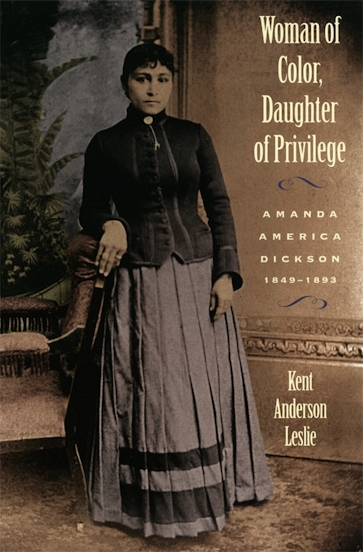
Woman of Color, Daughter of Privilege: Amanda America Dickson, 1849–1893

Posted in Biography, Books, History, Law, Media Archive, Monographs, Slavery, United States, Women on 2010-06-25 21:46Z by Steven

Woman of Color, Daughter of Privilege: Amanda America Dickson, 1849–1893

University of Georgia Press
1996
248 pages
Illustrated
Trim size: 6 x 9
Paperback ISBN: 978-0-8203-1871-4

Kent Anderson Leslie

Woman of Color, Daughter of Privilege

The true story of a slave who became the wealthiest black woman in the South

This fascinating story of Amanda America Dickson, born the privileged daughter of a white planter and an unconsenting slave in antebellum Georgia, shows how strong-willed individuals defied racial strictures for the sake of family. Kent Anderson Leslie uses the events of Dickson’s life to explore the forces driving southern race and gender relations from the days of King Cotton through the Civil War, Reconstruction, and New South eras.

Although legally a slave herself well into her adolescence, Dickson was much favored by her father and lived comfortably in his house, receiving a genteel upbringing and education. After her father died in 1885 Dickson inherited most of his half-million dollar estate, sparking off two years of legal battles with white relatives. When the Georgia Supreme Court upheld the will, Dickson became the largest landowner in Hancock County, Georgia, and the wealthiest black woman in the post-Civil War South.

Kent Anderson Leslie’s portrayal of Dickson is enhanced by a wealth of details about plantation life; the elaborate codes of behavior for men and women, blacks and whites in the South; and the equally complicated circumstances under which racial transgressions were sometimes ignored, tolerated, or even accepted.

Table of Contents

  • Acknowledgments
  • Introduction
  • CHAPTER 1. Exceptions to the Rules
  • CHAPTER 2. A Story
  • CHAPTER 3. The Dickson Will
  • CHAPTER 4. The Death of a Lady
  • Appendixes
  • Notes
  • Bibliography
  • Index
Tags: , , ,

“It’s a Kind of Destiny″: The Cultural Mulatto in the “New Black Aesthetic″ and ‘Sarah Phillips’

Posted in Articles, Book/Video Reviews, Media Archive on 2010-06-25 17:17Z by Steven

“It’s a Kind of Destiny″: The Cultural Mulatto in the “New Black Aesthetic” and ‘Sarah Phillips’

The Humanities Review
A Publication of St. John’s University English Department, Jamaica, New York
Volume 6.1 (Fall 2007)
pages 21-28

Habiba Ibrahim, Assistant Professor of English
University of Washington

An Essay

IN “THE NEW BLACK AESTHETIC,” published in Callaloo in 1989, Trey Ellis identifies a rupture between the black aesthetics of previous generations, and the “new” aesthetics of black artists who came of age in a post-integration era. These younger artists, unfettered by concerns over racial authenticity or, more pertinently, black cultural traditions, borrow as easily from white culture as from black, and are therefore what Ellis refers to as “cultural mulattoes.” He writes, “Just as a genetic mulatto is a black person of mixed parents who can often get along fine with his white grandparents, a cultural mulatto, educated by a multi-racial mix of cultures, can also navigate easily in the white world” (235). This easy navigation between black and white worlds is the key distinction between a “new” black aesthetic-which, according to Ellis, encompasses such varied forms as the comedy of Eddie Murphy and Chris Rock, the films of Spike Lee, the jazz of Wynton Marsalis-and older black aesthetic movements, most notably the Black Arts Movement, which often focused on delineating an essential blackness through art and meaning. Ellis proposes that the young black artists who came of age after integration form a black arts movement that constantly challenges what blackness “is.”..

Read the entire article here.

Tags: , , ,

Blacks and Blackness in Central America: Between Race and Place

Posted in Anthologies, Books, Caribbean/Latin America, History, Identity Development/Psychology, Media Archive, Slavery, Social Science on 2010-06-24 21:47Z by Steven

Blacks and Blackness in Central America: Between Race and Place

Duke University Press
September 2010
400 pages
21 photographs, 14 tables, 4 maps
Cloth ISBN: 978-0-8223-4787-3
Paperback ISBN: 978-0-8223-4803-0

Edited By:

Lowell Gudmundson, Professor of Latin American Studies and History
Mount Holyoke College

Justin Wolfe, William Arceneaux Associate Professor of Latin American History
Tulane University

Contributors: Paul Lokken, Russell Lohse, Karl H. Offen, Rina Cáceres Gómez, Catherine Komisaruk , Juliet Hooker, Lara Putnam, Ronald Harpelle, Mauricio Meléndez Obando

Many of the earliest Africans to arrive in the Americas came to Central America with Spanish colonists in the sixteenth and seventeenth centuries, and people of African descent constituted the majority of nonindigenous populations in the region long thereafter. Yet in the development of national identities and historical consciousness, Central American nations have often countenanced widespread practices of social, political, and regional exclusion of blacks. The postcolonial development of mestizo or mixed-race ideologies of national identity have systematically downplayed African roots and participation in favor of Spanish and Indian antecedents and contributions. In addition, a powerful sense of place and belonging has led many peoples of African descent in Central America to identify themselves as something other than African American, reinforcing the tendency of local and foreign scholars to see Central America as peripheral to the African diaspora in the Americas. The essays in this collection begin to recover the forgotten and downplayed histories of blacks in Central America, demonstrating the centrality of African Americans to the region’s history from the earliest colonial times to the present. They reveal how modern nationalist attempts to define mixed race majorities as “Indo-Hispanic,” or as anything but African American, clash with the historical record of a region considered by many to be one of the most successful cases of African American achievement, political participation, and power following independence from Spain in 1821.

Table of Contents

Acknowledgments
Introduction / Lowell Gudmundson and Justin Wolfe

Part I. Colonial Worlds of Slavery and Freedom

Part II. Nation Building and Reinscribing Race 

  • “The Cruel Whip”: Race and Place in Nineteenth-Century Nigaragua / Justin Wolfe
  • What Difference did Color Make? Blacks in the “White Towns” of Western Nicaragua in the 1880s / Lowell Gudmundson
  • Race and the Space of Citizenship: The Mosquito Coast and the Place of Blackness and Indigeneity in Nicaragua / Juliet Hooker
  • Eventually Alien: The Multigenerational Saga of British Western Indians in Central America, 1870-1940 / Lara Putnam
  • White Zones: American Enclave Communities of Central America / Ronald Harpelle
  • The Slow Ascent of the Marginalized: Afro-Descendents in Costa Rica and Nicaragua / Mauricio Meléndez Obando

Bibliography
Contributors
Index

Tags: , , , , , , , , , , ,