Questions for Maya Soetoro-Ng: All in the Family

Posted in Articles, Interviews, Media Archive, Politics/Public Policy, United States, Women on 2010-07-08 17:54Z by Steven

Questions for Maya Soetoro-Ng: All in the Family

The New York Times
2008-01-20

Deborah Solomon

Q: Let’s talk about the Democratic presidential caucuses taking place on Feb. 19, in Hawaii, where Barack Obama was born. Will you be campaigning for your brother?
Yes, of course. I have taken time off from my various teaching jobs in Honolulu and just got back from two months of campaigning. I have a bumper sticker on my car that says: “1-20-09. End of an Error.”…

Do you think of your brother as black?
Yes, because that is how he has named himself. Each of us has a right to name ourselves as we will.

Do you think of yourself as white?
No. I’m half white, half Asian. I think of myself as hybrid. People usually think I’m Latina when they meet me. That’s what made me learn Spanish.

That sort of culturally mixed identity was seen as an anomaly when you were growing up.
Of course, there was a time when that felt like unsteady terrain, and it made me feel vulnerable…

Read the entire interview here.

Tags: , ,

Obama’s Mixology

Posted in Articles, Barack Obama, Media Archive, Politics/Public Policy, United States on 2010-07-07 03:43Z by Steven

Obama’s Mixology

The Root
2008-10-30

Michele Elam, Martin Luther King, Jr. Centennial Professor of English and Olivier Nomellini Family University Fellow in Undergraduate Education
Stanford University

Give Obama credit for not trying to use his biracial background as an appeal to white working-class voters.

Mix’ology: noun. The art and science of mixings

In these final days of this presidential campaign, John McCain and his supporters have been trying desperately to raise doubts about Barack Obama’s identity. They have called him a terrorist sympathizer, a socialist, an unrepentant liberal. For weeks, their tagline has been “Who is Barack Obama?” The McCain campaign hopes that the question will resonate with the part of the electorate that Obama had putatively most alienated: the white, working class.

For different reasons, this same identity question has also had some traction with people of color, many of whom worry that Obama will usher in what Danzy Senna calls the “mulatto millennium,” especially if it implies that, as some of Obama’s supporters chanted earlier this year, “race doesn’t matter.”…

…But Obama has rejected post-racialism, certainly to the extent it meant identifying as “mixed” rather than “black.” His position was evident as early as 2005, when he told representatives from the MAVIN Foundation, one of the nation’s largest mixed-race advocacy organizations, who had clearly hoped he would be both an icon and legislative whip on their behalf: “I am always cautious about…persons of mixed race focusing so narrowly on their own unique experiences that they are detached from larger struggles, and I think it’s important to try to avoid that sense of exclusivity, and feeling that you’re special in some way.

As his Indonesian-Caucasian sister, Maya Soetoro-Ng, noted, Obama identifies as black not because he is conscripted by the one-drop rule, but because he actively chooses it. He belongs to the black community not only because, historically, mixed people have always belonged, and because black has never been pure; he belongs also, his sister suggests, because of personal commitment and responsibility. The issue may appear moot since race is part choice, part social ascription, and Obama could not simply opt out of the race even if he woke up some morning and chose to. But it remains important that he does not bill himself as “mixed” or “other” even when it might appear politically convenient or grant him cultural glam…

Read the entire article here.

Tags: , ,

ENGLISH 261E: Mixed Race Literature in the U.S. and South Africa (seminar)

Posted in Africa, Course Offerings, History, Literary/Artistic Criticism, Media Archive, United States on 2010-07-06 23:05Z by Steven

ENGLISH 261E: Mixed Race Literature in the U.S. and South Africa (seminar)

Stanford University
Department of English
Winter Quarter, 2010-2011

Michele Elam, Martin Luther King, Jr. Centennial Professor of English and Olivier Nomellini Family University Fellow in Undergraduate Education

Grant Parker, Associate Professor of Classics
Stanford Univeristy

As scholar Werner Sollors recently suggested, novels, poems, stories about interracial contacts and mixed race constitute “an orphan literature belonging to no clear ethnic or national tradition.” Yet the theme of mixed race is at the center of many national self-definitions, even in our U.S. post-Civil Rights and South Africa’s post-Apartheid era. This course examines aesthetic engagements with mixed race politics in these trans- and post-national dialogues, beginning in the 1700s and focusing on the 20th and 21st centuries.

Tags: , ,

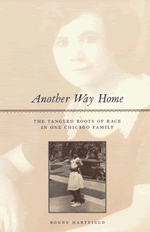
Another Way Home: The Tangled Roots of Race in One Chicago Family

Posted in Autobiography, Biography, Books, History, Identity Development/Psychology, Media Archive, Monographs, United States on 2010-07-05 05:10Z by Steven

Another Way Home: The Tangled Roots of Race in One Chicago Family

University of Chicago Press
2004
200 pages
22 halftones, 5-1/2 x 8-1/2
Cloth ISBN: 9780226318219
Paper ISBN: 9780226318233

Ronne Hartfield

In her prologue to Another Way Home, Ronne Hartfield notes the dearth of stories about African Americans who have occupied the area of mixed race with ease and harmony for generations. Her moving family history is filled with such stories, told in beautifully crafted and unsentimental prose. Spanning most of the twentieth century, Hartfield’s book celebrates the special occasion of being born and reared in a household where miscegenation was the rule rather than the exception—where being a woman of mixed race could be a fundamental source of strength, vitality, and courage.

Hartfield begins with the early life of her mother, Day Shepherd. Born to a wealthy British plantation owner and the mixed-race daughter of a former slave, Day negotiates the complicated circumstances of plantation life in the border country of Louisiana and Mississippi and, as she enters womanhood, the quadroon and octoroon societies of New Orleans. Equally a tale of the Great Migration, Another Way Home traces Day’s journey to Bronzeville, the epicenter of black Chicago during the first half of the twentieth century. Here, through the eyes of Day and, ultimately, her daughter, we witness the bustling city streets and vibrant middle-class culture of this iconic black neighborhood. We also relive crucial moments in African American history as they are experienced by the author’s family and others in Chicago’s South Side black community, from the race riots of 1919 and the Great Depression to the murder of Emmett Till and the dawn of the civil rights movement.

Throughout her book, Hartfield portrays mixed-race Americans navigating the challenges of their lives with resilience and grace, making Another Way Home an intimate and compelling encounter with one family’s response to our racially charged culture.

Read an excerpt here.

Table of Contents

Prologue
1. Alpha: The Long Mysterious Exodus of Death
2. Beginnings: Strange Fates
3. Sacred Wounds
4. On the Place
5. Matriarchy
6. The Lightning Fields
7. New Orleans
8. Day and the City
9. The Ring
10. A Stern Destiny: Chicago Found and Lost
11. The Post-Depression Years
12. Streetcars
13. In the Castle of Our Skin
14. Dining In
15. Go Down the Street
16. Naming the Holy
17. Strange Fruit
18. Our Father’s Freight Train Blues
19. Lifelines
20. Last Years
21. Omega
Epilogue
Acknowledgments

Tags: ,

Barack Obama and the Charm of the Stranger

Posted in Articles, Barack Obama, Identity Development/Psychology, Media Archive, Social Science, United States on 2010-07-05 04:59Z by Steven

Barack Obama and the Charm of the Stranger

The Zeleza Post
2009-01-25

Francis Njubi Nesbitt, Associate Professor of Africana Studies
San Diego State University

What is source of Barack Obama’s charm? Why was he able to win over whites, blacks and Latinos in a country that is famously partisan? Arguably, there are politicians who are equally gifted but there is seems to be a special aura about Obama.

Commentators have noted how he seems to absorb difference. They project their hopes and dreams on him. He has an aura of objectivity. People trust him. These are all qualities of a particular type of personality referred to in the literature as “the stranger,” “the outsider,” or “the marginal man.”

In an influential essay titled “The Stranger,” the Jewish scholar Georg Simmel argued that the stranger is by nature “no owner of the soil” and thus is able to absorb difference and project an aura of objectivity. Some may be comfortable confessing to the stranger actions and thoughts that hey keep from insiders. According to Simmel: “The stranger may develop charm and significance as long as he is considered a stranger in the eyes of the other, he is not an owner of the soil.”

Both Georg Simmel in “The Stranger,” and his student, Robert E. Park in “Migration and the Marginal Man,” argue that this personality type is often found among people of mixed race or excluded minorities who are caught between two cultures. They are forced to learn both their native ways and the ways of the majority population. W. E. B. Du Bois, Park’s contemporary and also a biracial man, put it eloquently in his famous lament about “double consciousness” that he wished to “merge my double self into a new and truer self.”

The problem, of course, is that it was not possible to resolve this double consciousness because of the one-drop rule that defined biracial individuals as black. The Jewish intellectual in Germany faced the same dilemma. He is caught between cultures, the rural and the urban, the Jewish and the German. One could not be both Jewish and German at the same time just like one could not be black and white at the same time…

Read the entire article here.

Tags: ,

Not So Plain as Black and White: Afro-German Culture & History, 1890-2000

Posted in Anthologies, Arts, Books, Europe, History, Identity Development/Psychology, Literary/Artistic Criticism, Media Archive on 2010-07-05 04:39Z by Steven

Not So Plain as Black and White: Afro-German Culture & History, 1890-2000

University of Rochester Press
2005-03-01
266 pages
Pages: 266
Size: 9 x 6
Hardback 13 Digit ISBN: 9781580461832
Imprint: University of Rochester Press

Edited by

Patricia M. Mazón, Associate Professor of History
State University of New York, Buffalo

Reinhild Steingröver, Assistant Professor of German
University of Rochester, Eastman School of Music

Since the Middle Ages, Africans have lived in Germany as slaves and scholars, guest workers and refugees. After Germany became a unified nation in 1871, it acquired several African colonies but lost them after World War I. Children born of German mothers and African fathers during the French occupation of Germany were persecuted by the Nazis. After World War II, many children were born to African American GIs stationed in Germany and German mothers. Today there are 500,000 Afro-Germans in Germany out of a population of 80 million. Nevertheless, German society still sees them as “foreigners,” assuming they are either African or African American but never German.

In recent years, the subject of Afro-Germans has captured the interest of scholars across the humanities for several reasons. Looking at Afro-Germans allows us to see another dimension of the nineteenth- and early twentieth-century ideas of race that led to the Holocaust. Furthermore, the experience of Afro-Germans provides insight into contemporary Germany’s transformation, willing or not, into a multicultural society. The volume breaks new ground not only by addressing the topic of Afro-Germans but also by combining scholars from many disciplines.

Table of Contents

  1. Dangerous Liaisons: Race, Nation, and German Identity
  2. The First Besatzungskinder: Afro-German Children, Colonial Childrearing Practices, and Racial Policy in German Southwest Africa, 1890-1914
  3. Converging Specters of an Other Within: Race and Gender in Pre- 1945 Afro-German History
  4. Louis Brody and the Black Presence in German Film Before 1945
  5. Narrating “Race” in 1950s’ West Germany: The Phenomenon of the Toxi Films
  6. Will Everything Be Fine? Anti-Racist Practice in Recent German Cinema
  7. Writing Diasporic Identity: Afro-German Literature since 1985
  8. The Souls of Black Volk: Contradiction? Oxymoron?
Tags: , , , , ,

We Who Are Dark: The Philosophical Foundations of Black Solidarity

Posted in Books, Media Archive, Monographs, Philosophy, Politics/Public Policy, Social Science, United States on 2010-07-04 22:04Z by Steven

We Who Are Dark: The Philosophical Foundations of Black Solidarity

Harvard University Press
2005
336 pages
5-1/2 x 8-1/4 inches
Paperback ISBN: 9780674025714

Tommie Shelby, Professor of African and African American Studies and of Philosophy
Harvard University

2005 New York Magazine Best Academic Book

African American history resounds with calls for black unity. From abolitionist times through the Black Power movement, it was widely seen as a means of securing a full share of America’s promised freedom and equality. Yet today, many believe that black solidarity is unnecessary, irrational, rooted in the illusion of “racial” difference, at odds with the goal of integration, and incompatible with liberal ideals and American democracy. A response to such critics, We Who Are Dark provides the first extended philosophical defense of black political solidarity.

Tommie Shelby argues that we can reject a biological idea of race and agree with many criticisms of identity politics yet still view black political solidarity as a needed emancipatory tool. In developing his defense of black solidarity, he draws on the history of black political thought, focusing on the canonical figures of Martin R. Delany and W. E. B. Du Bois, and he urges us to rethink many traditional conceptions of what black unity should entail. In this way, he contributes significantly to the larger effort to re-envision black politics and to modernize the objectives and strategies of black freedom struggles for the post-civil rights era. His book articulates a new African American political philosophy–one that rests firmly on anti-essentialist foundations and, at the same time, urges a commitment to defeating racism, to eliminating racial inequality, and to improving the opportunities of those racialized as “black.”

Table of Contents

  • Preface
  • Introduction: Political Philosophy and the Black Experience
  • 1. Two Conceptions of Black Nationalism
  • 2. Class, Poverty, and Shame
  • 3. Black Power Nationalism
  • 4. Black Solidarity after Black Power
  • 5. Race, Culture, and Politics
  • 6. Social Identity and Group Solidarity
  • Conclusion: The Political Morality of Black Solidarity
  • Notes
  • Index
Tags: ,

DNA tests probe the genomic ancestry of Brazilians

Posted in Anthropology, Articles, Brazil, Caribbean/Latin America, Media Archive on 2010-07-04 19:28Z by Steven

DNA tests probe the genomic ancestry of Brazilians

Brazilian Journal of Medical and Biological Research
Volume 42, Number 10 (October 2009)
pages 870-876
DOI: 10.1590/S0100-879X2009005000026

S .D. J. Pena
GENE, Núcleo de Genética Médica, Belo Horizonte, MG, Brasil
Departamento de Bioquímica e Imunologia, Universidade Federal de Minas Gerais, Belo Horizonte, MG, Brasil

L. Bastos-Rodrigues
Departamento de Bioquímica e Imunologia, Universidade Federal de Minas Gerais, Belo Horizonte, MG, Brasil

J. R. Pimenta
GENE, Núcleo de Genética Médica, Belo Horizonte, MG, Brasil

S. P. Bydlowski
Laboratório de Genética e Hematologia Molecular (LIM-31), Faculdade de Medicina, Universidade de São Paulo, Hospital das Clínicas, São Paulo, SP, Brasil

We review studies from our laboratories using different molecular tools to characterize the ancestry of Brazilians in reference to their Amerindian, European and African roots. Initially we used uniparental DNA markers to investigate the contribution of distinct Y chromosome and mitochondrial DNA lineages to present-day populations. High levels of genetic admixture and strong directional mating between European males and Amerindian and African females were unraveled. We next analyzed different types of biparental autosomal polymorphisms. Especially useful was a set of 40 insertion-deletion polymorphisms (indels) that when studied worldwide proved exquisitely sensitive in discriminating between Amerindians, Europeans and Sub-Saharan Africans. When applied to the study of Brazilians these markers confirmed extensive genomic admixture, but also demonstrated a strong imprint of the massive European immigration wave in the 19th and 20th centuries. The high individual ancestral variability observed suggests that each Brazilian has a singular proportion of Amerindian, European and African ancestries in his mosaic genome. In Brazil, one cannot predict the color of persons from their genomic ancestry nor the opposite. Brazilians should be assessed on a personal basis, as 190 million human beings, and not as members of color groups.

Introduction

Brazilians are one of the most heterogeneous populations in the world, the result of five centuries of interethnic crosses between peoples from three continents: Amerindians, Europeans and Africans. Little is known about the number of indigenous people living in the area of what is now Brazil when the Portuguese arrived in 1500 (1), although a figure often cited is that of 2.5 million individuals. The Portuguese-Amerindian admixture started soon after the arrival of the first colonizers and later became commonplace, being even encouraged after 1755 as a strategy for population growth and colonial occupation of the country….

From the middle of the 16th century, Africans were brought to Brazil to work on sugarcane farms and, later, in the gold and diamond mines and on coffee plantations. Historical records suggest that between circa 1550 and 1850 (when the slave trade was abolished), around four million Africans arrived in Brazil (2)…

Uniparental genetic markers in Brazilians

…To learn about the maternal counterpart, we analyzed mtDNA, which revealed a different reality. Considering Brazil as a whole, 33, 39, and 28% of matrilineages were of Amerindian, European and African origin, respectively (9,12). As expected, the frequency of different regions reflected their genealogical histories: most matrilineal lineages in the Amazon region were of Amerindian origin, while African ancestrality was preponderant in the Northeast (44%) and European haplogroups were prevalent in the South (66%). These data have since been amply confirmed by numerous other studies. For instance, we recently analyzed the mtDNA haplogroup structure of 242 self-identified white individuals from São Paulo and ascertained 24% Amerindian, 22% African and 54% European matrilineal proportions (Dornelas HG, Bydlowski SP, Pena SDJ, unpublished data).

Next, for further confirmation, we studied mtDNA lineages in 120 black individuals from the city of São Paulo. The results, as expected, showed a mirror image of those previously found in white Brazilians: on the one hand, 85% of the lineages originated in Sub-Saharan Africa, 12% were from Amerindians and only 3% were from Europe; on the other, only 48% of the Y chromosome lineages originated from Sub-Saharan Africa (the vast majority belonging to haplogroups E3a7 and E3a*). Studies on black individuals from the cities of Rio de Janeiro and Porto Alegre produced very similar results.

Taken together, these numbers disclose a picture of very strong directional mating between European males and Amerindian and African females, which agrees perfectly with the known history of the peopling of Brazil since 1500. These studies also reveal that the genomes of most Brazilians are mosaic, having mtDNA and NRY of different phylogeographical origins.

Biparental genetic markers and ancestry in Brazilians

In Brazil, notwithstanding relatively large levels of genetic admixture and a myth of “racial democracy”, there exists widespread social prejudice that seems to be particularly connected to the physical appearance of an individual. Color (in Portuguese, cor) denotes the Brazilian equivalent of the English term race (raça) and is based on a complex phenotypic evaluation that takes into account, besides skin pigmentation, also hair type, nose shape and lip shape. The reason why the word color is preferred to race in Brazil is probably because it captures the continuous aspects of phenotypes. In contrast with the situation in the United States, there appears to be no racial descent rule operational in Brazil and it is possible for two siblings differing in color to belong to completely diverse racial categories.

Based on the criteria of self-classification of the 2000 census of the Instituto Brasileiro de Geografia e Estatística (IBGE), the Brazilian population was then composed of 53.4% Whites, 6.1% Blacks and 38.9% Brown (“pardos” in Portuguese). How do these numbers correlate with genomic ancestry?..

Read the entire article here.
Tags: , , , ,

Hawaiian Blood: Colonialism and the Politics of Sovereignty and Indigeneity

Posted in Anthropology, Books, History, Identity Development/Psychology, Law, Media Archive, Monographs, Politics/Public Policy, United States on 2010-07-03 02:10Z by Steven

Hawaiian Blood: Colonialism and the Politics of Sovereignty and Indigeneity

Duke University Press
2008
264 pages
5 photographs, 2 tables
Cloth ISBN: 978-0-8223-4058-4
Paperback ISBN: 978-0-8223-4058-4

J. Kēhaulani Kauanui, Associate Professor of Anthropology and American Studies
Wesleyan University

In the Hawaiian Homes Commission Act (HHCA) of 1921, the U.S. Congress defined “native Hawaiians” as those people “with at least one-half blood quantum of individuals inhabiting the Hawaiian Islands prior to 1778.” This “blood logic” has since become an entrenched part of the legal system in Hawai‘i. Hawaiian Blood is the first comprehensive history and analysis of this federal law that equates Hawaiian cultural identity with a quantifiable amount of blood. J. Kēhaulani Kauanui explains how blood quantum classification emerged as a way to undermine Native Hawaiian (Kanaka Maoli) sovereignty. Within the framework of the 50-percent rule, intermarriage “dilutes” the number of state-recognized Native Hawaiians. Thus, rather than support Native claims to the Hawaiian islands, blood quantum reduces Hawaiians to a racial minority, reinforcing a system of white racial privilege bound to property ownership.

Kauanui provides an impassioned assessment of how the arbitrary correlation of ancestry and race imposed by the U.S. government on the indigenous people of Hawai‘i has had far-reaching legal and cultural effects. With the HHCA, the federal government explicitly limited the number of Hawaiians included in land provisions, and it recast Hawaiians’ land claims in terms of colonial welfare rather than collective entitlement. Moreover, the exclusionary logic of blood quantum has profoundly affected cultural definitions of indigeneity by undermining more inclusive Kanaka Maoli notions of kinship and belonging. Kauanui also addresses the ongoing significance of the 50-percent rule: Its criteria underlie recent court decisions that have subverted the Hawaiian sovereignty movement and brought to the fore charged questions about who counts as Hawaiian.

Table of Contents

A Note to Readers
Acknowledgments
Introduction: Got Blood?

  1. Racialized Beneficiaries and Genealogical Descendants
  2. “Can you wonder that the Hawaiians did not get more?” Historical Context for the Hawaiian Homes Commission Act
  3. Under the Guise of Hawaiian Rehabilitation
  4. The Virile, Prolific, and Enterprising: Part-Hawaiians and the Problem with Rehabilitation
  5. Limiting Hawaiians, Limiting the Bill: Rehabilitation Recoded
  6. Sovereignty Struggles and the Legacy of the 50-Percent Rule

Notes
Bibliography
Index

Tags: , ,

Blackness, Hypodescent, and Essentialism: Commentary on McPherson and Shelby’s “Blackness and Blood”

Posted in Literary/Artistic Criticism, Media Archive, United States on 2010-07-02 16:18Z by Steven

Blackness, Hypodescent, and Essentialism: Commentary on McPherson and Shelby’s “Blackness and Blood”

Symposia on Gender, Race and Philosophy
Volume 1, Number 1, May 2005

Gregory Velazco y Trianosky, Professor of Philosopy
California State University, Northridge

In their fascinating and thoughtful paper, McPherson and Shelby seek to defend everyday African American understandings of their own identity against the critique launched by Anthony Appiah in his Tanner lectures. I have no deep disagreements with their defense. Instead I will propose what I hope are useful clarifications of some of the key claims in that defense, and perhaps some further contribution to the discussion they have begun.

1. Roughly speaking, Appiah argues as follows: (1) African Americans typically adhere to the rule of hypodescent, understood as a criterion for membership in the group of black people. However, says Appiah, in conjunction with (2) the nationalist belief that black people owe special obligations of support or group solidarity to other black people, this adherence is problematic. For the truth is that (3) many phenotypically white people in the United States in fact have black ancestors and thus, by a strict application of the rule of hypodescent, are black rather than white, regardless of appearance. Given this fact, (4) adherence to the rule of hypodescent requires black people (insofar as they are nationalists) to extend to many phenotypically white people the same kind of support they believe they owe to all black people. But this means (5) that the actions of black nationalists will, insofar as they are based on the facts, undermine the very project of black nationalism. Appiah goes on to argue that in cases where a group’s beliefs about its identity undermine its own political and social projects, the liberal state should intervene to “soul-make,” that is, to reshape the understanding that group has of itself…

Read the entire commentary here.

Tags: , , , , , ,