The Modern Mulatto: A Comparative Analysis of the Social and Legal Positions of Mulattoes in the Antebellum South and the Intersex in Contemporary America

Posted in Articles, Gay & Lesbian, History, Identity Development/Psychology, Law, Media Archive, Politics/Public Policy, Slavery, United States on 2011-05-02 22:05Z by Steven

The Modern Mulatto: A Comparative Analysis of the Social and Legal Positions of Mulattoes in the Antebellum South and the Intersex in Contemporary America

Columbia Journal of Gender and Law
Volume 15, Number 3 (September 2006)

Marie-Amélie George, Associate Lawyer
Paul, Weiss, Rifkind, Wharton & Garrison LLP

Recognizing new social forces working against the “correction” of intersexed children at birth, this article explores the undefined position of the sometimes invisible segment of the population that is intersexed. In examining the similarities between the legal position of mulattoes in the Antebellum south with that of the intersex today, the article takes on the very definition of sex in contemporary society. The author argues that sex, like race, is not binary, but rather constructed so as to reinforce heteronormative patriarchal norms. Through an examination of case law concerning transsexuals, the author demonstrates the ways in which law erroneous relies on a sexual binary, and goes on to provide a guide for understanding how courts would locate intersexuals in contemporary society.

…”This case involves the most basic of questions. When is a man a man, and when is a woman a woman? Every schoolchild, even of tender years, is confident he or she can tell the difference, especially if the person is wearing no clothes.” (1) With this opening statement, Judge Harberger, writing the majority opinion in Littleton v. Prange, quickly goes on to demonstrate that this most basic of questions can be more difficult to answer than appears at first glance. The case at issue, which required the court to determine the legal sex of a post-operative transsexual, questioned the basic notion that male and female are fixed, immutable, and oppositional categories. The very premise of the case is an assault on the foundational assumption that sex is a binary and biological phenomenon, which has been overwhelming accepted in contemporary thought. Importantly, these two concepts once underpinned race theory, but were subsequently rejected by both the academic and legal worlds. (2) The same, while examined and critiqued at length in feminist and sexuality theory, (3) has thus far failed to occur in the realm of legal doctrine and social consciousness.

This Article seeks to add to the scholarship that illustrates the way in which sex can be conceptualized in much the same way as race, and may thus be divested of the presumptions of dichotomy and physiology, by comparing the regulation of race in the antebellum period (4) and sex in the modern day. In doing so, it also aims to undermine objections that sex and race are not in fact parallel socio-physiological categories. (5) Specifically, this Article examines the manner in which antebellum mulattoes, whose mixed race challenged the bases for racial hierarchy, were socially and legally made black so as to be folded within the binary on which slavery depended. It then follows this analysis with a consideration of the ways in which the intersex, who are persons with ambiguously sexed genitals, chromosomes, or phenotypes, are physically forced into one sex or the other so as not to cast doubt on the sexual binary necessary to sustain a patriarchal political and social system. Using this comparison as a framework from which to extend its deconstruction of social categories, this Article then turns to an examination of the role of the law in regulating sexual identity, noting how the law has the potential to be used to create sex in much the same way as it was employed to craft race during the antebellum period.

The importance of this analogy is evident in the implications that flow from it. If sex is as much a construction as is race, the laws and statutes which rely on sexual demarcations, such as whether an individual is protected by Title VII, what penal laws may be applied to a person, in which athletic competitions an individual is permitted to participate, whether a person is subject to a military draft, and who an individual may marry, among others, lose their foundational support, as the premises on which they rely do not exist. (6) The social impact is potentially much greater, as the law is but a shallow reflection of the deep sex-based differences on which society is based. Whether a legal recognition that sex is a construction will have a substantial effect on social norms is unclear, though the possibility does exist. (7) With these ideas in mind, Part I of this Article begins by focusing on race in the American antebellum South, detailing both the cultural factors that resulted in mulattoes joining the disfavored racial category and the legal means by which a binary racial hierarchy was established. This section discusses the attempts at combating miscegenation, as well as the regulations that delineated blackness and established mulattoes’ place as blacks in terms of status, condition, and physicality. In Part II, the analysis turns to theoretical perspectives on sex as a social creation so as to provide a framework from which to develop a better understanding of the ways in which the intersex, as the physical intermediaries between the two established sexes, violate the political and social order. Part III examines the social and legal position of intersex individuals in contemporary American society, drawing attention to the parallels and divergences between the legal status of the intersex today and mulattoes of the antebellum world. It then highlights the ways in which this serves to undermine the basis for different judicial standards of review for race and sex based discrimination. Part IV concludes the Article, evaluating the likelihood for potential change in the law’s treatment of sex as a biological phenomenon.

I. SOCIAL AND LEGAL REGULATION OF MULATTOES IN THE ANTEBELLUM SOUTH

 The constructed nature of race is clearly illustrated by the social perspectives on and the legal regulation of miscegenation in the antebellum South. Interracial sexual relationships, while accepted as standard in some parts of the South during the colonial era, were by the antebellum period uniformly perceived as extremely dangerous to white supremacy. This was due in large part to the mulatto offspring they produced, as mixed-race children blurred the line between the races, thereby upsetting the clear racial hierarchy on which slavery depended. Slavery was defended on the notion that racial stratification was part of a natural order, one in which whites dominated blacks due to their superior physical, mental, and behavioral traits. (8) Racial dilution not only led to a deterioration of these attributes, but also demonstrated immorality and cultural degeneracy. (9) Mulattoes, as evidence of interracial sex, were also “a visible reproach to the white man’s failure to live up to basic moral and social precepts.” (10) Consequently, hybridism was described as “heinous,” and mulattoes became a “spurious” issue requiring legal regulation. (11)

Mulattoes threatened a vision of the natural order as being one of clear, defined categories to one of gradations, a theory upon which the institution of slavery could not stand, as “[s]lavery rest[ed] on the fundamental distinction between human labor and those who own[ed] it, and the total relations between master and slave generate[d] the idea that all relationships … should [have] be[en] total.” (12) Plantation economies required whites to control the labor force in its entirety, a proposition that would have been impossible were it not for the strict bounds of the racial hierarchy. By relegating mulattoes to the status of their pure black contemporaries, the sharpness of racial distinctions would be maintained, and the power relationships that relied on racial purity could be sustained. (13) Such a clear racial divide also provided Southern lawmakers with a means of preventing interracial alliances between white servants and blacks, as giving value to whiteness granted the servant class privileges that they would seek to preserve. (14) Consequently, the white underclass would identify its interests as protected by racial division, as opposed to developing a class-based ideology, which could have undermined the system on which the Southern economy was based.

Given the threats they produced, interracial sexual liaisons had to be deterred and the mixed-race progeny regulated so as not to disturb the political and economic systems that fostered white privilege. Before turning to the legal measures adopted to accomplish these goals, however, it is first instructive to examine the ways in which colonial attitudes on amalgamation formed and developed, as such information will assist in understanding the timing and purpose of the legal regulations.

A. Social Perspectives of Mulattoes in the Colonial Era

The colonial South was not unified in terms of racial divides, attitudes, and mixing, but rather was a bifurcated region with respect to the status of blacks and mulattoes. (15) The upper South, comprised of Delaware, Virginia, Maryland, Kentucky, Tennessee, North Carolina, Missouri, and the District of Columbia, contained a relatively large mulatto population. (16) Often the offspring of white indentured servants and both free and enslaved blacks, a considerable portion were free, but overwhelmingly impoverished. (17) The economically depressed circumstances into which they were born, along with the low status of their parents and their residence in rural, rather than urban, areas, guaranteed mulattoes a place in the social underclass. Mulattoes did tend to rank in the upper echelons of free black society, but this did not alter the ways in which white citizens viewed mixed-race persons. (18) Indeed, whites equated mulattoes with blacks, making few distinctions as to hue or ancestry amongst persons of color. Mulattoes were thus just as socially, economically, and legally marginalized as their fully black brethren.

The lower South, consisting of South Carolina, Georgia, Florida, Alabama, Mississippi, Louisiana, and Texas, (19) had a contrastingly generous view of free mulattoes, and afforded these individuals a status superior to that of blacks, thereby creating a third, intermediate class between black and white. (20) The impetus for this was based on practical as well as cultural influences, many of which were linked to the settlement pattern that emerged in the lower South. Unlike the upper South, many early immigrants to the lower South were from the West Indies, where the pattern of race relations resulted in a multi-tiered racial hierarchy, with mulattoes serving as a variable intermediate class. (21) Further, settlement in the lower South was characterized by a small number of white plantation owners and overseers and a large population of black slaves. (22) The scarcity of white women encouraged amalgamation, both because it increased a sense of sexual license and because it prevented settlers from reestablishing European patterns of domestic life, with its ideal of a monogamous heterosexual couple at its center. (23) Consequently, mulatto children were often the progeny of prosperous fathers and slave women. (24) While the plantation economy discouraged fathers from manumitting their mixed-race children, those who were granted freedom joined the upper strata of society, due in large part to the recognition and largess of their white fathers. (25) The topmost few lived nearly on par with their white neighbors, and mulattoes as a whole dominated the free black community. (26) Avoiding interaction with unmixed blacks, many mulattoes adopted the attitudes of whites toward the lower castes, and took advantage of the social and economic opportunities that their lighter skin afforded. (27) These privileges provided incentives for free mulattoes to support the status quo in the lower South, and thus for mulattoes to ally themselves with the white dominating class. With a high ratio of blacks to whites in the plantation communities of the lower South, whites valued the buffer that the intermediate mulatto category provided. (28)

The three-tier class structure of the lower South disintegrated in the face of increased anxiety and tension due to abolitionist attacks on slavery. (29) Whites were fueled to defend the institution, a difficult endeavor when the line drawn between the two races, a line supposedly signifying a natural distinction between ruler and ruled, (30) was blurred by a significant mulatto population. A movement for society to be divided into two groups, black and white, gained momentum, and the white population of the lower South became less tolerant of miscegenation and the preferential treatment of mulattoes. (31) The potential for insurrection also served to lessen whites’ support for a free class of blacks, regardless of the hue of the individuals at issue. (32) As a result, by the antebellum period, the lower South had become a two-class society like its Northern counterpart.

B. Legal Regulation

While the attitudes concerning mixed-race individuals originally differed in the colonial South, by the antebellum period all of the states had imposed stringent regulations on miscegenation and had relegated mulattoes to the same status as “pure” blacks. These statutes addressed interracial marriage and fornication, so as to deter the production of mulatto children, and also worked to disarm the potential power of a mixed-race class by legislating blackness onto mulattoes.

1. Marriage and Fornication

In order to protect its economic system, as well as the social and political institutions that accompanied slavery, Southern lawmakers attempted to eradicate interracial liaisons by imposing legal sanctions on interracial marriage and fornication. In the early seventeenth century, Virginia began lashing out at miscegenation, declaring sexual intercourse with blacks to be equivalent to bestiality. (33) Courts imposed severe punishments on those found guilty of this trespass; in 1630, Virginian Hugh Davis “was sentenced ‘to be soundly whipped, before an assembly of Negroes and others for abusing himself to the dishonor of God and shame of Christians, by defiling his body in lying with a Negro, which fault he is to acknowledge next Sabbath day.”‘ (34) The penalties became less corporeal in subsequent years, and in 1662, the legislature mandated that “‘if any christian shall commit fornication with a negro man or woman, hee or shee soe offending shall pay double'” the previously imposed fine. (35) This provision, while reducing the punishment from physical to fiscal, was nevertheless important because it was a marked change from the colony’s precedent, which punished all violators, regardless of the sexual makeup of the fornicating couple, equally. (36)

Other colonies imposed even more stringent consequences on the participants of interracial relationships. South Carolina, a colony originally known for its widespread acceptance of interracial unions, punished interracial bastardy by binding out white men and women and free black men as indentured servants for seven years; the child of any such union was forced to serve until adulthood. (37) Maryland’s 1664 anti-miscegenation law provided punishments similar to those imposed in South Carolina. White women who married male slaves were compelled to serve their husbands’ masters for the lifetimes of their husbands, and any children born to the couple were required to labor for the parish for thirty-one years. (38) In 1692, the Maryland Assembly amended the statute by requiring free blacks who married white women to be forced into a lifetime of bondage. (39) Pennsylvania had the same provision, and also permitted courts to impose a sentence of seven years in bondage to all free persons convicted of interracial fornication. (40) Virginia diverged from its contemporaries by choosing banishment from the colony as its foremost penalty for interracial marriage. In 1691, Virginia passed a law prohibiting marriage between blacks and whites, “ordering that any white person marrying a black person be ‘banished and removed from this dominion forever.”‘ (41) This punishment was changed to six months in jail in 1705; the same edict also imposed a fine of up to 10,000 pounds of tobacco against the minister performing the ceremony. (42 Virginia did not punish the black members of the union, presumably because most blacks were slaves, and thus any penalties against these individuals would have deprived masters of their slaves’ labor. (43)

By the time of the Civil War, twenty-one out of thirty-four states had some sort of legislation proscribing and punishing interracial sexual relationships. (44) While these laws diverged in identifying the violators, the specific proscribed offenses, and the punishments meted out for violations, the provisions generally tended to target white female offenders. (45) Indeed, the Maryland legislature, abhorrent of white women’s sexual exploits with black men, described marriages between white women and black men as “always to the Satisfaccon of theire Lascivious & Lustfull desires, & to the disgrace not only of the English butt also of many other Christian Nations.” (46) Virginia, similarly concerned, enacted a bill aimed at addressing miscegenation that provided for banishment within three months of the mixed child’s birth. However, it further declared that any white woman “who gave birth to ‘a bastard child by any Negro or mulatto’ would be heavily fined or subject to five years of servitude and that the child would be bound into servitude until it reached age thirty.” (47) While this regulation may have been enacted due to a concern over the number of mixed-race children born to white women, there were other reasons for colonialists to target white women’s sexuality and regulate it heavily. (48) Bastard children were a problem regardless of color, as the community was then pressured to provide for those children. (49) Furthermore, given the demographic realities of the time, with white men outnumbering white women well into the 1750s, providing disincentives for interracial relationships encouraged intra-racial procreation, thereby ensuring the perpetuation of a racially pure, white dominating class. Also important were the negative perceptions of white female morality, in that white women were seen as being of frail moral character; this was linked to the desire to maintain a paternalistic social order. Finally, this regulation was a way of addressing the fact that mulatto progeny blurred the lines of freedom. “Since the law defined freedom according to the status of mothers, it became imperative for white men to specifically delineate severe punishments for those white women who crossed the sexual color line.” (50)

Importantly, the fact that the mother’s status of slave or free determined whether or not the child would be enslaved was a marked shift from the English common law, whereby children followed the status of the father. (51) However, due to the large numbers of mixed race children born to slave mothers and white fathers, colonies enacted statutes mandating a “status of the mother” rule. As Charles Robinson notes, “most interracial sexual relations involved intercourse between white masters and slave women…. Colonial authorities had real concerns that English common law might in fact undermine the institution of slavery by allowing biracial children to claim freedom on the basis of their paternal heritage.” (52) Under such circumstances, there would have been a large free mulatto population, which could have shifted the balance of power away from the white ruling class. This legal rule thus emerged so as to prevent mulatto freedom, and did not derive from a “natural” identity. In short, social needs trumped what were considered biological realities under the law.

Forcing mulatto children into servitude had the desired effect of propelling mixed race persons as close to slave status as possible:

By the time these men and women reached their freedom, they often…

Read or purchase the article here.

Tags: ,

The Octoroon: A Play, In Four Acts

Posted in Arts, Media Archive, Slavery, United States on 2011-04-26 02:19Z by Steven

The Octoroon: A Play, In Four Acts

First Performed at the Winter Garden Theatre
New York, New York
December, 1859

Dion Boucicault, ESQ (1820-1890)

Text from James A. Cannavino Library, Marist University, Poughkeepsie, New York

Characters Original Cast

GEORGE PEYTON (Mrs. Peyton’s
Nephew, educated in Europe, and just returned home)

Mr. A. H.
Davenport.     
 

 JACOB M’CLOSKY
(formerly Overseer of Terrebonne, but now Owner of one half of the
Estate)


Mr. T. B. Johnston.

 SALEM SCUDDER
(a Yankee from Massachusetts, now Overseer of Terrebonne, great on
improvements and inventions, once a Photographic Operator, and been
a little of everything generally)


Mr. J. Jefferson.

 PETE (an “Ole Uncle,” once the late Judge’s
body servant, but now “too ole to work, sa”)

Mr. G. Jamieson.

 SUNNYSIDE (a Planter, Neighbour, and Old Friend of the
Peytons)

Mr. G. Holland.

 LAFOUCHE
(a Rich Planter)

Mr. Stoddart.

 PAUL
(a Yellow Boy, a favourite of the late Judge’s, and so allowed to do much as he
likes)

Miss Burke.

 RATTS
(Captain of the Magnolia Steamer)

Mr. Harrison.

 COLONEL POINDEXTER
(an Auctioneer and Slave Salesman)

Mr. Russell.

 JULES THIBODEAUX
(a Young Creole Planter)

Miss H. Secor.

 CAILLOU
(an Overseer)

Mr. Peck.

 JACKSON
(a Planter)

Mr. Tree.

 CLAIBORNE
(the Auctioneer’s Clerk)

Mr. Ponisi.

 SOLON
(a Slave)

Mr. Styles.

 WAH-NO-TEE
(an Indian Chief of the Lepan Tribe)

Mr. Pearson.

 MRS. PEYTON
(of Terrebonne Plantation, in the Attakapas, Widow of the late Judge Peyton)

Mrs. Blake.

 ZOE
(an Octoroon Girl, free, the Natural Child of the late Judge by a Quadroon
Slave)

Mrs. J. H. Allen.

 DORA SUNNYSIDE
(only Daughter and Heiress to Sunnyside, a Southern Belle)

Mrs. Stoddart.

 GRACE
(a Yellow Girl, a Slave)

Miss Gimber

 DIDO
(the Cook, a Slave)

 Mrs. Dunn.

 MRS. CLAIBORNE 

Miss Clinton.

 MINNIE
(a Quadroon Slave)

Miss Walters.
Planters, Slaves, Deck Hands, &c.

Read the entire play here.

Tags:

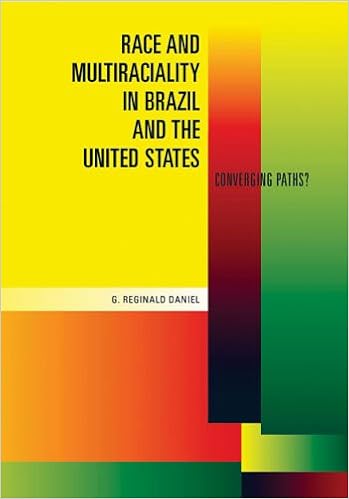
Race and Multiraciality in Brazil and the United States: Converging Paths?

Posted in Books, Brazil, Caribbean/Latin America, History, Media Archive, Monographs, Slavery, Social Science, United States on 2011-04-25 03:30Z by Steven

Race and Multiraciality in Brazil and the United States: Converging Paths?

Pennsylvania State University Press
2006
384 pages
6 x 9
Cloth ISBN: 978-0-271-02883-5
Paper ISBN: 978-0-271-03288-7

G. Reginald Daniel, Professor of Sociology
University of California at Santa Barbara

Although both Brazil and the United States inherited European norms that accorded whites privileged status relative to all other racial groups, the development of their societies followed different trajectories in defining white/black relations. In Brazil pervasive miscegenation and the lack of formal legal barriers to racial equality gave the appearance of its being a “racial democracy,” with a ternary system of classifying people into whites (brancos), multiracial individuals (pardos), and blacks (pretos) supporting the idea that social inequality was primarily associated with differences in class and culture rather than race. In the United States, by contrast, a binary system distinguishing blacks from whites by reference to the “one-drop rule” of African descent produced a more rigid racial hierarchy in which both legal and informal barriers operated to create socioeconomic disadvantages for blacks.

But in recent decades, Reginald Daniel argues in this comparative study, changes have taken place in both countries that have put them on “converging paths.” Brazil’s black consciousness movement stresses the binary division between brancos and negros to heighten awareness of and mobilize opposition to the real racial discrimination that exists in Brazil, while the multiracial identity movement in the U.S. works to help develop a more fluid sense of racial dynamics that was long felt to be the achievement of Brazil’s ternary system.

Against the historical background of race relationsin Brazil and the U.S. that he traces in Part I of the book, including a review of earlier challenges to their respective racial orders, Daniel focuses in Part II on analyzing the new racial project on which each country has embarked, with attention to all the political possibilities and dangers they involve.

Table of Contents

  • Preface
  • Acknowledgments
  • Introduction
  • Part I. The Historical Foundation
    • 1. Eurocentrism: Racial Formation and the Master Racial Project
    • 2. The Brazilian Path: The Ternary Racial Project
    • 3. The Brazilian Path Less Traveled: Contesting the Ternary Racial Project
    • 4. The U.S. Path: The Binary Racial Project
    • 5. The U.S. Path Less Traveled: Contesting the Binary Racial Project
  • Part II. Converging Paths
    • 6. A New U.S. Racial Order: The Demise of Jim Crow Segregation
    • 7. A New Brazilian Racial Order: A Decline in the Racial Democracy Ideology
    • 8. The U.S. Convergence: Toward the Brazilian Path
    • 9. The Brazilian Convergence: Toward the U.S. Path
  • Epilogue: The U.S. and Brazilian Racial Orders: Changing Points of Reference
  • Notes
  • References
  • Index
Tags: , ,

The Slave Trader, the White Slave, and the Politics of Racial Determination in the 1850s

Posted in History, Law, Louisiana, Media Archive, Slavery, United States on 2011-04-25 02:36Z by Steven

The Slave Trader, the White Slave, and the Politics of Racial Determination in the 1850s

Journal of American History
Volume 87, Issue 1
(June 2000)
pages 43-56
DOI: 10.2307/2567914

Walter Johnson, Winthrop Professor of History and Professor of African and African American Studies
Harvard University

In January of 1857 Jane Morrison was sold in the slave market in New Orleans. The man who bought her was James White, a longtime New Orleans slave trader, who had recently sold his slave pen and bought land just up the river from New Orleans, in Jefferson Parish, Louisiana. Morrison, apparently, was to be one of his last speculations as a trader or one of his first investments as a planter. Sometime shortly after her sale, however, Morrison ran away. By the time White saw her again, in October 1857, they were in a courtroom in Jefferson Parish where Morrison had filed suit against him. Before it was settled, that suit would be considered by three different juries, be put before the Louisiana Supreme Court twice, and leave a lasting record of the complicated politics of race and slavery in the South of the 1850s. The reason for the stir would have been obvious to anyone who saw Morrison sitting in court that day: the fifteen-year-old girl whom White claimed as his slave had blond hair and blue eyes.

Morrison began her petition to the Third District Court by asking that William Dennison, the Jefferson Parish jailer, be appointed her legal representative and that she be sequestered in the parish prison to keep White from seizing and selling her. In her petition, Morrison asked that she be declared legally free and white and added a request that the court award her ten thousand dollars damages for the wrong that White had done her by holding her as a slave. She based her case on the claim that her real name was Alexina, not Jane, that she was from Arkansas, and that she had “been born free and of white parentage,” or, as she put it in a later affidavit, “that she is of white blood and free and entitled to her freedom and that on view this is manifest.” Essentially, Alexina Morrison claimed that she was white because she looked that way.

In his response, White claimed that he had purchased Morrison (he still called her Jane) from a man named J. A. Halliburton, a resident of Arkansas. White exhibited an unnotarized bill of sale for Morrison (which would have been legal proof of title in Arkansas, but was not in Louisiana) and offered an alternative explanation of how the young woman had made her way into the courtroom that day. Morrison, he alleged, was a runaway slave. Indeed, he said, he had it on good authority that Morrison had been “induced” to run away from him by a group of self-styled “philanthropists” who were “in reality acting the part of abolitionists.” In particular, White blamed Dennison, whom he accused of having used his position to “incourage” Morrison to run away and of having “afterwards harboured her, well knowing that she was a runaway.” White was drawing his terminology from the criminal laws of the state of Louisiana and accusing Dennison and his shadowy “abolitionist” supporters of committing a crime: stealing and harboring his slave.

The record of the contest that followed is largely contained in the transcription that was made of the records from the lower court hearings of the case when the state supreme court considered Morrison v. White for the final time in 1862. As codified in the statutes of the state of Louisiana and generally interpreted by the Louisiana Supreme Court, the legal issues posed by the case were simple enough: If Alexina Morrison could prove she was white, she was entitled to freedom and perhaps to damages; if James White could prove that her mother had been a slave at the time of Morrison’s birth or that Morrison herself had been a slave (and had not been emancipated), he was entitled to her service; if she was not proved to be either white or enslaved, her fate would be decided by the court on the basis of a legal presumption of “mulattoes’” freedom under Louisiana law. Captured in the neat hand of the legal clerk who prepared the record of the lower court hearings of the case, however, are circumstances that were apparently considerably more complicated than the ones envisioned by those who had made the laws.

Testimony from the lower court hearings of Morrison v. White provides a pathway into the complex history of slavery, class, race, and sexuality in the changing South of the 1850s: particularly into slaveholders’ fantasies about their light-skinned and female slaves; the role of performance in the racial identities of both slaves and slaveholders; the ways anxieties about class and capitalist transformation in the South were experienced and expressed as questions about racial identity; the babel of confusion surrounding the racial ideal on which the antebellum social structure was supposedly grounded; the relationship of the law of slavery as made by legislators and appellate judges to its everyday life in the district courtrooms of the antebellum South; and the disruptive effects of one woman’s effort to make her way to freedom through the tangle of ideology that enslaved her body. In the South of the 1850s, Alexina Morrison’s bid for freedom posed a troubling double question: Could slaves become white? And could white people become slaves?

Whiteness and Slavery

By the time Morrison v. White went to trial, Alexina Morrison would claim that her whiteness made her free, but when Morrison and White first met, in the slave market, it might simply have made her more valuable. It is well known that slaveholders favored light-skinned women such as Morrison to serve in their houses and that those light-skinned women sold at a price premium. What is less often realized is that in the slave market apparent differences in skin tone were daily formalized into racial categories—the traders were not only marketing race but also making it. In the slave market, the whiteness that Alexina Morrison would eventually try to turn against her slavery was daily measured, packaged, and sold at a very high price.

The alchemy by which skin tone and slavery were synthesized into race and profit happened so quickly that it has often gone unnoticed. When people such as Morrison were sold, they were generally advertised by the slave traders with a racial category. Ninety percent of the slaves sold in the New Orleans market were described on the Acts of Sale that transferred their ownership with a word describing their lineage in terms of an imagined blood quantum—such as “Negro,” “Griffe,” “Mulatto,” or “Quadroon.” Those words described pasts that were not visible in the slave pens by referring to parents and grandparents who had been left behind with old owners. In using them, however, the traders depended upon something that was visible in the pens, skin color. When buyers described their slave market choices they often made the same move from the visible to the biological. When, for example, they described slaves as “a griff colored boy,” or “not black, nor Mulatto, but what I believe is usually called a griff color, that is a Brownish Black, or a bright Mulatto,” buyers were seeing color, but they were looking for lineage.6 The words the buyers used—griffe, mulatto, quadroon—preserved a constantly shifting tension between the “blackness” favored by those who bought slaves to till their fields, harvest their crops, and renew their labor forces and the “whiteness” desired by those who went to the slave market in search of people to serve their meals, mend their clothes, and embody their fantasies. They sectioned the restless hybridity, the infinite variety of skin tone that was visible all over the South, into imagined degrees of black and white that, once measured, could be priced and sold…

Read the entire article here.

Tags: , , ,

“Quadroon” Balls in the Spanish Period

Posted in Articles, Louisiana, Media Archive, Slavery, United States on 2011-04-25 00:48Z by Steven

“Quadroon” Balls in the Spanish Period

Louisiana History: The Journal of the Louisiana Historical Association
Volume 14, Number 3 (Summer, 1973)
pages 310-315

Translated and Edited by

Ronald R. Morazan, Assistant Professor of History
Southern University, Baton Rouge, Louisiana

With the influx of free blacks into Spanish Louisiana from the island of Santo Domingo, the Spanish authorities provided them with special privileges to hold public dances which eventually became known as “quadroon balls.” Soon after the public dance hall for whites was established in 1792, Governor Carondelct granted Santiago Bernardo Coquet the privilege of giving weekly a public dance for the blacks. Preferring black women, as they were “less demanding,” the white men began patronaing the dance hall for blacks. To correct this situation, Gabriel Fonvergne, the Attorney General (Sindico Procurador General) of the Cabildo, asked the City Council to petition Governor Carondelet to prohibit slaves from entering the dance hall. The governor, because of numerous complaints and objections from slave owners, refused the request of the Cabildo and the attorney general but decided instead to prohibit white people from going into the dances for blacks. Permission to continue the dances was given by the following administration, which was that of Don Manuel Gayoso de Lcmos, but after his death, the new Attorney General of the Cabildo, Don Pedro Dulcido Barran, asked the City Council to petition Acting Civil Governor Don Nicolas Maria Vidal to abolish the dances once and for all; however, Governor Vidal refused…

Tags: , , ,

Creole Angel: The Self-Identity of the Free People of Color of Antebellum New Orleans

Posted in Dissertations, History, Identity Development/Psychology, Louisiana, Media Archive, Slavery, United States on 2011-04-25 00:33Z by Steven

Creole Angel: The Self-Identity of the Free People of Color of Antebellum New Orleans

University of North Texas
August 2006
136 pages

Ben Melvin Hobratsch

Thesis Prepared for the Degree of Masters of Arts, University of North Texas, August 2006

This thesis is about the self-identity of antebellum New Orleans’s free people of color. The emphasis of this work is that French culture, mixed Gallic and African ancestry, and freedom from slavery served as the three keys to the identity of this class of people. Taken together, these three factors separated the free people of color from the other major groups residing in New Orleans—Anglo-Americans, white Creoles and black slaves.

The introduction provides an overview of the topic and states the need for this study. Chapter 1 provides a look at New Orleans from the perspective of the free people of color. Chapter 2 investigates the slaveownership of these people. Chapter 3 examines the published literature of the free people of color. The conclusion summarizes the significance found in the preceding three chapters and puts their findings into a broader interpretive framework.

Table of Contents

  • INTRODUCTION
  • Chapters
    • 1. THE FREE PEOPLE OF COLOR’S ANTEBELLUM NEW ORLEANS
    • 2. THE SLAVEHOLDING OF NEW ORLEANS’S SLAVEHOLDING FREE PEOPLE OF COLOR, 1820-1840
    • 3. THE LITERATURE OF NEW ORLEANS’S FREE PEOPLE OF COLOR, 1837-1845
  • CONCLUSION
  • Appendices
    • A. CENSUS SLAVE SCHEDULES, 1820-1840
    • B. EMANCIPATION PETITIONS, 1814-1843
  • BIBLIOGRAPHY 

Free people of color, or gens de couleur libres, were men and women of either African or mixed African and European ancestry that were legally free from slavery, yet were proscribed in their social condition by the law. These men and women had always played a significant role within New Orleans. This was due, in part, to their sheer numbers. In New Orleans in 1840, for instance, free people of color numbered 19,226 of a total population of 102,193 or 18.8% of the population. Only Baltimore, Maryland could claim relatively similar numbers of free people of color. Of Baltimore’s total population of 102,313 in 1840, 17,967 or 17.5% were free people of color. Other southern cities did not even come close to approaching such levels. In the same year, in Charleston, another southern city in which a significant population of free men and women of color resided, only 5.4% of the population or 1,588 of a total population of 29,261 were free people of color.

The important role of free men and women of color within New Orleans was also due to the fact that until the implementation of American order in Louisiana in 1803, there had existed a tripartite socioracial stratification within the city, along the Latin model. This non-Anglo socioracial stratification allowed the gens de couleur libres to enjoy more social rights than free people of color in any other area of North America, in addition to near-equality with whites in regards to legal rights. In the Anglo-dominated United States, a binary socioracial hierarchy existed that placed free people of color at the same level as enslaved men and women of color.

The tripartite socioracial stratification of colonial New Orleanian society was one of fracture and fragmentation (see Table 0.1). One’s place in society was determined by economic and racial factors. As with most societies, individuals in antebellum New Orleans were categorized based upon their economic status. Individuals were wealthy, poor, or somewhere in between.

Factors of racial ancestry complicated a purely economic classification. Individuals, regardless of their economic status, were labeled white, black or “of color” (somewhere in between). In antebellum New Orleans, an individual’s racial phenotype took precedence over wealth. As a result New Orleanian society was first ordered by skin color, then, within each of the three separate racial groups, by economic condition. Within this Latin-style tripartite social stratification, the free people of color occupied the middle strata. As occupants of the middle strata, free people of color were viewed as socially “below” whites (of whatever economic condition) and “above” all black slaves…

Read the entire thesis here.

Tags: , , , , ,

PBS series explores black culture in Latin America

Posted in Anthropology, Articles, Brazil, Caribbean/Latin America, Census/Demographics, History, Identity Development/Psychology, New Media, Slavery, Social Science on 2011-04-24 04:27Z by Steven

PBS series explores black culture in Latin America

2011-04-18

Jennifer Kay
Associated Press

MIAMI—On a street in a seaside city in Brazil, four men describe themselves to Henry Louis Gates Jr. as black. Flabbergasted, the Harvard scholar insists they compare their skin tones with his.

In a jumble, their forearms form a mocha spectrum. Oh, the men say: We’re all black, but we’re all different colors.

Others in the marketplace describe Gates, who is black and renowned for his African American studies, with a variety of terms for someone of mixed race—more of an indication of his social status as a U.S. college professor than of his skin color.

“Here, my color is in the eye of the beholder,” Gates says, narrating over a scene filmed last year for his new series for PBS, “Black in Latin America.” The first of four episodes filmed in six Caribbean and Latin American countries begins airing Tuesday. A book expanding on Gates’ research for the series is set for publication in July.

Throughout the series, Gates finds himself in conversations about race that don’t really happen in the U.S., where the slavery-era “one-drop” concept—that anyone with even just one drop of black blood was black—is still widely accepted.

The idea for the series stems from a surprising number: Of the roughly 11 million Africans who survived the trans-Atlantic slave trade, only about 450,000 came to the U.S. By contrast, about 5 million slaves went to Brazil alone, and roughly 700,000 went to Mexico and Peru. And they all brought their music and religion with them…

…New U.S. census figures are revealing how complicated and surprising conversations about race can be. For example, the number of Puerto Ricans identifying themselves solely as black or American Indian jumped about 50 percent in the last 10 years, suggesting a shift in how residents of the racially mixed U.S. territory see themselves…

Read the entire article here.

Tags: , , , , ,

Brazil’s census offers recognition at last to descendants of runaway slaves

Posted in Anthropology, Articles, Brazil, Caribbean/Latin America, Census/Demographics, Media Archive, Slavery, Social Science on 2011-04-22 02:43Z by Steven

Brazil’s census offers recognition at last to descendants of runaway slaves

The Guardian
2010-08-25

Tom Phillip

Interviewers plan to reach 190m people, including the long-ignored Kalunga, by motorbike, plane, canoe and donkey

When Jorge Moreira de Oliveira’s great-great-great-great-great-grandfather arrived in Brazil in the 18th century he was counted off the slave-ship, branded and dispatched to a goldmine deep in the country’s arid mid-west. After years of scrambling for gold that was shipped to Europe, he fled and became one of the founding fathers of the Kalunga quilombo, a remote mountain-top community of runaway slaves.

On Wednesday last week, more than 200 years later, it was Moreira’s turn to be counted—this time not by slavemasters but by Cleber, a chubby census taker who appeared at his home clutching a blue personal digital assistant (PDA).

“I’m Kalunga. A Brazilian Kalunga,” Moreira told his visitor from the Brazilian Institute of Geography and Statistics, who diligently noted down details about the interviewee’s eight children, monthly income and toilet arrangements.

Such is Brazil’s 2010 census—a gigantic logistical operation that aims to count and analyse the lives of more than 190 million people in one of the most geographically and racially diverse nations on earth…

…Identity

“It is a question of identity,” said Ivonete Carvalho, the government’s programme director for traditional communities. “When you assert your identity you are saying you want [government] action and access to public policies. [The census] is a fantastic x-ray.”

The Kalungas’ fight for recognition is part of a wider movement for racial equality in Brazil, a country with deep roots in Africa but where Afro-Brazilian politicians and business leaders remain few and far between. According to Carvalho, only one of Brazil’s 81 senators is black, despite the fact that Afro-Brazilians represent at least 53% of the population. The last census found that fewer than 40% of Afro-Brazilians had access to sanitation compared with nearly 63% of whites.

Just as descendents of Brazil’s runaway slaves are finding their voice—and telling the census takers about it—so too are Brazil’s officially black and indigenous communities swelling as a growing number of Brazilians label themselves “black” or “indigenous” rather than “mulatto” when the census takers come knocking.

“People are no longer scared of identifying themselves or insecure about saying: ‘I’m black, and black is beautiful,’ ” Brazil’s minister for racial equality, Elio Ferreira de Araujo, told the Guardian…

Read the entire article here.

Tags: , ,

Problems with Plaçage: Historical Imagination and Femmes de couleurs libres in Colonial and Antebellum New Orleans

Posted in Articles, History, Identity Development/Psychology, Louisiana, Media Archive, Slavery, United States, Women on 2011-04-18 05:25Z by Steven

Problems with Plaçage: Historical Imagination and Femmes de couleurs libres in Colonial and Antebellum New Orleans

Bridges: A Journal of Student Research
Coastal Carolina University
Issue 3 (Winter 2009)

Philip Whalen, Associate Professor of History
Coastal Carolina University

This essay compares two approaches to understanding the condition of free women of color who struggled to maximize their autonomy and sustain social relations within the repressive environment of colonial and antebellum New Orleans. While recent scholarship squarely addresses how free women of color constructed and sustained a viable Creole heritage, it must reckon with a tradition of primary sources written by moralists, and itinerant observers—ranging from Fanny Trollope and Gustave de Beaumont to Amos Stoddard and Grace King—whose analysis of the daily lives of Creole women was suspect in that it drew disproportionate attentions to the sexual activities of free women of color with white men.

In Louisiana the highest position that can be held by a free woman of color is that of a prostitute… She raises herself by prostituting herself to the white man.
—Gustav de Beaumont, Marie (1835)

Free women of color, or filles de couleurs, occupied a unique and precarious social position in late-eighteenth and early-nineteenth century Louisiana. Legally defined as being of no more than ¼ African ancestry but commonly identified as belonging to a class of free persons exhibiting some degree of color (Garrigus, 1988, p. vii and Berlin, 1998), they rejected identification with black slaves and free whites in order to construct distinct identities for themselves in a racially oppressive and sexually exploitive environment (Gould, 1996, p. 193). The strategies they employed to advance and protect their interests illustrate how they tackled the circumstances and conditions that defined their struggle. These ranged from taking advantage of their slim but not inconsequential legal rights, to educating themselves, to holding and transmitting property, to developing exclusive community networks, to cornering various market activities, and engaging in a variety of legal and extra-legal personal unions.

From the first introduction of slaves to the early twentieth century, Louisiana’s efforts to legally establish a hierarchy of racial identification—especially where Creoles and “mixed bloods” were concerned—were bedeviled by competing identity claims, a disorderly population (Spear, 1999, p. 155), and an environment in which “antimiscegenation measures were flagrantly disregarded” (Lachance, 1994, p. 214). In fact, Doris Garraway notes, “the class of free people of color was quite diverse in gender, color, and circumstance. Referred to variously… the free people of color included former slaves and the descendants of all skin tones” (2005, p. 211). It should also be remembered that early nineteenth-century accounts described white creoles in terms of ethnicity and heritage rather than skin color. Amos Stoddard, for example, described the “Creoles, or native inhabitants” in his Sketches Historical and Descriptive of Louisiana as partly the descendants of the French Canadians and partly of those who migrated “intermixed with some natives of France, Spain, Germany, and the United States, and in many instances the Aborigines” (1973, p. 323). Despite contradictory evidence provided in the narratives of novelists, historians, moralists, and other chroniclers of life in New Orleans who frequently observed that Creole women resembled “the women of Cadiz and Naples and Marseilles; with a self possession, ease, and elegance which the Americans seldom possess” (King, 1920, p. 273), considerations of ethnicity, lineage or linguistic (especially French, German, Caribbean) identity rarely, in the final analysis, inhibited them from using the preferred racial schemas to taxonomize Louisiana’s gens de couleurs. The gens de couleurs, wrote Grace King:

were a class apart, separated from and superior to the negroes, ennobled, were it by only one drop of white blood in their veins…. To the whites, all Africans who were not of pure blood were gens de couleurs. Among themselves, however, there were jealous and fiercely guarded distinctions; mulattoes, quadroons, octoroons, griffes, each term meaning one more generation’s elevation, one degree’s further transfiguration in the standard of racial perfection; white blood. (1920, p. 333)

This inferior racial identity projected onto gens de couleurs was compounded by moral and social prejudices. Assumptions hardened into received opinion—easily detected in contemporary literature, memoirs, and histories—as racial prejudices were translated into laws designed to increase the legal distinctions between different racial groups were legislated when Louisiana became part of the Unites States (including the reestablishment, by the Louisiana Legislature of the French Code Noir of 1724 as the Black Code in 1806), and New Orleans Creoles evolved into a separate and more self-conscious ethnic caste with fewer exogamous marriages by the mid nineteenth century (Spear, 1999, pp. 101-153 and Lachance, 1994, p. 213, p. 229 and pp. 233-35)…

Read the entire article here.

Tags: , , , ,

The Mysterious Portraitist Joshua Johnson

Posted in Arts, Biography, History, Media Archive, Slavery, United States on 2011-04-10 20:25Z by Steven

The Mysterious Portraitist Joshua Johnson

Archives of American Art Journal
Volume 36, Number 2 (1996)
pages 2-7

Jennifer Bryan

Robert Torchia

The Maryland Historical Society’s Department of Manuscripts recently received three volumes of Baltimore County court chattel records—registers of personal property transactions such as mortgages, deeds of gift, powers of attorney, bills of sale, and releases of slaves from bondage. The earliest of the three volumes contains the bill of sale and the manumission record of America’s first-known black artist, the mysterious portraitist Joshua Johnson, who was active from 1790 to 1825. These extremely significant documents have survived through pure chance. According to the donor, M. Peter Moser. when the Baltimore City courthouse underwent renovation in 1954, many original documents were slated for destruction. His father. Judge Herman M. Moser, saw the discarded chattel records being thrown into bins and asked if he could have a few of the books, coincidentally saving the volume containing Johnson’s sale and manumission records.

Johnson’s existence was unknown until 1939, when Baltimore genealogist and an historian J. Hall Pleasants attributed thirteen paintings to him and attempted to reconstruct his career on the basis of fragmentary and often contradictory information. Pleasants characterized Johnson as a “nebulous figure” and he has remained so over the last fifty-eight years, despite numerous exhibitions and articles devoted to him. Only one of Johnson’s paintings bears his signature, Sarah Ogden Gustin (ca.  1805, National Gallery of Art, Washington. D.C.), and only one is documented in papers left by a patron, the well-known Rebecca Myring Everett and Her Children (1818, Maryland Historical Society, Baltimore). His life dates are unknown, and historians argue over whether his name was spelled Johnson or Johnston.

Even Johnson’s race has been a subject of contention. The idea that the artist was black was challenged when prices for his paintings escalated on the an market during the early 1970s. The authors of a history of African-American artists cast stronger doubts when they noted the highly circumstantial and speculative nature of the “evidence.”* Pleasants had collected four different accounts from the descendants of old Baltimore families who owned portraits by Johnson in which the artist was variously described as a slave, a slave trained as a blacksmith, a black servant afflicted with consumption, and an immigrant from the West Indies. In the federal censuses for Baltimore of 1790 and 1800, a Joshua Johnson is listed as a free white head of household. In the most comprehensive survey of Johnson’s life to date, Carolyn J. Weekley discovered an additional family tradition that held that Johnson was black and one that identified him as a “red man.” Until now, the sole documentary evidence that Joshua Johnson was indeed black was the Baltimore City Directory of 1817-1818, in which he is listed among “Free Householders of Colour.”

The issue of Johnson’s race has sociological and political ramifications. His gradual rise from anonymity to prominence paralleled the civil rights movement and, more recently, the academic emphasis on multiculturalism. Influenced by this climate, historians have tended to romanticize the artist, often at the expense of historical accuracy. Johnson has progressed from being parenthetically mentioned in a 1954 survey of American art as “a colored artist” who “remained a true primitive” to being the African-American artist par excellence.

The chattel records conclusively prove that Johnson was a mulatto, the son of a white man and a black slave woman owned by a William Wheeler. Sr. On July 15, 1782. the clerk of the Baltimore County court enrolled two documents, the bill of sale and the release from bondage of a slave named Joshua, “now aged upwards of Nineteen Years.” The bill records that on October 6…

Tags: , , , , , , , ,