Thomas Jefferson and Sally Hemings: An American Controversy

Posted in Books, History, Media Archive, Monographs, Slavery, United States, Virginia on 2011-06-09 20:22Z by Steven

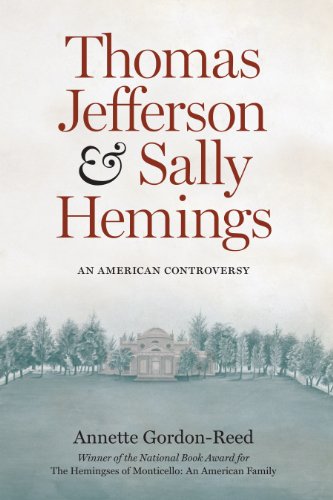
Thomas Jefferson and Sally Hemings: An American Controversy

University of Virginia Press
1998
305 pages
6 x 9
Paper ISBN: 978-0-8139-1833-4

Annette Gordon-Reed, Charles Warren Professor of American Legal History; Carol K. Pforzheimer Professor, Radcliffe Institute for Advanced Study; Professor of History
Harvard University

When Annette Gordon-Reed’s groundbreaking study was first published, rumors of Thomas Jefferson’s sexual involvement with his slave Sally Hemings had circulated for two centuries. Among all aspects of Jefferson’s renowned life, it was perhaps the most hotly contested topic. The publication of Thomas Jefferson and Sally Hemings intensified this debate by identifying glaring inconsistencies in many noted scholars’ evaluations of the existing evidence. In this study, Gordon-Reed assembles a fascinating and convincing argument: not that the alleged thirty-eight-year liaison necessarily took place but rather that the evidence for its taking place has been denied a fair hearing.

Friends of Jefferson sought to debunk the Hemings story as early as 1800, and most subsequent historians and biographers followed suit, finding the affair unthinkable based upon their view of Jefferson’s life, character, and beliefs. Gordon-Reed responds to these critics by pointing out numerous errors and prejudices in their writings, ranging from inaccurate citations, to impossible time lines, to virtual exclusions of evidence—especially evidence concerning the Hemings family. She demonstrates how these scholars may have been misguided by their own biases and may even have tailored evidence to serve and preserve their opinions of Jefferson. This updated edition of the book also includes an afterword in which the author comments on the DNA study that later confirmed the Jefferson and Hemngs liaison.

Possessing both a layperson’s unfettered curiosity and a lawyer’s logical mind, Annette Gordon-Reed writes with a style and compassion that are irresistible. Each chapter revolves around a key figure in the Hemings drama, and the resulting portraits are engrossing and very personal. Gordon-Reed also brings a keen intuitive sense of the psychological complexities of human relationships—relationships that, in the real world, often develop regardless of status or race. The most compelling element of all, however, is her extensive and careful research, which often allows the evidence to speak for itself. Thomas Jefferson and Sally Hemings: An American Controversy is the definitive look at a centuries-old question that should fascinate general readers and historians alike.

Tags: , , , ,

Passing for Black: Sermon

Posted in History, Media Archive, Papers/Presentations, Religion, Slavery, United States on 2011-06-03 04:46Z by Steven

Passing for Black: Sermon

Unitarian Church of Norfolk
Norfolk, Virginia
2010-08-29

Dr. Walter Skip Earl

OPENING WORDS

Forty-seven years ago yesterday, on August 28, 1963, before a huge crowd of African and other Americans gathered in front of the Lincoln Memorial, Dr. Martin Luther King Jr. said:

In a sense, we’ve come to our nation’s capital to cash a check. When the architects of our republic wrote the magnificent words of the Constitution and the Declaration of Independence, they were signing a promissory note to which every American was to fall heir. This note was a promise that all men, yes, black men as well as white men, would be guaranteed the “unalienable rights” of “Life, Liberty and the pursuit of Happiness”. It is obvious today that America has defaulted on this promissory note, insofar as her citizens of color are concerned. Instead of honoring this sacred obligation, America has given the negro people a bad check, a check which has come back marked “insufficient funds.”

But we refuse to believe that the bank of justice is bankrupt. We refuse to believe that there are insufficient funds in the great vaults of opportunity of this nation. And so, we’ve come to cash this check, a check that will give us upon demand the riches of freedom and the security of justice…

…READING:

Our reading this morning comes from the jacket (show) previews of Clarence E. Walker’s 2009 University of Virginia press, MONGREL NATION, The America Begotten by Thomas Jefferson and Sally Hemings. The term “mongrel” is usually used as a derogatory term for “Mixed Race” .

The first quote is from Annette Gordon-Reed, New York Law School and author of THE HEMINGSES OF MONTICELLO: An American Family.

America has indeed been a mongrel nation, not just in terms of blood, but in terms of culture and politics, from the very beginning. Walker very rightly challenges the assumption that the Jefferson-Hemings liaison was either unusual or exceptional.

Secondly, from the author himself, Clarence E. Walker, Professor of History at the University of California, Davis and also the author of WE CAN’T GO HOME AGAIN: An Argument about Afrocentrism.

The debate over the affair between Thomas Jefferson and Sally Hemings rarely rises above the question, “Did they or didn’t they?” But lost in the argument over the existence of such a relationship are equally urgent questions about a history that is more complex, both sexually and culturally, than most of us realize.

(T)he relationship between Jefferson and Hemings must be seen not in isolation but in the broader context of interracial affairs within the plantation complex. Viewed from this perspective, the relationship ..was fairly typical. For many, this is a disturbing realization because it forces us to abandon the idea of American exceptionalism and reexamine slavery in America as part of a long, global history of slaveholders frequently crossing the color line.

More than many other societies—and despite our obvious mixed-race population—our nation has displayed particular reluctance to acknowledge this dynamic….From Jefferson’s time to our own, the general public denied—or remained oblivious to—the possibility of the affair. Historians, too, dismissed the idea, even when confronted with compelling arguments by fellow scholars. It took the DNA finds of 1998 to persuade many (although to this day, doubters remain).

The president’s apologists, both before and after the DNA findings, have constructed an iconic Jefferson that tells us more about their own beliefs—than it does about the interaction between slave owners and slaves. Much more than a search for the facts about two individuals , the debate over Jefferson and Hemings is emblematic of tensions in our society between competing conceptions both of race and of our nation. (underlining is mine)

This sermon is not meant to be a history lesson. Nor is it meant to be a summary of the contents of MONGREL NATION.

Rather, it is my RESPONSE to having read the book. It is my attempt to react to the thesis of Clarence Walker’s latest book within the time frame of these next 15 to 20 minutes. And I appreciate your sharing this with me by listening…

Read the entire sermon here.

Tags: , , , , , ,

The Afro-Mexican presence in Guadalajara at the dawn of independence

Posted in Anthropology, Caribbean/Latin America, Dissertations, History, Media Archive, Mexico, Slavery on 2011-05-23 03:56Z by Steven

The Afro-Mexican presence in Guadalajara at the dawn of independence

Purdue University
December 2010
85 pages
Publication Number: AAT 1490649
ISBN: 9781124557854

Beau D. J. Gaitors

A Thesis Submitted to the Faculty of Purdue University by Beau D. J. Gaitors In Partial Fulfillment of the Requirements for the Degree of Master of Arts

Scholars often characterize the Afro-Mexican experience through depictions of a large presence during the colonial period and a rapid decline after Mexican independence. Prior studies emphasized miscegenation and racism as causes of the disappearance of Afro-Mexicans from Mexican society. This thesis addresses the presence and subsequent disappearance of Afro-Mexicans from Guadalajara. Census records show that the Afro-Mexican population in Guadalajara was significant, one-fourth of the population, at the end of the colonial period. However, records also show that the Afro-Mexican population experienced a substantial decline to only two percent of Guadalajara’s population at the dawn of independence. This thesis asserts that the “disappearance” of Afro-Mexicans was a result of integration, especially in the residential and occupational spheres of Guadalajara. The two percent of Afro-Mexicans recorded in the census illustrates that Afro-Mexicans continued to integrate into society and did not simply disappear. Afro-Mexicans became Mexicans through social incorporation into the city through residential, occupational, and marital integration.

Table of Contents

  • LIST OF TABLES
  • ABSTRACT
  • CHAPTER 1. INTRODUCTION
  • CHAPTER 2. THE AFRICAN PRESENCE IN NEW SPAIN
  • CHAPTER 3. THE GROWTH OF GUADALAJARA TO 1791
  • CHAPTER 4. RESIDENTS OF GUADALAJARA 1791-1822
  • CONCLUSION
  • BIBLIOGRAPHY

List of Tables

  • Table 1. Afro-Mexicans in Guadalajara, 1821-1822, by Cuartel
  • Table 2. Marriage within Race (Major Groups)
  • Table 3. Afro-Mexican Marriage Across Race
  • Table 4. Race in the System of Education
  • Table 5. Distribution of Afro-Mexican Occupational Positions

CHAPTER 1. INTRODUCTION

On December 6, 1810, standing on the balcony of the Palacio Real in the city of 

Guadalajara, Father Miguel Hidalgo y Costilla proclaimed the independence of the Mexican nation. In this proclamation he also declared that the independence of Mexico, known as New Spain in the colonial period, would be accompanied by the emancipation of all slaves in the nation.1 More specifically, Hidalgo stated that all slaveholders should emancipate their slaves within ten days of the decree. These enslaved individuals constituted several different racial and ethnic groups, including Native American and African. Native Americans were taken captive during wars and employed as slaves by the Spanish especially in Northern New Spain. In contrast, the vast majority of Africans arrived in New Spain alongside Europeans either as enslaved laborers or free conquistadors, creating a sizeable population of Africans within New Spain. African descendants remained in many regions of New Spain throughout the colonial period; however, centuries of assimilation and integration rendered the African presence in Mexico miniscule at the dawn of independence.

Today when people are asked, “What is a Mexican?” individuals rarely visualize a person of African descent. Despite a considerable presence in the history of Mexico, Mexicans of African descent, or Afro-Mexicans, have been essentially invisible in the history of Mexico. Afro-Mexicans, like many other marginalized groups in other nations, have been constantly neglected in contemporary national narratives or given brief references in national histories despite the prominent historic role they played. Afro-Mexicans have experienced varying degrees of invisibility in the contemporary portrayal of Mexican history and national identity. The neglect of the Afro- Mexican in the national history directly impacts the present-day position of people of African descent in Mexico. The inability of individuals to immediately and quickly point to the significant contributions and the presence of Africans in the history of Mexico makes it easy to assume that African descendants do not have a space in present-day Mexico. More specifically, the neglect of the African presence in the narrative of Mexico makes it easy for people to imagine Mexico as a nation without strong ties to African heritage and blood. Yet, in the last fifteen to twenty years, Afro-Mexicans have struggled to gain a representative space in the Mexican self-portrait, causing many scholars to reevaluate and reconsider the presence of people of African descent in Mexico. Although individuals have reconsidered the varying degrees of invisibility of the African heritage in Mexico, there is still a lack of momentum in recovering the African links to Mexico in the present day.

The process resulting in the invisibility of Afro-Mexicans is not simply a contemporary issue; it is steeped in the historic construction of the Mexican identity. Centuries of miscegenation and assimilation of different racial and ethnic groups led to the creation of a multi-racial society in Mexico. Theories emerged to account for the image of the Mexican nation and its interracial heritage. Individuals in power constructed the Mexican identity with great influence on the perceptions of citizens. In the 1920s Mexican intellectuals, most notably José Vasconcelos, began to promote the idea of a cosmic race, “la raza cósmica,” in Mexico. This theory sought to promote a collective group identity that went beyond race and ethnicity in Mexico. Individuals of Spanish descent, Native American descent, and African descent populated the vast region that made up Mexico. However, these three groups had many variations within themselves. There were numerous indigenous groups that populated the region that would later become Mexico. People of African descent had a significant role in populating Mexico in the colonial period. Some were born in different regions in Africa and brought to the New World, while others were born in the Americas. Furthermore, the African position in the colonial system varied, as some Africans were enslaved while others were free. Just as with the African case, there were Spaniards who were born in the New World, known as criollos, and Spaniards born in Spain, known as peninsulares. Throughout the colonial and post-independence periods the indigenous, African, and Spanish groups constituted a multiracial and multiethnic society. Contributing to this mixed landscape were the sexual relations between these individuals, resulting in the birth of mixed-race individuals who inhabited colonial Mexico.

The concept of the “cosmic race” necessitated the erasure of specific group contributions in the construction of the Mexican state in order to create a homogenized Mexican national identity. This new identity was intended to go beyond the multiple distinct groups and mixed groups in Mexican society. The new Mexican identity would theoretically represent the diverse groups as equal participants in the construction of the Mexican nation. These diverse groups would be represented as part of a collective that provided the building blocks to construct the Mexican nation. Yet, the emergence of a homogenous identity resulted in a substantial disappearance and neglect of some groups that participated in the construction of Mexican society. Individual groups were subsumed into the collective identity of the Mexican nation as their contributions were bulked into a single framework of progress.

Although specific groups were brought into a collective identity, they found it difficult to ignore their distinct differences. With this in mind, specific groups presented themselves as both Mexican and their unique group identity. When the cultural contributions to Mexico were acknowledged, the focus was on Spanish and indigenous groups as the primary participants in the construction of Mexico, while the contributions of Afro-Mexicans were relegated to the margins.

Although Afro-Mexicans have been relegated to the margins, their presence in Mexico cannot be so easily overlooked. There are locations in Mexico that hold populations of African descendants in large numbers. Coastal regions and port cities such as Costa Chica, Guerrero, and Veracruz, reflect the significant presence of people of African descent in Mexico. Despite the presence in these regions, the potential for the representation of Afro-Mexicans is limited. The concentration of Afro-Mexicans in these regions encourages the social invisibility of African presence within the greater Mexican nation. More specifically, it is readily assumed that people of African descent have resided solely in these areas. However, Afro-Mexicans were also present on a large scale in other areas of Mexico, especially in urban centers such as Mexico City and Guadalajara. Many Afro-Mexican slaves found their way to various locales in colonial Mexico as a result of slavery and the migratory patterns of slaveholders…

Purchase the dissertation here.

Tags: , , , , ,

Black or White?

Posted in Articles, Biography, History, Law, Media Archive, Passing, Slavery, United States on 2011-05-21 01:27Z by Steven

Black or White?

The New York Times
2011-05-14

Daniel J. Sharfstein, Professor of Law
Vanderbilt University

Daniel J. Sharfstein is the author of “The Invisible Line: Three American Families and the Secret Journey from Black to White.”

In February 1861, just weeks after Louisiana seceded from the Union, Randall Lee Gibson enlisted as a private in a state army regiment. The son of a wealthy sugar planter and valedictorian of Yale’s Class of 1853, Gibson had long supported secession. Conflict was inevitable, he believed, not because of states’ rights or the propriety or necessity of slavery. Rather, a war would be fought over the inexorable gulf between whites and blacks, or what he called “the most enlightened race” and “the most degraded of all the races of men.” Because Northern abolitionists were forcing the South to recognize “the political, civil, and social equality of all the races of men,” Gibson wrote, the South was compelled to enjoy “independence out of the Union.” (Read Randall Lee Gibson’s article, “Our Federal Union.”)

The notion that war turned on a question of black and white as opposed to slavery and freedom was hardly an intuitive position for Gibson or for the South. Although Southern society was premised on slavery, the line between black and white had always been permeable. Since the 17th century, people descended from African slaves had been assimilating into white communities. It was a great migration that was covered up even as it was happening, its reach extending into the most unlikely corners of the South: although Randall Gibson was committed to a hardline ideology of racial difference, this secret narrative of the American experience was his family’s story.

Gibson’s siblings proudly traced their ancestry to a prosperous farmer in the South Carolina backcountry named Gideon Gibson. What they didn’t know was that when he first arrived in the colony in the 1730s, he was a free man of color. At the time the legislature thought he had come there to plot a slave revolt. The governor demanded a personal audience with him and learned that he was a skilled tradesman, had a white wife and had owned land and slaves in Virginia and North Carolina. Declaring the Gibsons to be “not Negroes nor Slaves but Free people,” the governor granted them hundreds of acres of land. The Gibsons soon married into their Welsh and Scots-Irish community along the frontier separating South Carolina’s coastal plantations from Indian country. It did not matter if the Gibsons were black or white—they were planters…

Read the entire opinion piece here.

Tags: , , , ,

From the Curse of Ham to the Curse of Nature

Posted in Anthropology, Articles, Health/Medicine/Genetics, History, Slavery on 2011-05-20 03:42Z by Steven

From the Curse of Ham to the Curse of Nature

The British Journal for the History of Science
Volume 40, Issue 3 (2007)
pages 367-388
DOI: 10.1017/S0007087407009788

Robert Kenny, ARC Research Fellow
The Australian Centre, School of Historical Studies
La Trobe University, Melbourne, Australia

This paper examines the debate engendered in ethnological and anthropological circles by Darwin’s Origin of Species and its effects. The debate was more about the nature of human diversity than about transmutation. By 1859 many polygenists thought monogenism had been clearly shown to be an antiquated and essentially religious concept. Yet the doctrine of natural selection gave rise to a ‘new monogenism‘. Proponents of polygenism such as James Hunt claimed natural selection had finally excluded monogenism, but Thomas Huxley, the most prominent exponent of the new monogenism, claimed it amalgamated the ‘best’ of both polygenism and monogenism. What it did provide was an explanation for the irreversible inequality of races, while it maintained that all humans were of one species. This bolstered belief in the innate superiority of the Caucasians over other peoples. The effect was finally to sever British ethnology from its evangelical monogenist roots. More subtly and surprisingly, it provided support in Church circles for a move away from the ideal of the ‘Native Church’.

It is well known that Darwin’s Origin of Species avoided applying the mechanism of natural selection to the development of the human species. Darwin waited twelve years before publishing his Descent of Man in 1871. Others were not so reticent. Natural selection provoked debate in British ethnological and anthropological circles through the 1860s, debates enacted in the shadow of the American war over slavery and British colonial expansion. Just as much as they were prompted by the transmutation theory, the debates had their antecedents in competing views of human diversity: did the variety of human races represent a single species descended from a common ancestor, or did the variety indicate separate species of humans descended from uncommon ancestors? Before 1859 the monogenist camp was seen, particularly by its opponents, as having based its arguments on religious conviction as much as on science, while many polygenists also saw their position as at least as much in harmony with Christian Scripture. But, to the surprise of many polygenists, after 1859 many of the most famous Darwinians, who had little truck with religion as a source of scientific knowledge, proclaimed themselves monogenists.

In the standard historiography, particularly in the writings of George Stocking, these debates are characterized as involving a conflict between a ‘Darwinian’ camp, ensconced in the Ethnological Society of London, and the ‘Anti-Darwinians’ of the Anthropological Society of London.1 Such histories, aiming to elucidate the progress of the ‘Darwinian revolution’ within anthropology, have underplayed the fundamental shift that occurred in the predominant attitude of the Ethnological Society under the influence of the Darwinians. This shift turned a monogenism of practical equality of races into a monogenism that accepted an irrevocable inequality of races and was politically little different from the polygenism advocated by the leaders of the Anthropological Society. Such histories have also overplayed polygenists’ antagonism to Darwin’s theory—for many polygenists transmutation was a means to understand the plurality of races as a plurality of species. The aim here is to examine the mechanics of the shift in monogenism and to show that natural selection, at least as then perceived by many, challenged and fatally undermined both polygenism and orthodox monogenism at their foundations. In so doing it established a new ‘scientific’ argument for human inequality that was to have far-reaching and surprising effects…

…Polygenisms

Despite his monogenism, Hodgkin was a long-time friend of the most vocal polygenists of the time, Robert Knox and the American Samuel Morton. They were all Edinburgh students together. Notoriously implicated in the Edinburgh scandals of Burke and Hare, Knox enthusiastically argued that the mulatto offspring of a European-native coupling were non-productive in the same way as a mule. He held that even in Ireland there had been ‘no amalgamation of the Celtic and Saxon blood’. This was not a novel position, as the term implies—’mulatto’ is from the Spanish for young mule. It was commonly held by settlers in Australia that Aboriginal women who had once borne a child to a European were thenceforward unable to conceive with an Aboriginal man. This supposed fact was used by Samuel Morton to support his polygenist doctrines in America, where polygenism had a greater following because it could so easily be used to support slavery. It had enough currency that Darwin felt the need to mention its disproof as late as 1871 in his Descent of Man.

Morton was famous for collecting and measuring skulls to demonstrate the moral and intellectual differences between races. His work was well known on both sides of the Atlantic. As Stephen Jay Gould demonstrated in his Mismeasure of Man, Morton fudged the measurements to ‘prove’ the Caucasian brain was bigger. This proof became a commonplace—in the decades that followed many writers used the term ‘ larger-brained European’. Friendship notwithstanding, Hodgkin was unimpressed by this science of skulls. In 1849 he wrote, ‘Having myself paid some attention to the ethnological grouping of skulls, I must confess that I have found considerable difficulty in adopting points of characteristic difference; and in this difficulty I find an argument in favour of the unity of species. ‘ He found greater variety of cranial capacity, Morton’s measure of cognitive ability, between individuals within a local group than between distant groups…

Read the entire article here.

Tags: , ,

The Creolizing Subject: Race, Reason, and the Politics of Purity

Posted in Books, Caribbean/Latin America, Media Archive, Monographs, Philosophy, Slavery on 2011-05-16 23:16Z by Steven

The Creolizing Subject: Race, Reason, and the Politics of Purity

Fordham University Press
May 2011
256 pages
Paperback ISBN: 9780823234509; Hardback ISBN: 9780823234493

Michael J. Monahan, Associate Professor of Philosophy
Marquette University

How does our understanding of the reality (or lack thereof ) of race as a category of being affect our understanding of racism as a social phenomenon, and vice versa? How should we envision the aims and methods of our struggles against racism?

Traditionally, the Western political and philosophical tradition held that true social justice points toward a raceless future—that racial categories are themselves inherently racist, and a sincere advocacy for social justice requires a commitment to the elimination or abolition of race altogether. This book focuses on the underlying assumptions that inform this view of race and racism, arguing that it is ultimately bound up in a “politics of purity”—an understanding of human agency, and reality itself, as requiring all-or-nothing categories with clear and unambiguous boundaries. Racism, being organized around a conception of whiteness as the purest manifestation of the human, thus demands a constant policing of the boundaries among racial categories.

Drawing upon a close engagement with historical treatments of the development of racial categories and identities, the book argues that races should be understood not as clear and distinct categories of being but rather as ambiguous and indeterminate (yet importantly real) processes of social negotiation. As one of its central examples, it lays out the case of the Irish in seventeenth-century Barbados, who occasionally united with black slaves to fight white supremacy—and did so as white people, not as nonwhites who later became white when they capitulated to white supremacy.

Against the politics of purity, Monahan calls for the emergence of a “creolizing subjectivity” that would place such ambiguity at the center of our understanding of race. The Creolizing Subject takes seriously the way in which racial categories, in all of their variety and ambiguity, situate and condition our identity, while emphasizing our capacity, as agents, to engage in the ongoing contestation and negotiation of the meaning and significance of those very categories.

Table of Contents

  • Acknowldegements
  • Introduction
  • Contingency, History, and Ontology: On Abolishing Whiteness
  • Turbulent and Dangerous Spirits: Irish Servitude in Barbados
  • Race and Biology: Scientific Reason and the Politics of Purity
  • “Becoming” White: Race, Reality, and Agency
  • The Politics of Purity: Colonialism, Reason, and Modernity
  • Creolizing Subjects: Antiracism and the Future of Philosophy
  • Notes
  • Works Cited
  • Index
Tags: , ,

‘The offspring of infidelity’: Polygenesis and the defense of slavery

Posted in Dissertations, Health/Medicine/Genetics, History, Media Archive, Slavery, United States on 2011-05-16 01:54Z by Steven

‘The offspring of infidelity’: Polygenesis and the defense of slavery

Emory University
2008
506 pages
Publication Number: AAT 3332327
ISBN: 9780549849544

Christopher Luse, Instructional Assistant Professor of History
University of Mississippi

This dissertation examines an internal debate within the antebellum South over the nature of slavery and race. Focusing on the printed materials of the public sphere, this work explores the impact of a newly popular doctrine within ethnology, polygenesis, on the southern defense of slavery. Supporters of polygenesis claimed that non-white races were not merely inferior, but separately created species with fundamentally different physiological, intellectual and moral natures. For centuries polygenesis had been over shadowed by the orthodox doctrine in ethnology, monogenesis, which claimed that all races descended from a common ancestor (Adam and Eve). Under attack from antislavery forces, white southerners turned to polygenesis. They asserted that only the permanent inferiority of blacks justified bondage. Southern physicians were at the forefront of popularizing this defense, using their knowledge of medicine and physiology to claim that blacks resembled apes more than Caucasians. Southern newspaper editors took up the cause to refute abolitionist attacks. Supporters developed the theory of “hybridity,” claiming that people of mixed racial ancestry were “hybrids” doomed to disease, infertility and an early death. Southern supporters used this theory to assert only slavery prevented “amalgamation.” In response, southern Christians heatedly attacked this new “infidelity” as undermining the Bible, the chief defense of slavery. Southern ministers defended their vision of “Christian Slavery.” They claimed that southern slavery was based on a beneficial paternalistic master-slave relationship. Polygenesis undermined the common bonds of humanity necessary for paternalism. Southern Christians used the latest scientific research to argue for a common physical and moral nature among all the races. With the coming of the Civil War, southern Christians attempted to reform slavery up to “Bible Standards” by legalizing slave marriages and access to the Bible. They failed. In the aftermath of defeat, many white Christians adopted polygenesis to attack Reconstruction and racial equality.

A Dissertation Submitted to the Faculty of the Graduate School of Emory University in partial fulfillment of the requirements for the degree of Doctor of Philosophy, Department of History

Table of Contents

  • Introduction
  • Chapter 1: Proslavery Ethnology
  • Chapter 2: Hybridity and Other Threats
  • Chapter 3: Christian Slavery
  • Chapter 4: The Moral and Theological Critique
  • Chapter 5: The Scientific Critique of Polygenesis
  • Chapter 6: I he Crisis of Christian Slavery
  • Bibliography

INTRODUCTION

On the eve of the secession of South Carolina, Reverend James Henley Thornwell held southern slaveholders to Scriptural standards and found them wanting. Thornwell, a reluctant secessionist, delivered a jeremiad to call on southerners to repent as they faced the fiery trial of preserving their embattled slaveholding community. The Presbyterian Thornwell, a prestigious clergyman often called “the Calhoun of the Church,” denounced a grave threat to slavery. The target of his wrath was not only the ravings of abolitionists, but the “science, falsely so-called” which defended slavery by making “the slave a different being from his master.” Thornwell maintained “those who defend slavery upon the plea that the African is not of the same stock with ourselves, are aiming a fatal blow at the institution by bringing it into conflict with the dearest doctrines of the Gospel.” Thornwell viewed with consternation the increasing popularity of polygenesis, a previously marginal theory within ethnology. This emerging school not only asserted the inferiority of “lower races,” but claimed their separate creation as species with fundamentally different natures. Within the antebellum South a paradoxical debate raged. Southern white Christians, staunch defenders of slavery, attacked this new form of scientific racism by defending the humanity of black slaves. The southern critics of polygenesis even employed many of the same arguments and sources as abolitionists. Thornwell aimed his harshest anathemas at southerners who adopted this “infidel” theory to defend slavery. Thornwell admitted that “our offense has been, that in some instances we have accepted and converted into a plea, the conclusions of this vain conceit.”

In his brilliant sermon Thornwell managed to address the most important themes of the controversy. He argued “such speculations have not sprung from slavery. They were not invented to justify it. They are the offspring of infidelity, a part of the process by which science has been endeavoring to convict Christianity of falsehood.” Thornwell was only partially correct. Polygenesis, and scientific racism as a whole, had multiple roots. The debate involved not only slavery, but the long process of accommodation and conflict between science and religion within Western culture. It did not pit enlightened scientists against obscurantist religious bigots, although the polygenists loved to claim as much. Foes of polygenesis like Thornwell defended an established vision of the relation of science to religion that proclaimed the unity between the Word and Works of the Creator. The troubled but vital partnership between Christianity and science underwent profound strain due to the use of ethnology to defend slavery and racial subordination. Because, with apologies to Thornwell, it is clear that the necessity to defend slavery and racial subordination drove the development of polygenesis, which also became very popular in the North and Europe. The Northern Democratic Party, especially, used polygenesis to denounced calls for racial equality.

I propose to resurrect and analyze a half-forgotten debate which illustrates major issues in antebellum intellectual and cultural life. I contend that the controversy was much more prominent in the sectional turmoil than has been generally appreciated. The issue was fiercely contested in the pulpit, the lecture platform, in newspaper editorials and on the political stage. The debate was not the mere hobby-horse of a small group of researchers confined to erudite scientific journals. Its prominence is reflected in both secular and denominational newspapers. I have sought the most popular sources available. In part, this explosion of material was due to significant innovations in print technology and transportation during the era. The late antebellum era witnessed a massive increase in the circulation of newspapers and reading material. I have assembled this weight of material to demonstrate that the controversy was pervasive in the public realm. Newspaper editorials often assumed the basic points of the issue to be public knowledge. The conflict affected a host of pressing issues, from slavery to the rise of new scientific disciplines to the nature of republican government. The debate pervaded the public sphere.

The debate illuminates southern slavery and southern culture as a whole. Historians continue to debate heatedly the nature of slavery. The controversy over polygenesis uncovers a uniquely conservative, patriarchal and religious worldview as well as a serious indigenous challenge to this Christian, paternalistic ideology. The antebellum South increasingly denounced the powerful currents of egalitarianism, religious liberalism, and “infidelity” sweeping the western world, but they could not separate themselves from them. Southerners saw themselves as modern men participating in the larger developments of Western civilization. They used the latest innovations in sociology, political science and natural history to defend an institution denounced as immoral and archaic by the rest of the Western world…

…Along with abolitionism and socialism, proslavery Christians wrestled with another “ism,” racism. At the heart of the ethnological debates was the nature of race. In order to understand the antebellum controversy it is necessary to deal with some of the theoretical issues of race. Nineteenth century ethnologists celebrated their increased understanding of human differences as a major advance in understanding the natural world. They believed that they discovered the nature of human variations in the same fashion that Isaac Newton discovered the laws of physics. They believed they had gained insight into the plans of the Creator. “Race” was an expression of natural law, not an artificial human category. In contrast, for the past eighty years, biologists, anthropologists and geneticists have been dismantling the idea of race as a valid scientific concept. In a fascinating instance of foreshadowing, antebellum critics of polygenesis anticipated a number of the modern assaults on race. Opponents repeatedly pointed out the impossibility of clearly defining racial boundaries. They presented the imperceptible gradations of complexion, hair and physiognomy among the races. Proslavery Christians even denied that there existed a uniform, degraded “Negro Type.” Modern geneticists have mapped the extraordinary amount of genetic overlap between the various “races,” concluding that on the most basic level of chromosomes and genes, the races are the same. As Audrey Smedley puts it, the “Biogenetic variations in the human species are not the same phenomenon as the social clusters we call ‘races.'” Modern scientists have largely abandoned race in favor of geographically based “breeding populations” with varying gene frequencies.

Modern anthropologists have traveled a similar path. Beginning in the early twentieth century with the pioneering work of Franz Boas, anthropologists have stressed the plastic nature of human behavior and capacities. Anthropologists view human behavior as mostly culturally determined and transmitted. For the purposes of this study, the most crucial insight is that race is socially and culturally constructed. Race is an ideology, not a science. Barbara J. Fields writes “Race is not an element of biology (like breathing oxygen or reproducing sexually), nor even an idea (like the speed of light or the value of pie) that can be imagined to live an eternal life of its own. Race is not an idea but an ideology.” Racial thought is inseparable from the purposes it serves within a specific society, the conflicts it attempts to resolve (or disguise), the hierarchies it justifies and the meanings it explains. The ideology of race is the descriptive vocabulary of the everyday reality of power relations, more specifically, of the historic ability of European peoples to dominate other peoples. Ideologies of race are always historic despite their focus on the natural world. Most scholars insist that “race” did not exist in anything like its modern form until the era of European discovery and expansion. Race was the product of unique historical developments despite the efforts of ethnologists to give permanency to racial categories. Like all ideologies, although not “real” in a scientific sense, race is the cultural expression of very real social relations. Race is a human invention in much the same sense as political systems, art or literature. And like all human creations, it changes according to the needs of its society.

The seductive power of race as an ideology rests in its explanatory power and its simplicity. Racial ideologies empower all members of the superior social caste to make immediate judgments on the worthiness and intelligence of the “lower races” which determine the allotting of power and privileges. Almost as important is its ability to comprehensively explain the world. This power underscores a contention of this project: that polygenesis represented the first comprehensive racial ideology. This new doctrine explained all of human history and culture in terms of permanent, inherent racial traits. Earlier theories on the origin and nature of races focused narrowly on how physiological distinctions originated. They attempted to explain how peoples seemed to differ. Early ethnologists sought explanations for human variations that preserved the idea of a common human origin. In contrast, polygenists placed race at the center of human history. They focused on why humans differed.

The late emergence of polygenesis as a prominent theory underscores one aspect of racism. Race as a concept did not emerge through scientific research or historical investigation, but through the experience of domination and exploitation. For centuries prior to the emergence of sophisticated racial theories, “folk racist” beliefs of the inferiority of other races were prevalent in America. Most of the scientific findings of polygenists justified long standing beliefs concerning Indians and Africans. In Colonial America, whites contended that only Africans could labor in the semi-tropical South and that mulattoes were weaker and more diseased than the pure races. Nineteenth-century ethnologists gave a veneer of  authority to these beliefs by expounding theories of “hybridity” and “acclimation.” Racial ideologies are nothing if not purposeful. They almost always address a pressing need, whether it is the need to justify the necessity of enslaved labor to grow staple crops, or the necessity to control a dangerous “middle caste” between black slaves and white freemen.

By the late antebellum era, “folk racist” beliefs solidified into a set of core contentions concerning “lower races.” This increasing sophistication underscores the dynamic and fluid nature of racist beliefs. As slavery came under increasing attack, basic assumptions concerning blacks could no longer be taken for granted. They required increasing support and evidence. Among the most important “principles” of scientific racism were that races represented permanent distinctions which could be measured and evaluated. These distinctions organized themselves in a hierarchy of racial “types.” “Types” were idealized representations which disguised all the innumerable complexities among actual peoples. In antebellum racial types, all Caucasians possessed the profile of a Grecian god, while all blacks were ape-like and prognathous. These types expressed the true nature of the distinct races. These types represented not merely physiological differences, but basic moral, spiritual and intellectual distinctions. Racists emphasized that surface somatic variations were merely signs indicating the more fundamental racial “essences.” White seeming quardoons were in a deep physiological and psychological sense still black or an unnatural mixture. Ethnologists contended that these fundamental distinctions reflected God’s will embodied in natural law…

Purchase the dissertation here.

Tags: , ,

Negro History, Part X: Miscegenation in America

Posted in Articles, History, Law, Media Archive, Slavery, Social Science, United States on 2011-05-15 01:53Z by Steven

Negro History, Part X: Miscegenation in America

Ebony Magazine
October 1962
pages 94-104
(Digitized by Google)

Lerone Bennett, Jr., Executive Editor

The material in this chapter on miscegenation during the slavery period is based largely on James Hugo Johnston’s doctorial dissertation at the University of Chicago, Race Relations in Virginia and Miscegenation in the South, 1776-1860; Carter Woodson’s article. “The Beginnings of The Miscegenation of the Whites and Blacks” in The Journal of Negro History; and A. W. Calhoun’s study, A Social History of the American Family.

Sin. Sex. Race.

The three words took deep roots, intertwined and became one in the Puritan psyche. In the famous sermon preached at Whitechapel in 1609 for Virginia-bound planters and adventurers, the minister fused the words in a stern admonition against miscegenation. From Genesis he summoned the figure of Abram who left his country and his father’s house and migrated to a land God had prepared for his seed.

“Abram’s posteritie,” the preacher said, “(must) keepe to themselves. They may not marry nor give in marriage to the heathen, that are uncircumcised…  …The breaking of this rule, may breake the necke of all good successe of this voyage, whereas by keeping the feare of God, the planters in shorte time, by the blessing of God, may grow into a nation formidable to all the enemies of Christ.”

It was easier said than done.

From the beginning, English colonists, following Abram’s example, married and mated with Hagars—red and black. Even more distressing to the Puritan mind was the broad tolerance of the English women who married and mated with Hagars brothers. Proscription began early. In 1630, a bare 21 years after the Whitechapel sermon, one Hugh Davis was “soundly whipped before an assemblage of Negroes and others for abusing himself to the dishonor of God and the shame of Christians by defiling his body in lying with a Negro…” Forty years later, white women were being whipped and sold into slavery and extended servitude for showing open preferences for Negro men. Alarmed by widespread miscegenation, colonists from South Carolina to Massachusetts began a systematic campaign which ultimately made the Whitechapel sermon the racial policy of the land. Every instrument of persuasion was used to teach white people that they should “not marry nor give in marriage” to Negroes. No amount of persuasion, however, could “keepe” whites to themselves.

Miscegenation in America started not in the thirteen original colonies but in Africa. English, French, Dutch and American slavetraders took black concubines on the Guinea coast and mated with females on the slave ships. It should be noted that many Africans and Europeans were themselves the products of thousands of years of mixing between various African, Asian and Caucasian peoples.

In and around Jamestown and the Massachusetts of Cotton Mather, there was an extensive trade in genes. Socio-economic conditions in the early colonies encouraged racial mingling. White men and women from England, Ireland and Scotland were bought and sold in the same markets with Negroes and bequeathed in the same wills. As indentured servants bound out for five or seven years, these whites worked in the fields with Negro servants and lived in the same rude tenant huts. A deep bond of sympathy developed between the Negro and white indentured servants who formed the bulk of the early population. They fraternized during off-duty hours and consoled themselves with the same strong rum. And in and out of wedlock, they sired a numerous mulatto brood.

When Negro servants were reduced to slavery, the colonial governing classes redoubled their efforts to stamp out racial mixing. Miscegenation in this era was not only a breach of Puritan morality, but it was also a threat to slavery and the stability of the servile labor force. As early as 1664, Maryland enacted the first anti-amalgamation statute. It was an astonishing document. The statute was aimed at white women who had resisted every effort to inoculate them with the virus of racial pride; and the preamble stated very clearly the reasons which drove white men to the extremity of enslaving white women.

And forasmuch as divers freeborn English women, forgetful of their free condition, and to the disgrace of our nation, do intermarry with negro slaves, by which also divers suits may arise, touching the issue of such women, and a great damage doth befall the master of such negroes, for preservation whereof for deterring such freehom women from such shameful matches, be it enacted: That whatsoever free-born woman shall intermarry with any slave, from and after the last day of the present assembly, shall serve the master of such slave during the life of her husband; and that all the issues of such free-born women, so married, shall be slaves as their fathers were.

This law failed to stay intermarriage. Some women chose love and slavery; others were reduced to slavery by scheming planters who forced them to marry Negro men in order to reap the additional economic benefits accruing from the extended service of the mothers and the perpetual slavery of their children. A celebrated case revolved around Irish Nell, an indentured servant who came over with Lord Baltimore. When Baltimore returned to England, he sold Irish Nell to a planter who forced or encouraged her to marry a Negro. Shocked by the practice of prostituting white women for economic purposes. Lord Baltimore used his influence to get the law changed. The new law was about as effective as the old one—which is to say, it was not effective at all. E. I. McConnac, the authority on white servitude in Maryland, said: “Mingling of the races in Maryland continued during the eighteenth century, in spite of all laws against it.”

Negro-white marriages, especially Negro male-white female marriages, were a problem in Virginia and other colonies. In 1691, Virginia restricted intermarriage. Similar laws were put on the books in Massachusetts in 1705, North Carolina in 1715. South Carolina in 1717. Shortly after the enactment of Virginia’s ban on intermarriage, Ann Wall was convicted of “keeping company with a Negro under pretense of marriage.” The Elizabeth County court sold Ann Wall for five years and bound out her two mulatto children for 31 years, and “it is further ordered,” the court said, “that ye said Ann Wall after she is free from her said master doe at any time presume to come into this county she shall be banished to ye Island of Barbadoes.”

In an unsuccessful attempt to halt intermingling, Pennsylvania banned intermarriage in 1725. Forty-five years later, during the glow of the Revolution, Pennsylvania repealed the ban on intermarriage. Thereafter, mixed marriages became common in Pennsylvania. Thomas Branagan visited Philadelphia in 1805 and averred that he had never seen so much intermingling. “There are,” he wrote, “many, very many blacks who… begin to feel themselves consequential… …will not be satisfied unless they get white women for wives, and are likewise exceedingly impertinent to white people in low circumstances… I solemnly swear, I have seen more white women married to, and deluded through the arts of seduction by negroes in one year in Philadelphia, than for eight years I was visiting (West Indies and the southern states)… …There are perhaps hundreds of white women thus fascinated by black men in this city and there are thousands of black children by them at present.”

Aristocrats did not always obey the rules they made. Benjamin Franklin, it is said, was quite open in his relationships with black women. Carter Woodson, the careful historian, says Franklin “seems to have made no secret of his associations with Negro women,” Well-to-do people usually stopped short of legal marriage, but there is evidence that some threw caution to the wind. The following item appears in the will of John Fenwick, the Lord Proprietor of New Jersey. “Item, I do except against Elizabeth Adams of having any ye leaste part of my estate, unless the Lord open her eyes to see her abominable transgression against him, me her good father, by giving her true repentance, and forsaking ye Black ye hath been ye ruin of her; and becoming penitent of her sins; upon ye condition only I do will and require my executors to settle five hundred acres of land upon her.”…

Read the entire article here.
Tags: , , , , , , , , ,

A Transnational Temperance Discourse? William Wells Brown, Creole Civilization, and Temperate Manners

Posted in Articles, Biography, History, Literary/Artistic Criticism, Slavery, United States on 2011-05-14 03:03Z by Steven

A Transnational Temperance Discourse? William Wells Brown, Creole Civilization, and Temperate Manners

The Journal of Transnational American Studies
Volume 3, Issue 1 (2011)
Article 16
27 pages

Carole Lynn Stewart, Assistant Professor of English
University of Maryland, Baltimore County

In the nineteenth century, temperance movements provided the occasion for a transnational discourse. These conversations possessed an intensity throughout Britain and the United States. In America temperance often became associated with strongly nationalistic Euro-American forms of identity and internal purity. Nonetheless, African American reformers and abolitionists bound themselves to temperance ideals in forming civil societies that would heal persons and provide communal modes of democratic freedom in the aftermath and recovery from chattel slavery. This paper explores the possibilities of temperance as a transnational discourse by considering its meaning in the life and work of the African American author and activist, William Wells Brown. Brown expressed a “creole civilization” that employed the stylistics of the trickster as a unique mode of restraint that revealed a peculiar power of passivity that was able to claim efficacy over one’s life and community. This meaning of temperance diverges from and dovetails with certain European meanings of civilization that were being forged in the nineteenth century. Brown was in conversation with temperance reformers in America, Britain, and Europe. He imagined the possible meaning of temperance in African, Egyptian, Christian, and Islamic civilizations. He speculated upon the possibility of temperance as a defining characteristic of a transnational civilization and culture that would provide spaces for the expression of democratic freedom. Brown reimagined temperance as a form of corporeal restraint that offered a direct and sacred relation to the land, space, people that appeared in between an ethnic nationalist ethos and the European imperialistic civilization.

And when the victory shall be complete—when there shall be neither a slave nor a drunkard on the earth—how proud the title of that Land, which may truly claim to be the birthplace and the cradle of both those revolutionaries, that shall have ended in that victory.

Abraham Lincoln, “An Address Delivered before the Springfield Washingtonian Temperance Society”

In the mid‐nineteenth century, temperance movements throughout Britain and the United States strove for universalist and international goals of individual sovereignty, restraint, and enlightened freedom. As with many international movements of civil societies emerging from the formation of modern states, they expressed themselves in strongly nationalistic forms of identity. American temperance movements often assumed many of the middle‐class, domestic, and individualistic values associated with the Protestant work ethic and its inner‐worldly asceticism. Temperance in general became prominent in the United States in the period that corresponded with the Second Great Awakening in the early 1800s, though examples of temperance organizations predate this surge of social movements in the revivalistic atmosphere. American temperance movements were simultaneously concerned with defining the purity of self and establishing a coherent national identity. The notion and practice of temperance has also been a salient orientation of many religions; however, in the colonial period, not even the New England Puritans were temperance activists. On the one hand, the birth of American temperance seemed to initially appear as a result of the nationalist revolutionary ethos, expressing the desire for widespread civil societies: “temperate” behavior suggested a type of rational, restrained, and public character. On the other hand, temperance movements acquired an evangelical character in the context of the affected and enthusiastic social spaces of “awakening.”

The opening epigraph from Abraham Lincoln captures the contiguity between concepts of slavery and intemperance, as well as the exceptionalist ethos prominent in the United States and brought to bear on issues of individual freedom of the “land.” Indeed, many temperance groups were nativist and virulently racist even when temperance was linked to antislavery. Notably, beyond popular goals of moderation, total abstinence, and prohibition, temperance also expressed different promises and civil ideals for many African American abolitionists who conjoined temperance and antislavery. For the former enslaved, temperance seemed to promote and encompass national values like the Protestant work ethic, self‐reliance, and individual restraint, particularly for the poor and those who were striving for social elevation by inculcating the values of the middle class…

…The word “civilization” does not grow out of American democracy and its revolutionary founding, but rather from modern European imperialism and its emerging structures of civil society. The word is particularly Eurocentric and was not in frequent use until the eighteenth century, first in France and then in England. Historian of religions Charles H. Long observed in his paper “Primitive/Civilized: The Locus of a Problem” that “the meaning of this term cannot be understood apart from the geographies and cultures of the New World that are both ‘other’ and empirical.” While an empirical other—recognized negatively as an enslaved person—Brown consistently wrote of such figures as the “tragic mulatta” and the predicament of one‐drop racism in the United States, with positive views of the eventual “amalgamation” of the “races.” Moreover, discussions of Brown’s work commonly allude to the self‐consciously constructed aspects of his identity—from the lack of a fixed identity, his biracial, nearly outwardly “white” identity that made it possible to almost pass, to Brown’s multiple roles in actual life and his writing. These roles begin with his name William as a child on the plantation being changed to Sandford because another white child had the same name, and his eventual renaming as William Wells Brown. The name was “bestowed upon” him from the Quaker, Wells Brown, who helped him escape. From that fluid and uncertain position, he assumed various vocational and activist roles as a steamboat operator, a barber, a banker, a husband and father, a gentleman among the ladies, a radical abolitionist and republican revolutionary, an anglophile, a temperance activist, a consummate man of letters, a historian, a playwright, a novelist, and, in the 1870s, a medical doctor of uncertain qualifications.

This intermixture of roles and identities also disrupted the familiar binary of primitive/civilized. Brown conceived of the inherently Eurocentric concept of civilization in creolized ways—living an intermixture that opposed the opposition of terms. Indeed, rather than necessarily leading to the situation of the empirical other, what some have understood as Brown’s liminal “trickster” identity could be viewed as a restrained orientation characterizing a basic revolutionary structure out of which Brown saw a modern civilization emerging. This notion of civilization not only came to fruition through Brown’s European travels (1849–1854) and direct reflections on the harbingers of “civilization,” but through his postbellum reflections on African civilizations and his pilgrimage for “home” to establish a dignified relation to the land in My Southern Home (1880). In Brown’s travels, temperance remained the locus for a new, creolized civilization, expressing a manner and style of behavior that resembles a sociogenetic and psychogenetic meaning of restraint forged in light of the history of transatlantic slavery and an imagined revolutionary founding, as well as countering the excesses inherent in modern “civilized” exchanged…

Read the entire article here.

Tags: , , , ,

The Mule as Metaphor in the Fiction of Charles Waddell Chesnutt

Posted in Articles, Literary/Artistic Criticism, Media Archive, Slavery on 2011-05-02 23:00Z by Steven

The Mule as Metaphor in the Fiction of Charles Waddell Chesnutt

Theory and Practice in English Studies
Volume 4 (2005):
Proceedings from the Eighth Conference of British, American and Canadian Studies. Brno: Masarykova univerzita

Christopher E. Koy, Faculty of Arts
University of West Bohemia, Plzen

The term “mulatto,” meaning the offspring of one black parent and one white parent, is a racist term etymologically derived from the Spanish word “mulatto” meaning a young mule. The mule, a sterile offspring of a mare and a male donkey, is an important metaphor in early African American literature and folklore. Anthropologists collected African American tales with mules, and Charles Waddell Chesnutt (1858-1932), inspired in part by this folklore, employed the mule as a metaphor in his literary works to represent the subjugation of blacks.

1 Introduction

The mule, the sterile offspring of a mare and a male donkey, is an important symbol in early African American literature and folklore. The term mulatto, meaning the offspring of one black parent and one white parent, is a racist term etymologically derived from the Spanish “mulatto” meaning a young mule. It is racist because it associates offspring of animals of different species with a person of mixed ancestry. The term “mulatto” is a cognate—even the Czech language uses “mulat/mulatka” to indicate a person of mixed African and Caucasian ancestry. The old-fashioned Czech idiom “drít jako mezek” (to slave like a mule) likewise links slave and mule.

Sander L. Gilman has argued that “the abyss between the perceiver and the object in concepts of race is total. It is a complete form of distancing. Placing the Other beyond the pale by stressing an unchanging sense of self provides an image of the Other that is the antithesis of self” (Gilman 1986: 255). One might assume that the case of people of racially mixed ancestry might fill in this “abyss” described by Gilman. If the person were between black and white, the distance would be shortened, so to speak. Yet, then again it may be an examination of the myth-making which forms the basis of any communal identity that needs to be addressed.

the United States today as in Charles Chesnutt’s time, legally as well as otherwise, a person is classified either as black or white. Birth certificates and visa applications require classification of a person’s race, i.e., “Caucasian” or “African American,”—one or the other, since these forms leave no alternative. The “mulatto” term served as a linguistic means to maintain distance between the “white” and “black” race by defining the mixture of the two as Other (than white). After the Civil Warmiscegenation” came to express the unacceptable notion of race mixing which in American English came to replace the term “amalgamation” as the word of choice.

2 The degeneracy of mulattos

Chesnutt implicitly and explicitly refutes the myth of race mixing as degenerate in part through the trope of the mule. On the plantation, the mule was known as the superior beast of burden to either the horse or donkey. The hybrid animal ate less, worked longer hours and lived longer. It became ill less frequently and required less attention from its owners. These characteristics are echoed in literature about lighter-skinned slaves, who were sold at higher prices at slave auctions. House slaves are further described as more refined, wearing finer clothes, surrounded by wealth as well as mastering to a greater extent than their darker skinned brethren the “more cultivated” language of their white master. Indeed, the lighter the pigmentation of Chesnutt’s African American characters, the closer their English language resembles that of their master, whereas darker blacks always speak African American vernacular…

Early African American fiction and folklore frequently focus on hybrid mulattos and mules. Chesnutt challenges the Anglo-Saxon myth that the mixing of races constitutes degeneracy (implying most often the degeneracy of the white race), an allegation directed against fair skinned heroes and heroines in his fiction. In Chesnutt’s first published novel, The House behind the Cedars, a medical journal reported that “…the smallest trace of negro blood would inevitably drag down the superior race to the level of the inferior” (Chesnutt 1993a[1900]: 71), replicating notorious medical racist notions of the time. In Chesnutt’s most renowned novel, The Marrow of Tradition (1901), a white journalist rebukes a black man who works for him for purchasing hair straightening solutions and chemicals to lighten skin pigmentation:

“Jerry, when I hired you to work for the Chronicle, you were black. The word ‘negro’ means ‘black.’ The best negro is a black negro, of the pure type, as it came from the hand of God. If you wish to get along well with the white people, the blacker you are the better,—white people do not like negroes who want to be white” (Chesnutt 1969[1901]: 245-246).

The advertisement claims, “mulattoes turned perfectly white” (Chesnutt 1969[1901]: 244). A change of appearance is regarded as degenerate as well as a threat to white Southerners. The white journalist knows that Jerry wants to join the privileged group in order to gain power. When his “black face is splotched with brown and yellow patches,” he is publicly exposed as a shoddy counterfeit, his face a metaphor of the “pathetic effort to escape from the universal doom of his race” (Chesnutt 1969[1901]: 245). At the same time that they decried race mixing as degenerate, in Chesnutt’s novels white characters persistently prefer lighter-skinned blacks. In The Quarry, which is set in the first quarter of the 20th century, the hero, Donald Glover, is fair-skinned. He

often had to explain that he was a Negro—he soon found out that most white people preferred the word to any designation that suggested or assumed blood kinship with themselves, though it was quite obvious that he got along better with them than a darker man would have, and in this way they acknowledged in practice what they rigorously ignored in theory (Chesnutt 1999b:189).

This experience was universal in the ante-bellum period, when lighter-skinned slaves served as domestic servants (or “house slaves”). The preference for fair-skinned blacks and the credence that they were somehow “better” or deserved preferential treatment is also not a uniquely American trait but can be observed among liberal-minded European intellectuals of the 19th century as well, even in countries with little experience in slavery or African colonialism…

Read the entire article here.

Tags: , , , , ,