Embodying race: gender, sex, and the sciences of difference, 1830-1934

Posted in Dissertations, Health/Medicine/Genetics, History, Media Archive, Slavery, United States on 2011-08-02 00:52Z by Steven

Embodying race: gender, sex, and the sciences of difference, 1830-1934

Rutgers University, New Brunswick
May 2008
356 pages

Melissa Norelle Stein, Postdoctoral Fellow
Center for Race and Ethnicity
Rutgers University

A Dissertation submitted to the Graduate School-New Brunswick Rutgers, The State University of New Jersey in partial fulfillment of the requirements for the degree of Doctor of Philosophy Graduate Program in History

This project uses the body as a site to examine the complex relationship between science, culture, and politics in the nineteenth- and early twentieth-century United States, and the ways in which gender and sex can be used to conceptualize other categories of difference, such as race and sexuality. Scientists during this period naturalized racial difference and socio-political exclusion by insisting that the bodies of racial minorities were not fully male or female at a time when power, citizenship, property, and protection were conferred according to sex. My dissertation makes other important interventions in the existing scholarship on nineteenth-century racial and scientific thought, as well as American race relations. Rather than treating ethnology as static, I reveal significant change over time in scientific discourse on race with regard to gender and sex. Scientists’ shifting uses of sex and gender to denote racial difference corresponded to larger shifts in American politics and culture, including Emancipation and the gendered questions of citizenship it raised, the rise of evolutionary theory, and turn-of-the-century fears about miscegenation, immigration, homosexuality, and “race suicide.” This discourse was not one-sided or monolithic, however. Accordingly, I also explore tensions within and challenges to white racialist science. Moreover, I demonstrate that scientific discourse was not divorced from the lives of real people; it had a tangible impact on how living human bodies were treated. Finally, while recent scholarship has identified important parallels between racial and sexual science, my work reveals that ethnology and sexology not only shared similar cultural politics in America, they were literally populated by the same prominent scientists.

While at its core an intellectual history of scientific thought on race and gender, this dissertation is not concerned only with ideas and discourse, but how such ideas were received and how they shaped race relations. Thus, my work utilizes a variety of sources—including scientific and medical texts, newspaper articles, private correspondence, political writing, and visual materials such as political cartoons and campaign posters—to interrogate scientists’ engagement with sociopolitical issues as well as the incursion of scientific thought into political culture.

Table of Contents

  • Abstract
  • Acknowledgements
  • List of Tables
  • List of Illustrations
  • Introduction
  • Section One—Gendering Scientific Racism
    • Chapter One—“Races of Men”: Ethnology in Antebellum America
    • Chapter Two—An “Equal Beard” for “Equal Voting”: Gender, Slavery, and Citizenship in American Ethnology, 1850-1877
  • Section Two—Bodily Threats, Threatening Bodies
    • Chapter Three—Inverts, Perverts, and Primitives: Racial Thought and the American School of Sexology
    • Chapter Four—Unsexing the Race: Lynching, Racial Science, and Black Mobilization, 1893-1934
  • Conclusion—The Fall and Rise of Racial Science
  • Appendix
  • Bibliography
  • Curriculum Vita

List of tables

  • Focus of Racial Science Texts by Race, 1830-1859 (Figure 1.1)
  • Thematic Focus of Antebellum Racial Science Texts (Figure 1.3)
  • Changing Focus of Racial Science Texts, 1830-1879 (Figure 2.2)

List of illustrations

  • Illustration, The Races of Men (Figure 1.2)
  • “The Candidate of Many Parties” (Figure 1.4)
  • Frontispiece, Negroes and Negro “Slavery” ( Figure 2.1)
  • Illustration, Types of Mankind (Figure 2.3)
  • “Marriage of the Free Soil and Liberty Parties” (Figure 2.4)
  • “Syphilis” (Figure 2.5)
  • “Nativity of the most capable soldier” (Figure 2.6)
  • “The Two Platforms” (Figure 2.7)
  • Illustrations, The Six Species of Men (Figure 2.8)
  • “Front View of Author at Thirty-three” (Figure 3.1)
  • “Rear View of Author at Thirty-three” (Figure 3.2)
  • “Fairie Boy” (Figure 3.3)
  • “Hermaphroditos” (Figure 3.4)
  • “Profile” (Figure 4.1)
  • “Photo from life by the author” (Figure 4.2)
  • “Walter White, 1935” (Figure 4.3)

…Sterile Hybrids and the Species of Men: Racial Mixture, Taxonomy, and Human Descent

Racial mixture also featured in the origins debate in antebellum ethnology. Numerous ethnologists of the era argued that the offspring between a black parent and white parent were largely infertile and thus incapable of producing a “permanent stock” beyond that first generation. This proved that the two races constituted separate species. Indeed, the word “mulatto” derived from the word “mule” or “a sterile hybrid.”

Not surprisingly, both black and white women were more present in discussions of racial mixture than in general considerations of the original unity or diversity of the races. Even though “mulatto” men and women alike were thought to be weak and largely infertile, discussions of sterile hybridity were more likely to target biracial women specifically as bad breeders. For example, Drs. H.A. Ramsey and W.T. Grant, the editors of the Georgia Blister and Critic, a journal largely dedicated to scientific justifications of chattel slavery, asked its readers: “In the cross of the white and negress, do the Ovary Cells diminish with each cross, until the fourth, and then nearly disappear entirely?” Like Van Evrie characterizing miscegenation between a black man and white woman as an absurdity, the Blister’s focus on the “cross of the white and negress” hinted at the reality of interracial sex in antebellum America. More often than not, it occurred between white men and black women in a culture in which the bodies of female slaves were legally owned by their white masters, and even free black women’s rights to their own bodies were frequently ignored in law and practice.

Hoping to collect opinions and anecdotal evidence from the Blister’s readership to assist his research, Samuel Cartwright had submitted this revealing query about ovary cells, but he was less interested in women per se than in uncovering further evidence of (permanent) racial difference. For their part, the Ramsey and Grant were happy to oblige, noting that “the question is important, and we ask for it a candid and careful investigation.” They admitted they had “presumed an answer, without the necessary data to confirm it.” Their presumptive answer presented no information about black, however. Instead, it made an observation about animals, just as Jefferson had done in the previous century in his own discussion of racial mixture. The editors wrote, “We think it quite probable that the Ovary Cells in the cross of the negress and white, may diminish, until sterility would be the result. Our dissections are not ample enough to determine the point precisely, but we see a cross in the horse and mule, produce sterility and why not in the white and black biped race? We see no reason to question.” They concluded by offering their own anecdotal example: “We will here remark, we had a negro man…with a wife, who is a fourth cross, as far as we can ascertain. She does not breed, although healthy, and her husband has been heretofore the father of children.” Perhaps not surprisingly in a society in which black women, particularly slaves, so often faced sexual exploitation that made the paternity of their children either difficult to ascertain or all too tempting for whites to ignore, white men wanted to believe that “mulatto” women in particular were sterile—at least by the fourth cross.

However, investigations of hybridity usually focused less on women—white or black—than on the the question of whether the races constituted different species or variations of the same species. In a two-part lecture before the Academy of Natural Sciences in Philadelphia in 1846, later published as an article in the American Journal of Science and Arts, Morton stated, “The facts connected with hybridity in the inferior classes of animals, have an important bearing on one of the most interesting questions in Ethnography.” Whereas Morton did not contend that human “mulattoes” were sterile, he maintained that their ability to reproduce did not prove the races to be one species of singular origin either. As Morton’s counter argument indicates, many scientists had made “hybridity the test of specific character,” arguing that animals of different species were unable to reproduce fertile offspring. For some, “sterile hybrids” were thus proof that the races were distinct species.

For Morton, however, the original unity or diversity of the races hinged less on the potential for reproduction between the races and more on the correct definition of “species” and “races.” “Races are properly successions of individuals propagated from any given stock,” Morton argued, “and we agree with the learned Dr. Pritchard, from whom we cite these definitions, that when races can be proved to possess certain primordial distinctions, which have been transmitted unbroken, they should be regarded as true species.” Arguments for the separate origins of the races were best supported by the distinct and unchanging character of the various races over thousands of years rather than the reproductive capacities of racial “hybrids.”

Other ethnologists were not so quick to divorce the issue of racial hybridity from the origins question or to concede that mulattoes could themselves reproduce, but their arguments were similarly geared toward proving longstanding and permanent racial difference. In introducing his 1844 Two Lectures, on the Natural History of the Caucasian and Negro Races, Nott discussed the “effect of crossing races.”65 He also thought that animals could shed light on questions of race, but he believed that the natural sciences had not adequately addressed the issue: “Naturalists have strangely overlooked the effects of mixing races, when the illustrations drawn from the crossing of animals speak so plainly—man physically is, but an animal at last, with the same physiological laws which govern others.” Elsewhere, Nott conceded that though fertile offspring could be produced from black and white parents, such offspring did not have the fecundity of its parent races and that over time it was “the higher type that in the end predominates.” However, no amount of infusion of white blood could turn the black race white or enable a mulatto to escape detection, for the skilled eyes of Nott and other racial experts could always “instantaneously trace the Negro type in complexion and feature.” And why did the “higher type” predominate but never subsume the lower race? Nott concluded, “The only physiological reason that may be assigned is this: the mulattoes, or mixed-breeds, die off before the dark stain can be washed out by amalgamation. No other rational explanation can be offered.” In a text that also offered an explicit defense of slavery—under which the sexual exploitation of slave women by their white masters was actually profitable—it was politically expedient to render racial mixture non-threatening. Thus, Nott argued that the issue of hybridity was of considerable interest to ethnologists, but he dismissed the human “hybrids” themselves as inconsequential, weak and ultimately destined to die out…

Read the entire dissertation here.

Tags: , , ,

Persistent Borderland: Freedom and Citizenship in Territorial Florida

Posted in Dissertations, Europe, History, Media Archive, Native Americans/First Nation, Slavery, United States on 2011-08-01 01:41Z by Steven

Persistent Borderland: Freedom and Citizenship in Territorial Florida

Texas A&M University
August 2007
295 pages

Philip Matthew Smith

A Dissertation by Philip Matthew Smith Submitted to the Office of Graduate Studies of Texas A&M University in partial fulfillment of requirements for the degree of DOCTOR OF PHILOSOPHY in History

Florida’s Spanish borderland was the result of over two hundred and fifty years of cooperation and contention among Indians, Spain, Britain, the United States and Africans who lived with them all. The borderland was shaped by the differing cultural definitions of color and how color affected laws about manumission, miscegenation, legitimacy, citizenship or degrees of rights for free people of color and to some extent for slaves themselves.

The borderland did not vanish after the United States acquired Florida. It persisted in three ways. First, in advocacy for the former Spanish system by some white patriarchs who fathered mixed race families. Free blacks and people of color also had an interest in maintaining their property and liberties. Second, Indians in Florida and escaped slaves who allied with them well knew how whites treated non-whites, and they fiercely resisted white authority. Third, the United States reacted to both of these in the context of fear that further slave revolutions in the Caribbean, colluding with the Indian-African alliance in Florida, might destabilize slavery in the United States.

In the new Florida Territory, Spanish era practices based on a less severe construction of race were soon quashed, but not without the articulate objections of a cadre of whites. Led by Zephaniah Kingsley, their arguments challenged the strict biracial system of the United States. This was a component of the persistent borderland, but their arguments were, in the end, also in the service of slavery and white patriarchy.

The persistent border included this ongoing resistance to strict biracialism, but it was even more distinct because of the Indian-African resistance to the United States that was not in the service of slavery. To defend slavery and whiteness, the United States sent thousands of its military, millions of its treasure, and spent years to subdue the Indian-African alliance and to make Florida and its long shorelines a barrier to protect whiteness and patriarchy in the Deep South.

TABLE OF CONTENTS

  • ABSTRACT
  • ACKNOWLEDGMENTS
  • TABLE OF CONTENTS
  • LIST OF FIGURES
  • LIST OF TABLES
  • CHAPTER
  • I INTRODUCTION
    • The problem
    • An imaginary line
  • II FLORIDA’S BORDERS
    • First-contact Florida.
    • First Spanish Period, 1565-1763
    • British Period, 1763-1784
    • Second Spanish Period, 1784-1821
    • The Adams-Onís Treaty, 1818-1821
  • III A NEW TERRITORY
    • “The Province is as yet such a Blank”
    • First impressions
    • “warm climates are congenial to bad habits.”
    • “There is such a heterogeneous mass here.”
    • Who was in Florida?
    • Appendages and sustenance
    • Who can be a citizen?
    • “no law except the law of force”
    • “the retreat of the opulent, the gay and the fashionable.”
    • Citizenship, lotteries and matrimony
    • Color, race, and subjection of the borderland
  • IV OPPORTUNITIES IN A CARRIBEAN PLACE
    • Borderland or profitable periphery
    • Unlocking the economy
    • Infrastructure
    • “In a Spanish street”
    • “The sickness rages here.”
    • “an added peculiar charm”
  • V INDIAN LANDS AND CARIBBEAN THREATS
    • “ – the land was not theirs, but belonged to the Seminoles”.
    • Natural and unnatural connections
    • “apprehensions of hostilities on our southern border”
    • “a separate and distinct people.”
    • “most exposed, but important frontiers of the Union”
    • “apply force to a much greater extent.”
    • “the horrors of St. Domingo enacted over again in earnest”
  • VI WHITE ADVOCATES
    • Liberty for people of color
    • Zephaniah Kingsley, Jr. and Anna Madigigine Jai
    • Kingsley’s arguments
    • “this species of our population”
    • “the grand chain of security”
    • “the materials of our own dissolution”
    • Colonization versus naturalization
    • The difference between biracial and multi-tier slavery
    • Memorial to Congress of 1833
    • Leaving Florida for Haiti
    • Other signers
    • Another white advocate
    • Legacy of white advocacy
  • VII BLACK CITIZENS
    • Free blacks in Florida
    • Slavery laws and manumission
    • Free black rights reduced
    • Free blacks resist
    • Mixed families, white allies
    • Parents and children
    • The good old flag of Spain
  • VIII CONCLUSION
    • Summary
    • True to our native land
    • The defining feature
    • The insecure Deep South
  • REFERENCES
  • APPENDIX A
  • APPENDIX B
  • VITA

LIST OF FIGURES

  1. La Florida, 1584
  2. Drake’s attack on St. Augustine, May 28 and 29, 1586
  3. Spanish missions in Florida, 1680
  4. Castillo de San Marcos, St. Augustine
  5. Fuerte Negro
  6. East Florida, 1826
  7. Florida, 1834
  8. Kingsley home, Fort George Island
  9. Anna’s house, Fort George Island
  10. Former slave dwellings on Fort George Island
  11. Ruins of Fort George Island slave dwellings

LIST OF TABLES

  • 1 Northeast Florida Non-Indian population
  • 2 Non-Spanish immigration to Florida during Second Spanish Period
  • 3 Population of St. Augustine during the Second Spanish Period
  • 4 Percent free blacks to slaves in 1830
  • 5 Percent free blacks to slaves in 1860
  • 6 Pre-emancipation census
  • 7 Free blacks in households, 1830
  • 8 Memorial signers’ households, 1830 and 1840
  • 9 Free blacks as a percent of total population during antebellum years
  • 10 Population of Nassau, Duval and St. Johns counties
  • 11 Black baptisms in St. Augustine, 1784-1821
  • A-1 1820 United States Census
  • A-2 1830 United States Census
  • A-3 1840 United States Census
  • A-4 1850 United States Census
  • A-5 1860 United States Census
  • A-6 1840 Florida Census
  • A-7 1850 Florida Census
  • A-8 1860 Florida Census

Read the entire dissertation here.

Tags: , , , , , , ,

Racial Ideologies, Racial-Group Boundaries, and Racial Identity in Veracruz, Mexico

Posted in Articles, Caribbean/Latin America, History, Identity Development/Psychology, Media Archive, Mexico, Slavery on 2011-07-31 22:02Z by Steven

Racial Ideologies, Racial-Group Boundaries, and Racial Identity in Veracruz, Mexico

Ethnic and Racial Studies
Volume 5, Number 3 (November 2010)
pages 273-299
DOI: 10.1080/17442222.2010.513829

Recent scholarly interest in the populations of African descent in Latin America has contributed to a growing body of literature. Although a number of studies have explored the issue of blackness in Afro-Latin American countries, much less attention has been paid to how blackness functions in mestizo American countries. Furthermore, in mestizo America, the theoretical emphasis has oftentimes been placed on the mestizo/Indian divide, leaving no conceptual room to explore the issue of blackness. This article begins to fill this gap in the literature by focusing on blackness in the western Caribbean cities of Port of Veracruz and Boca del Río, which lie in the Mexican state of Veracruz. Specifically, it looks at the racial-based and color-based identification of individuals of African descent, societal construction of the ‘black’ category, and the relationship between national and racial identities. This article relies on data from participant observation conducted over the course of one year and 112 semi-structured interviews.

…Blackness in Mexico

During the 16th and 17th centuries, Mexico and Peru were the largest importers of African slaves in Spanish America (Palmer, 1976). Most scholars estimate that approximately 200,000 African slaves reached Mexico’s shores, although the number may be higher since many slaves were imported illegally (Aguirre Beltrán, 1944). When the slave system collapsed in the early 1700s, the biological integration of the population increased as the African-origin population increasingly mixed with the Indian and Spanish groups (Cope, 1994). After 1821, when Mexico gained independence from Spain, legal distinctions pertaining to race were terminated (González Navarro, 1970). By this time it was generally assumed that the black population had ‘disappeared’ through biological integration with the broader population.

Mexico’s early-20th-century post-revolutionary ideology further solidified the narrative of the disappearance of Mexico’s black population. This ideology promoted the mixed-race individual (mestizo) as the quintessential Mexican (Knight, 1990; Vasconcelos, 1925). In doing so, however, it not only glorified the mestizo, but sought to assimilate the Indigenous (Knight, 1990) and African (Hernández Cuevas, 2004, 2005) components of Mexico’s population through integration. The erasure of the African element in Mexico continued in the following decades through the Eurocentric re-interpretation of particular aspects of Mexican culture (Gonzalez-El Hilali, 1997; Hernandez-Cuevas, 2004, 2005).

The supposed disappearance of the African-origin population was first questioned in the 1940s when Gonzalo Aguirre Beltrán (1946, 1958) studied what he defined as a ‘black’ population in the Costa Chica region of Mexico’s southern coast. Aguirre Beltrán’s pioneering study set the stage for the re-emergence of the issue of blackness in Mexico. In the past few decades, there has been a surge of scholarly work on the topic, much of which has focused on the historical experience of Africans and their descendants (Aguirre Beltrán, 1944; Alcántara López, 2002; Bennett, 2003; Carroll, 2001; Chávez Carbajal, 1997; García Bustamante, 1987; Gil Maronã, 1992; Herrera Casasús, 1991; Martínez Montiel & Reyes, 1993; Martínez Montiel, 1993; Motta Sánchez, 2001; Naveda Chávez-Hita, 1987, 2001; Palmer, 1976; Rout, 1976; Vincent, 1994; Vinson III, 2001; Winfield Capitaine, 1988) and the African contribution to Mexican culture (Díaz Pérez et al., 1993; Gonzalez-El Hilali, 1997; Hall, 2008; Hernandez-Cuevas, 2004, 2005; Malcomson, forthcoming; Martínez Montiel, 1993; Ochoa Serrano, 1997; Pérez Montfort, 2007; for more general overviews and/or discussions of Afro-Mexicans, see Hoffman, 2006a, 2008; Martinez Montiel, 1997; Muhammad, 1995; Vinson III & Vaughn 2004); less attention has been paid to the contemporary experience of Mexicans of African descent. When the contemporary experience is addressed, most scholars focus on the Costa Chica region (Aguirre Beltrán, 1946, 1958; Althoff, 1994; Campos, 2005; Díaz Pérez et al., 1993; Flanet, 1977; Gutiérrez Ávila, 1988; Hoffman, 2007a; Lewis, 2000, 2001, 2004; Moedano Navarro, 1988; Tibón, 1961; Vaughn, 2001a). However, Hoffman (2007a, 2007b) argues that the Costa Chica represents an exceptional case in Mexico, and that identity formation in this region is not based on negotiation with state-sponsored institutions due to their limited presence in the area…

Read or purchase the article here.

Tags: , , , , , ,

The Clamorgans: One Family’s History of Race in America [Review: Eubanks]

Posted in Articles, Book/Video Reviews, History, Media Archive, Passing, Slavery, United States on 2011-07-30 05:39Z by Steven

The Clamorgans: One Family’s History of Race in America [Review: Eubanks]

The Washington Independent Review of Books
2011-07-04

W. Ralph Eubanks, Director of Publishing at the Library of Congress
Author of Ever Is a Long Time and The House at the End of the Road

Julie Winch, The Clamorgans: One Family’s History of Race in America, New York: Hill and Wang, 2011. pp. 424.

In spite of the prominent role of race in our culture, American society has spent more than 200 years trying to find a way to downplay the role of it—whether through proclaiming our society color blind or a melting pot—with varying levels of success. Consequently, there are numerous stories of how race manifests itself as America’s original sin, many involving families that crossed and bridged racial lines, including my own family’s story. Few of these stories are as complicated and fascinating as the one Julie Winch tells in The Clamorgans: One Family’s History of Race in America.
 
Through the life and times of one American family, the Clamorgans of St. Louis, Missouri, Winch traces the evolving role race has played in family life, the law and broader American society, from slavery to abolition, to Reconstruction and beyond. Today’s millennial generation would label the Clamorgans as multiracial. But in the 18th and 19th centuries, and well into the 20th century, the one-drop rule marked them with a taint of African ancestry, in spite of appearances to the contrary. Still, the Clamorgans challenged traditional notions of race and identity and carefully negotiated a way through society’s complicated racial maze. To do this, they used the same confusing twists and turns used to define them as a means of furthering their own interests. As the author notes, the Clamorgans’ story is one of money, land, power and race. But at its core this is the story of a family with a scrappy survival instinct that transcends race, which is why the reader gets drawn into this saga quickly….

…Money was a means of whitening, since “a dark-skinned individual with money often made the transition from ‘black’ to ‘mulatto.’ The Clamorgans and other mixed-race people took the next step, moving from ‘mulatto’ to ‘white.’ ” Sometimes it was for a reason, other times it was because the census takers were confused by a person’s appearance or last name. In St. Louis, some names were exclusively “colored,” while others were exclusively white. Certain names existed in both communities, making the census taker’s job more complicated…

Read the entire review here.

Tags: , ,

Atlantic Creoles in the Age of Revolutions

Posted in Books, Caribbean/Latin America, History, Media Archive, Monographs, Slavery on 2011-07-29 21:15Z by Steven

Atlantic Creoles in the Age of Revolutions

Harvard University Press
ISBN 9780674035911
February 2010
352 pages
5-1/2 x 8-1/4 inches, 21 halftones, 2 maps

Jane G. Landers, Gertrude Conaway Vanderbilt Professor of History
Vanderbilt University

2011 Rembert Patrick Award, Florida Historical Society

Sailing the tide of a tumultuous era of Atlantic revolutions, a remarkable group of African-born and African-descended individuals transformed themselves from slaves into active agents of their lives and times. Big Prince Whitten, the black Seminole Abraham, and General Georges Biassou were “Atlantic creoles,” Africans who found their way to freedom by actively engaging in the most important political events of their day. These men and women of diverse ethnic backgrounds, who were fluent in multiple languages and familiar with African, American, and European cultures, migrated across the new world’s imperial boundaries in search of freedom and a safe haven. Yet, until now, their extraordinary lives and exploits have been hidden from posterity.
 
Through prodigious archival research, Jane Landers radically alters our vision of the breadth and extent of the Age of Revolution, and our understanding of its actors. Whereas Africans in the Atlantic world are traditionally seen as destined for the slave market and plantation labor, Landers reconstructs the lives of unique individuals who managed to move purposefully through French, Spanish, and English colonies, and through Indian territory, in the unstable century between 1750 and 1850. Mobile and adaptive, they shifted allegiances and identities depending on which political leader or program offered the greatest possibility for freedom. Whether fighting for the King of Kongo, England, France, or Spain, or for the Muskogee and Seminole chiefs, their thirst for freedom helped to shape the course of the Atlantic revolutions and to enrich the history of revolutionary lives in all times.

Tags: , , ,

Pigmentocracy

Posted in Articles, Definitions, History, Media Archive, Passing, Slavery on 2011-07-26 02:14Z by Steven

Pigmentocracy

Freedom’s Story: Teaching African American Literature and History
National Humanities Center
April 2010

Trudier Harris, J. Carlyle Sitterson Professor of English, Emerita
University of North Carolina, Chapel Hill

Definition and Background

In the past couple of decades, the word pigmentocracy has come into common usage to refer to the distinctions that people of African descent in America make in their various skin tones, which range from the darkest shades of black to paleness that approximates whiteness. More specifically, the “ocracy” in pigmentocracy carries with it notions of hierarchical value that viewers place on such skin tones. Lighter skin tones are therefore valued more than darker skin tones. Such preferences have social, economic, and political implications, as persons of lighter skin tones historically were frequently—and stereotypically—viewed as being more intelligent, talented, and socially graceful than their darker skinned black counterparts. Blacker blacks were viewed as unattractive, indeed ugly, and generally considered of lesser value. Europeans standards of beauty thus dominated an African people for most of their history in America.

Although the word pigmentocracy may have come into widespread usage fairly recently, the concept extends throughout the history of Africans on American soil. During slavery, black people who were fathered by their white masters often gained privileges based on their lighter coloring. Indeed, one reported pattern is that blacks of lighter skin were reputedly selected to work in the Big Houses of plantation masters while blacks of darker hues were routinely sent to the fields. Moreover, one of the origins of the Dozens, the ritual game of insult in African American culture, is reputed to have developed as a result of slurs darker skinned blacks who worked in the fields hurled at lighter skinned blacks because their mothers had given birth to children sired by white masters. Some masters who recognized their paternity publicly sometimes sent their partially colored offspring to the North to be educated. This practice explains in part the belief that blacks of lighter skin were more intelligent (they simply had more educational opportunities). It was convenient to the mythology of slavery to suggest this pattern as well, for even without formal admission, whites were aware that some blacks looked more like them than others. Since many theories of bestiality and dehumanization were aligned with darker skinned blacks, it was perhaps preferable to be more tolerant of the lighter skinned ones. Even this, however, was not a consistent pattern, for theories also developed about mongrelization, that is, the mixing of black and white blood, leading to extreme anti-social behavior in persons so endowed.

Value based on skin tones led to some interesting historical developments both within and outside African American communities. To prevent blacks fathered by white masters from making claims on their masters, children born to enslaved women were legally designated to take the status of those women. Blond-haired, blue-eyed enslaved persons, therefore, could not change their condition through any legal process. To ensure that this pattern could not be broken, anyone determined to have had black blood in one of their ancestors five generations removed was still designated “Negro.” Mulattoes, quadroons, octoroons, sextaroons [hexadecaroon?], and whatever word would define a person who had 1/32 black blood [dotriacontaroon??] were all designated to be fully black by laws of American society. “The mighty drop” of black blood, as some scholars refer to it, was powerful enough to control generations of persons legally classified as black who might otherwise have been classed as white or who might have passed for white…

Read the entire article here.

Tags:

The myth of racial democracy and national identity in Brazil

Posted in Brazil, Caribbean/Latin America, Dissertations, History, Identity Development/Psychology, Media Archive, Slavery, Social Science on 2011-07-26 02:05Z by Steven

The myth of racial democracy and national identity in Brazil

The New School, New York, New York
February 2006
195 pages
Publication Number: AAT 3239941
ISBN: 9780542943904

Leone Campos de Sousa

Submitted to the Graduate Faculty of Political and Social Science of the New School in partial fulfillment of the requirements for the degree of Doctor of Philosophy

In the 1930s and 40s, both government and academics popularized the notion that several centuries of miscegenation had rendered Brazilian society uniquely free from racial prejudice and discrimination, a society in which citizens of all ‘races’ and ethnicities lived in harmony and had equal access to societal advantages. Since the 1950s, however, social scientists and black activists have insistently denounced the Brazilian myth of racial democracy as disingenuous for occluding racial inequalities. Indeed, statistics-oriented studies have largely documented the discrepancy in levels of socioeconomic conditions between whites and nonwhites in Brazil.

More recently, scholars of race have claimed the myth of racial democracy is in truth part of a deliberate ‘racial policy’ designed by white elites and enforced by the State to subjugate blacks and perpetuate white domination. They are committed to demystify the myth of racial democracy and enhance the racial consciousness of the ‘non-white’ population, who could thus politically defeat ‘racial hegemony.’ Even the Brazilian State, which has traditionally cultivated the myth of racial democracy, now rejects the idea that ‘race is not an issue in Brazil.  The last two administrations have implemented racial quotas to increase the access of ‘racial minorities’ to public universities and jobs in the public sector.

These efforts notwithstanding, it is a fact that the large majority of blacks and mixed-race people in Brazil have not been inclined to cultivate a strong racial identity. In fact, evidence shows that most Brazilians, regardless of ‘race,’ remain convinced that their society is blessed with relatively harmonious racial relations and oppose the ‘racialization’ of society explicitly proposed by this solution. Moreover, public opinion has fiercely rejected race-based affirmative action measures.

To make sense of Brazilians’ die-hard belief in the idea of racial democracy, I reconstruct the trajectory of this concept in the light of some theories of nationalism, especially Liah Greenfeld’s. I demonstrate that this myth was crucial to Brazilian national identity, and its long-lasting significance attests to the power of nationalism in Brazil.

Table of Contents

  • Chapter 1: Introduction
    • I. Race and Nationality in Brazil
    • II. Theoretical Framework
    • III. The Relevance of The Topic and Further Research
    • IV. Methodology and Sources
    • V. Structure of The Dissertation
  • Chapter 2: Constructing An Identity: Nation-Building and Race in Brazil
    • I. Early Nationalism in Brazil
    • II. In Search of A “European” Identity
    • III. Miscegenation As “Whitening”
    • IV. The Rise of “Aggressive” Nationalism
    • V. Getúlio Vargas and The Triumph Of Brazilian Nationalism
    • VI. Gilberto Freyre And The Myth of Racial Democracy
    • VII. Conclusion
  • Chapter 3: Deconstructing The Myth of Racial Democracy
    • I. From Fact to Myth
    • II. Challenging The Myth of Racial Democracy
    • III. The Myth Survives
    • IV. Conclusion
  • Chapter 4: The Myth of racial Democracy As National Identity: Three Alternative Explanations
    • I. Race And Nationality By Thomas Skidmore
    • II. Anthony Marx’s Making Race And Nation
    • III. Race Vs. Nation: Hanchard’s Orpheus and Power
    • IV. Conclusion
  • Chapter 5: The Myth Persists: Brazilians reaction to Affirmative Action Policies
    • I. The Increasing Influence of The Black Movement
    • II. The Controversy About Affirmative Action Policies in Brazil
    • III. Conclusion
  • Chapter 6: Conclusion
    • I. Theories Of Nationalism And The Myth Of Racial Democracy
    • II. Alternative Explanations: A Critique
    • III. Globalization Then And Now: The Case of Brazil
  • Bibliography

Introduction

This dissertation focuses on the role of the myth of racial democracy in the formation of Brazilian national identity. It discusses why the idea that Brazil’s multiethnic population lives in racial harmony has persisted despite centuries of slavery, as well as evidence of deeply ingrained racial prejudice against blacks, Indians, and the mixed-race people. This study argues that the myth of racial democracy, elaborated by Brazilian intellectuals in the first half of the last century, draws its strength from the fact that it was able to offer an answer to society’s apprehensions and misgivings about the large colored population in Brazil. Brazilian intellectuals resented popular European theories about the existence of a link between underdevelopment and racial composition, and responded by interpreting in a positive light what had been traditionally seen as the country’s Achilles’ heel: miscegenation. Racial mixture became the very basis of the concept of racial democracy that has since been crucial in the formation of Brazilian national identity.

Race and National Identity in Brazil

Until recently, both the Brazilian population and intelligentsia conceived of their society as relatively free of racial prejudice and discrimination, a society in which citizens of all “races” and ethnicities lived in harmony with similar access to societal advantages. It was also assumed that this laudable trait of Brazilian society reflected the widespread process of mestiçagem (miscegenation) that has taken place in that country since the colonial era. Although the celebration of mestiçagem as a distinct feature of Brazil can be traced to the mid-nineteenth century, it was in the 1930s that the discourse on Brazil as a “racial democracy” was accepted as a credible depiction of social reality by the cultivated elites and incorporated into popular jargon.

The racism-free image of Brazilian society gained recognition after the publication of Casa-Grande & Senzala in 1934, written by Gilberto Freyre, a young Brazilian social scientist recently graduated from Columbia University. Freyre sought to uncover the fundamental characteristics of Brazil’s society and culture. Although the main thesis of his book refers to the role of the colonial patriarchal family as the foundation of Brazilian society, Casa-Grande & Senzala also celebrates Brazil as a “hybrid civilization”—the product of a blending of Africans, Indians, and Europeans (primarily Portuguese).

The country he describes is not a racial paradise. He recognizes the structural disadvantages that blacks and mestiços (mixed-race) faced both in slavery and in their attempts toward social mobility after freedom, topic he further developed later in Sobrados e Mucambos. Freyre claims that racial miscegenation and cultural amalgamation in Brazil has not only created a new type of society but also founded the basis of a unique variety of ethnic and social democracy. According to him, the relative tolerance and communicability between the races engendered in the casa grandes (the masters’ mansions in the colonial era made modern race relations in Brazil less antagonistic than in any other country. Even though he never used the expression “racial democracy” in his Casa-Grande & Senzala, the author did suggest that:

Perhaps nowhere else is the meeting, intercommunication, and harmonious fusion of diverse or, even antagonistic cultural traditions occurring in so liberal a way as it is in Brazil… the Brazilian regime cannot be accused of rigidity or of a lack of vertical mobility, and in a number of social directions it is one of the most democratic, flexible, and plastic regimes to be found anywhere.

Some empirical facts seemed indeed to corroborate the discourse about the virtues of racial relations in Brazil. As a multiracial country, with a long history of slavery, the country has never witnessed, as in the United States or South Africa, relevant civil rights or racial-based movements. Racial discrimination had been declared illegal since the inauguration of the Republic in 1889. Brazil’s system of racial classification employs a color system—dividing Brazilians into whites, blacks, pardos, and yellows – which is perceived as a mere objective description of reality, as opposed to categories that evoke clear-cut racial or ethnic descent such as “Afro” or “Native” Brazilians…

…By the late 1970’s, the image of Brazil as a racial democracy came under fierce attack by many scholars and black activists who have claimed that it is in reality a veiled form of racism, part of a deliberate policy created by the Brazilian “white elites,” and enforced by the State, to subjugate blacks and mixed-raced peoples. This has been especially suggested by a new generation of scholars of race influenced by American scholarship on racial relations as well as by Abdias Nascimento. As Peter Fry has noted, for these authors. Brazil no longer represents a superior alternative but rather “an archaic and obscurantist system of race relations that must give way to the ‘reality’ of clearly defined races.”…

Purchase the dissertation here.

Tags: , , , , ,

Negotiating Honor: Women and Slavery in Caracas, 1750-1854

Posted in Anthropology, Caribbean/Latin America, Dissertations, Family/Parenting, History, Media Archive, Slavery, Social Science, Women on 2011-07-16 04:44Z by Steven

Negotiating Honor: Women and Slavery in Caracas, 1750-1854

University of New Mexico, Albuquerque
May 2011
214 pages

Sue E. Taylor

A Dissertation Submitted in Partial Fulfillment of the Requirements for the Degree of Doctor of Philosophy in History

This study examines three interrelated groups—female slaves, female slave owners, and free women of African heritage—living in the city and state of Caracas, Venezuela from the middle of the eighteenth through the middle of the nineteenth centuries in order to improve our historical understanding of gender and slavery. Venezuela represented the largest and longest lasting slave-owning regime in Spanish South America. Slavery, as a system of labor, was an integral part of colonial Venezuelan society and affected all segments of the populace. Understanding gender relations within slavery is crucial to understanding the dynamics of gender, power, race, and sexuality in the society as a whole. Women of Spanish, African, and mixed descent were involved in and affected by slavery.

Each group of women had a concept of what honor meant for them and each sought to preserve honor by demanding fair and humane treatment, to be treated with respect and dignity, and to protect their reputations. They also expected those people who had control over them to behave with honor. Sometimes honor, as seen in the cases and as demanded by slave and free black women, corresponded to traditional concepts of honor as birthright as defined by elite members of society and other times not. In other examples, women of color used honor along the lines of Stewart’s concept of honor as the entitlement of treatment as a worthwhile person. By looking beyond honor as birthright, the women in my study also invoked honor in their expectation that they be treated with dignity and respect and be able to preserve their reputations in society and with their peers. Slave owners, on the other hand, were sensitive to accusations of being overly harsh in their treatment of their human possessions. Their good reputation required both paternalism and firm control. Slave litigants tested the boundaries of appropriate coercion and restraint in their suits against abusive or unreasonable slave owners. They also showed a sophisticated understanding of legal codes and institutions.

Table of Contents

  • List of Tables
  • Introduction
    • Honor, women, and slavery
    • Historiography
    • Literature on gender and slave women
    • Literature on Honor
    • Honor in Latin America
    • Methodology and Sources
    • Organization of Chapters
  • Part I: Redefining Honor
    • Chapter 2: Mistreatment as an indicator of dishonor
      • Protecting honor through the court
      • Conclusion
    • Chapter 3: Redefining Sexual Honor: Broken Promises and Respectable Work
      • Broken Promises
      • Respectable Work and Honor
      • Conclusion
  • Part II: The slave family
    • Chapter 4: Slave and free black families as seen through Church documentation
      • The Parish of San Pablo
      • Marriage
      • Baptisms
      • Matriculas
    • Chapter 5: Preserving the Family
      • Children and Childhood
      • Enslaved Children: Achieving Freedom
      • The death of an owner
      • Marriage and Honor
      • Families and use of the law
  • Part III: Slavery, freedom, and emancipation in the post-independence Liberal State
    • Chapter 6: Slavery and Independence
      • Venezuela moves toward revolution
      • The Junta de Secuestros
      • Revolution, slaves, and free blacks
      • Slavery in the republic of Venezuela
      • Freedom in the post-independence state
      • Conclusion
    • Chapter 7: Conclusion
  • Bibliography

List of Tables

  • Table 1: Slave and Free Black Marriages, San Pablo Parish
  • Table 2: Slave Marriages
  • Table 3: Free Black and slave/manumiso baptisms by year
  • Table 4: Slave and Manumiso Baptisms
  • Table 5: Slave and manumiso baptisms 1752-1852 by gender and status
  • Table 6: Godparents
  • Table 7: Heads of Household by race & marital status
  • Table 8: Single heads of household
  • Table 9: Slave Ownership
  • Table 10: Slave Distribution
  • Table 11: Slave Statistics
  • Table 12: Overview of San Pablo Parish

Chapter 1: Introduction

Venezuela represented the largest and longest lasting slave-owning regime in Spanish South America. Slavery, as a system of labor, was an integral part of colonial Venezuelan society and affected all segments of the populace. Understanding gender relations within slavery is crucial to understanding the dynamics of gender, power, race, and sexuality in the society as a whole. Women of Spanish, African, and mixed descent were involved in and affected by slavery.

My study examines three interrelated groups—female slaves, female slave owners, and free women of African heritage—living in the city and state of Caracas, Venezuela from the middle of the eighteenth through the middle of the nineteenth centuries in order to improve our historical understanding of gender and slavery. This study aids in our understanding of gender and power relations within late colonial Venezuela and beyond, and will contribute to our knowledge of slavery in Latin America more broadly. The intersection of power, gender, race, and sexuality is especially important to this study. By power, I mean the socially sanctioned coercion of one category of person over another that permitted domination of masters over slaves, men over women, etc. Gender refers to socially constructed assumptions regarding behaviors, values, and societal roles assigned to men and women; it serves as a lens through which we can study the experiences and actions of historical actors. How power was mediated between masters and slaves and men and women, including female slave owners is a central concern of this study…

…Winthrop Wright’s monograph on race and class in Venezuela studies the changes in racial attitudes from the colonial period through the first half of the twentieth-century. Wright argues that the cash crop economy and resultant labor arrangements determined the nature of Venezuela’s colonial two-tiered society. The nature of colonial society in Venezuela—relatively under-populated, rural, at the fringe of the empire, with a majority of the population of African descent – mandated racial mixing, according to Wright. However, because miscegenation did not break down the barriers between the elite and the lower classes, race became a “systemic factor in the division of colonial society into distinct castes.” This colonial order persisted until black and mixed race troops were included in the independence movement.

A useful gender study that transcends race and class boundaries is Verena Stolcke’s (Martinez-Alier) 1974 monograph, Marriage, Class and Colour in Nineteenth-Century Cuba. She uses marriage, specifically deviations from the norm, as a lens to assess nineteenth-century Cuban society. Stolcke examines cases of parents opposed to their child’s marriage, cases of elopement, and instances of interracial marriage, arguing that these deviations not only highlight conflicts within the system, but more importantly, make the norms even more apparent. This book deals specifically with interracial marriage within a slave-owning society. The fact that a large portion of the Cuban population were slaves, ex-slaves, or descendants of slaves is crucial to her argument. Her work raises important issues to colonial Cuban society and gender that are applicable to my case.

Finally, my study examines free African and mixed-race women living during the era of slavery to discover how their lives, occupations, opportunities, religious practices, and family relationships may have differed from those of their enslaved counterparts. Because slavery continued to expand in Venezuela through the end of the eighteenth century, the free population of color was sizeable, numbering nearly 200,000 free people of color, or forty-six percent of the population, by the end of the century…

Read the entire dissertation here.

Tags: , , , , ,

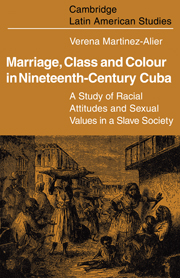
Marriage, Class and Colour in Nineteenth-Century Cuba

Posted in Anthropology, Books, Caribbean/Latin America, History, Law, Media Archive, Monographs, Slavery, Social Science, Women on 2011-07-16 04:11Z by Steven

Marriage, Class and Colour in Nineteenth-Century Cuba

Cambridge University Press (available in the United States at University of Michigan Press here.)
August 1974
224 pages
216 x 140 mm
Paperback ISBN: 9780521098465

Verena Martinez-Alier (a.k.a. Verena Stolcke), Professor Emeritus of Social Anthropology
Universitat Autónoma de Barcelona

An analysis of marriage patterns in nineteenth-century Cuba, a society with a large black population the majority of which was held in slavery but which also included considerable numbers of freedmen. Dr Martinez-Alier uses as her main source of evidence the records in Havana of administrative and judicial proceedings of cases in which parents opposed a marriage, of cases involving elopement, and of cases of interracial marriage. Dr Martinez-Alier develops a model of the relation between sexual values and social inequality. She considers the importance of the value of virginity in supporting the hierarchy of Cuban society, based on ascription rather than achievement. As a consequence of the high evaluation of virginity, elopement was often a successful means of overcoming parental dissent to an unequal marriage. However, in cases of interracial elopement, the seduced coloured woman had little chance of redress through marriage. In this battle of the sexes and the races, the free coloured women and men played roles and acquired values which explain why matrifocality became characteristic of black free families.

Table of Contents

  • Introduction
  • Part I. Interracial Marriage:
    • 1. Intermarriage and family honour
    • 2. Intermarriage and politics
    • 3. Intermarriage and Catholic doctrine
    • 4. The white man’s view
    • 5. Colour as a symbol of social status
    • 6. Intraracial marriage
  • Part II. Honour and Class:
    • 7. Elopement and seduction
    • 8. Conclusion: Some analytical comparisons.

Read the introduction here.

…Nineteenth-century Cuba cannot be treated as a historical and geographical isolate. Political factors outside Cuba were significant in shaping interracial marriage policy. The cultural tradition of Spain which during three centuries had espoused ‘purity of blood’ as the essential requisite of Spanishness must also be taken into consideration. Racism antedates slavery in the Americas and, as W. Jordan has proposed, the question would be to explain why African negroes (and not for instance the American Indians) were enslaved in the first place. To establish, therefore, a direct causal link between slavery as a highly exploitative system of production and racism would be too simple…

Tags: , , ,

Creating the Creole Island: Slavery in Eighteenth-Century Mauritius

Posted in Africa, Books, Europe, History, Media Archive, Monographs, Slavery on 2011-07-15 01:04Z by Steven

Creating the Creole Island: Slavery in Eighteenth-Century Mauritius

Duke University Press
2004
360 pages
5 illustrations
Cloth ISBN: 978-0-8223-3402-6
Paperback ISBN: 978-0-8223-3399-9

Megan Vaughan, Smuts Professor of Commonwealth History
Cambridge University

The island of Mauritius lies in the middle of the Indian Ocean, about 550 miles east of Madagascar. Uninhabited until the arrival of colonists in the late sixteenth century, Mauritius was subsequently populated by many different peoples as successive waves of colonizers and slaves arrived at its shores. The French ruled the island from the early eighteenth century until the early nineteenth. Throughout the 1700s, ships brought men and women from France to build the colonial population and from Africa and India as slaves. In Creating the Creole Island, the distinguished historian Megan Vaughan traces the complex and contradictory social relations that developed on Mauritius under French colonial rule, paying particular attention to questions of subjectivity and agency.

Combining archival research with an engaging literary style, Vaughan juxtaposes extensive analysis of court records with examinations of the logs of slave ships and of colonial correspondence and travel accounts. The result is a close reading of life on the island, power relations, colonialism, and the process of cultural creolization. Vaughan brings to light complexities of language, sexuality, and reproduction as well as the impact of the French Revolution. Illuminating a crucial period in the history of Mauritius, Creating the Creole Island is a major contribution to the historiography of slavery, colonialism, and creolization across the Indian Ocean.

Table of Contents

  • Acknowledgments
  • Preface
  • One – In the Beginning
  • Two – Engineering a Colony, 1735-1767
  • Three – Enlightenment Colonialism and Its Limits, 1767-1789
  • Four – Roots and Routes: Ethnicity without Origins
  • Five – A Baby in the Salt Pans: Mothering Slavery
  • Six – Love in the Torrid Zone
  • Seven – Reputation, Recognition, and Race
  • Eight – Speaking Slavery: Language and Loss
  • Nine – Metissage and Revolution
  • Ten – Sugar and Abolition
  • Notes
  • Works Cited
  • Index
Tags: , , ,