Revealed: How Britons welcomed black soldiers during WWII, and fought alongside them against racist GIs

Posted in Articles, History, Media Archive, United Kingdom, United States on 2015-12-07 02:12Z by Steven

Revealed: How Britons welcomed black soldiers during WWII, and fought alongside them against racist GIs

The Telegraph
2015-12-06

Patrick Sawer, Senior Reporter

This was no ordinary Saturday night punch-up outside a pub.

At the height of World War Two, with the country gripped in a life or death fight for freedom against fascism and dictatorship, dozens of local drinkers fought alongside black soldiers against white Military Police officers harassing them outside a Lancashire pub.

It was just one extraordinary example of the active support shown by ordinary Britons for the thousands of black American troops stationed amongst them during the war – in stark contrast to the vicious racist abuse they received from their fellow countrymen.

The Lancashire riot was just one of hundreds of cases of simple humanity displayed by ordinary Britons towards black soldiers.

Details of the riot are revealed in a new book exploring the experience of black GIs stationed in Britain during the war.

While white GIs sought to have them banned from pubs, clubs and cinemas and frequently subjected them to physical and verbal assault, many ordinary Britons welcomed the black troops into their homes – and on several occasions physically stood up to their tormentors.

The book, Forgotten: The Untold Story of D-Day’s Black Heroes, at Home and at War, also reveals how in June 1943 there was a public outcry when four black servicemen were refused service in a bar in Bath, for no reason other than the colour of their skin…

…While most people have heard of the GI babies the US troops left behind, few have considered that many of these children were of mixed-race, the offspring of affairs between local white women and the black soldiers they encountered.

Many of those “brown babies” only came to know their fathers in later years, with some of their descendants now embarking on a search for their American grandfathers.

Miss Hervieux said: “Given the racial tensions that exist in Britain today, as in other countries, it is hard to believe that the UK was once a relative racial paradise for African Americans. Britons were willing to open their hearts and minds to fellow human beings who were there to help them…

Read the entire article here.

Tags: , , ,

White Debt: Reckoning with what is owed — and what can never be repaid — for racial privilege.

Posted in Articles, History, Media Archive, Politics/Public Policy, Social Science, United States on 2015-12-06 04:00Z by Steven

White Debt: Reckoning with what is owed — and what can never be repaid — for racial privilege.

The New York Times
2015-12-02

Eula Biss. Professor of Instruction
Department of English
Northwestern University, Evanston, Illinois


Illustration by Geoff McFetridge

The word for debt in German also means guilt. A friend who used to live in Munich mentioned this to me recently. I took note because I’m newly in debt, quite a lot of it, from buying a house. So far, my debt is surprisingly comfortable, and that’s one quality of debt that I’ve been pondering lately — how easy it can be.

I had very little furniture for the first few months in my new house and no money left to buy any. But then I took out a loan against my down payment, and now I have a dining-room table, six chairs and a piano. While I was in the bank signing the paperwork that would allow me to spend money I hadn’t yet earned, I thought of Eddie Murphy’s skit in which he goes undercover as a white person and discovers that white people at banks give away money to other white people free. It’s true, I thought to myself in awe when I saw the ease with which I was granted another loan, though I understood — and, when my mortgage was sold to another lender, was further reminded — that the money was not being given to me free. I was, and am, paying for it. But that detail, like my debt, is easily forgotten.

“Only something that continues to hurt stays in the memory,” Nietzsche observes in “On the Genealogy of Morality.” My student-loan debt doesn’t hurt, though it hasn’t seemed to have gotten any smaller over the past decade, and I’ve managed to forget it so thoroughly that I recently told someone that I’d never been in debt until I bought a house. Creditors of antiquity, Nietzsche writes, tried to encourage a debtor’s memory by taking as collateral his freedom, wife, life or even, as in Egypt, his afterlife. Legal documents outlined exactly how much of the body of the debtor that the creditor could cut off for unpaid debts. Consider the odd logic, Nietzsche suggests, of a system in which a creditor is repaid not with money or goods but with the pleasure of seeing the debtor’s body punished. “The pleasure,” he writes, “of having the right to exercise power over the powerless.”…

…Whiteness is not a kinship or a culture. White people are no more closely related to one another, genetically, than we are to black people. American definitions of race allow for a white woman to give birth to black children, which should serve as a reminder that white people are not a family. What binds us is that we share a system of social advantages that can be traced back to the advent of slavery in the colonies that became the United States. “There is, in fact, no white community,” as Baldwin writes. Whiteness is not who you are. Which is why it is entirely possible to despise whiteness without disliking yourself…

Read the entire article here.

Tags: , ,

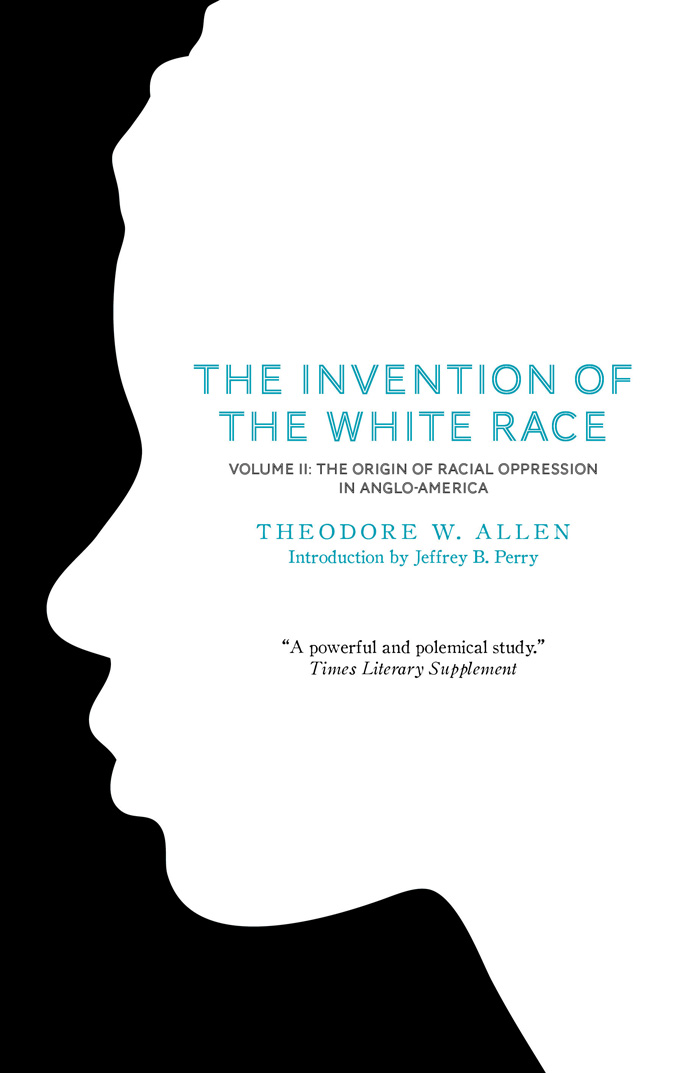
The Invention of the White Race, Volume 2: The Origin of Racial Oppression in Anglo-America

Posted in Books, History, Media Archive, Monographs, Slavery, United States on 2015-12-06 03:42Z by Steven

The Invention of the White Race, Volume 2: The Origin of Racial Oppression in Anglo-America

Verso Books
November 2012 (Originally published in August, 1997)
422 pages
Paperback ISBN: 9781844677702
Ebook ISBN: 9781844678440

Theodore W. Allen (1919-2005)
Introduction and notes by Jeffrey B. Perry

Groundbreaking analysis of the birth of racism in America.

On the steps of the Lincoln Memorial in 1963, Martin Luther King outlined a dream of an America where people would not be judged by the color of their skin. That dream has yet to be realized, but some three centuries ago it was a reality. Back then, neither social practice nor law recognized any special privileges in connection with being white. But by the early decades of the eighteenth century, that had all changed. Racial oppression became the norm in the plantation colonies, and African Americans suffered under its yoke for more than two hundred years.

In Volume II of The Invention of the White Race, Theodore W. Allen explores the transformation that turned African bond-laborers into slaves and segregated them from their fellow proletarians of European origin. In response to labor unrest, where solidarities were not determined by skin color, the plantation bourgeoisie sought to construct a buffer of poor whites, whose new racial identity would protect them from the enslavement visited upon African Americans. This was the invention of the white race, an act of cruel ingenuity that haunts America to this day.

Allen’s acclaimed study has become indispensable in debates on the origins of racial oppression in America. In this updated edition, scholar Jeffrey B. Perry provides a new introduction, a select bibliography and a study guide.

Tags: , ,

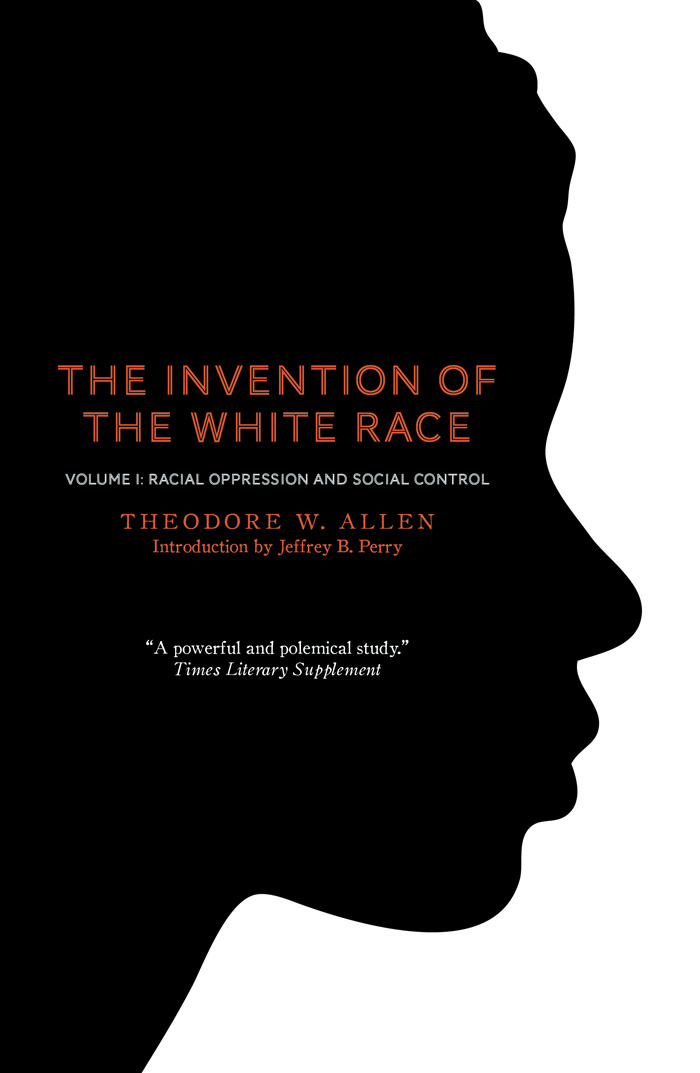
The Invention of the White Race, Volume 1: Racial Oppression and Social Control

Posted in Books, History, Media Archive, Monographs, United States on 2015-12-05 18:07Z by Steven

The Invention of the White Race, Volume 1: Racial Oppression and Social Control

Verso Books
November 2012 (Originally published in August, 1997)
372 pages
Paperback ISBN: 9781844677696
Ebook ISBN: 9781844678433

Theodore W. Allen (1919-2005)
Introduction and notes by Jeffrey B. Perry

Groundbreaking analysis of the birth of racism in America.

When the first Africans arrived in Virginia in 1619, there were no “white” people there. Nor, according to colonial records, would there be for another sixty years. In this seminal two-volume work, The Invention of the White Race, Theodore W. Allen tells the story of how America’s ruling classes created the category of the “white race” as a means of social control. Since that early invention, white privileges have enforced the myth of racial superiority, and that fact has been central to maintaining ruling-class domination over ordinary working people of all colors throughout American history.

Volume I draws lessons from Irish history, comparing British rule in Ireland with the “white” oppression of Native Americans and African Americans. Allen details how Irish immigrants fleeing persecution learned to spread racial oppression in their adoptive country as part of white America.

Since publication in the mid-nineties, The Invention of the White Race has become indispensable in debates on the origins of racial oppression in America. In this updated edition, scholar Jeffrey B. Perry provides a new introduction, a short biography of the author and a study guide.

Tags: , ,

Leaving to learn

Posted in Articles, Biography, Campus Life, Caribbean/Latin America, History, Media Archive, Mexico, Passing, Slavery, United States on 2015-12-03 02:37Z by Steven

Leaving to learn

Columbia Daily Spectator
2015-12-02

Claire Liebmann


Courtesy of Karl Jacoby

Several years ago while browsing newspaper clippings online, Karl Jacoby, a history professor at Columbia, came across the story of William Ellis—a Texan slave who built a million dollar fortune while posing as a Mexican millionaire in New York, essentially hacking the system of American expansionism and oppression.

Tracking Ellis as he took on different names and personas was difficult: Ellis deliberately introduced falsehoods into the historical record to ensure that his racial passing was accepted by the broader society, but Jacoby stuck with it. Years later, this chance encounter with Ellis’ story would come to drive his personal historical research. Undertaking a yearlong leave of absence, he pursued his interest in reclaiming untold narratives, working on his book The Strange Career of William Ellis: The Texas Slave Who Became a Mexican Millionaire.

Jacoby’s academic career is driven by his interest in complicating comfortable historical narratives. This process of reinvention and rediscovery depends on another kind of separation from the establishment: Jacoby’s reliance on his leave of absence as a means of promoting academic innovation…

Read the entire article here.

Tags: , , , , , , , ,

Krotoa-Eva’s Suite: A performance by poet Toni Stuart

Posted in Africa, Arts, History, Live Events, Media Archive, South Africa, Women on 2015-12-02 01:56Z by Steven

Krotoa-Eva’s Suite: A performance by poet Toni Stuart

Goldsmiths University of London
New Cross
London, United Kingdom
Caribbean Studies Centre
Top Floor, Education Building
2015-12-03, 18:30-20:30Z

Join the Centre for Caribbean and Diaspora Studies and the Centre for Feminist Research for a performance by poet Toni Stuart and a ‘Stories are Medicine’ discussion circle.

Toni Stuart (@nomadpoet) is a poet, performer, festival organiser and educator from Cape Town, South Africa.

She’ll be performing poems from her collection in progress, Krotoa-Eva’s Suite – a cape jazz poem in three movements. This is the re-imagined story of Krotoa-Eva, a Khoi woman who played a pivotal role in South African history in the 17th Century, when the first European settlers arrived at Cape Town, as it is known today. The poems give voice to Krotoa-Eva’s “interior” life, and aim to offer a counter-narrative to the male, colonial perspectives through which her story has previously been told.

The performance will be followed by an informal discussion circle around the role of self-care and healing in our work as feminists. And, it will explore how stories and the creative arts might facilitate and support this practice.

For more information, click here.

Tags: , , , , , ,

A stone for the Chief: Black Anchorage leader who passed as white honored with memorial

Posted in Articles, Biography, History, Media Archive, Passing, United States on 2015-12-01 20:23Z by Steven

A stone for the Chief: Black Anchorage leader who passed as white honored with memorial

Alaska Dispatch News
Anchorage, Alaska
2015-10-29

Mike Dunham, Play & Arts & Entertainment Reporter


From left, Corey Todoroff, Jim Vignola and Lex Patten of the Anchorage Fire Department unveil a new grave marker for longtime Anchorage Fire Chief Thomas Bevers, who passed away in 1944, during a ceremony at the Anchorage Memorial Park Cemetery on Thursday, October 29, 2015. Bevers was also notable for co-founding what would become the Anchorage Fur Rendezvous festival, and for being a black man who passed as white.
Loren Holmes / ADN

The 1930 Anchorage census tells us this about Thomas S. Bevers: He was 39 years old, male, married, white, a veteran of the World War and the city’s fire chief.

But his final resting place was unmarked until Thursday, when an honor guard from the Anchorage Fire Department unveiled a headstone for him at a ceremony in the Anchorage Memorial Park Cemetery.

As his job title suggests, Bevers was more important than the average roustabout hoping to strike it rich — or maybe just get by — in the far-off territory of Alaska. He arrived in Anchorage in 1921 and served as a volunteer fireman. The ladder wagons were pulled by horses and the pumps were worked by hand.

By 1930, he was in the front ranks of city leaders, a man of property, a landlord, a partner in a major fur farm on 10th Avenue. He became involved with civic causes that included building a new hospital and Merrill Field. His ongoing business ventures ranged from establishing the Fairview neighborhood (originally Bevers Subdivision) to part-ownership of the Buffalo Mine near Chickaloon.

He was a member of the Anchorage Boosters Club who loved to give visitors tours of Anchorage while extolling its possibilities. Most famously, he co-founded the Fur Rendezvous winter festival.


Anchorage Fire Department Chief Thomas Bevers in the 1930s
Courtesy Anchorage Fire Department

In 1922 Bevers became the first paid fireman in the city. He retired from the position of chief in 1940 and ran for city council in 1941, winning the office with 772 votes.

In October 1944, during a duck hunting trip on the north side of Knik Arm, he went to bed and quietly died of a heart attack. An editorial in the Anchorage Times lamented, “Anchorage (has) lost one of its best friends and leaders.”

He had no immediate family in the territory. The 1940 census listed him as single. Officials summoned a sister in Virginia to come and claim the body.

Upon her arrival, his friends and business partners did a double take…

Read the entire article here.

Tags: , , , , , ,

Black Lives Matter in the Dominican Republic

Posted in Articles, Caribbean/Latin America, History, Law, Media Archive, Social Justice on 2015-11-30 01:28Z by Steven

Black Lives Matter in the Dominican Republic

teleSUR
2015-08-11

Auset Marian Lewis

Racial profiling is not just happening in the U.S., Haitians in the Dominican Republic suffer the same discrimination.

Black lives matter” is a resounding cry heard around the world. The UN Working Group of Experts of People of African Descent said as much in a recent news release regarding the deportation of Haitian residents and migrant workers in the Dominican Republic. Mirelle Fanon Mendes France, head of the U.N. group stated, “The Dominican Republic does not recognize the existence of a structural problem of racism and xenophobia, but it must address these issues as a matter of priority so the country can live free from tension and fear.”

Since June 21 some 19,000 Haitians have fled the Dominican Republic for Haiti fearing the unfair deportation policies that make it difficult for legal residents to comply with demands, which not only disregard the Dominican Constitution but also violate international norms.

In 2013, the constitutional court of the Dominican Republic ruled that offspring of undocumented immigrants would become illegal retroactive to 1929. This immediately invalidated the legal status of an estimated 200,000 Dominican citizens. Of the 450,000 Haitian migrant workers in the country, 290,000 met a filing deadline for legal status. Of those who filed, the government ruled that only 2 percent were legal.

The clash between Haiti and the Dominican Republic on the island of Hispaniola has a strained history beyond the obvious racial differences. Haitians are the dark progeny of the French African slave trade while Dominican Republicans are mulattoes of Spanish descent. The enmity between the two countries is not only racial, but also cultural and historical. However, just as the world witnesses how little Black lives matter in American extrajudicial killings, the mistreatment of dark Haitians could well inspire a #Haitian Lives Matter twitter campaign…

Read the entire article here.

Tags: , , , ,

In the Creole Twilight: Poems and Songs from Louisiana Folklore

Posted in Anthropology, Books, History, Louisiana, Media Archive, Poetry, United States on 2015-11-28 21:50Z by Steven

In the Creole Twilight: Poems and Songs from Louisiana Folklore

Louisiana State University Press
September 2015
88 pages
6.00 x 9.00 inches
30 halftones
Hardcover ISBN: 9780807161548

Joshua Clegg Caffery, Visiting Professor in Folklore
Indiana University, Bloomington

Many recurring motifs found in south Louisiana’s culture spring from the state’s rich folklore. Influenced by settlers of European and African heritage, celebrated customs like the Courir de Mardi Gras and fabled creatures like the Loup-Garou are outgrowths of the region’s distinctive oral traditions. Joshua Clegg Caffery’s In the Creole Twilight draws from this vibrant and diverse legacy to create an accessible reimagining of traditional storytelling and song.

A scholar and Grammy-nominated musician, Caffery borrows from the syllabic structures, rhyme schemes, narratives, and settings that characterize Louisiana songs and tales to create new verse that is both well-researched and refreshingly inventive. Paired with original pen-and-ink illustrations as well as notes that clarify the origins of characters and themes, Caffery’s compositions provide a link to the old worlds of southern Louisiana while constructing an entirely new one.

Tags: , ,

The quadroon concubines of New Orleans on Wanton Weekends

Posted in Articles, History, Louisiana, Media Archive, United States, Women on 2015-11-28 20:05Z by Steven

The quadroon concubines of New Orleans on Wanton Weekends

Jude Knight
2015-10-25

Jude Knight

In New Orleans at the end of the 18th Century, a wealthy white man would generally live on his plantation with his wife and children, but he would also have a townhouse in New Orleans where his other family lived: his quadroon mistress and the children he had made with her.

To the men and women involved, these marriages de la main gauche (left-handed marriages) were honourable arrangements. The women were faithful to their protectors, and the men were expected to provide for their children. It was what a gentleman did…

Read the entire article here.

Tags: , ,