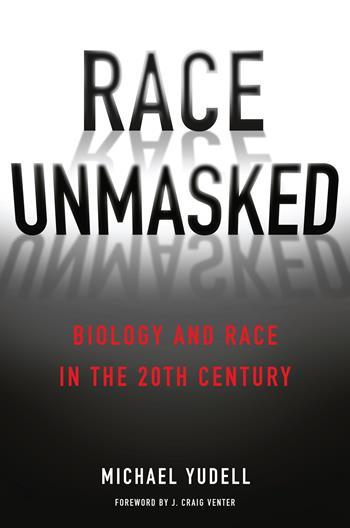
Race Unmasked: Biology and Race in the Twentieth Century

Posted in Books, Health/Medicine/Genetics, History, Media Archive, Monographs on 2014-12-12 21:18Z by Steven

Race Unmasked: Biology and Race in the Twentieth Century

Columbia University Press
September 2014
304 pages
Hardcover ISBN: 9780231168748
E-book ISBN: 9780231537995

Michael Yudell, Associate Professor, Interim Chair, Community Health and Prevention
Drexel University School of Public Health, Philadelphia, Pennsylvania

Foreword by J. Craig Venter

Race, while drawn from the visual cues of human diversity, is an idea with a measurable past, an identifiable present, and an uncertain future. The concept of race has been at the center of both triumphs and tragedies in American history and has had a profound effect on the human experience. Race Unmasked revisits the origins of commonly held beliefs about the scientific nature of racial differences, examines the roots of the modern idea of race, and explains why race continues to generate controversy as a tool of classification even in our genomic age.

Surveying the work of some of the twentieth century’s most notable scientists, Race Unmasked reveals how genetics and related biological disciplines formed and preserved ideas of race and, at times, racism. A gripping history of science and scientists, Race Unmasked elucidates the limitations of a racial worldview and throws the contours of our current and evolving understanding of human diversity into sharp relief.

Contents

  • Foreword by J. Craig Venter
  • Acknowledgments
  • Introduction
  • 1. A Eugenic Foundation
  • 2. Charles Davenport and the Biology of Blackness
  • 3. Eugenics in the Public’s Eye
  • 4. The National Research Council and the Scientific Study of Race
  • 5. Coloring Race Difference
  • 6. Biology and the Problem of the Color Line
  • 7. Race and the Evolutionary Synthesis
  • 8. Consolidating the Race Concept in Biology
  • 9. Challenges to the Race Concept
  • 10. Naturalizing Racism: The Controversy Over Sociobiology
  • 11. Race in the Genomic Age
  • Epilogue: Dobzhansky’s Paradox and the Future of Racial Research
  • Notes
  • Bibliography
  • Index
Tags: , ,

Brute Ideology

Posted in Articles, Book/Video Reviews, History, Media Archive, Slavery, Social Science, United States on 2014-12-11 15:55Z by Steven

Brute Ideology

Dissent
Fall 2014

Walter Johnson, Winthrop Professor of History; Professor of African and African American Studies; Director, Charles Warren Center for the Study of American History
Harvard University

Racecraft: The Soul of Inequality in American Life by Barbara J. Fields and Karen E. Fields. Verso, 2012, 310 pp.

The Problem of Slavery in the Age of Emancipation by David Brion Davis. Knopf, 2014, 448 pp.

The field of U.S. history today is characterized by a mania for management. The “new” history of capitalism has focused its attention on the creation and daily reanimation of the grand abstraction from which it draws its title: the mid-level market makers who take capital and transform it into capitalism. In the aftermath of the 2008 financial crisis, increasing numbers of historians have turned their attention to the histories of powerful historical actors we have too long ignored or dismissed as “dead white men” unworthy of the attention of the properly progressive historian: financiers, bankers, and businessmen of all kinds. Despite the obvious importance of the task and the avowedly critical purpose of the turn towards the study of the mechanisms of market practice, however, some of the bolder claims that have been used to mark out the novelty of this “new” history seem unwarranted, perhaps even misguided. Can historians really set aside the study of racial and sexual domination now that they have discovered the economic exploitation underlying all other history? Can they really write a better history of capitalism by simply replacing the history of the marginal with the history of the powerful? Amidst the end-of-historiography enthusiasm for the “new” history of capitalism, two recent books remind us of the enduring importance of some of the questions posed by the old history of capitalism: questions of determination, ideology, and hegemony, and of collective action, resistance, and (even) revolutionary social change.

Bringing together previously published and new essays treating U.S. history from the time of the American Revolution to the eve of the Occupy movement in 2011, Racecraft reminds us that, at the very least, the “new” history of capitalism has some very distinguished antecedents. Taken together, the writing of the historian Barbara J. Fields and the sociologist Karen E. Fields (sisters; hereafter “Fields and Fields”) provides a sustained and brilliant exposition of the history and practice of race-marking in America. If race is “socially constructed,” as virtually every educated person in the United States knows it officially to be, then why do we believe we can determine the race of the person on the other end of the line as soon as we pick up the phone?

As the title’s invocation of witchcraft suggests, the book is framed by the idea that there is something occult about such everyday practices of divination. For the authors, race is a kind of magical thinking, a way of isolating a few of the surface features of near-infinite human diversity and over-generalizing them into an architecture of biological, social, and even metaphysical difference. Race thinking, they suggest, is a sort of transubstantiation that adduces essence out of circumstance, made up of turns of phrase and ways of thinking so familiar and yet so powerful as to persistently remake the material world in their own image.

Fields and Fields illustrate and expose this sort of magic through a close reading of the printed matter of our times: newspaper accounts of proudly segregated high-school proms and white supremacists carrying guns to Obama campaign rallies; peer-reviewed articles published in scholarly journals and the bureaucratic memos that established the “multiracial” category in the U.S. census. They juxtapose the “troglodyte racism” of the crypto-Klan birthers to the breathless intonations of historical transcendence (“the end of racism??!!”) common among twenty-first-century white liberals. The main argument of the book is with the latter’s sometimes unwitting, sometimes self-congratulatory engagement with the dark magic of racial difference itself.

Take the “multiracial” moment—the idea that the bad old days of “black” and “white” may finally be giving way to an embrace of “mixture” and “difference.” But wait: “mixture” of what with what? According to Racecraft, the Census Bureau defines a “multiracial” person as “someone with two monoracial parents.” Through the heart of the celebration of the new multiracialism circulates a notion of blood purity worthy of The Birth of a Nation. For Fields and Fields, any invocation of “race” as an explanatory or even descriptive category is in and of itself racist. The use of “race” to explain anything from ancestry to economic inequality unwittingly reinforces the false belief in deep-rooted biological differences between black and white people. “Ancestry,” according to the authors, should be understood as a way that individuals are linked across generations without being thickened into “race.” Heredity, whether responsible for visible traits like curly hair or hidden ones like the sickle cell, is just that and nothing more: “‘genetic’ is not equivalent to ‘racial.’”

If we had only to worry about a mediascape where relevance is measured by the ability to attach ideas to beginnings and endings (the “post-racial” election of the “first black president”) things would be bad enough. “Racecraft,” however, has infiltrated even the hallowed ground of academia. Precisely and compellingly, Fields and Fields demonstrate that scientists use “racial” causes to explain what are in fact social effects. A recent scientific study of high asthma rates among schoolchildren in the South Bronx, for example, concluded that—in addition to heavy traffic, dense population, poor housing, and lack of preventative health care—the neighborhood was characterized by “a large population of blacks and Hispanics, two groups with very high rates of asthma.”…

Read the entire review of both books here.

Tags: , , , , , , ,

Racecraft: The Soul of Inequality in American Life

Posted in Books, History, Media Archive, Monographs, Social Science, United States on 2014-12-11 15:20Z by Steven

Racecraft: The Soul of Inequality in American Life

Verso Books
October 2012
310 pages
Paperback ISBN: 9781781683132
Ebook ISBN: 9781844679959
Hardback ISBN: 9781844679942

Karen E. Fields, Independent Scholar

Barbara J. Fields, Professor of History
Columbia University, New York, New York

Tackling the myth of a post-racial society.

Most people assume that racism grows from a perception of human difference: the fact of race gives rise to the practice of racism. Sociologist Karen E. Fields and historian Barbara J. Fields argue otherwise: the practice of racism produces the illusion of race, through what they call “racecraft.” And this phenomenon is intimately entwined with other forms of inequality in American life. So pervasive are the devices of racecraft in American history, economic doctrine, politics, and everyday thinking that the presence of racecraft itself goes unnoticed.

That the promised post-racial age has not dawned, the authors argue, reflects the failure of Americans to develop a legitimate language for thinking about and discussing inequality. That failure should worry everyone who cares about democratic institutions.

Tags: , , , , ,

UNPOPULAR OPINION: 6 Reasons Why Your Utopic Vision for a Mixed-Race Future is My Nightmare

Posted in Anthropology, Articles, Asian Diaspora, History, Media Archive, Social Science, United States on 2014-12-10 17:54Z by Steven

UNPOPULAR OPINION: 6 Reasons Why Your Utopic Vision for a Mixed-Race Future is My Nightmare

xoJane
2014-12-10

Kristina Wong

Guess what? One day, when we’re all mixed race, racism won’t magically disappear.

Before you start trolling me (not that I don’t need the attention), let me tell you the specific sentiment that this whole essay addresses. It usually starts when someone chimes in with their wide-eyed vision for 2050, the year when people of color will outnumber white people in America:

“One day when all the races have mixed together, and we can’t tell what anyone is anymore, there won’t be racism! All our cultures will blend together! And…the babies will be beautiful!”

Ah yes! This magic mixed-race future, where everyone will have fucked the hate out of everyone and in the process, thousands of years of colonialism, violence, and systemic oppression disappear into the “interesting facial features” of mixed-race people!

I’m not indicting the lives of mixed-race people nor chastising interracial relationships. But let’s get real — the hypothetical “Future World of Mixed-Race Babies” being the end of racism suffers from frighteningly naive logic about how racism actually works.

Here are SIX reasons why racial utopia won’t suddenly appear once we pull our pants down and start boning across borders…

Read the entire article here.

Tags: ,

White Anxiety and the Futility of Black Hope

Posted in Articles, History, Media Archive, Philosophy, Politics/Public Policy, Social Science, United States on 2014-12-09 02:07Z by Steven

White Anxiety and the Futility of Black Hope

The New York Times
2014-12-05

George Yancy, Professor of Philosophy
Duquesne University, Pittsburgh, Pennsylvania

Shannon Sullivan, Professor of Philosophy
University of North Carolina, Charlotte

This is the third in a series of interviews with philosophers on race that I am conducting for The Stone. This week’s conversation is with Shannon Sullivan, a professor in the department of philosophy at the University of North Carolina, Charlotte. She is the author of “Good White People: The Problem with Middle-Class White Anti-Racism.” — George Yancy

George Yancy: What motivated you to engage “whiteness” in your work as a philosopher?

Shannon Sullivan: It was teaching feminist philosophy for the first time or two and trying to figure out how to reach the handful of men in the class — white men, now that I think of it. They tended to be skeptical at best and openly hostile at worst to the feminist ideas we were discussing. They felt attacked and put up a lot of defenses. I was trying to see things from their perspective, not to endorse it (it was often quite sexist!), but to be more effective as a teacher. And so I thought about my whiteness and how I might feel and respond in a class that critically addressed race in ways that implicated me personally. Not that race and gender are the same or can be captured through analogies, but it was a first step toward grappling with my whiteness and trying to use it.

What really strikes me now, as I think about your question, is how old I was — around 30 — before I ever engaged whiteness philosophically, or personally, for that matter. Three decades where that question never came up and yet the unjust advantages whiteness generally provides white people fully shaped my life, including my philosophical training and work…

G.Y.: For many whites the question of their whiteness never comes up or only comes up when they are much older, as it did in your case. And yet, as you say, there is the accrual of unjust white advantages. What are some reasons that white people fail to come to terms with the fact that they benefit from whiteness?

S.S.: That’s a tough one and there probably are lots of reasons, including beliefs in boot-strap individualism, meritocracy and the like. Another answer, I think, has to do with class differences among white people. A lot of poor white people haven’t benefited as much from whiteness as middle- and upper-class white people have. Poor white people’s “failure” to come to terms with the benefits of their whiteness isn’t as obvious, I guess I’d say. I’m not talking about a kind of utilitarian calculus where we can add up and compare quantities of white advantage, but there are differences…

G.Y.: And yet for so many poor people of color there is not only the fact that the wages pay less than pennies, as it were, but that black life continues to be valued as less. Is there a history of that racial differential wage between poor whites and poor blacks or people of color?

S.S.: Yes, definitely. Class and poverty are real factors here, but they don’t erase the effects of race and racism, at least not in the United States and not in a lot of other countries with histories (and presents) of white domination. The challenge philosophically and personally is to keep all the relevant factors in play in thinking about these issues. In that complex tangle, you hit the nail on the head when you said that black life continues to be valued as less. Poor white people’s lives aren’t valued for much either, but at least in their case it seems that something went wrong, that there was something of potential value that was lost.

Let’s put it even more bluntly: America is fundamentally shaped by white domination, and as such it does not care about the lives of black people, period. It never has, it doesn’t now, and it makes me wonder about whether it ever will…

Read the entire article here.

Tags: , , ,

Class, Race, or Ethnicity Apart? Changing Whiteness and Counting People of Mexican Descent

Posted in Articles, Caribbean/Latin America, Census/Demographics, History, Latino Studies, Law, Mexico, Social Science, United States on 2014-12-09 01:55Z by Steven

Class, Race, or Ethnicity Apart? Changing Whiteness and Counting People of Mexican Descent

U.S. History Scene
2013-10-09

Ester Terry
University of Pittsburgh

In June 2013, Sebastien de la Cruz sang the National Anthem for Games 3 and 4 of the National Basketball Association (NBA) Finals in San Antonio. In July 2013, Marc Anthony sang “God Bless America” at the Major League Baseball (MLB) All-Star Game. Both de la Cruz and Anthony are U.S. citizens; the family of de la Cruz descends from México, and Marc Anthony’s family from Puerto Rico. Social media backlash labeled both of them Mexican and indicated neither belonged as U.S. nationals. The United States Census currently categorizes both performers as ‘Hispanic/Latino.’…

…This heated debate over who ‘belongs’ to the United States, who is worthy of being called American, shows a longstanding contention over geography and history, race and national belonging. México, after all, once included the present-day southwestern United States. Before Mexican independence, imperial Spain claimed these lands. And before that, the indigenous peoples of Anáhuac, Mogollon, and Diné.

Neither Marc Anthony nor Sebastien de la Cruz is a Mexican national, even though the backlash pejoratively labeled them as such. The usage of Mexican in the backlash could refer to nationality or to race. Twentieth century battles over racialized school segregation policies and U.S. Census categories reveal an equally contentious history fought by people of Mexican descent over race and national belonging…

Read the entire article here.

Tags: , , ,

Female Slaves and the Law

Posted in History, Law, Slavery, United States, Videos, Women on 2014-12-08 21:16Z by Steven

Female Slaves and the Law

C-SPAN: Created by Cable
Lectures in History
2014-10-21

Martha S. Jones, Arthur F Thurnau Professor, Associate Professor of History and Afroamerican and African Studies
University of Michigan

Professor Martha Jones talked about the mid-19th century court case of Celia, a female slave who killed her master after repeated sexual assaults. Topics included what options Celia may have had, and the involvement of her fellow slaves and her master’s white neighbors in her court case.

View the lecture here (01:21:40). See also, “Celia, A Slave, Trial (1855): An Account” by Douglas O. Linder (2011).

Tags: , , ,

The Half Has Never Been Told with Edward E. Baptist, Ph.D.

Posted in Audio, Economics, History, Live Events, Media Archive, Slavery, United States on 2014-12-06 00:08Z by Steven

The Half Has Never Been Told with Edward E. Baptist, Ph.D.

Research at the National Archives and Beyond
BlogTalk Radio
Thursday, 2014-12-18 21:00 EST (Friday, 2014-12-19, 02:00Z)

Bernice Bennett, Producer and Host

Historian Edward E. Baptist reveals in The Half Has Never Been Told, the expansion of slavery in the first eight decades after American independence drove the evolution and modernization of the United States. In the span of a single lifetime, the South grew from a narrow coastal strip of worn-out tobacco plantations to a continental cotton empire, and the United States grew into a modern, industrial, and capitalist economy. Until the Civil War, Baptist explains, the most important American economic innovations were ways to make slavery ever more profitable. Through forced migration and torture, slave owners extracted continual increases in efficiency from enslaved African Americans. Thus the United States seized control of the world market for cotton, the key raw material of the Industrial Revolution, and became a wealthy nation with global influence.

Told through intimate slave narratives, plantation records, newspapers, and the words of politicians, entrepreneurs, and escaped slaves, The Half Has Never Been Told offers a radical new interpretation of American history. It forces readers to reckon with the violence at the root of American supremacy, but also with the survival and resistance that brought about slavery’s end—and created a culture that sustains America’s deepest dreams of freedom.

Edward E. Baptist is an Associate Professor in the Department of History and House Professor and Dean at the Carl Becker House at Cornell University.

For more information, click here.

Tags: , , , ,

The Forsaken: Portraits of Mixed-Race Orphans in Postwar Korea

Posted in Articles, Arts, Asian Diaspora, History, Media Archive on 2014-12-04 19:48Z by Steven

The Forsaken: Portraits of Mixed-Race Orphans in Postwar Korea

TIME Magazine
2014-12-04

David Kim
Yale Law School


Joo Myung Duck (1940-)

Pictures made in the ’60s by a young photographer, Joo Myung Duck, depict the mixed-race children of foreign servicemen and Korean women

On July 27, 1953, a ceasefire ended open hostilities in the Korean War, and the United Nations, the People’s Republic of China, and the Democratic People’s Republic of Korea (North Korea) established a border and a demilitarized zone at the 38th parallel. After three years of fighting, the border between north and south was, in effect, exactly where it had been prior to the beginning of the war. The Republic of Korea (South Korea) refused to join the armistice; and, as a formal peace treaty was never signed, South and North Korea today remain technically at war, 60 years after the guns fell silent.

Nearly three million people died or went missing in the war, in which North Korean and Chinese troops fought an international force comprised largely of Americans. Of those three million, more than half were civilians, and most were Korean. Since the mid-1950s, meanwhile, the American military has maintained a heavy presence in South Korea; this footprint is the uneasy foundation that underlies relations between the two countries.

The photos in this gallery were made in the early 1960s by Joo Myung Duck, then a young photojournalist. They depict mixed-race orphans, the children of foreign servicemen and Korean women, at the Holt orphanage in Seoul. Most of these children were born after the war, and they were abandoned by nearly everyone: by their fathers, who rarely remained in Korea; by their mothers, who endured ostracism and social stigma; and by the Korean government, which endorsed a politics of racial purity and sought to expel mixed-race children from the country.

In exploring these realities, Joo’s photographs are at-once inquisitive, undaunted, and gentle, attending carefully to variations in racial appearance while suggesting the centrality of Christian faith at Holt. His highly formal compositions revel in visual detail. And, in large part, he avoids sentimentality…

Read the entire article and view the photographs here.

Tags: , , , , , , , , , ,

Where the Negroes Are Masters: An African Port in the Era of the Slave Trade by Randy J. Sparks, and: Another America: The Story of Liberia and the Former Slaves Who Ruled It by James Ciment (review)

Posted in Africa, Articles, Book/Video Reviews, History, Media Archive, Slavery on 2014-12-03 17:37Z by Steven

Where the Negroes Are Masters: An African Port in the Era of the Slave Trade by Randy J. Sparks, and: Another America: The Story of Liberia and the Former Slaves Who Ruled It by James Ciment (review)

Journal of the Early Republic
Volume 34, Number 4, Winter 2014
pages 686-690
DOI: 10.1353/jer.2014.0068

Andrew N. Wegmann
Louisiana State University

Where the Negroes Are Masters: An African Port in the Era of the Slave Trade. By Randy J. Sparks. (Cambridge, MA: Harvard University Press, 2014. Pp. 309. Cloth $29.95)

The Atlantic slave trade stands at the center of Atlantic World studies. Indeed, the centuries-long trade in human beings from the coast of Africa to the Americas and Europe has come to define how each society bordering the Atlantic explains its cultural and racial demographics. Tales of families torn apart for the profit of a white man, of countless numbers taken across the Atlantic and forced into the fields of Jamaica, South Carolina, and Virginia, have fascinated and frustrated scholars and readers for decades. But rarely have these stories looked back to their origins, situating Africa at the center of the trade and the Atlantic community that made it possible. In Where the Negroes Are Masters, Randy Sparks does just that.

The strength of Sparks’s work lies in its uncommon approach. By placing the West African town of Annamaboe at the heart of the Atlantic slave-trading world, he shifts the academic focus of the slave trade from American fields and British trading houses to a Gold Coast trading town in which Africans call the shots, make enormous profit, and interact as commercial equals with European slavers. Sparks does not mince words, claiming that “the successful, capable, and wily merchants of Annamaboe were as integral to Atlantic commerce as those of Liverpool, London, Cádiz, Nantes, Charleston, New York, or Kingston” (3). Ruled and ‘‘owned’’ by the Fante people, Annamaboe was a place of commercial as well as cultural exchange, a site where the colonial powers of Europe entered into agreements and treaties with the reportedly ‘‘savage,’’ ‘‘barbarous’’ blacks of Africa. It was a place to which England sent its youngest, brightest captains to serve as governors before they rose in the political ranks to North America and the Caribbean. In return, the leaders (called caboceers) of Annamaboe frequently sent their sons to London and Paris for education, trading experience, and acculturation.

But, as Sparks points out, this was all a game. The caboceers at Annamaboe knew that both England and France wanted the thousands of slaves leaving the coast each year. The young men sent to London and Paris from Annamaboe, like the famous William Ansah Sessarakoo, son of the powerful caboceer John Corantee, imbibed European culture while also acquiring an intimate knowledge of the European side of the trade— profit margins, active political disputes, anything the leaders at Annamaboe could use to outwit and manipulate their European buyers.

Indeed, on a number of occasions the French and English nearly came to blows over the right of deposit at Annamaboe Road, the town’s primary port. In the end, the English muscled the French out of the region, and constructed a fort in town, for which they paid tribute, rent, and customs duties.

The relationship between Africans and Europeans did not stop at the trade itself. English merchants, traders, and governors residing in town often took ‘‘country wives’’—African women, sometimes mixed-race, who provided relief of carnal urges as well as connections in Annamaboe’s merchant elite. Richard Brew, an Irish-born trader who arrived at Annamaboe around 1745, became the wealthiest, most powerful private trader on the Gold Coast due in part to his ‘‘marriage’’ to John Corantee’s daughter. They lived together at Brew’s Annamaboe mansion (called ‘‘Castle Brew’’), and raised three mulatto children, all of whom took their father’s surname and served as interpreters and traders for Annamaboe until the early nineteenth century. As Sparks explains, the mulattoes, of which there were many along the Gold Coast, bridged the cultural and racial gap manifested in their pedigrees. Some served as soldiers for the English aboard slavers and in forts, positions strictly reserved for the mixed-race sons of European officials. Others, like the Brew children, served as interpreters, political representatives, and port traders for the caboceers. Many were Christian. Nearly all spoke both English and Fante, as well as ‘‘creole’’ (which Sparks never fully defines), and dressed in European stylings. They were the products of the cultural and racial exchange that brought Annamaboe, and the rest of the Gold Coast, into the heart of the Atlantic World.

Although central to the commercial and cultural development of the Atlantic World, Sparks’s…
Tags: , , , , , ,