Mary Seacole – International Woman

Posted in Articles, Biography, Europe, History, Media Archive, United Kingdom, Women on 2015-03-08 20:09Z by Steven

Mary Seacole – International Woman

The Huffington Post, United Kingdom
2015-03-04

Elizabeth Anionwu, Emeritus Professor of Nursing
University of West London

Later this year a memorial statue to Mary Seacole will be unveiled in the gardens of St Thomas’ hospital, overlooking the River Thames and the Houses of Parliament. Sir Hugh Taylor, Chairman of Guys & St Thomas’ NHS Foundation Trust, said: “Mary Seacole was a pathfinder for the generations of people from black and minority ethnic backgrounds who have served the NHS over the years and she remains a positive role model for the current generation. The Trust is proud to be hosting the statue, not least because it speaks to the diversity of our local population, our patients and the staff who work here.”

It was 160 years ago that Mary first set foot in the Crimea to feed and nurse British soldiers and she stayed there for the remaining 18 months of the conflict. Sir William Howard Russell, The Times newspaper’s Crimean War correspondent praised her efforts. In 1857 he wrote “I trust that England will not forget one who nursed her sick, who sought out her wounded to aid and succour them, and who performed the last offices for some of her illustrious dead.” He would have been sad to see that Mary was virtually forgotten for a century following her death in London on 14 May 1881. This was despite an obituary appearing in the pages of The Times!…

Read the entire article here.

Tags: , , ,

Obama, at Selma Memorial, Says, ‘We Know the March Is Not Over Yet’

Posted in Articles, Barack Obama, History, Law, Media Archive, Politics/Public Policy, United States on 2015-03-08 00:44Z by Steven

Obama, at Selma Memorial, Says, ‘We Know the March Is Not Over Yet’

The New York Times
2015-03-07

Peter Baker, Chief White House Correspondent

Richard Fausset


Doug Mills/The New York Times

SELMA, Ala. — As a new generation struggles over race and power in America, President Obama and a host of political figures from both parties came here on Saturday, to the site of one of the most searing days of the civil rights era, to reflect on how far the country has come and how far it still has to go.

Fifty years after peaceful protesters trying to cross a bridge were beaten by police officers with billy clubs, shocking the nation and leading to passage of the landmark Voting Rights Act of 1965, the nation’s first African-American president led a bipartisan, multiracial testimonial to the pioneers whose courage helped pave the way for his own election to the highest office of the land.

But coming just days after Mr. Obama’s Justice Department excoriated the police department of Ferguson, Mo., as a hotbed of racist oppression, even as it cleared a white officer in the killing of an unarmed black teenager, the anniversary seemed more than a commemoration of long-ago events on a black-and-white newsreel. Instead, it provided a moment to measure the country’s far narrower, and yet stubbornly persistent, divide in black-and-white reality…

Read the entire article here. Read President Obama’s transcript here.

Tags: , , ,

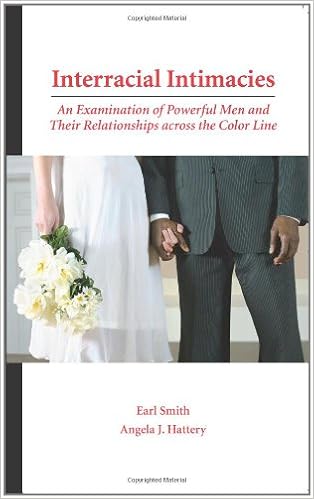
Interracial Intimacies: An Examination of Powerful Men and Their Relationships across the Color Line

Posted in Books, History, Law, Media Archive, Monographs, Politics/Public Policy, Social Science, United States on 2015-03-07 02:02Z by Steven

Interracial Intimacies: An Examination of Powerful Men and Their Relationships across the Color Line

Carolina Academic Press
2009
144 pages
Paper ISBN: 978-1-59460-496-6

Earl Smith, Professor Emeritus of Sociology
Wake Forest University, Winston-Salem, North Carolina

Angela J. Hattery, Professor and Director of Women and Gender Studies
George Mason University, Fairfax, Virginia

Unique among books on interracial relationships, this book examines the lives of high profile men who have produced public discourses on race and interracial relationships and who themselves, often contradictory to their rhetoric, were or continue to be involved in love relationships across the color line. The book opens with a discussion of the history of interracial couplings in the United States, including an examination of the relationship of Richard and Mildren Loving which led to the landmark case Loving v. Virginia in which the U.S. Supreme Court, in 1967, rendered unconstitutional all state laws that prohibited interracial marriage. Each of the subsequent chapters is devoted to an individual man or couple; we explore the lives of men about whom their interracial relationships are relatively well known, including Thomas Jefferson, Strom Thurmond, Clarence Thomas, Frederick Douglass, and William Cohen. We also explore a few figures about whom less is known about their intimate lives including George Washington and Richard Mentor Johnson.

Rather than simply focusing on the relationships exclusively, this book examines specifically the role that power plays in shaping the negotiation of intimate relationships, family forms, racial identity, hegemonic ideology and public policy among public figures who not only contributed to the public discourses on race and interracial unions, but also contributed to the racial ideologies that gained hegemony and dominated Americans’ beliefs about race and the laws and public policies that established second class citizenship for those identified as “Black.”

This book offers the interested reader a glimpse into the personal lives of famous and not so famous American men who clandestinely or in open view loved women across the color line. In some cases, these loving relationships mirrored the men’s beliefs about race and interracial unions—Richard Mentor Johnson, William Cohen—and in others these relationships were in seeming contradiction to the beliefs these men held and in fact developed about racial purity and segregation—Thomas Jefferson, Clarence Thomas, Strom Thurmond. These contradictions between the public and private lives of our country’s public servants offers a rich arena for exploration of race in the United States. In light of the recent election of the first African American president, Barack Obama, this book could not be more timely.

Tags: , , , , , , , , , , , ,

The Men Who Left Were White

Posted in Articles, Autobiography, History, Media Archive, United States on 2015-03-06 02:20Z by Steven

The Men Who Left Were White

Gawker
2014-04-12

Josie Duffy

There are three things you should know.

First: I’m not biracial.

“What are you?” people ask, and they expect me to say something thrilling and tribal. I answer, but still they press. “Where are your ancestors from?” people ask, and they want answers that aren’t San Antonio and Wheeling, West Virginia. But that’s all I got. My story is both simple and untold.

The bones of it, of me: I’m black, despite the skin that goes virtually translucent in the winter. Despite the thin unpredictable curls. My mom and dad are black, as are my grandparents. That’s all she wrote. That’s all there is, even as I write this sentence. My parents, usually liberal employers of nuance, have always been militant-clear about drawing that line. We aren’t biracial.

When I tell people I’m black, they find it unsatisfying. “That’s no fun,” one girl joked to me recently. “I thought you were going to have a story.”

Second: I’m 44% European, 49% African. Not exactly an equal split, but pretty damn close.

I hear the same sentence twice…

Read the entire article here.

Tags: ,

Occupation Babies: Mixed-Race Japanese Children

Posted in Articles, Asian Diaspora, History, Media Archive, United States on 2015-03-03 15:24Z by Steven

Occupation Babies: Mixed-Race Japanese Children

Wonders & Marvels: A Community for Curious MInds who love History, its Odd Stories, and Good Reads
2015-02-28

James McGrath Morris, Guest Contributor

One of the pleasures of researching a book is coming across something you don’t anticipate, something surprising that is fascinating to both the reader and the writer.

In my case, in the course of working on Eye on the Struggle, I learned for the first time the story of mixed-race babies in Japan born from African American soldiers and Japanese women in the years shortly after World War II when American troops occupied Japan. White soldiers fathered children as well, but the offspring of black fathers were far more ostracized.

Being of such visible mixed race, the babies were unwanted by the Japanese, who abhorred what they viewed as the tainting of their blood. They were frequently abandoned upon birth. In one case, a train passenger unwrapped a cloth bundle she spotted on the luggage rack to discover the corpse of a black Japanese baby…

Read the entire article here.

Tags: , , , ,

A Chosen Exile: A History of Racial Passing in American Life [Live event at the National Archives Museum]

Posted in History, Live Events, Media Archive, Passing, United States, Videos on 2015-03-03 01:32Z by Steven

A Chosen Exile: A History of Racial Passing in American Life [Live event at the National Archives Museum]

The National Archives Museum
William G. McGowan Theater
Corner of Constitution Avenue and 7th Street, NW
Washington, D.C.
2015-02-27, 12:00 EST (Local Time)

Airs on C-SPAN 2, Sunday, 2015-03-08, 19:00 EDT. For more information, click here.

Between the 18th and mid-20th centuries, countless African Americans passed as white, leaving behind families and friends, roots and community. Historian Allyson Hobbs explores the possibilities and challenges that racial indeterminacy presented to men and women living in a country obsessed with racial distinctions.

A book signing will follow the program. Purchase this book [A Chosen Exile: A History of Racial Passing in American Life] on the day of the event from the myArchives Store and receive a 15% discount (members get 20% off).

For more information, click here.

Tags: , ,

One Drop of Love at Iowa State University

Posted in Arts, Census/Demographics, History, Live Events, Media Archive, Social Science, United States on 2015-03-01 02:16Z by Steven

One Drop of Love at Iowa State University

Great Hall, Memorial Union
Iowa State University
Ames, Iowa
2015-03-01, 19:00 CST (Local Time), Doors open at 18:30

One Drop of Love produced by Ben Affleck and Matt Damon, performed by Fanshen Cox Digiovanni is a multimedia solo show that tells the story of how the notion of ‘race’ came to be in the United States. In addition, Fanshen whom is of mixed race shares personal accounts of how it affected the relationship with her father.

Admission is free.

For more information, click here.

Tags: , , , ,

Black Slaves, Indian Masters: Slavery, Emancipation, and Citizenship in the Native American South

Posted in Books, History, Media Archive, Monographs, Native Americans/First Nation, Slavery, United States on 2015-02-24 21:59Z by Steven

Black Slaves, Indian Masters: Slavery, Emancipation, and Citizenship in the Native American South

University of North Carolina Press
February 2015
232 pages
6.125 x 9.25
11 halftones, notes, bibl., index
Paper ISBN: 978-1-4696-2187-6

Barbara Krauthamer, Associate Professor of History
University of Massachusetts, Amherst

From the late eighteenth century through the end of the Civil War, Choctaw and Chickasaw Indians bought, sold, and owned Africans and African Americans as slaves, a fact that persisted after the tribes’ removal from the Deep South to Indian Territory. The tribes formulated racial and gender ideologies that justified this practice and marginalized free black people in the Indian nations well after the Civil War and slavery had ended. Through the end of the nineteenth century, ongoing conflicts among Choctaw, Chickasaw, and U.S. lawmakers left untold numbers of former slaves and their descendants in the two Indian nations without citizenship in either the Indian nations or the United States. In this groundbreaking study, Barbara Krauthamer rewrites the history of southern slavery, emancipation, race, and citizenship to reveal the centrality of Native American slaveholders and the black people they enslaved.

Krauthamer’s examination of slavery and emancipation highlights the ways Indian women’s gender roles changed with the arrival of slavery and changed again after emancipation and reveals complex dynamics of race that shaped the lives of black people and Indians both before and after removal.

Tags: , , ,

The white man who pretended to be black

Posted in Articles, Biography, History, Media Archive, Passing, United States on 2015-02-23 21:45Z by Steven

The white man who pretended to be black

The Telegraph
2015-02-05

Tim Stanley

With the release of the movie Selma, a lot of Americans are asking how far race relations have really come in the United States. On the one hand, the movie depicts the success of the Sixties civil rights crusade – its victory confirmed by Barack Obama’s election in 2008.

On the other hand, the recent deaths of young black men at the hands of white cops and vigilantes, and the resulting race riots, suggest that a lot of things haven’t changed at all. Whites may ask, “Why are working-class blacks angry? They have the right to vote and an African-American president – everything Martin Luther King Jr fought for.”

But some of the apparent triumph of black civil rights is a veneer. Racism isn’t just about law but about attitudes. Attitudes that are hard to change because of the gulf of understanding between different communities.

Can a white person ever really understand how a black person sees the world? Back in 1959, six years before Martin Luther King marched for civil rights in Selma, one man tried. A white Texan writer called John Howard Griffin walked into a doctor’s office in New Orleans and asked him to turn his skin colour black. Griffin took oral medication and was bombarded with ultraviolet rays; he cut off his hair to hide an absence of curls and shaved the back of his hands. Then he went on a tour of the Deep South.

The result was a bestselling book called Black Like Me, which is still regarded as an American classic. Griffin wanted to test the claim that although the southern United States was segregated it was essentially peaceful and just – that the two races were separate but equal…

Read the entire article here.

Tags: , ,

The Secret History of South Asian & African American Solidarity

Posted in Articles, Asian Diaspora, History, Media Archive, Social Science, United States on 2015-02-23 20:13Z by Steven

The Secret History of South Asian & African American Solidarity

NBC News
2015-02-16

Frances Kai-Hwa Wang

Most Americans know about Dr. Martin Luther King, Jr.’s adoption of Gandhian non-violent principles. Not as well known is the shared solidarity between South Asians and African Americans that dates back over a hundred years.

For African American History Month, one of the curators of the famed Berkeley South Asian Radical History Walking Tour, Anirvan Chatterjee, has launched a new digital project to highlight that hidden past, called, “The Secret History of South Asian and African American Solidarity.”

“Since the tragedy in Ferguson, I’ve been seeing a lot of Asian Americans working to engage anti-Black racism through conversations in their families and communities, protests, and direct action,” said Chatterjee, “but they’re not the first.”

Pairing period photographs with quotes and adding short historical captions, Chatterjee shows how African Americans repeatedly advanced South Asian rights, such as the NAACP passing a resolution in favor of Indian independence, Langston Hughes‘ poems about the oppression of South Asian freedom fighters, and Bayard Rustin, lead organizer of the 1963 March on Washington, forming the Free India Committee while in jail…

Read the entire article here.

Tags: , ,