Myths of Racial Democracy: Cuba, 1900-1912

Posted in Articles, Caribbean/Latin America, History, Media Archive, Social Science on 2012-08-19 22:49Z by Steven

Myths of Racial Democracy: Cuba, 1900-1912

Latin American Research Review
Volume 34, Number 3 (1999)
pages 39-73

Alejandro de la Fuente, UCIS Research Professor of History
University of Pittsburgh

This article reviews the recent literature on the so-called myths of racial democracy in Latin America and challenges current critical interpretations of the social effects of these ideologies. Typically, critics stress the elitist nature of these ideologies, their demobilizing effects among racially subordinate groups, and the role they play in legitimizing the subordination of such groups. Using the establishment of the Cuban republic as a test case, this article contends that the critical approach tends to minimize or ignore altogether the opportunities that these ideologies have created for those below, the capacity of subordinate groups to use the nation-state’s cultural project to their own advantage, and the fact that these social myths also restrain the political options of their own creators.

In a very real sense, nothing can be more real than the unreal.
Ashley Montagu, Race, Science, and Humanity

Brazilian sociologist Florestan Fernandes called it “prejudice against prejudice”; U.S. sociologist Thomas Lynn Smith described it as “a veritable cult.” Both were referring to what has come to be known as the Brazilian myth of racial democracy.

In its simplest formulation, the “myth” is that all Brazilians, regardless of “race,” enjoy equal opportunities and live in a racially harmonious society. It could not be otherwise, according to the myth, because Brazil’s strength and greatness reside in the widespread racial mixture of its population. It therefore makes no sense to talk about blacks and whites in a country in which most citizens are some of both. “Race” in Brazilian society is constructed along a continuum moving from “black” to “white” based on phenotypical features (skin color, type of hair, facial features) and on social factors like education and financial status. Several centuries of intimate contact and miscegenation, biological and cultural, have created a new hybrid race that is authentically Brazilian.

The notoriety of the Brazilian case has been guaranteed by the brilliance of its myth makers, foremost among them Gilberto Freyre. But it has also been sustained by two fundamental facts: no other country in the hemisphere has a numerically larger population of African descent; and no other country enslaved its black population as late as Brazil did, until 1888. A hegemonic ideology advocating some form of racial fraternity is remarkable in a country like Brazil but hardly unique. Since the late nineteenth century, particularly during the 1920s and 1930s, intellectual elites in numerous Latin American countries have articulated racial ideologies that were similar in purpose and content to the Brazilian myth. Mestizaje was exalted as the true American essence, a synthesis that incorporated (allegedly on equal terms) the best cultural and physical traits that the various ethnic and racial groups populating the Americas had to offer.

Forced to cope with the troubling aspects of a North Atlantic ideology that flatly advocated the inferiority of non-Anglo-Saxon peoples and the deleterious effects of racial mixing, the elites in Latin America had to reach a compromise that would allow them to reconcile the goal of modernity with the undeniably mixed nature of their populations. During this search, the mestizo was invented as a national symbol. The result was an ideological formulation that broke with the past while upholding it. The discourse on mestizaje remained prisoner of the same canon that scientific racism proclaimed as incontrovertible truths—the essentialness of race—but the discourse revolutionized social thinking by minimizing the other central tenet of the hegemonic racial gospel: biological determinism. Although race was still associated with ascribed characteristics as immutable and overpowering as those championed by genetically based racism, the emphasis was shifted to geographical, cultural, and historical factors. This is no small distinction. By placing social factors at the core of their ideological constructions, Latin American intellectuals were openly contesting the notion that their countries were doomed to failure and perpetual backwardness, while asserting (however implicitly) that social transformation was the way to reach modernity. They thus had fabricated a way out of the ideological iron cast that the North Atlantic world had manufactured by means of its high science, universities, and royal societies.

But the escape was only partial. While contesting or just ignoring the idea that racial miscegenation meant degeneration, Latin American thinkers accepted the premise that ample sectors of their populations were basically inferior and that their human stock needed to be “improved” Such inferiority was to be explained in terms of culture, geography, or climate rather than pure genetics, but the dominant vision still presented the lighter end of the spectrum as the ideal and denigrated the darker end as primitive and uncivilized. In this formulation, whiteness still represented progress. Miscegenation was perceived as the way to “regenerate” a population unfit to perform the duties associated with a modern polity, with white immigration serving as a precondition for progress. The idea that regeneration was possible at all subverted biological determinism, but the expressed need for regeneration presupposed acceptance of the idea that “race” explained the “backwardness” of Latin American societies. Whitening became the way to remove a surmountable, albeit formidable, obstacle on the road to modernity.

Read the entire article here.

Tags: , ,

Blacks and Whites in São Paulo, Brazil 1888–1988

Posted in Books, Brazil, Caribbean/Latin America, History, Media Archive, Monographs, Politics/Public Policy, Social Science on 2012-08-19 04:05Z by Steven

Blacks and Whites in São Paulo, Brazil 1888–1988

University of Wisconsin Press
November 1991
376 pages
6 x 9; 1 map
Paper ISBN: 978-0-299-13104-3

George Reid Andrews, Distinguished Professor of History
University of Pittsburgh

Winner of the 1993 Arthur P. Whitaker Prize

For much of the twentieth century Brazil enjoyed an international reputation as a “racial democracy,” but that image has been largely undermined in recent decades by research suggesting the existence of widespread racial inequality. George Reid Andrews provides the first thoroughly documented history of Brazilian racial inequality from the abolition of slavery in 1888 up to the late 1980s, showing how economic, social, and political changes in Brazil during the last one hundred years have shaped race relations.

No laws of segregation or apartheid exist in Brazil, but by looking carefully at government policies, data on employment, mainstream and Afro-Brazilian newspapers, and a variety of other sources, Andrews traces pervasive discrimination against Afro-Brazilians over time. He draws his evidence from the country’s largest and most economically important state, São Paulo, showing how race relations were affected by its transformation from a plantation-based economy to South America’s most urban, industrialized society.

The book focuses first on Afro-Brazilians’ entry into the agricultural and urban working class after the abolition of slavery. This transition, Andrews argues, was seriously hampered by state policies giving the many European immigrants of the period preference over black workers. As immigration declined and these policies were overturned in the late 1920s, black laborers began to be employed in agriculture and industry on nearly equal terms with whites. Andrews then surveys efforts of blacks to move into the middle class during the 1900s. He finds that informal racial solidarity among middle-class whites has tended to exclude Afro-Brazilians from the professions and other white-collar jobs.

Andrews traces how discrimination throughout the century led Afro-Brazilians to mobilize, first through the antislavery movement of the 1880s, then through such social and political organizations of the 1920s and 1930s as the Brazilian Black Front, and finally through the anti-racism movements of the 1970s and 1980s. These recent movements have provoked much debate among Brazilians over their national image as a racial democracy. It remains to be seen, Andrews concludes, whether that debate will result in increased opportunities for black Brazilians.

Contents

  • Lists of Tables
  • Acknowledgments
  • Chapter 1. Introduction
  • Part 1. Workers
    • Chapter 2. Slavery and Emancipation, 1800-1890
    • Chapter 3. Immigration, 1890-1930
    • Chapter 4. Working, 1920-1960
  • Part 2. The Middle Class
    • Chapter 5. Living in a Racial Democracy, 1900-1940
    • Chapter 6. Blacks Ascending, 1940-1988
    • Chapter 7. Organizing, 1945-1988
  • Part 3. Past, Present, Future
    • Chapter 8. One Hundred Years of Freedom: May 13, 1988
    • Chapter 9. Looking Back, Looking Forward
  • Appendix A. Population of Sao Paulo State, 1800-1980
  • Appendix B. Brazilian Racial Terminology
  • Appendix C. Personnel Records at the Jafet and São Paulo Tramway, Light, and Power Companies
  • Glossary
  • Notes
  • Selected Bibliography
  • Index
Tags: , ,

Capturing complexity in the United States: which aspects of race matter and when?

Posted in Articles, Census/Demographics, Media Archive, Social Science, United States on 2012-08-14 01:27Z by Steven

Capturing complexity in the United States: which aspects of race matter and when?

Ethnic and Racial Studies
Volume 35, Issue 8, 2012
Special Issue:Accounting for ethnic and racial diversity: the challenge of enumeration
pages 1484-1502
DOI: 10.1080/01419870.2011.607504

Aliya Saperstein, Assistant Professor of Sociology
Stanford University

The experience of race in the United States is shaped by both self-identification and ascription. One aspect reflects personal history, ancestry, and socialization while the other draws largely on appearance. Yet, most data collection efforts treat the two aspects of race as interchangeable, assuming that the relationship between each and an individual’s life chances will be the same. This study demonstrates that incorporating racial self-identification and other-classification in analyses of inequality reveals more complex patterns of advantage and disadvantage than can be seen using standard methods. These findings have implications for how racial data should be collected and suggest new directions for studying racial inequality in the United States and around the world.

It is templing to assume there are clear distinctions that identify a person as being a particular race or ethnicity. Though the characteristics that define racial or ethnic difference vary across societies, it is nevertheless common for people to maintain thai their country’s ‘others’ are easily singled out e.g., by face, accent, name, or dress. Indeed, in recent years, governments around the world have begun to mandate the collection of data to monitor racial/ethnic discrimination as if the information needed were obvious. In the United States, official racial data has been collected since at leasl 1790, and how it
should be gathered was rarely questioned because, according to commonsense belief, racial differences were ‘unmistakable’. Today, the assumption of measurement agreement can take on a different tone as racial data is put to different purposes: why quibble over…

Read or purchase the article here.

Tags: ,

Indigenous Nationalities and the Mestizo Dilemma

Posted in Anthropology, Articles, Canada, Caribbean/Latin America, Media Archive, Mexico, Native Americans/First Nation, Social Science, United States on 2012-08-06 00:14Z by Steven

Indigenous Nationalities and the Mestizo Dilemma

Indian Country Today Media Network
2012-07-24

Duane Champagne, Professor of Sociology
University of California, Los Angeles

Mestizo. Métis. Mixed bloods. Though clearly different, all these terms are used to racially classify people with Indian ancestry. However, the definitions vary—and none is wholly satisfactory.
 
Part of the problem is the widely varying histories of these people. The U.S. and Canada, for example, are settler states, where immigrants who took the land went on to form the majority. There, Indian and mixed-blood populations are a distinct minority.
 
However, many other countries like Mexico, El Salvador, Peru and Ecuador have majority mixed-blood and indigenous populations, or mixed-blood leadership over indigenous majorities. Here, indigenous and mixed-blood identities and political relations come into sharper focus.
 
Officially, racial classifications were officially discouraged in so-called Latin America after Spain lost control over most of its colonies there in the early 1800s. Just the same, many governments, like Mexico’s, promoted a mestizo national identity based on a mix of European and indigenous heritages. In the United States and Canada, we call this process assimilation.
 
In Mexico, by contrast, it is called mestizaje. Mestizaje policies ask Indigenous Peoples to join the national community and economy, adopt the Spanish language, and abandon their traditional tribal communities, culture, language and dress.

Read the entire article here.

Tags: ,

Shades of Passing (AAS 340 / ENG 391 / AMS 340)

Posted in Asian Diaspora, Course Offerings, History, Law, Literary/Artistic Criticism, Media Archive, Passing, Social Science, United States on 2012-08-05 04:12Z by Steven

Shades of Passing (AAS 340 / ENG 391 / AMS 340)

Princeton University
Fall 2012-2013

Anne A. Cheng, Professor of English and African American Studies

This course studies the trope of passing in 20th century American literary and cinematic narratives in an effort to re-examine the crisis of identity that both produces and confounds acts of passing. We will examine how American novelists and filmmakers have portrayed and responded to this social phenomenon, not as merely a social performance but as a profound intersubjective process embedded within history, law, and culture. We will focus on narratives of passing across axes of difference, invoking questions such as: To what extent does the act of passing reinforce or unhinge seemingly natural categories of race, gender, and sexuality?

Sample reading list:
William Faulkner, Light in August
Toni Morrison, The Bluest Eye
Nella Larsen, Passing
Chang-rae Lee, A Gesture Life
Douglas Sirk (director), Imitation of Life (film, 1959)
Woody Allen (director), Zelig (film, 1983)

Tags: , ,

Introduction: Passing, Imitations, Crossings

Posted in Articles, Literary/Artistic Criticism, Media Archive, Passing, Social Science on 2012-08-05 02:54Z by Steven

Introduction: Passing, Imitations, Crossings

Humanities Research
Volume XVI. Number 1 (2010)

Monique Rooney, Lecturer and Honours Convenor
College of Arts and Social Sciences
Austrailian National University

When it was revealed that Anglo-Australian writer Helen Darville had passed as Ukrainian to publish a novel about the Holocaust, there was much public and scholarly debate about the nature of identity and the meaning of multiculturalism. Such ‘passing’ controversies have the capacity to unsettle everyday perceptions about personhood and about social classifications and identifications. The essays collected in this special issue of Humanities Research, ‘Passing, Imitations, Crossings’, explore the theme and act of ‘passing’ in a range of social, historical and cultural contexts. Put simply, passing is a type of border crossing, one that normally involves a movement from social disadvantage to advantage or from a socially stigmatised position to one that grants some privilege, or at least allows avoidance or evasion of group classification. Passing is distinct from other identity performances in that it generally refers to a surreptitious transgression of widely accepted social practices. That is, the passer normally masks the fact of his or her ‘true’ identity—he or she might rely on subterfuge or might remove him or herself from a telling context or simply suppress information that might lead to disclosure of his or her identity—in order to cross social boundaries. In the case of African-Americans, passing for white historically entailed crossing the social divide that separated black and white according to changing cultural, scientific and legal measurements of what constituted racial identity. As St Clair Drake and Horace R. Cayton observed in their study of African-American social life in Chicago’s South Side in the 1930s, ‘there are thousands of Negroes whom neither colored nor white people can distinguish from full-blooded whites, it is understandable that in the anonymity of the city many Negroes “pass for white” daily, both intentionally and unintentionally’. The prospect of passing multiplies in societies in which the often anonymous flow of people sets the scene for opportunism, masquerade and other forms of role-playing. There are women who have cross-dressed as male to publish books or participate in war and gays and lesbians who have passed as straight to avoid homophobia. There are those who pass out of necessity, to escape war or life-threatening discrimination, and those who pass for greater gain or simply for the thrill of experiencing life on the ‘other side’, as passing provides the opportunity to temporarily or permanently depart from a designated identity.

The transport and communications revolution that took place in the United States at the end of the nineteenth and in the early decades of the twentieth centuries—a time also of great movement and mixing of diverse social groups in American cities, as well as a period of new strictures and the terrors of lynching—created a fertile context for passing. The many fictional and sociological recordings of African-Americans who ‘passed as white’ to cross the colour line, from the middle of the nineteenth century through to the 1950s and 1960s—when African-Americans began to win civil rights—suggests how prevalent the act was in a US context. In his encyclopedic study of ‘inter-racial’ themes in US history, Werner Sollors differentiates the passer from the parvenu (the social climber or upstart). While the act of passing potentially encompasses ‘the crossing of any line that divides social groups’—and Everett V. Stonequist argues that ‘passing is found in every race situation where the subordinate race is held in disesteem’—Sollors’ study locates the phenomenon firmly in US social history. In particular, Sollors connects passing with the burden of racial ancestry for the descendents of slaves. While the general expectation is that newly arrived immigrants will gradually assimilate, the descendents of slaves—in what Sollors calls America’s ‘hypodescent’ system—have been treated as members of a caste. African-Americans have been subject to a form of ‘ancestor-counting’ that reduces personhood to a racial part

Read the entire article here.

Tags: ,

The Negro in Washington: A Study in Race Amalgamation

Posted in Anthropology, Books, Media Archive, Monographs, Social Science, United States on 2012-08-04 04:25Z by Steven

The Negro in Washington: A Study in Race Amalgamation

Walter Neale, Publisher, New York
1930
332 pages
Original Classification ID: E185.93.D695
Source: University of California via The Hathi Trust Digital Library

A. H. Shannon, B. D., M. A.
Former Chaplain of the Mississippi State Penetentiary
Member, American Anthropological Association

CONTENTS

  • A. A Personal Word to the Reader.
  • B. Introduction.
  • I. Statement of the Case.
  • II. The Mulatto
  • III. Illegitimacy
  • IV. Isabella and Jamestown
  • V. The Near-White.
  • VI. The Poor-White
  • VIII. Politics and the Race Problem
  • III. Race and Religion
  • IX. Colonization as a Solution of the American Race Problem
  • X. Some Conclusions and a Forward Look

A PERSONAL WORD TO THE READER

The author of this book has been, for some years, a  close observer of race relations and a student of those  problems growing out of racial contacts. As Chaplain of the Mississippi State Penitentiary, he was called  upon to minister to several hundred Negro prisoners,  thus gaining a measure of intimate knowledge of the Negro criminal. As a teacher in the employ of the  Imperial Government of Japan, he was privileged to  make a brief study of an Oriental civilization. Here  was gained some knowledge of the Eurasian problem, so acute in some of the Asiatic countries and in evidence  wherever contact of East and West has occurred.

The chief interest of the author in the Negro problem has centered about the matter of racial intermixture—the Mulatto problem—and most of his writings have had to do with this evil. The present study, while endeavoring to ascertain and to state fact impartially, necessarily gives a large measure of personal reaction  to certain of the problems involved in present-day contacts of the two races, the black and the white, in the United States. Whoever really understands conditions now obtaining in North America is prepared to understand the situation wherever two dissimilar races occupy the same territory, or wherever casual racial contacts occur—as they now do throughout the greater part of the world.

There is a conscious and an intentional limiting of this study largely to those features of the situation which may well tend toward discouragement, if not toward hopeless pessimism. Since it now appears fashionable to approach the Negro problem from the standpoint of the invincible optimist, resolutely ignoring or consciously discarding those facts which, fairly faced, would shatter so many pleasing theories, it is well that some one should present the darker side of the picture, for there is a terribly dark side. The reader, once the situation is clearly analyzed and its elements indicated, may be trusted to interpret aright the issues unquestionably involved. Americans, white and black alike, are not awake to the real situation confronting them, a fact clearly evidenced by more than half century of silence and indifference touching the vital issue of race amalgamation and the conditions under which this is now occurring.

As an answer to the ever-ready charge of ministering to, if not creating, racial antagonisms and hates—a charge behind which there sometimes lurks more of moral and of intellectual inertia than some good people are aware of—there is to be noted the difference between a clear statement of fact, a clear-cut challenge to the self-respect of each of two groups, and a maligning of one group by the other. If it has come to the pass that a calm facing of fact, a thorough analysis of a given situation, must be opposed because it reveals the destructiveness of an inherited unreasonable and unreasoned program, there should, at least, be a clear understanding of the attitudes displayed and a close scrutiny of the motives behind these attitudes.

Both races in America, especially in the United States, are confronted by facts demanding careful consideration; by problems the solution of which depends primarily upon thorough analysis as the basis for a full understanding of what is really involved. Various organizations, secular and religious, are in the field, voluntarily endeavoring to carry out programs which they are free to make what they will. Most of these would resent the charge that they are contributing directly to moral confusion and to racial degradation. Most of them would resent the charge that their work and the attitudes upon which it rests constitute the most destructive influence against which the full-blood Negro must contend at the present time. Can it be shown that such charge is untrue? If only there could be a general and an honest, dispassionate inquiry, bringing these matters into the realm of conscious thought and purposive program, there would be hope of constructive action. If this volume assists the reader to break with traditional lines of thought and the attitudes and the programs based upon these lines of thought, thus promoting independent analysis and rationally constructive programs, it will serve a useful and a timely purpose.

The author is forced into a position which is es sentially unpleasant. It becomes necessary to point out the grounds of criticism, the delinquencies, of those who, holding positions of leadership—political, educational, religious—have failed to see, or seeing have failed to meet, or have met with utter indifference, the problems here discussed. Upon the part of the leaders of both races there has been, at best, a light estimate of the trust reposed in their leadership. No further evidence is necessary to establish this fact than to call attention to present conditions and to the manner in which these conditions have grown up, without effective protest or warning, and that they are now generally accepted, without analysis, and without intelligent evaluation of their logical, their inevitable, results.

The thanks of the author are due to both Authors  and Publishers permitting the use of quotations appear ing in this volume. Credit is given in each case. Professor E. B. Reuter has been especially generous, permitting the unrestricted use of material the collection of which necessarily cost him much expense, in addition, to time and labor involved. His book, The Mulatto in the United States, is a very valuable statement of ultimate fact.

Read the entire book here.

Tags: , , , , , , ,

Mixed Messenger

Posted in Articles, Asian Diaspora, Barack Obama, Social Science, United States on 2012-08-03 01:23Z by Steven

Mixed Messenger
The New York Times
2008-03-23

Peggy Orenstein

A few weeks ago, while stuck at the Chicago airport with my 4-year-old daughter, I struck up a conversation with a woman sitting in the gate area. After a time, she looked at my girl — who resembles my Japanese-American husband — commented on her height and asked, “Do you know if her birth parents were tall?”

Most Americans watching Barack Obama’s campaign, even those who don’t support him, appreciate the historic significance of an African-American president. But for parents like me, Obama, as the first biracial candidate, symbolizes something else too: the future of race in this country, the paradigm and paradox of its simultaneous intransigence and disappearance.

It’s true that, over the past months, Obama has increasingly positioned himself as a black man. That’s understandable: insisting on being seen as biracial might alienate African-American leaders and voters who have questioned his authenticity. White America, too, has a vested interest in seeing him as black it’s certainly a more exciting, more romantic and more concrete prospect than the “first biracial president.” Yet, even as he proves his black cred, it may be the senator’s dual identity, and his struggles to come to terms with it, that explain his crossover appeal and that have helped him to both embrace and transcend race, winning over voters in Birmingham, Iowa, as well as Birmingham, Ala…

…But the rise of multiracialism is not all Kumbaya choruses and “postracial” identity. The N.A.A.C.P. criticized the census change, fearing that since so few in the black community are of fully African descent, mass attrition to a mixed-race option could threaten political clout and Federal financing. Mexican-Americans, a largely mixed-race group, fought to be classified as white during the first half of the 20th century; during the second half, they fought against it.

Among Asians, Japanese-Americans in Northern California have argued over “how Japanese” the contestants for the Cherry Blossom Queen must be (the answer so far: 50 percent, which is less rigid than San Francisco’s Miss Chinatown U.S.A., whose father must be Chinese, but more strict than the 25 percent Chinese required to be Miss Los Angeles Chinatown)…

Read the entire article here.

Tags: , ,

Unsuitable Suitors: Anti-Miscegenation Laws, Naturalization Laws, and the Construction of Asian Identities

Posted in Articles, Asian Diaspora, History, Law, Media Archive, Social Science, United States on 2012-08-02 01:09Z by Steven

Unsuitable Suitors: Anti-Miscegenation Laws, Naturalization Laws, and the Construction of Asian Identities

Law & Society Review
Volume 41, Issue 3 (September 2007)
pages 587–618
DOI: 10.1111/j.1540-5893.2007.00315.x

Deenesh Sohoni, Associate Professor of Sociology
The College of William & Mary, Williamsburg, Virginia

In this article, I use state-level anti-miscegenation legislation to examine how Asian ethnic groups became categorized within the American racial system in the period between the Civil War and the civil rights movement of the 1960s. I show how the labels used to describe Asian ethnic groups at the state level reflected and were constrained by national-level debates regarding the groups eligible for U.S. citizenship. My main point is that Asian ethnic groups originally were viewed as legally distinct—racially and ethnically, and that members of these groups recognized and used these distinctions to seek social rights and privileges. The construction of “Asian” as a social category resulted primarily from congressional legislation and judicial rulings that linked immigration with naturalization regulations. Anti-miscegenation laws further contributed to the social exclusion of those of Asian ancestry by grouping together U.S.-born and foreign-born Asians.

Read or purchase the article here.

Tags: ,

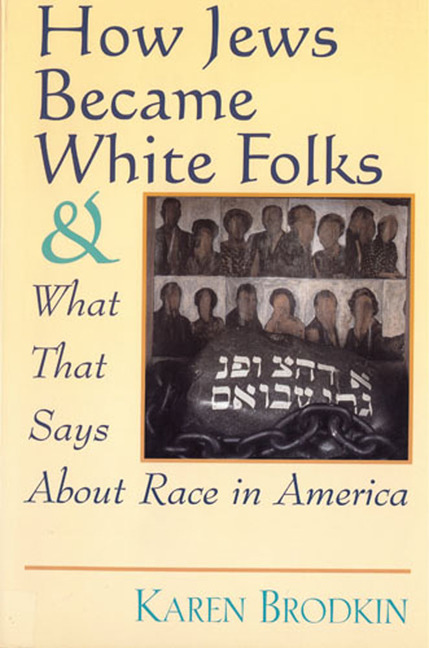
How Jews Became White Folks and What That says about Race in America

Posted in Anthropology, Books, Judaism, Media Archive, Monographs, Religion, Social Science, United States on 2012-08-02 00:53Z by Steven

How Jews Became White Folks and What That says about Race in America

Rutgers University Press
1998-10-01
272 pages
Cloth ISBN: 978-0-8135-2589-1
Paper ISBN: 978-0-8135-2590-7

Karen Brodkin, Professor Emeritus of Anthropology
University of California, Los Angeles

A wide-ranging and provocative assessment of how race, class, and gender shape social identity in the United States.

We fashion identities in the context of a wider conversation about American nationhood, to whom it belongs and what belonging means. Race and ethnicity, class, gender, and sexuality are all staple ingredients in this conversation. They are salient aspects of social being from which economic practices, political policies, and popular discourses create “Americans.” Because all of these facets of social being have such significant meaning on a national scale, they also have major consequences for both individuals and groups in terms of their success and well-being, as well as how they perceive themselves socially and politically.

The history of Jews in the United States is one of racial change that provides useful insights on race in America. Prevailing classifications have sometimes assigned Jews to the white race and at other times have created an off-white racial designation for them. Those changes in racial assignment have shaped the ways American Jews of different eras have constructed their ethnoracial identities. Brodkin illustrates these changes through an analysis of her own family’s multi-generational experience. She shows how Jews experience a kind of double vision that comes from racial middleness: on the one hand, marginality with regard to whiteness; on the other, whiteness and belonging with regard to blackness.

Class and gender are key elements of race-making in American history. Brodkin suggests that this country’s racial assignment of individuals and groups constitutes an institutionalized system of occupational and residential segregation, is a key element in misguided public policy, and serves as a pernicious foundational principle in the construction of nationhood. Alternatives available to non-white and alien “others” have been either to whiten or to be consigned to an inferior underclass unworthy of full citizenship. The American ethnoracial map-who is assigned to each of these poles-is continually changing, although the binary of black and white is not. As a result, the structure within which Americans form their ethnoracial, gender, and class identities is distressingly stable. Brodkin questions the means by which Americans construct their political identities and what is required to weaken the hold of this governing myth.

Contents

  • Acknowledgments
  • Introduction
  • 1. How Did Jews Become White Folks?
  • 2. Race Making
  • 3. Race, Gender, and Virtue in Civic Discourse
  • 4. Not Quite White: Gender and Jewish Identity
  • 5. A Whiteness of Our Own? Jewishness and Whiteness in the 1950s and 1960s
  • Conclusion
  • Notes
  • Bibliography
  • Index
Tags: ,