The Sum of Our Parts: Mixed-Heritage Asian Americans

Posted in Anthologies, Asian Diaspora, Books, Census/Demographics, Media Archive, Politics/Public Policy, United States on 2009-10-15 20:55Z by Steven

The Sum of Our Parts: Mixed-Heritage Asian Americans

Temple University Press
June 2001
296 pages
7×10
2 tables 4 figures 3 halftones
paper: EAN: 978-1-56639-847-3 (ISBN: 1-56639-847-9)

edited by Teresa Williams-León and Cynthia L. Nakashima, foreword by Michael Omi

Largely as a result of multiracial activism, the US Census for 2000 offers people the unprecedented opportunity to officially identify themselves with more than one racial group. Among Asian-heritage people in this country and elsewhere, racial and ethnic mixing has a long but unacknowledged history. According to the last US Census, nearly one-third of all interracial marriages included an Asian-descent spouse, and intermarriage rates are accelerating. This unique collection of essays focuses on the construction of identity among people of Asian descent who claim multiple heritages.

In the U.S., discussions of race generally center on matters of black and white; mixed heritage Asian Americans usually figure in conversations about race as an undifferentiated ethnic group or as exotic Eurasians. The contributors to this book disrupt the standard discussions by considering people of mixed Asian ethnicities. They also pay particular attention to non-white multiracial identities to decenter whiteness and reflect the experience of individuals or communities who are considered a minority within a minority. With an entire section devoted to the Asian diaspora, The Sum of Our Parts suggests that questions of multiracial and multiethnic identity are surfacing around the globe. This timely and provocative collection articulates them for social scientists and students.

Table of Contents

  • ForewordMichael Omi
  • Acknowledgments
  • Introduction: Reconfiguring Race, Rearticulating Ethnicity – Teresa Williams-León and Cynthia L. Nakashima
  • Part I: Multiraciality and Asian America: Bridging the Hybrid Past to the Multiracial Present
    • 1. Who Is an Asian? Who Is a Pacific Islander? Monoracialism, Multiracial People, and Asian American Communities – Paul Spickard
    • 2. Possibilities of a Multiracial Asian America – Yen Le Espiritu
    • 3. Servants of Culture: The Symbolic Role of Mixed-Race Asians in American Discourse – Cynthia L. Nakashima
    • 4. “The Coming of the Neo-Hawaiian American Race”: Nationalism and Metaphors of the Melting Pot in Popular Accounts of Mixed-Race Individuals – John Chock Rosa
  • Part II: Navigating Sociocultural Terrains of Family and Identity
    • 5. Factors Influencing the Variation in Racial and Ethnic Identity of Mixed-Heritage Persons of Asian Ancestry – Maria P. P. Root
    • 6. Alaska’s Multiracial Asian American Families: Not Just at the Margins – Curtiss Takada Rooks
    • 7. The Diversity of Biracial Individuals: Asian-White and Asian-Minority Biracial Identity – Christine C. Iikima Hall and Trude I. Cooke Turner
    • 8. Black, Japanese, and American: An Asian American Identity Yesterday and Today – Michael C. Thornton and Harold Gates
  • Part III: Remapping Political Landscapes and Communities
    • 9. A Rose by Any Other Name: Names, Multiracial/Multiethnic People, and the Politics of Identity – Daniel A. Nakashima
    • 10. Multiracial Comedy as a Commodity in Hawaii – Darby Li Po Price
    • 11. Doing the Mixed-Race Dance: Negotiating Social Spaces Within the Multiracial Vietnamese American Class Typology – Kieu Linh Caroline Valverde
    • 12. The Convergence of Passing Zones: Multiracial Gays, Lesbians, and Bisexuals of Asian Descent – Teresa Williams-León
    • 13. Mirror, Mirror, on the Wall: Mapping Discussions of Feminism, Race, and Beauty in Japanese American Beauty Pageants – Rebecca Chiyoko King
    • 14. Mixed but Not Matched: Multiracial People and the Organization of Health Knowledge – Cathy J. Tashiro
  • Part IV: Asian-Descent Multiraciality in Global Perspective
    • 15. “We Paved the Way”: Exemplary Spaces and Mixed Race in Britain – David Parker
    • 16. A Dutch Eurasian Revival? – Mark Taylor Brinsfield
    • 17. Multiethnic Lives and Monoethnic Myths: American-Japanese Amerasians in Japan – Stephen Murphy-Shigematsu
    • 18. The Racial Politics of Being Dogla and of “Asian” Descent in Suriname – Loraine Y. Van Tuyl
    • 19. The Tiger and His Stripes: Thai and American Reactions to Tiger Woods’s (Multi-) “Racial Self” – Loraine Y. Van Tuyl
  • Bibliography
  • About the Contributors
Tags: , , , , , , , , , , , , , , , , , , , , , , , , ,

The Effects of Black Identity on Candidate Evaluations: An Exploratory Study

Posted in Articles, Barack Obama, Media Archive, Politics/Public Policy, United States on 2009-10-14 13:56Z by Steven

The Effects of Black Identity on Candidate Evaluations: An Exploratory Study

Journal of Black Studies
Volume 40, Number 2 (2009)
pages 215-237
DOI: 10.1177/0021934707309430

Jas M. Sullivan, Assistant Professor of Political Science
Louisiana State University

Keena N. Arbuthnot, Associate Professor of Education
Louisiana State University

Although Barack Obama’s entrance into the 2008 presidential campaign has been warmly received by Whites, Blacks have been somewhat ambivalent. Some even have claimed that Obama is not “Black.” The case of Barack Obama brings to the forefront the prospect of intragroup identity differences that exist among Blacks and the potential importance of a candidate’s racial background in elections. Consequently, the authors ask the following questions: (a) Does the racial background of a political candidate affect Black voters’ support and evaluation of a candidate’s personal attributes (i.e., trust, concern, strength, and qualification)? and (b) Focusing purely on the treatment groups separately (White, biracial, and Black candidates), does Black identity affect Blacks’ support and evaluation of a candidate’s personal attributes?  The experimental results of this exploratory study find race does make a difference on candidate support, and Black identity influences the way in which Black respondents perceive White, biracial, and Black candidates. As a result, these findings suggest that differences in how Blacks feel about a candidate will depend on the candidate’s racial background, their own attitudes and beliefs about being Black, and where they fall on various demographic and political measures.

Read or purchase the entire article here.

Tags: , , , ,

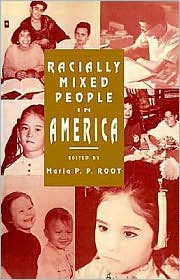
Racially Mixed People in America

Posted in Anthologies, Autobiography, Books, Census/Demographics, Identity Development/Psychology, Media Archive, Politics/Public Policy, Social Science, United States on 2009-10-14 00:31Z by Steven

Racially Mixed People in America

SAGE Publications, Inc.
1992
400 pages
Paperback ISBN: 9780803941021

Edited by Maria P. P. Root

Recipient of the Gustavus Myers Center for the Study of Human Rights in the United States 1993 Outstanding Book Award.

America has been the breeding ground of a “biracial baby boom” for the past 25 years. Unfortunately, there has been a dearth of information regarding how racially mixed people identify and view themselves and how they relate to one another. Racially Mixed People in America steadily bridges this gap and offers a comprehensive look at the social and psychological adjustment of mixed-race people, models for identity development, contemporary immigration and marriage patterns, and methodological issues involved in conducting research with mixed-race people, all in the context of America’s mixed race past and present. Including contributions by ethnohistorians, psychologists, and sociologists, this powerful volume will provide the reader a tool for examining ideologies surrounding race, race relations, and the role of social science in the deconstruction of race. Racially Mixed People in America is essential reading for researchers and practitioners in cross-cultural studies, psychology, family studies, sociology, and social work.

Table of Contents

  • PART ONE: RACIAL ECOLOGY
    • Within, Between, and Beyond Race — Maria P. P. Root
    • The Illogic of American Racial CategoriesPaul R. Spickard
    • The Human Ecology of Multiracial Identity — Robin L. Miller
    • Developmental Pathways — Deborah J. Johnson
    • Toward an Ecological Theoretical Formulation of Race Identity in Black/White Biracial Children
    • Mixed Heritage Individuals — Cookie White Stephan
    • Ethnic Identity and Trait Characteristics
    • The Quiet Immigration — Michael C. Thornton
    • Foreign Spouses of US Citizens, 1945-1985
    • Beauty and the Beast — Carla K. Bradshaw
    • On Racial Ambiguity
  • PART TWO: RECOVERING THE MULTIRACIAL PAST
    • Passers and Pluralists G. Reginald Daniel
    • Subverting the Racial Divide
    • Blood Quantum — Terry P. Wilson
    • Native American Mixed Bloods
    • La Raza and the Melting Pot — Carlos A. Fernandez
    • A Comparative Look at Multiethnicity
    • From Dust to Gold Kieu — Linh Caroline Valverde
    • The Vietnamese Amerasian Experience
    • An Invisible Monster — Cynthia L. Nakashima
    • The Creation and Denial of Mixed Race People in America
  • PART THREE: WHAT OF THE CHILDREN
    • Back to the Drawing Board Maria P. P. Root
    • Methodological Issues in Research on Multiracial People
    • Identity Development in Biracial Children — James H. Jacobs
    • Between a Rock and a Hard Place — Ana Mari Cauce et al
    • Social Adjustment of Biracial Youth
    • Negotiating Ethnic Identity — Jewelle Taylor Gibbs and Alice M. Hines
    • Issues for Black/White Biracial Adolescents
    • Offspring of Cross-Race and Cross-Ethnic Marriages in Hawaii — Ronald C. Johnson
    • Please Choose One — Christine C. Iijima Hall
    • Ethnic Identity Choices for Biracial Individuals
    • Interracial Japanese Americans — Amy Iwasaki Mass
    • The Best of Both Worlds or the End of the Japanese American Community?
    • Prism Lives Teresa — Kay Williams
    • Identity of Binational Amerasians
    • The Developmental Process of Asserting a Biracial, Bicultural Identity — George Kitahara Kich
  • PART FOUR: CHALLENGING THE CENSUS
    • Is Multiracial Status Unique? The Personal and Social Experience — Michael C. Thornton
    • Coloring Outside the Lines — Christine C. Iijima Hall
    • Multicultural Identity and the Death of Stereotypes — Philip Tajitsu Nash
    • Beyond Black and White — G. Reginald Daniel
    • The New Multiracial Consciousness
    • From Shortcuts to Solutions — Maria P. P. Root
Tags: , , , , , , , , , , , , , , , , , , , , , ,

American Mixed Race: The Culture of Microdiversity

Posted in Anthologies, Arts, Books, Identity Development/Psychology, Media Archive, Philosophy, Politics/Public Policy, United States on 2009-10-13 20:00Z by Steven

American Mixed Race: The Culture of Microdiversity

Rowman & Littlefield Publishers, Inc.
March 1995
420 pages
6 1/4 x 9 1/4
Cloth ISBN: 0-8476-8012-6 / 978-0-8476-8012-2
Paper ISBN: 0-8476-8013-4 / 978-0-8476-8013-9

Edited by Naomi Zack, Professor of Philosophy
University of Oregon

This exciting multidisciplinary collection brings together twenty-two original essays by scholars on the cutting edge of racial theory, who address both the American concept of race and the specific problems experienced by those who do not fit neatly into the boxes society requires them to check.

List of Contributors
Linda Alcoff, Debra A. Barrath, Jennifer Clancy, Susan Clements, F. James Davis, Abby L. Ferber, Carlos A. Fernandez, Freda Scott Giles, David Theo Goldberg, Susan R. Graham, Helena Jia Hershel. M. Annette Jaimes, Cecile Ann Lawrence, Zena Moore, Maria P.P. Root, Laurie Shrage, Stephen Satris, Carol Roh Spaulding, Mariella Squire-Hakey, Teresa Kay Williams, Bruentta R. Wolfman, and Naomi Zack.

Table of Contents

  • Introduction – Naomi Zack
  • Autobiography
    • Five Arrows – Susan Clements
    • Color Fades Over Time – Brunetta R. Wolfman
    • Racelessness – Cecile Ann Lawrence
    • Check the Box That Best Describes You – Zena Moore
    • What Are They? – Stephen Satris
  • Art
    • From Melodrama to the Movies – Freda Scott Giles
    • The Theater of Identity – Teresa Kay Williams
    • The Go-Between People – Carol Roh Spaulding
  • Social Science
    • The Hawaiian Alternative to the One-Drop Rule – F. James Davis
    • Some Kind of Indian – M. Annette Jaimes
    • Exploring the Social Construction of Race – Abby L. Ferber
    • Therapeutic Perspectives on Biracial Identity Formation and Internalized Oppression – Helena Jia Hershel
  • Public Policy
    • Grassroots Advocacy – Susan R. Graham
    • Testimony of the Association of Multi Ethnic Americans – Carlos A. Fernàndez
    • Multiracial Identity Assertion in the Sociopolitical Context of Primary Education – Jennifer Clancy
    • Yankee Imperialism and Imperialist Nostalgia – Mariella Squire-Hakey
  • Identity Theory
    • The Multiracial Contribution to the Psychological Browning of America – Maria P. P. Root
    • Made in the USA – David Theo Goldberg
    • Mestizo Identity – Linda Alcoff
    • Race and Racism – Debra A. Barrath
    • Ethnic Transgressions: Confessions of an Assimilated Jew – Laurie Shrage
    • Life After Race – Naomi Zack
Tags: , , , , , , , , , , , , , , , , , , , , ,

Mixed Messages: Multiracial Identities in the “Color-Blind” Era

Posted in Anthologies, Books, Family/Parenting, Identity Development/Psychology, Media Archive, Politics/Public Policy, Social Science, United States, Women on 2009-10-12 23:29Z by Steven

Mixed Messages: Multiracial Identities in the “Color-Blind” Era

Lynne Rienner Publishers
2006
405 pages
Hardcover: ISBN: 978-1-58826-372-8
Paperback: ISBN: 978-1-58826-398-8

Edited by David L. Brunsma, Professor of Sociology
Virginia Polytechnic Institute and State University

The experiences and voices of multiracial individuals are challenging current categories of race, profoundly altering the meaning of racial identity and in the process changing the cultural fabric of the nation. Exploring this new reality, the authors of Mixed Messages examine what we know about multiracial identities—and the implications of those identities for fundamental issues of justice and equality.

Read the entire introduction here.

Table of Contents

  • Mixed Messages: Doing Race in the Color-Blind Era—David L. Brunsma
  • SHIFTING COLOR LINES.
    • Defining Race: Comparative Perspectives—F. James Davis.
    • Black, Honorary White, White: The Future of Race in the United States?—Eduardo Bonilla-Silva and David G. Embrick.
    • Racial Justice in a Black/Nonblack Society—George Yancey.
    • Carving Out a Middle Ground: The Case of Hawai’i—Jeffrey Moniz and Paul Spickard.
    • New Racial Identities, Old Arguments: Continuing Biological Reification—Rainier Spencer.
    • Color Blindness: An Obstacle to Racial Justice?—Charles A. Gallagher.
    • Racism, Whitespace, and the Rise of the Neo-Mulattos—Hayward Derrick Horton.
  • MANIPULATING MULTIRACIAL IDENTITIES.
    • Race, Multiraciality, and the Neoconservative Agenda—G. Reginald Daniel and Josef Manuel Castañeda-Liles.
    • White Separatists in the Color-Blind Era: Redefining Multiracial and White Identities—Abby L. Ferber.
    • Defining Racism to Achieve Goals: The Multiracial and Black Reparations Movements—Johanna E. Foster.
    • Selling Mixedness: Marketing with Multiracial Identities—Kimberly McClain DaCosta.
  • SOCIALIZATION IN MULTIRACIAL FAMILIES.
  • DILEMMAS OF MULTIRACIAL IDENTITY.
    • Negotiating Racial Identity in Social Interactions—R. L’Heureux Lewis and Kanika Bell.
    • Black/White Friendships in a Color-Blind Society—Kathleen Korgen and Eileen O’Brien.
    • Black and Latino: Dominican Americans Negotiate Racial Worlds—Benjamin Bailey.
    • Finding a Home: Housing the Color Line—Heather Dalmage.
    • Confronting Racism in the Therapist’s Office—Kwame Owusu-Bempah.
    • Culture and Identity in Mixed-Race Women’s Lives—Debbie Storrs.
Tags: , , , , , , , , , , , , , , , , , , , , , , , , , , ,

Perspectives and Research on the Positive and Negative Implications of Having Multiple Racial Identities

Posted in Articles, Census/Demographics, Identity Development/Psychology, Media Archive, Politics/Public Policy, United States on 2009-10-11 16:14Z by Steven

Perspectives and Research on the Positive and Negative Implications of Having Multiple Racial Identities

Psychological Bulletin
Volume 131, Number 4 (June 2005)
pages 569–591
DOI: 10.1037/0033-2909.131.4.569

Margaret Shih, Professor in Management and Organizations
Anderson School of Management
University of California, Los Angeles

Diana T. Sanchez, Associate Professor of Social Psychology
Rutgers University

Much attention has been directed toward understanding the impact having a multiracial background has on psychological well-being and adjustment. Past psychological research has focused on the challenges multiracial individuals confront in defining a racial identity. The implication is that these challenges lead to outcomes that are psychologically detrimental. However, evidence to support this assertion is mixed.  The authors review qualitative and quantitative empirical research examining multiracial individuals’ identity development, depression, problem behaviors, peer relationships, school performance, and selfesteem, finding support for detrimental outcomes only in studies sampling clinical populations. Studies on nonclinical samples find that multiracial individuals tend to be just as well-adjusted as their monoracial peers on most psychological outcomes. Earlier assertions of maladjustment may have been due to reliance on qualitative research that sampled clinical populations. Other implications and futureresearch are discussed.

Tiger Woods has received much attention, not only for being the youngest person to win the prestigious Masters Golf Tournament, but also for being an individual of mixed-race ancestry. His father is Black, Native American, and Chinese, and his mother is Thai, Chinese, and White. Woods represents a growing trend in American society. Since the repeal in 1967 of miscegenation laws prohibiting racial mixing, the number of interracial marriages in the United States has increased dramatically (Kennedy, 2003; Root, 2001). Consequently, the number of individuals who can claim membership in multiple racial categories has also increased dramatically (Root, 1996). The population of multiracial children has multiplied from 500,000 in 1970 to more than 6.8 million in 2000 (Jones & Symens Smith, 2001).

This explosion in the number of individuals with multiracial backgrounds has raised the issue of understanding where these individuals fit into preexisting social categories. Nowhere is this difficulty more clearly illustrated than in the controversy over whether the 2000 Census should have included a multiracial category.  Until then, individuals of mixed ancestry had to choose between their component identities on the census form. However, multiracial groups have argued that picking just one identity forces multiracial individuals to deny other parts of themselves (Gaskins, 1999) and does not accurately reflect the nation’s true racial make-up (Holmes, 1997). On the other hand, prominent civil rights activists, such as Jesse Jackson and Kweisi Mfume, argued against the creation of a separate multiracial category in order to preserve minority numbers and maintain political influence (Rockquemore & Brunsma, 2002).

A federal task force was set up to investigate the political and social implications of creating a new racial classification (Holmes, 1997).  The task force asked questions such as, “If a multiracial category were included, would all people with different combinations of racial backgrounds, such as Black/Asian and Native American/White, be considered members of the same group?  Would there still be individuals with multiracial identities who would choose to identify by a single race?” This issue was finally resolved in 1997, when it was recommended that the category “multiracial” should not be included in census forms but that instead multiracial individuals could check off more than one racial category.

This controversy illustrates that having a multiracial identity challenges American society’s traditional notions and assumptions about race and racial categories (Johnson, 1992; Ramirez, 1996; Root, 1992; Spickard, 1992). Given the seeming difficulty American society has with trying to understand the notion of multiracial identity, psychologists have begun studying many of those questions considered by the U.S. Census Bureau Task Force, such as, how do multiracial individuals understand their racial identities? In addition, because multiracial families and multiracial individuals may pose a challenge to existing racial categories and the social systems upon which these categories rest, psychologists have become interested in understanding the consequence of coming from a multiracial background and in identifying the tremendous difficulties multiracial families and multiracial individuals encounter in navigating their social world (Gibbs, 1987, 1989; Root, 1992). For example, multiracial families contend with hardships such as a lack of social recognition (Nakashima, 1996), disapproval from extended family, exclusion from neighborhood and community (Kerwin & Ponterotto, 1995; Kerwin, Ponterotto, Jackson, & Harris, 1993), discrimination, and social isolation (Brown, 1995; Gaskins, 1999)…

Read the entire article here.

Tags: , , , , , ,

Educational Policy, Politics, and Mixed Heritage Students in the United States

Posted in Articles, Campus Life, Census/Demographics, Media Archive, Politics/Public Policy, Social Science, United States on 2009-10-08 02:41Z by Steven

Educational Policy, Politics, and Mixed Heritage Students in the United States

Journal of Social Issues
Volume 65, Number 1 (March 2009)
pages 165-183
DOI: 10.1111/j.1540-4560.2008.01593.x

Kristen A. Renn, Professor of Higher, Adult, & Lifelong Education
Michigan State University

This article describes local, state, and federal policies related to collecting, aggregating, and reporting data on student race and ethnicity in U.S. K-12 and postsecondary education. It traces data policy from the 1997 decision by the Office of Management and Budget to change from single-race reporting to a format that permits respondents to choose more than one race, to the October 2007 issuance of final guidance from the Department of Education. Taking a K-20 perspective, I consider how policies for data collection and reporting may affect educational and developmental outcomes for students, as well as local, state, and national education policy environments.

Read or purchase the article here.

Tags: , , , ,

Moving Beyond the Black-White Color Line? Immigration, Diversity, and Multiracial Identification in the United States

Posted in Census/Demographics, Media Archive, Papers/Presentations, Politics/Public Policy, United States on 2009-10-06 21:38Z by Steven

Moving Beyond the Black-White Color Line? Immigration, Diversity, and Multiracial Identification in the United States

Paper presented at the annual meeting of the American Sociological Association
Hilton San Francisco & Renaissance Parc 55 Hotel
San Francisco, CA
2004-08-14

Jennifer Lee

This paper explores theory and evidence about immigration, race/ethnicity, intermarriage, and multiracial identification, and assesses the implications of trends and patterns for changes in America’s color lines, focusing especially on the traditional and relatively persistent black-white color line that has long divided the country. For more than three and a half decades, continued immigration from Latin America and Asia has transformed the United States from a largely biracial society consisting of a large white majority and smaller black minority into a society composed of multiple racial and ethnic groups. At the same time, the rate of intermarriage between whites and nonwhites increased dramatically, and along with its rise, the growth in the multiracial population. For the first time in U.S. history, the 2000 Census allowed Americans the option to mark “more than one race” to self-identify, reflecting the view that race is no longer conceived of as a bounded category. Increases in immigration, intermarriage, and multiracial identification might appear to indicate that race is declining in significance, and racial/ethnic divides, eroding for all groups. However, the trends and patterns of interracial marriage and multiracial reporting indicate that while racial/ethnic boundaries may be loosening for some groups, they are not loosening for all. Moreover, while the traditional black-white divide may be fading, a new divide seems to be emerging-one that separates blacks and non-blacks.

Read entire paper here.

Tags: ,

Political Discourse on Racial Mixture: American Newspapers, 1865 to 1970

Posted in Communications/Media Studies, History, Literary/Artistic Criticism, Media Archive, Papers/Presentations, Politics/Public Policy, United States on 2009-10-01 00:59Z by Steven

Political Discourse on Racial Mixture: American Newspapers, 1865 to 1970

Paper presented at the annual meeting of the MPSA Annual National Conference
Palmer House Hotel
Hilton, Chicago, IL
2008-04-03

Jennifer L. Hochschild, Henry LaBarre Jayne Professor of Government & Professor of African and African American Studies
Harvard University

Brenna Marea Powell
Harvard University

Vesla Weaver, Assistant Professor
The Woodrow Wilson Department of Politics
University of Virginia

We trace American political discourse around multiracialism, race-mixing, and mixed-race people from the end of the Civil War through the civil rights era. We use two new sources of data: counts of keywords such as “mulatto” and “multiracial” in two black and four white newspapers over 150 years, and a content analysis of themes and assumptions in almost 2,100 articles from the same newspapers, also using keywords that indicate racial mixture.

These datasets provide evidence on two analytic and two substantive points: First, the press’s treatment of mixture permits us to analyze “racial meaning,” defined as the varied ways in which Americans construe, practice, and judge group-based identities and identifications. Second, the datasets enable us to trace the timing of changes in ideas about racial meaning, and to map these changes onto a new periodization of distinct institutional treatments of racial mixture. Substantively, the dataset show vividly how much Americans argued over what counted as a race, how people were to be allocated to and across races, and what implications racial groupings should have. The contemporary racial order, which looks inevitable and orderly in hindsight, was not at all clear while it was being created. Most importantly, the language of the newspaper articles shows vividly that Americans’ debates over racial mixture and racially mixed people were (and continue to be) a critical site for contestation over racial hierarchy, advance, and equality.

Read the entire paper here.

Tags: , , , , ,

The Shifting Politics of Multiracialism in the United States

Posted in Census/Demographics, Media Archive, Papers/Presentations, Politics/Public Policy, United States on 2009-09-28 03:14Z by Steven

The Shifting Politics of Multiracialism in the United States

Paper presented at the annual meeting of the American Political Science Association (APSA) 2008 Annual Meeting
Hynes Convention Center
Boston, Massachusetts
2008-08-28

38 pages

Awarded the American Political Science Association Public Policy Section 2008 prize for her paper, co-authored with Vesla Weaver, of the University of Virginia Government Department, “The Shifting Politics of Multiculturalism in the United States.”  The award will be presented at the APSA Annual Meeting, 2009-09-03 through 2009-09-06  in Toronto, Canada.

Jennifer L. Hochschild, Henry LaBarre Jayne Professor of Government & Professor of African and African American Studies
Harvard University

Vesla Weaver, Assistant Professor
The Woodrow Wilson Department of Politics
University of Virginia

For the first time in American history, the 2000 census allowed respondents to identify with more than one race. That change resulted, in part, from mobilization of activists and an increasing population of mixed-race partnerships and multiracial offspring.  However, despite both supporters’ and opponents’ predictions of rapid growth in multiracial identification, less than 3 percent of the population chose more than one race in 2000.  And the largest recent surveys show similar results.

This paper explores whether and how far multiracialism has become embedded in Americans’ practice and understanding of race, and considers what might happen in the foreseeable future. Starting from theories that elegantly explicate various forms of policy feedback and transformation but are weaker on causal explanations for them, we identify four factors that lead an enacted policy to endure or be blocked.  They are: whether other agencies have incentives to institutionalize the policy, whether the policy triggers development of a committed constituency, whether opposing groups remain strong, and whether the change is supported by independent societal trends. We find that the first and fourth factors encourage consolidation of multiracial identification, while the second and third work toward keeping it very low. Thus institutional procedures and underlying societal trends tend in one direction while individuals’ active and intentional choices are tending the opposite way: a fascinating and unusual situation with important implications for theories of path dependency and policy transformation.

The trajectory of multiracial identification could change the racial order in the United States, for better or for worse. If it increases, it might portend a shift in classification norms that could break down racial boundaries and even reduce interracial hostility and fear.  Alternatively, an increase could signal Americans’ desire to find one more route out of blackness and into some less denigrated status, to the detriment of African Americans. If multiracial identification does not increase, that will indicate the power of old single race understandings regardless of demographic changes, with all of their implications for prejudice and group loyalty.

Read the entire paper here.

Tags: , , , ,