Understanding the Educational Needs of Mixed Heritage Pupils

Posted in Media Archive, Politics/Public Policy, Reports, Social Science, Teaching Resources, United Kingdom on 2009-10-24 01:21Z by Steven

Understanding the Educational Needs of Mixed Heritage Pupils

University of Bristol
June 2004
ISBN: 1844782646
121 pages

Leon Tikly, Professor in Education and Deputy Director of Research
University of Bristol

Chamion Caballero, Senior Research Fellow
Families & Social Capital Research Group
London South Bank University

Jo Haynes, Lecturer in Sociology
University of Bristol

John Hill
Birmingham LEA

in association with
Birmingham Local Education Authority

Introduction

In March 2003, a team from the University of Bristol working in association with Birmingham Local Education Authority (LEA) was commissioned by the DfES (Department for Education and Skills) to conduct research into the educational needs of mixed heritage pupils with specific reference to the barriers to achievement faced by White/Black Caribbean pupils. Qualitative research was carried out in fourteen schools in six LEAs (primary schools with more than 10% of mixed heritage pupils and secondary schools with more than 5% of mixed heritage pupils). Quantitative data from the DfES National Pupil Database are also reported.

Key findings

  • The attainment of White/Black Caribbean pupils is below average, the attainment of White/Black African pupils is similar to average in primary schools and slightly below average in secondary schools and the attainment of White/Asian pupils is above average.
  • The key barriers to achievement facing pupils of White/Black Caribbean origin are in many cases similar to those faced by pupils of Black Caribbean origin. They are more likely to come from socially disadvantaged backgrounds; are more likely to experience forms of institutionalised racism in the form of low teacher expectations; and, are more likely to be excluded from school.
  • White/Black Caribbean pupils also face specific barriers to achievement. Low expectations of pupils by teachers often seem based on a stereotypical view of the fragmented home backgrounds and ‘confused’ identities of White/Black Caribbean pupils. These pupils often experience racism from teachers and from their White and Black peers targeted at their mixed heritage. This can lead to the adoption of what are perceived to be rebellious and challenging forms of behaviour.
  • The barriers to achievement experienced by White/Black Caribbean pupils operate in a context where mixed heritage identities (including those of White/Black Caribbean, White/Black African and White/Asian pupils) are not recognised in the curriculum or in policies of schools and of LEAs. In the case of White/Black Caribbean pupils, their invisibility from policy makes it difficult for their underachievement to be challenged.
  • In those schools where White/Black Caribbean pupils achieve relatively highly they often benefit from inclusion in policies targeted at Black Caribbean learners, with whom they share similar barriers to achievement and with whom they often identify.
  • Even in these schools, however, the specific barriers to achievement faced by White/Black Caribbean learners are rarely explicitly addressed.

In our 2004 report from the DfES, our analysis indicated that 2.5% of the national school age population were identified as belonging to the overall ‘Mixed’ ethnic group, with large regional variations. The largest proportion of these pupils could be found in the Inner London area – they constituted 7.3% of school pupils. The smallest was in the North East – 0.7%.

Read the entire report here.

Tags: , , , , ,

Mixed Race America and the Law: A Reader

Posted in Anthologies, Books, Census/Demographics, History, Law, Media Archive, Passing, Politics/Public Policy, United States on 2009-10-23 23:45Z by Steven

Mixed Race America and the Law: A Reader

New York Univeristy Press
2003-02-01
512 pages
ISBN: 9780814742570

Edited by:

Kevin R. Johnson, Mabie-Apallas Professor of Public Interest Law and Chicano/a Studies
University of California Davis

For the first time in United States history, the Year 2000 census allowed people to check more than one box to identify their race. This new way of gathering data and characterizing race and ethnicity reflects important changes in how racial identity is understood in America. Besides acknowledging the presence of mixed race citizens, this new understanding promises to have major implications for American law and policy.

With this anthology, Kevin R. Johnson brings together ground-breaking scholarship on the mixed race experience in America to examine the impact of law on these citizens. The foundational essays that comprise the collection present the historical, social, and political contexts surrounding the body of law that addresses race while analyzing the implications of multiracialism. Divided into 12 sections, the reader includes an introduction by Johnson and essential essays by contributors such as Garrett Epps, Judith Resnick, Richard Delgado, Ian Haney López, Randall Kennedy, and Patricia Hill Collins. Selections address miscegenation, racial classification, interracial adoption, the 2000 census, “passing,” and other topics; each section includes questions to promote further discussion. This book is an invaluable resource for examining the complexities of racial categories in modern America.

Read the entire introduction here.

Tags: , , , , , , ,

Race in another America: the significance of skin color in Brazil

Posted in Books, Brazil, Caribbean/Latin America, History, Media Archive, Monographs, Politics/Public Policy, Social Science on 2009-10-23 01:42Z by Steven

Race in another America: the significance of skin color in Brazil

Princeton University Press
2004
336 pages
27 line illus. 5 halftones
6 x 9 1/4
Hardcover ISBN: 9780691127927
Ebook ISBN: 9781400837434

Edward E. Telles, Professor of Sociology
University of California, Santa Barbara

  • Winner of the 2006 Oliver Cromwell Cox Award, Section on Race and Ethnic Minorities, American Sociological Association
  • Winner of the 2006 Distinguished Book Award, American Sociological Association
  • Winner of the 2005 Otis Dudley Duncan Award, Section on Sociology of Population, American Sociological Association
  • Winner of the 2005 Hubert Herring Award, Pacific Coast Council of Latin American Studies
  • Winner of the 2005 Best Book on Brazil in English, Brazil Section of the Latin American Studies Association

This is the most comprehensive and up-to-date book on the increasingly important and controversial subject of race relations in Brazil. North American scholars of race relations frequently turn to Brazil for comparisons, since its history has many key similarities to that of the United States. Brazilians have commonly compared themselves with North Americans, and have traditionally argued that race relations in Brazil are far more harmonious because the country encourages race mixture rather than formal or informal segregation.

More recently, however, scholars have challenged this national myth, seeking to show that race relations are characterized by exclusion, not inclusion, and that fair-skinned Brazilians continue to be privileged and hold a disproportionate share of wealth and power.

In this sociological and demographic study, Edward Telles seeks to understand the reality of race in Brazil and how well it squares with these traditional and revisionist views of race relations. He shows that both schools have it partly right–that there is far more miscegenation in Brazil than in the United States–but that exclusion remains a serious problem. He blends his demographic analysis with ethnographic fieldwork, history, and political theory to try to “understand” the enigma of Brazilian race relations–how inclusiveness can coexist with exclusiveness.

The book also seeks to understand some of the political pathologies of buying too readily into unexamined ideas about race relations. In the end, Telles contends, the traditional myth that Brazil had harmonious race relations compared with the United States encouraged the government to do almost nothing to address its shortcomings.

Read the entire first chapter in HTML or PDF format.

Read a book review here.

Tags: , ,

From Black to Biracial: Transforming Racial Identity Among Americans

Posted in Books, Census/Demographics, Identity Development/Psychology, Media Archive, Monographs, Politics/Public Policy, Social Science, United States on 2009-10-18 19:38Z by Steven

From Black to Biracial: Transforming Racial Identity Among Americans

Praeger Publishers an imprint of Greenwood Publishing Group
1998
160 pages
Trim Size: 6 1/8 x 9 1/4
Paperback ISBN: 0-275-96744-1; ISBN-13: 978-0-275-96744-4

Kathleen Odell Korgen, Professor of Sociology
William Paterson University, Wayne, New Jersey

Is a person with both a white and African American parent black?  Thirty years ago in American society the answer would have been yes. Today, the answer most likely depends on whom you ask. According to the U.S. Census, a person with both a black and a white parent is, in fact, black. However, most young persons who fit this description describe themselves as biracial, both black and white. Most young Americans, whatever their racial background, agree.  Since the Voting Rights Act of 1965 signaled the culmination of the Civil Rights Movement, a transformation has occurred in the racial self-definition of Americans with both an African American and a white parent. This book describes the transformation and explains why it has occurred and how it has come about. Through extensive research and dozens of interviews, Korgen describes how the transformation has its roots in the historical and cultural transitions in U.S. society since the Civil Rights era. A ground breaking book, From Black to Biracial will help all Americans understand the societal implications of the increasingly multiracial nature of our population. From affirmative action to the present controversy over the U.S. Census 2000, the repercussions of the transformation in racial identity related here affect all race-based aspects of our society. Students and faculty in sociology and multicultural studies, business leaders, and general readers alike will benefit from reading this work.

Table of Contents:

  • Introduction: The Transformation of Racial Identity
  • Biracial Americans: White, Black, Both, Neither
  • Black by Definition or The Best of Both Worlds?
  • The Transformation: From Black to Biracial
  • Turning Points: Biracial College Students and Dating
  • Marginality and the Biracial American
  • Identities and Transformation
  • Public Policy Implications
  • Appendix: Notes on Methodology
  • Bibliography
  • Index
Tags: , , ,

Relative/Outsider: The Art and Politics of Identity Among Mixed Heritage Students

Posted in Books, Identity Development/Psychology, Media Archive, Monographs, Politics/Public Policy, Teaching Resources, United States on 2009-10-18 18:20Z by Steven

Relative/Outsider: The Art and Politics of Identity Among Mixed Heritage Students

Praeger Publishers
2001-05-30
200 pages
Trim Size: 6 1/8 x 9 1/4
Paperback ISBN: 978-1-56750-551-1
Hardback ISBN: 978-1-56750-550-4
e-Book ISBN: 978-0-313-07598-8
DOI: 10.1336/1567505511

Kendra R. Wallace, Assistant Professor of Education
University of Maryland, Baltimore

The author explores the ethnic and racial identity formation among high school and college students of racially mixed heritage. The portraits in this book provide a thorough examination of the dynamic ethnic and racial lives of a multifaceted and growing segment of students. Unlike most recent projects on mixed heritage people which are narrow in scope and focus on one set of backgrounds (e.g., black and white or black and Japanese), the subjects in this study represent a vast array of heritages, including those of dual minority ancestry.

The students’ stories speak volumes about the uneven nature of racial and ethnic experience within and across traditional communities in contemporary U.S. society. Unlike studies analyzing broad intergroup processes, this work begins by examining the cultural dynamics of the home, contributing valuable insights into the otherwise invisible lives of mixed heritage families. Processes of enculturation and discourse acquisition are considered in the development of ethnic identity. The book also helps to frame how changes within the U.S. racial ecology lead many recently mixed heritage individuals to see themselves as occupying (un)common ground. Finally, this work offers recommendations for educators concerned with creating school contexts that are critically supportive of human diversity.
 
Table of Contents

Preface
Introduction
Surveying the U.S. Racial Ecology
Out of the Borderlands: Interethnic/Interracial Families
Lessons of Community: Origins of and Approaches to Ethnic Identity
Constructing Race
On Being Mixed: Issues and Interpretations
Conclusions and Educational Implications
Appendix A: Race-Ethnicity Survey
Appendix B: Recruitment Flyer
Appendix C: Expressive Autobioraphical Interview Probes
References
Index

Tags: , ,

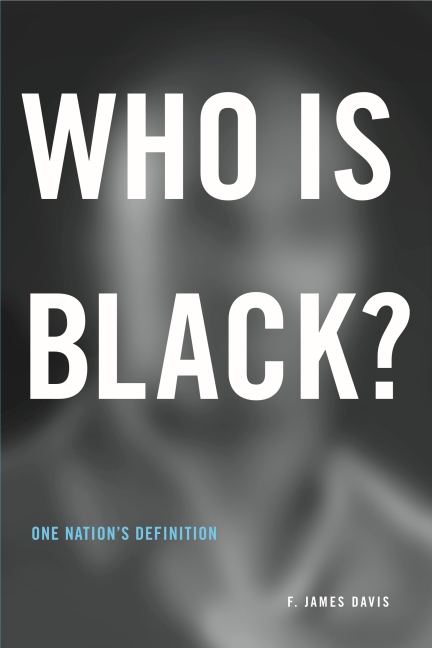
Who Is Black? One Nation’s Definition

Posted in Books, Census/Demographics, History, Media Archive, Monographs, Politics/Public Policy, Social Science, United States on 2009-10-17 21:04Z by Steven

Who Is Black? One Nation’s Definition

Penn State Press
2001 (Originally published in 1992)
232 pages
6 x 9
ISBN 978-0-271-02172-0

F. James Davis, Professor Emeritus of Sociology
Illinois State University

Winner of the 1992 Outstanding Book on the Subject of Human Rights from the Gustavus Myers Center for the Study of Human Rights in the United States.

Tenth Anniversary Edition

Reprinted many times since its first publication in 1991, Who Is Black? has become a staple in college classrooms throughout the United States, helping students understand this nation’s history of miscegenation and the role that the “one-drop rule” has played in it. In this special anniversary edition, the author brings the story up to date in an epilogue. There he highlights some revealing responses to Who Is Black? and examines recent challenges to the one-drop rule, including the multiracial identity movement and a significant change in the census classification of racial and ethnic groups.

Table of Contents

  • PREFACE
  • CHAPTER ONE: THE NATION’S RULE
    • The One-Drop Rule Defined
    • Black Leaders, But Predominantly White
    • Plessy, Phipps, and Other Challenges in Courts
    • Census Enumeration of Blacks
    • Uniqueness of the One-Drop Rule
  • CHAPTER TWO: MISCEGENATION AND BELIEFS
    • Racial Classification and Miscegenation
    • Racist Beliefs About Miscegenation
    • The Judge Brady Paradox
    • Miscegenation in Africa and Europe
    • Race vs. Beliefs About Race
  • CHAPTER THREE: CONFLICTING RULES
    • Early Miscegenation in the Upper South: The Rule Emerges
    • South Carolina and Louisiana: A Different Rule
    • Miscegenation on Black Belt Plantations
    • Reconstruction and the One-Drop Rule
    • The Status of Free Mulattoes, North and South
    • The Emergence and Spread of the One-Drop Rule
  • CHAPTER FOUR: THE RULE BECOMES FIRM
    • Creation of the Jim Crow System
    • The One-Drop Rule Under Jim Crow
    • Effects of the Black Renaissance of the 1920s
    • The Rule and Myrdal’s Rank Order of Discriminations
    • Sexual Norms and the Rule: Jim Crow vs. Apartheid
    • Effects of The Fall of Jim Crow
    • De Facto Segregation and Miscegenation
    • Miscegenation Since the 1960s
    • Development of the One-Drop Rule in the Twentieth Century
  • CHAPTER FIVE: OTHER PLACES, OTHER DEFINITIONS
    • Racial Hybrid Status Lower Than Both Parents Groups
    • Status Higher Than Either Parent Group
    • In-Between Status: South Africa and Others
    • Highly Variable Class Status: Latin America
    • Two Variants in the Caribbean
    • Equality for the Racially Mixed in Hawaii
    • Same Status as the Subordinate Group: The One-Drop Rule
    • Status of an Assimilating Minority
    • Contrasting Socially Constructed Rules
  • CHAPTER SIX: BLACK ACCEPTANCE OF THE RULE
    • Alex Haley, Lillian Smith, and Others
    • Transracial Adoptions and the One-Drop Rule
    • Rejecton of the Rule: Garvey, American Indians, and Others
    • Black Acceptance: Reasons and Implications
  • CHAPTER SEVEN: AMBIGUITIES, STRAINS, CONFLICTS, AND TRAUMAS
    • The Death of Walter White’s Father and Other Traumas
    • Collective Anxieties About Racial Identity: Some Cases
    • Personal Identity: Seven Modes of Adjustment
    • Lena Home’s Struggles with Her Racial Identity
    • Problems of Administering the One-Drop Rule
    • Misperceptions of the Racial Identity of South Asians, Arabs, and Others
    • Sampling Errors in Studying American Blacks
    • Blockage of Full Assimilation of Blacks
    • Costs of the One-Drop Rule
  • CHAPTER EIGHT: ISSUES AND PROSPECTS
    • A Massive Distortion? A Monstrous Myth?
    • Clues for Change in Deviations from the Rule
    • Clues for Change in Costs of the Rule
    • Possible Direction: Which Alternative?
    • Prospects for the Future
  • EPILOGUE TO THE TENTH ANNIVERSARY
  • EDITION
  • WORKS CITED
  • INDEX
Tags: , , ,

The Social Construction of Race and Ethnicity in the United States (2nd Edition)

Posted in Anthologies, Anthropology, Books, Census/Demographics, Law, Media Archive, Politics/Public Policy, Social Science, United States on 2009-10-17 19:19Z by Steven

The Social Construction of Race and Ethnicity in the United States (2nd Edition)

Prentice Hall
2001
525 pages
Paperback ISBN-10: 0130283231; ISBN-13:  9780130283238

Edited By:

Joan Ferrante
Northern Kentucky University

Prince Brown, Jr.
Northern Kentucky University

For undergraduate courses in race and ethnic relations.

This groundbreaking collection of classic and cutting edge sociological research gives special attention to the social construction of race and ethnicity in the United States. It offers an in-depth and eye-opening analysis of (a) the power of racial classification to shape our understanding of race and race relations, (b) the way in which the system came into being and remains, and (c) the real consequences this system has on life chances.

I. THE PERSONAL EXPERIENCE OF CLASSIFICATION SCHEMES.
Patricia Riley, Adventures of an Indian Princess. Timothy Egan, Expelled in 1877, Indian Tribe is Now Wanted as a Resource. Lawrence Otis Graham, Black Man with a Nose Job. Garrett Hongo, Culture Wars in Asian America. Andrea Kim, Born and Raised in Hawaii, But Not Hawaiian. Yolanda Adams, Don’t Want to Be Black Anymore. Mitzi Uehara-Carter, On Being Blackanese. Joan Ferrante, Six Case Studies. Dympna Ugwu-Oju, What Will My Mother Say. Paul Andrew Dawkins, Apologizing for Being a Black Male. Judy Scales-Trent, Choosing Up Sides. Marilyn Halter, Identity Matters: The Immigrant Children. Sarah Van’t Hul, How It Was for Me. Joseph Tovares, Mojado Like Me. Yuri Kochiyama, Then Came the War.

II. CLASSIFYING PEOPLE BY RACE.
Paul Knepper, Historical Origins of the Prohibition of Multiracial Legal Identity in the State and the Nation. Federal Statistical Directive No. 15 THE U.S. OFFICE OF MANAGEMENT AND BUDGET, OMB’s Decisions: Revisions to Federal Statistical Directive. Prince Brown, Jr., Biology and the Social Construction of the “Race” Concept. Ian F. Haney Lopez, The Mean Streets of Social Race. Jack D. Forbes, “Indian” and “Black” as Radically Different Categories. Michael Granberry, A Tribe’s Battle for Its Identity. Madison Hemings, The Memoirs of Madison Hemings. Ariela J. Gross, Litigating Whiteness. Laura L. Lovett, Invoking Ancestors. Angelo N. Ancheta, Race Relations in Black and White . Time Magazine, How to Tell Your Friends From the Japs.

III. ETHNIC CLASSIFICATION.
The U.S. Bureau of the Census, Questions Related to Ethnicity. Luis Angel Toro, Directive No. 15 and Self-Identification. Himilce Novas, What’s in a Name? Julie E. Sprott, The Mingling of Alaska Natives with “Foreigners”: A Brief Historical Overview. Mary C. Waters, Choosing an Ancestry. David Steven Cohen, Reflections on American Ethnicity. Yen Le Espiritu, Theories of Ethnicity. Rudolph J. Vecoli, Are Italian-Americans Just White Folk? Peter D. Salins, Americans United by Myths.

IV. THE PERSISTENCE, FUNCTIONS, AND CONSEQUENCES OF SOCIAL CLASSIFICATION.
Judy Scales-Trent, On Being Like a Mule. Article XIX, Chinese, Constitution of the State of California, 1872; Repealed, November 4, 1952, State of California. Howard Zinn, Persons of Mean and Vile Condition. Stephen Jay Gould, Science and Jewish Immigration. J. A. Rogers, Remarks on the First Two Volumes of Sex and Race. Prince Brown, Jr., Why “Race” Makes No Scientific Sense: The Case of Africans and Native Americans. Albert Jacquard, Science, Pseudo-science and Racism. Charles A Gallagher, White Reconstruction in the University. Trina Grillo and Stephanie M. Wildman, Taking Back the Center. The U.S. Supreme Court, Plessy v. Ferguson. Cheryl I. Harris, Plessy. Albert Jacquard, Declaration of Athens: Scientists Speak Out Against Racism.

V. TOWARD A NEW PARADIGM: TRANSCENDING CATEGORIES.
Vivian J. Rohrl, The Anthropology of Race: A Study of Ways of Looking at Race. Letter from Thomas Jefferson: Virginia’s Definition of a Mulatto. Cruz Reynoso, Ethnic Diversity: Its Historical and Constitutional Roots. Erich Loewy, Making Good Again. Stephen H. Caldwell and Rebecca Popenoe, Perceptions and Misperceptions of Skin Color. Selected Discrimination Cases Handled by the U.S. Department of Justice in 1999. Nicholas Peroff, Indianess. K.C. Cole, Brain’s Use of Shortcuts Can Be A Route to Bias. Richard T. Schaefer, Talking Past One Another. Ward Churchill, Let’s Spread the “Fun” Around: The Issue of Sports Team Names and Mascots. Lawrence Otis Graham, The Rules of Passing. Anthony S. Parent and Susan Brown Wallace, Childhood and Sexual Identity Under Slavery. Patricia Hill Collins, Toward a New Vision: Race, Class, and Gender as Categories of Analysis and Connection. Bruce N. Simon, White-Blindness. Robert Jensen, White Privilege Shapes the U.S. Robert Jensen, More Thoughts on Why the System of White Privilege is Wrong.

Tags: , , , , , , , , , , , , , , , , , , , , , , , , , , , , , , , , , , , , , , , , ,

Multiracial Classification on the United States Census: Myth, Reality, and Future Impact

Posted in Articles, Census/Demographics, Media Archive, Politics/Public Policy, United States on 2009-10-16 19:28Z by Steven

Multiracial Classification on the United States Census: Myth, Reality, and Future Impact

Revue Européenne des Migrations Internationales
Volume 21, Number 2 (2005)
Pages 111-134

Ann Morning, Associate Professor of Sociology
New York University

The 2000 census in the United States provoked a flurry of media attention in the months leading up to it, as well as in its aftermath. At issue was the new federal decision permitting Americans to identify themselves with more than one race on the census form. Advocated in large part by interracially-married couples and their offspring, this bureaucratic change in racial classification practices was widely interpreted in the press as having a wider significance for the nation as a whole. As one reporter put it, “the change is fueling a weighty debate about the meaning of race” (2000). Other articles spoke to the same thought-provoking effect of the new classification standards: the Washington Post ran “Mixed-Race Heritage, Mixed Emotions: In Census and Society, Question of Categories Yields Many Answers” (Fears, 2001), while Newsday asked, “Does It All Add Up? New Census Race Categories Raise Questions About How They’re Used” (Winslow, 2001). According to the latter, “the impact of racial classifications on the latest census has far-reaching implications– socially, politically, even statistically– that have sown anger, suspicion, uncertainty and excitement in varying quarters.”

This essay examines the expectations – both positive and negative- that characterized public discourse about the introduction of multiple-race reporting on the 2000 U.S. census. More importantly, I revisit these predictions in order to assess whether they have proved accurate. In so doing, the paper aims for a clear stock-taking of the impact of multiple-race reporting to date: which expectations have been borne out, which have not, and what unforeseen developments seem most likely to be the medium or long-term legacy of the revision of the federal racial standards?

I begin by recalling both the benefits and the drawbacks that commentators in the late 1990s and early 2000s expected from multiple-race classification. With the understanding that some predictions were too long-term to fully assess today, I nonetheless consider each and offer a prognosis. I then extend the discussion to consider two potential results of multiple-race reporting that have received less attention: its impact on essentialist or biological interpretations of race, and its implications for the classification of the Hispanic population. In conclusion, I argue that the most widely-publicized hopes and fears about multiracial classification are likely to prove minor outcomes, while the unanticipated consequences may well be more significant…

Read the entire article here.

Tags: ,

The Effects of Mixed-Race Households on Residential Segregation

Posted in Articles, Census/Demographics, Media Archive, Politics/Public Policy, Social Science, United States on 2009-10-16 17:58Z by Steven

The Effects of Mixed-Race Households on Residential Segregation

Journal Urban Geography
Issue Volume 28, Number 6, August 16-September 30, 2007
Online Date: 2007-11-27
Pages 554-577
ISSN: 0272-3638
DOI 10.2747/0272-3638.28.6.554

Mark Ellis
University of Washington

Steven R. Holloway
University of Georgia

Richard Wright
Dartmouth College

Margaret East
The University of Texas, Arlington

This paper investigates how household-scale racial mixing affects measurements of neighborhood-scale racial segregation. This topic is increasingly important as mixed-race households are becoming more common across the United States.  Specifically, our research asks two questions: What is the sensitivity of neighborhood racial segregation measures to levels of household-scale racial mixing? And what is the relationship between neighborhood racial diversity and the presence of mixed-race households? We answer these questions with an analysis that uses confidential long-form data from the 1990 U.S. census. These data provide information on household racial composition at the tract level. The results show that racial mixing within households has meaningful effects on measurements of neighborhood segregation, suggesting that patterns of mixed-race household formation and residential location condition understandings of neighborhood segregation dynamics. We demonstrate that mixed-race households are a disproportionate source of neighborhood diversity in the least racially plural neighborhoods. This article also reflects on the complications that mixed-race households pose for the interpretations of neighborhood-scale segregation and cautions against drawing conclusions about residential desegregation based on racial mixing in households.

Read or purchase the article here.

Tags: , , , , ,

New Faces in a Changing America: Multiracial Identity in the 21st Century

Posted in Africa, Anthologies, Books, Brazil, Census/Demographics, Media Archive, Politics/Public Policy, Social Science, South Africa, United States, Women on 2009-10-16 03:06Z by Steven

New Faces in a Changing America: Multiracial Identity in the 21st Century

SAGE Publications, Inc.
Paperback ISBN: 9780761923008
2001
432 pages

Edited by

Loretta I. Winters
California State University, Northridge

Herman L. DeBose
California State University, Northridge

How multiracial people identify themselves can have major consequences on their positions in their families, communities and society. Even the U.S. Census has recognized the rapidly increasing numbers of those who consider themselves multiracial, adding a new racial category to the 2000 Census form: two or more races.

New Faces in a Changing America: Multiracial Identity in the 21st Century examines the multiracial experience, its history and the political issues and consequences surrounding biracial and multiracial identity, bringing together top names in the field to give readers cutting edge views and insights gained from contemporary research.

This important new text follows the trail blazed by Maria Root, who contributes its opening chapter. An introduction places the issues of multiracial identity into context via a discussion of U.S. Census data and debates, providing an overview of the varied readings to come covering such topics as:

  • Race as a social, rather than biological, construction
  • The Multiracial Movement
  • Racial/Ethnic Groups in America and Beyond
  • Race, Gender & Hierarchy
  • Gang Affiliation and Self-Esteem
  • Black/White Interracial Couples and the Beliefs that Help Them to Bridge the Racial Divide

The book concludes with “The Multiracial Movement: Harmony and Discord,” by co-editor Loretta Winters, an epilogue putting the readings into perspective according to three models in the multiracial identity literature: the Multiracial Movement model, the Counter Multiracial movements model and the Ethnic Movement model.

Timely and comprehensive in its range of topics, this is an important resource for many audiences: students in Ethnic Studies, Race Relations and related courses; human service professionals including psychologists, counselors, social workers and school personnel and, importantly, multiracial individuals themselves.

Forward  
Introduction Herman L. DeBose
Acknowledgments  
PART I: RACE AS A SOCIAL CONSTRUCTION  
1. Five Mixed Race Identities: From Relic to Revolution Maria P. P. Root
2. The New Multiracialism: An Affirmation or an End to Race as we Know It? Mary Thierry Texeira
PART II: THE MULTIRACIAL MOVEMENT  
3. New Faces, Old Faces: Counting the Multiracial Population (Click here to read.) Ann Morning
4. Multiracial Identity: From Personal Problem to Public Issue Kimberly McClain DaCosta
5. From Civil Rights to the Multiracial Movement Kim M. Williams
6. Census 2000: Assessments in Significance Rainier Spencer
7. Evolution of Multiracial Organizations: Where We Have Been & Where We Are Going Nancy G. Brown & Ramona E. Douglas
PART III: RACIAL/ETHNIC GROUPS IN AMERICA & BEYOND  
8. The Dilemma of Biracial People of African American Descent Herman L. DeBose & Loretta L. Winters
9. Check All That Apply: Trends & Perspectives Among Asian Descent Multiracials Teresa Williams-Leon
10. Beyond Mestizaje: The Future of Race in America Gregory Velazco y Trianosky
11. Colonization, Cultural Imperialism, and the Social Construction of American Indian Mixed Blood Identity Karren Baird-Olson
12. “Race,” “Ethnicity,” and “Culture” in Hawai’i: The Myth of the “Model Minority” State Laura Desfor Edles
13. Multiracial Identity in Global Perspective: The United States, Brazil, and South Africa G. Reginald Daniel
PART IV: RACE, GENDER & HIERARCHY  
14. Does Multiraciality Lighten? Me-too Ethnicity & the Whiteness Trap Paul Spickard
15. The Hazards of Visibility: “Biracial Women,” Media Images, and Narratives of Identity Caroline A. Streeter
16. Masculine Multiracial Comedians Darby Li Po Price
PART V: SPECIAL TOPICS  
17. Gang Affiliation & Self-Esteem: The Effects of a Mixed Heritage Identity Patricia O’Donnell Brummett & Loretta I. Winters
18. Black/White Interracial Couples & the Beliefs That Help Them to Bridge the Racial Divide Kristyan M. Kouri
Epilogue: The Multiracial Movement: Harmony & Discord Loretta I. Winters
Index  
About the Editors  
About the Contributors
Tags: , , , , , , , , , , , , , , , , , , , , , , ,