Bi-racial U.S.A. vs. Multi-racial Brazil: Is the Contrast Still Valid?

Posted in Articles, Brazil, Caribbean/Latin America, Media Archive, Politics/Public Policy, Social Science, United States on 2009-12-24 16:49Z by Steven

Bi-racial U.S.A. vs. Multi-racial Brazil: Is the Contrast Still Valid?

Journal of Latin American Studies
Volume 25, Issue 2 (May 1993)
pages 373-386
DOI: 10.1017/S0022216X00004703

Thomas E. Skidmore, Carlos Manuel de Céspedes Professor of History Emeritus
Brown University

In the last two decades the comparative analysis of race relations in the U.S.A. and Brazil has been based on a conventional wisdom. It is the corollary of a larger conventional wisdom in the study of comparative race relations. The thesis is that systems of race relations in the Western Hemisphere are primarily of two types: bi-racial and multi-racial. The distinction is normally spelled out as follows. The U.S.A. is a prime example of a bi-racial system. In the prevailing logic of the US legal and social structure, individuals have historically been either black or white. In Brazil, on the other hand, there has been a spectrum of racial distinctions. At a minimum, Brazilian social practice has recognised white, black and mulatto. At a maximum, the phenotypical distinctions have become so refined as to defy analysis, or effective application for those who would discriminate.

Tags:

“The New Kubla Khan: Mixed Race Multi-Nationalism”

Posted in Media Archive, Papers/Presentations, Politics/Public Policy, Social Science on 2009-12-19 23:07Z by Steven

“The New Kubla Khan: Mixed Race Multi-Nationalism”

Paper presented at the annual meeting of the American Studies Association
2009-05-24

Michele Elam, Martin Luther King, Jr. Centennial Professor of English, Professor, Director of African & African American Studies
Stanford University

This paper examines how, and to what ends, people of the “mixed race experience” are being discursively contextualized as posterchildren of the “post-race,” “post-nation” era. As early as 1996, Stanley Crouch was proclaiming that “race is over;” since then, others also have rung race’s death knell: Holland Cotter in a 2001 New York Times piece, for example, has claimed that the time for “ethno-racial identity” is past, that we are now witnessing the coming of “postblack or postethnic art” that represents what Anthony Appiah recently called a “New Cosmopolitanism.” This presentation argues that “mixed race” has emerged in the context of these “post-race” cultural discourses, discourses which suggest, as Belize in Tony Kushner’s Angels in America puts it, that “race, taste and history” are “finally overcome.” Hybridity for many represents “life after race”(Naomi Zack), a step “beyond race” (Dinesh D’Sousa), a gesture “against race”(Paul Gilroy), the “new racial order” (G. Reginald Daniel), a “new frontier”(Maria Root) advanced by a “new people” (Jon Michael Spencer) who are ushering in a new world beyond race, identity, and nation. My presentation examines this problematic representation of mixed race people as post-nation vanguards in both mainstream media and in the field of pop-culture, and the send-up of the idea that “mixed race” people constitute a new nation-beyond-nationalism in Danzy Senna’s novel, Symptomatic (2005).

Tags: , , , , , , , , , , , ,

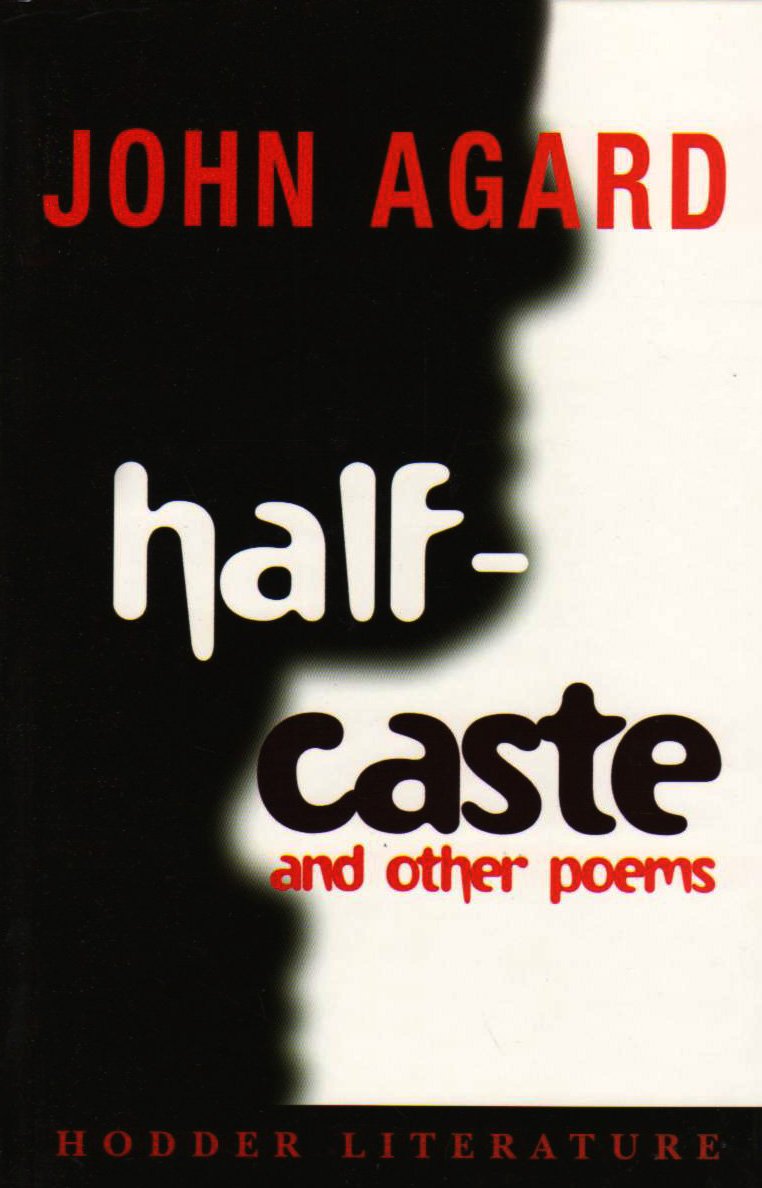
Half-Caste and Other Poems

Posted in Books, Identity Development/Psychology, Media Archive, Poetry, Politics/Public Policy, Social Science, Teaching Resources, United Kingdom on 2009-12-19 22:06Z by Steven

Half-Caste and Other Poems

Hodder Literature
2005-09-15
Paperback: 80 pages
19.4 x 12.2 x 0.8 cm
ISBN-10: 0340893893
ISBN-13: 978-0340893890

John Agard

Half-Caste’, the title poem of this collection, is one of the set poems for GCSE English for AQA A, the largest spec with 375,000 candidates. But its influence and presence extends well beyond the ‘AQA’ schools, making John Agard one of the most popular, well-known and respected poet-performers on the schools circuit.

Through his 45 poems, John Agard explores a wide variety of themes: racial harmony, tension and diversity; war and religion; society, patriotism and politics; as well as more personal ideas on relationships, love and attraction. This is all delivered with a range and depth in terms of content, language, poetic form and technique that will engage and motivate KS3 and KS4 pupils while developing their understanding. An ideal collection to sit at the heart of a scheme of work on cross-cultural themes.

Table of Contents

And All Was Good
My Move Your Move
Union Jack and Union Jill
Half-caste [Read here.]
Rainbow
Tongue
A Word
Message From Your Mobile
Right-On Mr Left
Smoke-loving Girl Blues
Angels For Neighbours
Flag
A Vampire’s Priorities
A Hello From Cello
The Hurt Boy and The Birds
Boomerang
That Mouth
Behold My Pen
Punctuating The Silence
Poetry Jump-Up
Follow That Steel Pan
Coal’s Son and Diamond’s Daughter
A Date With Spring
volte For Your Local Shadow
Twins
Quest
Clouds
The Ozone Liar
Cowtalk
Who’ll Sve Dying Man?
For the Record
One Question From A Bullet
A Hand On A Forehead
Not Arms
Checking Out Me History
Toussaint L’Overture Acknowledges Wordsworth’s Sonnet ‘To Toussaint L’Overture’
Windrush Child
Crybaby Prime Minister
Skin
A Social Skeleton
The Giant With A Taste For Mongrel Blood
Behind The Menu
Salt
Coal
Marriage of Opposites
Notes

Tags: , , ,

Between Camps: Nations, Cultures and the Allure of Race

Posted in Books, Media Archive, Monographs, Politics/Public Policy, Social Science on 2009-12-19 20:59Z by Steven

Between Camps: Nations, Cultures and the Allure of Race (Also published in the United States by Harvard University Press as Against Race: Imagining Political Culture beyond the Color Line)

Routledge
2004-08-26
424 pages
Trim Size: 234X156
Paperback ISBN: 978-0-415-34365-7

Paul Gilroy, Anthony Giddens Professorship in Social Theory
The London School of Economics and Political Science


In this provocative book, now reissued with a new introduction, Paul Gilroy contends that race-thinking has distorted the finest promises of modern democracy.  He compels us to see that fascism was the principal political innovation of the twentieth century – and that its power to seduce did not die in a bunker in Berlin.

Between Camps addresses questions such as:

Gilroy examines the ways in which media and commodity culture have become pre-eminent in our lives in the years since the 1960s and especially in the 1980s with the rise of hip-hop and other militancies. With this trend, he contends, much that was valuable about black culture has been sacrificed in the service of corporate interests and new forms of cultural expression tied to visual technologies. He argues that the triumph of the image spells death to politics and reduces people to mere symbols.

At its heart, Between Camps is a Utopian project calling for the renunciation of race. Gilroy champions a new humanism, global and cosmopolitan, and he offers a new political language and a new moral vision for what was once called ‘anti-racism’.

Tags: ,

Barack Obama’s Improbable Election and the Question of Race and Racism in Contemporary America

Posted in Articles, Barack Obama, New Media, Politics/Public Policy, Social Science, United States on 2009-12-18 01:46Z by Steven

Barack Obama’s Improbable Election and the Question of Race and Racism in Contemporary America

Journal of Black Studies
January 2010
Volume 40, No. 3

Guest Editor
Pamela D. Reed, Assistant Professor of English Composition and Africana Literature
Virginia State University

The Journal of Black Studies has now issued two special issues on President Barack Hussein Obama. “The Barack Obama Phenomenon” (Mazama, 2007) examines the historic candidacy of the then Illinois Senator. The present issue explores Obama’s nascent presidency and matters of race and racism, both in the run-up to and in the wake of his landmark victory.

Try as one might, it is not possible to minimize the centrality of race in all areas of American life, even now. Indeed, since the inception of the American republic, built on the backs of enslaved Africans, race and color have been the ultimate determinants of socioeconomic status. For over four centuries, dating from around the mid-15th century, millions of Africans were forcibly transported across the Atlantic Ocean, and scores of them were brought to the United States, where their forced labor provided the engine for the American capitalist machine…

…Whatever the case, W. E. B. Du Bois’s prescient statement (1903) regarding the problem of the color line in the 20th century is no less true today—even as we head into the second decade of the 21st century. Be that as it may, Barack Hussein Obama is the 44th President of these United States. As a result, scholars will undoubtedly dissect his election and his presidency for the foreseeable future. We begin that process herein.

Table of Conents

  • Pamela D. ReedIntroduction: Barack Obama’s Improbable Election and the Question of Race and Racism in Contemporary America. pp. 373-379.
  • Philip S. S. HowardTurning Out the Center: Racial Politics and African Agency in the Obama Era. 380-394.
  • Christopher J. MetzlerBarack Obama’s Faustian Bargain and the Fight for America’s Racial Soul. pp. 395-410.
  • Martell Teasley and David IkardBarack Obama and the Politics of Race: The Myth of Postracism in America. pp. 411-425.
  • Thomas EdgeSouthern Strategy 2.0: Conservatives, White Voters, and the Election of Barack Obama. pp. 426-444.
  • Felix Germain “Presidents of Color,” Globalization, and Social Inequality. pp. 445-461.
  • Pearl K. Ford, Tekla A. Johnson, and Angie Maxwell“Yes We Can” or “Yes We Did”?: Prospective and Retrospective Change in the Obama Presidency. pp. 462-483.
  • David MasteySlumming and/as Self-Making in Barack Obama’s Dreams From My Father. pp. 484-501.

 
Read the entire introduction here.

Tags: , , , , , , , , , , , ,

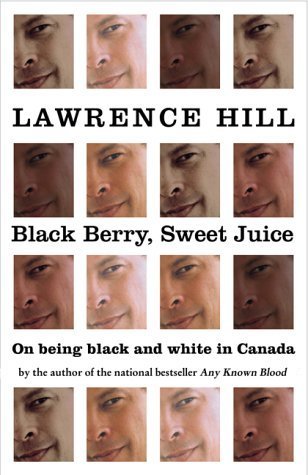
Black Berry, Sweet Juice: On Being Black and White in Canada

Posted in Books, Canada, Identity Development/Psychology, Media Archive, Monographs, Politics/Public Policy, Social Science on 2009-12-15 20:07Z by Steven

Black Berry, Sweet Juice: On Being Black and White in Canada

Harper Collins Canada
September 2001
256 pages
Paperback ISBN: 9780006385080; ISBN10: 0006385087

Lawrence Hill

Lawrence Hill’s remarkable novel, Any Known Blood, a multi-generational story about a Canadian man of mixed race, was met with critical acclaim and it marked the emergence of a powerful new voice in Canadian writing. Now Hill, himself a child of a black father and white mother, brings us Black Berry, Sweet Juice, Hill: On Being Black and White in Canada, a provocative and unprecedented look at a timely and engrossing topic.

In Black Berry, Sweet Juice, Hill movingly reveals his struggle to understand his own personal and racial identity. Raised by human rights activist parents in a predominantly white Ontario suburb, he is imbued with lingering memories and offers a unique perspective. In a satirical yet serious tone, Hill describes the ambiguity involved in searching for his identity – an especially complex and difficult journey in a country that prefers to see him as neither black nor white.

Interspersed with slices of his personal experiences, fascinating family history and the experiences of thirty-six other Canadians of mixed race interviewed for this book, Black Berry, Sweet Juice also examines contemporary racial issues in Canadian society. Hill explores the terms used to describe children of mixed race, the unrelenting hostility towards mix-race couples and the real meaning of the black Canadian experience. It arrives at a critical time when, in the highly publicized and controversial case of Elijah Van de Perre, the son of a white mother and black father [Theodore “Blue” Edwards] in British Columbia, the Supreme Court of Canada has just granted custody to Elijah’s mother, Kimberly Van de Perre.

A reflective, sensitive and often humourous book, Black Berry, Sweet Juice is a thought provoking discourse on the current status of race relations in Canada and it’s a fascinating and important read for us all.

Tags: ,

Check All That Apply: The Psychological Costs and Benefits of Adopting a Multiracial Identity

Posted in Identity Development/Psychology, Live Events, Media Archive, Politics/Public Policy, Social Science, United States on 2009-12-15 18:40Z by Steven

Check All That Apply: The Psychological Costs and Benefits of Adopting a Multiracial Identity

SPSP 2010
The Eleventh Annual Meeting of the Society for Personality and Social Psychology
Royal Pavilion 6
Friday, 2010-01-29, 09:45-11:00 PST (Local Time)

Chair: Todd L. Pittinsky, Harvard University

Multiracial people have always challenged the conventional notions of racial categorization, exemplified by the recent debate over President Obama’s racial identity—was he “Too Black” or “Not Black enough”? Despite his biological multiracial background, he consistently self-identifies as Black. This example illustrates the inherent flexibility in racial identification and raises questions about how this flexibility affects both the target and perceiver. This symposium assembles four diverse programs of research that explore race as a flexible construct. Our findings demonstrate how examining multiracial people can offer novel insight into the relationship between racial identification and discrimination, as well as their links to health and cognitive outcomes. Giamo and colleagues discuss how both perceptions of discrimination and parental ethnicity influence multiracial individuals’ conveyance of their racial identity. Sanchez and colleagues investigate how White ancestry reduces multiracial individuals’ credentials as an ethnic minority, affecting their worthiness as a candidate for affirmative action. Shih and La Plante explore the prevalence of health risk behaviors among monoracial and multiracial individuals. Finally, Pauker and Ambady examine whether multiracial individuals can flexibly adopt different racial identifications to guide preferential “own-race” memory and the involvement of discrimination narratives in such changes in racial identification. These studies introduce new advances in thinking about how perceived experiences with discrimination shape both self and other perceptions of racial identity. Additionally, they highlight that the adoption of a flexible, multiracial identity can engender a complex set of consequences and benefits, including both negative health outcomes and positive cognitive outcomes.

Talk 1- The Influence of Perceptions of Discrimination and Parental Ethnicity on Multiracial Identity

Lisa S. Giamo
Simon Fraser University

Michael T. Schmitt
Simon Fraser University

H. Robert Outten
Simon Fraser University

Talk 2 – Minority Status Perceptions of Black/White Biracial Individuals

Diana T. Sanchez
Rutgers University

Jessica J. Good
Rutgers University

George Chavez
Rutgers University

Talk 3 – Health Risk Behaviors of Multiracial and Monoracial Young Adults

Margaret J. Shih
University of California, Los Angeles

Debi A. LaPlante
Harvard Medical School

Talk 4 – Multiracial Individuals’ Flexible “Own-Race” Memory

Kristin Pauker
Stanford University

Nalini Ambady
Tufts University

For complete information on the four talks, click here.
Sixth Annual Ray Warren Multicultural Symposium (2009): Mixed: The Politics of Hybrid Identities

Posted in Live Events, New Media, Politics/Public Policy, Social Science, United States on 2009-12-15 01:54Z by Steven

Sixth Annual Ray Warren Multicultural Symposium (2009): Mixed: The Politics of Hybrid Identities

Lewis and Clark College
Portland, Oregon
2009-11-11 through 2009-11-13

Events

  • “Obama and the Biracial Factor: Race, Sexuality, and the Battle for a New America” – Andrew Jolivétte (Introduced by Brenda Salas Neves, L&C student and symposium co-chair)
  • “Secrets of a Mixed Race Child” – Dmae Roberts (Introduced by Parasa Chanramy, L&C student and symposium co-chair)
  • Interracial Relationships, Adoption, and Identity – Moderator: Reiko Hillyer with Jiannbin Shiao, Astrid Dabbeni, Nicole Cullen, Hanako Conrad
  • Remix: Identities and Artistic Expression – Moderator: Franya Berkman with Dmae Roberts, Gerardo Calderón, Nelda Reyes, Christabel Escarez and Nico Jose
  • “The Future of Multiracial Politics” – Kim Williams (Introduced by Chris Wendt)
  • Indigeneity and Cultural Exchange – Moderator: Elliott Young with Se-ah-dom Edmo, Tana Atchley, Muki Hansteen Izora, L&C students Lu’u Nakanelua and Allison Perry
  • Nation-Building and Mixed Populations – Moderator: Rich Peck with Oren Kosansky, Cari Coe, Osaebea Amoako, Tim Moore
  • Race Monologues – Identity: According to Whom? (Introduced by Parasa Chanramy) with L&C students Christabel Escarez, Adrian Guerrero, Temesghen Habte, Christina Herring, Jessica Houston, Nico Jose, Yollie Keeton, Rhea Manley, Jasin Nazim,Goldann Salazar, Jared Schy, and Madelyn Troiano
Tags: , , , , , , , , , , , , , , , , , , , , , , , , , , , , , , , , , , , ,

Dispatches from the Color Line: The Press and Multiracial America

Posted in Books, Census/Demographics, Communications/Media Studies, Media Archive, Monographs, Politics/Public Policy, Social Science, United States on 2009-12-14 18:52Z by Steven

Dispatches from the Color Line: The Press and Multiracial America

State University of New York Press
July 2007
295 pages
Hardcover ISBN10: 0-7914-7099-7; ISBN13: 978-0-7914-7099-2
Paperback ISBN10: 0-7914-7100-4; ISBN13: 978-0-7914-7100-5

Catherine R. Squires, Cowles Professor of Journalism, Diversity and Equality
University of Minnesota

Explores contemporary news media coverage of multiracial people and identities.

When modern news media choose to focus attention on people of multiracial descent, how does this fit with broader contemporary and historical racial discourses? Do these news narratives complicate common understandings of race and race relations? Dispatches from the Color Line explores these issues by examining contemporary news media coverage of multiracial people and identities. Catherine R. Squires looks at how journalists utilize information from many sources—including politicians, bureaucrats, activists, scholars, demographers, and marketers—to link multiracial identity to particular racial norms, policy preferences, and cultural trends. She considers individuals who were accused (rightly or wrongly) of misrepresenting their racial identity to the public for personal gain, and also compares the new racial categories of Census 2000 as reported in Black owned, Asian American owned, and mainstream newspapers. These comparisons reveal how a new racial group is framed in mass media, and how different media sources reinforce or challenge long-standing assumptions about racial identity and belonging in the United States.

Tags: , ,

Maya Ethnolinguistic Identity: Violence, Cultural Rights, and Modernity in Highland Guatemala

Posted in Anthropology, Books, Caribbean/Latin America, Identity Development/Psychology, Media Archive, Monographs, Politics/Public Policy, Social Science on 2009-12-12 20:36Z by Steven

Maya Ethnolinguistic Identity: Violence, Cultural Rights, and Modernity in Highland Guatemala

University of Arizona Press
2010
192 pages
6.0 x 9.0
Cloth ISBN: 978-0-8165-2767-0

Brigittine M. French, Assistant Professor of Anthropology
Grinnell College

In this valuable book, ethnographer and anthropologist Brigittine French mobilizes new critical-theoretical perspectives in linguistic anthropology, applying them to the politically charged context of contemporary Guatemala. Beginning with an examination of the “nationalist project” that has been ongoing since the end of the colonial period, French interrogates the “Guatemalan/indigenous binary.” In Guatemala, “Ladino” refers to the Spanish-speaking minority of the population, who are of mixed European, usually Spanish, and indigenous ancestry; “Indian” is understood to mean the majority of Guatemala’s population, who speak one of the twenty-one languages in the Maya linguistic groups of the country, although levels of bilingualism are very high among most Maya communities. As French shows, the Guatemalan state has actively promoted a racialized, essentialized notion of “Indians” as an undifferentiated, inherently inferior group that has stood stubbornly in the way of national progress, unity, and development—which are, implicitly, the goals of “true Guatemalans” (that is, Ladinos).

French shows, with useful examples, how constructions of language and collective identity are in fact strategies undertaken to serve the goals of institutions (including the government, the military, the educational system, and the church) and social actors (including linguists, scholars, and activists). But by incorporating in-depth fieldwork with groups that speak Kaqchikel and K’iche’ along with analyses of Spanish-language discourses, Maya Ethnolinguistic Identity also shows how some individuals in urban, bilingual Indian communities have disrupted the essentializing projects of multiculturalism. And by focusing on ideologies of language, the author is able to explicitly link linguistic forms and functions with larger issues of consciousness, gender politics, social positions, and the forging of hegemonic power relations.

Read an excerpt here.

Tags: , ,