Who And What You Are

Posted in Articles, Barack Obama, Identity Development/Psychology, New Media, Politics/Public Policy, Social Science, United States on 2010-01-07 21:22Z by Steven

Who And What You Are

Contexts
Fall 2009
Vol. 8, No. 4
Pages 64–65
DOI 10.1525/ctx.2009.8.4.64

Sangyoub Park, Assistant Professor of Sociology
Washburn University

Barack Obama‘s presidency and changes in how the U.S. Census tracks race underline the importance of the social construction of race and ethnicity in the United States. Changes in our racial landscape, including increases in interracial marriage and childbearing, pose intriguing questions about how future generations will respond to the growth of multiracial identities.

Tags: ,

Mixing It Up

Posted in Articles, Media Archive, Politics/Public Policy, Social Science, United States on 2010-01-07 21:08Z by Steven

Mixing It Up

Contexts
Volume  4, Number 4 (Fall 2005)
Pages 15–16
DOI 10.1525/ctx.2005.4.4.15

Kimberly McClain DaCosta, Associate Professor
Gallatin School of Individualized Study, New York University

Jamie Tibbetts is a member of the Generation Mix National Awareness Tour. He and four other mixed-race young adults are driving across the country, making stops in sixteen cities to “raise awareness of America’s multiracial baby boom” and “promote a national dialogue about the mixed-race experience.” The tour is sponsored by the Mavin Foundation, which advocates on behalf of people who identify as being of mixed race in the United States. The Mavin Foundation continues and extends the work of earlier multiracial advocacy groups that coalesced around the issue of census classification in the 1990s and successfully challenged the federal “check one only” policy of racial enumeration. Beginning in 2000, the U.S. Census instructed people to “mark one or more” racial categories, resulting in new statistical measures of the “two or more races” population. (This interview was conducted in April 2005.)

Tags: , ,

Crossing Boundaries, Claiming a Homeland: The Mexican Chinese Transpacific Journey to Becoming Mexican, 1930s–1960s

Posted in Articles, Asian Diaspora, Caribbean/Latin America, History, Identity Development/Psychology, Media Archive, Mexico, Politics/Public Policy, Social Science on 2010-01-07 20:17Z by Steven

Crossing Boundaries, Claiming a Homeland: The Mexican Chinese Transpacific Journey to Becoming Mexican, 1930s–1960s

Pacific Historical Review
Volume 78, Number 4 (November 2009)
pages 545–577
DOI 10.1525/phr.2009.78.4.545

Julia María Schiavone Camacho, Assistant Professor of History
University of Texa, El Paso

This article follows Mexican Chinese families from Mexico, across the Mexican-U.S. border, to China, and back to Mexico. Settling in northern Mexico in the nineteenth century, Chinese formed multiple ties with Mexicans. An anti-Chinese movement emerged during the Mexican Revolution and peaked during the Great Depression. The Mexican government deported several thousand Chinese men and their Mexican-origin families from Sonora and neighboring Sinaloa, some directly to China and others to the United States, whose immigration agents also deported the families to China. They arrived in Guangdong (Canton) Province but eventually congregated in Macau where they forged a coherent Mexican Chinese enclave. Developing a strategic Mexican nationalism, they appealed for repatriation. The Mexican Chinese “became Mexican” only after authorities compelled them to struggle for years from abroad for the inclusion of their mixed-race families in the nation. They became diasporic citizens and fashioned hybrid identities to survive in Mexico and China.

Tags: , , ,

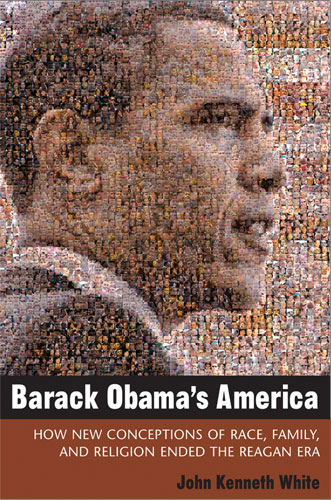
Barack Obama’s America: How New Conceptions of Race, Family, and Religion Ended the Reagan Era

Posted in Barack Obama, Books, Media Archive, Monographs, Politics/Public Policy, Social Science, United States on 2010-01-05 23:56Z by Steven

Barack Obama’s America: How New Conceptions of Race, Family, and Religion Ended the Reagan Era

The University of Michgan Press
2009
320 pages
6 x 9
Cloth ISBN: 978-0-472-11450-4
Paper ISBN: 978-0-472-03391-1
Ebook Formats ISBN: 978-0-472-02179-6

John Kenneth White, Professor of Politics
Catholic University of America, Washington, D.C

Research and reflections on the American demographic shift that led to the election of President Barack Obama

The election of Barack Obama to the presidency marks a conclusive end to the Reagan era, writes John Kenneth White in Barack Obama’s America. Reagan symbolized a 1950s and 1960s America, largely white and suburban, with married couples and kids at home, who attended church more often than not.

Obama’s election marks a new era, the author writes. Whites will be a minority by 2042. Marriage is at an all-time low. Cohabitation has increased from a half-million couples in 1960 to more than 5 million in 2000 to even more this year. Gay marriages and civil unions are redefining what it means to be a family. And organized religions are suffering, even as Americans continue to think of themselves as a religious people. Obama’s inauguration was a defining moment in the political destiny of this country, based largely on demographic shifts, as described in Barack Obama’s America.

Read the Q&A with the University of Michigan Press and John Kenneth White here.

University of Michigan Press: Was Barack Obama’s election a reflection of change in American attitudes, or more a change in the type of people who make up the country?

John Kenneth White: …The America of the 1950s through the 1980s has come to an end. Whites will be a minority of all Americans by the middle of the twenty-first century. Hispanics will be nearly a third of the population by 2030. The face of America is turning from white into some form of beige or bronze. Even how we define race is an open question. For much of American history, race was categorized into two categories: black or white. Mixed race was frowned upon and degrading terms such as “quadroon” were invented. Now there are more mixed racial marriages than ever before and the children from those marriages are not easily categorized….

Tags: , ,

Being Multiracial in a Country that Sees Black and White

Posted in Articles, Barack Obama, History, Identity Development/Psychology, New Media, Politics/Public Policy, Social Science, United States on 2010-01-05 00:13Z by Steven

Being Multiracial in a Country that Sees Black and White

Interpolations: A Journal of First Year Writing
Deparment of English, University of Maryland
Fall 2009

Lavisha McClarin
University of Maryland

In America mixed race individuals are becoming more prominent in the media, politics and sports throughout the country. Some of the most popular mixed race individuals that we see everyday include Tiger Woods, Vin Diesel, Mariah Carey, Dwayne “the Rock” Johnson, Derek Jeter, Halle Berry, Alicia Keys and of course President [Barack] Obama. The fact that this population of mixed race individuals is growing at an astounding rate is the reason behind the current discussion on the racial classification of such individuals. Before the 1960s many researchers considered “biracial identity [to be] equivalent to black identity…or a subset of blacks” (Rockquemore 21). This thought continued to exist in the United States by researchers until the 1990s [sic] when “biracial people were [considered] a separate [racial] group” (21). The multiracial movement that has arisen during the 1990s believes that “every person, especially every child, who is multi-ethnic/interracial has the same right as any other person to assert an identity that embraces the fullness and integrity of their actual ancestry” (Tessman 1). Although there are overall positive effects for these individuals from the movement, there are also negative affects that could potentially cause more problems for America’s current racial system. However, despite the negative effects of the movement, there is evidence that shows that this potential transition to a multiracial system in the US has beneficial aspects to it…

Read the entire article here.

Tags: , , , , , , , ,

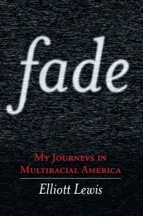
Fade: My Journeys in Multiracial America

Posted in Autobiography, Books, Census/Demographics, Identity Development/Psychology, Media Archive, Monographs, Politics/Public Policy, Social Science, United States on 2010-01-04 23:26Z by Steven

Fade: My Journeys in Multiracial America

Basic Books an imprint of The Perseus Books Group
2006-12-28
302 pages
ISBN: 9780786718825
ISBN-10: 078671882X

Elliott Lewis

Television journalist Elliott Lewis weaves his memoirs as a black-and-white biracial American with the voices of dozens of multiracial people who are challenging how we think and speak about race today. “What are you?” This seemingly ordinary but politically charged question has become a touchstone for debate around race and ethnicity. Now, more than ever, mixed race Americans are calling themselves biracial and multiracial rather than feeling forced to choose only one race. Nearly seven million people checked more than one racial category in the 2000 US census, the first time in history Americans had the option to mark more than one box. With Fade, Lewis offers a comprehensive look at the multiracial state of the union. Here he speaks with dozens of individuals, tackling hot button issues such as the often complicated lives of multiracial people in communities of color, interracial dating, transracial adoption, and the birth of the multiracial movement. The author also shares his own moving — and often humorous — firsthand experiences with race, along with intimate stories from those at the forefront of nationwide efforts to formally recognize the multiracial population.

Tags: , ,

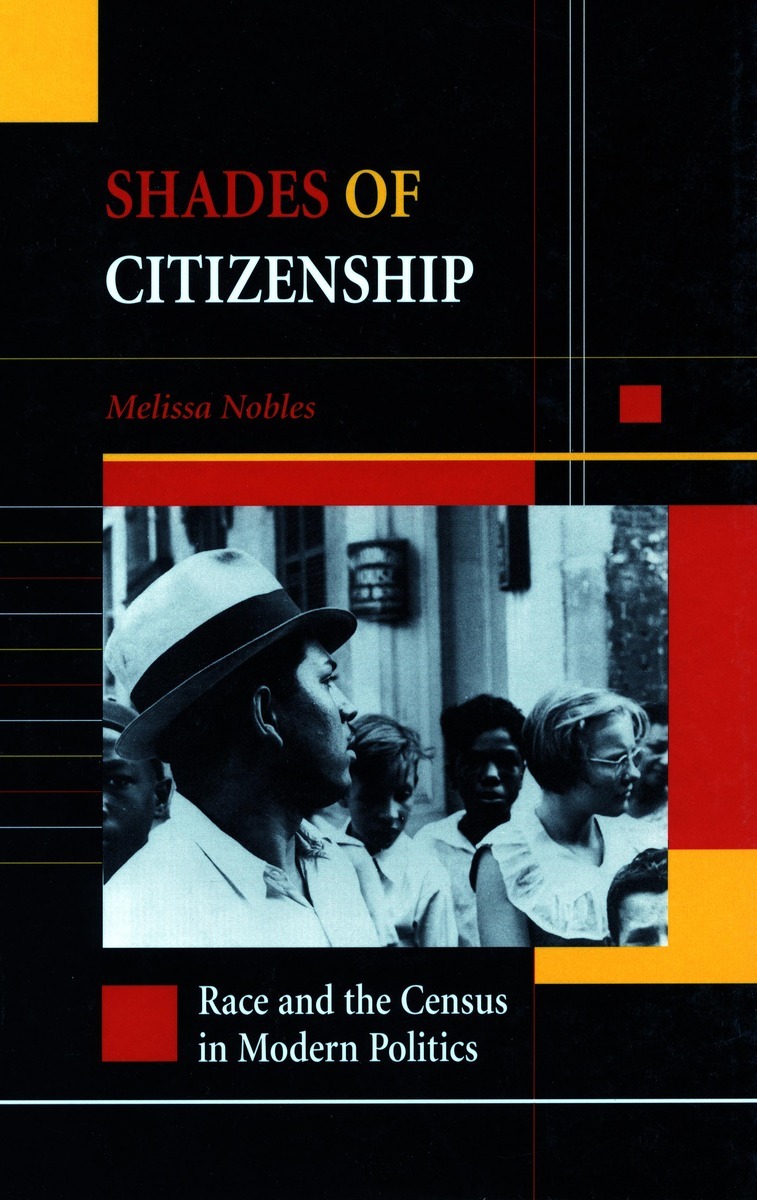
Shades of Citizenship: Race and the Census in Modern Politics

Posted in Books, Brazil, Caribbean/Latin America, Census/Demographics, Media Archive, Monographs, Politics/Public Policy, United States on 2010-01-02 01:38Z by Steven

Shades of Citizenship: Race and the Census in Modern Politics

Stanford University Press
2000
256 pages
4 tables.
Cloth ISBN-10: 0804740135
Cloth ISBN-13: 9780804740135
Paper ISBN-10: 0804740593
Paper ISBN-13: 9780804740593

Melissa Nobles, Arthur and Ruth Sloan Professor of Political Science
Massachusetts Institute of Technology

This book explores the politics of race, censuses, and citizenship, drawing on the complex history of questions about race in the U.S. and Brazilian censuses. It reconstructs the history of racial categorization in American and Brazilian censuses from each country’s first census in the eighteenth and nineteenth centuries up through the 2000 census. It sharply challenges certain presumptions that guide scholarly and popular studies, notably that census bureaus are (or are designed to be) innocent bystanders in the arena of politics, and that racial data are innocuous demographic data.

Using previously overlooked historical sources, the book demonstrates that counting by race has always been a fundamentally political process, shaping in important ways the experiences and meanings of citizenship. This counting has also helped to create and to further ideas about race itself. The author argues that far from being mere producers of racial statistics, American and Brazilian censuses have been the ultimate insiders with respect to racial politics.

For most of their histories, American and Brazilian censuses were tightly controlled by state officials, social scientists, and politicians. Over the past thirty years in the United States and the past twenty years in Brazil, however, certain groups within civil society have organized and lobbied to alter the methods of racial categorization. This book analyzes both the attempt of America’s multiracial movement to have a multiracial category added to the U.S. census and the attempt by Brazil’s black movement to include racial terminology in census forms. Because of these efforts, census bureau officials in the United States and Brazil today work within political and institutional constraints unknown to their predecessors. Categorization has become as much a “bottom-up” process as a “top-down” one.

Tags: ,

Racial Formation in the New Millennium

Posted in Books, Media Archive, Monographs, Politics/Public Policy, Social Science, United States on 2009-12-31 22:41Z by Steven

Racial Formation in the New Millennium

Routledge
 2008-03-01
256 pages
Trim Size: 6 x 9
Hardback ISBN: 978-0-415-95025-1

Michael Omi, Associate Professor of Ethnic Studies
University of California, Berkeley

Howard Winant, Professor of Sociology
University of California, Santa Barbara

First published in 1986, and then again in 1994, Omi and Winant’s Racial Formation in the United States is considered a classic text on race and ethnicity. Racial Formation in the New Millennium builds upon the ideas set forth in Omi and Winant’s classic text – providing a sophisticated and up-to-date overview of race and ethnicity in the United States. In this volume, they include current issues and controversies related to racism, race/class/gender interrelationships, modern life and racial politics.

Tags: , ,

Racial Formation in the United States: From the 1960s to the 1990s, 2nd Edition

Posted in Books, History, Media Archive, Monographs, Politics/Public Policy, Social Science, United States on 2009-12-31 22:33Z by Steven

Racial Formation in the United States: From the 1960s to the 1990s, 2nd Edition

Routledge
Publication Date: 1994-03-22
240 pages
Trim Size: 6 x 9
Paperback ISBN: 978-0-415-90864-1

Michael Omi, Associate Professor of Ethnic Studies
University of California, Berkeley

Howard Winant, Professor of Sociology
University of California, Santa Barbara

First published in 1986, Racial Formation in the United States is now considered a classic in the literature on race and ethnicity. This second edition builds upon and updates Omi and Winant’s groundbreaking research. In addition to a preface to the new edition, the book provides a more detailed account of the theory of racial formation processes. It includes material on the historical development of race, the question of racism, race-class-gender interrelationships, and everyday life. A final chapter updates the developments in American racial politics up to the present, focusing on such key events as the 1992 Presidential election, the Los Angeles riots, and the Clinton administration’s racial politics and policies.

Tags: , ,

The Multiracial Experience: Racial Borders as the New Frontier

Posted in Anthologies, Anthropology, Books, Census/Demographics, Gay & Lesbian, Identity Development/Psychology, Media Archive, Politics/Public Policy, Social Science, Teaching Resources on 2009-12-30 17:59Z by Steven

The Multiracial Experience: Racial Borders as the New Frontier

SAGE Publications
1995
512 pages
Paperback ISBN: 9780803970595

Edited by Maria P. P. Root

In her bold new edited volume, The Multiracial Experience, Maria P. P. Root challenges current theoretical and political conceptualizations of race by examining the experience of mixed-race individuals. Articulating questions that will form the basis for future discussions of race and identity, the contributors tackle concepts such as redefining ethnicity when race is less central to the definition and how a multiracial model might dismantle our negative construction of race. Researchers and practitioners in ethnic studies, anthropology, education, law, psychology, nursing, social work, and sociology add personal insights in chapter-opening vignettes while providing integral critical viewpoints. Sure to stimulate thinking and discussion, the contributors focus on the most contemporary racial issues, including the racial classification system from the U.S. Census to the schools; the differences between race, ethnicity, and colorism; gender and sexuality in a multicultural context; ethnic identity and identity formation; transracial adoption; and the future of race relations in the United States. The Multiracial Experience opens up the dialogue to rethink and redefine race and social relations in this country. This volume provides discussions key to all professionals, practitioners, researchers, and students in multicultural issues, ethnic relations, sociology, education, psychology, management, and public health.

Table of Contents

The Multiracial Experience: Racial Borders as a Significant Frontier in Race Relations – Maria P. P. Root

PART ONE: HUMAN RIGHTS

  • A Bill of Rights for Racially Mixed People –  Maria P. P. Root
  • Government Classification of Multiracial/Multiethnic People – Carlos A. Fernandez
  • The Real World – Susan R. Graham
  • Multiracial Identity in a Color-Conscious World – Deborah A. Ramirez
  • Transracial Adoptions: In Whose Best Interest? – Ruth G. McRoy and Christine C. Iijima Hall
  • Voices from the Movement: Approaches to Multiraciality – Cynthia L. Nakashima

PART TWO: IDENTITY

  • Hidden Agendas, Identity Theories, and Multiracial People –  Michael C. Thornton
  • Black and White Identity in the New Millenium: Unsevering the Ties That Bind – G. Reginald Daniel
  • On Being and Not-Being Black and Jewish – Naomi Zack
  • An `Other’ Way of Life: The Empowerment of Alterity in the Interracial Individual – Jan R. Weisman

PART THREE: BLENDING AND FLEXIBILITY

  • LatiNegra Lillian: Mental Health Issues of African –  Lillian Comas-Diaz
  • Race as Process: Reassessing the `What Are You?’ Encounters of Biracial Individuals – Teresa Kay Williams
  • Piecing Together the Puzzle: Self-Concept and Group Identity in Biracial Black/White Youth – Lynda D. Field
  • Changing Face, Changing Race: The Remaking of Race in the Japanese American and African American Communities – Rebecca Chiyoko King and Kimberly McClain DaCosta
  • Without a Template: The Biracial Korean/White Experience – Brian Chol Soo Standen

PART FOUR: GENDER AND SEXUAL IDENTITY

  • In the Margins of Sex and Race: Difference, Marginality, and Flexibility – George Kitahara Kich
  • (Un)Natural Boundaries: Mixed Race, Gender, and Sexuality – Karen Maeda Allman
  • Heterosexual Alliances: The Romantic Management of Racial Identity-  Francine Winddance Twine
  • Ambiguous Bodies: Locating Black/White Women in Cultural Representations – Caroline A. Streeter

PART FIVE: MULTICULTURAL EDUCATION

  • Making the Invisible Visible: The Growth of Community Network Organizations – Nancy G. Brown and Ramona E. Douglass
  • Challenging Race and Racism: A Framework for Educators – Ronald David Glass and Kendra R. Wallace
  • Being Different Together in the University Classroom: Multiracial Identity as Transgressive Education – Teresa Kay Williams et al
  • Multicultural Education – Francis Wardle

PART SIX: THE NEW MILLENIUM

  • 2001: A Race Odyssey – Christine C. Iijima Hall
Tags: , , , , , , , , , , , , , , , , , , , , , , , , , , ,