U.S. far from an interracial melting pot

Posted in Articles, Census/Demographics, New Media, Politics/Public Policy, Social Science, United States on 2010-06-17 03:00Z by Steven

U.S. far from an interracial melting pot

CNN
2010-06-16

Daniel T. Lichter, Ferris family professor in the Department of Policy Analysis and Management, and Professor of Sociology
Cornell University

Ithaca, New York (CNN)—According to a recent report by the Pew Research Center, one of every seven new marriages in 2008 was interracial or interethnic—the highest percentage in U.S. history. The media and blogosphere have been atwitter.

Finally, it seems, we have tangible evidence of America’s entry into a new post-racial society, proof of growing racial tolerance. Intermarriage trends are being celebrated as a positive sign that we have come to think of all Americans as, well, Americans…

…It’s time for everyone—on all sides of this issue—to relax and take a deep breath. The reality is that racial boundaries remain firmly entrenched in American society. They are not likely to go away anytime soon.

We are still far from a melting pot where distinct racial and ethnic groups blend into a multi-ethnic stew…

Read the entire article here.

Tags: , ,

Race in an Era of Change: A Reader

Posted in Family/Parenting, Health/Medicine/Genetics, History, Identity Development/Psychology, Law, Media Archive, Native Americans/First Nation, Politics/Public Policy, Social Science, United States on 2010-06-08 04:42Z by Steven

Race in an Era of Change: A Reader

Oxford University Press
September 2010
544 pages
ISBN13: 9780199752102
ISBN10: 0199752109

Edited By:

Heather Dalmage, Professor of Sociology and Director of the Mansfield Institute
Roosevelt University

Barbara Katz Rothman, Professor of Sociology
Baruch College of the City Univerity of New York
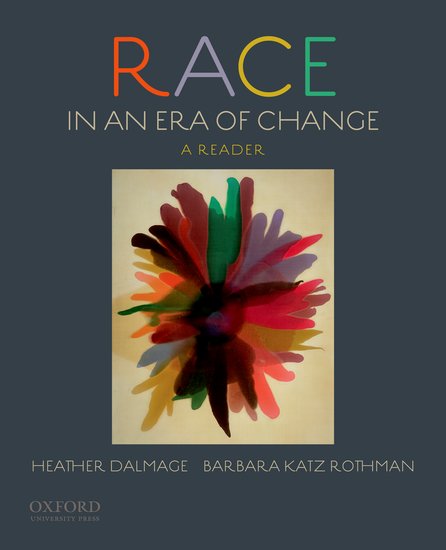
Featuring a wide range of classic and contemporary selections, Race in an Era of Change: A Reader is an affordable and timely collection of articles on race and ethnicity in the United States today. Opening with coverage of racial formation theory, it goes on to cover “racial thinking” (including the challenging and compelling concept of “whiteness”) and the idea of “assigned and claimed” racial identities. The book also discusses the relationships between race and a variety of institutions—including healthcare, economy and work, housing and environment, education, policing and prison, the media, and the family—and concludes with a section on issues of globalization, immigration, and citizenship.

Editors Heather Dalmage and Barbara Katz Rothman have carefully edited the selections so that they will be easily accessible to students. A detailed introduction to each article contains questions designed to help students focus as they begin reading. In addition, each article is followed by a “journaling question” that encourages students to share their responses to the piece. Offering instructors great flexibility for course use—the selections can be used in any combination and in any order—Race in an Era of Change: A Reader is ideal for any undergraduate course on race and ethnicity.

Table of Contents

PART I: RACIAL FORMATION THEORY

1. Michael Omi and Howard Winant, from Racial Formation in the United States
2. Eva Marie Garroutte, “The Racial Formation of American Indians”
3. Nicholas DeGenova and Ana Y. Ramos-Zayas, “Latino Racial Formations in the United States: An Introduction”

PART II: RACIAL THINKING

Essentialism

4. Joanne Nagel, “Sex and Conquest: Domination and Desire on Ethnosexual Frontiers”
5. Janell Hobson, “The “Batty” Politics: Towards an Aesthetic of the Black Female Body”
6. Barbara Katz-Rothman, from The Book of Life: A Personal Guide to Race, Normality, and the Implications of the Genome Project
A Voice from the Past: Franz Boas, “Race and Progress”

The Social Construction of Race

7. Eduardo Bonilla Silva, David Embrick, Amanda Lewis, “‘I did not get that job because of a Black man…’ The storylines and testimonies of color-blind racism”
8. Margaret Hunter, “The Beauty Queue: Advantages of Light Skin”
9. Heather Dalmage, “Discovering Racial Borders”
A Voice from the Past: W.E.B. Du Bois, “The Conservation of the Races”

Outing Whiteness

A Special Introduction by the Editors
10. France Winddance Twine and Charles Gallagher, “Introduction: The Future of Whiteness: A Map of the ‘Third Wave'”
11. Troy Duster, “The Morphing Properties of Whiteness”
12. Jennifer L. Eichstedt, “Problematic Identities and a Search for Racial Justice”
A Voice from the Past: Frederick Douglass, “The Color Line”

PART III: RACIAL IDENTITIES

A Special Introduction by the Editors
13. Joy L. Lei, “(Un) Necessary Toughness?: ‘Those Loud Black Girls’ and Those ‘Quiet Asian Boys'”
14. Nada Elia, “Islamophobia and the ‘Privileging’ of Arab American Women”
15. Nina Asher, “Checking the Box: The Label of ‘Model Minority'”
16. Patty Talahongva, “Identity Crisis: Indian Identity in a Changing World”
17. Juan Flores, “Nueva York – Diaspora City: U.S. Latinos Between and Beyond”
18. Nancy Foner, “The Social Construction of Race in Two Immigrant Eras”

PART IV: RACIALIZED AND RACIALIZING INSTITUTIONS

Economy and Work

19. Sherry Cable and Tamara L. Mix, “Economic Imperatives and Race Relations: The Rise and Fall of the American Apartheid System”
20. Marianne Bertrand and Sendhil Mullainathan, “Are Emily and Greg More Employable than Lakisha and Jamal? A Field Experiment on Labor Market Discrimination”

Housing & Environment

21. Benjamin Howell, “Exploiting Race and Space: Concentrated Subprime Lending as Housing Discrimination”
22. Mary Patillo, “Black Middle Class-Class Neighborhoods”
23. Kari Marie Norgaard, “Denied Access to Traditional Foods Including the Material Dimension to Institutional and Environmental Racism”

Education

24. Linda Darling-Hammond, “Race, Inequality, and Educational Accountability: The Irony of ‘No Child Left Behind'”
25. Amanda E. Lewis, Mark Chesler, and Tyrone Forman, “The Impact of ‘Colorblind’ Ideologies on Students of Color: Intergroup Relations at a Predominantly White University”

Policing and Prison

26. Loic Wacquant, “Deadly Symbiosis: When Ghetto and Prison Meet and Mesh”
27. David Harris, “U.S. Experiences with Racial and Ethnic Profiling: History, Current Issues, and the Future”

Media

28. Jose Antonio Padin, “The Normative Mulattoes: The Press Latinos. And the Racial Climate on the Moving Immigration Frontier”
29. Jonathan Markovitz, “Anatomy of a Spectacle: Race, Gender, and Memory in the Kobe Bryant Rape Case”

Family

30. Dorothy Roberts, from Shattered Bonds: The Color of Child Welfare
31. Krista M Perreira, Mimi V Chapman, and Gabriela L Stein, “Becoming an American Parent: Overcoming Challenges and Finding Strength in a New Immigrant Latino Community”

Healthcare

32. Mathew R. Anderson, Susan Moscou, Celestine Fulchon and Daniel R. Neuspiel, “The Role of Race in the Clinical Presentation”
33. Susan Starr Sered and Rushika Fernandopulle, “Uninsured in America: Life and Death in the Land of Opportunity”

PART V: GLOBALIZATION, IMMIGRATION AND CITIZENSHIP

34. Anupam Chander, “Flying the Mexican Flag in Los Angeles”
35. Patricia Hill Collins, “New Commoditites, New Consumers: Selling Blackness in a Global Marketplace”
36. William I. Robinson, “‘Aqui estamos y no nos vamos!’: Global capital and immigrant rights”

Tags: , ,

Race 2008: Critical Reflections on an Historic Campaign

Posted in Anthologies, Barack Obama, Books, Media Archive, Politics/Public Policy, United States on 2010-06-01 20:49Z by Steven

Race 2008: Critical Reflections on an Historic Campaign

BrownWalker Press
2010
229 pages
ISBN-10: 1599425378
ISBN-13: 9781599425375

Edited by

Myra Mendible, Professor of English and Department Chair for Language and Literature
Florida Gulf Coast University

Race 2008: Critical Reflections on an Historic Campaign brings together a diverse group of scholars and activists to examine the gendered politics, images, rhetorical practices, and racial/ethnic conflicts that served as a backdrop to this momentous election. It features perspectives marginalized or ignored by mainstream media and political pundits, thus providing alternative, critical insights on the social dynamics fueling campaign rhetoric, grassroots activism, and intergroup conflicts in 2008 and beyond.

Table of Contents

  • Contributors
  • Introduction: Post-Election Blues; Myra Mendible
  • Cracks in the Ceiling: Gender and Sexuality
    • 1. Making Space: Articulating an Inclusive Framework of Reproductive and Sexual Health Politics; Tanya Bakhru
    • 2. What Kind of Feminist is a ‘Feminist for Life’? The Case of Sarah Palin; Françoise Coste
  • What’s in a Name? The Politics of Identity
    • 3. The Election’s Imagined Identities: The Ghettoization of Muslims in the Race for the White House; Cyra Akila Chodhury
    • 4. From Rev. Wright to “Joe the Plumber”: Racial and Class Anxieties in the 2008 Elections; John M. Cox
    • 5. Black with ‘White Blood’? To Advertise, or Not Advertise, the Race of Obama’s Mother; Daniel McNeil
  • Visual Media and Representation
    • 6. Out of the Wilderness into the Spotlight: Celebrity and Radical Prophecy in the Obama Presidential Campaign; Margaret Cavin Hambrick
    • 7. Obama, McCain, and Alfred E. Smith: Putting the “Comic” Back in “Comic Frame”; Katherine Hale
  • Ethnic Constituencies on the Front Lines
    • 8. “Why is Barack Obama a Filipino?” Race, Immigrant Identities, and Community Organizing among Filipino Americans; Estella Habal
    • 9. Baiting Red, Turning Blue: The Dynamics of Change in Cuban Miami; Myra Mendible
    • 10. Did Obama Have an “Asian Problem”? Oiyan A. Poon
  • Index

Read the first 25 pages here.

Tags: , , , , , , , , , , ,

Never a Neutral State: American Race Relations and Government Power

Posted in Articles, Economics, History, Law, Media Archive, Politics/Public Policy, United States on 2010-05-29 21:46Z by Steven

Never a Neutral State: American Race Relations and Government Power

Cato Journal
Volume 29, Number 3 (Fall 2009)
Pages 417-453

Jason Kuznicki, Research Fellow and Managing Editor, Cato Unbound
Cato Institute

Economics tells us that racial discrimination is expensive. Yet social psychology suggests that humans nonetheless tend to mistrust those whom they identify as outsiders. As a result, governments can exacerbate this mistrust and thereby encourage costly discrimination by creating or maintaining official race-based definitions of outgroups and differential outcomes based on race.

This article reviews evidence from economic and legal history to argue that not only did U.S. governments incentivize and even mandate racial discrimination, but these acts tended to reinforce racial mistrust as time went by. Segregation became more strict, not less, from the end of Reconstruction until the mid-20th century, largely because of growing and self-perpetuating state action. Discrimination created its own constituency.

Some skeptics of the civil rights movement have viewed racial discrimination as an essentially private matter that did not warrant the extensive state intervention. This view is untenable. Although certain measures passed in the name of black civil rights still raise serious legal issues in light of strict constitutional construction, the civil rights movement also dismantled a wide variety of even more troubling measures. Most of these can be characterized as straightforward impediments to the freedoms of movement, trade, and association.

Although, if given a free market and a neutral state, economic incentives will tend to work against racial discrimination, American history has never witnessed a neutral state. Instead, and until the mid-20th century, the market incentives that might have worked against discrimination were repeatedly frustrated. Recent historical scholarship, notably from left-leaning scholars, has done much to
show the depth and surprising recentness of state support for discrimination…

…Consider the American experience with legal definitions of race. From the earliest English settlements to the present, governments have worked to establish and refine definitions of race, almost always for invidious purposes, and frequently with tighter and tighter standards as to who received racial privileges and who did not. This behavior is indeed similar to that observed in guilds, occupational licensure, and professional organizations, in which membership requirements tend to grow more stringent over time and new areas are brought under the restrictive umbrella (Gelhorn 1976, Young 1991, Dorsey 1983).

Legal definitions based on genealogy arrived very early. Although mixed-race individuals were born shortly after the first importation of African slaves, 17th century legislatures nonetheless criminalized sex between Africans and Europeans (Jordan 1968: 139–44). These punishments did little to stop interracial sex, however, as both demographics and ever-stricter laws would seem to demonstrate. A 1705 statute from Virginia declared that the “child, grand child or great grand child of a negro”—that is, anyone of one-eighth or more African descent—would also be classified as black. Colonial North Carolina went further, to one sixteenth (Jordan 1968: 168).

In general, the legal scrutiny applied to one’s ancestors tended to increase rather than decrease over time. By the 1830s, U.S. courts were occasionally encountering the argument that, regardless of what the law said, a person with any degree of racial mixing would have to be considered black, and these arguments gradually spread through the 19th century legal system. Yet it may surprise today’s readers that the first legislated statewide “one-drop” policy only arrived in 1910, following a series of court cases in the late 19th century that had adopted this rule either out of a perceived necessity or, sometimes, at the requests of black litigants. Prior to 1910, and as recently as the South Carolina Constitutional Convention of 1895, whites had generally rejected the one-drop rule for fear that their own mixed-race ancestries—and liaisons—would be called into question (Sweet 2005: 299–316).

The year 1910 saw the heyday of both Jim Crow and the eugenics movement. Many state legislators were eager to preserve white racial purity, then understood as a scientifically validated goal, and interested parties in the white population increasingly viewed “racial hygiene” as a legitimate state aim (Cynkar 1981). The creators and defenders of anti-miscegenation and one-drop laws believed that their efforts went hand in hand with forced sterilization and the eugenics movement more generally; all were seen as prudent measures to prevent degradation of white America’s genetic stock. Virginia’s Racial Integrity Act, which both established the one-drop rule and reiterated the state’s longstanding ban on miscegenation, was signed into law on March 20, 1924, the same day as its sterilization act. Both were understood at the time to be part of a coherent agenda (Sherman 1988: 69).

There is little evidence, however, that this law initially enjoyed significant popular support. On the contrary, outside the legislature and the few interested parties that lobbied for it, the populace appears to have been well aware of (though certainly uncomfortable with) its racially mixed ancestry. As historian Richard B. Sherman writes, “The campaign for racial integrity in Virginia was not the product of a great popular ground swell. Rather, it was primarily the work of [a] dedicated coterie of extremists who played effectively on the fears and prejudices of many whites” (Sherman 1988: 71–72). Sherman argues for the crucial importance of a small and not very well-attended group of “Anglo-Saxon Clubs of America” in drafting and lobbying for Virginia’s one-drop statute. Although the phrase had not yet been made infamous, these clubs called for a “final solution” to “the Negro problem,” terms that even stripped of their Nazi associations are still deeply disturbing (Sherman 1988: 74–75).

Virginia newspapers were among the proposed law’s early supporters, perhaps because they recognized the shock value of a moral panic that combined sex, secrecy, and many readers’ private anxieties. Predictably, another supporter was the director of the Virginia Bureau of Vital Statistics, Dr. Walter Ashby Plecker, who would see a significant increase in his own power and prestige as the bill became a law. His bureau was charged with classifying the race of all births in the state and with certifying the racial purity of every marriage between Virginia residents, an extraordinary new addition to government power (Sherman 1988: 75–77)…

Read the entire article here.

Tags: ,

Book Review: Dispatches from the Color Line: The Press and Multiracial America

Posted in Articles, Book/Video Reviews, New Media, Politics/Public Policy, Social Science, United States on 2010-05-26 02:53Z by Steven

Book Review: Dispatches from the Color Line: The Press and Multiracial America

Hot Topics in Journalism and Mass Communication
2010-05-19

Queenie A. Byars, Assistant Professor of Journalism and Mass Communication
University of North Carolina, Chapel Hill

Dispatches from the Color Line: The Press and Multiracial America. Catherine R. Squires. Albany, NY: State University of New York Press, 2007.

When Dispatches from the Color Line was published, Barack Obama was still  the junior senator from Illinois and fresh from a rousing keynote speech at the 2004 Democratic National Convention. Fast forward to 2009 and President Barack Obama has jokingly compared his multiracial identity to that of a mixed-breed dog. Obama’s joking aside, the October 2009 case of a Louisiana justice of the peace refusing to issue a marriage license to an interracial couple is no laughing matter, and underscores the value of this book.

Catherine R. Squires is the Cowles Professor of Journalism, Diversity and Equality at the University of Minnesota. Her scholarly work in Dispatches from the Color Line offers serious discourse on the media’s role in framing the identity of multiracial people. She uses case study analysis to examine this issue…

Read the entire review here.

Tags: , , , ,

Not-Black by Default

Posted in Articles, Barack Obama, Census/Demographics, Media Archive, Politics/Public Policy, Social Science, United States on 2010-05-25 02:16Z by Steven

Not-Black by Default

The Nation
Diary of a Mad Law Professor
2010-04-21

Patricia J. Williams, James L. Dohr Professor of Law
Columbia University

Most people who appear phenotypically “black” don’t play around when the government asks them to report their race.

Last week, Melissa Harris-Lacewell wrote an insightful column, “Black by Choice,” about President Obama’s having checked the box marked “Black, African American or Negro” on his Census form. As she notes, despite the way his complex heritage both disrupts “standard definitions of blackness” and creates “a definitional crisis for whiteness,” in American culture “having a white parent has never meant becoming white” if one also has an African-descended parent…

Read the entire article here.

Tags: , , , , ,

The Multiracial Sheep IS the White Supremacist Fox

Posted in Articles, Census/Demographics, Media Archive, Politics/Public Policy, Social Science, United States on 2010-05-24 01:47Z by Steven

The Multiracial Sheep IS the White Supremacist Fox

Black Agenda Report: the journal of African American political thought and action
2010-03-16

Jared A. Ball, Associate Professor of Communication Studies
Morgan State University, Baltimore, Maryland

A government and society that is ever ready to restrict the freedoms of Black folks now offers “freedom” from Blackness. This census and social “opt-out” for the progeny of interracial couples allows them to hope to be considered “as something entirely separate, different and apart from” what Curtis Mayfield called the “dark deep well.” The Black “baggage” can be left behind.

Let’s be very clear from the outset.  Multiracial categorization is an aggressive defense of white supremacy.  Multiracial census categorization, particularly in the era of what some are calling the first Black and multiracial president, is, pun-intended, the bulked up steroid-induced version of the old sports aphorism that “the best defense is a good offense.”  By aggressively encouraging younger generations to identify officially as multiracial the national desire to disappear worsening racial divides gets further juice by offering folks a chance to both adopt the illusion of the “post-racial” and to seemingly categorize themselves away from, if not out of, oppression. The beautiful dialectic traditionally developed in this country’s form of white supremacy was its built-in inability to be white and forced inclusion into Black which has made Black America, if even to a fault, among the most diverse, open and accepting communities in the world.  It also increased the potential that that community would become more threatening to white domination which has led to the centuries-long development of neocolonial-styled light-skin privilege as a mechanism of siphoning off some of the more willing participants in an escape from blackness…

Read the entire article here.

Tags: , ,

Politics and policies: attitudes toward multiracial Americans

Posted in Articles, New Media, Politics/Public Policy, Social Science, United States on 2010-05-23 17:25Z by Steven

Politics and policies: attitudes toward multiracial Americans

Ethnic and Racial Studies
First Published on: 2010-04-15
Volume 33, Issue 9 (October 2010)
pages 1511-1536
DOI: 10.1080/01419871003671929

Mary E. Campbell, Associate Professor of Sociology
University of Iowa

Melissa R. Herman, Assistant Professor of Sociology
Dartmouth College

The growing prominence of the multiracial population in the United States is prompting new questions about attitudes toward multiracial people and popular opinion of policies designed to protect them from discrimination. Currently, American anti-discrimination policies are directed at groups who identify with a single race, but the rising profile of multiracial groups introduces new complexity into questions about racial policy. In this study, we find generally positive affect toward multiracial people, although monoracial minorities are more positive toward multiracial people than whites are. About half of the monoracial minorities and the majority of whites oppose including multiracial people in anti-discrimination policies. Attitudes are associated with traditional predictors such as education and political beliefs, and also with the racial heterogeneity of the local context and intimate contact with other racial groups. Although multiracial people report experiencing discrimination at levels similar to those of monoracial minorities, our results suggest there may be significant resistance to anti-discrimination policies that include multiracial groups. 

Read the entire article here.

Tags: , , , ,

Census trend shows mixed-race Americans are more likely to identify with their multiracial background

Posted in Articles, Barack Obama, Census/Demographics, Identity Development/Psychology, New Media, Politics/Public Policy, Social Science, United States on 2010-05-19 15:30Z by Steven

Census trend shows mixed-race Americans are more likely to identify with their multiracial background

Daily Bruin
University of California, Los Angeles
2010-05-18

Brittany Wong, Bruin contributor

When President Barack Obama got to Question No. 9 on the 2010 Census, he did what mixed-race respondents nationwide were asked to do: pare down and define his complex racial background by checking all the boxes he saw fit.

His decision to exclusively check “Black, African Am., or Negro” and the fractured response that followed speaks to the complex nature of being mixed race today, said Kyeyoung Park, an associate professor of sociocultural anthropology at UCLA who teaches a class about race.

A new generation of mixed-race people are coming into their own this decade, and as they do, many are more comfortable self-identifying in a way that encompasses all of their background, Park said…

Miguel Unzueta, a professor at the UCLA Anderson School of Management who conducted a study that showed that self-identified mixed-race children were better adjusted in school, said he was somewhat surprised by Obama’s decision. Given the president’s discussion of his mixed heritage during the primaries, he said he expected a census answer more in line with his talk on the campaign trail.

But the decision also speaks to the reality that the way Americans talk about race is not always the way they think, he said.

“I think people are more comfortable with having a mixed-race background, but there still isn’t a label that we’re comfortable with in society,” Unzueta said…

Read the entire article here.

Tags: , , , ,

Seeing Like Citizens: Unofficial Understandings of Official Racial Categories in a Brazilian University

Posted in Articles, Brazil, Caribbean/Latin America, Identity Development/Psychology, Media Archive, Politics/Public Policy, Social Science on 2010-05-17 23:50Z by Steven

Seeing Like Citizens: Unofficial Understandings of Official Racial Categories in a Brazilian University

Journal of Latin American Studies
Number 41 (2009)
pages 221–250
DOI: 10.1017/S0022216X09005550

Luisa Farah Schwartzman, Assistant Professor of Sociology
University of Toronto

This paper investigates how students at the State University of Rio de Janeiro (UERJ), one of the first Brazilian universities to adopt race-based quotas for admissions, interpret racial categories used as eligibility criteria. Considering the perspectives of students is important to understand the workings of affirmative action policies because UERJ’s quotas require applicants to classify themselves. Students’ interpretations of those categories often diverge from the interpretations intended by people who shaped the policy. Students’ perspectives are formed by everyday experiences with categorisation and by their self-assessment as legitimate beneficiaries of quotas. In contrast, the policies were designed according to a new racial project, where black consciousness-raising and statistics played an important role.

Brazil has a long history of discrimination based on skin colour and a well documented association between people’s racial category and their access toresources, patterns of socialisation and family formation. At the same time, recently implemented affirmative action policies, designed to address these social injustices, have generated a heated debate over whether it is possible (or appropriate) for such policies to rely on racial classification. Some commentators claim that accurate categorisation is impossible in Brazil because Brazilians are a mixed-race people with no clear racial boundaries. Others suggest that classification is difficult due to ‘fraud’: people can dishonestly declare their racial category in order to benefit from the policy. This paper argues that indeed potential policy beneficiaries often classify themselves differently from how policymakers and advocates would expect them to, but not simply for the above-mentioned reasons. More importantly, there is mismatch between the worldviews and knowledge that policy beneficiaries (those who are able to define whether official categories apply to themselves) and policy designers (who have determined or influenced the shaping of the policies) bring with them when considering the appropriate rules for classifying people for affirmative action purposes…

Read the entire article here.

Tags: , , ,