Bringing the Mix-d: Experience to Leicester College: A Good Practice Guide to Meeting the Needs of Mixed Heritage Students in Further Education

Posted in Media Archive, Politics/Public Policy, Reports, Teaching Resources, United Kingdom on 2010-11-16 06:04Z by Steven

Bringing the Mix-d: Experience to Leicester College: A Good Practice Guide to Meeting the Needs of Mixed Heritage Students in Further Education

Multiple Heritage Project
May 2010
26 pages

Leicester College was successful in gaining funding from the LSC [Learning Skills Council] for a specific action research project to work with a group of mixed heritage young people on their issues, and to produce this good practice guidance, other resources and staff training. The College advertised for a consultancy to undertake the work and subsequently commissioned the Multiple Heritage Project  (MHP) based in Manchester, as they had wide ranging national experience and a proven track record in this area. This is their report.

…Mix-d: on the margins of FE

Mix-d: [mixed heritage] students are the focus for this good practice guide because the data shows that they increasingly occupy stereotypical positions in society and institutions, are a growing group and are rarely, if ever, acknowledged in educational research. The small amount of research that exists suggests that mix-d: people are often expected to choose one racial identity at the exclusion of another, or are seen as occupying a ‘confused’ middle space.

At the same time, mix-d: people are often heralded as the embodiments of a culturally diverse and post-racial society. As the numbers of mix-d: students entering FE increases, their absence from current race equality policies and invisibility within the curriculum are causing education practitioners to analyse more closely what is currently being offered to those who identify as mix-d:.

Although race is a social construct, the “politics” of race—and the part racism plays—is a regular and unavoidable feature of life for many and should not be confused with ethnicity which simply means belonging to a human group ie White British people also have an ethnicity.

Limited research in the area of mix-d: students suggests that there is a significant number of younger people in this group who are failing to have their needs met. Indications in this area of work are that socio-economic factors, family structure, stereotyping and lack of appropriate terminology can hinder any positive moves forward.

There seems to be a dearth of policy in this area and low levels of awareness regarding this growing group. Some professionals appear reticent to address issues concerning race and ethnicity and still frequently struggle with appropriate terminology. It is time that targeted and focussed research addressed the presence of this growing population…

Read the entire report here.

Tags: , , , ,

Race remains hot topic despite Obama presidency

Posted in Articles, Barack Obama, Media Archive, Politics/Public Policy, Social Science, United States on 2010-11-11 20:45Z by Steven

Race remains hot topic despite Obama presidency

USA Today
2010-10-17

Shannon Mullen, Asbury Press

The election of the first black president in U.S. history was supposed to usher in a post-racial era in America.

But a series of controversies since then, from the White House “Beer Summit” to the conflicts between the tea party and NAACP, shows that race is still a hot-button issue.

“As a society, clearly we’re not over race,” said Hettie V. Williams, lecturer in the African American History Department at Monmouth University…

…But Williams, of Monmouth University, and others still see reason for optimism. Mixed marriages are on the rise, she noted, and more Americans of mixed parentage feel comfortable identifying themselves as multiracial.

In New Jersey, one of the most racially and ethnically diverse states in the country, nearly 2 of 3 residents say it is important for people of different races and ethnic groups to live, go to school and work closely together, according to the latest Monmouth University/Gannett New Jersey Press Media poll. Forty percent say blacks and whites are now treated equally..

…But Deepa Kumar, associate professor of journalism and media studies at Rutgers University, sees disturbing parallels between the rise of right-wing, “anti-immigrant, anti-Muslim” groups across Europe and the rhetoric of the tea party and Pamela Geller’s Stop Islamization of America group, which has led the fight against the ground zero mosque…

Tukufu Zuberi, a sociologist and professor of race relations at the University of Pennsylvania, says the media presents a superficial view of the role of race in America.

“There is a tremendous disconnect between what we see and hear and read in the media and the racial realities that people are experiencing in society,” Zuberi said…

Read the entire article here.

Tags: , , , , ,

Because the Numbers Matter: Transforming Postsecondary Education Data on Student Race and Ethnicity to Meet the Challenges of a Changing Nation

Posted in Articles, Caribbean/Latin America, Media Archive, Politics/Public Policy, United States on 2010-11-11 01:58Z by Steven

Because the Numbers Matter: Transforming Postsecondary Education Data on Student Race and Ethnicity to Meet the Challenges of a Changing Nation

Educational Policy
Volume 18, Number 5 (November 2004)
pages 752-783
DOI: 10.1177/0895904804269941

Kristen A. Renn, Associate Professor of Higher, Adult, and Lifelong Education
Michigan State University

Christina J. Lunceford, Professor of Education
California State University, Fullerton

In 1997, the Office of Management and Budget revised guidelines for treatment of racial and ethnic data, adding a requirement to allow respondents to indicate more than one race and mandating a change in all federal data collection and reporting by January 1, 2003. Nearly 2 years after the deadline for implementation, however, higher education institutions had not yet been required by the National Center for Education Statistics to make the change. This article discusses the policy context for collecting and reporting data on student race and ethnicity in higher education and challenges created by the addition of the multiple race option. This article describes the current status of postsecondary racial/ethnic data collection, predicts challenges in aggregating and bridging data, and makes recommendations for policy and practice.

Read the entire article here.

Tags: , , , ,

Selling eugenics: the case of Sweden

Posted in Articles, Europe, Health/Medicine/Genetics, Media Archive, Politics/Public Policy, Social Science on 2010-11-08 23:56Z by Steven

Selling eugenics: the case of Sweden

Notes & Records of the Royal Society
Volume 64, Number 4
pages 379-400
DOI: 10.1098/rsnr.2010.0009

Maria Björkman
Department of Thematic Studies, Technology and Social Change
Linköping University

Sven Widmalm
Department of Thematic Studies, Technology and Social Change
Linköping University

This paper traces the early (1910s to 1920s) development of Swedish eugenics through a study of the social network that promoted it. The eugenics network consisted mainly of academics from a variety of disciplines, but with medicine and biology dominating; connections with German scientists who would later shape Nazi biopolitics were strong. The paper shows how the network used political lobbying (for example, using contacts with academically accomplished MPs) and various media strategies to gain scientific and political support for their cause, where a major goal was the creation of a eugenics institute (which opened in 1922). It also outlines the eugenic vision of the institute’s first director, Herman Lundborg. In effect the network, and in particular Lundborg, promoted the view that politics should be guided by eugenics and by a genetically superior elite. The selling of eugenics in Sweden is an example of the co-production of science and social order.

Read the entire article here.

Tags: , , , ,

What Obama Isn’t: Black Like Me on Race

Posted in Articles, Barack Obama, Media Archive, Politics/Public Policy, United States on 2010-11-04 00:59Z by Steven

What Obama Isn’t: Black Like Me on Race

New York Daily News
2006-11-02

Stanley Crouch

If Barack Obama makes it all the way to becoming the Democratic nominee for President in 2008, a feat he says he may attempt, a much more complex understanding of the difference between color and ethnic identity will be upon us for the very first time.

Back in 2004, Alan Keyes made this point quite often. Keyes was the black Republican carpetbagger chosen by the elephants to run against Obama for the U.S. Senate seat from Illinois. The choice of Keyes was either a Republican version of affirmative action or an example of just how dumb the party believes black voters to be, since it was obvious that Keyes came from the Southeast, not the Midwest.

That race was never much of a contest, but one fascinating subplot was how Keyes was unable to draw a meaningful distinction between himself as a black American and Obama as an African-American. After all, Obama’s mother is of white U.S. stock. His father is a black Kenyan. Other than color, Obama did not—does not—share a heritage with the majority of black Americans, who are descendants of plantation slaves…

Read the enter opinion here.

Tags: ,

Multiethnicity and Multiethnic Families: Development, Identity, and Resilience

Posted in Anthologies, Books, Family/Parenting, Health/Medicine/Genetics, Identity Development/Psychology, Media Archive, Native Americans/First Nation, Politics/Public Policy, Social Science, United States on 2010-11-01 00:12Z by Steven

Multiethnicity and Multiethnic Families: Development, Identity, and Resilience

Xlibris
2010
384 pages
ISBN 13 Softcover: 978-1-4500-1231-7
ISBN 13 Hardcover: 978-1-4500-1232-4
ISBN 13 Ebook: 978-1-4500-0340-7

Edited By:

Hamilton McCubbin, Krystal Ontai, Lisa Kehl, Laurie McCubbin, Ida Strom, Heidi Hart, Barbara DeBaryshe, Marika Ripke and Jon Matsuoka

Guided by the increasing number of interracial marriages, cross-cultural adoptions and resulting multiethnic individuals and  families, scholars and scientists reveal the complex and persistent changes in the ethnic profile of Americans, families and their communities. 

The editors of this book selected the research of 31 nationally and internationally recognized scholars who present 14 chapters of current knowledge on the changing demographics of multiethnicity and their implications for human development and identity development, social and family relationships, functioning, stress, coping and resilience.

The senior contributing scholars and their disciplines are:  Sharon Lee, PhD, Demography; Emmy Werner, PhD, Child Development; Jonathan Okamura, PhD, Sociology; Cathy Tashiro, PhD, Nursing;  Hamilton McCubbin, PhD, Family Science; Barbara DeBaryshe, PhD, Human Development; Cardell Jacobson, PhD, Sociology; Jenifer Bratter, PhD, Psychology;  Xuanning Fu, PhD, Anthropology; Richard Lee, PhD, Psychology;  Laurie McCubbin, PhD, Counseling Psychology;  Farzana Nayani, PhD, Ethnic Studies; Jeannette Johnson,  PhD, Psychology; and Michael Ungar, PhD, Social Work.

Multiethnicity and Multiethnic Families: Development, Identity, and Resilience (Le`a Publications) addresses core theoretical, methodological and policy issues surrounding the changing demographics of multiethnic and particularly indigenous groups in the United States. The issues of historical trauma, schema, appraisal, adaptation, measurement and intervention are magnified. The introduction and fourteen chapters aim to build upon prior writings and research and to improve upon our understanding of these populations with all their complexities. Present and future research and knowledge gained on what it means to be multiethnic is vital to our efforts to shape their futures and improve upon our professional understanding and investment in enabling this emerging population to thrive as well as survive.

Chapters include:

Multiraciality and health disparities: Encountering the contradictions and conundrums of race, ethnicity, and identity, by Cathy Tashiro

Read the front matter here.

Tags: , , , , , , , , , , , , , , , , , , , , ,

Everyone Looks a Little Bit Asian

Posted in Articles, Asian Diaspora, New Media, Politics/Public Policy, Social Science, United States on 2010-10-29 21:27Z by Steven

Everyone Looks a Little Bit Asian

truthdig: drilling beneath the headlines
2010-10-27

Marcia Alesan Dawkins, Visiting Scholar
Brown University

Like many other Hispanics, I am a member of Generation E.A. (ethnically ambiguous). Over the years I’ve been mistaken for just about every racial or ethnic combination—from Eurasian to Afro-Irish to Arab-Native American.

This guessing game is something members of Generation E.A. are used to in discussions with acquaintances, classmates, co-workers and curious passersby. Sometimes it’s even educational. But this is never something one would expect to hear from a politician, particularly a politician addressing the Hispanic Student Union at Rancho High School in Las Vegas, Nev. Yet this is exactly what happened when Sharron Angle, the Republican candidate for Senate in Nevada, told a group of students that she did not know if the brown border crossers featured in her “Best Friend” commercial were all Hispanic because “some of you look a little more Asian to me.” She continued, “What we know, what we know about ourselves is that we are a melting pot in this country. My grandchildren are evidence of that. I’m evidence of that. I’ve been called the first Asian legislator in our Nevada State Assembly.”…

…But the most recent confusing remarks about race and ethnicity are different because they serve a unique purpose. They provide an opportunity to open dialogue in a campaign season that has been more focused on economics than on ethnicity. Could it be that the two are connected?

“The interesting thing about Angle’s version of racial and ethnic talk is that it is more focused on Hispanic issues than on the traditional black-white paradigm,” according to professor Ulli K. Ryder of Brown University’s Center for the Study of Race and Ethnicity in America. “What’s happening here is that Hispanics and Asians are being compared and confused because they both equal foreign in the U.S. racial imagination.” So, Angle is saying that these two foreign groups can melt and look alike, but that they will never look like Americans...

Read the entire article here.

Tags: , , , , , , ,

Critical Mixed Race Studies Conference

Posted in Arts, Asian Diaspora, Canada, Census/Demographics, History, Identity Development/Psychology, Literary/Artistic Criticism, Live Events, Native Americans/First Nation, New Media, Papers/Presentations, Politics/Public Policy, Social Science, United States, Women on 2010-10-26 23:40Z by Steven

Critical Mixed Race Studies Conference

DePaul University, Lincoln Park Campus
DePaul University Student Center
2250 N. Sheffield
Chicago, Illinois USA 60614
2010-11-05 through 2010-11-06

Sponsored by DePaul University Asian American Studies and Latin American and Latino Studies and co-sponsored by the College of Ethnic Studies at San Francisco State University and the MAVIN Foundation.

“Emerging Paradigms in Critical Mixed Race Studies,” the first annual Critical Mixed Race Studies Conference, will be held at DePaul University in Chicago on November 5-6, 2010.

The CMRS conference brings together scholars from a variety of disciplines nationwide. Recognizing that the diverse disciplines that have nurtured Mixed Race Studies have reached a watershed moment, the 2010 CMRS conference is devoted to the general theme “Emerging Paradigms in Critical Mixed Race Studies.”

Critical Mixed Race Studies (CMRS) is the transracial, transdisciplinary, and transnational critical analysis of the institutionalization of social, cultural, and political orders based on dominant conceptions of race. CMRS emphasizes the mutability of race and the porosity of racial boundaries in order to critique processes of racialization and social stratification based on race. CMRS addresses local and global systemic injustices rooted in systems of racialization.

Fanshen Cox, Tiffany Jones, and myself will participate in a Greg Carter (University of Wisconsin, Milwaukee) moderated round-table discussion titled “Exploring the Mixed Experience in New Media” on 2010-11-05 from 10:15 to 12:15 CDT at the conference.

View the finalized schedule here.

Organizers:

Wei Ming Dariotis, Assistant Professor Asian American Studies
San Francisco State University, IPride Board
dariotis@sfsu.edu

Camilla Fojas, Associate Professor and Chair
Latin American and Latino Studies
DePaul University

Laura Kina, Associate Professor Art, Media and Design and Director Asian American Studies
DePaul University

Tags: , , , , ,

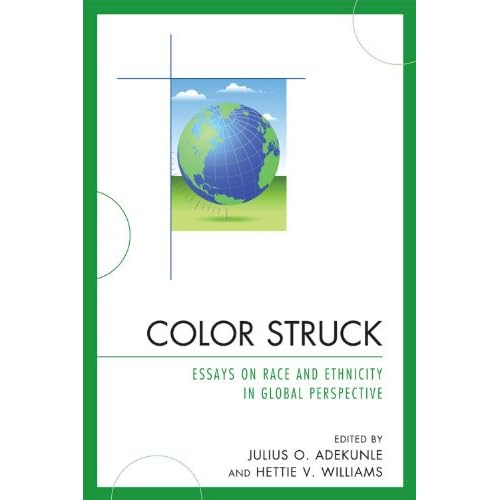
Color Struck: Essays on Race and Ethnicity in Global Perspective

Posted in Africa, Anthologies, Anthropology, Asian Diaspora, Books, Brazil, History, Identity Development/Psychology, Media Archive, Politics/Public Policy, Religion, Slavery, Social Science on 2010-10-24 14:10Z by Steven

Color Struck: Essays on Race and Ethnicity in Global Perspective

University Press of America
April 2010
516 pages
Paper ISBN: 0-7618-5064-3 / 978-0-7618-5064-9
Electronic ISBN: 0-7618-5092-9 / 978-0-7618-5092-2

Edited by

Julius O. Adekunle, Professor of History
Monmouth University, West Long Branch, New Jersey

Hettie V. Williams, Lecturer, African American History
Department of History and Anthropology
Monmouth University, West Long Branch, New Jersey

Color Struck: Essays of Race and Ethnicity in Global Perspective is a compilation of expositions on race and ethnicity, written from multiple disciplinary approaches including history, sociology, women’s studies, and anthropology. This book is organized around a topical, chronological framework and is divided into three sections, beginning with the earliest times to the contemporary world. The term “race” has nearly become synonymous with the word “ethnicity,” given the most recent findings in the study of human genetics that have led to the mapping of human DNA. Color Struck attempts to answer questions and provide scholarly insight into issues related to race and ethnicity.

Table of Contents

Preface
Acknowledgements
Introduction

Part 1: The First Complex Societies to Modern Times

1. Race, Science, and Human Origins in Africa
Julius O. Adekunle

2. Race and the Rise of the Swahili Culture
Julius O. Adekunle

3. ‘Caste’-[ing] Gender: Caste and Patriarchy in Ancient Hindu Jurisprudence
Indira Jalli

4. Comparative Race and Slavery in Islam, Judaism, and Christianity: Texts, Practices, and Current Implications
Magid Shihade

5. The Dark Craven Jew: Race and Religion in Medieval Europe
James M. Thomas

6. Growth of the Atlantic Slave Trade: Racial Slavery in the New World
Kwaku Osei Tutu

7. The Yellow Lady: Mulatto Women in the Suriname Plantocracy
Hilde Neus

Part 2: Race and Mixed Race in the Americas

8. Critical Mixed Race Studies: New Approaches to Resistance and Social Justice
Andrew Jolivétte

9. Militant Multiraciality: Rejecting Race and Rejecting the Conveniences of Complicity
Rainier Spencer

10. Whiteness Reconstructed: Multiracial Identity as a Category of “New White”
Kerry Ann Rockquemore and David L. Brunsma

11. Conversations in Black and White: The Limitations of Binary Thinking About Race in America
Johanna E. Foster

12. The Necessity of a Multiracial Category in a Race-Conscious Society
Francis Wardle

13. Mixed Race Terminologies in the Americas: Globalizing the Creole in the Twenty First Century
DeMond S. Miller, Jason D. Rivera, and Joel C. Telin

14. Examining the Regional and Multigenerational Context of Creole and American Indian Identity
Andrew Jolivétte

15. Race, Class, and Power: The Politics of Multiraciality in Brazil
G. Reginald Daniel and Gary L. Haddow

16. All Mixed Up: A New Racial Commonsense in Global Perspective
G. Reginald Daniel and Gary L. Haddow

Part 3: Race, Ethnicity, and Conflict in Contemporary Societies

17. Black No More: African Americans and the ‘New’ Race Science
Hettie V. Williams

18. Contesting Identities of Color: African Female Immigrants in the Americas
Philomina Okeke-Ihejirika

19. Burdened Intersections: Black Women and Race, Gender, and Class
Marsha J. Tyson Darling

20. Ethnic Conflicts in the Middle East: A Comparative Analysis of Communal Violence within the Matrix of the Colonial Legacy, Globalization, and Global Stability
Magid Shihade

21. Ethnic Identity in China: The Politics of Cultural Difference
Dru C. Gladney

22. Shangri-la has Forsaken Us: China’s Ethnic Minorities, Identity, and Government Repression
Reza Hasmath

23. The Russian/Chechen Conflict and It’s Consequences
Mariana Tepfenhart

Contributors
Index

Tags: , , , , , , , , , , , , , , , , , , , , , , , , , , , , , , , ,

Video From Angle Event Reopens Subject of Race

Posted in Articles, Media Archive, Politics/Public Policy, Social Science, United States on 2010-10-22 01:27Z by Steven

Video From Angle Event Reopens Subject of Race

New York Times
2010-10-19

Susan Saulny, National Correspondent

Louie Gong, a 36-year-old Seattle resident who is a mix of American Indian, white and Chinese, is often mistaken for Latino.

“Most people don’t look at me and say ‘Chinese,’ ” he said. “Then I tell them what my heritage is, and they argue with me, saying, ‘No, you look Hispanic.’ That’s offensive on a whole other level—it’s like their sensibility of racial aesthetics trumps my 36 years of life experience, and the fact that my last name is Gong.” …

…Further complicating the role of race is that a growing number of Americans are identifying themselves as racial mixtures that can be difficult to categorize based on looks alone. Beyond that, some members of minorities are pushing back against anyone who wants to tell them what race they are, then stereotype them, whether Asian or Latino or black or some combination.

“We are more complex than our phenotype,” said Mr. Gong, the past president of Mavin, an advocacy group for mixed-race families, and the co-founder of the Mixed Race Heritage Center, an information clearinghouse. “People have the right to self-identify in this country, on the census or in personal actions.”…

Read the entire article here.

Tags: , ,