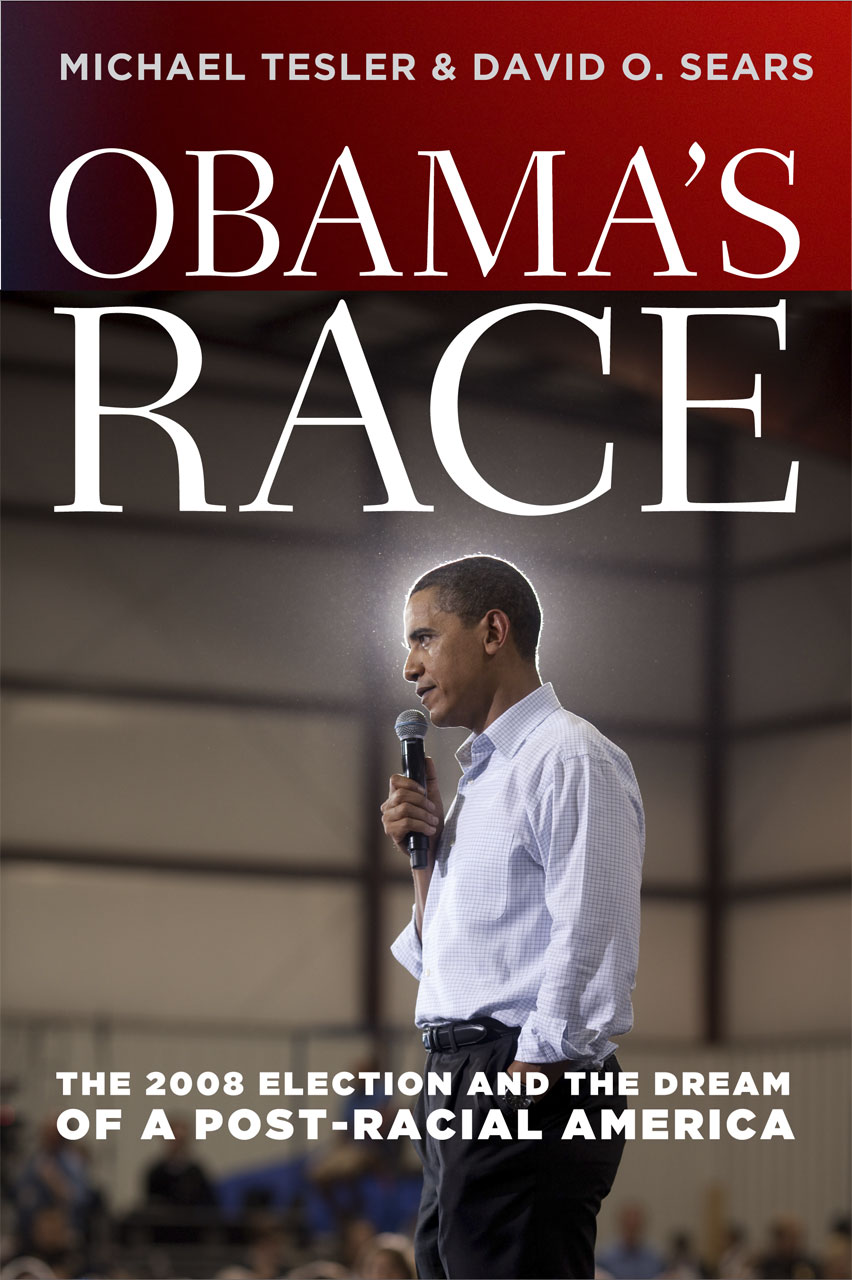
Obama’s Race: The 2008 Election and the Dream of a Post-Racial America

Posted in Barack Obama, Books, Media Archive, Monographs, Politics/Public Policy, United States on 2011-08-21 00:44Z by Steven

Obama’s Race: The 2008 Election and the Dream of a Post-Racial America

University of Chicago Press
2010
208 pages
37 line drawings, 7 tables
6 x 9
Cloth ISBN: 9780226793825; Paperback ISBN: 9780226793832; E-Book ISBN: 9780226793849

Michael Tesler, Doctoral Student in Political Science
University of California, Los Angeles

David O. Sears, Distinguished Professor of Psychology and Political Science
University of California, Los Angeles

Barack Obama’s presidential victory naturally led people to believe that the United States might finally be moving into a post-racial era. Obama’s Race—and its eye-opening account of the role played by race in the election—paints a dramatically different picture.

The authors argue that the 2008 election was more polarized by racial attitudes than any other presidential election on record—and perhaps more significantly, that there were two sides to this racialization: resentful opposition to and racially liberal support for Obama. As Obama’s campaign was given a boost in the primaries from racial liberals that extended well beyond that usually offered to ideologically similar white candidates, Hillary Clinton lost much of her longstanding support and instead became the preferred candidate of Democratic racial conservatives. Time and again, voters’ racial predispositions trumped their ideological preferences as John McCain—seldom described as conservative in matters of race—became the darling of racial conservatives from both parties. Hard-hitting and sure to be controversial, Obama’s Race will be both praised and criticized—but certainly not ignored.

Contents

  • Acknowledgments
  • Introduction: Obama as Post-Racial?
  • Chapter 1: Background: Race in Presidential Elections
  • Chapter 2: Racialized Momentum: The Two Sides of Racialization in the Primaries
  • Chapter 3: The General Election: The Two Sides of Racialization and Short-Term Political Dynamics
  • Chapter 4: The Spillover of Racialization
  • Chapter 5: The Racialized Voting Patterns of Racial and Ethnic Minorities
  • Chapter 6: The Paradox of Gender Traditionalists’ Support for Hillary Clinton
  • Chapter 7: Beyond Black and White: Obama as “Other”
  • Chapter 8: Is the Obama Presidency Post-Racial? Evidence from His First Year in Office
  • Appendix
  • Notes
  • References
  • Index
Tags: , , ,

Somewhere between Jim Crow & Post-Racialism: Reflections on the Racial Divide in America Today

Posted in Articles, Barack Obama, Census/Demographics, Media Archive, Politics/Public Policy, Social Science, United States on 2011-08-20 01:43Z by Steven

Somewhere between Jim Crow & Post-Racialism: Reflections on the Racial Divide in America Today

Dædalus, the Journal of the American Academy of Arts & Sciences
Volume 140, Number 2, Spring 2011, Race, Inequality & Culture, Volume 2
pages 11-36

Lawrence D. Bobo, W. E. B. Du Bois Professor of the Social Sciences
Harvard University

In assessing the results of the Negro revolution so far, it can be concluded that Negroes have established a foothsold, no more. We have written a Declaration of Independence, itself an accomplishment, but the effort to transform the words into a life experience still lies ahead.
Martin Luther King, Jr., Where Do We Go From Here? (1968)

By the middle of the twentieth century, the color line was as well defined and as firmly entrenched as any institution in the land. After all, it was older than most institutions, including the federal government itself. More important, it informed the content and shaped the lives of those institutions and the people who lived under them.
John Hope Franklin, The Color Line (1993)

This is where we are right now. It’s a racial stalemate we’ve been stuck in for years. Contrary to the claims of some of my critics, black and white, I have never been so naive as to believe that we can get beyond our racial divisions in a single election cycle, or with a single candidacy–particularly a candidacy as imperfect as my own.
Barack H. Obama, “A More Perfect Union” (May 18, 2008)

The year 1965 marked an important inflection point in the struggle for racial justice in the United States, underscoring two fundamental points about race in America. First, that racial inequality and division were not only Southern problems attached to Jim Crow segregation. Second, that the nature of those inequalities and divisions was a matter not merely of formal civil status and law, but also of deeply etched economic arrangements, social and political conditions, and cultural outlooks and practices. Viewed in full, the racial divide was a challenge of truly national reach, multilayered in its complexity and depth. Therefore, the achievement of basic citizenship rights in the South was a pivotal but far from exhaustive stage of the struggle…

…A second and no less controversial view of post-racialism takes the position that the level and pace of change in the demographic makeup and the identity choices and politics of Americans are rendering the traditional black-white divide irrelevant. Accordingly, Americans increasingly revere mixture and hybridity and are rushing to embrace a decidedly “beige” view of themselves and what is good for the body politic. Old-fashioned racial dichotomies pale against the surge toward flexible, deracialized, and mixed ethnoracial identities and outlooks.

A third, and perhaps the most controversial, view of post-racialism has the most in common with the well-rehearsed rhetoric of color blindness. To wit, American society, or at least a large and steadily growing fraction of it, has genuinely moved beyond race–so much so that we as a nation are now ready to transcend the disabling racial divisions of the past. From this perspective, nothing symbolizes better the moment of transcendence than Obama’s election as president. This transcendence is said to be especially true of a younger generation, what New Yorker editor David Remnick has referred to as “the Joshua Generation.” More than any other, this generation is ready to cross the great river of racial identity, division, and acrimony that has for so long defined American culture and politics…

…Consider first the matter of group boundaries. The 2000 Census broke new ground by allowing individuals to mark more than one box in designating racial background. Indeed, great political pressure and tumult led to the decision to move the Census in a direction that more formally and institutionally acknowledged the presence of increasing mixture and heterogeneity in the American population with regard to racial background. Nearly seven million people exercised that option in 2000. The successful rise of Obama to the office of president, the first African American to do so, as a child of a white American mother and a black Kenyan father, has only accelerated the sense of the newfound latitude and recognition granted to those who claim more than one racial heritage.

Despite Obama’s electoral success and the press attention given to the phenomenon, some will no doubt find it surprising that the overwhelming majority of Americans identify with only one race. As Figure 1 shows, less than 2 percent of the population marked more than one box on the 2000 Census in designating their racial background. Fully 98 percent marked just one. I claim no deep-rootedness or profound personal salience for these identities. Rather, my point is that we should be mindful that the level of “discussion” and contention around mixture is far out of proportion to the extent to which most Americans actually designate and see themselves in these terms. Moreover, even if we restrict attention to just those who marked more than one box, two-thirds of these respondents designated two groups other than blacks (namely, Hispanic-white, Asian-white, or Hispanic and Asian mixtures), as Figure 2 shows. Some degree of mixture with black constituted just under a third of mixed race identifiers in 2000. Given the historic size of the black population and the extended length of contact with white Americans, this remarkable result says something powerful about the potency and durability of the historic black-white divide.

It is worth recalling that sexual relations and childbearing across the racial divide are not recent phenomena. The 1890 U.S. Census contained categories for not only “Negro” but also “Mulatto,” “Quadroon,” and even “Octoroon”; these were clear signs of the extent of “mixing” that had taken place in the United States. Indeed, well over one million individuals fell into one of the mixed race categories at that time. In order to protect the institution of slavery and to prevent the offspring of white slave masters and exploited black slave women from having a claim on freedom as well as on the property of the master, slave status, as defined by law, followed the mother’s status, not the father’s. For most of its history, the United States legally barred or discouraged racial mixing and intermarriage. At the time of the Loving v. Virginia case in 1967, seventeen states still banned racial intermarriage…

…Does that pressure for change foretell the ultimate undoing of the black-white divide? At least three lines of research raise doubts about such a forecast. First, studies of the perceptions of and identities among those of mixed racial backgrounds point to strong evidence of the cultural persistence of the one-drop rule. Systematic experiments by sociologists and social psychologists are intriguing in this regard. For example, sociologist Melissa Herman’s recent research concluded that “others’ perceptions shape a person’s identity and social understandings of race. My study found that partblack multiracial youth are more likely to be seen as black by observers and to define themselves as black when forced to choose one race.”…

…Third, some key synthetic works argue for an evolving racial scheme in the United States, but a scheme that nonetheless preserves a heavily stigmatized black category. A decade ago, sociologist Herbert Gans offered the provocative but wellgrounded speculation that the United States would witness a transition from a society defined by a great white–nonwhite divide to one increasingly defined by a black–non-black fissure, with an in-between or residual category for those granted provisional or “honorary white” status. As Gans explained: “If current trends persist, today’s multiracial hierarchy could be replaced by what I think of as a dual or bimodal one consisting of ‘nonblack’ and ‘black’ population categories, with a third ‘residual’ category for the groups that do not, or do not yet, fit into the basic dualism.” Most troubling, this new dualism would, in Gans’s expectations, continue to bring a profound sense of undeservingness and stigma for those assigned its bottom rung.

Gans’s remarks have recently received substantial support from demographer Frank Bean and his colleagues. Based on their extensive analyses of population trends across a variety of indicators, Bean and colleagues write: “A black-nonblack divide appears to be taking shape in the United States, in which Asians and Latinos are closer to whites. Hence, America’s color lines are moving toward a new demarcation that places many blacks in a position of disadvantage similar to that resulting from the traditional black-white divide.”…

Read the entire article here.
Tags: , ,

Race in America: Restructuring Inequality: Intergroup Race Relation

Posted in Barack Obama, Census/Demographics, Media Archive, Politics/Public Policy, Reports, Social Science, United States on 2011-08-20 00:20Z by Steven

Race in America: Restructuring Inequality: Intergroup Race Relation

Center on Race & Social Problems
School of Social Work
The University of Pittsburgh
2010
29 pages

Editors:

Larry E. Davis, Dean and Donald M. Henderson Professor of Social Work and Director of the Center on Race and Social Problems
University of Pittsburgh

Ralph Bangs, Associate Director
Center on Race and Social Problems
University of Pittsburgh

The Third of Seven Reports on the Race in America Conference (June 3-6, 2010)

Despite significant progress in America’s stride toward racial equality, there remains much to be done. Some problems are worse today than they were during the turbulent times of the 1960s. Indeed, racial disparities across a number of areas are blatant—family formation, employment levels, community violence, incarceration rates, educational attainment, and health and mental health outcomes.

As part of an attempt to redress these race-related problems, the University of Pittsburgh School of Social Work and Center on Race and Social Problems organized the conference Race in America: Restructuring Inequality, which was held at the University of Pittsburgh June 3–6, 2010. The goal of the conference was to promote greater racial equality for all Americans. As our entire society has struggled to recover from a major economic crisis, we believed it was an ideal time to restructure existing systems rather than merely rebuilding them as they once were. Our present crisis afforded us the opportunity to start anew to produce a society that promotes greater equality of life outcomes for all of its citizens.

The conference had two parts: 20 daytime sessions for registered attendees and three free public evening events. The daytime conference sessions had seven foci: economics, education, criminal justice, race relations, health, mental health, and families/youth/elderly. Each session consisted of a 45-minute presentation by two national experts followed by one hour of questions and comments by the audience. The evening events consisted of an opening lecture by Julian Bond, a lecture on economics by Julianne Malveaux, and a panel discussion on postracial America hosted by Alex Castellanos of CNN.

This report provides access to the extensive and detailed information disseminated during the intergroup race relations sessions at the conference. This information will be particularly helpful to community and policy leaders interested in gaining a better understanding of race relations and finding effective strategies for improving these conditions.

Table of Contents

  • Introduction
  • In the Mix: Multiracial Demographics and Social Definitions of Race
  • Coming Together: Promoting Harmony among Racial Groups
    • Obama and the Durable Racialization of American Politics Lawrence D. Bobo
    • Somewhere Over the Rainbow?: Postracial and Panracial Politics in the Age of Obama Taeku Lee
  • The White Way?: Discussing Racial Privilege and White Advantage
    • Where and Why Whites Still Do Blatant Racism: White Racist Actions and Framing in the Backstage and Frontstage Joe Feagin
    • The Future of White Privilege in Post-Race, Post-Civil Rights, Colorblind America Charles Gallagher

Race: Changing Composition, Changing Definition

Presenter: Howard Hogan, Associate Director for Demographic Programs, U.S. Census Bureau

Moderator: Pat Chew, Professor of Law, University of Pittsburgh

America’s categorization of race is more of a definition of how America chooses to see individuals and less the result of how people categorize themselves. Our concept of race in the United States has evolved over the country’s history. In America’s first census in 1790, the country viewed itself racially as comprising only three groups: Whites, slaves, and others. American Indians were not identified as a distinct group for this census. As immigration increased, our racial composition changed rapidly, and it was for this reason that in 1850 and 1860, the United States felt that it was necessary to gather information on the birthplaces of individuals. The term “Black” was first used as a census race category in the census of 1850, and the term “Negro” did not appear as a census race category until 1930…

…The concept of race and identification of racial origin continue to serve a role in the United States with regard to monitoring and enforcing civil rights legislation for employment, educational opportunities, and housing. It was for this reason the U.S. Supreme Court, in the 1980s, declared Judaism to be a race for purposes of antidiscrimination. Data on race also are used to study changes in the social, economic, and demographic characteristics and changes in our population. But there is no reason to assume that it will get easier for OMB and the U.S. Census Bureau to make the kind of distinctions they need to be able to collect this information…

Obama and the Durable Racialization of American Politics

Presenter: Lawrence D. Bobo, W.E.B. Du Bois Professor of the Social Sciences, Harvard University

Moderator: Lu-in Wang, Associate Dean for Academic Affairs and Professor of Law, University of Pittsburgh

There are some in American society who are unable to assess issues of racial discord because they accept the concept that the United States has become a postracial nation. There are others who consider postracialism to be a politically neutralizing falsehood that veils how the racial divide is constructed and maintained in American society. The prevalence of racial dissonance has waned over time in comparison to the racial conflicts America faced in the past. However, in order for this recuperation to continue, American society has to be forthright about current race relations conditions and open to developing new ways to improve relations in the future. The United States has adopted a new contemporary form of racism, because the blatant Jim Crow discrimination of years past is not as socially acceptable. The characteristics of this contemporary form, called laissez-faire racism, are the widespread and consequential harboring of negative stereotypes and the collective racial resentment of African Americans. Laissez-faire racism is very prevalent in today’s society despite the belief by many that the United States has transitioned into postracialism, spearheaded by Barack Obama’s presidential election. However, the majority of White voters chose not to vote for Barack Obama for president. An overwhelming majority of minority voters chose to vote for him.

There are several reasons why America has not reached the point where the color line between Blacks and Whites has become blurred beyond recognition. First, only 14.6 percent of U.S. marriages in 2008 were between spouses of a different race or ethnicity, and only 11 percent of these mixed marriages were White-Black. Second, only 7 million (2 percent) of the U.S. population in 2000 marked more than one race on the census. One-quarter of these were Black. Third, Black-White wealth gaps have grown, even among educated Blacks.

In order to relieve some of the racial discord in society, progressive dialogue on the current realities of race relations in the United States is needed, as well as structural and cultural change…

…The anti-Black cultural project of “erasing Blackness” has not destabilized the core racial binary. Although many believe that miscegenation—the mixing of races through marriage, cohabitation, sexual relations, and procreation—an overwhelming majority of Whites, Blacks, Hispanics, and Asians still marry within their racial group.

Miscegenation

Many Americans buy into the notion that miscegenation is causing the end of the Black and White races and that eventually the color line between Whites and Blacks will become blurred beyond recognition. The data show:

  • African Americans are the least likely of all races to marry Whites.
  • Although the pace of interracial marriage increased more rapidly in the 1990s than it did in other periods, the social boundaries between Blacks and Whites remained highly rigid and resistant to change.
  • Although interracial marriages have increased greatly in recent years, they still only account for 15 percent of marriages in the U.S.
  • Only 7 million Americans (2 percent) identified more than one race when given the option to do so on the 2000 Census. Of those 7 million, one-quarter identified having any mixture with African Americans.
  • Biracial African American-White individuals have historically identified themselves as Black and typically married other African
    Americans…

Read the entire report here.

Tags: , , , , , , , , , , , , , , ,

Science must not invent new myths about race

Posted in Articles, Health/Medicine/Genetics, Media Archive, Politics/Public Policy, Social Science, United Kingdom on 2011-08-19 22:38Z by Steven

Science must not invent new myths about race

London Evening Standard
2009-11-16

Lindsay Johns

Science and race have never been easy bedfellows. Since Victorian times, when Western scientific advancement was used as an intellectual and moral justification for European colonial expansion, science or pseudo-science has occupied an uncomfortable place in our understanding of race.

Yet today, as Professor Steve Jones will argue at a debate tonight, it is commonly held by scientists that, genetically, there is no such thing as race.

It has been proven that there is a negligible amount of difference between the DNA of different “races”. Rather, race is a social construct, a fluid and malleable entity.

In America, the “one drop” rule of black blood still effectively renders anyone with any in them, even if they are quite light skinned, as “black”.

Elsewhere, race being such a nebulous entity, it can often be confusing. For example, many mixed-race people, myself included, are often mistaken for Arabs…

…Yet it would be naive to deny that race, although biologically inconsequential, is still very much a social reality.

Many social and economic disparities still arise from it: people use race to define themselves.

Scientists of all backgrounds have a duty to interpret data responsibly: their pronouncements on race have ethical, legal and social implications…

Read the entire article here.

Tags: , ,

For black Britons, this is not the 80s revisited. It’s worse

Posted in Articles, Law, Media Archive, Politics/Public Policy, Social Science, United Kingdom on 2011-08-15 03:04Z by Steven

For black Britons, this is not the 80s revisited. It’s worse

The Guardian
2011-08-11

Joseph Harker, Assistant Comment Editor

Our MPs are ‘on message’, our media in decline and the Commission for Racial Equality abolished. Who speaks for us?

This is not 1981. Nor 1985. As has been pointed out over the past few days, things have changed a lot since the “inner-city unrest”—as it was quaintly named back then—erupted in Brixton, Tottenham, Toxteth, Handsworth and other parts of Britain.

But with each passing day, the old maxim, “The more things change, the more they stay the same”, has increasing relevance. In the 80s, as now, rioting was sparked by a confrontation between black people and the police and spread to the rest of the country, including to “white” areas. In 1981, the Conservative prime minister dismissed suggestions that the Brixton riot was due to unemployment and racism. Time proved that she was badly wrong. But fast forward three decades, and David Cameron tells the House of Commons that this week’s rioting was “criminality, pure and simple”.

In the years up to 1981, tension had been building between black people and the police over the “sus” laws, which gave officers powers to arrest anyone they suspected may be intending to steal. For them, a black youngster glancing at a handbag was enough. After Brixton, this law was repealed. Today, however, black people are seven times more likely than white people to be stopped and searched. And under the 1994 Criminal Justice and Public Order Act—which allows police to search anyone in a designated area without specific grounds for suspicion—the racial discrepancy rises to 26 times. This is symptomatic of the many ways in which, for black Britons, life seemingly improved but has steadily descended again…

…Over the last three decades we’ve allowed ourselves to be fooled that, with greater integration, plus a few black faces in sport and entertainment, things have improved. People gush about the growing mixed-race population, supposedly Britain’s “beautiful” future. Well, Mark Duggan had a white parent but it didn’t make much difference to his prospects…

Read the entire article here.

Tags: ,

Texas bucks U.S. trend on standardized scoring

Posted in Articles, Campus Life, Media Archive, Politics/Public Policy, Texas, United States on 2011-08-09 04:10Z by Steven

Texas bucks U.S. trend on standardized scoring

Houston Chronicle
2011-07-25

Jennifer Radcliffe
 
It will tally multiracial students but not report their scores separately

Multiracial students are being tallied for the first time in Texas history, but their standardized test scores won’t appear as a separate group when accountability ratings are released Friday.

As it grapples with increasing diversity, Texas has opted not to measure the scores of the state’s 78,419 multiracial, non-Hispanic students as an ethnic subgroup whose performance matters in determining whether a school made “adequate yearly progress.”
 
Instead, they’ll join the ranks of the 180,000 Asian students lumped in with their schools’ entire student body for accountability purposes…

…Some scores moved
 
As Texas transitions to the new categories this year, state officials have opted to return some multiracial students’ scores to their previous category, if records indicate that the student was originally listed as white or African American. Their scores will only count in that previous category if they improve the school’s rating…

Read the entire article here.

Tags: , ,

Being counted is crucial in the U.S…

Posted in Census/Demographics, Media Archive, Politics/Public Policy, Social Science, United States on 2011-08-08 21:54Z by Steven

My academic research is on racial categories in national censuses.  When I first started reading about the push to get a “mixed-race” category on the U.S. census in the 1990s, I was absolutely on the side of the multiracial movement. I thought the census should recognize our identities, no matter how complicated they may be.  Then I kept reading and realized that the multiracial activists were only concerned with recognition and didn’t care that it potentially came at the expense of civil rights agendas.  Being counted is crucial in the U.S.—and elsewhere. It is linked to money, political power, grassroots mobilization and even community cohesion.  Having a separate mixed-race category threatened all that—and the hard-fought victories of the civil rights movement.  The multiracial organizations that testified before Congress in the 1990s were mostly white mothers of multiracial children who did not want their children to have to choose one race over another.  But they failed to recognize what else was at stake—though the census was once an instrument used to manage and control racial populations, it now has a political power that racial minorities can access and use to advance their claims. The entire U.S. civil rights regime rests on the idea of discrete racial categories. One group’s recognition could lead to another’s oppression.  But the mixed-race activists didn’t care—they went on to argue (unsuccessfully) for their cause and even struck alliances with Republicans, including Newt Gingrich, whose ten steps for better race relations in the U.S. included adding a multiracial category to the census and doing away with affirmative action.

Debra Thompson, “The language and the Ethics of Mixed Race,” In Other Tongues: Mixed-Race Women Speak Out, edited by Adebe De Rango-Adem and Andrea Thompson (Toronto: Inanna Publications, 2010), 267.

Tags:

Mixed Messages: Barack Obama and Post-Racial Politics

Posted in Articles, Barack Obama, Literary/Artistic Criticism, Media Archive, Politics/Public Policy, Social Science, United States on 2011-08-07 21:40Z by Steven

Mixed Messages: Barack Obama and Post-Racial Politics

Spectator (Journal of the University of Southern California’s School of Cinematics Arts)
Volume 30, Number 2 (Fall 2010)
pages 9-17

Marcia Alesan Dawkins, Visiting Scholar
Brown University

The election of President Barack Hussein Obama marks an important milestone in United States racial politics. Many cultural critics and opinion leaders argue that Obama’s popularity and position represent post-racial accomplishments for the nation.

In this article I argue that post-racial politics, the ideology that race and/or racism is dead, ignores the salient fact that we continue to live in a society deeply influenced by race, with material consequences that affect life chances. I support this argument through an examination of Obama’s racial rhetoric in the address of March 18, 2008 “A More Perfect Union.” Through Obama’s uses of mixed race identity, the speech acknowledges the actual history of racial injustice and the ideal future of racial reconciliation through frank deliberation and political intervention, and thus serves as a prologue to racial dialogue rather than a post-racial epilogue or monologue.

The 21st century has ushered in a set of paradigm shifts that are responding to changes in technology, economics, politics, cultural flows, and narratives of identification. From the advent of social media, to the Great Recession, to health care reform, to the revised racial categories on the U.S. Census, American lives are faced with increasing tensions and ambiguities. No single icon reflects these tensions and ambiguities, and the paradigm shifts they are inspiring, more cohesively than President Barack Obama.

Some critics argue that Obamas election to the Presidency and status as global “supercelebrity” are signs that we have entered a post-racial moment in which everyone and everything is mixed. “Watching Obama campaign with his African American wife, his Indonesian-Caucasian half-sister, his Chinese-Canadian brother-in-law…all of their children,” not to mention the memories of his Kenyan father and white American mother and grandparents from Kansas, is evidence of this mixed, and ultimately post-, racial moment. Census statistics support this view, revealing that the population of multiracial children in the United States has soared from approximately 500,000 in 1970 to more than 6.8 million in 2000, and that they are happier than their mono-racial counterparts.

As a result of this mixing, many now question the existence of racial prejudice and discrimination writ large. In a recent interview with CNNs John King, President Obama was asked about the role he thinks race and racism play in his political reception. The President suggested that while racism exists, it lives more so in our imaginations than our intentions. If post-racial proponents are interpreting Obamas words and images correctly, then we may be on the verge of entering an era in which discriminatory racial barriers, partisan emotions and divisiveness have been dismantled. Put bluntly, in post-racial America, racism will be dead. If post-racial proponents are incorrect, then our dream of a post-racial America is a myth that both constrains and contains an ongoing drama concerning multiracialism, identity, and Obamas ability to change national public policy. In either case Obama is, as Peggy Orenstein claims, our emblematic “mixed messenger.” In the pages that follow I will engage post-racial politics by asking and answering three questions: What does post-race mean? How does Obamas racial rhetoric address a post-race perspective? And, what are the implications of Obama’s iconic racial status for U.S. racial politics?…

…In this article I argue that post-racial politics, the ideology that race and/or racism is dead, ignores the salient fact that we continue to live in a society deeply influenced by race, with material consequences that affect life chances. I support this argument through an examination of Barack Obamas racial rhetoric in his address of March 18, 2008—”A More Perfect Union”—perhaps the most climactic moment of his first Presidential campaign…

…In addition, those of African ancestry were the subjects of pseudo-scientific racist studies concluding they were soulless beasts, a threat to civilization itself, a drain on the economy, and a generally cursed people. These sinister images became the basis for a biological theory known as “hybrid degeneracy,” which claimed that mixed race people were emotionally unstable, irrational, recalcitrant, and sterile. According to Robyn Wiegman, this theory became a biological fact in Western discourse based on pseudo-scientific observation and comparative anatomy, especially of the brain, skull, and reproductive organs. As a result of these sociological and pseudo-scientific findings, white/European Americans were instructed to dissociate from African Americans in social life in order to maintain their purity. It is therefore unsurprising that blacks and whites who dared to cross the color line in any way, whether to attend school, vote, or mix with one another romantically, were the subjects of torture and abuse. Such physical and juridical policing of the color line is why the study of mixed race identification remains important to any discussion of racial and post-racial politics. Moreover, those of mixed race who passed as either white or black demonstrated that the color line promoted suffering on both sides and in the spaces in-between, making it at the same time all too real and extremely unstable…

Read the entire article here.

Tags: , , ,

The historical politics of the New Zealand half-caste

Posted in Articles, History, Literary/Artistic Criticism, Media Archive, Oceania, Politics/Public Policy on 2011-08-06 22:36Z by Steven

The historical politics of the New Zealand half-caste

MAI Review
Issue 3 (2008)
Article 7
ISSN 1177-5904
11 pages

Gina M. Colvin-McCluskey

The archives of settler journalism provides us with a rich resource for engaging with some of the ‘raced’ discourses in circulation at the commencement of Britain’s colonial project in Āotearoa/New Zealand. From these early literary resources we find chronicled in the settler press evidence of a complex, contradictory and largely imagined relationship with the ‘Natives’. As the colonist confronted the ‘Native’ and authored the encounter in the settler media, he was at the same time working through social hierarchies, resource entitlements, political institutions and the face of a burgeoning indigenous contest.

The Euronesians is a single newspaper article which appeared in 1843 in an Auckland newspaper, The Daily Southern Cross, established in the same year. This article has been analysed using a critical discourse methodology in order to understand the way in which seemingly munificent articles, that appear superficially, at least, to demonstrate a generous disposition toward the ‘Native’, are at the same time wedded to Britain’s colonising project, and work to justify, excuse, and accommodate a hegemonic white presence. At the core of critical discourse methodologies therefore is a desire to understand how language works to normalise social, economic and political domination. The discourse analyst’s methodological tool kit is therefore a set of key questions that are asked of the text. What is the background to the text? What does it say at its surface? What patterns of meaning do we find and what political work is the text doing? What is silenced? Are the patterns of meaning consistent over time? This paper addresses these questions.

An analysis of the text demonstrates that the apparent display of generosity toward those children of mixed racial parentage (Pākehā and Māori) is in fact demonstrative of a complex relationship between the seemingly contradictory discourses of cultural benevolence and appropriation. As will be demonstrated, the appearance of goodwill and concern for the ‘half-caste’, in this article, retreats into a rationale for demonstrating the untenable nature of certain obligations, protection and rights afforded to the Treaty of Waitangi signatories, which effectively precluded the colonist from the purchase of Native lands. The article ‘The Euronesians” is partially reproduced along with the punctuation and editing used in the original publication. The use of ‘native’ using the lower case was standard form of the day.

THE EURONESIANS, Or the Children of European and Native Parents.
Daily Southern Cross
Volume I, Issue 23, (23 September 1843)
Page 2

We have advocated the rights of the European and Native, frequently and fully. We have treated of the effects of British Government, as far as the present and prospective circumstances of both are concerned, but there is another, and a very important portion of our community whose interests we have always had in view, although we have not had an opportunity until now of bringing their case prominently before the public. A class of persons, who appear to have been entirely subjects of treaties and of laws; the privileges of the former have been attempted to be limited and prescribed, and the rights of the latter have been usurped and violated, but there is a class of persons who cannot be affected in their rights, either by the treaty of Waitangi, or the Land Claims Bill. We allude to the descendants of European fathers, and Maorie mothers, commonly called “half casts.” These persons are in many instances, the children of misfortune, and as such, are too often neglected and despised; but they are still our, fellow-creatures, and entitled, under the laws and dispensations of the God of nature, to an equal interest, and an equal participation in the soil on which he has planted them…

Read the entire article here.

Tags: , , ,

Debate: Are the Americas ‘sick with racism’ or is it a problem at the poles? A reply to Christina A. Sue

Posted in Articles, Barack Obama, Caribbean/Latin America, Latino Studies, Media Archive, Politics/Public Policy, Social Science, United States on 2011-07-31 21:19Z by Steven

Debate: Are the Americas ‘sick with racism’ or is it a problem at the poles? A reply to Christina A. Sue

Ethnic and Racial Studies
Volume 32, Issue 6 (July 2009)
Special Issue: Making Latino/a Identities in Contemporary America
pages 1071-1082
DOI: 10.1080/01419870902883536

Eduardo Bonilla-Silva, Professor of Sociology
Duke University

Christina A. Sue commented on my 2004 article in Ethnic and Racial Studies on the Latin Americanization of racial stratification in the USA. Almost all her observations hinge on the assumption that racial stratification in Latin American countries is fundamentally structured around ‘two racial poles’. I disagree with her and in my reply do three things. First, I address three major claims or issues in her comment. Second, I point out some methodological limitations of Americancentred race analysis in Latin America. Third, I conclude by discussing briefly the Obama phenomenon and suggest this event fits in many ways my Latin Americanization thesis.

The Americas are sick with racism, blind in both eyes from North to South.
(Eduardo Galeano 2000, p. 56)

Since I unveiled my Latin Americanization thesis in 2001, I have received plenty of critical feedback  some negative, but mostly positive. Accordingly, I welcome Christina Sue’s comment. Although we see race matters in both Americas quite differently  I believe the Americas are ‘sick with racism’ and Sue seems to believe racism is a problem at the ‘racial poles’  our exchange may stimulate further debate about the racial question in Latin America and the USA.

In this rejoinder I do three things. First, I address some of Sue’s criticisms. Second, I advance several methodological observations orthogonally related to Sue’s comments. Third, I briefly tackle the big elephant in the contemporary American racial room (the election of a black man as president) and suggest it fits my Latin Americanization thesis…

…First, Obama, like most politicians in the Americas, worked hard during the campaign at making a nationalist, post-racial appeal. Second, like some racially mixed leaders in the Americas, Obama was keen to signify the peculiar character of his ‘blackness’ (his half-white, half-black background) and the provenance of his blackness (his father hailed from Kenya and in the USA African blackness is perceived as less threatening). Obama has cultivated an outlook where his ‘blackness’ is more about style than political substance; Obama is the ‘cool’, exceptional black man not likely to rock the American racial boat. Third, Obama has exhibited an accommodationist stand on race (Street 2009). In a speech in Selma, Alabama, he stated the USA was ‘90% on the road to racial equality’ (Obama 2007) and continued this path in his so-called ‘race speech’ (Obama 2008). Fourth, whites see Obama as a ‘safe black’ who, unlike traditional black politicians, will not advocate race-based social policy. Fifth, Obama will formulate ‘universal’ (class-based) policies that are unlikely to remedy racial inequality (Obama 2004). Sixth, his election, in conjunction with other developments in the last decades, evinces the ascendance to political power (with a small ‘p’) of ‘neo-mulattos’ (Horton and Sykes 2004), will exacerbate the existing colour-class divide within the black community, and reinforce ‘multiculturalist white supremacy’ (Rodríguez 2008)…

Read the entire article here.

Tags: , , , ,