Talking Race w/ Social Critic/Legal Scholar Dorothy Roberts

Posted in Audio, Health/Medicine/Genetics, Interviews, Media Archive, Politics/Public Policy on 2011-12-27 01:30Z by Steven

Talking Race w/ Social Critic/Legal Scholar Dorothy Roberts

Blogtalk Radio
Tuesday, 2011-10-11

Michelle McCrary, Host
Is That Your Child?

Dorothy Roberts, George A. Weiss University Professor of Law and Sociology; Raymond Pace and Sadie Tanner Mossell Alexander Professor of Civil Rights
University of Pennsylvania

ITYC is honored to welcome leading legal scholar and social critic Dorothy Roberts to the podcast. Author of the over 75 articles and essays in books and scholarly journals, including Harvard Law Review, Yale Law Journal, and Stanford Law Review, Robert’s latest work Fatal Invention: How Science, Politics, and Business Re-create Race in the Twenty-First Century, is an eye-opening look at the way race continues to be reproduced and legitimized in our society.

Roberts is the Kirkland & Ellis Professor at Northwestern University School of Law and a faculty fellow at the Institute for Policy Research. She is also the author of Killing the Black Body and Shattered Bonds and has received fellowships and grants from the National Science Foundation, Searle Fund, Fulbright Scholars Program, Harvard University Program in Ethics and the Professions, and Stanford Center for Comparative Studies in Race and Ethnicity.

..this was a book that really, completely, changed and challenged everything that I knew and I thought I knew about race. And I thank you for that, because it’s just one of those books that really, really kind of changes your life in a way because it sort of opens things up and makes you think about the world a completely different way, it’s a really powerful book.

Download the interview here (01:17:41).

Tags: ,

Check One Box: Reconsidering Directive No. 15 and the Classification of Mixed-Race People

Posted in Articles, Census/Demographics, Law, Media Archive, Politics/Public Policy, United States on 2011-12-26 02:38Z by Steven

Check One Box: Reconsidering Directive No. 15 and the Classification of Mixed-Race People

California Law Review
Volume 84, Number 4 (July, 1996)
pages 1233-1291

Kenneth E. Payson

Introduction

“What are you?” As the child of a Japanese mother and a White father, I have often been asked this question. While I am also male, heterosexual, law student, spouse, sibling, and child, this query is usually directed at my racial identity. As a mixed-race person, I am part of an ill-defined, amorphous group of persons who are increasingly becoming the subject of private and public scrutiny. As one commentator quipped, one “cannot turn on ‘Oprah’ without seeing a segment on multiraciality…” The simple question “What are you?” illustrates the fundamental role race plays in defining our relationships with others. When faced with ambiguous morphology, we seek clarification of another’s racial identity so that we may begin defining our…

Read the entire article here.

Tags: , ,

The Persistence of the Color Line: Racial Politics and the Obama Presidency

Posted in Barack Obama, Books, Media Archive, Monographs, Politics/Public Policy, Social Science, United States on 2011-12-24 18:20Z by Steven

The Persistence of the Color Line: Racial Politics and the Obama Presidency

Random House, Inc.
2011-08-16
336 pages
Hardback ISBN: 978-0-307-37789-0
Paperback ISBN: 978-0-307-45555-0

Randall Kennedy, Michael R. Klein Professor of Law
Harvard Law School

Timely—as the 2012 presidential election nears—and controversial, here is the first book by a major African-American public intellectual on racial politics and the Obama presidency.
 
Renowned for his cool reason vis-à-vis the pitfalls and clichés of racial discourse, Randall Kennedy—Harvard professor of law and author of the New York Times best seller Nigger: The Strange Career of a Troublesome Word—gives us a keen and shrewd analysis of the complex relationship between the first black president and his African-American constituency.
 
Kennedy tackles such hot-button issues as the nature of racial opposition to Obama, whether Obama has a singular responsibility to African Americans, electoral politics and cultural chauvinism, black patriotism, the differences in Obama’s presentation of himself to blacks and to whites, the challenges posed by the dream of a postracial society, and the far-from-simple symbolism of Obama as a leader of the Joshua generation in a country that has elected only three black senators and two black governors in its entire history.
 
Eschewing the critical excesses of both the left and the right, Kennedy offers a gimlet-eyed view of Obama’s triumphs and travails, his strengths and weaknesses, as they pertain to the troubled history of race in America.

Read an excerpt here.

Table of Contents

  • Introduction
  • 1. The Obama Inaugural
  • 2. Obama Courts Black America
  • 3. Obama and White America: “Why Can’t They All Be Like Him?”
  • 4. The Race Card in the Campaign of 2008
  • 5. Reverend Wright and My Father: Reflections on Blacks and Patriotism
  • 6. The Racial Politics of the Sotomayor Confi rmation
  • 7. Addressing Race “the Obama Way”
  • 8. Obama and the Future of American Race Relations
  • Tags: ,

    Student reflection on the Luther Lecture

    Posted in Articles, Asian Diaspora, Canada, History, Identity Development/Psychology, Media Archive, Native Americans/First Nation, Politics/Public Policy, Women on 2011-12-22 19:29Z by Steven

    Student reflection on the Luther Lecture

    Impetus
    Luther College at the University of Regina, Saskatchewan, Canada
    Fall 2011

    Jenna Tickell

    Senator Lillian Eva Dyck was the 36th Annual Luther Lecturer.  Senator Dyck presented her personal story in relation to the issues of racism and sexism in Canada.  She began with power-point statistics and ended with a standing ovation from the audience.  Her main point pertaining to statistics was to indicate the reality that statistics can be manipulated in various ways, so we must be cautious of what we take as fact from presumably unbiased numbers.  When looking at statistics, Senator Dyck reminded us not to get overwhelmed with the notion that maybe some race and gender issues are too big to tackle; for one, because statistics can be manipulated in various ways and truth from numbers is always subjective, and two, that the positive changes that have occurred in Canada regarding gender and race equality should be used to empower us to take the next step.  When Senator Dyck began her personal life story, her lecture really blossomed for me.  Through telling her life story, she reinforced what I had learned through my university studies while also educating me on a piece of Canadian history that I had not heard before.  As a Métis woman and as a university student, the value of guest lectures such as this is immense; she educated me regarding her personal history while at the same time empowered my activism and sense of self-discovery.              
     
    Senator Dyck comes from a “mixed” racial family; her mother is Cree and her father is Chinese.  Her mother grew up on a reserve where abuse was high and poverty was extreme because of colonialist policies and laws.  During the same time period, there was considerable immigration from China, as workers were first needed to build the railway and then were left to find employment, often resulting in local Chinese cafes scattered throughout the small prairie towns in Saskatchewan.  Due to restrictive immigration policies, Chinese men were forced to leave their families behind but hoped that one day they would have the financial means to bring them to Canada. Unfortunately, immigration laws became even more restrictive, and this created an interesting phenomenon called the Chinese bachelors.  The government allowed their entrepreneurial efforts, but implemented a rule stating that Chinese men could not hire white women to work for them.  Chinese men needed waitresses for their small restaurants and since they could not hire white women it opened the opportunity for Aboriginal women to work with and meet Chinese men.  Thus, the racist laws actually facilitated “mixed” marriages between Chinese men and Aboriginal women within Saskatchewan…

    Read the entire article here.

    Tags: , , , , ,

    When It Counts—More On Obama and the Census

    Posted in Barack Obama, Census/Demographics, Identity Development/Psychology, Media Archive, Politics/Public Policy, Religion, United States on 2011-12-20 05:36Z by Steven

    When It Counts—More On Obama and the Census

    InterfaithFamiliy.com
    2010-05-03

    Ruth Abrams

    Elizabeth Chang wrote in an op-ed in the Washington Post last week, “Why Obama should not have checked ‘black’ on his census form,”

    Although I knew Obama self-identifies as African American, I was disappointed when I read that that’s what he checked on his census form. The federal government, finally heeding the desires of multiracial people to be able to accurately define themselves, had changed the rules in 2000, so he could have also checked white. Or he could have checked “some other race.” Instead, Obama went with black alone.

    I understand why Chang wrote this, and even though I’m mostly on the same page with her about a lot of this, I think she’s wrong.

    Chang identifies as the mother of biracial children in an interfaith family, and as someone raising biracial Jewish children. The whole Jewish community is behind her in wanting her children to be able identify as more than one thing. Jewish and Chinese and Hawaiian? Beautiful, we are so on board with that.

    But on the other hand, I think there is something to Chang’s phrase, “when it counts, he is black.” When it counts, stand up for the people who need you. Based on his experiences, Obama judged this was the time to count as an African American. I read the piece in Newsweek last September on the work ahead of parents who want to raise anti-racist children. Parenting “colorblind”—pretending that racism doesn’t exist and that people aren’t different—doesn’t make racism go away or make your children accept difference. In fact it demonstrably does the opposite…

    Read the entire article here.

    Tags: ,

    TV Review: Mixed Race Britain – Mixed Britannia

    Posted in Articles, Health/Medicine/Genetics, History, Identity Development/Psychology, Interviews, Law, Media Archive, Politics/Public Policy, Social Science, Social Work, United Kingdom, Videos on 2011-12-15 03:24Z by Steven

    TV Review: Mixed Race Britain – Mixed Britannia

    BioNews
    Number 630 (2011-10-24)

    Anoushka Shepherd

    Mixed Race Britain: Mixed Britannia, BBC2, 6-20 October 2011, Presented by George Alagiah

    I am mixed race, and thereby a member the fastest growing ethnic minority in the UK. My British dad met my Sri Lankan mum while travelling in the 1970s. They married and settled in Manchester where I grew up. And although I was definitely alive to the fact that their marriage was a joining of two very different cultures, I had no idea of the deep and contentious history of mixed relationships in this country.

    In this three-part documentary, George Alagiah recounts the largely untold story of mixed race Britain and the many love stories that overcame extreme social hardship to create it…

    …In summary, all three programmes are packed with interviews and are rich in photographs and footage from the archives. This is a very real and intimate recollection of the history of this country told in the refreshingly honest words of those who were there. All the stories told are different, interesting and moving in their own ways…

    Read the entire review here.

    Tags: , , ,

    Book review: What’s the use of race? Modern governance and the biology of difference

    Posted in Articles, Book/Video Reviews, Health/Medicine/Genetics, Media Archive, Politics/Public Policy on 2011-12-15 02:08Z by Steven

    Book review: What’s the use of race? Modern governance and the biology of difference

    BioNews
    Number 634 (2011-11-21)

    Dr. Rachael Panizzo

    Decoding the human genome has revealed details of our evolution and patterns of migration across the world. The study of genetic diversity between ethnic groups can help explain the ways in which race influences our biology and susceptibility to disease. It promises to deliver a new era of personalised medicine, where an individual’s unique DNA profile is used to make predictions about their future health; where specialised drugs are tailored to individual patients, based in part on their genetic ancestry.

    But what do we mean by ‘race’, exactly? Is race a relevant biological or medical category, and how is it defined in practice?

    These issues are considered in the collection of essays What’s the use of race? Modern governance and the biology of difference, edited by Dr Ian Whitmarsh of the University of California San Francisco, and Dr David Jones at the Massachusetts Institute of Technology. The contributors explore the use of race in biomedical research and some of the emerging practical applications in medicine and forensic science. Their diverse and sometimes conflicting perspectives result in an engaging book that highlights the complexity of the issue.
     
    Genetics has become the foundation of a new ‘biocitizenship’, where it is our civic duty to know and share our own genetic information and engage with our health at a molecular level. Common genetic make-up replaces common social experience, and group identities are carved along lines of shared genetic traits, ‘reinterpreting existing political identities and creating new ones’, says Professor Dorothy Roberts, from Northwestern University. Social and political categories of difference—such as gender or race…

    …In the medical setting, subtle statistical differences are often interpreted as blanket differences between races, and individual patients are assumed to reflect the average characteristics of their race. But Jay Kaufman, associate professor of epidemiology at McGill University, and Professor Richard Cooper, of Loyola University, Chicago, demonstrate that in practice, a patient’s ethnic identity adds little to the diagnosis or prognosis of disease and is rarely medically relevant.

    The essays of Professor Jonathan Kahn (Hamline University), and Pamela Sankar, associate professor of bioethics at the University of Pennsylvania emphasise how embedded racial categories are in forensic science, giving examples of DNA fingerprinting and phenotyping. Originally, racial information was used in DNA fingerprinting technology to improve accuracy, but as it has improved substantially, Professor Kahn argues it is now superfluous, irrelevant, and risks perpetuating racial stereotypes – ‘conflating race, genes and violent crime’…

    …Should race be used at all in medical research? Many authors argue that its inclusion reifies the concept of race as a fundamental human characteristic. But Dr Kaufmann, Professor Cooper, and Harvard School of Public Health Professor Nancy Krieger suggest race does have a place in biomedical research, as a social category—including information about race or ethnicity is a way of documenting health inequalities, which would otherwise be invisible and ignored….

    Read the entire review here.

    Tags: , , , , , , , , , , , ,

    African-American Reflections on Brazil’s Racial Paradise

    Posted in Anthologies, Books, Brazil, Caribbean/Latin America, History, Media Archive, Politics/Public Policy, Social Science, United States on 2011-12-12 17:30Z by Steven

    African-American Reflections on Brazil’s Racial Paradise

    Temple University Press
    February 1992
    276 pages
    5.5 x 8.25
    Cloth ISBN: 0-87722-892-2
    eBook ISBN: 978-1-59213-104-4

    Edited by

    David J. Hellwig, Professor Emeritus of Interdisciplinary Studies
    St. Cloud State University, St. Cloud, Minnesota

    Essays that focus on the authors’ observations of race relations in Brazil from the first decade of the century through the 1980s

    At the turn of the twentieth century, the popular image of Brazil was that of a tropical utopia for people of color, and it was looked upon as a beacon of hope by African Americans. Reports of this racial paradise were affirmed by notable black observers until the middle of this century, when the myth began to be challenged by North American blacks whose attitudes were influenced by the civil rights movement and burgeoning black militancy. The debate continued and the myth of the racial paradise was eventually rejected as black Americans began to see the contradictions of Brazilian society as well as the dangers for people of color.

    David Hellwig has assembled numerous observations of race relations in Brazil from the first decade of the century through the 1980s. Originally published in newspapers and magazines, the selected commentaries are written by a wide range of African-American scholars, journalists, and educators, and are addressed to a general audience.

    Contents

    • Acknowledgments
    • Preface
    • Introcution: The Myth of the Racial Paradise
    • Part I: The Myth Affirmed (1900-1940)
      • 1. “Brazilian Visitors in Norfolk”
      • 2. “Brazil vs. United States”
      • 3. “Brazil and the Black Race”
      • 4. “Brazil” – W.E.B. Du Bois
      • 5. “Opportunities in Brazil: South American Country Offers First Hand Knowledge of the Solving of the Race Question”
      • 6. “Brazil” – Cyril V. Briggs
      • 7. “Wonderful Opportunities Offered in Brazil for Thrifty People of All Races” – Associated Negro Press
      • 8. “South America and Its Prospects in 1920” – L. H. Stinson
      • 9. “Brazil as I Found It” – E.R. James
      • 10. “Sidelights on Brazil Racial Conditions” – Frank St. Claire
      • 11. “My Trip Through South America” – Robert S. Abbott
      • 12. “Sightseeing in South America” – William Pickens
    • Part II: The Myth Debated (1940-1965)
      • 13. “The Color Line in South America’s Largest Republic” – Ollie Stewart
      • 14. “Stewart in Error – No Color Line in Brazil” – James W. Ivy
      • 15. Letter by W.E.B. Du Bois to Edward Weeks, Atlanta, Georgia, October 2, 1941
      • 16. “Brazil Has No Race Problem” – E. Franklin Frazier
      • 17. “A Comparison of Negro-White Relations in Brazil and the United States” – E. Franklin Frazier
      • 18. Excerpt from Quest for Dignity: An Autobiography of a Negro Doctor – Thomas Roy Peyton
      • 19. “Brazilian Color Bias Growing More Rampant” – George S. Schuyler
      • 20. “The Negro in Brazil” – Lorenzo D. Turner
    • Part III: The Myth Rejected (1965-)
      • 21. “From Roxbury to Rio-and Back in a Hurry” – Angela M. Gilliam
      • 22. “Brazil: Study in Black, Brown and Beige” – Leslie B. Rout, Jr.
      • 23. “Equality in Brazil: Confronting Reality” – Cleveland Donald, Jr.
      • 24. “‘Mestizaje’ vs. Black Identity: The Color Crisis in Latin America” – Richard L. Jackson
      • 25. “Black Consciousness vs. Racism in Brazil” – Niani (Dee Brown)
      • 26. “Brazil and the Blacks of South America” – Gloria Calomee
      • 27. “In Harmony with Brazil’s African Pulse” – Rachel Jackson Christmas
    Tags: , , , , , , , , , , , , , , , , , , , , , , , , ,

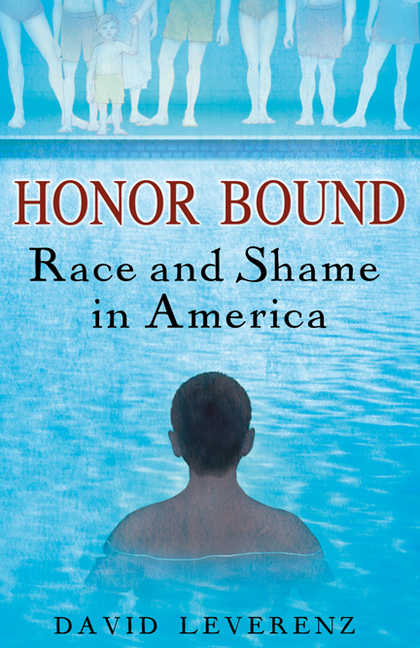
    Honor Bound: Race and Shame in America

    Posted in Books, History, Identity Development/Psychology, Media Archive, Monographs, Politics/Public Policy, Social Science, United States on 2011-12-12 02:09Z by Steven

    Honor Bound: Race and Shame in America

    Rutgers University Press
    2012-03-27
    288 pages
    Paper ISBN: 978-0-8135-5270-5
    Cloth ISBN: 978-0-8135-5269-9

    David Leverenz, Professor Emeritus of English
    University of Florida

    As Bill Clinton said in his second inaugural address, “The divide of race has been America’s constant curse.” In Honor Bound, David Leverenz explores the past to the present of that divide. He argues that in the United States, the rise and decline of white people’s racial shaming reflect the rise and decline of white honor. “White skin” and “black skin” are fictions of honor and shame. Americans have lived those fictions for over four hundred years.

    To make his argument, Leverenz casts an unusually wide net, from ancient and modern cultures of honor to social, political, and military history to American literature and popular culture.

    He highlights the convergence of whiteness and honor in the United States from the antebellum period to the present. The Civil War, the civil rights movement, and the election of Barack Obama represent racial progress; the Tea Party movement represents the latest recoil.

    From exploring African American narratives to examining a 2009 episode of Hardball—in which two white commentators restore their honor by mocking U.S. Attorney General Eric Holder after he called Americans “cowards” for not talking more about race—Leverenz illustrates how white honor has prompted racial shaming and humiliation. The United States became a nation-state in which light-skinned people declared themselves white. The fear masked by white honor surfaces in such classics of American literature as The Scarlet Letter and Adventures of Huckleberry Finn and in the U.S. wars against the Barbary pirates from 1783 to 1815 and the Iraqi insurgents from 2003 to the present. John McCain’s Faith of My Fathers is used to frame the 2008 presidential campaign as white honor’s last national stand.

    Honor Bound concludes by probing the endless attempts in 2009 and 2010 to preserve white honor through racial shaming, from the “birthers” and Tea Party protests to Joe Wilson’sYou lie!” in Congress and the arrest of Henry Louis Gates Jr. at the front door of his own home. Leverenz is optimistic that, in the twenty-first century, racial shaming is itself becoming shameful.

    Tags: ,

    Intimate encounters, Racial Frontiers: Stateless GI babies in South Korea and the United States, 1953-1965

    Posted in Asian Diaspora, Dissertations, History, Media Archive, Politics/Public Policy, United States on 2011-12-09 23:02Z by Steven

    Intimate encounters, Racial Frontiers: Stateless GI babies in South Korea and the United States, 1953-1965

    University of Minnesota
    June 2010
    239 pages

    Bongsoo Park

    A DISSERTATION SUBMITTED TO THE FACULTY OF THE GRADUATE SCHOOL OF THE UNIVERSITY OF MINNESOTA IN PARTIAL FULFILLMENT OF THE REQUIREMENTS FOR THE DEGREE OF DOCTOR OF PHILOSOPHY

    This dissertation explores the policy implications of statelessness by examining G.I. babies, born of non-marital sexual relations between U.S. soldiers in South Korea and Korean women between 1953 and 1965. Using English and Korean language documents about adoption and immigration of stateless GI babies, my work shows that statelessness reveals a racially exclusionary vision of national belonging that shaped citizenship policies of both nations. The GI babies’ presence challenged the myth of racial purity and confounded racial categories in both nations. The dissertation seeks to elucidate some limits of Cold War racial liberalism informed by humanitarian concerns for abandoned Korean war orphans but helped maintain racially exclusionary strategies on citizenship conferral that made the children stateless.

    Table of Contents

    • Acknowledgements
    • Introduction
    • 1. Ties That Bind: Making of the Origin of Korean Race
    • 2. Technologies of Imperial Rule: The Nationality Act of 1940 in the Age of American Expansionism
    • 3. Pitied But Not Entitled: Redemptive Adoption and Limits of Cold War Liberalism
    • 4. Making of a National Hero: Alchemy of Race, Blood, and Memory
    • Epilogue
    • Bibliography

    Read the entire dissertation here.

    Tags: , , , ,