Oscar James Dunn: A Case Study in Race & Politics in Reconstruction Louisiana

Posted in Biography, Dissertations, History, Louisiana, Media Archive, Politics/Public Policy, United States on 2012-01-11 02:36Z by Steven

Oscar James Dunn: A Case Study in Race & Politics in Reconstruction Louisiana

University of New Orleans
December 2011
296 pages

Brian Mitchell

A Dissertation Submitted to the Graduate Faculty of the University of New Orleans in partial fulfillment of the requirements for the degree of Doctor of Philosophy in Urban Studies

The study of African American Reconstruction leadership has presented a variety of unique challenges for modern historians who struggle to piece together the lives of men, who prior to the Civil War, had little political identity. The scant amounts of primary source data in regard to these leaders’ lives before the war, the destruction of many documents in regard to their leadership following the Reconstruction Era, and the treatment of these figures by historians prior to the Revisionist movement have left this body of extremely important political figures largely unexplored. This dissertation will examine the life of one of Louisiana’s foremost leaders, Lt. Governor Oscar James Dunn, the United States’ first African American executive officeholder.
 
Using previously overlooked papers, Masonic records, Senate journals, newspaper articles and government documents, the dissertation explores Dunn’s role in Louisiana politics and chronicles the factionalization of the Republican Party in Reconstruction New Orleans. Born a slave and released from bondage at an early age, Oscar J. Dunn was able to transcend the stigma which was often attached to those who had been held in slavery. A native of New Orleans, born to Anglo-African parents, he was also able to transcend the language barrier that often excluded Anglo-Africans from social acceptability in Afro-Creole society. Although illiterate, Dunn’s parents made critical strides in securing his social mobility by providing him with both a formal education and a trade apprenticeship. Those skills propelled Dunn forward within his Anglo-African community wherein he became a key figure in the community’s two most important institutions, the York Rite Masonic Lodge and the African Methodist Episcopal church.
 
This dissertation argues that Dunn’s political ascent was linked to the political enfranchisement of antebellum Anglo-Africans in Louisiana, Dunn’s involvement in Anglo-African institutions (particularly the York Rite Masonic Lodge and the African Methodist Episcopal church) and Dunn’s ability to find middle ground in the racially charged arguments that engulfed Reconstruction New Orleans’s political arena.

TABLE OF CONTENTS

  • LIST OF TABLES
  • LIST OF ILLUSTRATIONS
  • ABSTRACT
  • CHAPTER I: Introduction
    • Understanding the complexities of Ethnicity and Class in Reconstruction New Orleans
  • CHAPTER II: Literature Review
    • Specific Literature in Regard to Oscar James Dunn
  • CHAPTER III: Methodology
    • The Problem
    • My Hypothesis
  • CHAPTER IV: Giving Roots to the Rootless: The Origin of Oscar James Dunn (1822-1865)
    • Dunn’s Parents
    • Oscar James Dunn’s Youth
    • Dunn the Music Teacher
    • A Plasterer Again
    • Dunn the Mason
    • Dunn the Soldier
    • What a Difference a Place Makes: Geography in Dunn‘s Early Life
    • Reaching a Consensus on Dunn’s Origin
  • CHAPTER V: Oscar J. Dunn’s Political Ascension
    • Outside of the Political Arena
    • Civil Rights and the Riot of 1866
    • White Lodge, Black Lodge
    • Cracks in the Foundation
  • CHAPTER VI: The Negro Lieutenant Governor and the Republican Schism (1868-1869)
    • The Reluctant Candidate
    • The Test Oath Imbroglio
    • Dunn‘s Inauguration
    • The Metropolitan Police Bill
    • The Civil Rights Bill
    • There and Back again: The First Black Political Junket
    • A Homecoming of Sorts
    • Ending the French Masonic Invasion
    • The Lieutenant Governor‘s New Home
  • CHAPTER VII: No Greater Divide (1870-1871)
    • The Masquerade Misadventure
    • Back in the Slammer Again
    • The Voodoo Exorcism
    • Airing Their Dirty Laundry in the Winds of Change
    • Warmoth‘s Presidential Visit
    • The Failed Coup: While the Cat was Away
    • The Two Conventions
    • The Longest Second Line
    • Hard Times and Fond Memories
  • CHAPTER VIII: Dunn-Forgotten Hero
  • BIBLIOGRAPHY
  • APPENDIX A: John Parson’s Biography of Dunn
  • APPENDIX B: J. Henri Burch’s Masonic Eulogy of Oscar J. Dunn
  • APPENDIX C: Dryden’s Biography of Dunn
  • APPENDIX D: Dunn’s Inaugural Address
  • APPENDIX E: Louisiana’s Civil Rights Bill
  • APPENDIX F: Lieut. Gov. Dunn’s Letter to Horace Greeley
  • APPENDIX G: Oscar J. Dunn Commemoration ( J. Morris Chester’s Speech)
  • VITA:

LIST OF TABLES

  • Table 1. Attackers of James Dunn
  • Table 2. Discrepancies in the Eureka Lodge‘s Roll and the First Regiment‘s Service
  • Table 3. Dunn‘s Addresses and Dates of Residence
  • Table 4. Black Voter Registration Sites in the City of New Orleans in 1865
  • Table 5. First Ballot: Dunn‘s nomination for Lt. Governor
  • Table 6. Second Ballot: Dunn‘s nomination for Lt. Governor

LIST OF ILLUSTRATIONS

  • Figure 1. The American Theater (The Old Camp)
  • Figure 2. Freedmen Voting in New Orleans (1867)
  • Figure 3. First Vote
  • Figure 4. The President Leaving the Willard Hotel (March 4,1853)
  • Figure 5. Lieutenant Governor Dunn. 137
  • Figure 6. Metropolitan Hotel (1863)
  • Figure 7. Canal Street above Claiborne Street circa 1860-1870
  • Figure 8. Lt. Governor Dunn and Family
  • Figure 9. Sketch of Dunn in Formalwear
  • Figure 10. Krewe of Comus Ball
  • Figure 11. Currier & Ives Image

Read the entire dissertation here.
Tags: , , , , , ,

Health in Black and White: Debates on Racial and Ethnic Health Disparities in Brazil

Posted in Anthropology, Brazil, Caribbean/Latin America, Dissertations, Health/Medicine/Genetics, Media Archive, Politics/Public Policy, United States on 2012-01-10 22:56Z by Steven

Health in Black and White: Debates on Racial and Ethnic Health Disparities in Brazil

University of California, San Diego
2011
320 pages
Publication Number: AAT 3458492
ISBN: 9781124703657

Anna Pagano

A dissertation submitted in partial satisfaction of the requirements for the degree Doctor of Philosophy in Anthropology

In 2006, the Brazilian Health Council approved a National Health Policy for the Black Population. The Policy is striking because it promotes the image of a biologically and culturally discrete black population in a nation where racial classification has historically been relatively fluid and ambiguous. It transforms established patterns of racialization by collapsing “brown” (pardo) and “black” (preto) Brazilian Census categories into a single “black population” (população negra) to be considered a special-needs group by the public health apparatus. This construction resembles the United States’ dominant mode of racialization based on hypodescent and represents a significant departure from hegemonic portrayals of Brazil as a racially mixed nation. Furthermore, the Policy challenges national ideologies of racial and cultural unity by affirming the existence of an essential black body with specific health concerns, as well as an essential Afro-Brazilian culture that materializes in recommendations for culturally competent health care. As such, the Policy constitutes an important site for new negotiations of racial and cultural identity in Brazil.

In this dissertation, I explore the political and social implications of treating racial and ethnic groups differently within Brazilian health care. I examine how the re-definition and medicalization of racial and cultural identities unfolds in public clinics, temples of Afro-Brazilian religion, and social movements based in São Luís and São Paulo, Brazil. Through an analysis of ethnographic data that I collected over twenty-four months, I assess the impact of recent developments in race-conscious health policy on Brazilians’ lived experiences of race, ethnicity, and health disparities.

I argue that the new Policy, and its associated health programs, signals the emergence of a new biopolitical paradigm in which the Brazilian state formalizes citizens’ racial and ethnic differences in order to address inequalities among them. I also show that many aspects of these programs, which incorporate global discourses and concepts related to health equity, fail to resonate with Brazilian citizens’ notions about race and health. Consequently, patients and healthcare providers often resist the new measures. The result is a disjuncture between policy and practice that ultimately hinders Brazil’s efforts to reduce health inequalities among its citizens.

TABLE OF CONTENTS

  • Signature Page
  • Table of Contents
  • List of Figures
  • List of Tables
  • Acknowledgements
  • Vita
  • Abstract of the Dissertation
  • PART I: RACE, MEDICINE, AND BIOPOLITICS IN BRAZIL
    • Chapter 1: Introduction
      • Race and Ethnicity
      • Biologization and the Re-Biologization of Race
      • Medicalization
      • Medicalization of Race
      • Biopower and Biopolitics
      • Applying a Biopolitical Framework to the Medicalization of Race
      • Race and National Identity in Brazil
      • Black Movement Activism
      • Public Health in Brazil
      • Ethnographic Field Sites
    • Chapter 2: Everyday Narratives on Race, Racism, and Health
      • Patients’ Narratives on Race and Health
      • Health Care Professionals’ Narratives on Race and Health
      • Patients and Providers: A Counter-Biopolitics
  • PART II: THE BLACK HEALTH AGENDA
    • Chapter 3: The Birth of the Black Health Agenda in Brazil
      • Black Health Activism in Brazil
      • The Black Health Agenda in São Paulo
      • The Black Health Agenda in São Luís
    • Chapter 4: The Black Health Epistemic Community in Brazil
      • The Politics of Categorization
      • The Imperative of Self-Declaration
      • Etiological Claims
      • Medicalizing Racism
      • Discourses of Difference
      • Implications for Citizenship
      • Conclusion
  • Part III: AFRO-BRAZILIAN RELIGIONS AND HEALTH
    • Chapter 5: Health and Healing in Afro-Brazilian Religions
      • Afro-Brazilian Religions: A Brief Background
      • Mãe Letícia
      • Pai Cesar
      • Healing in Afro-Brazilian Religions
    • Chapter 6: Afro-Brazilian Religions and the State
      • Partnerships between Terreiros and SUS: Rehabilitating History
      • Razor Blades and Comic Strips
      • Other Sources of Conflict
      • Cultural Competence and the Terreiro
      • De-Sacralizing the Terreiro
      • Conclusion
    • Chapter 7: Afro-Brazilian Religions and Ethnic Identity Politics in the Brazilian
      • Public Health Arena
      • Terreiro Health Activists’ Identity Politics
      • Conclusion
    • Chapter 8: Health in Black and White
  • Bibliography

LIST OF FIGURES

  • Figure 1. Household Income, 2000
  • Figure 2. Distribution of Race/Color (Pretos and Pardos), 2000
  • Figure 3. Public Health Facilities and Distribution of Population by Color in São Paulo, 2000
  • Figure 4. Population Density of São Paulo, 2000

LIST OF TABLES

  • Table 1. Characteristics of Sample Population
  • Table 2. Self-Identified Race or Color
  • Table 3. Beliefs Regarding Health Outcomes between Blacks and Whites

Purchase the dissertation here.

Tags: , , ,

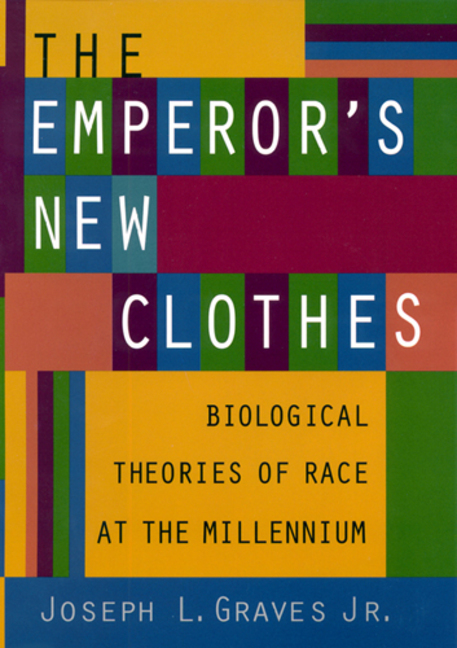
The Emperor’s New Clothes: Biological Theories of Race at the Millennium

Posted in Books, Health/Medicine/Genetics, Media Archive, Monographs, Politics/Public Policy, Social Science on 2012-01-09 06:53Z by Steven

The Emperor’s New Clothes: Biological Theories of Race at the Millennium

Rutgers University Press
2003-01-23
272 pages
14 figures, 24 tables
Cloth ISBN: 978-0-8135-2847-2
Paper ISBN: 978-0-8135-3302-5

Joseph L. Graves, Jr., Professor & Associate Dean for Research
Joint School of Nanoscience and Nanoengineering
North Carolina A&T State University & University of North Carolina, Greensboro

In this groundbreaking book, Joseph Graves traces the development of thought about human genetic diversity. He argues that racism has persisted in our society because adequate scientific reasoning has not entered into the equation. Graves champions the scientific method, and explains how we may properly ask questions about the nature of population differentiation and how (if at all) we may correlate that diversity to differences in human capacity and behavior. He also cautions us to think critically about scientific findings that have historically been misused in controversies over racial differences in intelligence heritability, criminal behavior, disease predisposition, and other traits. Greek philosophy, social Darwinism, New World colonialism, the eugenics movement, intelligence testing biases, and racial health fallacies are just a few of the topics he addresses.

According to Graves, this country cannot truly address its racial problems until people understand that separate human races do not exist empirically. With the biological basis for race removed, racism becomes an ideology, one that can and must be expunged.

Tags: , , , ,

The New Racial Dialogue: Arriving at Whiteness in the Age of Obama

Posted in Articles, Barack Obama, Media Archive, Politics/Public Policy, United States on 2012-01-08 08:46Z by Steven

The New Racial Dialogue: Arriving at Whiteness in the Age of Obama

Journal of African American Studies
Volume 13, Number 2 (June 2009) (“Joy Unspeakable: The First African American President”)
pages 184-186
DOI: 10.1007/s12111-008-9077-y

David H. Roane

My essay issues a challenge for whites to see the blackness of President-Elect Obama as a reflection of the similar complexity lying within themselves. By acknowledging the otherness within their whiteness, white Americans may finally grant themselves their race in a way that compels their much-needed participation in the national dialogue about race.

With the election of the nation’s first black president, there still remains the following question: how docs the “end” of public or institutional racism translate into an end of the negative biases that exist in private? To put it another way, what will the effect of having elected the nation’s first black president really have on the way people design their schools and neighborhoods, construct their families, and conceive their self-identities? What occurs in the ordinary business of people’s day-to-day life only marks true change.

For any national dialogue about race to move forward in a way that is real and significant—i.e. in a way that is personal—it will need new participants. The Age of Obama should be an age when white people can finally talk about their whiteness, not so much as a social identity (they already know how to do this and know how to leverage this quite well), but instead will come to learn what whiteness means as a culture linked to an ethnicity (something they understand much less). With that said, the problem of the 21st century is still the problem of the color line, only this time its frontier has a new set of pioneers.

So, what exactly is whiteness? Can it carry meaning beyond the typical hegemonic associations it has with the oppression of non-white groups? Can we…

Read or purchase the article here.

Tags: , ,

Conference Keynote: White Privilege and the Biopolitics of Race

Posted in Articles, Health/Medicine/Genetics, Media Archive, Papers/Presentations, Politics/Public Policy, Social Science, United States on 2012-01-06 03:20Z by Steven

Conference Keynote: White Privilege and the Biopolitics of Race

Understanding and Dismantling Privilege
Volume 1, Number 1 (2010)
16 pages
Online ISSN: 2152-1875

10th Annual White Privilege Conference Keynote Address
Saturday, April 4, 2009
Memphis, Tennessee

Dorothy Roberts, George A. Weiss University Professor of Law and Sociology; Raymond Pace and Sadie Tanner Mossell Alexander Professor of Civil Rights
University of Pennsylvania

Genomics has resurrected scientific interest in biological concepts of race by attempting to identify race at the molecular level. In that last decade, there has been an explosion of biotechnologies that use race as a biological category, such as race-specific pharmaceuticals, commercial genetic testing for determining racial identity and genealogy, egg donation and embryo selection involving race, and racial profiling with DNA forensics. These technological innovations are part of a new biopolitics of race that helps to maintain white privilege in the 21st century, post-civil rights era. We must contest both the persistent myth that race is natural and persistent injustices based on race.

…My question is: How is white privilege preserved yet made invisible in the twenty-first century? That’s the tricky thing about white privilege, right? It’s been imbedded in U.S. institutions for centuries and yet many people don’t see it. I think we always have to ask, how is it that white privilege persists today? What is the mechanism that obscures white privilege in our current day and age? What are the forces, the institutions, the ways of thinking that we have to contest? The White Privilege Conference quotes on its flier a brilliant observation by Martin Luther King Jr.: “The best way to solve any problem is to remove its cause.” But, of course, we can’t remove the cause of the problem if we misdiagnose it. One of the ways that white privilege is perpetuated in this country is by convincing people that it’s natural for white people to have a privileged position in society. That’s just the way it’s supposed to be.

Why do many people still believe that white privilege is natural? Why do they think it’s natural that our prisons are filled with black and brown people, that most of the children in foster care are black and brown, and that black and brown people die early deaths? How can all this inequality be natural? One way people are persuaded that inequality is natural is through a misunderstanding of genetics. On June 26, 2000, President Bill Clinton unveiled a working draft of the map of the human genome and famously announced, “I believe one of the great truths to emerge from this triumphant expedition inside the human genome is that, in genetic terms, all human beings, regardless of race, are more than 99.9 percent the same.” We differ only in a very tiny percentage of our genes. This confirmed the American Anthropological Association statement that race is a social and cultural construction. I would say, race is a political construction. The human species cannot be divided into genetically distinct races. So many scientists and scholars believed that the misunderstanding of race as a biological category had ended. Everyone would realize that all human beings are fundamentally the same. White privilege would disappear because scientists had discovered that these divisions don’t exist at the genetic level. Well, what happened?…

…So what is the origin of race? Is it genetics or is it power? One way to think about it is to ask, is there a genetic test for whiteness? Many genetic researchers focus on people of color and what’s wrong with them. Why do they die at faster rates from so many diseases? Millions of dollars goes into this kind of research seeking the genetic cause for why different groups of people of color are so diseased. But there is not very much attention to this question: What’s the genetic test for white people? If the origin of race is in genetics, we should be able to tell this racial category by the genes.

Well, if there’s a genetic test for whiteness, then tell me who in Barack Obama’s family is white. A family photo from his childhood shows his mother, who is of Irish decent; the Indonesian man she married after she separated from Barack Obama’s father, who’s Kenyan; Barack Obama’s sister, whose parents are Barack Obama’s mother and his stepfather. Who in this picture is definitely white? Apparently, just his mother. But could you tell that from a genetic test? If you test them, Barack Obama and his little sister are the genetic children of a white mother. The only way you can determine that he is black or that she is Asian and not white is to use a political test; there is no genetic test that can decide it. More generally, the only way you can tell who is white is a political test because it is a political category: White means people who are entitled to white privilege. This is a contest that’s gone on in the United States for centuries—who will be included in this category? The answer has nothing to do with genetics. At one point Jewish people were not included in this category. Irish people were not included in this category (Painter, 2010)…

Read the entire keynote here.

Tags: , ,

Were the riots about race?

Posted in Articles, Economics, Interviews, Law, Media Archive, Politics/Public Policy, Social Science, United Kingdom on 2012-01-01 18:57Z by Steven

Were the riots about race?

The Guardian
2011-12-08

Reading the Riots: Investigating England’s summer of disorder
In partnership with the London School of Economics
Supported by the Joseph Rowntree Foundation and the Open Society Foundations

Hugh Muir, Diary Editor

Yemisi Adegoke, Freelance Journalist

Some commentators were quick to call them ‘race riots’, but the true picture was more complicated

Amid the chaos and confusion of this summer’s riots, a few commentators felt the benefit of certainty. “These riots were about race. Why ignore the fact?” chided the Telegraph columnist Katharine Birbalsingh. Abroad, there seemed no need for deeper reflection. “Over 150 arrested after London hit by huge race riots,” said one US business website. “Let’s talk about those race riots in London,” urged talkshow hosts in New Zealand. Those on the other side of the debate could appear just as certain. “This is not about race at all,” Max Wind-Cowie of the left-leaning thinktank Demos told the Huffington Post

…Of the 270 rioters interviewed by the Guardian and the LSE, 50% were black, 27% were white, 18% of mixed race and 5% Asian…

Read the entire article here.

Tags: , , ,

The Retreat of Scientific Racism: Changing Concepts of Race in Britain and the United States between the World Wars

Posted in Anthropology, Books, Health/Medicine/Genetics, Literary/Artistic Criticism, Media Archive, Monographs, Politics/Public Policy, United Kingdom, United States on 2012-01-01 01:52Z by Steven

The Retreat of Scientific Racism: Changing Concepts of Race in Britain and the United States between the World Wars

Cambridge University Press
September 1993
396 pages
228 x 152 mm
ISBN: 9780521458757
DOI: 10.2277/0521458757

Elazar Barkan, Professor of International and Public Affairs
Columbia University

This fascinating study in the sociology of knowledge documents the refutation of scientific foundations for racism in Britain and the United States between the two world wars, when the definition of race as a biological concept was replaced by a cultural notion of race. Discussing the work of the leading biologists and anthropologists who wrote about race between the wars, Dr. Barkan argues that the impetus for the shift in ideologies of race came from the inclusion of outsiders—women, Jews, and leftists—into the mainstream of scientific discourse.

Table of Contents

  • Preface
  • List of abbreviations
  • Introduction
  • PART I: ANTHROPOLOGY
    • 1. Constructing a British identity
      • Colors into races. A transition to modern British anthropology. The founding fathers. Mummies, bones and stones. The shift in British archaeology. A British glimpse at race relations.
    • 2. American diversity
      • Haunted sentinels. European skulls and the primitive mind. The Boasians. American physical anthropology. The politics of coexistence. Dionysia in the Pacific.
  • PART II: BIOLOGY
    • 3. In search of a biology of race
      • NewGenics. The statistician’s fable. Race crossing in Jamaica. A Canadian in London: rigid Reginald Ruggles Gates.
    • 4. The limit of traditional reform
      • A racist liberal: Julian Huxley’s early years. Herbert Spencer Jennings and progressive eugenics. A conservative critique: Raymond Pearl. Bridging race formalism and population genetics.
    • 5. Mitigating racial differences
      • Lancelot Hogben. “Africa view” – Huxley’s changing perspectives. J. B. S. Haldane: a defiant aristocrat. Medicine and eugenics: expanding the environment. Eugenics reformed.
  • PART III: POLITICS
    • 6. Confronting racism: scientists as politicians
      • 1933 – Early hesitations. Britain – Race and Culture Committee. We Europeans. The American scene. An international interlude. The Paris Congress. The population committee. Out of the closet.
  • EPILOGUE
  • Bibliography
  • Index
Tags: , , , , , , , , , ,

Racial Politics in Contemporary Brazil

Posted in Anthologies, Books, Brazil, Caribbean/Latin America, History, Identity Development/Psychology, Media Archive, Politics/Public Policy, Slavery, Social Science on 2011-12-31 22:27Z by Steven

Racial Politics in Contemporary Brazil

Duke University Press
1999
232 pages
9 tables
Paperback ISBN: 978-0-8223-2272-6
Cloth ISBN: 978-0-8223-2252-8

Edited by

Michael Hanchard, Professor of Political Science and African American Studies
Johns Hopkins University, Baltimore, Maryland

Bringing together U.S. and Brazilian scholars, as well as Afro-Brazilian political activists, Racial Politics in Contemporary Brazil represents a significant advance in understanding the complexities of racial difference in contemporary Brazilian society. While previous scholarship on this subject has been largely confined to quantitative and statistical research, editor Michael Hanchard presents a qualitative perspective from a variety of disciplines, including history, sociology, political science, and cultural theory.

The contributors to Racial Politics in Contemporary Brazil examine such topics as the legacy of slavery and its abolition, the historical impact of social movements, race-related violence, and the role of Afro-Brazilian activists in negotiating the cultural politics surrounding the issue of Brazilian national identity. These essays also provide comparisons of racial discrimination in the United States and Brazil, as well as an analysis of residential segregation in urban centers and its affect on the mobilization of blacks and browns. With a focus on racialized constructions of class and gender and sexuality, Racial Politics in Contemporary Brazil reorients the direction of Brazilian studies, providing new insights into Brazilian culture, politics, and race relations.

This volume will be of importance to a wide cross section of scholars engaged with Brazil in particular, and Latin American studies in general. It will also appeal to those invested in the larger issues of political and social movements centered on the issue of race.

Table of Contents

  • Introduction / Michael Hanchard
  • Free African Brazilians and the State in Slavery Times / Richard Graham
  • Black Cinderella? Race and the Public Sphere in Brazil / Michael Hanchard
  • Ethnic Boundaries and Political Mobilization among African Brazilians: Comparisons with the U.S. Case / Edward E. Telles
  • Racial Democracy and Racial Identity: Comparing the United States and Brazil / Howard Winant
  • Miguel Reale and the Impact of Conservative Modernization on Brazilian Race Relations / Michael Mitchell
  • Women and Racial Inequality at Work in Brazil / Peggy A. Lovell
  • Notes on Racial and Political Inequality in Brazil / Carlos Hasenbalg and Nelson do Valle Silva
  • The Black Movement and Political Parties: A Challenging Alliance / Benedita da Silva
  • My Conscience, My Struggle / Thereza Santos
  • Blacks and Political Power / Ivanir dos Santos
  • Contributors
  • Index
Tags: , , , , , , , , , , , ,

Multicultural ‘obsession’ drives new Parliamentary Poet Laureate

Posted in Articles, Asian Diaspora, Canada, Identity Development/Psychology, Media Archive, Politics/Public Policy on 2011-12-28 22:38Z by Steven

Multicultural ‘obsession’ drives new Parliamentary Poet Laureate

The Globe and Mail
Toronto, Canada
2011-12-21

Jane Taber, Senior Political Writer

Fred Wah is a little more familiar with the outside of Parliament than the inside, having from time to time protested on its sweeping lawn as part of the Writers’ Union of Canada.

But that’s about to change. Tuesday, the award-winning scribe was appointed the country’s new Parliamentary Poet Laureate. As such, the 72-year-old Saskatchewan-born Vancouverite is not required to be reciting poetry on the floor of the Commons or the Senate, but is hoping to at some point unleash his pen on the country’s political institutions…

…Although he sees his appointment as “a symbolic gesture,” he’s got some ideas about what he wants to do, including the “possibility of developing some educational aspects” into the post. “I think there is a great need to get some our poetry and some of our Canadian literature into our schools,” he said.

Characterizing himself as a “Heinz 57,” Mr. Wah’s father was half-Chinese, his mother Swedish and he grew up “in my father’s Chinese-Canadian restaurant.” That has helped to fuel his “obsession” to the issue of race and multiculturalism. “And I’m very interested in the whole notion of hybridity and how we negotiate that in our culture,” he added.

He points to his book of short prose fiction, Diamond Grill, as a example of that. In it, he looks at family and identity. He is also proud of his 1985 book of poetry, Waiting for Saskatchewan, for which he won the Governor-General’s Literary Award…

Read the entire article here.

Tags: , , ,

Obama’s story resonates in racially diverse Brazil

Posted in Articles, Barack Obama, Brazil, Caribbean/Latin America, Media Archive, Politics/Public Policy, Social Science, United States on 2011-12-27 22:49Z by Steven

Obama’s story resonates in racially diverse Brazil

Washington Post
2011-03-18

Juan Forero, Staff Writer

RIO DE JANEIRO — Brazil is a big gumbo of ethnicities, its people proud of their diversity and confident their country is among the most tolerant of nations. But this country—a leading center of black culture—has never had a black president.

So like many Brazilians, Carlos Jose Melo said he would eagerly turn out for President Obama when he tours the country’s signature city on Sunday, a day after meeting with President Dilma Rousseff in Brasília.

Melo has spent most of his life in favelas, Rio’s rough-and-tumble shantytowns, which were first settled by former slaves and dirt-poor soldiers.

“In Brazil, we have all kinds of culture, people, and our inner identity comes from black people,” said Melo, 47, a drug abuse counselor in City of God, a favela Obama is expected to visit on Sunday. “That’s why I think Obama is important for the world, because a poor guy suddenly becomes the most important man in the world.”

Obama’s story—the humble beginnings and the rise to prominence and power—is familiar here. And so is his race, which has struck a chord in a country with the world’s second-largest black population, after Nigeria.

…T-shirt dealer Dilci Aguiar de Paula, who is black and has worked at the base of Sugar Loaf for 25 years, said she can hardly contain her excitement.

“He is a president the whole world likes, a black president,” she said. “I would give him a hug. I would tell him he is a good president.”…

Read the entire article here.

Tags: ,