Racing ahead, going nowhere

Posted in Articles, Asian Diaspora, Media Archive, Politics/Public Policy, Social Science on 2012-01-22 19:23Z by Steven

Racing ahead, going nowhere

Very Fine Commentary
2011-04-17

Yoong Ren Yan, Editor

Are we running around in circles with our policies on race?

Racism is bad. What more is there to say?”

It may not have been the case just 50 years ago in the time of Rosa Parks and Martin Luther King, but in today’s world, being against racism is rather unremarkable. Part of the reason Nelson Mandela is such a universally revered figure is because his cause is no longer controversial. Those that are the least bit racist are promptly and collectively refuted, and with good reason: racism is not only astoundingly irrational, but also one of the worst forms of injustice humans have ever inflicted on others.

Yet there is more to the issue of race. Our insistence that people not be judged based on their skin has not extended to consensus on how to achieve that end. While we all agree that racial discrimination, exploitation and conflict should be things of the past, there are, broadly, two contradictory visions for the future. Which of these should be pursued, and by what means, are sources of unrecognised controversy, and therefore deserve further debate.

More is not better

Singapore represents one of these cases. The Singaporean model is encapsulated in our national obsession with ‘multi-’: we are taught that our nation is multi-racial, multi-cultural, multi-religious, multi-lingual. We present ourselves as a rojak society, a mix of different cultures and ethnicities whose flavours blend into a single dish. Our government is committed to ‘racial harmony’, and envisages Singapore’s four races coexisting peacefully, accepting one another’s differences and working together to build a nation.

For a country that not so long ago was mired in communal violence, division and mutual mistrust, Singapore has made notable progress. It is a prime example of multi-racialism. It has succeeded with two parallel strategies: firstly, to group the population into CMIO (Chinese Malay Indian Others); and secondly, to encourage, and where necessary enforce, cohesion amongst these four races. This approach has manifested itself in our policies on language (English first, no dialects), education (English-medium schools), housing (the Ethnic Integration Policy), social security (ethnic self-help groups) and even the media (censorship, the Sedition Act).

Yet, as Minister Mentor Lee Kuan Yew constantly reminds us, our multi-racial society is still fragile and vulnerable, and could just unravel if we become complacent. In a world stricken with ethnic conflict, his words resonate. But in some senses, Singapore’s drive to become multi-racial has sown the seeds of subterranean tension by continuing to entrench notions of race in society, just at a time when such notions are gradually fading away. Instead of allowing the winds to blow over our divisions, multi-racialism deepens the lines in the sand and widens our already narrowing differences.

This is exemplified by Racial Harmony Day, an attempt to promote cohesion by showcasing the four nationally-sanctioned cultures. Exposure to cultural differences may have been useful in our formative years, but today, a day that celebrates differences rather than similarities and inculcates the notion of race in our children from a young age seems rather anachronistic. Worse yet, divergent racial identities are enforced even when these identities have become far fainter over the years. The result is a farce where Singaporeans put in the special effort to buy cheongsams or learn how to play the angklung on Racial Harmony Day to fit into the race and culture of which they are supposedly a part…

…In concentrating on multi-racialism, our strategies have obstructed society from becoming less race-conscious, which has artificially perpetuated the existence of race in Singapore, with its attendant tensions and clashes. It is difficult enough to encourage integration. If society spontaneously turns away from race, why should the government stick obsessively to its multi-racial stance?…

Read the entire article here.

Tags: , ,

Identity Politics in the Public Realm: Bringing Institutions Back In

Posted in Anthologies, Books, Caribbean/Latin America, Census/Demographics, Europe, Media Archive, Philosophy, Politics/Public Policy, United States on 2012-01-22 02:41Z by Steven

Identity Politics in the Public Realm: Bringing Institutions Back In

University of British Columbia Press
2011-10-11
308 pages
Hardcover ISBN: 9780774820813   

Edited by:

Avigail Eisenberg, Professor of Political Science
University of Victoria

Will Kymlicka, Canada Research Chair in Political Philosophy
Queen’s University

In an age of multiculturalism and identity politics, many minority groups seek some form of official recognition or public accommodation of their identity. But can public institutions accurately recognize or accommodate something as subjective and dynamic as “identity?” Are there coherent standards and fair procedures for responding to identity claims?

In this book, Avigail Eisenberg and Will Kymlicka lead a distinguished team of scholars who explore state responses to identity claims worldwide. Their case studies focus on key issues where identity is central to public policy—such as the construction of census categories, interpretation of antidiscrimination norms, and assessment of indigenous rights—and assess the influence of democratization on the capacity of institutions to respond to group claims. By illuminating both the risks and opportunities of institutional responses to diversity, this volume shows that public institutions can either enhance or distort the benefits of identity politics. Much depends on the agency of citizens and the ability of institutions to adapt to success and failure.

Table of Contents

  • Preface
  • 1. Bringing Institutions Back In: How Public Institutions Assess Identity / Avigail Eisenberg and Will Kymlicka
  • 2. The Challenge of Census Categorization in the Post—Civil Rights Era / Melissa Nobles
  • 3. Knowledge and the Politics of Ethnic Identity and Belonging in Colonial and Postcolonial States / Bruce J. Berman
  • 4. Defining Indigeneity: Representation and the Indigenous Peoples’ Rights Act of 1997 in the Philippines / Villia Jefremovas and Padmapani L. Perez
  • 5. Indigenous Rights in Latin America: How to Classify Afro-Descendants? / Juliet Hooker
  • 6. Domestic and International Norms for Assessing Indigenous Identity / Avigail Eisenberg
  • 7. The Challenge of Naming the Other in Latin America / Victor Armony
  • 8. From Immigrants to Muslims: Shifting Categories of the French Model of Integration / Eléonore Lépinard
  • 9. Beliefs and Religion: Categorizing Cultural Distinctions among East Asians / André Laliberté
  • 10. Assessing Religious Identity in Law: Sincerity, Accommodation, and Harm / Lori G. Beaman
  • 11. Reasonable Accommodations and the Subjective Conception of Freedom of Conscience and Religion / Jocelyn Maclure
  • Contributors
  • Index
Tags: , , , , , , , , , , , , , , ,

Census and Identity: The Politics of Race, Ethnicity, and Language in National Censuses

Posted in Africa, Anthologies, Asian Diaspora, Books, Canada, Census/Demographics, Europe, Media Archive, Politics/Public Policy, United States on 2012-01-22 02:00Z by Steven

Census and Identity: The Politics of Race, Ethnicity, and Language in National Censuses

Cambridge University Press
January 2002
224 pages
Dimensions: 228 x 152 mm
Paperback ISBN: 9780521004275
Hardback ISBN: 9780521808231
eBook ISBN: 9780511029325
DOI: 10.2277/0521004276

Edited by:

David I. Kertzer, Dupee University Professor of Social Science, Professor of Anthropology & Italian Studies
Brown University

Dominique Arel, Professor of Political Science
University of Ottawa

This study examines the ways that states have attempted to pigeon-hole the people within their boundaries into racial, ethnic, and language categories. These attempts, whether through American efforts to divide the U.S. population into mutually exclusive racial categories, or through the Soviet system of inscribing nationality categories on internal passports, have important implications not only for people’s own identities and life chances, but for national political and social processes as well. The book reviews the history of these categorizing efforts by the state, offers a theoretical context for examining them, and illustrates the case with studies from a range of countries.

Features

  • The first in a new series that specifically addresses the needs of the student
  • Focuses on the charged topic of efforts to categorize individuals into racial and ethnic categories in the national census
  • Highly integrated volume with extensive introductory chapter that helps define a new field

Table of Contents

  1. Censuses, identity formation, and the struggle for political power David I. Kertzer and Dominique Arel
  2. Racial categorization in censuses Melissa Nobles
  3. Ethnic categorization in censuses: comparative observations from Israel, Canada, and the United States Calvin Goldscheider
  4. Language categories in censuses: backward- or forward-looking? Dominique Arel
  5. The debate on resisting identity categorization in France Alain Blum
  6. On counting, categorizing, and violence in Burundi and Rwanda Peter Uvin
  7. Identity counts: the Soviet legacy and the census in Uzbekistan David Abramson.
Tags: , , , , , , , , , , , , ,

Tale of a ‘Seditionist’–The Lawrence Dennis Story

Posted in Articles, Biography, History, Law, Media Archive, Politics/Public Policy, United States on 2012-01-22 01:22Z by Steven

Tale of a ‘Seditionist’–The Lawrence Dennis Story

AntiWar.com
2000-04-29

Justin Raimondo

War infects and weakens our republican form of government, spreads social and political diseases throughout the body politic—but is, as Randolph Bourne put it, “the health of the State.” The State, in wartime, is glorified and empowered: the militarization of society means that all resources are mobilized and placed at the disposal of government, and all dissent, however meek and mild, must be utterly discredited if not entirely snuffed out. In wartime the benevolent mask of the “democratic” state invariably slips, and the true face of repression is revealed in all its leering ugliness…

…WORLD WAR II AND THE HIGH ART OF DEMONIZATION

The infamous Moscow Trials of the 1930s, staged by Stalin to cement his hold on absolute power, were the model for the effort undertaken by the US government during the war years to not only discredit its opponents but also to jail them, if at all possible. The massive roundup of Japanese, German, and Italian-Americans was a corollary to the relentless propaganda campaign that singled them out as a “fifth column” coiled and ready to strike. This massive smear campaign was also directed at the large and combative antiwar movement of the time, the America First Committee, as well as its leading spokesmen: Charles A. Lindbergh, John T. Flynn, and “isolationists” in every walk of life were singled out by the War Party and viciously attacked—and this was true especially in the arts, from the actress Lillian Gish to the poet Robinson Jeffers, and in publishing, where the editorial staffs of the major American newspapers and magazines were purged of virtually all “isolationists.” When war finally came, the War Party took its terrible revenge on all who had held out the hope of peace—and none suffered more than Lawrence Dennis, who has yet to finally receive the honor that is his due.

THE OUTSIDER

Lawrence Dennis was an outsider in a movement of outsiders, a unique and largely solitary figure whose career as a writer and notorious “seditionist” embodies the tragedy and bravery of the Old Right, the pre-World War IIAmerica First” generation of conservative intellectuals and activists. In many important ways, Dennis is the prototype of modern “paleo-conservatives.” His career as a controversialist and the leading American nationalist intellectual of his time charts the rise and fall of the Old Right – and, perhaps, holds a lesson for us today. Born in Atlanta in 1893, Dennis had what historian Justus Doenecke describes as “a varied career,” which included a stint as a “boy evangelist.” A recent article on Dennis in The Baffler—in which the author, transcending his own leftist politics, seems to appreciate if not fully understand his subject—informs us that he was born Lonnie Lawrence Dennis, adopted by a mulatto couple, and was undoubtedly of mixed race: his mother was black, but his father was in all probability white. To say that young Lonnie was a precocious kid is a definite understatement: by the age of five he was preaching before large audiences in Atlanta, and was soon bringing the Word to congregations around the country as “The Mulatto Boy Evangelist,” and taking his road show as far as England. He published his autobiography at the ripe old age of ten.

…THE BLACKEST IRONY

For Dennis to be anointed leader of a racist fifth column in America was just another irony in a life rich with them. For a supposed fellow-traveler of Hitler, Dennis hardly fit the Aryan mold. Charles A. Lindbergh, for whom Dennis is said to have written a few speeches, described him as having a “rugged,” dark-complexioned look that made him seem as if he would be more “at home at a frontier trading post.” Dennis’s archenemy, the notorious agent provocateur John Roy Carlson, noted that “Dennis’ hair is woolly, dark and kinky. The texture of his skin is unusually dark and the eyes of Hitler’s intellectual keynoter of ‘Aryanism’ are a rich deep brown, his lips fleshy.” This is the measure of what Lawrence had to endure: the man Life magazine called, in a picture caption, “America’s No. 1 intellectual Fascist . . . brain-truster for the forces of appeasement” and Hitler’s alleged pawn was almost certainly an African-American….

Read the entire article here.

Tags: , , ,

Racial/Ethnic Categories: Do They Matter?

Posted in Articles, Census/Demographics, Media Archive, Politics/Public Policy, United States on 2012-01-21 22:56Z by Steven

Racial/Ethnic Categories: Do They Matter?

Poverty & Race
November/December 1994

Lawrence Wright

Chester Hartman, Director of Research
Poverty & Race Research Action Council

Last fall, the House Subcommittee on Census, Statistics and Postal Personnel, chaired by Rep. Thomas Sawyer (D-OH), held a series of hearings on modification of the existing racial categories used by the Census and on the larger question of whether it is proper for the government to classify people according to arbitrary distinctions of skin color and ancestry. The issue is of deep interest to scientists, government agencies that collect data, and, of course, to advocacy groups in the various minority communities concerned with group entitlements.
 
Census statistics are crucial for so many reasons. “Congressional districts rise and fall with the shifting demographics of the country,” as Wright notes. And program funding of all sorts is a function of how many people are placed in each category—”the numbers drive the dollars,” as Sawyer puts it.
 
The government agency responsible for determining standard classifications of racial and ethnic data is the Office of Management & Budget. OMB’s 1977 Statistical Directive 15, which controls these categories for all federal forms and statistics, recognizes four general racial groups in the US: American Indian or Alaskan Native; Asian or Pacific Islander; Black; and White. With regard to ethnicity, Directive 15 also recognizes Hispanic Origin and Not of Hispanic Origin. “The categories,” as Wright notes, “ask that every American fit himself or herself into one racial and one ethnic box.”…

…Multiracialism

One obvious problem with the existing classification system is mixed-race persons, whose numbers are vast but not precisely known. There have been proposals to add a “Multiracial” category to the Census. The proportion of people who now check the Black box but could, because of mixed genetic heritage, check Multiracial, is at least 75% and may be as high as 90%. This proposed new category, Wright observes, “threatens to undermine the concept of racial classification altogether.”
 
Some, of course, argue that would be no “threat” at all. “Multiracialism has the potential for undermining the very basis of racism, which is its categories,” asserts G. Reginald Daniel of UCLA. But the impact on present programs could be catastrophic. School desegregation plans would be thrown into the air. Legislative districts would have to be redrawn. “The entire civil rights regulatory program concerning housing, employment and education,” Wright notes, “would have to be reassessed . . . Those who are charged with enforcing civil rights laws see the Multiracial box as a wrecking ball aimed at affirmative action.” While no one knows how many multiracial persons in fact would opt for that new category, “merely placing such an option on the Census invites people to consider choosing it,” says Wright. He notes that when the Census listed “Cajun” as one of several examples under the ancestry question, the number of Cajuns jumped nearly 2,000%.
 
Multiracialism, of course, is the story of America ever since Columbus and his men stepped on our shores. Clearly, slavery fueled the process, as white slave-owners, in order to enlarge the slave population (as well as gratify their own lust) fathered tens of thousands of mixed-race “Negroes.”
 
Census categories have constantly confused and been confused about race. “How unsettled this country has always been about its racial categories is evident in that fact that nearly every census since [the original 1790 Census] has measured race differently. “With regard to the most volatile racial category, until recently we had “that peculiar American institution known informally as the ‘one-drop rule‘,” which defined as Black a person who had as little as a single drop of that mythical substance, “Black blood.” The measure applied only to people of African descent. And it is, of course, a racist rule, two-way street: one did not jump over the white community by virtue of having’ “white blood.” (Wright notes that the rule may still be the law of the land, according to a 1986 Supreme Court decision.)
 
America, to be sure, has always had “Black” leaders who were to some extent “white”—Booker T. Washington, Frederick Douglass, W.E.B. DuBois, Malcolm X, Martin Luther King, Jr., Lani Guinier, Douglas Wilder and Louis Farrakhan are a few of the more prominent names. Both whites and Blacks acceded in defining such persons as Black…

Read the entire article here.

Tags: , , , ,

Creating a New Racial Order: How Immigration, Multiracialism, Genomics, and the Young Can Remake Race in America

Posted in Barack Obama, Books, Latino Studies, Media Archive, Monographs, Politics/Public Policy, Social Science, United States on 2012-01-21 19:51Z by Steven

Creating a New Racial Order: How Immigration, Multiracialism, Genomics, and the Young Can Remake Race in America

Princeton University Press
March 2012
282 pages
6 x 9; 17 halftones. 14 line illus. 10 tables
Cloth ISBN: 9780691152998
eBook ISBN: 9781400841943

Jennifer L. Hochschild, Henry LaBarre Jayne Professor of Government and Professor of African and African American Studies
Harvard University

Vesla M. Weaver, Assistant Professor
The Woodrow Wilson Department of Politics
University of Virginia

Traci R. Burch, Assistant Professor of Political Science
Northwestern University
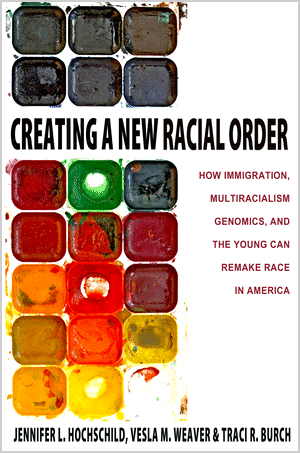
The American racial order—the beliefs, institutions, and practices that organize relationships among the nation’s races and ethnicities—is undergoing its greatest transformation since the 1960s. Creating a New Racial Order takes a groundbreaking look at the reasons behind this dramatic change, and considers how different groups of Americans are being affected. Through revealing narrative and striking research, the authors show that the personal and political choices of Americans will be critical to how, and how much, racial hierarchy is redefined in decades to come.

The authors outline the components that make up a racial order and examine the specific mechanisms influencing group dynamics in the United States: immigration, multiracialism, genomic science, and generational change. Cumulatively, these mechanisms increase heterogeneity within each racial or ethnic group, and decrease the distance separating groups from each other. The authors show that individuals are moving across group boundaries, that genomic science is challenging the whole concept of race, and that economic variation within groups is increasing. Above all, young adults understand and practice race differently from their elders: their formative memories are 9/11, Hurricane Katrina, and Obama’s election—not civil rights marches, riots, or the early stages of immigration. Blockages could stymie or distort these changes, however, so the authors point to essential policy and political choices.

Portraying a vision, not of a postracial America, but of a different racial America, Creating a New Racial Order examines how the structures of race and ethnicity are altering a nation.

Contents

  • List of Figures and Tables
  • Introduction
  • PART I: THE ARGUMENT
    • 1. Destabilizing the American Racial Order
  • PART II: CREATING A NEW ORDER
    • 2. Immigration
    • 3. Multiracialism
    • 4. Genomics
    • 5. Cohort Change
    • 6. Blockages to Racial Transformation
  • PART III: POSSIBILITIES
    • 7. The Future of the American Racial Order
  • Notes
  • References
  • Index

Introduction

A racial order—the set of beliefs, assumptions, rules, and practices that shape the way in which groups in a given society are connected with one another—may seem fixed. Racial orders do change, however. The change may be gradual, as when America evolved over two centuries from being a society with slaves to a slave society, or cataclysmic as when slavery or serfdom is abolished or apartheid instituted. A racial order can change for some groups but not others; the Immigration Act of 1924 denied all Asians and most Kuropcans and Africans, but not Latin Americans, the right of entry to the United States. Change in a racial order is most visible when it results from severe struggle, but it may also occur unintentionally through thousands of cumulative small acts and thoughts. And a racial order can change in some but not all dimensions; American Indians gained U.S. citizenship in 1924 but few have reacquired the land lost through centuries of conquest and appropriation.

Variation in pace, direction, activity, and object makes it difficult to see major change while it is occurring. Nevertheless, we argue that the racial order of the late twentieth century that emerged from the 1960’s civil rights movement, opening of immigration, and Great Society is undergoing a cumulative, wide-ranging, partly unintentional and partly deliberate transformation. The transformation is occurring in locations and laws, beliefs and practices. Its starting point was the abolition of institutional supports and public commitments of the pre-1960s racial order, such as intermarriage bans, legally mandated segregation, unembarrassed racism, and racial or ethnic discrimination. Once those props were removed, the changes broadly signaled by “the 1960s” could develop over the next forty years. They included a rise in immigration, Blacks’ assertion of pride and dignity, Whites’ rejection of racial supremacy (at least in public), a slow opening of schools, jobs, and suburbs to people previously excluded, and a shift in government policy from promoting segregation and hierarchy and restricting interracial unions to promoting (at least officially) integration and equality and allowing interracial unions.

As a consequence, in the first decade of the twenty-first century, new institutions and practices have been moving into place: official records permit people to identify with more than one race, anti-discrimination policies are well established in schools and workplaces, and some non-Whites hold influential political positions. At the same time, the late twentieth century’s understanding of the very meaning of race—a few exhaustive and mutually exclusive groups—is becoming less and less tenable as a consequence of new multiracial identities, immigrants’ rejection of conventional American categories, and genomic science. Social relations, particularly among young Americans, are less driven by stereotypes, more fluid and fragmented, and more susceptible to creation rather than acquiescence. Even deeply seated hierarchies of income, educational attainment and achievement, prestige, and political power are easing for some groups and in some dimensions of life. Race or ethnicity, though still important, is less likely to predict a young person’s life chances than at any previous point in American history; today’s young adults will move through adulthood with the knowledge that one need not be White in order to become the most powerful person in the world…

…Thus the late twentieth-century racial order captures less and less of the way in which race and ethnicity are practiced in the United States today and may be practiced in the foreseeable future. If transformative forces persist and prevail, the United States can finally move toward becoming the society that James Madison envisioned in Federalist #10, one in which no majority faction, not even native-born European Americans, dominates the political, economic, or social arena.

The Madisonian vision must not blind us to two concerns. If it persists, creation of a new racial order will not have only beneficial results. Some Americans are likely to be harmed by these changes and will thereby suffer relative or even absolute losses. Continuing the venerable American pattern, they will be disproportionately African American or Native American, supplemented by undocumented immigrants. All Americans are likely to lose some of the joys and advantages of a strong sense of group identity and rootedness. The greater concern, however, is that the newly created racial order will not persist and prevail. Black poverty and alienation may be too deep; White supremacy may be too tenacious; institutional change may be too shallow; undocumented immigrants may not attain a path to belonging; genomic research may usher in a new era of eugenic discrimination. In short, Americans may in the end lack the political will to finish what demographic change, scientific research, young adults’ worldviews, and the momentum of the past decade have
started…

…Our exploration of transformative forces and their blockages is spread over three parts and seven chapters. Part 1, “The Argument,” has one chapter. Chapter 1 explicates the five components of a societal racial order and suggests what is at stake in the ongoing reinvention of the American racial order. Examples show how immigration, multiracialism, genomics, and cohort change are transforming each component of the late twentieth-century racial order. Chapter 1 also points to elements of American society that could distort or block transformation of the racial order. Perhaps most important, it provides analytic justification for our expectation that creative forces will outweigh blockages, so long as Americans take steps to incorporate those now in danger of exclusion and to improve the life chances of those at the bottom.

Part 2, “Creating a New Order,” consists of five chapters. Chapters 2 through 5 respectively analyze immigration, multiracialism, genomics, and cohort change, in each case using the five components of a racial order to organize the discussion. Despite variation in the content and process of change, a consistent pattern emerges: each transformative force independently (and all of them interactively) is changing how Americans understand what a race is, how individuals are classified, how groups are relatively positioned, how state actions affect people’s freedom of choice, and how people relate to one another in the society. Chapter 6 looks at the opposite side of the creative dynamic—that is, features of the American racial order that reinforce the late twentieth-century order of clear racial and ethnic boundaries, relatively fixed group positions, intermittently prohibitive state actions, and hostile social relations. Chapter 6 focuses on four issues that directly challenge the transformative forces—the costs of a loss in group identity, wealth disparities, unprecedented levels of Black and Latino incarceration, and the possibility that illegal immigrants or Muslims might become the new pariah group. It warns that effective creation of a new racial order can itself deepen the disadvantage of the worst off even while moving toward a more racially inclusive polity.

Finally, part 3, “Possibilities,” consists of one chapter. Chapter 7 concludes by considering the likelihood that the current American racial order will look very different by the time our children reach old age. It also sketches some political and policy directions necessary to promote transformation, expand its benefits, and reduce the proportion of Americans who arc left out or harmed…

Tags: , , , , , , ,

Envisioning Chinese Identity and Managing Multiracialism in Singapore

Posted in Asian Diaspora, Communications/Media Studies, Identity Development/Psychology, Media Archive, Papers/Presentations, Politics/Public Policy, Social Science on 2012-01-21 16:14Z by Steven

Envisioning Chinese Identity and Managing Multiracialism in Singapore

International Association of Societies of Design Research Conference
2009-10-18 through 2009-10-22
Coex, Seoul, Korea
9 pages

Leong Koon Chan, Associate Professor
School of Design Studies
University of New South Wales, Sydney, Australia

Multiracialism and bilingualism are key concepts for national ideology and policy in the management of Singapore for nation building. Multiracialism is implemented in social policies to regulate racial harmony in the population of Chinese-Malay-Indian-Other, a social stratification matrix inherited from the British administration. Bilingualism—the teaching and learning of English and the mother tongue in primary and secondary schools—is rationalised as the ‘cultural ballast’ to safeguard Asian identities and values against Western influences. This focus on ‘culture’ as a means of engendering a relationship between the individual and the nation suggests that as a tool for government policy culture is intricately linked to questions of identity. In discussing multiracialism it is necessary to address ethnicity for the two concepts are intertwined.

This paper investigates the crucial role that imagery plays in our understanding of nationalism by examining the policy and process of language reform for the Chinese in Singapore through the visual culture of the Speak Mandarin Campaigns, 1979-2005. Drawing upon object analysis, textual/document analysis and visual interpretation, the research analyses how the graphic communication process is constructed and reconstructed as indices of government and public responses to the meanings of multiracialism and Chineseness.

Central to the findings are Anthony D. Smith’s (1993) contention that “national symbols, customs and ceremonies are the most potent and durable aspects of nationalism,” and Raymond Williams’ (1981) contention that social ideologies are reflective of “structures of feeling”, defined as individual and collective meanings and values, “…with specific internal relations, at once interlocking and in tension…a social experience which is still in process.”

Read the entire paper here.

Tags: , , ,

Science in the Service of the Far Right: Henry E. Garrett, the IAAEE, and the Liberty Lobby

Posted in Articles, Media Archive, Politics/Public Policy, United States on 2012-01-19 02:21Z by Steven

Science in the Service of the Far Right: Henry E. Garrett, the IAAEE, and the Liberty Lobby

Journal of Social Issues
Volume 54, Issue 1 (Spring 1998)
pages 179–210
DOI: 10.1111/j.1540-4560.1998.tb01212.x

Andrew S. Winston, Professor of Psychology
University of Guelph, Ontario, Canada

Henry E. Garrett (1894–1973) was the President of the American Psychological Association in 1946 and Chair of Psychology at Columbia University from 1941 to 1955. In the 1950s Garrett helped organize an international group of scholars dedicated to preventing race mixing, preserving segregation, and promoting the principles of early 20th century eugenics and “race hygiene.” Garrett became a leader in the fight against integration and collaborated with those who sought to revitalize the ideology of National Socialism. I discuss the intertwined history the International Association for the Advancement of Ethnology and Eugenics (IAAEE), the journal Mankind Quarterly, the neofascist Northern League, and the ultra-right-wing political group, the Liberty Lobby. The use of psychological research and expertise in the promotion of neofascism is examined.

Read or purchase the article here.

Tags: , , , ,

What’s Race Got to Do With It?

Posted in Articles, Barack Obama, Media Archive, Politics/Public Policy, United States on 2012-01-16 03:40Z by Steven

What’s Race Got to Do With It?

The New York Times
2012-01-14

Lee Seigel

Mitt Romney may not have officially clinched the Republican nomination, but his victory has never really been in doubt. Nor has his viability in November: the most fanatical Tea Partiers are not about to withhold their votes and risk allowing President Obama to be re-elected.

Pundits have already begun the endless debate over whether Mr. Romney’s wealth and religion are hindrances or assets. But there has yet to be any discussion over the one quality that has subtly fueled his candidacy thus far and could well put him over the top in the fall: his race. The simple, impolitely stated fact is that Mitt Romney is the whitest white man to run for president in recent memory.

Of course, I’m not talking about a strict count of melanin density. I’m referring to the countless subtle and not-so-subtle ways he telegraphs to a certain type of voter that he is the cultural alternative to America’s first black president. It is a whiteness grounded in a retro vision of the country, one of white picket fences and stay-at-home moms and fathers unashamed of working hard for corporate America…

…In this way, whether he means to or not, Mr. Romney connects with a central evangelic fantasy: that the Barack Obama years, far from being the way forward, are in fact a historical aberration, a tear in the white space-time continuum. And let’s be clear: Mr. Obama’s election was not destiny, but a fluke.

Despite a general revulsion against George W. Bush and his policies, despite John McCain’s lack of ideas and his remoteness from contemporary American problems, the Republican ticket was ahead of Mr. Obama by several points in September 2008. Then came the fall: Lehman Brothers, the stock-market plunge and skyrocketing unemployment (not to mention Sarah Palin).

By the iron law of elections, the country threw the bums out and rejected anyone even remotely tied to them. The result? America’s first black president…

Read the entire opinion piece here.

Tags: ,

Call at Rio fashion show for more black models

Posted in Articles, Arts, Brazil, Caribbean/Latin America, Media Archive, Politics/Public Policy, Social Science on 2012-01-15 21:41Z by Steven

Call at Rio fashion show for more black models

Agence France-Presse
2012-01-14

Only a handful of black models sashayed down the catwalk at this week’s Rio fashion show, sparking fresh calls for quotas to ensure greater diversity in a country where more than half of the population is of African ancestry.

Some 24 labels displayed their latest designs at the Rio de Janeiro winter 2012 fashion week, that ran from Wednesday to Saturday, and as in previous years the models were overwhelmingly white.

Yet Brazil, home to 190 million people, has the world’s second largest black population after Nigeria.

Organizers refused to address this perennial lack of racial diversity, although in the past they claimed that “there is no racial discrimination” in an industry known for its preference for eurocentric standards of beauty.

For the first time in June 2009, the Sao Paulo Fashion Week (SPFW)—Latin America’s premier fashion event—imposed quotas requiring at least 10 percent of the models to be black or indigenous…

…Luana Genot, one of the eight black models out of more 200 employed by the main Rio modeling agency, 40° Models, gave details of the hurdles blacks face.

“They call us only when the the theme of the show is linked to black culture,” said the 23-year-old who is also an advertising student at Rio Catholic University (PUC).

“I am often told: What am I going to do with your hair? And for make-up, I am always the last so as not to dirty the brush with overly dark tones,” she added.

Last June, during Black Consciousness Week, Genot organized a debate on “ethnic diversity in fashion” at PUC.

We are told that the winter collection is for whites in Europe or that black women’s butts are too big, their hips too wide. I am shocked to see that in Brazil, where more than half of the people are descendants of black slaves, there is so little space for us,” she added.

“Brazil’s population is very mixed and this must be reflected in fashion,” Genot said…

Read the entire article here.

Tags: