The Obama Effect: Multidisciplinary Renderings of the 2008 Campaign

Posted in Anthologies, Barack Obama, Books, Communications/Media Studies, Media Archive, Politics/Public Policy, United States on 2012-03-27 04:00Z by Steven

The Obama Effect: Multidisciplinary Renderings of the 2008 Campaign

SUNY Press
September 2010
300 pages
Hardcover ISBN10: 1-4384-3659-9; ISBN13: 978-1-4384-3659-3
eBook SBN10: 1-4384-3661-0; ISBN13: 978-1-4384-3661-6

Edited by:

Heather E. Harris, Associate Professor of Business Communication
Stevenson University, Stevenson, Maryland

Kimberly R. Moffitt, Assistant Professor of American Studies
University of Maryland, Baltimore County

Catherine R. Squires, John and Elizabeth Bates Cowles Professor of Journalism, Diversity, and Equality
University of Minnesota


Timely, multidisciplinary analysis of Obama’s presidential campaign, its context, and its impact.

November 4, 2008 ushered in a historic moment: Illinois Senator Barack Obama was elected the forty-fourth President of the United States of America. In The Obama Effect, editors Heather E. Harris, Kimberly R. Moffitt, and Catherine R. Squires bring together works that place Barack Obama’s candidacy and victory in the context of the American experience with race and the media. Following Obama’s victory, optimists claimed that the campaign signaled the arrival of an era of postracism and postfeminism in the United States. This collection of essays, all presented at a national conference to discuss the meaning and impact of the nomination of the first presidential candidate of African descent, remind the reader that reaching a point in U.S. history where a biracial man could be deemed “electable” is part of a still-ongoing struggle. It resists the temptation to dismiss the uncertainty, hope, and fear that characterized the events and discourse of the two-year primary and general election cycle and brings together multidisciplinary approaches to assessing “the Obama effect” on public discourse and participation. This volume provides readers with a means for recalling and mapping out the enduring issues that erupted during the campaign—issues that will continue to shape how our society views itself and President Obama in the coming years.

Tags: , , , , , , ,

Why race still matters

Posted in Articles, Health/Medicine/Genetics, Media Archive, Philosophy, Politics/Public Policy, United States on 2012-03-25 18:41Z by Steven

Why race still matters

Dædalus
Volume 134, Number 1 (Winter 2005)
Pages 102-116
DOI: 10.1162/0011526053124460

Ian Hacking, Professor of Philosphy
University of Toronto

Why has race mattered in so many times and places? Why does it still matter? Put more precisely, why has there been such a pervasive tendency to apply the category of race and to regard people of different races as essentially different kinds of people? Call this the ‘first question.’ Of course there are many more questions that one must also ask: Why has racial oppression been so ubiquitous? Why racial exploitation? Why racial slavery? Perhaps we lend to think of races as essentially different just because we want to excuse or to justify’ the domination of one race by another.

I shall proceed with the first question by canvassing live possible answers to it that variously invoke nature, genealogy (in the sense of Michel Foucault), cognitive science, empire, and pollution rules.

One final preliminary remark is in order. Most parts of this essay could have been written last year or next year, but the discussion of naturalism, medicine, and race could only have been written in November of 2004. and may well be out of date by the time this piece is printed.

Why has the category of race been so pervasive? One answer says that the distinction is just there, in the world for all to see. Superficial differences between races do exist in nature, and these are readily recognized.

The naturalist agrees at once that the distinctions are less in the nature of things than they once were, thanks to interbreeding among people whose ancestors have come from geographically distinct blocks. Racial distinctions are particularly blurred where one population has been translated by force to live in the midst of another population and yet has not been assimilated—slaves taken from West Africa and planted in the Southern United States, for example. The naturalist notes that traditional racial distinctions are less and less viable the more children are born to parents whose geographical origins are very different.

Sensible naturalists stop there. The belief that racial differences are anything more than superficial is a repugnant. John Stuart Mill was the wisest spokesman for this position…

…In the United States, the National Bone Marrow Program maintains the master registry. Most people in existing registries have tended to be middle-aged and white, which means that whites have a good chance of finding a match. Hence there have been racially targeted programs for Asian and African Americans. In the United States and Canada there is also the Aboriginal Bone Marrow Registries Association, and in the United Kingdom there is the African Caribbean Leukemia Trust. Asians for Miracle Marrow Matches has been very successful, especially in the Los Angeles region. The African Americans Uniting for Life campaign has been less successful, for all sorts of historical reasons. An African American with leukemia has a far worse chance of finding a match in time than members of other populations have. That is a social fact, but there is also a biological fact: there is far greater heterogeneity in the human leukemia antigen in persons of African origins than in other populations. (This fact fits well with the hypothesis that all races are descendants of only one of many African populations that existed at the time that human emigration began out of Africa—populations whose characteristics have continued to be distributed among Africans today.)

If you go to the websites for the organizations that maintain the registries, you will see they do not shilly-shally in some dance of euphemistic political correctness about race. For them it is a matter of life and death. Without the Asian registries there would have been many more dead Asian Americans in the past decade. For lack of more African Americans on the registries there will be more dead African Americans in the next few years than there need be…

…How much more powerful pollution and the imperial imperative become when history puts them together! Pollution rules are important for maintaining the imperial group intact. As soon as pollution rules break down, men of the master group sire children with women from subjugated groups, and a new kind of person–the half-breed–emerges. The etymology of words such as ‘Eurasian’ embodies this phenomenon. We learn from the trusty 1911 Encyclopaedia that ‘Eurasian’ was “originally used to denote children born to Hindu mothers and European (especially Portuguese) fathers.” There are pecking orders between conquerors, as well as among the conquered–and this British word was a put-down meant to keep the Portuguese in Goa in their place. Note also the dominance order between the sexes: a Hindu father and a European woman would yield, at least in the official reckoning, a Hindu, not a Eurasian.

The French noun métis, derived from a Portuguese word originally used for Eurasians, dates back to 1615. In French Canada it signified the children of white fathers and native mothers. Early in the nineteenth century it was adopted in English to denote the offspring of French Canadian men, originally trapper/traders, and native women. In other words, ‘Eurasian’ and métis alike meant the children of males from conquering groups of lower status and females from the totally subjugated groups–and then the offspring of any of those children.

For a few generations, one can be precise in measuring degrees of pollution. At that the Spanish and Portuguese Empires excelled. First came ‘mulattoes,’ the children of Spanish or Portuguese men and South American Indian women. With the importation of black slaves from West Africa, the label was transferred to the children of white masters and black slaves, and then to mixed race in general. The OED [Oxford English Dictionary] says it all: the English word is derived from Portuguese and Spanish, “mulato, young mule, hence one of mixed race.”

The Spanish cuarteron became the English ‘quadroon,’ the child of a white person and a mulatto. The few quotations given in the OED are a record of colonial history. Here is the first, dated 1707: “The inhabitants of Jamaica are for the most part Europeans … who are the Masters, and Indians, Negroes, Mulatos, Alcatrazes, Mestises, Quarterons, & c. who are the slaves.” The next quotation in the list is from Thomas Jefferson.

And so on: from Spanish the English language acquired ‘quintroon,’ meaning one who is one-sixteenth of Negro descent. The 1797 Encyclopaedia Britannica has it that “The children of a white and a quintroon consider themselves free of all taint of the negro race.” More importantly, from an 1835 OED citation, “‘The child of a Quintroon by a white father is free by law.’ Such was recently the West-Indian slave code.” Better to have a white father than a white mother.

In real life, interbreeding was endemic, so such classifications were bound to become haphazard. Only one option was left. The American solution was definitive. One drop of Negro blood sufficed to make one Negro. Which in turn implied that many Americans could make a cultural choice to be black or not, a choice turned into literature in Toni Morrison’s Jazz and, more recently, in Philip Roth’s The Human Stain. The one drop of blood rule perfectly harmonizes the imperial imperative and the preservation of group identity by pollution prohibitions.

Why is there such a widespread tendency to regard people of different races as essentially different kinds of people? That was our first question…

Read the entire article here.

Tags: , ,

Driving FORCE Métis community significant economic resource

Posted in Articles, Canada, Media Archive, Native Americans/First Nation, Politics/Public Policy on 2012-03-24 23:44Z by Steven

Driving FORCE Métis community significant economic resource

Winnipeg Free Press
2012-03-17

Barbara Bowes

Although time has passed quickly, I’m sure you’ll recall that Manitoba recently celebrated Louis Riel Day. For most people, Louis Riel Day is simply another statutory holiday while for others, it is recognition that the Métis people were the driving force behind Manitoba becoming Canada’s fifth province.

Many people and especially new immigrants are not familiar with the term Métis, nor its historical significance. To help bring about a better understanding, we define the Métis people as one of the aboriginal groups that can trace their ancestral heritage to marriages of mixed First Nations and European heritage. And today, 144 years later, our Métis citizens are once again being seen as a driving force in Manitoba’s economy.

Yet, if the Métis people are indeed a driving force in the economy, where are they located? How can they be accessed as potential employees?

Believe it or not, if you checked recent demographic data, you’ll find there are over 100,000 Métis people in Manitoba living in various communities. Over half of this population is under the age of 30 and lives in an urban setting. However, in spite of having the highest rate of post-secondary education completion of all aboriginal groups in the province, the Métis median income is 24 per cent lower than for non-aboriginal people.

As you can imagine, a population of 100,000 represents a significant and relatively untapped resource in terms of employment and business partnerships. The challenge now is how to create a co-ordinated effort to link potential job candidates with employers so they can work together as partners in Manitoba’s economic growth…

Read the entire article here.

Tags: , ,

S.66, the Native Hawaiian Health Care Improvement bill in the 112th Congress — Reauthorizing an ineffective but socially dangerous pork-barrel waste of taxpayer dollars

Posted in Articles, Health/Medicine/Genetics, Law, Media Archive, Politics/Public Policy, United States on 2012-03-24 19:25Z by Steven

S.66, the Native Hawaiian Health Care Improvement bill in the 112th Congress — Reauthorizing an ineffective but socially dangerous pork-barrel waste of taxpayer dollars

Hawaii Reporter
2011-03-07

Kenneth R. Conklin, Ph.D.

S.66 is a bill in the 112th Congress entitled “The Native Hawaiian Health Care Improvement Act,” introduced by Senator Dan Inouye on January 15, 2011. At the end of February the bill had no cosponsors—not even the figurehead champion of ethnic Hawaiians, Senator Dan Akaka.
 
The bill’s stated purpose is to re-authorize and expand previous legislation going back to 1988 which established Papa Ola Lokahi, the federally-funded ethnic Hawaiian healthcare system—one of the largest racially exclusionary programs for the benefit of ethnic Hawaiians. (There are more than a thousand Hawaiians-only programs; see “references”).
 
A hidden purpose of S.66 is to restate and enshrine language from the apology resolution of 1993 and the failed Akaka bill of 2000 to 2010. S.66 would thereby bolster the claim that the federal government already recognizes ethnic Hawaiians as an Indian tribe, thus strengthening legal defenses against 14th Amendment challenges to Hawaii’s plethora of racial entitlement programs…

…Some defenders of race-based medicine assert that ethnic Hawaiians are a unique people with unique social customs requiring a culture-based medical delivery system. But nearly all ethnic Hawaiians are of mixed race. They live, work, play, and pray right next to people of other races in Hawaii’s fully integrated multicultural society. Assimilated people don’t have unique social needs as a group, and should not be racially profiled or stereotyped that way. Hawaii has many first, second, or third generation U.S. citizens from countries which do indeed have very different cultures; but there are no demands for federally funded race-based or culture-based healthcare systems to serve them…

Read the entire opinion piece here.

Tags: , , ,

Are medical and nonmedical uses of large-scale genomic markers conflating genetics and ‘race’?

Posted in Articles, Health/Medicine/Genetics, Media Archive, Politics/Public Policy on 2012-03-24 03:04Z by Steven

Are medical and nonmedical uses of large-scale genomic markers conflating genetics and ‘race’?

Nature Genetics
Volume 36, Number 11s (2004)
pages S43-S47
DOI: 10.1038/ng1439

Charles N. Rotimi, Director
Center for Research on Genomics and Global Health

“…with each birth and each death we alter the genetic attributes of human populations and drawing a line around an ephemeral entity like a human race is an exercise in futility and idiocy.” —Pat Shipman, The Evolution of Racism

We now have the tools to describe the pattern of genetic variation across the whole genome and its relationship to the history of human origins and the differential distribution of diseases across populations and geography. We can begin to dissect common complex diseases and devise new therapeutic strategies to reduce adverse drug reactions, a key public health problem ranking between the fourth and sixth leading cause of death in the US. At the social level, the new genomic tools can help us to better appreciate the fluidity of social identity, including ‘race’, ‘ethnicity’ and the more complex notion of ancestry. Challenges surrounding the design of large-scale genotyping projects such as the international HapMap initiative and their future applications illustrate the complexities and ambiguities associated with the use of group labels in genomic research. Depending on how we use this information, the potential exists to describe simultaneously our similarities and differences without reaffirming old prejudices…

…Genetic variation and social identity

To reap the full benefits of the Human Genome Project and spin-offs like the HapMap project, we must be willing to move beyond old and simplistic interpretations of differential frequencies of disease variants by poorly defined social proxies of genetic relatedness like ‘race’. We should allow the genome to teach us the extent of our evolutionary history without abbreviating it with preconceived notions of population boundaries and social identities. We must recognize that social identities are formed in various ways—ancestry, ethnic and tribal background, geopolitical boundaries, language, and other social and behavioral activities. Identities change over time and from one context to another. Their use as markers of ‘relatedness’ in genetic research without appreciation for how they were formed is likely to produce misleading information concerning the distribution of genetic variation.

We all have a common birthplace somewhere in Africa and this common origin is the reason why we share most of our genetic information. Our common history also explains why contemporary African populations have more genetic variation than younger human populations that migrated out of Africa 100,000 years ago to populate other parts of the world, carrying with them a subset of the existing genetic information.

Given this shared history, why do we interpret human genetic variation data as though our differences rise to the level of subspecies? Two facts are relevant: (i) as a result of different evolutionary forces, including natural selection, there are geographical patterns of genetic variations that correspond, for the most part, to continental origin; and (ii) observed patterns of geographical differences in genetic information do not correspond to our notion of social identities, including ‘race’ and ‘ethnicity’. In this regard, no matter what categorical framework is applied, we cannot consistently use genetics to define racial groups without classifying some human populations as exceptions. Our evolutionary history is a continuous process of combining the new with the old, and the end result is a mosaic that is modified with each birth and death. This is why the process of using genetics to define ‘race’ is like slicing soup: “You can cut wherever you want, but the soup stays mixed”.

How can we grasp the population structure of our species? I believe this requires universal awareness that genomic information cannot be used either to confirm or to refine old social, political and economic classifications such as ‘race’. In particular, we should understand the following points: (i) individuals in genetics studies may have membership in more than one biogeographical clusters; (ii) the borders of these clusters are not distinct; and (iii) population clusters are influenced by sampling strategies. For example, the inference drawn from a study with one or two African populations will probably be very different from that drawn from a study with 100 African populations sampled from north, east, west, central and south Africa. As Steve Olson observed, “Not only do all people have the same set of genes, but all groups of people also share the major variants of those genes. Geneticists have never found a genetic marker that is of one type in all the members of one large group and of a different type in all the members of another large group”50. Furthermore, because most alleles are widespread, genetic differences among human populations are the result of gradations in allele frequencies rather than distinctive diagnostic genotypes…

Read the entire perspective here.

Tags: , , ,

Grassroots Marketing in a Global Era: More Lessons from BiDil

Posted in Articles, Health/Medicine/Genetics, Media Archive, Politics/Public Policy, United States on 2012-03-24 02:07Z by Steven

Grassroots Marketing in a Global Era: More Lessons from BiDil

The Journal of Law, Medicine & Ethics
Volume 39, Issue 1, Spring 2011
pages 79–90
DOI: 10.1111/j.1748-720X.2011.00552.x

Britt M. Rusert, External Humanities Fellow
Center for the Humanities
Temple University

Charmaine D. M. Royal, Associate Research Professor
Institute for Genome Sciences & Policy; Department of African and African American Studies
Duke University

BiDil, a heart failure drug for African Americans, emerged five years ago as the first FDA approved drug targeted at a specific racial group. While critical scholarship and the popular media have meticulously detailed the history of BiDil from its inauspicious beginnings as a generic combination drug for the general population to its dramatic resuscitation as a racial medicine, the enthusiastic support shown by some African American interest groups has been too little understood, as has their argument that BiDil was an important response to race-based health disparities. In this essay, we show how the drugmaker, NitroMed, used the support it had solicited from black advocacy groups and community members to market BiDil as a unique “grassroots” pharmaceutical to the African American community. We go on to situate BiDil, which relied on a domestic, U.S.-centered conception of race, within the context of the global nature of both race and health disparities. Ironically, the grassroots angle of the BiDil case ultimately obscured the global crisis in health disparities. Furthermore, we argue that the grassroots model initiated by NitroMed should be taken note of, as it marks a potential avenue for the marketing of other drugs in the future.

Read the entire article here.

Tags: , , , , , ,

Is Race-Based Medicine Good for Us?: African American Approaches to Race, Biomedicine, and Equality

Posted in Articles, Health/Medicine/Genetics, Media Archive, Politics/Public Policy, United States on 2012-03-24 01:39Z by Steven

Is Race-Based Medicine Good for Us?: African American Approaches to Race, Biomedicine, and Equality

The Journal of Law, Medicine & Ethics
Volume 36, Issue 3, September 2008
pages 537–545
DOI: 10.1111/j.1748-720X.2008.302.x

Dorothy Roberts, George A. Weiss University Professor of Law and Sociology; Raymond Pace and Sadie Tanner Mossell Alexander Professor of Civil Rights
University of Pennsylvania

This article presents a preliminary framework for exploring the intersection of science and racial politics in the public debate about race-based pharmaceuticals, especially among African Americans. It examines the influence of three political approaches to race consciousness on evaluations of racial medicine and offers an alternative critique.

Read or purchase the article here.

Tags: , , ,

The Impact of the Obama Presidency on Civil Rights Enforcement in the United States

Posted in Articles, Barack Obama, Law, Media Archive, Politics/Public Policy, United States on 2012-03-20 02:51Z by Steven

The Impact of the Obama Presidency on Civil Rights Enforcement in the United States

Indiana Law Journal
Volume 87: Issue 1 (Spring 2012)
Symposium: “Labor and Employment Under the Obama Administration: A Time for Hope and Change?”

Joel Wm. Friedman, Jack M. Gordon Professor of Law
Tulane University Law School

Panel 6: Employment Law: Antidiscrimination Law Under a Black President in a “Post-Racial” America?

On Friday, August 4, 1961, police officers in Shreveport, Louisiana, arrested four African American freedom riders after the two men and two women refused to accede to the officers’ orders to exit the whites-only waiting room at the Continental Trailways bus terminal. Four thousand miles away, in the delivery room at Kapi’olani Maternity & Gynecological Hospital in Honolulu, Hawaii, Stanley Ann Dunham, a Kansas-born American anthropologist whose family had moved to the island state twenty years earlier, gave birth to the only child that she would have with her first husband, Barack Obama Sr., an ethnic Luo who had come to Hawaii from the Nyanza Province in southwest Kenya to pursue his education at the University of Hawaii. Just over forty-seven years later, on November 4, 2008, their son, Barak Obama II, a mixed-race man who identifies as black, was elected the 44th president of the United States.

The election of the nation’s first African American president was hailed as an event of historic importance. Many heralded Obama’s victory as signaling the dismantling of “the last racial barrier in American politics.” Analogies were quickly and frequently drawn to the historic moment when Jackie Robinson became the first African American player in Major League Baseball. This superficially obvious comparison, however, diminished the causal significance of Obama’s election. When Jackie Robinson left the Kansas City Monarchs of the Negro Leagues on October 23, 1945, to sign a contract with the Brooklyn Dodgers, and then made his debut on a major league diamond at Ebbets Field on April 15, 1947, he breached the unofficial, but rigidly enforced exclusionary “color line” in professional baseball. But this momentous event was the product of a courageous and visionary decision by one man—Branch Rick[e]y, the part-owner, president, and general manager of the Brooklyn Dodgers. Obama’s election triumph, on the other hand, was the result of millions of individual determinations to vote for an African American candidate for the nation’s highest office.

Beyond the unique historical aspect of Obama’s election triumph, the results of the 2008 presidential election were interpreted by many as marking the onset of a new era of American “postracialism.” For example, much was made of the fact  that in Virginia, home of the Confederacy’s capital city, Obama amassed more votes than his Caucasian opponent. Many analysts concluded that the voters’ comparative assessments of each candidate’s ability to deal with the nation’s economic woes, and not his racial classification, were a crucial determinant in their decisions in the voting booth. They pointed to the fact that Obama’s 8.5 million vote margin of victory was, in part, the result of his receipt of 40% of the votes cast by white men, a higher share than had been garnered by any of the five previous (white) Democratic presidential nominees…

Read the entire article here.

Tags: , ,

Using the Mixed-Race Category to Expose the Persistence of Anti-Black Racism: A Response to Thomas Chatterton Williams

Posted in Articles, Barack Obama, Identity Development/Psychology, Media Archive, Politics/Public Policy, Social Science, United States on 2012-03-18 20:44Z by Steven

Using the Mixed-Race Category to Expose the Persistence of Anti-Black Racism: A Response to Thomas Chatterton Williams

2012-03-17

Mark S. James, Fulbright Scholar
Horlivka State Pedagogical Institute of Foreign Languages

This article [Thomas Chatterton Williams, “As Black as We Wish to Be,” New York Times (March 16, 2012)] stipulates that people of mixed-race parentage do indeed experience advantages that those who are perceived to be monoracially black do not, yet argues that these people should deny this advantage because of an “ethical obligation” to identify as (monoracially) “black,” as if numbers alone tells the whole story of racial discrimination. It seems to me that it is precisely because many mixed-race individuals experience advantages that many “pure” black people do not that we can most effectively use the mixed-race category as a way of exposing the persistence of anti-black racism.

As we have seen with Obama, though he did not get the majority of white votes, one can argue that it was precisely his being part white that made quite a few white voters feel comfortable with voting for him. This was why he spoke about his white family early and often. It is highly unlikely that these voters would have felt similarly about a “pure” African American, let alone voted for him (or her). This is perhaps why we did not see the “Bradley effect.” Enough white people voted for him to enable the overwhelming majorities of minority votes to decide the election. Yet when he won, many of these same white people (and others) took this as proof of a “post-racial America.” Suddenly, it was cooler to highlight his “blackness” as evidence of “how far we’ve come.” I believe that some people—and not a trivial number at that—voted for him because of his “whiteness,” and then celebrated his election because of his “blackness.” Therefore, to the extent that we focus on Obama’s “blackness” to the exclusion of how “whiteness” and white privilege functioned in his election, we fail to come to terms with how anti-black racism works today.

It seems to me that Chatterton Williams has it exactly backward. As mixed race people continue to multiply and take advantage of opportunities that may not be available to those who continue to suffer from social and institutional anti-black racism, it makes little sense for him to insist on a “pure” black designation. If he says, “I’m black,” what’s to keep someone from saying, “Well then how can racism still exist? You’re clearly a highly educated black man living in Paris, married to a white woman, and that fact, as you put it, raises few eyebrows. What more do you all want, Negro?”

If, on the other hand, he can argue that it was precisely his proximity and access, however incomplete, to white privilege in terms of colorism, access to schools denied those who did not live in a (presumably mostly white) New Jersey suburb, etc., he can more effectively draw attention to how anti-black racism continues to function and even thrive in an environment where a “black” (but not really *wink, wink*) man can be president. It is conceivable that less privileged African Americans (those without access to white privilege) may be faring even worse under Obama than they did under W [George W. Bush] or Clinton. In my view, it is precisely because so many Americans are now looking for Obama to betray a bias towards black people that he cannot afford to even consider some policies that could specifically target the effects of anti-black racism that a “white” president could. To the chagrin of Cornel West, Tavis Smiley, et al., he has had to avoid race in a way other presidents before him did not have to, had they been so inclined.

In short, by identifying as “purely black,” Chatterton Williams’s essay seems more like self-congratulation masquerading as progressive politics. Chatterton Williams proudly proclaiming, “I’m one of them” in 2012 does not have anything like the same impact as it did for Ellison in the shadow of Jim Crow segregation. When Ellison did it, he was exposing those efforts to cast him as the “exceptional Negro” and therefore not like other “Negros” who “deserved” or “earned” their poor treatment. His saying, “I am one of them” raised the real question of, “Well, how many Ellisons are there that just don’t have a chance because of the explicitly anti-black racism that has been in practice since the founding of this country?” It was a spur to push for more civil rights for all African Americans. When Chatterton Williams does it in a post Civil Rights environment where so many are looking for proof that America has done quite enough on this score, they are more likely to say, “Yes, yes, YES!!! I accept that you are one of them! Therefore, we need do no more!”

©2012, Mark S. James

Tags: , ,

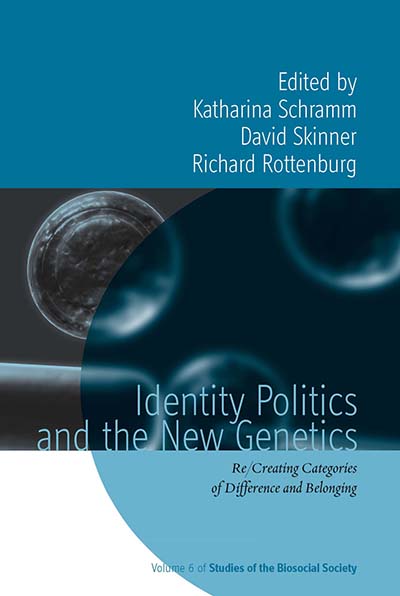
Identity Politics and the New Genetics: Re/Creating Categories of Difference and Belonging

Posted in Anthologies, Anthropology, Books, Caribbean/Latin America, Europe, Health/Medicine/Genetics, History, Identity Development/Psychology, Media Archive, Politics/Public Policy, Social Science, United Kingdom on 2012-03-18 03:04Z by Steven

Identity Politics and the New Genetics: Re/Creating Categories of Difference and Belonging

Berghahn Books
January 2012
226 pages
tables & figs, bibliog., index
Hardback ISBN: 978-0-85745-253-5

Edited by:

Katharina Schramm, Senior Lecturer of Social Anthropology
Martin-Luther-University Halle-Wittenberg

David Skinner, Reader in Sociology
Anglia Ruskin University, United Kingdom

Richard Rottenburg, Professor Social Anthropology
Martin-Luther-University Halle-Wittenberg

Racial and ethnic categories have appeared in recent scientific work in novel ways and in relation to a variety of disciplines: medicine, forensics, population genetics and also developments in popular genealogy. Once again, biology is foregrounded in the discussion of human identity. Of particular importance is the preoccupation with origins and personal discovery and the increasing use of racial and ethnic categories in social policy. This new genetic knowledge, expressed in technology and practice, has the potential to disrupt how race and ethnicity are debated, managed and lived. As such, this volume investigates the ways in which existing social categories are both maintained and transformed at the intersection of the natural (sciences) and the cultural (politics). The contributors include medical researchers, anthropologists, historians of science and sociologists of race relations; together, they explore the new and challenging landscape where biology becomes the stuff of identity.

Contents

  • List of Illustrations and Tables
  • Acknowledgments
  • Introduction: Ideas in Motion: Making Sense of Identity After DNA; Katharina Schramm, David Skinner, Richard Rottenburg
  • Chapter 1. ‘Race’ as a Social Construction in Genetics; Andrew Smart, Richard Tutton, Paul Martin, George Ellison
  • Chapter 2. Mobile Identities and Fixed Categories: Forensic DNA and the Politics of Racialised Data; David Skinner
  • Chapter 3. Race, Kinship and the Ambivalence of Identity; Peter Wade
  • Chapter 4. Identity, DNA, and the State in Post-Dictatorship Argentina; Noa Vaisman
  • Chapter 5. ‘Do You Have Celtic, Jewish, Germanic Roots?’ – Applied Swiss History Before and After DNA; Marianne Sommer
  • Chapter 6. Irish DNA: Making Connections and Making Distinctions in Y-Chromosome Surname Studies; Catherine Nash
  • Chapter 7. Genomics en route: Ancestry, Heritage, and the Politics of Identity Across the Black Atlantic; Katharina Schramm
  • Chapter 8. Biotechnological Cults of Affliction? Race, Rationality, and Enchantment in Personal Genomic Histories; Stephan Palmié
  • Notes on Contributors
  • Bibliography
  • Index
Tags: , , , , , , , , , , , ,