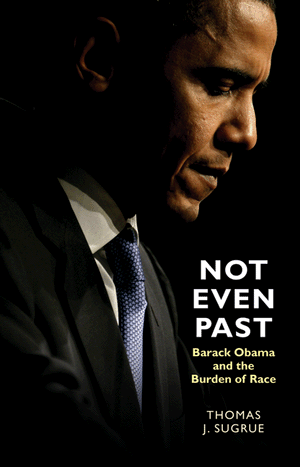
Not Even Past: Barack Obama and the Burden of Race

Posted in Barack Obama, Biography, Books, History, Media Archive, Monographs, Politics/Public Policy, United States on 2012-05-26 23:07Z by Steven

Not Even Past: Barack Obama and the Burden of Race

Princeton University Press
2010
178 pages
5 1/2 x 8 1/2
Cloth ISBN: 9780691137308
eBook ISBN: 9781400834198

Thomas J. Sugrue, David Boies Professor of History and Professor of Sociology
University of Pennsylvania
Finalist, The 2010 Benjamin L. Hooks Institute for Social Change National Book Award, The University of Memphis

Barack Obama, in his acclaimed campaign speech discussing the troubling complexities of race in America today, quoted William Faulkner’s famous remark “The past isn’t dead and buried. In fact, it isn’t even past.” In Not Even Past, award-winning historian Thomas Sugrue examines the paradox of race in Obama’s America and how President Obama intends to deal with it.

Obama’s journey to the White House undoubtedly marks a watershed in the history of race in America. Yet even in what is being hailed as the post-civil rights era, racial divisions–particularly between blacks and whites—remain deeply entrenched in American life. Sugrue traces Obama’s evolving understanding of race and racial inequality throughout his career, from his early days as a community organizer in Chicago, to his time as an attorney and scholar, to his spectacular rise to power as a charismatic and savvy politician, to his dramatic presidential campaign. Sugrue looks at Obama’s place in the contested history of the civil rights struggle; his views about the root causes of black poverty in America; and the incredible challenges confronting his historic presidency.

Does Obama’s presidency signal the end of race in American life? In Not Even Past, a leading historian of civil rights, race, and urban America offers a revealing and unflinchingly honest assessment of the culture and politics of race in the age of Obama, and of our prospects for a postracial America.

Table of Contents

  • Introduction
  • CHAPTER I: “This Is My Story”: Obama, Civil Rights, and Memory
  • CHAPTER II: Obama and the Truly Disadvantaged: The Politics of Race and Class
  • CHAPTER III: “A More Perfect Union”? The Burden of Race in Obama’s America
  • Acknowledgments
  • Notes

Introduction

It is now a commonplace that the election of Barack Obama marks the opening of a new period in America’s long racial history. The unlikely rise of a black man to the nation’s highest office—someone who was a mostly unknown state senator only five years before he was inaugurated president—confirms the view of many, especially whites, that the United States is a postracial society. At last, the shackles of discrimination have been broken and individual merit is rewarded, regardless of skin color. In this view, blackness—once the clearest marker of difference in American society—has lost some or all of its stigma. Barack Obama, in the most common formulation, transcends race; his ancestry fuses African and European into a new hybrid; his political vision of unity discredits those who cling bitterly to notions of racial superiority and, at the same time, rebukes those who harbor a divisive identity politics fueled by an exaggerated sense of racial grievance.

As with all interpretations of the relationship between the past and the present, the notion that Obama’s election marks an epochal change in racial dynamics is not without its critics. Obama himself offers a tempered view, suggesting that even if America has advanced considerably over the last forty years, some racial prejudices remain in place and some racial discrimination still exists. In his view, we have realized much, but not all, of the dream of racial equality. Other commentators, like Berkeley historian David Hollinger, suggest that Obama heralds the emergence of a new, multihued racial order, a majority-minority society where static notions of race are losing their purchase, and where race-specific remedies like affirmative action have outlived their usefulness. Many scholars and pundits further to the left, by contrast, are skeptical that much has changed at all. They point to the angry denunciations of Obama during his campaign and since his inauguration (Obama as Muslim, Obama as black man in whiteface, Obama as witch doctor, Obama as noncitizen) as evidence of a deep-seated racism that is inflamed by the discomfiting presence of a brown-hued man in the White House.

In the most dystopian vision, offered by Duke sociologist Eduardo Bonilla-Silva, the symbolism of an African-descended president obscures a deeper, more troubling reality: the “Latin Americanization” of the United States, namely, the emergence of a society where a tripartite system of color gradation will supplant the “one-drop rule” of racial classification, but where the darkest-skinned racial minorities remain concentrated at the bottom…

…To understand Obama’s life and times requires an examination of race and racial politics. It is safe to say that few domestic issues have been more controversial in late twentieth- and early twenty-first-century America. And few issues have generated more passion among scholars and journalists. Debates about civil rights, black power, race consciousness, and inequality are often couched in predictable and analytically problematic formulations that reflect the moral dualism that still shapes our understandings of race. The first binary—“race versus class”—inflects much scholarship and liberal journalism about race. Either race matters as a dominant force or it is a screen—or a form of false consciousness—that masks far deeper inequalities of class. This is a simplistic formulation that downplays the ways that racial and economic disadvantages are fundamentally intertwined, and fails to address how the American economy generates inequalities that affect people regardless of their background but are still disproportionatelyborne by people of color. A second binary—with special hold in public discourse—is “racism versus color blindness.” This contrasts a pathology and a principle, a flawed reality and an ideal. But it, too, does not stand up to close scrutiny. As legal scholar Richard Thompson Ford has argued, to hurl the invective “racist” loosely is to put too much weight on individual beliefs or values. And conversely, to proclaim color blindness is to overlook the ways that racial inequalities persist and sometimes harden regardless of the good intentions or the benign disposition of any single actor. There are stone-cold racists in America, and there are people who believe that they are wholly free of prejudice. Ultimately, the most enduring racial inequalities in the United States today are not the consequence of conspiracy or intention, or even the unconscious prejudice that neuropsychologists argue exists in the amygdala; rather they stem from the long-term institutional legacies of economic and public policies that have systematically disadvantaged African Americans and, when left unaltered, continue to do so in key realms of American life today. The third binary is “pessimism versus optimism.” Either America is still a profoundly racist society, or we have mostly overcome past racial injustices. Any clear-eyed examination of race in modern America must recognize the changes that have transformed the life chances of African Americans in the United States since the mid-twentieth century, and that enabled Barack Obama’s remarkable ascent through some of America’s most prestigious institutions and ultimately to the White House—most of them the result of grassroots activism, litigation, and public policy innovation. And it must also account for what even a cursory review of census data, opinion surveys, and health, educational, and housing statistics reveals: namely, that racial gaps are deep and persistent in American life. Those statistics, the way that Obama understands and interprets them, and the ways that Americans in general make sense of them, are at the heart of this book…

Read the entire Introduction here.

Tags: , ,

Sharing Outsider Status and a Style of Coping

Posted in Articles, Barack Obama, Media Archive, Politics/Public Policy, Religion, United States on 2012-05-26 15:27Z by Steven

Sharing Outsider Status and a Style of Coping

The New York Times
2012-05-25

Jodi Kantor

The United States quietly passed a milestone this spring, mostly lost amid the clamor of the presidential race: for the first time, neither party’s candidate is a white Protestant. The contenders are both from outsider groups that were once persecuted, and despite Harvard degrees and notable successes, both men have felt the sting of being treated as somehow strange or different.

The campaigns have mostly been in a state of détente on identity politics, trying to avoid mutually assured destruction. But the outsider backgrounds of Barack Obama and Mitt Romney have marked the race in subtler ways, shaping the candidates and campaigns, causing them to mirror each other in many ways.

Both sides face the specter of longstanding prejudices that no ad, slogan or speech may be able to dispel. In a Wall Street Journal/NBC News survey conducted last week, 27 percent of those polled said that having a Mormon president raised concerns for them or someone they know, and 12 percent said the same for a black president. Some voters say outright that they will not vote for Mr. Obama because he is black; others make jokes about Mr. Romney belonging to a cult…

…There are also parallels between the two candidates themselves, like their elliptical language: In a speech at Liberty University this month, Mr. Romney talked about his faith without ever saying “Mormon.” Weighing in on the racially fraught Trayvon Martin case, the president never used the word “black,” instead saying, indirectly but with clear feeling, “If I had a son, he’d look like Trayvon.”…

…Their approaches are safe but also somewhat obscuring. Being the first black president is one of the richest, most singular veins of Mr. Obama’s experience, but he almost never lets the country know what it is like. Mr. Romney has called being a member of the Church of Jesus Christ of Latter-day Saints one of his chief influences, and yet he does not reveal whatever emotion, lessons or moral force he derives from faith. Neither man is a voluble, heart-on-sleeve politician to begin with, and refusing to discuss central aspects of their identities can make each seem yet more remote…

Read the entire article here.

Tags: , , ,

When a Boy Found a Familiar Feel in a Pat of the Head of State

Posted in Articles, Barack Obama, Media Archive, Politics/Public Policy, United States on 2012-05-24 02:35Z by Steven

When a Boy Found a Familiar Feel in a Pat of the Head of State

The New York Times
2012-05-23

Jackie Calmes


Pete Sousa/White House

WASHINGTON — For decades at the White House, photographs of the president at work and at play have hung throughout the West Wing, and each print soon gives way to a more recent shot. But one picture of President Obama remains after three years.

In the photo, Mr. Obama looks to be bowing to a sharply dressed 5-year-old black boy, who stands erect beside the Oval Office desk, his arm raised to touch the president’s hair — to see if it feels like his. The image has struck so many White House aides and visitors that by popular demand it stays put while others come and go.

As a candidate and as president, Mr. Obama has avoided discussing race except in rare instances when he seemed to have little choice — responding to the racially incendiary words of his former pastor, for example, or to the fatal shooting of an unarmed black teenager in Florida. Some black leaders criticize Mr. Obama for not directly addressing young blacks or proposing policies specifically for them.

Yet the photo is tangible evidence of what polls also show: Mr. Obama remains a potent symbol for blacks, with a deep reservoir of support. As skittish as White House aides often are in discussing race, they also clearly revel in the power of their boss’s example…

…Jacob spoke first.

“I want to know if my hair is just like yours,” he told Mr. Obama, so quietly that the president asked him to speak again.

Jacob did, and Mr. Obama replied, “Why don’t you touch it and see for yourself?” He lowered his head, level with Jacob, who hesitated.

“Touch it, dude!” Mr. Obama said.

As Jacob patted the presidential crown, Mr. Souza snapped.

“So, what do you think?” Mr. Obama asked.

“Yes, it does feel the same,” Jacob said.

…“As a photographer, you know when you have a unique moment. But I didn’t realize the extent to which this one would take on a life of its own,” Mr. Souza said. “That one became an instant favorite of the staff. I think people are struck by the fact that the president of the United States was willing to bend down and let a little boy feel his head.”…

…A copy of the photo hangs in the Philadelphia family’s living room with several others taken that day. Mr. Philadelphia, now in Afghanistan for the State Department, said: “It’s important for black children to see a black man as president. You can believe that any position is possible to achieve if you see a black person in it.”

Read the entire article here.

Tags: , , , , ,

Breaking the Race Barrier

Posted in Articles, Campus Life, Census/Demographics, Identity Development/Psychology, Media Archive, Politics/Public Policy, United States on 2012-05-24 01:03Z by Steven

Breaking the Race Barrier

360 Magazine
Ithica College
2012-05-02

Danielle Torres

“I’m Puerto Rican.”

That’s usually what I say when people ask a second time where I am from. The first time someone asks me that question I usually say, “I’m from New York.” Then the person rephrases the question, “What are you? What is your background?”

I come from a Puerto Rican family that is short and loud. Actually, I’m a little West Indian, too, on my mother’s side. I also say I’m Hispanic but I have been told that label falls under ethnicity. I’m a little displaced when it comes to the question of race. Growing up, my family used to chuckle about the race section on the Census. We always lingered on that section a bit longer than the others trying to decide what box or boxes we should check off.

In 2009, when I was a freshman at Ithaca College, none of my peers cared about the Census. It was just another survey and spring finals were coming up. Yet, although it was a single sheet of paper, I felt that it was another symbol of young adulthood. It was my turn to decide for myself how I was going to answer the race question. What is Person 1’s race? Mark X one or more boxes. I paused, pen hovering, weighing my options…

Read the entire article here.

Tags: ,

Black Mormons and the Politics of Identity

Posted in Articles, Barack Obama, Media Archive, Politics/Public Policy, Religion, United States on 2012-05-22 21:03Z by Steven

Black Mormons and the Politics of Identity

The New York Times
2012-05-22

Susan Saulny

SALT LAKE CITY — When Marguerite Driessen, a professor here, entered Brigham Young University in the early 1980s, she was the first black person many Mormon students had ever met, and she spent a good bit of her college time debunking stereotypes about African-Americans. Then she converted to Mormonism herself, and went on to spend a good deal of her adult life correcting assumptions about Mormons.

So the matchup in this year’s presidential election comes as a watershed moment for her, symbolizing the hard-won acceptance of racial and religious minorities.

“A Mormon candidate and a black candidate? Who would have thunk!” Ms. Driessen said. “I think 30 years ago, we would not have had this choice.”

After examining the dual — and sometimes conflicting — identities, she has decided that she will cast her vote for President Obama over Mitt Romney, the presumptive Republican nominee. Ms. Driessen believes that there is plenty in the Book of Mormon to support Mr. Obama’s candidacy, and she likes to cite chapter and verse, like Mosiah 29:39 and 23:13…

…While the church does not track members by race, there are thriving Mormon churches with hundreds of black members today in many urban areas, including Washington, Chicago and New York, although African-Americans represent only a tiny fraction of the six million Mormons in the United States…

…“I feel a definite sense of pride in the U.S.A. that we have a Mormon candidate and black candidate,” said Catherine Spruill, who is mixed-race like Mr. Obama and Mormon like Mr. Romney. “I feel pride for my people, because America picked that.”…

…Religion is always on her mind, however, and she particularly enjoys a certain political punch line that is making the rounds among some black Mormons here.

It goes like this: Mr. Obama calls Mr. Romney to say he thinks it is time the country had a Mormon president. But just as Mr. Romney is thanking the president for the apparent concession, Mr. Obama interrupts him to say, “My baptism is on Saturday.”

Undoubtedly, some black Mormons are still wrestling with the decision of whom to vote for.

“It’s tough because you’ve got the first black president, but he’s running against a candidate who has the values I believe in,” said Eddie Gist, 43, a black Mormon who lives in Salt Lake City. Mr. Gist said he may end up leaning more toward Mr. Romney, but added, “I really can’t go wrong either way.”…

Read the entire article here.  Watch the video of the interview with Susan Saulny and Megan Liberman here.

Tags: , , , ,

Medicating Race: Heart Disease and Durable Preoccupations with Difference

Posted in Dissertations, Health/Medicine/Genetics, History, Media Archive, Politics/Public Policy, United States on 2012-05-21 22:04Z by Steven

Medicating Race: Heart Disease and Durable Preoccupations with Difference

Massachusetts Institute of Technology
2007
250 pages

Anne Pollock, Assistant Professor of Science, Technology and Culture
Georgia Institute of Technology, Atlanta, Georgia

Submitted to the Program in Science, Technology and Society In Partial Fulfillment of the Requirements of the Degree of Doctor of Philosophy in the History and Social Study of Science and Technology At the Massachusetts Institute of Technology

This dissertation is an examination of intersections of race, pharmaceuticals, and heart disease over the course of the 20th century and today. Each of these parts has had a dynamic history, and when they are invoked together they provide a terrain for arguments about interventions in health and in justice in the present.

An enduring aspect of discourses of heart disease over the past century has been articulating connections between characterizations of the modem American way of life and of heart disease. In that process, heart disease research and practice has participated in differentiating Americans, especially by race. This dissertation uses heart disease categories and the drugs prescribed for them as windows into racialized medicine.

The chapters are organized in a way that is roughly chronological, beginning with the emergence of cardiology as a specialty just before World War II and the landmark longitudinal Framingham Heart Study that began shortly thereafter. A central chapter tracks the emergence and mobilization of African American hypertension as a disease category since the 1960s. Two final chapters attend to current racial invocations of two pharmaceuticals: thiazide and BiDil. Using methods from critical historiography of race, anthropology, and science studies, this thesis provides an account of race in medicine with interdisciplinary relevance.

By attending to continuities and discontinuities over the period, this thesis illustrates that race in heart disease research and practice has been a durable preoccupation. Racialized medicine has used epistemologically eclectic notions of race, drawing variously on heterogeneous aspects that are both material and semiotic. This underlying ambiguity is central to the productivity of the recorded category of race. American practices of medicating race have also been mediating it, arbitrating and intervening on new and renewed articulations of inclusion and difference in democratic and racialized American ways of life.

Table of Contents

  • Abstract
  • Acknowledgements
  • Chapter 1: Introduction
  • Chapter 2: Preoccupations with Racialized Modernity in Early Cardiology
  • Chapter 3: Constructing and Supplementing Framingham’s Normal White Americans: The Framingham and Jackson Heart Studies
  • Chapter 4: The Durability of African American Hypertension as a Disease Category
  • Chapter 5: Thiazide and Racialization of a Generic Drug
  • Chapter 6: BiDil: Medi©ating the Intersection of Race and Heart Failure
  • Epilogue: Tracking Plural Noninnocent Discourses
  • Works Cited

…Early Framingham investigators did their research in an all-white population, but they participated in larger conversations about black/white differences, too. The Framingham investigators themselves participated in the simultaneous constructions of hypertension and African American hypertension in the 1960s, an era that saw the ascendance both of hypertension as a risk factor and of the Civil Rights Movement. Their own study’s lack of inclusion of African Americans did not preclude their participation in arguments about racial differences in hypertension. Addressing “Environmental Factors in Hypertension” in a 1967 publication, the investigators wrote:

The principal population groups among whom blood pressures have been reported to be lower than among Americans and Europeans are various primitive peoples. The sample size has usually been small, especially in the older ages, and conclusions about age trends are complicated both by this fact, and by the fact that it is often not possible to accurately determine the age of the subjects. Among those population groups studied adequately, the following may be said:

Blood pressure distributions are similar among such diverse groups as: Caucasians living in Europe, the United States, and the West Indies; among Chinese living in Taiwan, and among Japanese in Japan.

Negro populations have higher blood pressures than whites living in the same areas and studied by the same investigators, particularly among females and in the older age groups. Distributions of blood pressures among Negro populations living in the United States and in the West Indies, whether rural or urban, high or low salt eaters, are similar. Their blood pressures are higher than those of Negroes in Liberia, a principal source of Negro migration to the Western Hemisphere. Admixture of the Negro races in the Western Hemisphere makes the interpretation of this data difficult. It is in this general background of unencouraging experience that the study of particular environmental factors, which could conceivably affect the blood pressure level, must be approached.

I will return to the question of African American Hypertension as a disease category in Chapter 4, but for now attend to other aspects of this quote. Here, we can see the distance between direct evidence or argument and the invocation of a common sense of racialization of cardiovascular disease. Although their phrasing evokes neutral grammars of data, there are no citations or evidence for these assertions about “Negro populations,” suggesting that the authors conceive of these statements less as arguments than as reflecting the consensus of the field. Unable to grapple with the embodied admixture that is not merely biological but also historical and cultural, much history is paved over in word choices such as “migration” to describe the slave trade and “admixture” to describe oppressive sexual relations under slavery.

Paucity of data is not actually the problem. The investigators make an odd claim about the cause of the difficulty of research into environmental causes of racial disease disparities: that “admixture” gets in the way of interpretation. Logically, assimilation would be the kind of mixing that would pose a problem for separating out environmental causes of disease by race, but the investigators lacked a language for cultural, in addition to biological admixture. The peculiarity of the investigators’ framing should alert us both to the fact of racialized hypertension’s existence at the nexus of the biological and the environmental, and that Framingham is telling both a white story and a universal one…

Read the entire dissertation here.

Tags: , , ,

“Racially-Tailored” Medicine Unraveled

Posted in Articles, Health/Medicine/Genetics, Law, Media Archive, Politics/Public Policy, Social Science, United States on 2012-05-21 20:56Z by Steven

“Racially-Tailored” Medicine Unraveled

American University Law Review
Volume 55, Number 2 (December 2005)
pages 395-452

Sharona Hoffman, Professor of Law, Professor of Bioethics, and Associate Director of the Law-Medicine Center
Case Western Reserve University School of Law

Table of Contents

  • Introduction
  • I. “Race-Based” Research and Therapeutic Practices
    • A. The Story of BiDil
    • B. “Race-Based” Research
    • C. A Growing Interest in “Race-Based” Medicine: Why Now?
  • II. Does “Race” Mean Anything?
    • A. “Race” in the Medical and Social Sciences
    • B. “Race” and the Law
    • C. Shifting the Focus Away from “Race”
  • III. The Dangers of “Racial Profiling” in Medicine
    • A. Medical Mistakes
    • B. Stigmatization and Discrimination
    • C. Exacerbation of Health Disparities
  • IV. Violation of Anti-Discrimination Provisions
    • A. Constitution and Federal Civil Rights Laws
    • B. State Laws Prohibiting Discrimination in the Medical Arena
      • 1. Civil rights statutes
      • 2. Hospital and medical facility licensing requirements
      • 3. Patients’ bill of rights laws
      • 4. Public services regulation
      • 5. Insurance codes
    • C. Violation of Research Regulations and Guidelines
      • 1. NIH policy and guidelines
      • 2. Federal research regulations
    • D. Discrimination Theory
  • V. Recommendations
    • A. Review of Research Studies by Scientific Review Boards and IRBs
      • 1. Scientific reviews
      • 2. Institutional review boards
    • B. Investigators and Health Care Providers
    • C. Public Discourse Concerning Attribute-Based Medicine:The Responsibilities of Investigators, Institutions, and the Media
  • Conclusion

Introduction

F.D.A. Approves a Heart Drug for African-Americans. This June 2005 headline announced the arrival of BiDil, a heart failure edication that is approved for African-Americans only. BiDil is the first drug in pharmaceutical history that will constitute standard therapy for only one particular “race.”Health care professionals are becoming increasingly interested in “racebased” medicine in the research and therapeutic contexts. Many researchers are attempting to discern “racial” differences in disease manifestation, biological functioning, and therapeutic response rates. As this approach develops, physicians may prescribe different dosages of medication for people of separate “races” or may provide them with entirely different drugs. In light of the success of BiDil, investigators are also likely to pursue the development of additional “racially-tailored” medications. In fact, several academic and professional conferences have already devoted significant time to the discussion of “race-based” medicine. On April 18, 2005, the University of Minnesota hosted aconference entitled Proposals for the Responsible Use of Racial & Ethnic Categories in Biomedical Research: Where Do We Go From Here? Likewise, the Eighth World Congress on Clinical Pharmacology and Therapeutics, held in 2004 in Brisbane, Australia, devoted an afternoon to ethnopharmacology.While “racial profiling” in medicine has generated significant discussion in medical and bioethics circles, it has thus far gained relatively little attention in legal literature. This Article aims to develop the discourse concerning this important topic. It argues that “race-based” medicine is an inappropriate and perilous approach. The argument is rooted partly in the fact that the concept of “race” is elusive and has no reliable definition in medical science, the social sciences, and the law.  Does “race” mean color, national origin, continent of origin, culture, or something else? What about the millions of Americans who are of mixed ancestral origins—to what “race” do they belong? To the extent that “race” means “color” in colloquial parlance, should physicians decide what testing to conduct or treatment to provide based simply on their visual judgment of the patient’s skin tone? “Race,” consequently, does not constitute a valid and sensible foundation for research or therapeutic decision-making.

Further, this Article contends that “racial profiling” in medicine can be dangerous to public health and welfare. A focus on “race,” whatever its meaning in the physician’s eye, can lead to medical mistakes if the doctor misjudges the patient’s ancestral identity or fails to recall that a particular condition affects several vulnerable groups and not just one “race.” The phenomenon can also lead to stigmatization and discrimination in the workplace and elsewhere if the public perceives certain “races” as more diseased or more difficult to treat than others. In addition, “racial profiling” could exacerbate health disparities by creating opportunities for health professionals to specialize in treating only one “race” or to provide different and inferior treatment to certain minorities. It could also intensify African-Americans’ distrust of the medical profession. Finally, “race-based” medicine might violate numerous anti-discrimination provisions contained in federal law, state law, and federal research regulations and guidelines…

…The Article will proceed as follows. Part I of the Article will describe “race-based” research and therapeutic practices and will examine the growing interest in “race-based” medicine and the reasons for it. Part II will argue that “race” is a concept that has no coherent meaning and that is potentially pernicious. Part III will focus on the dangers of “raciallytailored” medicine, and Part IV will analyze a variety of anti-discrimination mandates that could potentially be violated by the practice. Finally, Part V will detail recommendations for the development of attribute-based medicine in a manner that will promote the health and welfare of all population groups…

…This Article argues against substantial use of the concept of “race” in medical settings. A primary reason for this restriction is that “race” has no coherent meaning, and therefore, reliance upon it for research or treatment purposes can be confusing at best and can lead to significant adverse consequences at worst. This section will build the argument that based on medical science, the social sciences, and the law, “race” has no reliable definition or real meaning. Moreover, it is a pernicious concept that has been used to suggest that human beings can be divided into subspecies, some of which are morally, intellectually, and physically inferior to others. Thus, medical professionals should focus on more precise and meaningful aspects of human identity rather than on the amorphous concept of “race.”…

Read the entire article here.

Tags: , ,

Off white

Posted in Articles, Census/Demographics, New Media, Politics/Public Policy, United States on 2012-05-20 00:23Z by Steven

Off white

The Indian Express
New Delhi, India
2012-05-19

Census data confirms America’s enduring ability to bring the world home

The United States has crossed a demographic tipping point, driven by changes in immigration, fertility and mortality patterns. By now, more than half the babies born in the US belong to a racial or ethnic minority. The US Census Bureau has confirmed what was clear ever since the 2000 census, where 49.8 per cent of infants under one were members of a minority — more than a quarter was Hispanic, 13.6 per cent blacks and 4.2 per cent Asian. Almost one in 20 births was a mixed-race baby. Of course, this counting is complicated. For instance, many mixed-race people and Latinos consider themselves white. However, it is clear that the United States of America is set to look markedly different than it did a few decades ago…

Read the entire article here.

Tags: ,

Out writer Andrew Jolivétte on Obama and race

Posted in Articles, Barack Obama, Gay & Lesbian, Media Archive, Politics/Public Policy, Social Science, United States on 2012-05-17 02:36Z by Steven

Out writer Andrew Jolivétte on Obama and race

Windy City Times
Chicago, Illinois
2012-02-21

David-Elijah Nahmod

History was made a few short years ago, when Barack Obama became the first African American president in U.S. history. Though it’s been mentioned, the fact that the president is actually half white hasn’t gotten nearly as much attention.

There’s no question that American demographics are changing rapidly. The Leave It To Beaver/Father Knows Best nuclear family is disappearing, and is being replaced by families that encompass all the colors of the rainbow.

In his new book, Obama and the Biracial Factor (The Policy Press), professor Andrew J. Jolivétte of San Francisco State University offers a series of essays in which a variety of writers discuss the changing colors of the American landscape. The writers are all university academics, representing a variety of schools and ethnicities. Jolivette talked with Windy City Times about why he felt the book was needed, as well as his own status as a multicultural gay man.

Windy City Times: Can you tell us about the classes you teach at San Francisco State University?

Andrew J. Jolivette: I started teaching almost 12 years ago at the University of San Francisco. It was a people of mixed-descent class that focused on people who are multiracial. I was born and raised in San Francisco and moved to Oakland about eight years ago. For the past two years I’ve been chair of the American Indian Studies Department at San Francisco State University.

I’ve taught a lot of different classes over the years: Mixed Race Studies, People of Color and AIDS, American Indian Education, American Indian Religion and Philosophy, and Black Indians in the Americas. I suppose because of my training in sociology I am interested in many different social and behavior explanations for societal inequalities, especially for Native Americans, LGBT and communities of color…

…WCT: Why do you think there’s a need for this book?

Andrew J. Jolivette: My own background as a Louisiana Creole (French, American Indian–Opelousa and Atakpa, African and Spanish ) has always hadan impact on my identity. Growing up I wasn’t sure where I fit in exactly in terms of race. My father is a Creole from the Southwest and my mother is African American and American Indian from Alabama and Indianapolis. People always tried to guess what my background was and I’ve heard just about everything from Egyptian and Cuban to East Indian. People from mixed backgrounds are often forced to move between different identities. In the case of Mr. Obama, I argue he knows how to navigate through many different communities. He can relate to white Americans, Black Americans and many other groups because he’s lived in so many different cultures. He has found a way to relate to people that helped him get elected…

…WCT: When he was first elected, much was made of Obama being the first Black president. Do you have any insight as to why his biracial status hasn’t gotten nearly as much attention?

Andrew J. Jolivette: Most of the country still argues that if you have any African or Black ancestry you will be seen and treated as Black. This is true only to a certain extent. In the book, I argue that being half white, being biracial, also shapes who he is as a person…

Read the entire article here.

Tags: , , ,

Race Decoded: The Genomic Fight for Social Justice

Posted in Books, Health/Medicine/Genetics, Media Archive, Monographs, Politics/Public Policy on 2012-05-17 02:22Z by Steven

Race Decoded: The Genomic Fight for Social Justice

Stanford University Press
April 2012
280 pages
Cloth ISBN: 9780804774079
Paper ISBN: 9780804774086
E-book: ISBN: 9780804782050

Catherine Bliss, Assistant Professor of Sociology
University of California, San Francisco

Winner of the 2014 Oliver Cromwell Cox Award, sponsored by the ASA Section on Racial and Ethnic Minorities.

In 2000, with the success of the Human Genome Project, scientists declared the death of race in biology and medicine. But within five years, many of these same scientists had reversed course and embarked upon a new hunt for the biological meaning of race. Drawing on personal interviews and life stories, Race Decoded takes us into the world of elite genome scientists—including Francis Collins, director of the NIH; Craig Venter, the first person to create a synthetic genome; and Spencer Wells, National Geographic Society explorer-in-residence, among others—to show how and why they are formulating new ways of thinking about race.

In this original exploration, Catherine Bliss reveals a paradigm shift, both at the level of science and society, from colorblindness to racial consciousness. Scientists have been fighting older understandings of race in biology while simultaneously promoting a new grand-scale program of minority inclusion. In selecting research topics or considering research design, scientists routinely draw upon personal experience of race to push the public to think about race as a biosocial entity, and even those of the most privileged racial and social backgrounds incorporate identity politics in the scientific process. Though individual scientists may view their positions differently—whether as a black civil rights activist or a white bench scientist—all stakeholders in the scientific debates are drawing on memories of racial discrimination to fashion a science-based activism to fight for social justice.

Table of Contents

  • Acknowledgments
  • Introduction
  • 1. The New Science of Race
  • 2. Making Science Racial
  • 3. The Sociogenomic Paradigm
  • 4. Making Sense of Race with Values
  • 5. Everyday Race-Positive
  • 6. Activism and Expertise
  • 7. The Enduring Trouble with Race
  • Notes
  • Index
Tags: , , , , ,