Virgina Ban on Interracial Marriages Goes to Federal Court This Week

Posted in Articles, Law, Media Archive, United States, Virginia on 2013-10-23 23:13Z by Steven

Virginia Ban on Interracial Marriages Goes to Federal Court This Week

The New York Times
1965-01-24
page 43

RICHMOND, Jan. 23—A constitutional test of Virginia laws that make it a crime for a white person to marry a Negro will begin here next week. The case is regarded as certain to go to the United States Supreme Court and may become a landmark. Eighteen other states have similar laws that would be affected by a Supreme Court decision in the Virginia case.

In a unanimous opinion last month, the Court struck down a Florida statute punishing extramarital cohabitation by whites and Negroes. It avoided a ruling on state laws against interracial marriage, but the decision raised new doubts about the continuing validity of such laws.

Knew About Law

On Wednesday, lawyers for the American Civil Liberties Union will argue before a three-judge Federal court here that the state’s enforcement of Virginia’s antimiscegenation laws has grossly violated the constitutional rights of Mr. and Mrs. Richard P. Loving, both life-long residents of Virginia.

Mr. Loving, 31 years old, is a big, silent construction worker. He is white. His wife, Mildred, 25, is colored—part Indian and part Negro. Both had spent their lives in Caroline County, just south of Fredericksburg, until January, 1959, when they were banished from the state by County Circuit Judge Leon M. Bazile. They moved to Washington with their three children. Aware of the Virginia law, they had been married in Washington on June 2, 1958.

The charge brought against them five weeks after their marriage was violation of Title 20, Sections 53 and 59 of the Virginia Code:

“If any white person and colored person shall go out of this state for the purpose of being married and with the intention of returning … they shall be punished — by confinement in the penitentiary for not less than one nor more than five years.”

Other sections of the code provide for the annulment of interracial marriages “without any decree of divorce” and for a fine of $200 for performing an interracial marriage ceremony, “of which the informer shall have one-half.”…

Read or purchase the article here.
Tags: , , , , ,

Interracial couples now part of mainstream

Posted in Articles, Media Archive, Social Science, United States on 2013-10-23 13:59Z by Steven

Interracial couples now part of mainstream

The Chicago Tribune
2013-10-23

Dawn Turner Trice, Reporter

Mixed-race relationships becoming more common in Chicago — and everywhere else

Stephen Blessman and Patricia Jones Blessman met in the mid-1990s and fell in love. It didn’t matter to either of them that he’s white and she’s African-American.

They have a lot in common. They are both Roman Catholic and deeply involved in the church. They came of age in the 1960s and are socially conscious.

“But we didn’t get married to prove a point,” said Blessman, 57, who lives with his wife of 14 years and their 5-year-old son in Chicago’s South Loop. “I fell in love with her because she’s funny, beautiful, smart and principled and we’re of the same generation and have the same values.”

As an interracial couple in America, the Blessmans are a relatively rare pairing — but such couples are not nearly as rare as they used to be. A study by the Pew Research Center found that in 2010 about 15 percent of all new marriages in the U.S. were between spouses of a different race or ethnicity — more than double the 6.7 percent in 1980.

The surge has brought the percentage of all current U.S. marriages that are interracial to 8.4 percent. In Chicago, about 7.4 percent of marriages in 2011 involved mixed-race couples, according to data compiled by the Center for Governmental Studies at Northern Illinois University…

…Even in politics, where for many years it was considered a drawback to be in an interracial relationship, there’s been a shift. In New York City, Bill de Blasio, a white man married to a black woman, is the front-runner in the mayoral race. In Illinois, two prominent white political figures, Gov. Pat Quinn and former Chicago Mayor Richard M. Daley, are dating black women. And of course, President Barack Obama is the product of an interracial marriage.

Even so, experts say modern mixed-race relationships, like the country’s racial past, can be complicated.

“When I research in white communities across the class division and the country, people say they’re fine with interracial relationships,” said Erica Chito Childs, an associate professor of sociology at Hunter College/CUNY Graduate Center.

“But they also say, ‘Why do it? Marriage is difficult enough. Why make it more difficult?’ You hear about young people growing up in a more multiracial world and being so much more accepting, but the majority says dating is fine, marriage is not.

She said that many young people still live in racially homogenous neighborhoods and their first pool of partners tends to reflect that. In addition, first marriages are often more closely tied to the expectations of family and community members…

…The Pew Research Center study released last year, using 2010 data, is the most recent major look at interracial relationships. It found that among new marriages in 2010, Asians were the group most likely to intermarry, at 27.7 percent. Hispanics were next at 25.7 percent, then blacks at 17.1 percent and whites at 9.4 percent. For the Pew study, marriages between two people who are mixed-race weren’t considered interracial.

In Chicago, the most common interracial marriages in 2011 were between Asians and whites. Those types of pairings were about four times more likely than black-white marriages, according to data compiled by the Center for Governmental Studies, using the Integrated Public Use Microdata Series.

Laura Kina, 40, is Japanese-American and white. For the past 16 years she has been married to Mitch Aronson, 54, who’s white and Jewish. She grew up as an evangelical Christian in a small Seattle suburb of Norwegian immigrants, and converted to Judaism after marrying. She said she’s always identified as a person of color…

…Online dating has made it easier for people who want to date interracially but don’t work together or hang out in racially diverse circles.

“It provides a safe space for people who are afraid of rejection and don’t feel comfortable walking up to someone of a different race and asking them out,” said Hunter College’s Childs, the author of “Fade to Black and White: Interracial Images in Popular Culture.”…

Read the entire article here.

Tags: , , , , , , , , , , , , , ,

crossings: undone presents, pyrrhic futures

Posted in Articles, Census/Demographics, Identity Development/Psychology, Media Archive, Politics/Public Policy, Social Science, United States on 2013-10-23 02:10Z by Steven

crossings: undone presents, pyrrhic futures

The State
Dubai, U.A.E.
Voicing
2013-03-30

Tiana Reid
Columbia University

“Cyaan live split. Not in this world.”

The first time I read Michelle Cliff’s 1987 book No Telephone to Heaven, I immediately forgot which character had said this line. Was it Harry/Harriet, the queer Jamaican character? Or was it Clare Savage, the cosmopolitan “bi-racial” protagonist? It could have been either/both really. And that was partially the point.

What I did remember, however—what I felt—was the resonances of feeling the impulse of having to choose identity. The backdrop, for Clare, and to some extent for Cliff too, is about negotiating an existence in between races, cultures, nationalities and an endless act of et cetera. In the book, Clare undergoes a process of becoming(s) through a series of transatlantic yearnings, which culminate in her realization that she must choose her identity. And then, well, dies for that choice. In an essay called “Clare Savage as a Crossroads Character,” Cliff writes that “in [Clare’s] death she has complete identification with her homeland; soon enough she will be indistinguishable from the ground. Her bones will turn to potash, as did her ancestors’ bones.”

All the same, Clare is never accepted and never accepts herself. I’m still not sure what’s worse. No Telephone to Heaven complicates the idea of wholeness and that in order to “be true to yourself” if you have one parent, say, of European ancestry and the other of African ancestry, you should, as a citizen of the West (or perhaps the global West, i.e., the world) acknowledge the ambiguity of your both/and state of being, as if everyone doesn’t exist in a similar mode of being. A multimodal existence— a similar vacillating position of entering, understanding and being in the world. Don’t we all exist between things—parents, cultures, lovers, yesses and nos, life and death?

What I remembered, then, was what I didn’t think I had to be aware of. What I remembered was that until then, until that very moment when I read No Telephone to Heaven, I had identified as “mixed,” which would refer to my White mom and my Black Jamaican dad, who got married and had sex and had miscarriages and then had me. But I mean, isn’t a child always a mixture? Aren’t we (and is the “we” here decidedly North American?) all products of mixings and jumbles and breaking of the law pre-Loving v. Virginia and also victims and perpetrators of rape before abolition, and, and, and…?

I won’t get into how I learned how not to identify as “mixed,” how I began to understand that “mixed-race” in my generation was predicated on racial essentialism, false notions of purity, historical inaccuracies and worst of all, a sense of superiority over those who were only Black. Soon, I understood “mixed” as an intermediary between Black and White, a cushion almost, between racism and progress…

Read the entire article here.

Tags: ,

Indiana’s Miscegenation Laws: An Ineffective Racist Agenda

Posted in Dissertations, History, Law, Media Archive, United States on 2013-10-23 01:55Z by Steven

Indiana’s Miscegenation Laws: An Ineffective Racist Agenda

Ball State University, Muncie, Indiana
May 2013
57 pages

Megan M. Harris

An Undergraduate Honors Thesis (HONRS 499)

Miscegenation laws have played an influential and explanatory role in Indiana’s perception and attitudes about interracial relationships. Indiana had stringent regulations against such unions, which existed for a large portion of the Hoosier state’s history. Despite the unusually harsh legislations against these couples, interracial marriages continued to occur in Indiana. In fact, some multiracial communities, such as the Longtown Settlement, were created as safe havens for these couples. Although these laws were repealed in Indiana two years before the country abolished them nationwide in 1967, the state has had persistent attitudes against interracial marriage that couples must endure. In the face of the continual growth of such unions, local and national attitudes can be adjusted to greater social acceptance, especially with a clear understanding of the racism that underlies the previous miscegenation laws that outlawed interracial marriages.

Read the entire thesis here.

Tags: , , ,

How Indiana Punishes Miscegenation

Posted in Articles, Law, Media Archive, United States on 2013-10-23 01:40Z by Steven

How Indiana Punishes Miscegenation

The New York Times
1879-05-21

Terre Haute, Ind., May 20.—William Nelson, a colored man, was sentenced to-day to pay a fine of $5,000 and be imprisoned in the Penitentiary for one year for marrying a white woman. The prosecution originated in spite, but Nelson was convicted under the law of 1856, which Judge Long held to be valid through a decision of the Supreme Court.

Tags: , , , ,

Critical Mixed Race Studies in the Twenty-First Century (ETHN 0090B S01)

Posted in Course Offerings, History, Literary/Artistic Criticism, Media Archive, Social Science, United States on 2013-10-21 02:38Z by Steven

Critical Mixed Race Studies in the Twenty-First Century (ETHN 0090B S01)

Brown University
Fall 2013

Alexandrina R. Agloro, Visiting Instructor in American Studies

This course will guide students through an understanding of the historical, contemporary, and ideological rationale behind the constructions of mixed race, and how mixed race theory plays out in history, art, and contemporary media. This course aims to expand the conversations of mixed race beyond the stereotypes of tragic mulattos and happy hapas, instead interrogating what mixed race looks like in the twenty-first century and what historical precedents can explain current phenomena.

For more information, click here. View the syllabus (in Microsoft Word format) here.

The week of October 20th, my co-authored article with Glenn C. Robinson titled, “The Impact of Internet Publishing and Online Communications on Mixed-Race Discourses” from the Asian American Literary Review Special Issue on Mixed Race, will be part of the required reading. Please read the syllabus for information on some other additional excellent resources.

Tags: , ,

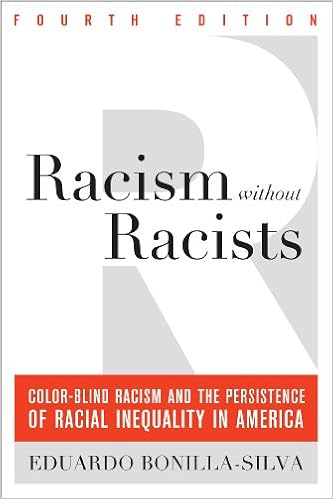
Racism without Racists: Color-Blind Racism and the Persistence of Racial Inequality in America (Fourth Edition)

Posted in Barack Obama, Books, Media Archive, Monographs, Politics/Public Policy, Social Science, United States on 2013-10-20 18:35Z by Steven

Racism without Racists: Color-Blind Racism and the Persistence of Racial Inequality in America (Fourth Edition)

Rowman & Littlefield
July 2013
384 pages
6 1/4 x 9 1/2
Hardback ISBN: 978-1-4422-2054-6
Paperback ISBN: 978-1-4422-2055-3
eBook ISBN: 978-1-4422-2056-0

Eduardo Bonilla-Silva, Professor of Sociology
Duke University

Eduardo Bonilla-Silva’s acclaimed Racism without Racists documents how beneath our contemporary conversation about race lies a full-blown arsenal of arguments, phrases, and stories that whites use to account for—and ultimately justify—racial inequalities. This provocative book explodes the belief that America is now a color-blind society.

The fourth edition adds a chapter on what Bonilla-Silva calls “the new racism,” which provides the essential foundation to explore issues of race and ethnicity in more depth. This edition also updates Bonilla-Silva’s assessment of race in America after President Barack Obama’s re-election. Obama’s presidency, Bonilla-Silva argues, does not represent a sea change in race relations, but rather embodies disturbing racial trends of the past.

In this fourth edition, Racism without Racists will continue to challenge readers and stimulate discussion about the state of race in America today.

Features

  • An engaging read that provokes classroom discussion
  • Challenges the truth behind the assumption “I don’t see race”
  • A new chapter on what Bonilla-Silva calls “new racism” in America introduces students to key themes in studying race and ethnicity
  • Assesses the impact of Obama’s presidency and reelection on race relations in America

Table of Contents

  • Acknowledgments
  • Preface to the Fourth Edition
  • 1. The Strange Enigma of Race in Contemporary America
  • 2. The New Racism: The U.S. Racial Structure Since the 1960s
  • 3. The Central Frames of Color-Blind Racism
  • 4. The Style of Color Blindness: How to Talk Nasty about Minorities without Sounding Racist
  • 5. “I Didn’t Get That Job Because of a Black Man”: Color-Blind Racism’s Racial Stories
  • 6. Peeking Inside the (White) House of Color Blindness: The Significance of Whites’ Segregation
  • 7. Are All Whites Refined Archie Bunkers? An Examination of White Racial Progressives
  • 8. Are Blacks Color Blind, Too?
  • 9. E Pluribus Unum, or the Same Old Perfume in a New Bottle? On the Future of Racial Stratification in the United States
  • 10. Race Matters in Obamerica: The Sweet (but Deadly) Enchantment of Color Blindness in Black Face
  • 11. “The (Color-Blind) Emperor Has No Clothes”: Exposing the Whiteness of Color Blindness
  • Bibliography
  • Index
  • About the Author
Tags: ,

The Uniqueness of Dante de Blasio

Posted in Articles, Media Archive, Politics/Public Policy, Social Science, United States on 2013-10-20 01:27Z by Steven

The Uniqueness of Dante de Blasio

Gotham Gazette: The Place or New York Policy and Politics
New York, New York
2013-09-24

Andy Beveridge, Professor of Sociology
Queens College, City University of New York

As New York took in the extent of the win by Bill de Blasio in the Democratic primary for mayor, the impact of a powerful television ad starring his son Dante seemed plain.

The ad hit on de Blasio’s main campaign points of taxing the wealthy, ending a “stop-and-frisk era that unfairly targets people of color” and universal pre-K. But it was the messenger that made it a show-stopper: A mixed-race kid with an exuberant Afro speaking to the camera about how his dad was “the only Democrat with the guts to really break with the Bloomberg years.”

De Blasio’s wife is a black woman, and both Dante and Chiara (his daughter) are mixed race. With his family and the ad featuring his son playing key roles in his campaign, de Blasio split the black vote almost evenly with former comptroller Bill Thompson, the only black candidate for mayor.

Remember, in the primary between Hillary Clinton and Obama, who is mixed race, in 2008 Hillary Clinton did better among white and Hispanic voters than she did overall, and Barack Obama won the black vote by a very wide margin in an overall close race. In terms of who voted for whom, race mattered.

As Joe Lenski, the man behind the exit polls, said in the Daily News, “I don’t know if I could ever remember a race where a black guy is (close to) losing the black vote, the woman is losing the woman vote, the Jewish guy is losing the Jewish vote. It’s quite impressive …. De Blasio did a good job of saying, ‘I’m one of you even though I’m not personally one of you.’ He was able to say, ‘my wife is African-American, my kids are multiracial.”

How unique is Dante de Blasio, the 16-year-old superstar of the 2013 elections, who communicated this important message? Just how many New Yorkers are non-Hispanic males who would identify themselves as black and white? An analysis of 2010 Census data shows that very few young New Yorkers are black and white, and even fewer are non-Hispanic black and white. Furthermore, there are much lower proportions of such individuals in New York City in the country at large. These data are presented in the accompanying table, and some are summarized in the two charts below…

Read the entire article here.

Tags: , , , , , , , ,

De Blasio Responds to Lhota’s Doomsday Ad With a Cheery One

Posted in Articles, Media Archive, Politics/Public Policy, United States on 2013-10-20 00:06Z by Steven

De Blasio Responds to Lhota’s Doomsday Ad With a Cheery One

Politicker
2013-10-17

Colin Campbell

Tale of Two Ads

A day after Joe Lhota released an ad warning of apocalyptic results if rival Bill de Blasio is elected mayor–complete with photos of race riots and corpses–Mr. de Blasio is out with a new spot of his own.

But Mr. de Blasio’s ad, narrated by his daughter Chiara, is almost saturated in sweetness.

“From the start of this campaign, Bill de Blasio has offered a vision for New York that leaves no one behind. Now that my dad’s on the move. His opponents are on the attack,” says the older of the de Blasio kids, wearing her signature rose-adorned headband, as cheery music plays…

Read the entire article here.

Tags: , , , , , , ,

Fitting Into the Right Box: Multiracial America on the Rise

Posted in Articles, Census/Demographics, Media Archive, Social Science, United States on 2013-10-19 23:53Z by Steven

Fitting Into the Right Box: Multiracial America on the Rise

Brown Political Review
2013-10-18

Meg Sullivan

As swimmer Michael Phelps knows, one of the highest priorities of food corporations is maintaining their squeaky clean mainstream appeal. This usually involves companies giving wide berth to any manner of controversy, but Cheerios ignored this policy four months ago. In June, the cereal company released a 30 second television commercial that featured a mixed race married couple. The only detail of the ad that deviated from standard cereal advertisement conventions was black man and white woman actors playing the parents in the all-American family.

Whether or not Cheerios predicted the commotion their commercial would cause, we don’t know. Regardless, the ad first met backlash–negative reactions drove YouTube to disable comments on the online video–but then an overwhelming show of support from Americans. The multiracial community applauded Cheerios for depicting a family on television that looked more like theirs.

Aside from generating good publicity for Cheerios, the advertisement has drawn attention to the growing number of mixed race marriages and multiracial children in the United States. In 2010, 8.4 percent of all marriages were between individuals of a different race or ethnicity

Read the entire article here.

Tags: , , ,