Honoring one of their own

Posted in Articles, History, Media Archive, United States on 2013-11-14 04:04Z by Steven

Honoring one of their own

Bucks County Courier Times
Levittown, Pennsylvania
2013-11-13

Phil Gianficaro, News columnist

The inscription on the small old tombstone in the shadow of the majestic oak tree is practically illegible. Weathered and darkened by 148 years, the tablet-shaped marker pales in comparison to others that are more ornate in the Hatboro Baptist Church Cemetery. A noteworthy war veteran from Hatboro, it would seem, deserves a more appropriate remembrance.

Now he has one.

Near that barren oak tree this week, they gathered on a sunny Veterans Day morning to honor one of their own, Barclay J. Stagner, the town’s first man of color to serve in the Civil War. A new tombstone, supplied by the Veterans Administration, was dedicated to Stagner and placed several feet from the old stone and beside the gravestone of his mother, Elizabeth.

“This is a special, long overdue honor,” said David Shannon, Hatboro historian and curator of the cemetery, before a small gathering at the graveside. “While many in the congregation were aware of Barclay, we were intent on letting the community know he existed.”…

…Stagner was born during the time of slavery. He wasn’t a member of the Hatboro Baptist Church, but was a close friend of Union Army Gen. William Davis, who was. That relationship, combined with his light skin color and blue eyes that belied his race, likely helped Stagner get accepted into the Union Army at a time before blacks were recruited or permitted to enlist.

“We don’t know if Barclay was black or what used to be called mulatto, or a mixed race,” Shannon said. “He was likely of mixed race. But because he wasn’t dark skinned, they probably didn’t know.”

Stagner became a sergeant in the 6th Pennsylvania Volunteer Cavalry, and fought in the Battle of Gettysburg. Upon his re-enlistment as a veteran volunteer, he rose to the rank of corporal. He died in Virginia at age 28 on Jan. 3, 1865, and his remains were sent to Hatboro to be interred…

Read the entire article here.

Tags: , , , , , ,

Being Black: It’s not the skin color

Posted in Articles, Arts, Autobiography, Identity Development/Psychology, Media Archive, Social Science, United States on 2013-11-13 16:37Z by Steven

Being Black: It’s not the skin color

Philadelphia Weekly
2013-11-13

Kennedy Allen et al.

Drexel prof Yaba Blay’s striking new photo book “One Drop” explores how a wide range of different skin tones affects Americans’ personal identities. In  this PW excerpt, eight Philadelphia-area residents of mixed heritage concur: However light they may be, they’re still most certainly Black. Our own Kennedy Allen agrees…

Growing up in Mt. Airy, an ethnic and economically diverse neighborhood, instilled within me a level of acceptance and tolerance regarding my fellow man that, confoundingly, many didn’t seem to share. I was one of seven Black kids in a class of 42. Because I spoke English properly and preferred rock to rap, I was deemed “White girl” by my racial peers—a label that haunted me for what felt like eons. I knew I wasn’t White, nor did I ever have the urge to be, outside of wishing my hair would blow in the wind like some of the girls in my class. Flash-forward to my final years of high school, in a black school where I was the “light-bright girl who talks White.” Dark-skinned people still sneer at me, somehow assuming that I believe myself to be “better” than they are because of my buttered-toffee skin tone.

When all is said and done, racial or ethnic identity rests upon the individual and their experiences. I identify myself as a black woman who happens to have Irish and Cherokee lineage. What of all the others who identify as black, but appear otherwise? Scholar and activist Arturo Schomburg, whose extensive collection of books and historical records of African people’s achievements eventually became the famed Schomburg Center for Research in Black Culture in Harlem, N.Y., identified as an Afro-Puerto Rican. (In fact, his passion for gathering all those documents was born after a grade-school teacher told him that black people had no history, heroes or accomplishments.) Would Schomburg’s experience be less valid because it fails to meet some homogenous notion of Blackness? Who has the right to determine these standards in the first place? And in an age of global interconnectedness and the instant, worldwide exchange of information and ideals, why does it still even matter?

Dr. Yaba Blay wondered some of the same things. A first-generation Ghanian-American and the co-director of Drexel’s Africana studies program, Blay has spent the past two years gathering vibrant portraits and intimate stories from nearly 60 individuals across the country in an attempt to shine some light upon questions of racial ambiguity and legitimacy. Those portraits now comprise a new book that she’s edited and published, (1)ne Drop: Shifting the Lens on Race—as well as an exhibit of the same name, currently on display at the Painted Bride Art Center

Read the entire article and eight subject profiles from the book here.

Tags: , , , , , , , , , , , , , , , ,

Red: Racism and the American Indian

Posted in Articles, Law, Media Archive, Native Americans/First Nation, United States on 2013-11-12 22:50Z by Steven

Red: Racism and the American Indian

UCLA Law Review
Volume 56, Issue 3 (February 2009)
pages 591-656

Bethany R. Berger, Thomas F. Gallivan, Jr. Professor of Real Property Law
University of Connecticut

How does racism work in American Indian law and policy? Scholarship on the subject too often has assumed that racism works for Indians in the same way that it does for African Americans, and has therefore either emphasized the presence of hallmarks of black-white racism, such as uses of blood quantum, as evidence of racism, or has emphasized the lack of such hallmarks, such as prohibitions on interracial marriage, to argue that racism is not a significant factor. This Article surveys the different eras of Indian-white interaction to argue that racism has been important in those interactions, but has worked in a distinctive way. North Americans were not primarily concerned with using Indian people as a source of labor, and therefore did not have to theorize Indians as inferior individuals to control that labor. Rather, the primary concern was to obtain tribal resources and use tribes as a flattering foil for American society and culture. As a result, it was necessary to theorize tribal societies as fatally and racially inferior groups, while emphasizing the ability of Indian individuals to leave their societies and join non-Indian ones. This theory addresses the odd paradox that the most unquestionably racist eras in Indian-white interaction emphasized and encouraged assimilation of Indian individuals. It also contributes to the ongoing effort to understand the varying manifestations of racism in a multiracial America. Most important, it provides a new perspective on efforts to curtail tribal sovereignty in the name of racial equality, revealing their connection to historic efforts to maintain the inferiority of Indian tribes by treating them as racial groups rather than political entities with governmental rights.

Read the entire article here.

Tags: , ,

Beyond Our Hearts: The Ecology of Couple Relationships

Posted in Articles, Book/Video Reviews, Law, Media Archive, United States on 2013-11-12 18:07Z by Steven

Beyond Our Hearts: The Ecology of Couple Relationships

California Law Review Circuit
Volume 4, October 2013
pages 155-164

Holning Lau, Professor of Law
University of North Carolina School of Law

In his review of Professor Angela Onwuachi-Willig’s book, According to Our Hearts: Rhinelander v. Rhinelander and the Law of the Multiracial Family, Professor Holning Lau extends Professor Onwuachi-Willig’s analysis of how external support is instrumental to the success of relationships beyond multiracial couples. Arguing that ecological factors should play a larger role in policy discussions about marital relations, Professor Lau examines the debates surrounding same-sex marriage and the Healthy Marriage Initiative and concludes that policymakers should more carefully consider how exogenous circumstances affect the success of intimate relationships.   

Read the entire article here.

Tags: , , ,

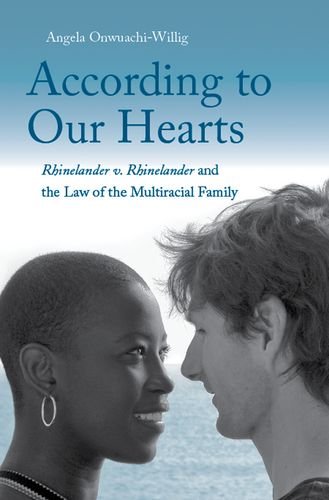
According to Our Hearts: Rhinelander v. Rhinelander and the Law of the Multiracial Family

Posted in Books, Law, Media Archive, Monographs, United States on 2013-11-12 17:24Z by Steven

According to Our Hearts: Rhinelander v. Rhinelander and the Law of the Multiracial Family

Yale University Press
2013-06-18
344 pages
6 1/8 x 9 1/4
30 b/w illus.
Cloth ISBN: 9780300166828

Angela Onwuachi-Willig, Charles M. and Marion J. Kierscht Professor of Law
University of Iowa

This landmark book looks at what it means to be a multiracial couple in the United States today. This book begins with a look back at a 1925 case, in which a two-month marriage ends with a man suing his wife for misrepresentation of her race, and shows how our society has yet to come to terms with interracial marriage. Angela Onwuachi-Willig examines the issue by drawing from a variety of sources including her own experiences. She argues that housing law, adoption law, and employment law fail, in important ways, to protect multiracial couples.  In a society in which marriage is used to give, withhold and take away status—in the workplace and elsewhere—she says interracial couples are at a disadvantage, which is only exacerbated by current law.

Tags: , ,

What’s Biology Got to Do with It? The Social Life of Genetics

Posted in Anthropology, Health/Medicine/Genetics, Media Archive, Social Science, United States on 2013-11-12 04:26Z by Steven

What’s Biology Got to Do with It? The Social Life of Genetics

Brooklyn Historical Society
Crossing Borders, Bridging Generations
Saturday, 2013-11-16, 15:00-18:00 EST (Local Time)

Part One of the reading series Quantifying Bloodlines

  • What do we learn about ourselves through genetics and genealogy?
  • How does DNA connect with what we know about our family’s ancestry and cultural heritage?

Join anthropologist, Jennifer Scott in conversation with sociologist Ann Morning, author of The Nature of Race: How Scientists Think and Teach about Human Difference (2011), for a discussion examining the social life of DNA.

Having read The Immortal Life of Henrietta Lacks by Rebecca Skloot, we will explore the tremendous social impact of one woman’s cellular legacy upon the world. We will discuss the impact on her direct descendants as Henrietta Lacks’ family discovers how their genes were used to make unprecedented medical advancements and enormous profits without their consent. Looking at the connections between biology and culture, this discussion session will explore the meanings of heredity, inheritance, and questions of bioethics.

Please plan to have read the book prior to our meeting.

This reading and discussion group is co-sponsored by MixedRaceStudies.org

For more information, click here.

Tags: , , , ,

Soledad O’Brien Explores Racial and Ethnic Identity in Provocative Black in America

Posted in Articles, Identity Development/Psychology, Media Archive, Social Science, United States, Videos on 2013-11-12 02:16Z by Steven

Soledad O’Brien Explores Racial and Ethnic Identity in Provocative Black in America

CNN Press Room
Cable News Network (CNN)
2012-12-04

Who is Black in America? Debuts Sunday, Dec. 9 at 8:00 p.m. & 11:00p.m. ET & PT
U.S. Encore: Sunday, January 27, 2013,  20:00 p.m. ET, 23:00 p.m ET, and Monday, 02:00 ET
International Debut on CNN International: Sunday, January 13, 02:00Z and 10:00Z (Saturday, January 12, 21:00 EST and Sunday, January 13, 05:00 EST). View regional schedules here.

“I don’t really feel Black,” says 17-year-old Nayo Jones. Her mother is Black; she was raised apart from her by her White father, and she identifies herself as biracial. “I was raised up with White people, White music, White food so it’s not something I know,” she says in a new documentary that explores the sensitive concepts of race, cultural identity, and skin tone.

For the fifth installment of her groundbreaking Black in America series, CNN anchor and special correspondent Soledad O’Brien reports for Who is Black in America? The documentary debuts Sunday, December 09 at 8:00p.m. and 11:00p.m. ET & PT and replays on Saturday, December 15 at 8:00p.m. and 11:00p.m. ET & PT.

Is Jones Black? Is Blackness based upon skin color or other factors? The 2010 U.S. Census found 15 percent of new marriages are interracial, a figure that is twice what was reported in 1980. One in seven American newborns were of mixed race in 2010, representing an increase of two percent from the 2000 U.S. Census. Within this context, O’Brien examines how much regarding race and identity are personal choices vs. reflections of an external social construct.

Tim Wise, an author and anti-racism activist believes in self identification, but says, in practice, society often will remind biracial people like Jones of their Blackness, “in a million subtle ways,” he says in the documentary.

As the hour unfolds, O’Brien follows Jones, and her best friend and fellow high school student Becca Khalil, as they take part in a spoken word workshop led by the Philadelphia-based poet, Perry “Vision” DiVirgilio.
 
Vision, who is biracial, says he never felt quite White or Black enough to fit in with friends who had parents of one race.  Vision identifies as Black, and says that identity is more than skin – that identity encompasses experiences and struggles.  Through his workshop, he encourages young people to think, talk, and write about identity, as well as the concept of colorism, which he blames for his early struggles with self-esteem and identity.
 
“Colorism is a system in which light skin is more valued than dark skin,” says Drexel University’s assistant teaching professor for Africana studies, Yaba Blay.  Blay tells O’Brien that, as a young African-American woman growing up in New Orleans, she felt discriminated against – often by lighter skinned African Americans – due to her dark skin tone.
 
Blay’s work focuses on how prejudice related to skin tone can confuse and negatively impact identity and self esteem.  She aims to help others also develop positive images of cultural identity – for African Americans of all shades.
 
Often complicating concepts of identity beyond multiracial heritage is skin tone.  Khalil, who has light-colored skin and two parents who are Egyptian in origin, identifies herself as African American.  She feels contemporaries dismiss her African American identity due to her light skin tone.  She says in the documentary that she wishes she had darker skin.
 
Writer, producer, and image activist, Michaela Angela Davis says she accepts that race is a social construct, but she feels it is important for people to name and claim their own racial identity: “You are who you say that you are,” she says in the documentary…

Read the entire press release here.

Tags: , , , , , , , , , , ,

“Free Negroes” and “Mulattoes” of Gloucester County and the Tidewater Area of Virginia Prior to 1800

Posted in Articles, History, Media Archive, United States, Virginia on 2013-11-12 01:56Z by Steven

“Free Negroes” and “Mulattoes” of Gloucester County and the Tidewater Area of Virginia Prior to 1800

Renegade South: histories of unconventional southerners
2013-08-01

The following guest essay by Wayne K. Driver expands upon my own research on the Morris Family of Gloucester County, Virginia.

Vikki Bynum, Moderator

By Wayne K. Driver

Throughout my years of researching my family from Gloucester County and the Tidewater Area of Virginia, I have noted that several families, including my own, were listed as “free Negroes” or “mulattoes” prior to 1800. This discovery ignited my interest; I wanted to know more about these families and how they fit into a society in which most people of African descent were slaves and where those of European descent dominated. I wondered if these free people of color had any rights, if they owned property or had the freedom to move about without being harassed.  Since my focus was on the years prior to 1800, I also wondered how they felt about the Revolutionary War.  Which side did they support? Which side promised a better future for them?

Families with the names ALLMOND/ALLMAN, BLUFORD, DRIVER, FREEMAN, GOWEN/ GOING, HEARN, KING, LEMON, MEGGS, MONOGGIN, and MORRIS are identified in various documents as living free from slavery.  “Free” did not necessarily mean, however, that they were as free as those of full European ancestry.  These “free” people did not have slave masters, but they did have limitations place upon them and hardships that would not be understood by my generation.

The above families of color, as well as others not cited in this essay, contributed to America by serving in wars, participating in religious movements, and working in many trades. At the same time, they strove for greater freedom of access to education, property ownership, and social equality.  Too often, these pioneers are forgotten in the history books; rarely are they recognized for their work in shaping the counties in which they lived.  When I drive through Gloucester, to my knowledge there is no physical memorial that bears witness to their service in the Revolutionary War, or their contributions to their communities.  I can find all types of negative propaganda concerning “free Negroes,” such as recommendations for their forced removal from the county, or punishment for not paying taxes. My hope is that someday the leaders of these communities will recognize free families of color and teach generations to come about their positive contributions…

Read the entire article here.

Tags: , , , , ,

INDIGO: An Exhibit of Textiles

Posted in Arts, Asian Diaspora, Judaism, Live Events, Media Archive, Religion, United States on 2013-11-12 01:26Z by Steven

INDIGO: An Exhibit of Textiles

Gandhi Memorial Center
4748 Western Avenue
Bethesda, Maryland, 20816
Washington, D.C.
Phone: 301-320-6871

Opening Reception:
Saturday, 2013-11-16, 14:00-16:00 EST (Local Time)
Inaugural Remarks at 14:30 EST

INDIGO, an exhibition of textiles by Laura Kina and Shelly Jyoti will be inaugurated at the Gandhi Memorial Center in cooperation with the Embassy of India and with support of the Indian Council for Cultural Relations on November 16th at the Gandhi Memorial Center, from 2pm to 4pm. Mr. Taranjit Singh Sandhu, Deputy Chief of Mission, will be the distinguished guest for the afternoon. The exhibition features Laura Kina’s “Devon Avenue Sampler” and Shelly Jyoti’s “Indigo Narratives”.  The common thread between both bodies of work is the color indigo blue from India’s colonial past, to indigo-dyed Japanese kasuri fabrics and boro patchwork quilts, through blue threads of a Jewish prayer tallis, to working class blue jeans in the U.S.  Since 2009, “Indigo” has exhibited in galleries and cultural centers in Baroda, New Delhi, Mumbai, Seattle, Miami, and Chicago.

For more information, click here.

Tags: , , ,

Infant Perceptions of Mixed-Race Faces: An Exploration of the Hypodescent Rule in 8.5 Month-Old Infants

Posted in Asian Diaspora, Dissertations, Identity Development/Psychology, Media Archive, United States on 2013-11-12 01:07Z by Steven

Infant Perceptions of Mixed-Race Faces: An Exploration of the Hypodescent Rule in 8.5 Month-Old Infants

Pitzer College, Claremont, California
Senior Theses
Spring 2013
42 pages

Sophie Beiers

Studies have shown that adults often categorize mixed-race individuals of White and non-White descent as members of the non-White racial group, an effect said to be reminiscent of the “hypodescent” or “one-drop rule.” This effect has not yet been thoroughly studied in infants, although 9-month-old infants have been shown to be able to categorize mono-racial faces into different racial groups. In the present study, the perception of mixed-race White and Asian/Asian American faces was studied in sixteen 8.5-month-old infants. The infants were randomly assigned to two stimulus groups. The stimuli were the photographed faces of female college students who had self-identified as White, Asian/Asian American, or a 50-50 mix of those two races. Half the infants were habituated to White faces and half were habituated to Asian/Asian American faces, after which all infants were shown a mixed-race face. The results revealed that only infants in the White stimulus group recovered looking to the mixed-race face. This effect suggests that 8.5- month-old infants might see the mixed-race face as part of a different racial group than the White faces, and may see the mixed-race face as part of the same racial group as the Asian faces. Implications of this study on a larger scale are discussed. Further research including a larger sample size and participants of Asian/Asian American descent is recommended.

Read the entire thesis here.

Tags: ,