Arabs, Hispanics seeking better US Census recognition

Posted in Articles, Census/Demographics, Latino Studies, Media Archive, United States on 2013-12-18 14:14Z by Steven

Arabs, Hispanics seeking better US Census recognition

Aljazeera America
2013-12-17

Haya El Nasser, Los Angeles Digital Reporter

 Many community organizations hope for a new Middle East and North Africa category in the next Census.

When Hassan Jaber, a Lebanese-American, fills out his Census questionnaire, the race question gives him pause. White? No. Black? No. Asian? American Indian? Native Hawaiian? No, no, no.

So he checks off the only other option: “some other race.”

“The categories really don’t represent us,” said Jaber, executive director of the Arab Community Center for Economic and Social Services (ACCESS) in Dearborn, Mich. “Even putting it under ‘other’ makes the reliability of the information very questionable.”

But all this could soon change.

In the face of an increasingly multiracial and multiethnic population that no longer fits neatly into traditional classifications set by the government, the Census Bureau has been testing major changes in how it asks people to identify their race and ethnicity.

Hispanic, an ethnicity, not a race, may soon be lumped into a broader “race and origin” category, effectively treating it as a race for the first time.

The line between race and ethnicity has become artificial, said William Frey, a demographer at the Brookings Institution in Washington, D.C., and the author of an upcoming book on the nation’s diversity. “What’s the definition of race? It’s not nationality. It’s not skin color, necessarily,” he said. “It’s sort of a mishmash.”

Last summer, the Arab American Institute sent a letter signed by 30 advocacy groups asking the Census Bureau and the Office of Management and Budget (OMB), which sets race standards, to create a MENA (Middle East and North Africa) category.

Nicholas Jones, chief of the Census racial-statistics branch, calls the letter “historic.”

Several populations are clamoring for their own categories, but, Jones said, “it’s the only group we’ve received a letter from requesting a separate ethnicity box.”…

Read the entire article here.

Tags: , , , , ,

Legal Fictions: Constituting Race, Composing Literature

Posted in Books, Law, Literary/Artistic Criticism, Media Archive, Monographs, United States on 2013-12-17 22:41Z by Steven

Legal Fictions: Constituting Race, Composing Literature

Duke University Press
January 2014
176 pages
3 photographs
Paperback ISBN: 978-0-8223-5595-3
Cloth ISBN: 978-0-8223-5581-6

Karla FC Holloway, James B. Duke Professor of English; Professor of Law; Professor of Women’s Studies
Duke University

In Legal Fictions, Karla FC Holloway both argues that U.S. racial identity is the creation of U.S. law and demonstrates how black authors of literary fiction have engaged with the law’s constructions of race since the era of slavery. Exploring the resonance between U.S. literature and U.S. jurisprudence, Holloway reveals Toni Morrison’s Beloved and Charles Johnson’s Middle Passage as stories about personhood and property, David Bradley’s The Chaneysville Incident and Ralph Ellison’s Invisible Man as structured by evidence law, and Nella Larsen’s Passing as intimately related to contract law. Holloway engages the intentional, contradictory, and capricious constructions of race embedded in the law with the same energy that she brings to her masterful interpretations of fiction by U.S. writers. Her readings shed new light on the many ways that black U.S. authors have reframed fundamental questions about racial identity, personhood, and the law from the nineteenth into the twenty-first centuries. Legal Fictions is a bold declaration that the black body is thoroughly bound by law and an unflinching look at the implications of that claim.

Table of Contents

  • Preface
  • Introduction: Bound by Law
    • Intimate Intersectionalities—Scalar Reflections
    • Public Fictions, Private Facts
    • Simile as Precedent
    • Property, Contract, and Evidentiary Values
  • 1. The Claims of Property: On Being and Belonging
    • The Capital in Question
    • Imagined Liberalism
    • Mapping Racial Reason
    • Being in Place: Landscape, Never Inscape
  • 2. Bodies as Evidence (of Things Not Seen)
    • Secondhand Tales and Hearsay
    • Black Legibility—Can I Get a Witness?
    • Trying to Read Me
  • 3. Composing Contract
    • “A novel-like tenor”
    • Passing and Protection
    • A Secluded Colored Neighborhood
  • Epilogue. When and Where “All the Dark-Glass Boys” Enter
  • A Contagion of Madness
  • Notes
  • References
  • Acknowledgments
  • Index
Tags: , , ,

Telling Multiracial Tales: An Autoethnography of Coming Out Home

Posted in Articles, Asian Diaspora, Autobiography, Gay & Lesbian, Media Archive, United States on 2013-12-16 20:29Z by Steven

Telling Multiracial Tales: An Autoethnography of Coming Out Home

Qualitative Inquiry
Volume 20, Number 1 (January 2014)
pages 51-60
DOI: 10.1177/1077800413508532

Benny LeMaster
Southern Illinois University, Carbondale

What follows are experimental autoethnographic tales of ambiguous embodiment. The tales weave in and out of the text and work to articulate gender in unsuspecting spaces. Together, we reconsider gender through multiple locations at once. I offer an autoethnography of multiracial tales: a simultaneous telling of embodiment as it manifests in my multiracial body. Rather than privileging one “side” of the family over another, I experiment with a concurrent telling. That is, multivocality in one body. To help anchor the telling, I use the academy as an assemblage of meaning. In the end, I find that my White family resists and rejects my queer masculinity because of my pursuit of higher education while my Asian family embraces my queer masculinity because of the same pursuit. These stories can only be known when told and processed concurrently; never alone, and never separate.

Read or purchase the article here.

Tags: , ,

Obama: I’m Not Interested in Talking About Race in the Abstract

Posted in Articles, Barack Obama, Media Archive, Politics/Public Policy, United States on 2013-12-16 13:51Z by Steven

Obama: I’m Not Interested in Talking About Race in the Abstract

The New York Observer
New York, New York
2007-11-26

Jason Horowitz

During a question-and-answer session in Berlin, New Hampshire last night, Barack Obama received a multi-part question about how he identified himself racially, race relations and his commitment to civil rights from an elderly liberal in a green ball cap…

…As for how he identified himself, Obama was clear.

“I’m an African American,” he said. “But I am somebody, like many African Americans, who has all kinds of stuff in him.”…

Read the entire article here.

Tags: , ,

“Dreadful Deceit”: Race is a myth

Posted in Articles, Book/Video Reviews, History, Media Archive, United States on 2013-12-16 02:06Z by Steven

“Dreadful Deceit”: Race is a myth

Salon
Sunday, 2013-12-15

Laura Miller, Staff Writer

A historian argues that one of the defining elements of American culture is merely a “social fiction”

Jacqueline Jones’ provocative new history, “Dreadful Deceit: The Myth of Race From the Colonial Era to Obama’s America,” contains a startling sentence on its 265th page. It comes after Jones quotes Simon Owens, the last of five African-Americans whose life stories she describes in the book. Owens — an auto worker, labor activist and writer who died in 1983 — stated, “I understood as a Negro first, in the South, the North, in the union, in the NAACP, in the C.P. [Communist Party] and in the S.W.P [Socialist Workers Party].” Jones adds, “Because generations of white people had defined him and all other blacks first and foremost as ‘Negroes,’ he had no alternative but to acknowledge — or, rather, react to — that spurious identity.”

That racial identities are “spurious” is the foundational argument of this fascinating book. Race is a cultural invention, rather than a biological fact (on this scientists widely agree), and Jones, a history professor at the University of Texas and recipient of a MacArthur Fellowship, wants to show how pernicious and persistent this falsity is. In the book’s epilogue, she points to an article from the 2012 edition of the New York Times titled “How Well You Sleep May Hinge on Race,” based on a study showing that living in high-crime neighborhood or having chronic conditions like diabetes or hypertension can cause insomnia. But, as Jones observes, these are problems deriving from poverty, not race, and so the article “blatantly conflated socioeconomic status with the idea of race.”

Of the five people whose life stories are told in “Dreadful Deceit,” the first is essentially voiceless: an enslaved man named Antonio, abducted from his homeland in Africa and murdered while being “corrected” by a colonial landowner in 17th-century Chesapeake. As Jones relates, Antonio’s race “had no practical meaning” to the man who purported to own him, Symon Overzee. Describing in well-researched detail the economic and political milieu of the time, she argues that what created Antonio’s vulnerability to Overzee was not his skin color or any other physical trait but his uprootedness, “without a tribe or a nation-state to protect and defend him in the Atlantic world.”…

…None of the life stories in the book supports this argument more forcefully than that of Richard W. White, a Civil War veteran elected to the office of clerk of the Chatham County Superior Court in Georgia. One of his opponents in the election filed suit against White, charging that he was ineligible to hold office in Georgia because he was “colored.” White, who was relatively new in town and “from unknown parts and of unknown lineage,” appeared to be “white.” The evidence marshaled to prove that White was not white consisted, as the judge freely admitted, of “the reputation of the person in his community, that is what he says of himself — what others say of him — his associates and his general reputation.” In other words, Jones underlines, a man’s race in this community “would be a matter not of ethnicity or heritage or appearance or biology. It would be, purely and simply, a social fiction — one without any appreciable basis in physical reality.”…

Read the entire review here.

Tags: , ,

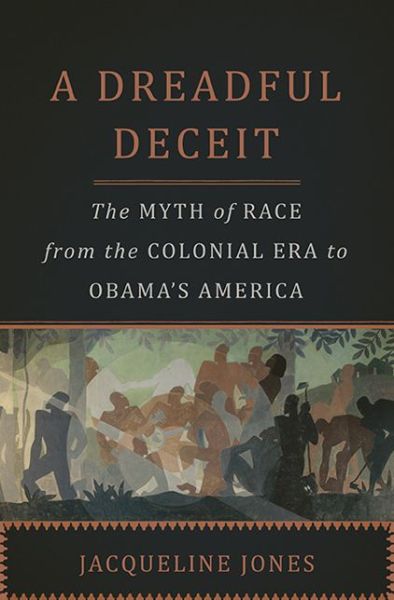
A Dreadful Deceit: The Myth of Race from the Colonial Era to Obama’s America

Posted in Books, History, Media Archive, Monographs, United States on 2013-12-16 01:53Z by Steven

A Dreadful Deceit: The Myth of Race from the Colonial Era to Obama’s America

Basic Books
2013-12-10
384 pages
Hardback ISBN-13: 9780465036707

Jacqueline Jones, Mastin Gentry White Professor of Southern History
University of Texas, Austin

In 1656, a Maryland planter tortured and killed an enslaved man named Antonio, an Angolan who refused to work in the fields. Three hundred years later, Simon P. Owens battled soul-deadening technologies as well as the fiction of “race” that divided him from his co-workers in a Detroit auto-assembly plant. Separated by time and space, Antonio and Owens nevertheless shared a distinct kind of political vulnerability; they lacked rights and opportunities in societies that accorded marked privileges to people labeled “white.”

An American creation myth posits that these two black men were the victims of “racial” discrimination, a primal prejudice that the United States has haltingly but gradually repudiated over the course of many generations. In A Dreadful Deceit, award-winning historian Jacqueline Jones traces the lives of Antonio, Owens, and four other African Americans to illustrate the strange history of “race” in America. In truth, Jones shows, race does not exist, and the very factors that we think of as determining it— a person’s heritage or skin color—are mere pretexts for the brutalization of powerless people by the powerful. Jones shows that for decades, southern planters did not even bother to justify slavery by invoking the concept of race; only in the late eighteenth century did whites begin to rationalize the exploitation and marginalization of blacks through notions of “racial” difference. Indeed, race amounted to a political strategy calculated to defend overt forms of discrimination, as revealed in the stories of Boston King, a fugitive in Revolutionary South Carolina; Elleanor Eldridge, a savvy but ill-starred businesswoman in antebellum Providence, Rhode Island; Richard W. White, a Union veteran and Republican politician in post-Civil War Savannah; and William Holtzclaw, founder of an industrial school for blacks in Mississippi, where many whites opposed black schooling of any kind. These stories expose the fluid, contingent, and contradictory idea of race, and the disastrous effects it has had, both in the past and in our own supposedly post-racial society.

Expansive, visionary, and provocative, A Dreadful Deceit explodes the pernicious fiction that has shaped four centuries of American history.

Tags: ,

Jim Beckwourth: Black Mountain Man and War Chief of the Crows

Posted in Biography, Books, Media Archive, Monographs, Native Americans/First Nation, United States on 2013-12-14 21:17Z by Steven

Jim Beckwourth: Black Mountain Man and War Chief of the Crows

University of Oklahoma Press
1980
264 pages
5.5″ x 8.25″
Paperback ISBN: 9780806115559

Elinor Wilson

Dismissed as a “gaudy liar” by most historians and often discredited by writers who deprecated his mixed blood, James Pierson Beckwourth was one of the giants of the early West, certainly deserving to rank alongside Kit Carson, Bill Williams, Louis Vasquez, and Jim Bridger.

Sometime around 1800 James Beckwourth was born a slave in Frederick County, Virginia, the natural son of Sir Jennings Beckwith and a slave girl. In 1810 Sir Jennings moved with his family to the wilderness of St. Louis, Missouri, where Jim was educated and eventually apprenticed to a blacksmith. His father recorded a Deed of Emancipation in his name on three different occasions, sending young Jim out into the world with his blessings.

Jim Beckwourth’s apprenticeship as a fur trapper was served with General William Ashley’s grueling 1824 winter expedition to the Rocky Mountains. Except for a short stint as an army scout during the Seminole campaign, Jim spent the remainder of his long, eventful life in the West, dying among the Crow Indians whom he loved. He was fur trapper, trader, scout war chief of the Crow Nation, explorer, hotelkeeper, dispatch carrier, storekeeper, prospector, Indian agent for the Cheyennes—in short, a mountain man extraordinaire.

In his old age Beckwourth dictated an autobiography to T.D. Bonner, a man more interested in making money with Jim’s adventures than in accurately recording his life. Beckwourth was later disparaged because of the inaccuracies that crept into Bonner’s account.

Tags: , , ,

Science Fiction and Multiraciality: From Octavia Butler to Harry Potter

Posted in Literary/Artistic Criticism, Live Events, Media Archive, United States on 2013-12-14 13:56Z by Steven

Science Fiction and Multiraciality: From Octavia Butler to Harry Potter

Brooklyn Historical Society
Crossing Borders, Bridging Generations
Saturday, 2013-12-14, 14:00-17:00 EST (Local Time)

How do science fiction narratives investigate questions about identity, racism, and fear?

Join us for a fun, interactive presentation and dialogue about mixed-race identity in the Harry Potter franchise, the legacy of African-American sci-fi author Octavia Butler, and the role of the imaginary in destabilizing oppression and re-envisioning multiracial community.

We will be debunking myths, talking back to popular sci-fi movies and stories, and exploring new possibilities for racial justice through imagination. We will explore racial elements of popular fictional universes, participate in collective storytelling, and we encourage dressing up as your favorite sci-fi character!

Presenters include: Eric Hamako from University of Massachusetts Amherst on Harry Potter and the Mistaken Myth of the Mixed-Race Messiah, and Walidah Imarisha, Co-Editor of Octavia’s Brood: Science Fiction Stories from Social Justice Movements.

This event is co-sponsored by the Harry Potter Alliance and MixedRaceStudies.org.

For more information, click here.

Tags: , , , ,

A Study of Tri-Racial Isolates in Eastern United States

Posted in Anthropology, Articles, Health/Medicine/Genetics, Media Archive, Tri-Racial Isolates, United States on 2013-12-13 21:05Z by Steven

A Study of Tri-Racial Isolates in Eastern United States

Human Heredity
Volume 6, Number 3, 1956/1957
DOI: 10.1159/000150862
pages 410–412

C. J. Witkop
National Institute of Dental Research, National Institutes of Health, Public Health Service, U.S. Department of Health, Education and Welfare, Bethesda, Maryland, U.S.A.

There are known to exist in the eastern part of the United States some 28 well defined tri-racial isolates. These groups represent gene pools of various proportions of Caucasian, Negro, and American Indian races. These groups are known as mixed bloods in their own communities. They are not accepted into the white community and do not consider themselves Negroes. As a result, they maintain their racial integrity by in-marriage within a few family names. They all represent the remnants of eastern Indian tribes.

A preliminary survey of each group was made by a questionnaire letter to the county health officer in whose district these groups reside. On the basis of subsequent studies it has been shown that about 10% of the genetically determined conditions that actually exist in these groups are reported by this method. One of these groups was selected for a detailed genetic study.

Detailed Study

A detailed study of the medical, dental, mental health, and social aspects of one of these groups comprising 5 000 living members is in progress in southern Maryland. We are trying to determine all of the hereditary pathological traits present in the group. This group was selected for study for the following reasons:

1. This group marries for the most part within only 14 family surnames. 2. Records indicate that the group has in-married for nearly 250 years. 3. These people reside in a limited geographic area of 2 counties of…

Read or purchase the article here.

Tags: , ,

Poll Finds Hope Is Running High for Next Mayor of New York City

Posted in Articles, Media Archive, Politics/Public Policy, United States on 2013-12-13 18:53Z by Steven

Poll Finds Hope Is Running High for Next Mayor of New York City

The New York Times
2013-12-13

Kate Taylor and Dalia Sussman

With Bill de Blasio’s inauguration less than a month away, New Yorkers are highly optimistic about his mayoralty — but they remain skeptical that he can achieve major changes on some of the core issues that defined his candidacy, like the widening gap between the rich and poor and the scarcity of affordable housing, according to a New York Times/Siena College poll.

Despite his four years as the city’s public advocate, Mr. de Blasio — who surged from behind late in the primary season to capture the Democratic nomination, and then coasted to a landslide victory in November — remains unfamiliar to many New Yorkers. More than half of city residents said they did not yet know enough about the mayor-elect, who takes office on Jan. 1, to form an opinion of him.

Still, 73 percent of city residents said they were generally optimistic about the next four years. About two-thirds said Mr. de Blasio would bring about real change in the way things are done. And while most said the Bloomberg administration favored the wealthy, a plurality said they expect Mr. de Blasio to treat rich, poor and middle-class New Yorkers equally. A majority said they believe he would have a positive effect on schools…

…Mr. de Blasio, whose wife, Chirlane McCray, is black, featured her and their two children prominently in his mayoral campaign, and captured 96 percent of the black vote in the general election, according to an exit poll by Edison Research. More than half of black New Yorkers polled said they believed that having the first biracial couple as mayor and first lady would help transform race relations in the city.

Mr. de Blasio has made clear that his wife will play an active role in his administration. Half of city residents, including a majority of women and six in 10 blacks, said they supported this, though 85 percent said they did not know enough about Ms. McCray to have an opinion of her…

Read the entire article here.

Tags: , , , , , , ,