Freedom’s Witness: The Civil War Correspondence of Henry McNeal Turner

Posted in Books, History, Media Archive, Monographs, Slavery, United States on 2013-12-27 01:23Z by Steven

Freedom’s Witness: The Civil War Correspondence of Henry McNeal Turner

University of West Virginia Press
March 2013
288 pages
Hardcover (Jacketed) ISBN: 978-1-935978-60-2
Paperback ISBN: 978-1-935978-61-9
ePub ISBN: 978-1-935978-62-6
PDF ISBN: 978-1-935978-95-4

Foreword by:

Aaron Sheehan-Dean, Fred C. Frey Professor of Southern Studies
Louisiana State University

Edited by:

Jean Lee Cole, Associate Professor of English
Loyola University Maryland, Baltimore
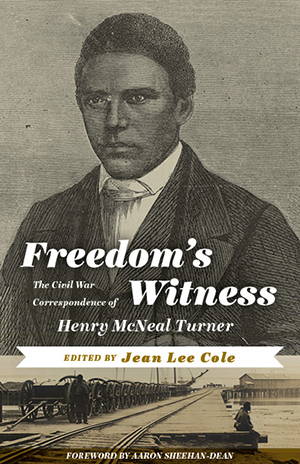
In a series of columns published in the African American newspaper The Christian Recorder, the young, charismatic preacher Henry McNeal Turner described his experience of the Civil War, first from the perspective of a civilian observer in Washington, D.C., and later, as one of the Union army’s first black chaplains.

In the halls of Congress, Turner witnessed the debates surrounding emancipation and black enlistment. As army chaplain, Turner dodged “grape” and cannon, comforted the sick and wounded, and settled disputes between white southerners and their former slaves. He was dismayed by the destruction left by Sherman’s army in the Carolinas, but buoyed by the bravery displayed by black soldiers in battle. After the war ended, he helped establish churches and schools for the freedmen, who previously had been prohibited from attending either.

Throughout his columns, Turner evinces his firm belief in the absolute equality of blacks with whites, and insists on civil rights for all black citizens. In vivid, detailed prose, laced with a combination of trenchant commentary and self-deprecating humor, Turner established himself as more than an observer: he became a distinctive and authoritative voice for the black community, and a leader in the African Methodist Episcopal church. After Reconstruction failed, Turner became disillusioned with the American dream and became a vocal advocate of black emigration to Africa, prefiguring black nationalists such as Marcus Garvey and Malcolm X. Here, however, we see Turner’s youthful exuberance and optimism, and his open-eyed wonder at the momentous changes taking place in American society.

Well-known in his day, Turner has been relegated to the fringes of African American history, in large part because neither his views nor the forms in which he expressed them were recognized by either the black or white elite. With an introduction by Jean Lee Cole and a foreword by Aaron Sheehan-Dean, Freedom’s Witness: The Civil War Correspondence of Henry McNeal Turner restores this important figure to the historical and literary record.

Table of Contents

  • Editor’s Note
  • Foreword, Aaron Sheehan-Dean
  • Acknowledgments
  • Introduction: “I have seen war wonders”: The Civil War Correspondence of Henry McNeal Turner
  • Chapter 1. Emancipation and Enlistment (March 22, 1862–April 18, 1863)
  • Chapter 2. The Siege of Petersburg (June 25, 1864–December 17, 1864)
  • Chapter 3. Fort Fisher (Jan. 7, 1865–Feb. 18, 1865)
  • Chapter 4. Freeing Slaves, Meeting Sherman (Feb, 25, 1865–June 10, 1865)
  • Chapter 5. Roanoke Island (June 24, 1865–August 5, 1865)
  • About the Authors
Tags: , , ,

Becoming Mexipino: Multiethnic Identities and Communities in San Diego [Floyd Review]

Posted in Articles, Asian Diaspora, Book/Video Reviews, History, Latino Studies, Media Archive, United States on 2013-12-26 18:42Z by Steven

Becoming Mexipino: Multiethnic Identities and Communities in San Diego [Floyd Review]

The Journal of San Diego History
Volume 59, Number 4 (Fall 2013)
pages 291-292

Carlton Floyd, Associate Professor of English
University of San Diego

Becoming Mexipino: Multiethnic Identities and Communities in San Diego. By Rudy P. Guevarra, Jr. New Brunswick, NJ: Rutgers University Press, 2012. Maps, photographs, tables, notes, and index. 256 pp. $25.95 paper.

Becoming Mexipino: Multiethnic Identities and Communities in San Diego by Rudy P. Guevarra Jr. deftly explores his Filipino and Mexican familial history from its origins in Spanish colonialism to its current Mexipino configurations in San Diego. Addressing a subject that has received little extended critical attention, Guevarra argues that Spain’s sixteenth-century colonial enterprises brought Mexicans and Filipinos together in ways that facilitated their intimate interaction. First, they shared or, more aptly, endured enslavement and indentured servitude as well as the interest in surviving these perilous conditions. Second, Mexicans and Filipinos took on a common language and religion: Spanish and Catholicism. Third, they discovered themselves in possession of a similar sense of familial arrangements—in the notions of godparents and in the practice of coming-of-age ceremonies for young women, to cite two examples. These various conditions facilitated intimate interethnic relationships then, and foreshadowed similar intimate interactions centuries later, particularly in the western parts of the United States…

Read the entire review here.

Tags: , , , , , , ,

Memoirs of Elleanor Eldridge

Posted in Autobiography, Books, History, Law, Media Archive, Monographs, United States, Women on 2013-12-26 04:01Z by Steven

Memoirs of Elleanor Eldridge

West Virginia University Press
December 2013
160 pages
Cloth ISBN: 978-1-935978-24-4
Paperback ISBN: 978-1-935978-23-7
ePub ISBN: 978-1-935978-25-1
PDF ISBN: 978-1-938228-64-3

Original Text by Frances Harriet Whipple (1805-1878) with Elleanor Eldridge (1794-1862)

Edited by:

Joycelyn K. Moody, Sue E. Denman Distinguished Chair in American Literature and Professor of English
University of Texas, San Antonio

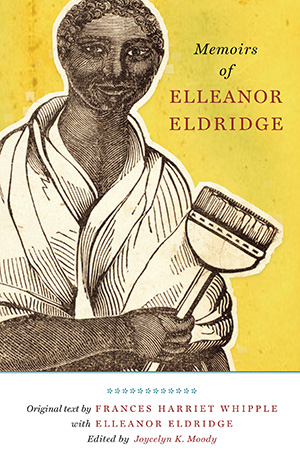
Elleanor Eldridge, born of African and US indigenous descent in 1794, operated a lucrative domestic services business in nineteenth century Providence, Rhode Island. In defiance of her gender and racial background, she purchased land and built rental property from the wealth she gained as a business owner. In the 1830s, Eldridge was defrauded of her property by a white lender. In a series of common court cases as defendant and plaintiff, she managed to recover it through the Rhode Island judicial system. In order to raise funds to carry out this litigation, her memoir, which includes statements from employers endorsing her respectable character, was published in 1838. Frances Harriet Whipple, an aspiring white writer in Rhode Island, narrated and co-authored Eldridge’s story, expressing a proto-feminist outrage at the male “extortioners” who caused Eldridge’s loss and distress.

With the rarity of Eldridge’s material achievements aside, Memoirs of Elleanor Eldridge forms an exceptional antebellum biography, chronicling Eldridge’s life from her birth. Because of Eldridge’s exceptional life as a freeborn woman of color entrepreneur, it constitutes a counter-narrative to slave narratives of early 19th-century New England, changing the literary landscape of conventional American Renaissance studies and interpretations of American Transcendentalism.

With an introduction by Joycelyn K. Moody, this new edition contextualizes the extraordinary life of Elleanor Eldridge—from her acquisition of wealth and property to the publication of her biography and her legal struggles to regain stolen property. Because of her mixed-race identity, relative wealth, local and regional renown, and her efficacy in establishing a collective of white women patrons, this biography challenges typical African and indigenous women’s literary production of the early national period and resituates Elleanor Eldridge as an important cultural and historical figure of the nineteenth century.

Read the original text from 1838 here.

Tags: , , , , , ,

De Blasio’s Daughter Reveals Substance Abuse

Posted in Articles, Media Archive, Politics/Public Policy, United States on 2013-12-26 01:44Z by Steven

De Blasio’s Daughter Reveals Substance Abuse

The New York Times
2013-12-24

Javier C. Hernandez and Michael M. Grynbaum


Chiara de Blasio, right, with her parents in September. Michael Appleton for The New York Times

Days before her father’s inauguration, the 19-year-old daughter of Mayor-elect Bill de Blasio disclosed a history of drug and alcohol abuse that his campaign had taken pains to shield throughout a candidacy that relied heavily on the image of a happy and tight-knit family from Brooklyn.

In a carefully crafted video distributed on Tuesday by her father’s staff, Chiara de Blasio spoke in candid terms about a battle with depression throughout her adolescence that led to drinking and drug use, habits that worsened when she was attending college in California last year.

“It didn’t start out as like a huge thing for me, but then it became a really huge thing for me,” Ms. de Blasio said in the five-minute video, in which she sat alone on screen, accompanied by soft piano music…

…Such is the celebrity of Mr. de Blasio’s children that Ms. de Blasio’s announcement on Tuesday was met with a statement from the director of the Office of National Drug Control Policy at the White House, who praised her “tremendous bravery in speaking out about her recovery.”…

…Hank Sheinkopf, a political consultant, said the city had elected a family when it chose Mr. de Blasio in November, and that New Yorkers should expect his wife and children to continue to play a prominent role…

Read the entire article here.

Tags: , , , , , , , , ,

Surprising New Face in Arabic Music

Posted in Articles, Arts, Media Archive, United States on 2013-12-25 12:47Z by Steven

Surprising New Face in Arabic Music

The New York Times
2013-12-03

Linsay Crouse

Jennifer Grout Sings Umm Kulthum Hits on ‘Arabs Got Talent’

The Arab world has an unlikely new star: an American who sings — but barely speaks — Arabic. Not only that, her genre is traditional Arab music.

Plucking her oud, an Arabic version of the lute, and singing with the undulating emotion of Umm Kulthum, the Arab world’s legendary diva, the 23-year-old Jennifer Grout has become a sensation across the Middle East as a contestant on the reality show “Arabs Got Talent.”

She will appear in the finals in Beirut, Lebanon, on Saturday, competing for viewer votes against an array of Arab performers, many of whom would be at home on a Western stage: comedians, hip-hop dancers and jugglers. The only performer of classical Arab music will be an American of European stock…

… “So many times I’ve heard the comment ‘It’s “Arabs Got Talent” — go back to America,’ ” Ms. Grout said in a recent phone interview from Marrakesh, Morocco, where she lives. “It’s like I’m starting an invasion, when really I just love singing Arabic music and desperately wanted a chance to perform it for an audience that would appreciate it.”

Her flair in doing so has also incited a wave of incredulity about her ethnicity: Ms. Grout, who is from Cambridge, Mass., describes her background as English, Scottish and Native American…

Read the entire article here.

Tags: , , , , ,

‘A Dreadful Deceit’ argues against a ‘racial’ past

Posted in Articles, Book/Video Reviews, History, Media Archive, United States on 2013-12-23 18:44Z by Steven

‘A Dreadful Deceit’ argues against a ‘racial’ past

The Los Angeles Times
2013-12-20

Robin D.G. Kelley, Distinguished Professor of History
University of California, Los Angeles

Jacqueline Jones in ‘A Dreadful Deceit’ aims to debunk the ‘myth of race’ and the ‘American creation story’ but for the most part is unconvincing in her argument.

Jacqueline Jones, A Dreadful Deceit: The Myth of Race from the Colonial Era to Obama’s America (New York: Basic Books, 2013).

Four years ago, Atty. Gen. Eric Holder called us a “nation of cowards” for refusing to confront our racial past. Jacqueline Jones’A Dreadful Deceit” dismisses the very idea that our past is “racial.”

What Holder identifies as our national burden, Jones calls the “American creation story”: the narrative that slavery was born of racial prejudice and that the election of a black president marked a triumph over the long shadow of race. Her objective is to debunk the “myth of race,” to relieve Americans of the specious belief that “race is real and that race matters.”

Jones is not the first. Franz Boas, W.E.B. DuBois and Ashley Montagu are among a veritable sea of scholars who have shown that “race” has no scientific basis. It is a socially created means of classifying and ranking humans based on any number of criteria. It is about power, not biology…

…”A Dreadful Deceit’s” insistence that race is not a factor leads Jones to ignore racism’s role in creating economic inequality. Today’s workforce, she asserts, is “defined less by skin color and history than by shared powerlessness within a global economy.” But if truly “shared,” how do we explain the widening wealth gap between whites and blacks or that the world’s cheap apparel is made in the global South by a non-white, super-exploited labor force?

Jones generally treats “race” (a means of classifying difference) as a proxy for “racism” (a hierarchical system of subjugation based on race). The point is not that race explains everything but that racism is built into the very structure of the economy. Race may be a myth, but racism survives

Read the entire review here.

Tags: , , ,

Miscegenetic Melville: Race and Reconstruction in Clarel

Posted in Articles, Literary/Artistic Criticism, Media Archive, United States on 2013-12-23 18:30Z by Steven

Miscegenetic Melville: Race and Reconstruction in Clarel

Zach Hutchins, Assistant Professor of English
Colorado State University

ELH
Volume 80, Number 4, Winter 2013
pages 1173-1203
DOI: 10.1353/elh.2013.0039

This essay investigates Herman Melville’s views on Reconstruction and racism in Clarel, the national epic published in the centennial year of 1876. In Clarel, Melville points toward miscegenation as the solution to problems of ethnic conflict festering since the Civil War, the key to rebuilding a nation torn apart by the economic exploitation and lingering racism of Reconstruction. Miscegenation is an ideal Melville pointed to somewhat naïvely in his earlier prose, but Clarel is Melville’s most sustained narrative commentary on race published after Benito Cereno and reflects a more sober assessment of racial realities and possibilities in the United States.

Tags: , , ,

Race in a Bottle: The Story of BiDil and Racialized Medicine in a Post-Genomic Age by Jonathan Kahn (review)

Posted in Articles, Book/Video Reviews, Health/Medicine/Genetics, Media Archive, United States on 2013-12-23 17:34Z by Steven

Race in a Bottle: The Story of BiDil and Racialized Medicine in a Post-Genomic Age by Jonathan Kahn (review)

Bulletin of the History of Medicine
Volume 87, Number 4, Winter 2013
pages 708-709
DOI: 10.1353/bhm.2013.0067

Anne Pollock, Assistant Professor of Science, Technology and Culture
Georgia Institute of Technology, Atlanta, Georgia

Jonatha Kahn, Race in a Bottle: The Story of BiDil and Racialized Medicine in a Post-Genomic Age. New York: Columbia University Press, 2013. xi + 311 pp. Ill. (978-0-231-16298-2).

When BiDil was approved by the U.S. Food and Drug Administration in 2005 for heart failure in black patients, it became the first ever drug to receive a racial indication. Race in a Bottle is likely to be the most in-depth book that will ever be written about BiDil’s controversial regulatory approval. Its author, Jonathan Kahn, has followed the case of BiDil’s approval at least as closely as anyone else, probably including those most directly involved (the clinicians, the pharmaceutical company, the FDA). Ever since he first heard about BiDil in 2002 (p. 4), Kahn has pursued the story doggedly. He became part of BiDil’s story through the articles he wrote about it, starting with a 2003 piece in Perspectives in Biology and Medicine, which debunked the statistic that blacks were twice as likely as whites to die of heart failure. These articles were read by regulators, among others, and in 2005 Kahn testified against BiDil’s race-specific indication at the FDA hearings on the drug (p. 94). Kahn notes that material in this book has previously been published in sixteen different journal articles and book chapters (pp. ix–x); Race in a Bottle is the definitive compilation of that body of work.

Regulatory processes are at the center of Kahn’s account. According to Kahn, “Race enters biomedicine through many pathways. Foremost among these are federal initiatives that shape the production and use of racial categories in biomedical research” (p. 25). Kahn carefully traces the ways in which the terrain of BiDil was laid by mandates at the FDA and NIH to use OMB categories and, especially, by patent law. This regulatory focus is not inevitable as a way to approach how race enters biomedicine: we might start with lived experience in a structurally racist society, or with clinical encounters, or with social movements mobilized against health disparities, or elsewhere. But Kahn’s passion is for regulation, and this is where his expertise is on display.

Race in a Bottle is at its most effective in debunking two things: BiDil’s racialized indication and racialized medicine as a path toward pharmacogenomics. As Kahn fastidiously shows, the vasodilating drug combination that would become BiDil (isosorbide dinitrate and hydralazine) was originally conceived of as a treatment for anyone with heart failure, not just blacks, and it was commercial imperatives—specifically circumventing the fact that the patent on the drug without the racial indication was about to expire—rather than persuasive scientific evidence that led the pharmaceutical company to seek approval for it as a drug for blacks. Kahn also persuasively debunks the notion that racialized medicine is a step toward pharmacogenomics. Although many BiDil proponents argued that race was a “crude surrogate” but nevertheless useful “in the meantime” until more was known about the genetics of drug response (p. 157), Kahn shows that even when there are genetic tests available to indicate drug response (as in warfarin, the “poster child for pharmacogenomics” [p. 165]), “far from withering away, race is persisting and even proliferating as genetic information increases” (p. 168).

Race in a Bottle is less convincing as a window into “racialized medicine in a post-genomic age.” Situating BiDil in a “post-genomic age” is misleading. In Kahn’s own account, BiDil emerged from statistical signals in clinical trial data, not from genetic research. Related claims of racial differences in heart failure foregrounded pathophysiology, not genetics. BiDil’s FDA indication is for “self-identified black patients,” an explicitly social category rather than a genetic one. Yet the book opens by describing the White House ceremony on the occasion of the completion of the Human Genome Project (p. 1). This narrative choice is emblematic of a preoccupation with genetics in the account as a whole, and shows the intractable appeal of analyzing race in terms of genetics, even for those explicitly critiquing genetic understandings of race. Even if some (but not all) BiDil proponents simply slide the drug into a genetic frame, why should critique of BiDil do so?

Finally, because of the explicitness of its racialization, BiDil has become an obvious icon of racialized medicine, but it is actually not clear that BiDil is…

Tags: , , ,

NYC Mayor-Elect’s Family Reflects Rise of Intermarriage

Posted in Articles, Census/Demographics, Media Archive, Social Science, United States on 2013-12-22 03:48Z by Steven

NYC Mayor-Elect’s Family Reflects Rise of Intermarriage

Voice of America
2013-12-17

Carolyn Weaver

In 1959, only four percent of Americans approved of interracial marriage. Today, 87 percent do, according to a Gallup poll. President Barack Obama was born to such a marriage, and census figures show that the fastest growing demographic under 18 is children of mixed race.

When New York City’s new mayor-elect, Bill de Blasio, a white man married to an African American woman, takes office January 1 with his wife and their two children at his side, his family will mirror this new American landscape.

It hardly could be more different from 1958, when people who married across racial lines were subject to arrest in 22 U.S. states. Mildred Jeter and Richard Loving wed that year in Washington, D.C. Mildred was African American and Richard was white. Six weeks after, when they returned to their home state of Virginia, police broke down the door of their house in the middle of the night…

Read the entire article here.

Tags: , ,

Landmark ’49 Film About Family Passing for White Recalled

Posted in Articles, Biography, Media Archive, Passing, United States on 2013-12-19 18:06Z by Steven

Landmark ’49 Film About Family Passing for White Recalled

The Los Angeles Times
1989-07-25

Margaret Lillard
The Associated Press

KEENE, N.H. — For 12 years, Dr. Albert Johnston and his wife had a secret–a secret they kept from friends, neighbors, even their children.

But in 1941, their secret came out–each was part black. The fair-skinned Johnstons had raised four children and built a life in Keene and Gorham, N.H., while passing as white.

The whole world knew their story 8 years later when it was presented, lightly fictionalized, in “Lost Boundaries,” in which Mel Ferrer (“El Greco,” “War and Peace“) made his film debut.

The doctor is now dead, but his family and members of the movie’s cast and crew reunited in Keene last week with a screening and small reception to celebrate a revolutionary film and friendships that withstood a revelation that was, in its time, shocking.

“That was the point of the story, the fact that something positive happened, that there wasn’t any problem as a result of it,” Albert Johnston Jr. recalled.

Albert Johnston, a Chicago native, and his blue-eyed wife, Thyra Baumann, born in New Orleans, had no thought of “passing” after their 1924 marriage when he was a premed student at the University of Chicago. But things changed when he tried to find work as an intern. Hospitals that accepted black interns were full, and others would not accept him because he was part black…

Read the entire article here.

Tags: , , , , , ,