That the Blood Stay Pure: African Americans, Native Americans, and the Predicament of Race and Identity in Virginia

Posted in Anthropology, Books, History, Law, Media Archive, Monographs, Native Americans/First Nation, United States, Virginia on 2014-05-14 00:42Z by Steven

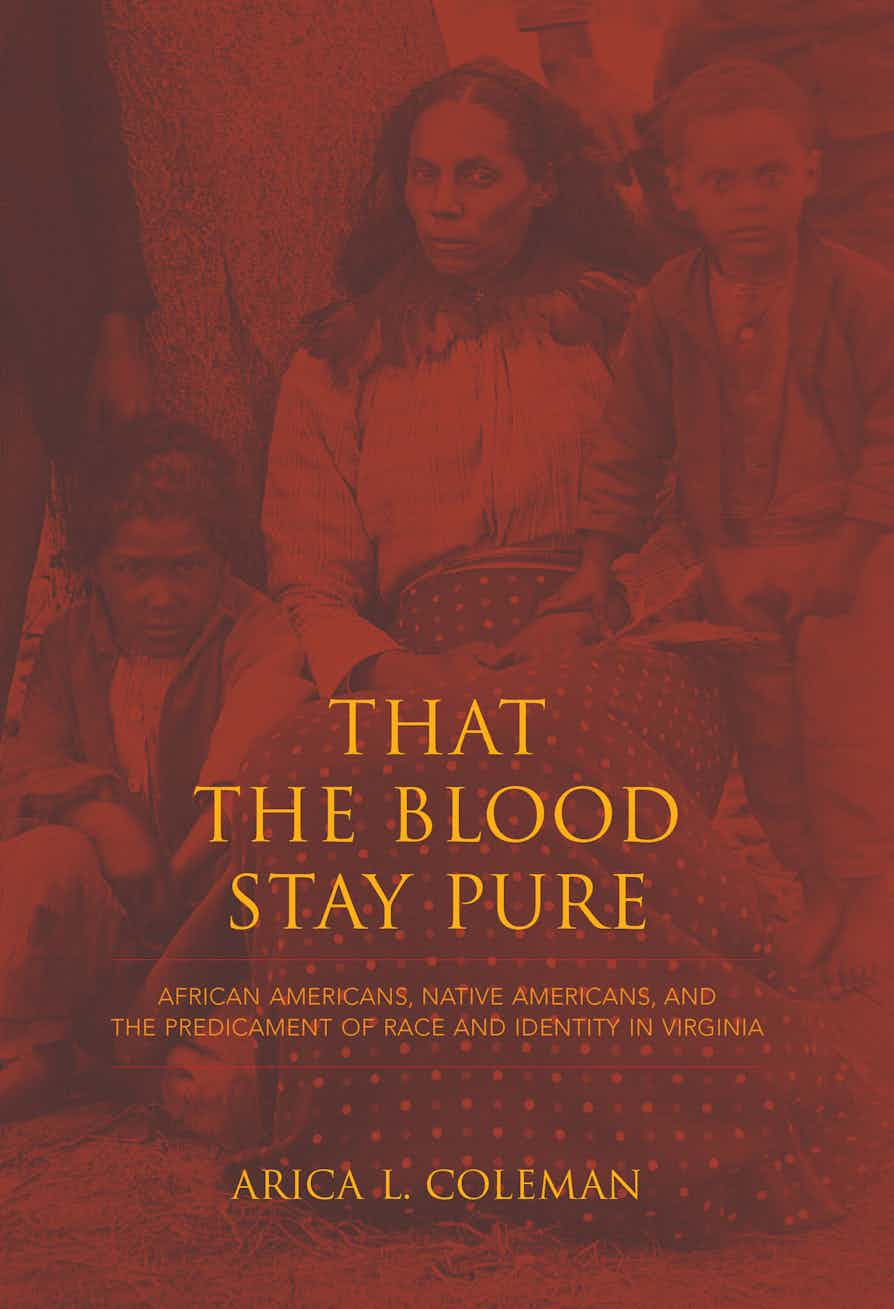
That the Blood Stay Pure: African Americans, Native Americans, and the Predicament of Race and Identity in Virginia

Indiana University Press
2013
328 pages
12 b&w illustrations
6 x 9
Cloth ISBN: 978-0-253-01043-8

Arica L. Coleman, Assistant Professor of Black American Studies
University of Delaware
A Choice Outstanding Academic Title for 2014

That the Blood Stay Pure traces the history and legacy of the commonwealth of Virginia’s effort to maintain racial purity and its impact on the relations between African Americans and Native Americans. Arica L. Coleman tells the story of Virginia’s racial purity campaign from the perspective of those who were disavowed or expelled from tribal communities due to their affiliation with people of African descent or because their physical attributes linked them to those of African ancestry. Coleman also explores the social consequences of the racial purity ethos for tribal communities that have refused to define Indian identity based on a denial of blackness. This rich interdisciplinary history, which includes contemporary case studies, addresses a neglected aspect of America’s long struggle with race and identity.

Table of Contents

  • Acknowledgments
  • Foreword
  • Author’s Note
  • Introduction
  • Part 1: Historicizing Black—Indian Relations in Virginia
    • Prologue: Lingering at the Crossroads: African-Native American History and Kinship Lineage in Armstrong Archer’s A Compendium on Slavery
    • 1. Notes on the State of Virginia: Jeffersonian Thought and the Rise of Racial Purity Ideology in the Eighteenth Century
    • 2. Redefining Race and Identity: The Indian-Negro Confusion and the Changing State of Black-Indian Relations in the Nineteenth Century
    • 3. Race Purity and the Law: The Racial Integrity Act and Policing Black/Indian Identity in the Twentieth Century
    • 4. Denying Blackness: Anthropological Advocacy and the Remaking of the Virginia Indians (The Other Twentieth Century Project)
  • Part 2: Black-Indian Relations in the Present State of Virginia
    • 5. Beyond Black and White: Afro-Indian Identity in the case of Loving V. Virginia
    • 6. The Racial Integrity Fight: Confrontations of Race and Identity In Charles City County, Virginia
    • 7. Nottoway Indians, Afro-Indian Identity, and the Contemporary Dilemma of State Recognition
  • Epilogue: Afro-Indian Peoples of Virginia: The Indelible Thread of Black and Red
  • Appendix: Racial Integrity Act Text
  • Notes
  • Selected Bibliography
  • Index
Tags: , ,

Beyond Biracial: When Blackness Is a Small, Nearly Invisible Fraction

Posted in Articles, Identity Development/Psychology, Media Archive, Social Work, United States on 2014-05-13 21:29Z by Steven

Beyond Biracial: When Blackness Is a Small, Nearly Invisible Fraction

The Root
2014-05-12

Jenée Desmond-Harris, Senior Staff Writer and White House Correspondent

In the past, these Americans would have been labeled “quadroons” or “octoroons.” Today their options are so much broader. What can they teach us about race in 2014 and in the future?

Stephanie Troutman, a 36-year-old professor at Appalachian State University in Boone, N.C., has a white mother and a black father. She has her own family’s racial elevator speech down to a single sentence: “I’m a mixed woman who has a child with a black man and a child with a white man.” Her 7-year-old son, Rex, is unambiguous when it comes to his racial identity and “very pro black,” even protesting when he’s described as merely “brown,” she says.

With her 11-year-old daughter, Melora—whose pale, golden-hued skin; light eyes; and long, copper-colored hair prompt strangers to ask if she’s “Mediterranean” or “Arab”—things aren’t as simple.

“For now I’ve told her that she’s a person of color. That’s the best way I can explain it. I want to take it away from black and white because those are weird options for her,” Troutman says. “But I always kind of knew that I’d have a kid who looked white, and I was right. When Melora was born, my friends were like, ‘How did her dad’s white hippie granola genes completely beat out your biracial genes?’ ”

Despite those biracial genes, Troutman realized as a teen that most people see her as “just light skinned” (in other words, black). That hit home one day in the mid-1990s when, in a classically tragic black-identity-forming moment, a Florida stranger yelled “nigger” at her from a passing car.

“At first I was like, ‘Damn, that’s kind of messed up. Who are they yelling at?’ And then I realized I was the only person on the street.”

Given the way she’s perceived, Troutman is “willing to talk about the biracial thing”—her own mixed heritage—in certain contexts, but most of the time, she says, “I don’t think there’s anything new or interesting about it.”

What is interesting to Troutman is the experience of her preteen daughter, who, if you’re doing the crude math, is one-quarter black. She’s the kind of person who would have been called a “quadroon” when that “one-drop rule“-inspired term appeared on census forms between about 1850 and 1920, alongside its also-retired relatives, “octoroon” (one-eighth black) and mulatto (one-half).

Of course, as Zebulon V. Miletsky, a visiting assistant professor of Africana studies at Stony Brook University whose research interests include the history of the mixed-race experience, explains, “A lot of times, the people who took the census would sort of guess those things.”…

…Attention to Americans who have both black- and white-identified parents peaked during what Miletsky calls the “biracial boom” of the 1990s. They found celebrity touchstones in the likes of Mariah Carey and Halle Berry; validation from support organizations; and—in the ultimate victory for those whose rallying cry was “Don’t put me in a box!“—the creation in 2000 of a new, multiracial census category. With that, says Ralina L. Joseph, author of Transcending Blackness: From the New Millennium Mulatta to the Exceptional Multiracial, came the fading of the “tragic mulatto” stereotype and the emergence of the “millennium mulatto,” along with an accompanying sense of legitimacy…

Read the entire article here.

Tags: , , , , , , ,

Fathers of Conscience with Bernie D. Jones [Part 2]

Posted in Audio, History, Interviews, Law, Live Events, Media Archive, Slavery, United States on 2014-05-08 00:10Z by Steven

Fathers of Conscience with Bernie D. Jones [Part 2]

Research at the National Archives & Beyond
Blogtalk Radio
2014-05-08, 21:00 EDT (2014-05-09, 02:00Z)

Bernice Bennett, Host

Bernie D. Jones, Associate Professor of Law
Suffolk University, Boston, Massachusetts

Join Author Bernie D. Jones for an engaging discussion about her book – Fathers of Conscience – Mixed-Race Inheritance in the Antebellum South.

Fathers of Conscience examines high-court decisions in the antebellum South that involved wills in which white male planters bequeathed property, freedom, or both to women of color and their mixed-race children. These men, whose wills were contested by their white relatives, had used trusts and estates law to give their slave partners and children official recognition and thus circumvent the law of slavery. The will contests that followed determined whether that elevated status would be approved or denied by courts of law.

For more information, click here.

Tags: , , , ,

Natasha Trethewey Presents Final Lecture as U.S. Poet Laureate, May 14

Posted in Articles, Live Events, Media Archive, United States on 2014-05-07 16:17Z by Steven

Natasha Trethewey Presents Final Lecture as U.S. Poet Laureate, May 14

News from the Library of Congress
Library of Congress
2014-04-17

Natasha Trethewey will conclude her tenure as the 19th Poet Laureate Consultant in Poetry at the Library of Congress with an evening lecture in the Coolidge Auditorium on May 14.

The lecture will start at 7 p.m. on Wednesday, May 14, in the Coolidge on the ground floor of the Thomas Jefferson Building, 10 First St. S.E., Washington, D.C. A book signing and reception will follow. The event is free and open to the public. Tickets and reservations are not required, but early arrival is strongly recommended.

Librarian of Congress James H. Billington said “Natasha Trethewey’s final lecture as Poet Laureate marks the conclusion of a remarkable two terms. Throughout that time her commitment and her enthusiasm have elevated the position, and the art.”

In her first term as laureate, from 2012 to 2013, Trethewey spent five months in residency in the Poetry Office at the Library of Congress, meeting with members of the general public. In her second term, from 2013 to 2014, she launched a signature project: a series of on-location reports with the PBS NewsHour called “Where Poetry Lives.” The series has featured poetry programs and workshops with Alzheimer’s patients in Brooklyn, N.Y.; middle-school students in Detroit, Mich.; medical students in Boston, Mass.; and teenagers of the King County Youth Services Center in Seattle, Wash. For more information, visit www.pbs.org/newshour/tag/where-poetry-lives/.

The lecture on May 14 will include Trethewey’s reflections on the state of poetry based on her experiences during her office hours and the filming of “Where Poetry Lives.” She also will consider the legacy of poets like Robert Penn Warren on the laureateship; the role of the poet as public intellectual; and the role of poetry in the remembrance of and reckoning with our national past—with particular focus on the 50th anniversary of milestones in the Civil Rights Movement.

When Trethewey was named Poet Laureate in 2012, Billington called her “an outstanding poet/historian in the mold of Robert Penn Warren, our first Poet Laureate Consultant in Poetry. Her poems dig beneath the surface of history—personal or communal, from childhood or from a century ago—to explore the human struggles that we all face.”

Trethewey is the author of four poetry collections, including: “Thrall” (2012); “Native Guard” (2006), winner of the 2007 Pulitzer Prize in Poetry; “Bellocq’s Ophelia” (2002); and “Domestic Work” (2000). She is also the author of a nonfiction book, “Beyond Katrina: A Meditation on the Mississippi Gulf Coast” (2010).

Her many honors include the Mississippi Governor’s Award for Excellence in the Arts and fellowships from the Guggenheim Foundation and the National Endowment for the Arts. In 2012, Trethewey was appointed Poet Laureate of Mississippi, and her term as state laureate has coincided with her laureateship at the Library—a first for the position…

Read the entire press release here.

Tags: ,

Talking Mixed-Race Identity with Young Children

Posted in Articles, Asian Diaspora, Family/Parenting, Identity Development/Psychology, Media Archive, United States on 2014-05-07 14:12Z by Steven

Talking Mixed-Race Identity with Young Children

Hyphen—Asian Americans Unabridged
2014-05-06

Sharon H. Chang

“Mom, am I White?”

A few weeks ago, when I got this question from my four-year-old, I wasn’t sure what to say. Technically my son is “biracial” — but that label does him a severe representative injustice, because his bloodline is actually Japanese, Taiwanese, Slovakian, German, French Canadian, British, and Welsh. He also does not possess a parent of just one race and a parent of another race, as if often assumed when people hear the term “biracial”—because both my husband and I are mixed-race Asian/White too. For these reasons, I much prefer to describe us, and our son, as multiracial.

I write about and research race, families, and children, with an especial focus on multiraciality. I don’t believe in avoiding race talk with my child, though I do try to discuss it in age-appropriate ways. I’ve tried to stand by my conviction that it’s better he learn how to think and talk about these issues within the family first, rather than have normative ideals force-fed down his throat by everyone else when he walks out the door. That said, I wasn’t fully prepared when he turned to me and asked, “Mom, am I White?”…

Read the entire article here.

Tags: , , ,

The Theme of “Passing” in the Novels of James Weldon Johnson and Nella Larsen

Posted in Articles, Literary/Artistic Criticism, Media Archive, Passing, United States on 2014-05-05 17:57Z by Steven

The Theme of “Passing” in the Novels of James Weldon Johnson and Nella Larsen

International Journal of Interdisciplinary and Multidisciplinary Studies (IJIMS)
Volume 1, Number 4 (2014)
pages 53-58
ISSN: 2348-0343

Dinesh Babu. P.
Department of English
Ramanujan College (University of Delhi), Kalkaji, New Delhi, India

The depiction of the experience of a very fair-skinned person of some “coloured” background who successfully passes into white society was a recurrent theme in early African American writings. In this paper an attempt is made to look at, and compare and contrast, two African American novels, The Autobiography of an Ex-Coloured Man (1912) and Passing (1929) which deal with the theme of passing, written by James Weldon Johnson and Nella Larsen, a Black man and a Black woman writer. This paper analyses how the two novels reject the rules of colour division, rules which demand that one accepts a position within a predetermined hierarchy.

Read the entire article here.

Tags: , , , ,

G.O.P. Hopeful Finds Tribal Tie Cuts Both Ways

Posted in Articles, Media Archive, Native Americans/First Nation, Politics/Public Policy, United States on 2014-05-04 11:30Z by Steven

G.O.P. Hopeful Finds Tribal Tie Cuts Both Ways

The New York Times
2014-05-03

Jonathan Martin, National Political Correspondent

BARTLESVILLE, Okla.T. W. Shannon will be Oklahoma’s first black senator if he wins the Republican nomination and is elected this November, but the quiet campaign stirring here about Mr. Shannon’s racial loyalties is not aimed at the African-American branch of his family tree.

Mr. Shannon, whose first name is Tahrohon, is a member of the Chickasaw Nation, the most influential tribe in a state where Native Americans are not merely the inheritors of a poignant history but also collectively constitute the state’s largest nongovernment employer outside of Walmart.

Most of those jobs are connected to Oklahoma’s 110-and-counting casinos, which are becoming as familiar here as oil derricks. Yet the gambling revenue that has showered millions on some of the state’s Native Americans has also bred resentment over the tribes’ expanding footprint. Now, as Mr. Shannon vies to make history, he has become both the political beneficiary of the tribes’ newfound wealth and a target for complaints about Native American sovereignty and possible competing loyalties…

Read the entire article here.

Tags: , , , ,

The Hunter and the Farmer: Jean Toomer’s Depression-Era Masculinist Writings

Posted in Articles, Literary/Artistic Criticism, Media Archive, United States on 2014-05-01 20:01Z by Steven

The Hunter and the Farmer: Jean Toomer’s Depression-Era Masculinist Writings

AmeriQuests
Volume 6, Number 1 (2008)

Anastasia C. Curwood, Visiting Fellow
James Weldon Johnson Institute for Race and Difference
Emory University, Atlanta, Georgia

In 1937, after he had written the novel Cane, left the African-American culture of Harlem, studied under the mystic Georges Gurdjieff in France, lost his wife to childbirth, and married for the second time, Jean Toomer sought to publish a series of essays. The subjects varied, but the most common theme was masculinity—men’s prerogatives, natures, and responsibilities. He theorized women’s temperaments as well, but it was clearly the study of maleness that captured his attention.

Toomer’s interest was noteworthy given the fact that he became ever more concerned with sexuality and gender as he left behind his African-American identity. Toomer did not intend to “pass,” as is commonly assumed—he actually wanted to be raceless, or of the “American” race. In his adopted home in the Pennsylvania countryside, Toomer attempted to construct his life based entirely on his masculinity. In Toomer’s opinion, his entire household—his white wife, his light-skinned daughter, and various temporary occupants—was a social experiment in supporting his masculine genius and creativity.

This essay is an intellectual history of Toomer’s self-construction. Using his diaries and published and unpublished writings, I will explain how Toomer saw his own male identity and how, although he had renounced his blackness, his racial identity mediated his ideal of his gender.

Read the entire article here.

Tags: , , ,

“Split At The Root”: The Reformation of The Mulatto Hero/Heroine

Posted in Articles, History, Literary/Artistic Criticism, Media Archive, United States, Women on 2014-05-01 19:13Z by Steven

“Split At The Root”: The Reformation of The Mulatto Hero/Heroine

AmeriQuests (Online)
Vanderbilt University
Volume 6, Number 1
2008-11-18

Tia L. Gafford, Assistant Professor of English and Africana Studies
Mercer University

Frances E. W. Harper’s Iola Leroy offers a valuable insight on the development of a holistic and natural model for patriarchy in the 19th century. Harper combines normally diametrically opposed ideologies of masculinity and femininely in the characters of Dr. Frank Latimer and Iola Leroy who become cultural heros/heroines by embracing a Black consciousness. By addressing what she considers to be a more cohesive productive society, Harper contextualizes the mulatto racial and social visions against the backdrop of the post-Reconstruction South. Within this new radical mixed race, Dr. Latimer and Iola Leroy rescues this normative stereotypical version and redefines them as the pre-cursors of Alain Locke’s “New Negro.” By rejecting whiteness as a mean to emancipate themselves out of an otherwise racial bondage, Iola Leroy and Dr. Latimer embrace the “one drop” rule. By “casting themselves” into the racial “pot,” Harper sets the mulatto up to ideally “work for the people.”

Read the entire article in HTML or PDF format.

Tags: , , , , , ,

Double Take: The Art of Amalgam and stereo*type*

Posted in Articles, Arts, Media Archive, United States on 2014-04-29 23:06Z by Steven

Double Take: The Art of Amalgam and stereo*type*

The Incluseum: Museums and Social Inclusion
2014-04-23

Aletheia Wittman, co-founder

In this post The Incluseum highlights the new work of some of Seattle’s industrious artist…

Two recent exhibits have disrupted the reliability of the first impression.  The artwork prompts a second, longer, deeper look.

Right now at Gallery4Culture (until Friday) you can visit Dave Kennedy’s Amalgam and experience a body of work that playfully and concisely draws attention to this process of destabilizing first impressions/assumptions. Large format photographs appear to be still lifes of immediately recognizable food items. With a closer gaze, the precise and deliberate sculpting of different types of edible organic matter to create a cohesive whole comes into focus.

The video work in Amalgam offers Kennedy’s take on the nature of his many layered and multiracial identity. A reminder that people, as well as art, can be stereotyped, labeled and generalized about – acts that are challenged by how Kennedy chooses to represent aspects of himself within his work; how he navigates through space, time and memory…

Read the entire article here.

Tags: , , , , , , , , ,