Not So Black and White

Posted in Autobiography, Books, Media Archive, Monographs, United States on 2014-07-23 19:30Z by Steven

Not So Black and White

Tree Spirit Publishing
2012
210 pages
9 x 6 x 0.5 inches
Paperback ISBN: 978-0615568249
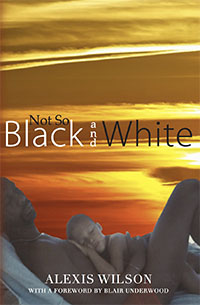
Alexis Wilson

Mixed marriage, abandonment, a mother’s secret, same sex parents, Broadway, the Ballet, and AIDS all make up a multi-colored tapestry of this author’s valiant journey towards a strong and clear passage; leaving the reader uplifted and wanting more.

It is the early 60’s in Europe, when a breathtakingly beautiful interracial couple dance great ballets together and fall passionately in love.  She is a Dutch ballerina and he is an African-American international ballet star.  They come to America and create a family and a new life.  While their daughter Alexis grows up dancing before she can walk, the marriage grows angrily apart.  Her father soon becomes one of the few celebrated black choreographers on Broadway, while her mother turns toward a shockingly desperate existence of survival.

At age eleven, Alexis’s world comes crashing.  Her mother abandons her and her brother and they are shuttled off to New York City to live with their adoring larger-than-life father, the footlights that beam on the likes of Sammy Davis Jr., Chita Rivera, and the other man in her father’s life.

Tags: ,

How Turbans Helped Some Blacks Go Incognito In The Jim Crow Era

Posted in Articles, History, Media Archive, Passing, United States on 2014-07-23 01:10Z by Steven

How Turbans Helped Some Blacks Go Incognito In The Jim Crow Era

Code Switch: Frontiers of Race, Culture and Ethnicity
National Public Radio
2014-07-19

Tanvi Misra

There’s a weekly trial on the Internet about who may be stealing culture from whom. Earlier this week, the defendants were Iggy Azalea and white gay men. A while back, it was Macklemore and the Harlem Shakers.

Now, we have come across a story from the Jim Crow era about cultural mimicry between people of color.

In mid-20th century America, the turban was a tool that people of color used for “confounding the color lines,” writes Manan Desai, board member of the South Asian American Digital Archive.

At the time, ideas of race in America were quite literally black and white. In some places, if you could pass yourself off as something other than black, you could circumvent some amount of discrimination. People of color — both foreigners and African-Americans — employed this to their advantage. Some did it just to get by in a racist society, some to make a political statement, and others — performers and businessmen — to gain access to fame and money they wouldn’t have otherwise had…

Read the entire article here.

Tags: , , ,

Why Mixed with White isn’t White

Posted in Articles, Asian Diaspora, Identity Development/Psychology, Media Archive, United States on 2014-07-22 23:15Z by Steven

Why Mixed with White isn’t White

Hyphen: Asian America Unabrided
2014-07-22

Sharon H. Chang

When I wrote my first post for Hyphen, “Talking Mixed-Race Identity with Young Children,” I was deliberately blunt about race. I wrote about how I don’t tell my multiracial son, who presents as a racial minority, that he’s white — but I do tell him he’s Asian. While the essay resonated with many people, others made comments like this:

“Your child is as white as he is Asian… Why embrace one label and not the other?”

“Why is he Asian but not white? He has white ancestors as much as Asian ones. So if it’s OK to call him Asian, it’s OK to call him white. Or, if it’s not OK to call him white (because he’s not completely white) then it’s not OK to call him Asian, because he’s not completely Asian either.”

“Your child is neither white nor Asian. I once heard this description: When you have a glass of milk and add chocolate to it, you no longer have just a glass of milk and you no longer just have chocolate because you have created something completely different. A bi-racial or multi-racial child is not either/or.”

In the 1990s, psychologist and mixed-race scholar Maria P.P. Root wrote the famous “Bill of Rights for People of Mixed Heritage,” stirred by her examination of mixed-race identity, interviews with hundreds of multiracial folk across the U.S., and the struggles multiracial people face in forming and claiming a positive sense of self. “I have the right not to justify my existence to the world,” it reads. “To identify myself differently than strangers expect me to identify. To create a vocabulary about being multiracial or multiethnic.”

Almost two decades later, these proclamations still ring so true. Some people are completely unwilling to honor my family’s choice to identify as mixed-race and Asian because it doesn’t align with their own ideas about how we should identify. The right of a mixed-race person to self-construct and self-define, even today, endures continual policing from people with their own agendas…

Read the entire article here.

Tags: , , , ,

Researchers discuss origins of Melungeon heritage at annual event

Posted in Articles, History, Interviews, Media Archive, Tri-Racial Isolates, United States, Videos, Virginia on 2014-07-14 05:41Z by Steven

Researchers discuss origins of Melungeon heritage at annual event

WCBY.com (News 5)
Brisol, Virginia
2014-06-28

Olivia Caridi

BIG STONE GAP, Va. – Wayne Winkler discovered he was a Melungeon at 12 years old. His grandmother is a Melungeon. His father is, too.

“I had never heard the word, so I asked my relatives what a Melungeon is. I asked what it was, and I’ve spent all this time since then trying to answer the question,” Winkler says.

For Winkler and others of mixed-ethnic groups, attending the 18th annual Melungeon Union on Saturday was a way to get some answers.

Melungeon’s were first documented in southwest Virginia and northeast Tennessee in the 19th century. “They are basically a mixed-ethnic group of a combination of Native American, European American and African American,” Winkler says.

Researchers have attempted to document the meaning of Melungeon identity for years. Lisa Alther, an author, wrote books exploring the history. “I always heard growing up that we were Anglo-Saxon and Celtic here in the mountains, so the most fascinating thing for me is realizing that we are here in the mountains really a melting pot of the entire world,” Alther says…

Read the article and watch the video here.

Tags: , , , , ,

Transcending Blackness: From the New Millennium Mulatta to the Exceptional Multiracial. Ralina L. Joseph. [Cannon]

Posted in Articles, Book/Video Reviews, Communications/Media Studies, Media Archive, United States on 2014-07-11 06:58Z by Steven

Transcending Blackness: From the New Millennium Mulatta to the Exceptional Multiracial. Ralina L. Joseph. [Cannon]

MELUS: Multi-Ethnic LIterature of the United States
Volume 39, Issue 3 (Fall 2014)
pages 207-209
DOI: 10.1093/melus/mlu028

Sarita Cannon, Associate Professor of English Language and Literature
San Francisco State University

Transcending Blackness: From the New Millennium Mulatta to the Exceptional Multiracial. Ralina L. Joseph. Durham: Duke University Press, 2012. 248 pages. $84.95 cloth; $23.95 paper.

Ralina L. Joseph’s timely book about representations of multiracial black women in popular culture makes a significant contribution to the growing field of critical mixed-race studies. Drawing on research in various fields, Joseph closely reads four texts produced between 1998 and 2008: Showtime’s television series The L Word (2004-09), Danzy Senna’s coming-of-age novel Caucasia (1998), Alison Swan’s independent film Mixing Nia (1998), and the reality competition show America’s Next Top Model (2003-present). Joseph examines representations of black mixed-race subjectivity in these texts through two tropes: the new millennium mulatta and the exceptional multiracial. These two very different archetypes of multiracial identity are nonetheless linked by a common desire to transcend blackness, a proposition that Joseph argues is deeply troubling in twenty-first-century America, where, although many proclaim that affirmative action is no longer necessary, structural inequalities between blacks and whites remain entrenched.

One of Joseph’s central claims in Transcending Blackness is that popular representations of black mixed-race women fall into one of two categories. The new millennium mulatta is, in many ways, a revision of the tragic mulatta figure, made popular in films such as The Birth of a Nation (1915) and Imitation of Life (1959). According to Joseph, the new…

Read or purchase the review here.

Tags: , , , , ,

Essentializing Ethnicity: Identification Constraint Reduces Diversity Interest

Posted in Articles, Identity Development/Psychology, Media Archive, United States on 2014-07-10 20:56Z by Steven

Essentializing Ethnicity: Identification Constraint Reduces Diversity Interest

Journal of Experimental Social Psychology
Available online: 2014-07-10
DOI: 10.1016/j.jesp.2014.07.001

Tiane L. Lee
University of Maryland, College Park

Leigh S. Wilton
Rutgers University, New Brunswick

Virginia S.Y. Kwan, Associate Professor of Psychology
Arizona State University

Highlights

  • We primed essentialism with instruction to “Check One”, rather than “Check All”, ethnicities.
  • Minorities reduced diversity engagement, distancing from activities that express background.
  • Essentialist European-Americans showed less interest in intergroup friendship.
  • Interaction with chronic essentialist beliefs replicated in a non-race-related context.

The present research investigates the effects of a subtle essentialist cue: restricting individuals to identify with only one ethnicity. Although this constraint is mundane and commonly used in everyday life, it sends a message of essentialized group differences. Three studies illustrate the harmful impact of this essentialist cue on diversity. Studies 1a and 1b show that it decreases Asian-Americans’ desire to participate in ethnicity-related activities. Study 2 reveals that it reduces essentialist European-Americans’ desire for friendship with a minority target. Study 3 illustrates the mechanism through which an essentialist cue reduces intergroup contact, with perceivers’ chronic beliefs moderating this effect. Together, these findings demonstrate the powerful impact of the seemingly small act of how we ask people to identify with an ethnic group.

Read or purchase the article here.

Tags: , , , , , ,

ARC Introduces Tiana Reid as Junior Arts Writer

Posted in Articles, Arts, Media Archive, United States on 2014-07-10 20:25Z by Steven

ARC Introduces Tiana Reid as Junior Arts Writer

ARC: Art. Recognition. Culture.
2014-02-03

Tiana Reid

I laboured for quite some time over what to write as my introduction to joining ARC Magazine’s team as Junior Arts Writer. How to approach the unstarted?

I was thinking first of preparing a brief manifesto-like document. That was one approach that could explicate the nuts and bolts of how I see the world. And in a few paragraphs or less! Perhaps, drawing on the words of Singapore artist Heman Chong and Sweden-based artist Anthony Marcellini’s 2013 video collaboration, I would mock up plots for things to come.

Another approach would be a biography. You know, “I was born in Toronto. I went to school at McGill. I have my M.A. in African-American Studies at Columbia. I live in Brooklyn.” I would likely pause on my non-art history background and explore my academic interest in visual culture against my permanent and affected interest as a writer in reading and speculation. When it comes to the former, my master’s thesis illuminated the shared yet dissimilar aesthetic practices of poet Natasha Trethewey and conceptual artist Adrian Piper. My thesis used ‘mixed-race’ studies as a vexed entryway to trouble claims to a speculative hybrid future, and argued that the desire and alleged ability to see a mythical (post)-racially hybrid body is intimately connected to the disavowal of black life and histories of violence…

Read the entire article here.

Tags: , , ,

Census Bureau explores new Middle East/North Africa ethnic category

Posted in Articles, Census/Demographics, Media Archive, United States on 2014-07-06 16:02Z by Steven

Census Bureau explores new Middle East/North Africa ethnic category

Pew Research Center
2014-03-24

Jens Manuel Krogstad, Writer/Editor
Pew Research Center’s Hispanic Trends Project

Organizations representing people of Middle Eastern and North African descent are asking the Census Bureau to add a new ethnic category on forms. People of this heritage are now categorized as “white,” a decades-old practice advocacy groups say is inaccurate.

The new category would be broader than the Arab ancestry data collected by the Census Bureau since 1980. The Arab-American population is small but growing, and its exact size is disputed. The Census Bureau estimates there are 1.8 million Arab-Americans in the U.S., up 51% since 2000. But the Arab American Institute Foundation estimates there are nearly 3.7 million Arab Americans living in the country. The Arab-American population is also diverse, with people claiming ties to 22 countries and various religious backgrounds…

Read the entire article here.

Tags: ,

The Institutional Racism Against Black Indians

Posted in Anthropology, Articles, Law, Media Archive, Native Americans/First Nation, United States on 2014-07-06 01:18Z by Steven

The Institutional Racism Against Black Indians

Indian Country Today Media Network.com
2014-07-04

Julianne Jennings

Black Indians are constantly confronted with the fact that they do not fit any of society’s stereotypes for Native Americans. Those stereotypes are imposed by both whites and sadly, other Indians. This lack of understanding of another nation’s history has interwoven ignorance thus extinguishing fact. Nevertheless, despite their own distortions and mutations of the past, it is interesting to note how the right to remember or forget are not going unnoticed; where personal biographies have intersected with historical watershed events (i.e. slavery, blood-mixing, cultural blending) is now producing historically-conscious discourse about race, racism, and who is a “real” Indian.

Raymond H. Brooks, 72, Montaukett Nation, Long Island, New York, was made furious from a recent posting he read on Facebook. The post read, “My good friend is a real Indian because he lives on an Indian reservation and the government gives him money. That’s how you can tell who a real Indian is.”

Those who hold the power, get to set the rules; and according to Brooks, “Our tribe had its status taken away in 1910 because a New York State county Judge Abel Blackmar said, “We were no longer a tribe because we had intermarried with blacks and whites. And that when he looked around the court room, He didn’t see any Indians” The tribe has been fighting to get their State recognition restored ever since. You can go to the tribes website and read their history and what is currently happening with their Bill (montauktribe.Org).

…Employing discredited biological over cultural definitions of who is an Indian and who is not is an assault on our self-determination. We have endured 450 years of forced assimilation which included slavery and post slavery intermarriage, making our walk one of plurality. We are therefore all multiracial. Blood mixing is also believed to be the reason certain phenotypes (physical characteristics) common within Native people also occur in African American populations…

Read the entire article here.

Tags: , ,

Multiracial Identity for the Year 2000 Census

Posted in Census/Demographics, Media Archive, Politics/Public Policy, United States, Videos on 2014-07-05 20:40Z by Steven

Multiracial Identity for the Year 2000 Census

C-SPAN
1998-05-30

Panelists discussed the federal government’s recent decision to allow individuals to define their race by more than one category on the 2000 census. They discussed the implications of this decision and its effect on areas such as social program funding and political representation. Panelists also answered media questions.

Hosted by:

National MultiCultural Institute

People in this video:

Susan Graham, President
Project RACE

Stuart Ishimaru, Counsel
United States Department of Justice, Civil Rights Division

Clarence Page, Columnist
Tribune Media Services

Jeffrey Passel, Director
Urban Institute, Immigration Policy Program

Elizabeth Salett, President
National MultiCultural Institute

Watch the video here.

Tags: , , , , ,