The Inner Life of Mestizo Nationalism

Posted in Books, Caribbean/Latin America, Literary/Artistic Criticism, Media Archive, Monographs, Native Americans/First Nation on 2011-12-03 02:17Z by Steven

The Inner Life of Mestizo Nationalism

University of Minnesota Press
2008
272 pages
6 x 9
Paper ISBN: 978-0-8166-5005-7
Cloth ISBN: 978-0-8166-5004-0

Estelle Tarica, Associate Professor of Latin American Literature and Culture
University of California, Berkeley

The only recent English-language work on Spanish-American indigenismo from a literary perspective, Estelle Tarica’s work shows how modern Mexican and Andean discourses about the relationship between Indians and non-Indians create a unique literary aesthetic that is instrumental in defining the experience of mestizo nationalism.

Engaging with narratives by Jesús Lara, José María Arguedas, and Rosario Castellanos, among other thinkers, Tarica explores the rhetorical and ideological aspects of interethnic affinity and connection. In her examination, she demonstrates that these connections posed a challenge to existing racial hierarchies in Spanish America by celebrating a new kind of national self at the same time that they contributed to new forms of subjection and discrimination.

Going beyond debates about the relative merits of indigenismo and mestizaje, Tarica puts forward a new perspective on indigenista literature and modern mestizo identities by revealing how these ideologies are symptomatic of the dilemmas of national subject formation. The Inner Life of Mestizo Nationalism offers insight into the contemporary resurgence and importance of indigenista discourses in Latin America.

Tags: , , , ,

The Passion of Tiger Woods: An Anthropologist Reports on Golf, Race, and Celebrity Scandal

Posted in Anthropology, Books, Media Archive, Monographs, United States on 2011-11-30 06:05Z by Steven

The Passion of Tiger Woods: An Anthropologist Reports on Golf, Race, and Celebrity Scandal

Duke University Press
November 2011
160 pages
20 illustrations
Paperback ISBN: 978-0-8223-5210-5
Cloth ISBN: 978-0-8223-5199-3

Orin Starn, Professor of Cultural Anthropology
Duke University

Perhaps the best golfer ever, Tiger Woods rocketed to the top of a once whites-only sport. Endorsements made him a global brand and the world’s richest athlete. The child of a multiracial marriage, Woods and his blond, blue-eyed wife, Elin Nordegren, seemed to represent a new postracial America. Then, in late 2009, Woods became embroiled in a sex scandal that made headlines worldwide. In this concise yet far-reaching analysis, Orin Starn brings an anthropologist’s perspective to bear on Tigergate. He explores our modern media obsession with celebrity scandals and their tawdry ritualized drama, yet he offers much more than the usual banal moralizing about the rich and famous. Starn explains how Tiger’s travails and the culture of golf reflect broader American anxieties—about race and sex, scapegoating and betrayal, and the role of the sports hero. The Passion of Tiger Woods is required reading for all those interested in the high-stakes world of professional golf, the politics of sports and celebrity, and the myths and realities surrounding the flawed yet riveting figure who remains among the most famous athletes of our time.

Table of Contents

  • Prologue
  • 1. Golf Backward Spells “Flog”
  • 2. The Tiger Woods Revolution
  • 3. Tigergate, Celebrity Scandal, and the Apology Society
  • 4. Internet Wars, Sex Addiction, and the Crucifixion of Tiger Woods
  • 5. Postracial Fantasies, Racial Realpolitik
  • 6. Tiger’s Penis
  • 7. Out of the Woods?
  • Notes
  • Bibliography
  • Acknowledgments
  • Index

Tags: , ,

Faking It: Poetics & Hybridity: Critical Writing 1984-1999

Posted in Asian Diaspora, Books, Canada, Identity Development/Psychology, Media Archive, Monographs, Poetry on 2011-11-25 03:58Z by Steven

Faking It: Poetics & Hybridity: Critical Writing 1984-1999

NeWest Press
Spring 2000
288 pages
Paperback ISBN 13: 978-1-896300-07-8

Fred Wah

According to Fred Wah, the act of thinking critically is one of exploration and discovery. In Faking It, Wah demonstrates how writing poetry is writing critically. This scrapbook of Wah’s work—collected from fifteen years of his writing—contains essays, reviews, journals, notes and, most importantly, poetic improvisations on contemporary poetry and identity. Faking It was written between 1984 and 1999—during major shifts in critical thinking and cultural production—and the hybrid style of the book is an apt reflection of these changing times, as well as a reflection and study of Wah’s own hybrid identity.

Tags: ,

Chinese Mexicans: Transpacific Migration and the Search for a Homeland, 1910-1960

Posted in Books, Caribbean/Latin America, History, Media Archive, Mexico, Monographs on 2011-11-25 03:02Z by Steven

Chinese Mexicans: Transpacific Migration and the Search for a Homeland, 1910-1960

University of North Carolina Press
May 2012
256 pages
6.125 x 9.25, 11 halftones, 2 maps, 4 tables
Cloth ISBN: 978-0-8078-3540-1

Published in association with the William P. Clements Center for Southwest Studies, Southern Methodist University

Julia María Schiavone Camacho, Assistant Professor of History
University of Texas, El Paso

At the turn of the twentieth century, a wave of Chinese men made their way to the northern Mexican border state of Sonora to work and live. The ties—and families—these Mexicans and Chinese created during led to the formation of a new cultural identity: Chinese Mexican. During the tumult of the Mexican Revolution of 1910, however, anti-Chinese sentiment ultimately led to mass expulsion of these people. Julia María Schiavone Camacho follows the community through the mid-twentieth century, across borders and oceans, to show how they fought for their place as Mexicans, both in Mexico and abroad.

Tracing transnational geography, Schiavone Camacho explores how these men and women developed a strong sense of Mexican national identity while living abroadin the United States, briefly, and then in southeast Asia where they created a hybrid community and taught their children about the Mexican homeland. Schiavone Camacho also addresses how Mexican women challenged their legal status after being stripped of Mexican citizenship because they married Chinese men. After repatriation in the 1930s-1960s, Chinese Mexican men and women, who had left Mexico with strong regional identities, now claimed national cultural belonging and Mexican identity in ways they had not before.

Tags: , , , ,

Measures of Equality: Social Science, Citizenship, and Race in Cuba, 1902-1940

Posted in Anthropology, Books, Caribbean/Latin America, History, Law, Media Archive, Monographs, Social Science on 2011-11-25 02:43Z by Steven

Measures of Equality: Social Science, Citizenship, and Race in Cuba, 1902-1940

University of North Carolina Press
November 2003
256 pages
6.125 x 9.25, 8 illus., notes, bibl., index
Paper ISBN  978-0-8078-5563-8

Alejandra Bronfman, Professor of History
University of British Columbia

In the years following Cuba’s independence, nationalists aimed to transcend racial categories in order to create a unified polity, yet racial and cultural heterogeneity posed continual challenges to these liberal notions of citizenship. Alejandra Bronfman traces the formation of Cuba’s multiracial legal and political order in the early Republic by exploring the responses of social scientists, such as Fernando Ortiz and Israel Castellanos, and black and mulatto activists, including Gustavo Urrutia and Nicolás Guillén, to the paradoxes of modern nationhood.

Law, science, and the social sciences—which, during this era, enjoyed growing status in Cuba as well as in many other countries—played central roles in producing knowledge and shaping social categories in postindependence Cuba. Anthropologists, criminologists, and eugenicists embarked on projects intended to employ the tools of science to rid Cuba of the last vestiges of a colonial past. Meanwhile, the legal arena created both new freedoms and new modes of repression. Black and mulatto intellectuals and activists, working to ensure that citizenship offered concrete advantages rather than empty promises, appropriated changing social scientific and legal categories and turned them to their own uses. In the midst of several decades of intermittent racial violence and expanding social and political mobilization by Cubans of African descent, debates among intellectuals and activists, state officials, and legislators transformed not only understandings of race, but also the terms of citizenship for all Cubans.

Tags: , , , , , ,

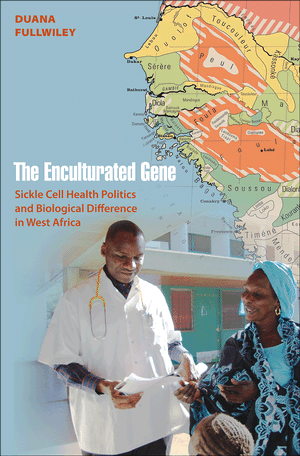
The Enculturated Gene: Sickle Cell Health Politics and Biological Difference in West Africa

Posted in Africa, Anthropology, Books, Health/Medicine/Genetics, Media Archive, Monographs, Social Science on 2011-11-20 22:29Z by Steven

The Enculturated Gene: Sickle Cell Health Politics and Biological Difference in West Africa

Princeton University Press
2011
368 pages
6 x 9; 7 halftones. 1 line illus. 4 maps
Paper ISBN: 9780691123172
Cloth ISBN: 9780691123165
eBook ISBN: 9781400840410

Duana Fullwiley, Associate Professor of African and African American studies and of Medical Anthropology
Harvard University

In the 1980s, a research team led by Parisian scientists identified several unique DNA sequences, or haplotypes, linked to sickle cell anemia in African populations. After casual observations of how patients managed this painful blood disorder, the researchers in question postulated that the Senegalese type was less severe. The Enculturated Gene traces how this genetic discourse has blotted from view the roles that Senegalese patients and doctors have played in making sickle cell “mild” in a social setting where public health priorities and economic austerity programs have forced people to improvise informal strategies of care.

Duana Fullwiley shows how geneticists, who were fixated on population differences, never investigated the various modalities of self-care that people developed in this context of biomedical scarcity, and how local doctors, confronted with dire cuts in Senegal’s health sector, wittingly accepted the genetic prognosis of better-than-expected health outcomes. Unlike most genetic determinisms that highlight the absoluteness of disease, DNA haplotypes for sickle cell in Senegal did the opposite. As Fullwiley demonstrates, they allowed the condition to remain officially invisible, never to materialize as a health priority. At the same time, scientists’ attribution of a less severe form of Senegalese sickle cell to isolated DNA sequences closed off other explanations of this population’s measured biological success.

The Enculturated Gene reveals how the notion of an advantageous form of sickle cell in this part of West Africa has defined–and obscured–the nature of this illness in Senegal today.

Table of Contents

  • List of Illustrations
  • Preface
  • Acknowledgments
  • Chapter One: Introduction: The Powers of Association
  • Chapter Two: Healthy Sicklers with “Mild” Disease: Local Illness Affects and Population-Level Effects
  • Chapter Three: The Biosocial Politics of Plants and People
  • Chapter Four: Attitudes of Care
  • Chapter Five: Localized Biologies: Mapping Race and Sickle Cell Difference in French West Africa
  • Chapter Six: Ordering Illness: Heterozygous “Trait” Suff ering in the Land of the Mild Disease
  • Chapter Seven: The Work of Patient Advocacy
  • Conclusion: Economic and Health Futures amid Hope and Despair
  • Notes
  • References
  • Index
Tags: , ,

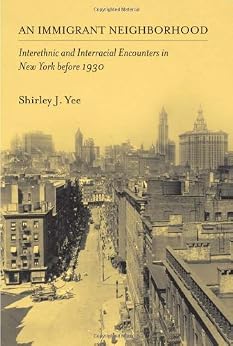
An Immigrant Neighborhood: Interethnic and Interracial Encounters in New York before 1930

Posted in Asian Diaspora, Books, History, Media Archive, Monographs, Social Science, United States on 2011-11-18 22:14Z by Steven

An Immigrant Neighborhood: Interethnic and Interracial Encounters in New York before 1930

Temple University Press
December 2011
256 pages
5.5 x 8.25
1 map, 6 halftones
Paper ISBN: 978-1-59213-128-0
Cloth ISBN: 978-1-59213-127-3
E-Book ISBN: 978-1-59213-129-7

Shirley Yee, Associate Professor of Women Studies; Adjunct Associate Professor of History; Adjunct Associate Professor of American Ethnic Studies
University of Washington

How the crowded neighborhoods of New York’s Lower East Side gave rise to cross-racial and cross ethnic bonds before 1930

Examining race and ethnic relations through an intersectional lens, Shirley J. Yee’s An Immigrant Neighborhood investigates the ways that race, class, and gender together shaped concepts of integration and assimilation as well as concepts of whiteness and citizenship in lower Manhattan during the late nineteenth and early twentieth centuries.

In contrast to accounts of insulated neighborhoods and ethnic enclaves, Yee’s study unearths the story of working-class urban dwellers of various ethnic groups—Chinese, Jews, Italians, and Irish—routinely interacting in social and economic settings.

Recounting the lived experiences in these neighborhoods, Yee’s numerous, fascinating anecdotes—such as the story of an Irishman who served for many years as the only funeral director for Chinese residents—detail friendships, business relationships, and sexual relationships that vividly counter the prevailing idea that ethnic groups mixed only in ways that were marked by violence and hostility.

Contents

  • Acknowledgements
  • Introduction
  • 1. Forming Households, Families, and Communities
  • 2. Building Commercial Relations
  • 3. Sustaining Life and Caring for the Dead
  • 4. Mixing with the Sinners: The Anti-vice Movement
  • 5. On (Un)Common Ground: Religious Politics in Settlements and Missions
  • Conclusion
  • Notes
  • Bibliography
  • Index

From the Introduction:

In the winter of 1877, a group of mourners gathered in a dimly lit funeral parlor on Pearl Street in lower Manhattan to pay their last respects to Ah Fung (sometimes referred to as Ah Lung), a Chinese man who had been brutally murdered in his Lower East Side apartment. He had died of “ghastly wounds” at Bellevue Hospital after living for eighty hours with his brain exposed. Both Irish and Chinese people attended the funeral, including Mrs. Ah Fung, a woman of Irish ancestry. The New York World described the mixed gathering as “something unprecedented . . . [that gave] a good idea of the cosmopolitan character of the city” Given the well-publicized history of anti-Chinese hostility among the Irish working class, it is not surprising that the editors viewed the Ah Fung funeral as an anomaly.

The details of Ah Fung’s life are murky. The World described him as a laundry worker, while the New York Times reported that he had eked out a living making cigars and cigarettes with a Chinese man, Tung Ha, also known as “Peter Johnson,” and his white wife, Theresa. The three lived at 17 Forsyth Street, located in an ethnically mixed neighborhood across from the future site of the Manhattan Bridge. For unknown reasons, the household had not included Ah Fung’s wife; the two apparently had been living apart for several months before the attack.

Like other working-class immigrant communities, the Chinese called on their local mutual aid societies to help cover the funeral costs. Members of the Ene E. Jong, a Chinese burial society, raised $200 for the funeral and burial expenses. But the dead man’s friends and relatives had to look outside the Chinese community for an undertaker, for it would not be until the 1930s that the Chinese could hire a licensed Chinese funeral director. They hired William H. Kennedy, who placed Ah Fung’s coffin in his carriage house “amidst numerous hacks, coffins of several sorts, and a dreary looking hearse.” The forty-five-year-old Irish immigrant was a former carpenter and stable and livery keeper known for having “buried all the Chinese that [had] died in the down-town settlement for a number of years past.” Readers of the World caught a glimpse of Chinese customs from Kennedy, who provided a lengthy description of Chinese funeral and burial rituals, information he had acquired after many years of serving the local Chinese community. He also provided details of the Ah Fung funeral, noting that Mrs. Ah Fung, whom he described as “bright and intelligent,” was apparently unmoved by her husband’s violent death. In the undertaker’s view, the young woman was “not in the least crushed by affliction, for having left a tidy sum to his widow, she [was] not left in poverty by the demise of her husband.” Kennedy’s perception that Mrs. Ah Fung was not aggrieved but satisfied at her newly acquired financial state reinscribed popular racial stereotypes of the time—that she could never have entered the marriage out of love, but only for economic gain.

The newspaper reports of Ah Fung’s murder and the funeral that followed were no different from other tales of interracial love, sex, and violence that had become standard fodder in an increasingly sensationalist press by the late nineteenth century. But once we sift through the lurid details of the crime and the “colorful” descriptions Kennedy provides, a layer of interracial/interethnic social and economic relations that operated beneath the radar of popular depictions of urban life begins to surface. Ah Fung’s community in 1877 consisted of both Chinese and non-Chinese people who in various ways provided friendship, kinship ties, social services, and financial as well as emotional support.

Ah Fung’s situation was not unusual. Interrracial/interethnic relations were a common feature of daily life among working-class New Yorkers even as the ethnic composition of working-class neighborhoods in lower Manhattan changed over time. Nearly fifty years after Ah Fung’s funeral, a few blocks north of Forsyth Street, Johanna Hurley sat with Ching Yeng and her four-year-old daughter, Lung Som Moy, as Ching’s husband, Lung Lin, lay dying. Hurley, a widowed German immigrant, lived in the same apartment building and had summoned the ambulance. The building on Division Street, where Hurley’s and Ching’s families resided, housed an ethnically mixed population of old and new immigrants, the latter being mostly Russian and Polish Jews who worked in the city’s garment factories, ran small shops, or peddled wares in the densely populated neighborhoods of lower Manhattan. Moy’s father worked as a store manager several blocks over on Pell Street in the area popularly known as “Chinatown.”…

…The language and politics of difference have undergone significant changes over the past two centuries, encoded in the categories “nationality,” “race,” “ethnicity,” “gender,” “culture,” and “class.” Such terms can denote group identities as well as official designations for enumeration and the development of public policy. Popular, legal and social-science definitions of race and ethnicity have been fluid and often inconsistent. In 1911, the Immigration Commission, headed by William P. Dillingham, departed from the practice of classifying people according to country of origin, opting instead to categorize people according to race. The commission defined race broadly rather than adopting the accepted notion that five distinct races existed—Caucasian, Mongolian, African, Malay, and Indian—which, its report argued, confined itself to only physical characteristics and color. According to the report, widening the definition of race to include what social scientists of the time would have referred to as “culture” was, the commission believed, more statistically accurate and practical in its effort to identify diverse groups coming from particular countries of origin. Thus, the commission retained the desire to classify, coming up with forty categories that it believed more accurately represented the identity of immigrant groups.

The terminology of race remained inconsistent in “objective” government documents, as well as in the courts. The social construction of race as an official classification shaped the ways in which government documents, such as the census, have categorized immigrants and their descendants into specific “racial” groups and reported their country of origin, or nationality. Even though federal census reports added more detail in terms of the numbers of categories, race remained an ambiguous category. Once classified as simply “colored” along with African Americans, the Chinese, for example, were classified as “Ch” for Chinese by 1890, but their children could be classified as either “Chinese” or “white,” especially if they had been born of marriages between Chinese and women of European ancestry. People of African descent were categorized alternatively as “colored,” “Negro,” “Black,” or “mulatto.” Such inconsistencies reflected the continued confusion among census takers about what race “really” was. At the root of the race problem were shifting meanings of whiteness.

Between the late nineteenth century and the 1930s, popular understandings of “race” had undergone important changes. As the nation moved steadily toward the narrow “one-drop” rule that signified “blackness,” the meaning of “whiteness” expanded to include the Irish and, later, all Europeans of Caucasian ancestry. By 1920, concerns about how to define “white” and, hence, “non-white” made its way into the U.S. Census guidelines. For the first time, the introduction to the census articulated the notion of racial purity as a way to resolve the problem of classifying mixed-race people and provided guidelines for census takers (who, as it turned out, used their own discretion when classifying people anyway). While previous census reports had simply declared “whiteness” to mean people of European ancestry, in the 1920 guidelines, the government added the terms “purity” and “blood” to further specify the meanings of “white,” “non-white,” and mixed-white: “The term ‘white’ as used in the census reports refers to persons understood to be pureblooded whites. A person of mixed blood is classified according to the nonwhite racial strain or, if the nonwhite blood itself is mixed, according to his racial status as adjudged by the community in which he resides.”…

Tags: , ,

The Masters and the Slaves (Casa-grande & senzala): A Study in the Development of Brazilian Civilization

Posted in Books, Brazil, Caribbean/Latin America, History, Media Archive, Monographs, Social Science on 2011-11-18 04:02Z by Steven

The Masters and the Slaves (Casa-grande & senzala): A Study in the Development of Brazilian Civilization

University of California Press
2nd revised edition (March 1987)
(originally published in 1933)
622 pages
ISBN: 9780520056657

Gilberto Freyre (1900-1987)

Introduction by:

David H. P. Maybury-Lewis

This book is out of print, but available for on-line reading here.

Table of Contents

  • Frontmatter
  • Preface to the first English-Language Edition
  • Preface to the Second English-language Edition
  • Translator’s Acknowledgments
  • Author’s Preface to the Paperback Edition
  • Introduction to the Paperback Edition
  • I General Characteristics of the Portuguese Colonization of Brazil: Formation of an Agrarian, Slave-Holding and Hybrid Society
  • II The Native in the Formation of the Brazilian Family
  • III The Portuguese Colonizer: Antecedents and Predispositions
  • IV The Negro Slave in the Sexual and Family Life of the Brazilian
  • V The Negro Slave in the Sexual and Family Life of the Brazilian (continued)
  • Plans showing Big House of the Noruega Plantation
  • Glossary of the Brazilian Terms Used
  • Bibliography
  • Index of Names
  • Index of Subjects

Read the entire book here.

Tags: , ,

Imagining Identity in New Spain: Race, Lineage, and the Colonial Body in Portraiture and Casta Paintings

Posted in Arts, Books, Caribbean/Latin America, History, Law, Media Archive, Mexico, Monographs, Religion on 2011-11-13 20:26Z by Steven

Imagining Identity in New Spain: Race, Lineage, and the Colonial Body in Portraiture and Casta Paintings

University of Texas Press
2003
216 pages
6 1/8 x 9 1/4 in.
12 color and 60 b&w illus., 4 tables
Hardcover ISBN: 978-0-292-71245-4

Magali M. Carrera, Professor of Art History
University of Massachusetts, Dartmouth

Reacting to the rising numbers of mixed-blood (Spanish-Indian-Black African) people in its New Spain colony, the eighteenth-century Bourbon government of Spain attempted to categorize and control its colonial subjects through increasing social regulation of their bodies and the spaces they inhabited. The discourse of calidad (status) and raza (lineage) on which the regulations were based also found expression in the visual culture of New Spain, particularly in the unique genre of casta paintings, which purported to portray discrete categories of mixed-blood plebeians.

Using an interdisciplinary approach that also considers legal, literary, and religious documents of the period, Magali Carrera focuses on eighteenth-century portraiture and casta paintings to understand how the people and spaces of New Spain were conceptualized and visualized. She explains how these visual practices emphasized a seeming realism that constructed colonial bodies—elite and non-elite—as knowable and visible. At the same time, however, she argues that the chaotic specificity of the lives and lived conditions in eighteenth-century New Spain belied the illusion of social orderliness and totality narrated in its visual art. Ultimately, she concludes, the inherent ambiguity of the colonial body and its spaces brought chaos to all dreams of order.

Table of Contents

  • List of Illustrations
  • Acknowledgments
  • Introduction: Visual Practices in Late-Colonial Mexico
  • Chapter One: Identity by Appearance, Judgment, and Circumstances: Race as Lineage and Calidad
  • Chapter Two: The Faces and Bodies of Eighteenth-Century Metropolitan Mexico: An Overview of Social Context
  • Chapter Three: Envisioning the Colonial Body
  • Chapter Four: Regulating and Narrating the Colonial Body
  • Chapter Five: From Popolacho to Citizen: The Re-vision of the Colonial Body
  • Epilogue: Dreams of Order
  • Notes
  • Glossary
  • Bibliography
  • Index
Tags: , , ,

The Lost German Slave Girl: The Extraordinary True Story of Sally Miller and Her Fight for Freedom in Old New Orleans

Posted in Books, History, Law, Louisiana, Media Archive, Monographs, Passing, Slavery, United States, Women on 2011-11-13 19:48Z by Steven

The Lost German Slave Girl: The Extraordinary True Story of Sally Miller and Her Fight for Freedom in Old New Orleans

Grove/Atlantic, Inc.
November 2005
288 pages
Paperback ISBN-13: 978-0-8021-4229-0

John Bailey

It is a bright, spring morning in New Orleans, 1843. In the Spanish Quarter, on a street lined with flophouses and gambling dens, Madame Carl Rouff recognizes a face from her past. It is the face of Salomé Müller, her best friend’s daughter who disappeared twenty-five years earlier. But the young olive-skinned woman claims her name is Mary Miller—she is the property of a Frenchman who owns a nearby cabaret. She is a slave, with no memory of a “white” past, or of the Müller family’s perilous journey from its German village to New Orleans. And yet her resemblance to her mother is striking, and she bears two telltale birthmarks. Had a defenseless European orphan been callously and illegally enslaved, or was she an imposter? So began one of the most celebrated and sensational trials of nineteenth-century America.

In brilliant novelistic detail, award-winning historian John Bailey reconstructs the exotic sights, sounds, and smells of mid-nineteenth-century New Orleans, an “infernal motley crew” of cotton kings, decadent river workers, immigrants, and slaves. Miller’s dramatic trial offers an eye into the fascinating laws and customs surrounding slavery, immigration, and racial mixing. Did Miller, as her relatives sought to prove, arrive from Germany under perilous circumstances as an indentured servant or was she, as her master claimed, part African and a slave for life? The trial pits a humble community of German immigrants against Mary’s previous owner, John Fitz Miller, a hardened capitalist who is as respected by the community for his wealth and power as he is feared and distrusted, and his attorney, John Randolph Grymes, one of the brashest and most flamboyant lawyers of his time. Was Sally Miller’s licentious lifestyle proof that she was part African, as the defense argued? Or was she the victim of a terrible injustice? Bailey follows the case’s incredible twists and turns all the way to the Supreme Court, and comes to a shocking conclusion.

A tour de force of investigative history that reads like a suspense novel, The Lost German Slave Girl is a fascinating exploration of slavery and its laws, a brilliant reconstruction of mid-nineteenth-century New Orleans, and a riveting courtroom drama. It is also an unforgettable portrait of a young woman in pursuit of freedom.

Tags: , , ,