Machado de Assis, the Brazilian Pyrrhonian

Posted in Biography, Books, Brazil, Caribbean/Latin America, Literary/Artistic Criticism, Media Archive, Monographs, Philosophy on 2011-12-14 02:05Z by Steven

Machado de Assis, the Brazilian Pyrrhonian

Purdue University Press
1994-06-01
248 pages
6 x 9
Hardback ISBN 10: 1557530513; ISBN 13: 9781557530516
eBook ISBN 10: 1612490948; ISBN 13: 9781612490946

José Raimundo Maia Neto, Professor of the Philosophy
Federal University of Minas Gerais

Machado de Assis, the Brazilian Pyrrhonian examines the towering figure of nineteenth century Latin American letters from a fresh perspective. Machado is a writer of philosophical fiction. His subtle criticism of cherished institutions is evident to all readers, and his skepticism (sometimes confused with pessimism) has often been mentioned by critics. Not until Maia Neto’s study, however, has Machado’s philosophical position been seriously examined by a philosopher.

Maia Neto traces Machado’s particular brand of skepticism to that of the ancient philosopher, Pyrrho of Elis, and reveals the sources through which he inherited that line of thought. The author then shows how Machado’s own philosophic development (as seen primarily through his fiction) follows the stages proposed by Pyrrho for the development of a skeptical world-view: flight from hypocritical society in favor of domestic quietude, investigation of manipulative social interactions, suspension of judgment, and mental tranquility.

Impressive for both the breadth and the depth of its reading, the study pays particular attention to the Brazilian master’s short stories and novels, pointing out how characters during different phases of the author’s career tend to portray the stages in the development of a skeptical philosophy.

For those who study literature, Maia Neto’s book will provide a foundation for understanding the thought of one of the most important writers of the Americas. For philosophers, the book will reveal a fascinating modern world-view, thoroughly rooted in the traditions of ancient skepticism.

Tags: , , , ,

Honor Bound: Race and Shame in America

Posted in Books, History, Identity Development/Psychology, Media Archive, Monographs, Politics/Public Policy, Social Science, United States on 2011-12-12 02:09Z by Steven

Honor Bound: Race and Shame in America

Rutgers University Press
2012-03-27
288 pages
Paper ISBN: 978-0-8135-5270-5
Cloth ISBN: 978-0-8135-5269-9

David Leverenz, Professor Emeritus of English
University of Florida

As Bill Clinton said in his second inaugural address, “The divide of race has been America’s constant curse.” In Honor Bound, David Leverenz explores the past to the present of that divide. He argues that in the United States, the rise and decline of white people’s racial shaming reflect the rise and decline of white honor. “White skin” and “black skin” are fictions of honor and shame. Americans have lived those fictions for over four hundred years.

To make his argument, Leverenz casts an unusually wide net, from ancient and modern cultures of honor to social, political, and military history to American literature and popular culture.

He highlights the convergence of whiteness and honor in the United States from the antebellum period to the present. The Civil War, the civil rights movement, and the election of Barack Obama represent racial progress; the Tea Party movement represents the latest recoil.

From exploring African American narratives to examining a 2009 episode of Hardball—in which two white commentators restore their honor by mocking U.S. Attorney General Eric Holder after he called Americans “cowards” for not talking more about race—Leverenz illustrates how white honor has prompted racial shaming and humiliation. The United States became a nation-state in which light-skinned people declared themselves white. The fear masked by white honor surfaces in such classics of American literature as The Scarlet Letter and Adventures of Huckleberry Finn and in the U.S. wars against the Barbary pirates from 1783 to 1815 and the Iraqi insurgents from 2003 to the present. John McCain’s Faith of My Fathers is used to frame the 2008 presidential campaign as white honor’s last national stand.

Honor Bound concludes by probing the endless attempts in 2009 and 2010 to preserve white honor through racial shaming, from the “birthers” and Tea Party protests to Joe Wilson’sYou lie!” in Congress and the arrest of Henry Louis Gates Jr. at the front door of his own home. Leverenz is optimistic that, in the twenty-first century, racial shaming is itself becoming shameful.

Tags: ,

To Die in this Way: Nicaraguan Indians and the Myth of Mestizaje, 1880-1965

Posted in Anthropology, Books, Caribbean/Latin America, History, Media Archive, Monographs, Native Americans/First Nation, Social Science on 2011-12-12 01:47Z by Steven

To Die in this Way: Nicaraguan Indians and the Myth of Mestizaje, 1880-1965

Duke University Press
1998
336 pages
11 b&w photographs, 2 maps
Paperback ISBN: 978-0-8223-2098-2
Cloth ISBN: 978-0-8223-2084-5

Jeffrey L. Gould, Rudy Professor of History
Indiana University, Bloomington

Challenging the widely held belief that Nicaragua has been ethnically homogeneous since the nineteenth century, To Die in This Way reveals the continued existence and importance of an officially “forgotten” indigenous culture. Jeffrey L. Gould argues that mestizaje—a cultural homogeneity that has been hailed as a cornerstone of Nicaraguan national identity—involved a decades-long process of myth building.

Through interviews with indigenous peoples and records of the elite discourse that suppressed the expression of cultural differences and rationalized the destruction of Indian communities, Gould tells a story of cultural loss. Land expropriation and coerced labor led to cultural alienation that shamed the indigenous population into shedding their language, religion, and dress. Beginning with the 1870s, Gould historicizes the forces that prompted a collective movement away from a strong identification with indigenous cultural heritage to an “acceptance” of a national mixed-race identity.

By recovering a significant part of Nicaraguan history that has been excised from the national memory, To Die in This Way critiques the enterprise of third world nation-building and thus marks an important step in the study of Latin American culture and history that will also interest anthropologists and students of social and cultural historians.

Tags: , , ,

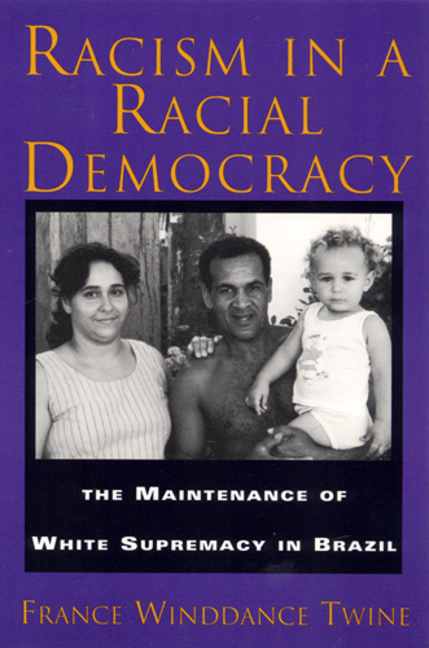
Racism in a Racial Democracy: The Maintenance of White Supremacy in Brazil

Posted in Anthropology, Books, Brazil, Caribbean/Latin America, History, Media Archive, Monographs, Social Science on 2011-12-12 01:28Z by Steven

Racism in a Racial Democracy: The Maintenance of White Supremacy in Brazil

Rutgers University Press
1997-10-01
192 pages
20 b & w photos
Cloth ISBN: 978-0-8135-2364-4
Paperback ISBN: 978-0-8135-2365-1

France Winddance Twine, Professor of Sociology
University of California, Santa Barbara

This groundbreaking ethnographic study analyzes everyday practices that leave intact the myth that Brazil is a racial democracy.

In Racism in a Racial Democracy, France Winddance Twine asks why Brazilians, particularly Afro-Brazilians, continue to have faith in Brazil’s “racial democracy” in the face of pervasive racism in all spheres of Brazilian life. Through a detailed ethnography, Twine provides a cultural analysis of the everyday discursive and material practices that sustain and naturalize white supremacy.

This is the first ethnographic study of racism in southeastern Brazil to place the practices of upwardly mobile Afro-Brazilians at the center of analysis. Based on extensive field research and more than fifty life histories with Afro- and Euro-Brazilians, this book analyzes how Brazilians conceptualize and respond to racial disparities. Twine illuminates the obstacles Brazilian activists face when attempting to generate grassroots support for an antiracist movement among the majority of working class Brazilians. Anyone interested in racism and antiracism in Latin America will find this book compelling.

Table of Contents

  • List of Illustrations and Tables
  • Acknowledgments
  • 1. Introduction
  • 2. Vasalia: The Research Site
  • 3. Mapping the Ideological Terrain of Racism: The Social, Sexual, Socioeconomic, and Semiotic Contours
  • 4. Discourses in Defense of the Racial Democracy
  • 5. Embranquecimento: Aesthetic Ideals and Resistance to Mestiçagem
  • 6. Memory: White Inflation and Willful Forgetting
  • 7. Strategic Responses to Racism: Preserving White Supremacy
  • Appendix A: Interview Schedule
  • Appendix B: Biographical Data on Interviewees
  • Notes
  • Glossary
  • Bibliography
  • Index
Tags: ,

Neither Black Nor White: Slavery and Race Relations in Brazil and the United States

Posted in Books, Brazil, Caribbean/Latin America, History, Media Archive, Monographs, Slavery, Social Science, United States on 2011-12-12 00:21Z by Steven

Neither Black Nor White: Slavery and Race Relations in Brazil and the United States

University of Wisconsin Press
July 1986
328 pages
Paperback ISBN: 978-0-299-10914-1

Carl N. Degler (1921-2015), Margaret Byrne Professor of American History Emeritus
Stanford University

Carl Degler’s 1971 Pulitzer-Prize-winning study of comparative slavery in Brazil and the United States is reissued in the Wisconsin paperback edition, making it accessible for all students of American and Latin American history and sociology.

Until Degler’s groundbreaking work, scholars were puzzled by the differing courses of slavery and race relations in the two countries. Brazil never developed a system of rigid segregation, such as appeared in the United States, and blacks in Brazil were able to gain economically and retain far more of their African culture. Rejecting the theory of Gilberto Freyre and Frank Tannenbaum that Brazilian slavery was more humane, Degler instead points to a combination of demographic, economic, and cultural factors as the real reason for the differences.

Table of Contents

  • Preface
  • I. The Challenge of the Contrast
    • Contrast in History
    • Contrast in Cultural Response
    • Contrast Acknowledged
    • An Explanation Advanced
  • II. Slavery Compared
    • Who Protects the Slave’s Humanity?
    • Manumission: How Easy, How Common?
    • Rebellions and Runaways
    • The International Slave Trade As Cause
    • Slave Rearing As Consequence
    • A Harsher Slavery
    • To Arm a Black Slave
    • Who Identifies with Negroes?
    • The Hidden Difference
  • III. The Outer Burdens of Color
    • The Geography of Color Prejudice
    • Who Is a Negro?
    • Permutations of Prejudice
    • Measures of Discrimination
  • IV. The Inner Burdens of Color
    • Negroes Alone Feel the the Weight
    • Eventually the Veil Falls
    • The Flight from Blackness
    • The Black Mother on Two Continents
    • Black Panthers Not Allowed
    • Sex, but Not Marriage
    • “A Negro with a White Soul”
    • The Heart of the Matter
  • V. The Roots of Difference
    • Consciousness of Color
    • The Historical Dimension
    • The Mulatto Is the Key
    • The Beginnings of the Mulatto Escape Hatch
    • White Wife Against White Man
    • A Path Not Taken
    • Cultural and Social Values Make a Differance
    • Democracy’s Contribution
    • The Differences As National Ideologies
  • VI. A Contrast in the Future?
    • The Gap Narrows
    • Negroes See a New Contrast
    • A Brazilian Dilemma
    • Always That
    • Indelible Color
  • Index
Tags: , , ,

A Singular Woman: The Untold Story of Barack Obama’s Mother

Posted in Barack Obama, Biography, Books, Media Archive, Monographs, Women on 2011-12-11 01:53Z by Steven

A Singular Woman: The Untold Story of Barack Obama’s Mother

Riverhead an Imprint of Penguin Press
2011-05-03
384 pages
9.25 x 6.25in
Hardcover ISBN: 9781594487972
Paperback ISBN: 9781594485596

Janny Scott

A major publishing event: an unprecedented look into the life of the woman who most singularly shaped Barack Obama—his mother.

Barack Obama has written extensively about his father, but little is known about Stanley Ann Dunham, the fiercely independent woman who raised him, the person he credits for, as he says, “what is best in me.” Here is the missing piece of the story.

Award-winning reporter Janny Scott interviewed nearly two hundred of Dunham’s friends, colleagues, and relatives (including both her children), and combed through boxes of personal and professional papers, letters to friends, and photo albums, to uncover the full breadth of this woman’s inspiring and untraditional life, and to show the remarkable extent to which she shaped the man Obama is today.

Dunham’s story moves from Kansas and Washington state to Hawaii and Indonesia. It begins in a time when interracial marriage was still a felony in much of the United States, and culminates in the present, with her son as our president- something she never got to see. It is a poignant look at how character is passed from parent to child, and offers insight into how Obama’s destiny was created early, by his mother’s extraordinary faith in his gifts, and by her unconventional mothering. Finally, it is a heartbreaking story of a woman who died at age fifty-two, before her son would go on to his greatest accomplishments and reflections of what she taught him.

Tags: , , , ,

Forgotten Tribes: Unrecognized Indians and the Federal Acknowledgment Process

Posted in Books, Monographs, Native Americans/First Nation, Politics/Public Policy, United States on 2011-12-04 21:24Z by Steven

Forgotten Tribes: Unrecognized Indians and the Federal Acknowledgment Process

University of Nebraska Press
2004
355 pages
paperback ISBN: 978-0-8032-8321-3
hardback ISBN: 978-0-8032-3226-6

Mark Edwin Miller, Associate Professor of History
Southern Utah University

The Federal Acknowledgment Process (FAP) is one of the most important and contentious issues facing Native Americans today. A complicated system of criteria and procedures, the FAP is utilized by federal officials to determine whether a Native community qualifies for federal recognition by the United States government. In Forgotten Tribes, Mark Edwin Miller offers a balanced and detailed look at the origins, procedures, and assumptions governing the FAP. His work examines the FAP through the prism of four previously unrecognized tribal communities and their battles to gain indigenous rights under federal law.

Based on a wealth of interviews and original research, Forgotten Tribes features the first in-depth history and overview of the FAP and sheds light on this controversial Native identification policy involving state power over Native peoples and tribal sovereignty.

Contents

  • Acknowledgments
  • Abbreviations
  • Map
  • Introduction
  • 1. Adrift with the Indian Office: The Historical Development of Tribal Acknowledgment Policy, 1776-–1978
  • 2. Building an Edifice: The BIA’s Federal Acknowledgment Process, 1978–-2002
  • 3. Bypassing the Bureau: The Pascua Yaquis’ Quest for Legislative Tribal Recognition
  • 4. Sometimes Salvation: The Death Valley Timbisha Shoshones of California and the BIA’s Federal Acknowledgment Process
  • 5. A Matter of Visibility: The United Houma Nation’s Struggle for Tribal Acknowledgment
  • 6. From Playing Indian to Playing Slots: Gaming, Tribal Recognition, and the Tiguas of El Paso, Texas
  • Conclusion
  • Notes
  • Bibliography
  • Index

Introduction

It was in the early 1990s that the small Mashantucket Pequot Tribe of Connecticut burst upon the national scene, indelibly marking popular perceptions of once unacknowledged Indian tribes in the public conscious. After struggling for centuries without federal tribal status, the Pequots under Richard “Skip” Hayward dashed with aplomb into the twenty-first century, leading the march toward self-suf ciency and self-government through their phenomenally successful Foxwoods Casino complex situated midway between New York City and Boston. Making one billion dollars annually by the end of the decade, Foxwoods was the most lucrative gambling Mecca in the United States, drawing widespread attention up and down the East Coast. A decade earlier when the tribe had secured federal acknowledgment through an act of Congress in 1983, the development had raised few eyebrows, however, causing more relief than alarm because it settled a lengthy and bitter land dispute between the Pequots and neighboring property owners. Some observers undoubtedly felt that the obscure tribe, once widely believed to be extinct, had finally gotten its revenge for past injustices. Other locals simply were happy to have a place to gamble so close to their homes, cheering the Pequots for making this possible and perhaps being a little amused by the whole unlikely scenario. Questions soon arose, however, when the group possessing Indian, European, and African ancestry grew increasingly rich and powerful, with its gambling enterprise shattering the once bucolic Connecticut countryside with crowds, traffic jams, and high-rise development. Angered by their suddenly powerful neighbor, many locals began to ask: Who were these people that variously appeared white, Indian, black, or something in-between? If they looked and lived much like their well-to-do neighbors, was the group really an Indian tribe at all? Clearly, tribal acknowledgment had given the Pequots all the bene ts of tribal status and sovereignty. But it had not allowed them to exist in obscurity as before. Every year during the 1990s tensions and recriminations grew. When a book emerged claiming that the Pequots may have tricked the federal government into believing they were an Indian tribe, local leaders clamored to have their status overturned. By 2000 the continuing deluge of press coverage ensured that the Mashantucket Pequots became the dominant face of recently acknowledged Indian tribes in the United States.

At the same time, in stark contrast to the glitz and wealth of the Pequots stood a struggling band of Shoshones in California. A world away from Connecticut in the desert sands of Death Valley National Park, the Timbisha Shoshone Indians also existed without federal acknowledgment until the early 1980s. The Shoshones were unlike the Pequots at first glance, however, and few non-Indians doubted that the tiny Timbisha group was Indian. In the late 1970s the Shoshones were struggling against the National Park Service’s efforts to evict them from their ancestral homeland, clinging to their crumbling adobe casitas and modest trailers that shifting sand dunes threatened to swallow at any moment. Decades earlier the Park Service had corralled them into a single village to make room for its luxury hotels, golf course, and RV resort to cater to tourists hoping to escape the northern winters or recapture the “Wild West” for a weekend. Like the Pequots, the Timbisha Shoshones also secured acknowledgment in 1983, but this new status provided few of the fringe benefits afforded the Connecticut tribe. In 2000 the band still lacked a federal reservation and lived in poor housing much like it had before recognition. The Timbisha Shoshones presented another face of once unacknowledged Indian peoples in the modern United States. The experience of the over two hundred other unacknowledged groups likely lies somewhere in between.

Issues

This work is about the process of acknowledging Indian tribes, whether accomplished through the administrative channels of the Bureau of Indian Affairs (BIA) or through Congress.  At its core it is about modern Indian identity: how the state identifies and legitimizes tribes and how recognized tribes, non-Indian scholars, and the American public perceive Indians. Along the way it provides a rare glimpse into Indian and non-Indian representations of “Indianness” and tribalism. These pages also present the histories of four unacknowledged tribal groups viewed through the prism of their efforts to gain federal recognition. Federal tribal acknowledgment or recognition is one of the most significant developments in Indian policy in the post–World War II era, yet is also one of the most acrimonious methods of sorting out and defining Indianness in the United States. As the list of over two hundred groups seeking to secure federal tribal status grows each year, federal acknowledgment policy has become increasingly controversial and contested terrain for determining Indian authenticity.

Tribal recognition is contentious precisely because it involves definitions of what constitutes an Indian tribe,who can lay claim to being an Indian, and what factors should be paramount in the process of identifying Indian tribes. Akin to the recognition of foreign governments, federal tribal acknowledgment is highly valued because it establishes a “government-to-government” relationship between the federal government and an Indian group. Federal status thus allows a newly recognized federal tribe the power to exercise sovereignty and participate in federal Indian programs emanating from the BIA and the Indian Health Service. It also affects issues as diverse as Indian self-government, health care, Native American cultural repatriation, Indian gaming, and public lands held by the National Park Service and other federal agencies. Beyond these facts the acknowledgment process can determine the life or death of struggling groups while providing unacknowledged tribes outside validation of their racial and cultural identity as Indians…

…From the start local whites questioned whether these groups were indeed tribes and expressed doubts about their Indian identity. To the eastern landowners, most of these groups “looked” variously white, black, Indian, or something in between. They clearly did not fit the image of the horseriding, buffalo-hunting Indians they had seen in Hollywood westerns. In court the town attorneys proceeded to impugn the cultural and tribal integrity of these people, claiming that the groups had long ago abandoned their tribal organizations and assimilated into American society and culture. Despite the Wampanoags’ assertions that the land on Martha’s Vineyard was sacred to their people and that they maintained a vibrant tribal organization, town lawyers echoed a popular belief that the Wampanoags——if they were a group at all——were assimilated individuals hoping to get rich off land claims. Because the rights asserted were group rights, the hopes of the Martha’s Vineyard Indians and others ultimately rested on whether they were still an Indian “tribal” entity…

Read the entire introduction here.

Tags: , , ,

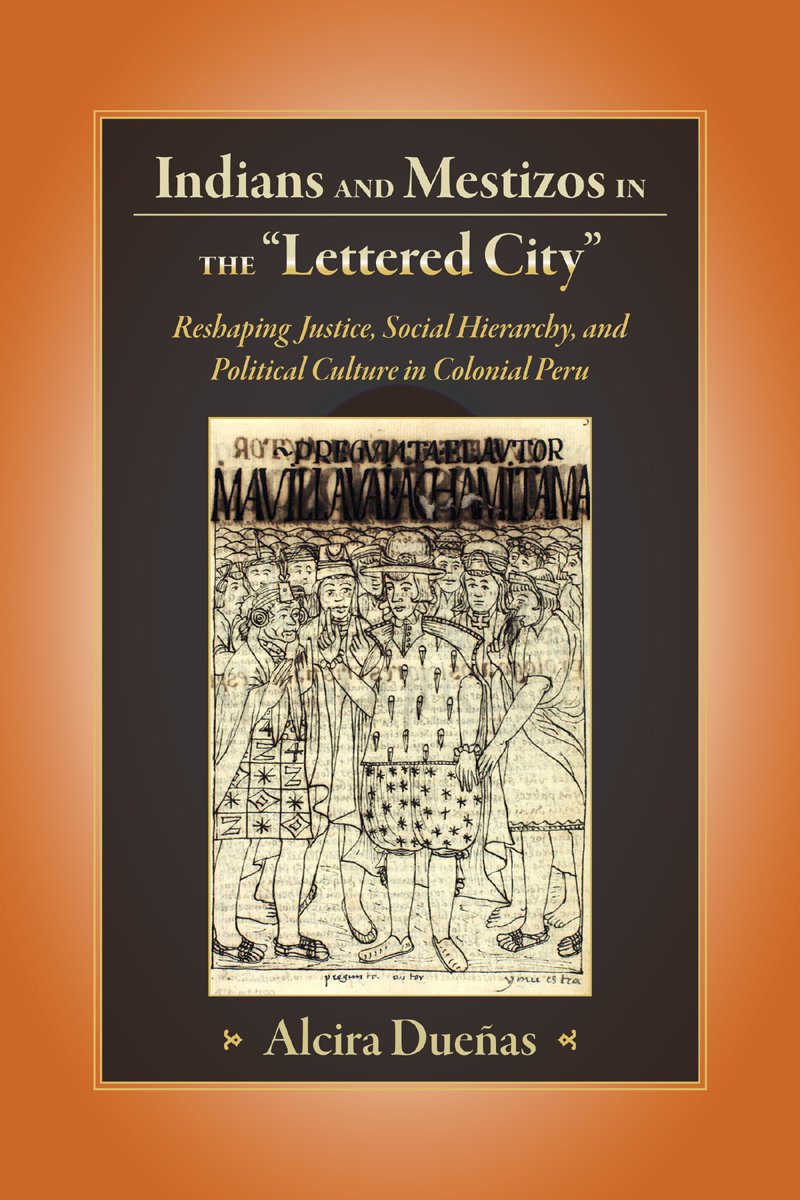
Indians and Mestizos in the “Lettered City”: Reshaping Justice, Social Hierarchy, and Political Culture in Colonial Peru

Posted in Anthropology, Books, Caribbean/Latin America, History, Literary/Artistic Criticism, Media Archive, Monographs on 2011-12-03 23:41Z by Steven

Indians and Mestizos in the “Lettered City”: Reshaping Justice, Social Hierarchy, and Political Culture in Colonial Peru

University Press of Colorado
2010
320 pages
5 line drawings, 1 map
Cloth ISBN: 978-1-60732-018-0
Ebook ISBN: 978-1-60732-019-7

Alcira Dueñas, Assistant Professor of Latin American History and World History
Ohio State University, Newark

Through newly unearthed texts virtually unknown in Andean studies, Indians and Mestizos in the “Lettered City” highlights the Andean intellectual tradition of writing in their long-term struggle for social empowerment and questions the previous understanding of the “lettered city” as a privileged space populated solely by colonial elites. Rarely acknowledged in studies of resistance to colonial rule, these writings challenged colonial hierarchies and ethnic discrimination in attempts to redefine the Andean role in colonial society.

Scholars have long assumed that Spanish rule remained largely undisputed in Peru between the 1570s and 1780s, but educated elite Indians and mestizos challenged the legitimacy of Spanish rule, criticized colonial injustice and exclusion, and articulated the ideas that would later be embraced in the Great Rebellion in 1781. Their movement extended across the Atlantic as the scholars visited the seat of the Spanish empire to negotiate with the king and his advisors for social reform, lobbied diverse networks of supporters in Madrid and Peru, and struggled for admission to religious orders, schools and universities, and positions in ecclesiastic and civil administration.

Indians and Mestizos in the “Lettered City” explores how scholars contributed to social change and transformation of colonial culture through legal, cultural, and political activism, and how, ultimately, their significant colonial critiques and campaigns redefined colonial public life and discourse. It will be of interest to scholars and students of colonial history, colonial literature, Hispanic studies, and Latin American studies.

Contents

  • List of Illustrations
  • Acknowledgments
  • Chapter 1. Introduction
  • Chapter 2. Foundations of Seventeenth-Century Andean Scholarship
  • Chapter 3. Andean Scholarship in the Eighteenth Century: Writers, Networks,and Texts
  • Chapter 4. The European Background of Andean Scholarship
  • Chapter 5. Andean Discourses of Justice: The Colonial Judicial System under Scrutiny
  • Chapter 6. The Political Culture of Andean Elites: Social Inclusion and Ethnic Autonomy
  • Chapter 7. The Politics of Identity Formation in Colonial Andean Scholarship
  • Chapter 8. Conclusion
  • Epilogue
  • Selected Bibliography
  • Index
Tags: , , ,

Recasting Race after World War II: Germans and African Americans in American-Occupied Germany

Posted in Arts, Books, Europe, History, Media Archive, Monographs on 2011-12-03 20:41Z by Steven

Recasting Race after World War II: Germans and African Americans in American-Occupied Germany

University Press of Colorado
2007
320
9 b&w photos
Cloth ISBN: 978-0-87081-869-1

Timothy L. Schroer, Associate Professor of History
University of West Georgia

Historian Timothy L. Schroer’s Recasting Race after World War II explores the renegotiation of race by Germans and African American GIs in post-World War II Germany. Schroer dissects the ways in which notions of blackness and whiteness became especially problematic in interactions between Germans and American soldiers serving as part of the victorious occupying army at the end of the war.

The segregation of U.S. Army forces fed a growing debate in America about whether a Jim Crow army could truly be a democratizing force in postwar Germany. Schroer follows the evolution of that debate and examines the ways in which postwar conditions necessitated reexamination of race relations. He reveals how anxiety about interracial relationships between African American men and German women united white American soldiers and the German populace. He also traces the importation and influence of African American jazz music in Germany, illuminating the subtle ways in which occupied Germany represented a crucible in which to recast the meaning of race in a post-Holocaust world.

Recasting Race after World War II will appeal to historians and scholars of American, African American, and German studies.

Tags: , , , , , , ,

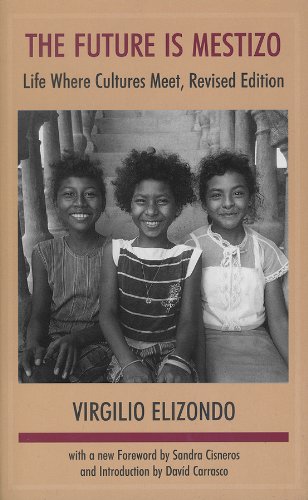
The Future is Mestizo: Life Where Cultures Meet, Revised Edition

Posted in Anthropology, Books, Latino Studies, Media Archive, Monographs, Religion, Social Science, United States on 2011-12-03 05:15Z by Steven

The Future is Mestizo: Life Where Cultures Meet, Revised Edition

University Press of Colorado
2000
136 pages
8.2 x 5.1 x 0.4 inches
Paper ISBN:978-0-87081-576-8

Virgilio Elizondo, Professor of Pastoral and Hispanic Theology; Fellow, Institute for Latino Studies and Kellogg Institute
Notre Dame University

Twelve years after it was first published, The Future is Mestizo is now updated and revised with a new foreword, introduction, and epilogue. This book speaks to the largest demographic change in twentieth-century United States history-the Latinization of music, religion, and culture.

Contents
Contents

  • Foreword by Sandra Cisneros
  • Preface The Great Border
  • Introduction The Future Is Mestizo: We Are the Shades by David Carrasco
  • 1. A Family of Migrants
    • My City
    • My Family
    • My Neighborhood and Parish
  • 2. Who Am I?
    • Moving into a “Foreign Land”
      vAcceptance, Belonging, and Affirmation
    • Experiences of Non-Being
    • Neither/Nor but Something New
  • 3. A Violated People
    • The Masks of Suffering
    • The Eruption
    • The Eruption Continues
    • Going to the Roots
  • 4. Marginality
    • Festive Breakthrough
    • Institutional Barriers
    • Invisible Mechanisms
  • 5. My People Resurrect at Tepeyac
    • The Dawn of a New Day
    • From Death to New Life
    • First “Evange!ium” of the Americas
    • Beginning of the New Race
  • 6. Galilee of Mestizos
    • Is Human Liberation Possible?
    • Conquest or Birth
    • The Unimagined Liberation
    • From Margination to Unity
  • 7. Toward Universal Mestizaje
    • From Unsuspected Limitations to Unsuspected Richness
    • A New Being: Universal and Local
    • Continued Migrations
    • Threshold of a New Humanity
    • The Ultimate Mestizaje
  • Epilogue: A Reflection Twelve Years Later
    • The Negative
    • The Challenge
Tags: , ,