Colonial Blackness: A History of Afro-Mexico

Posted in Books, Caribbean/Latin America, History, Media Archive, Mexico, Monographs, Religion on 2012-01-02 04:35Z by Steven

Colonial Blackness: A History of Afro-Mexico

Indiana University Press
2009
248 pages
6.125 x 9.25
Paperback ISBN: 978-0-253-22331-9

Herman L. Bennett, Professor of Latin American History
City Univerisity of New York

Asking readers to imagine a history of Mexico narrated through the experiences of Africans and their descendants, this book offers a radical reconfiguration of Latin American history. Using ecclesiastical and inquisitorial records, Herman L. Bennett frames the history of Mexico around the private lives and liberty that Catholicism engendered among enslaved Africans and free blacks, who became majority populations soon after the Spanish conquest. The resulting history of 17th-century Mexico brings forth tantalizing personal and family dramas, body politics, and stories of lost virtue and sullen honor. By focusing on these phenomena among peoples of African descent, rather than the conventional history of Mexico with the narrative of slavery to freedom figured in, Colonial Blackness presents the colonial drama in all its untidy detail.

Tags: , , , , ,

The Retreat of Scientific Racism: Changing Concepts of Race in Britain and the United States between the World Wars

Posted in Anthropology, Books, Health/Medicine/Genetics, Literary/Artistic Criticism, Media Archive, Monographs, Politics/Public Policy, United Kingdom, United States on 2012-01-01 01:52Z by Steven

The Retreat of Scientific Racism: Changing Concepts of Race in Britain and the United States between the World Wars

Cambridge University Press
September 1993
396 pages
228 x 152 mm
ISBN: 9780521458757
DOI: 10.2277/0521458757

Elazar Barkan, Professor of International and Public Affairs
Columbia University

This fascinating study in the sociology of knowledge documents the refutation of scientific foundations for racism in Britain and the United States between the two world wars, when the definition of race as a biological concept was replaced by a cultural notion of race. Discussing the work of the leading biologists and anthropologists who wrote about race between the wars, Dr. Barkan argues that the impetus for the shift in ideologies of race came from the inclusion of outsiders—women, Jews, and leftists—into the mainstream of scientific discourse.

Table of Contents

  • Preface
  • List of abbreviations
  • Introduction
  • PART I: ANTHROPOLOGY
    • 1. Constructing a British identity
      • Colors into races. A transition to modern British anthropology. The founding fathers. Mummies, bones and stones. The shift in British archaeology. A British glimpse at race relations.
    • 2. American diversity
      • Haunted sentinels. European skulls and the primitive mind. The Boasians. American physical anthropology. The politics of coexistence. Dionysia in the Pacific.
  • PART II: BIOLOGY
    • 3. In search of a biology of race
      • NewGenics. The statistician’s fable. Race crossing in Jamaica. A Canadian in London: rigid Reginald Ruggles Gates.
    • 4. The limit of traditional reform
      • A racist liberal: Julian Huxley’s early years. Herbert Spencer Jennings and progressive eugenics. A conservative critique: Raymond Pearl. Bridging race formalism and population genetics.
    • 5. Mitigating racial differences
      • Lancelot Hogben. “Africa view” – Huxley’s changing perspectives. J. B. S. Haldane: a defiant aristocrat. Medicine and eugenics: expanding the environment. Eugenics reformed.
  • PART III: POLITICS
    • 6. Confronting racism: scientists as politicians
      • 1933 – Early hesitations. Britain – Race and Culture Committee. We Europeans. The American scene. An international interlude. The Paris Congress. The population committee. Out of the closet.
  • EPILOGUE
  • Bibliography
  • Index
Tags: , , , , , , , , , ,

My Confederate Kinfolk: A Twenty-First Century Freedwoman Discovers Her Roots

Posted in Autobiography, Books, History, Media Archive, Monographs, United States on 2011-12-30 20:36Z by Steven

My Confederate Kinfolk: A Twenty-First Century Freedwoman Discovers Her Roots

Basic Civitas Books
2007-01-02
352 pages
Paperback ISBN: 9780465015740; ISBN-10: 0465015743

Thulani Davis

Starting from a photograph and writings left by her grandmother, acclaimed African-American novelist Thulani Davis goes looking for the “white folk” in her family, a Scots-Irish family of cotton planters unknown to her-and uncovers a history far richer and stranger than she had ever imagined. Her journey challenges us to examine the origins of some of our most deeply ingrained notions about what makes a family black or white, and offers an immensely compelling, intellectually challenging alternative.

Tags: ,

The Herndons: An Atlanta Family

Posted in Biography, Books, History, Monographs, United States on 2011-12-29 03:57Z by Steven

The Herndons: An Atlanta Family

University of Georgia Press
2002-06-21
272 pages
8 x 10
Cloth ISBN: 978-0-8203-2309-1

Carole Merritt, Director
The Herndon Home, Atlanta, Georgia

A compelling portrait of one of Atlanta’s most prominent African American families

Born a slave and reared a sharecropper, Alonzo Herndon (1858-1927) was destined to drudgery in the red clay fields of Georgia. Within forty years of Emancipation, however, he had amassed a fortune that far surpassed that of his White slave-master father.

Through his barbering, real estate, and life insurance ventures, Herndon would become one of the wealthiest and most respected African American business figures of his era. This richly illustrated book chronicles Alonzo Herndon’s ascent and his remarkable family’s achievements in Jim Crow Atlanta.

In this first biography of the Herndons, Carole Merritt narrates how Herndon nurtured the Atlanta Life Insurance Company from a faltering enterprise he bought for $140 into one of the largest Black financial institutions in America; how he acquired the most substantial Black property holdings in Atlanta; and how he developed his barbering business from a one-chair shop into the nation’s largest and most elegant parlor, the resplendent, twenty-three chair “Crystal Palace” in the heart of White Atlanta.

The Herndons’ world was the educational and business elite of Atlanta. But as Blacks, they were intimately bound to the course of Black life. The Atlanta Race Riot of 1906 and its impact on the Herndons demonstrated that all Blacks, regardless of class, were the victims of racial terrorism.

Through the Herndons, issues of race, class, and color in turn-of-the-century Atlanta come into sharp focus. Their story is one of by-the-bootstraps resolve, tough compromises in the face of racism, and lasting contributions to their city and nation.

Tags: , , , , , ,

The Mystery of Samba: Popular Music and National Identity in Brazil

Posted in Books, Brazil, Caribbean/Latin America, History, Literary/Artistic Criticism, Media Archive, Monographs, Slavery on 2011-12-28 23:11Z by Steven

The Mystery of Samba: Popular Music and National Identity in Brazil

University of North Carolina Press
February 1999
168 pages
6.125 x 9.25, notes, bibl., index
Paper ISBN  978-0-8078-4766-4

Hermano Vianna

Edited and translated by

John Charles Chasteen, Associate Professor of History
University of North Carolina, Chapel Hill

Samba is Brazil’s “national rhythm,” the foremost symbol of its culture and nationhood. To the outsider, samba and the famous pre-Lenten carnival of which it is the centerpiece seem to showcase the country’s African heritage. Within Brazil, however, samba symbolizes the racial and cultural mixture that, since the 1930s, most Brazilians have come to believe defines their unique national identity.

But how did Brazil become “the Kingdom of Samba” only a few decades after abolishing slavery in 1888? Typically, samba is represented as having changed spontaneously, mysteriously, from a “repressed” music of the marginal and impoverished to a national symbol cherished by all Brazilians. Here, however, Hermano Vianna shows that the nationalization of samba actually rested on a long history of relations between different social groups–poor and rich, weak and powerful–often working at cross-purposes to one another.

A fascinating exploration of the “invention of tradition,” The Mystery of Samba is an excellent introduction to Brazil’s ongoing conversation on race, popular culture, and national identity.

Table of Contents

  • Translator’s Preface
  • Author’s Preface to the U.S. Edition
  • Acknowledgments
  • 1. The Encounter
  • 2. The Mystery
  • 3. Popular Music and the Brazilian Elite
  • 4. The Unity of the Nation
  • 5. Race Mixture
  • 6. Gilberto Freyre
  • 7. The Modern Samba
  • 8. Samba of My Native Land
  • 9. Nowhere at All
  • 10. Conclusions
  • Notes
  • Index
Tags: , , , , , , ,

Blackness Without Ethnicity: Constructing Race in Brazil

Posted in Books, Brazil, Caribbean/Latin America, Media Archive, Monographs, Social Science on 2011-12-26 20:01Z by Steven

Blackness Without Ethnicity: Constructing Race in Brazil

Palgrave Macmillan
August 2003
256 pages
5 1/2 x 8 1/4 inches
Hardback ISBN: 978-0-312-29374-1, ISBN10: 0-312-29374-7
Paperback ISBN: 978-0-312-29375-8, ISBN10: 0-312-29375-5

Livio Sansone, Vice Director of Centro de Estudos Afro-Asiaticos
Universidade Candido Mendes in Brazil

Drawing on 15 years of research in Bahia, Rio de Janeiro, Suriname, and the Netherlands, Livio Sansone explores the very different ways that race and ethnicity are constructed in Brazil and the rest of Latin America. He compares Latin American conceptions of race to US and European notions of race that are defined by clearly identifiable black-white ethnicities. Sansone argues that understanding more complex, ambiguous notions of culture and identity will expand international discourse on race and move it away from American definitions unable to describe racial difference. He also explores the effects of globalization on constructions of race.

Table of Contents

  • Introduction: An Afro-Latin Paradox? Ambiguous Ethnic Lines, Sharp Class Divisions, and a Vital Black Culture
  • Negro Parents, Black Children: Work, Color, and Generational Differences
  • From Africa to Afro: Uses and Abuses of Africa in Brazil
  • The Local and Global in Today’s Afro-Bahia
  • Funk in Bahia and Rio: Local Versions of a Global Phenomena
  • The Internationalization of Black Culture: A Comparison of Lower-Class Youth in Brazil and the Netherlands
  • Conclusions: The Place of Brazil in the Black Atlantic
Tags: ,

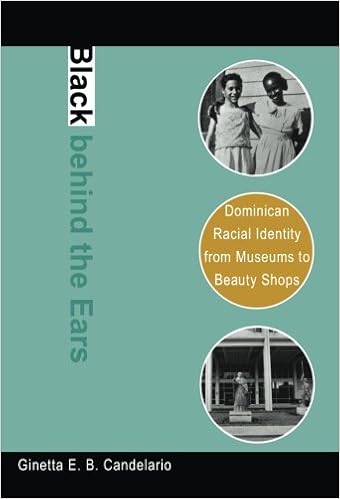
Black behind the Ears: Dominican Racial Identity from Museums to Beauty Shops

Posted in Books, Caribbean/Latin America, History, Media Archive, Monographs, Social Science, United States on 2011-12-26 02:14Z by Steven

Black behind the Ears: Dominican Racial Identity from Museums to Beauty Shops

Duke University Press
2007
360 pages
37 b&w photos, 9 tables
Paperback ISBN: 978-0-8223-4037-9
Cloth ISBN: 978-0-8223-4018-8

Ginetta E. B. Candelario, Associate Professor of Sociology and Latin American and Latina/o Studies
Smith College, Northampton, Massachusetts

Black behind the Ears is an innovative historical and ethnographic examination of Dominican identity formation in the Dominican Republic and the United States. For much of the Dominican Republic’s history, the national body has been defined as “not black,” even as black ancestry has been grudgingly acknowledged. Rejecting simplistic explanations, Ginetta E. B. Candelario suggests that it is not a desire for whiteness that guides Dominican identity discourses and displays. Instead, it is an ideal norm of what it means to be both indigenous to the Republic (indios) and “Hispanic.” Both indigeneity and Hispanicity have operated as vehicles for asserting Dominican sovereignty in the context of the historically triangulated dynamics of Spanish colonialism, Haitian unification efforts, and U.S. imperialism. Candelario shows how the legacy of that history is manifest in contemporary Dominican identity discourses and displays, whether in the national historiography, the national museum’s exhibits, or ideas about women’s beauty. Dominican beauty culture is crucial to efforts to identify as “indios” because, as an easily altered bodily feature, hair texture trumps skin color, facial features, and ancestry in defining Dominicans as indios.

Candelario draws on her participant observation in a Dominican beauty shop in Washington Heights, a New York City neighborhood with the oldest and largest Dominican community outside the Republic, and on interviews with Dominicans in New York City, Washington, D.C., and Santo Domingo. She also analyzes museum archives and displays in the Museo del Hombre Dominicano and the Smithsonian Institution as well as nineteenth- and early-twentieth-century European and American travel narratives.

Table of Contents

  • Figures and Tables
  • Acknowledgments
  • Introduction. “We Declare That We Are Indians”: Dominican Identity Displays and Discourses in Travel Writing, Museums, Beauty Shops, and Bodies
  • 1. “It Is Said That Haiti Is Getting Blacker and Blacker”: Traveling Narratives of Dominican Identity
  • 2. “The Africans have No [Public] History”: The Museo del Hombre Dominicano and Indigenous Displays of Dominican Identity
  • 3. “I Could Go the African American Route”: Dominicans in the Black Mosaic of Washington, D.C.
  • 4. “They Are Taken into Account for Their Opinions”: Making Community and Displaying Identity at a Dominican Beauty Shop in New York City
  • 5. “Black Women are Confusing, but the Hair Lets You Know”: Perceiving the Boundaries of Dominicanidad
  • Conclusion: “Black Behind the Ears, and Up Front, Too”: Ideological Code Switching and Ambiguity in Dominican Identities
  • Notes
  • References
  • Index
Tags: , , ,

A More Noble Cause: A. P. Tureaud and the Struggle for Civil Rights in Louisiana

Posted in Biography, Books, Law, Louisiana, Media Archive, Monographs, United States on 2011-12-25 18:30Z by Steven

A More Noble Cause: A. P. Tureaud and the Struggle for Civil Rights in Louisiana

Louisiana State University Press
April 2011
328 pages
6 x 9 inches, 21 halftones
Hardcover ISBN: 9780807137932

Alexander P. Tureaud, Jr.

Rachel L. Emanuel

Throughout the decades-long legal battle to end segregation, discrimination, and disfranchisement, attorney Alexander Pierre Tureaud was one of the most influential figures in Louisiana’s courts. A More Noble Cause presents both the powerful story of one man’s lifelong battle for racial justice and the very personal biography of a black professional and his family in the Jim Crow-era Louisiana.

During a career that spanned more than forty years, A. P. Tureaud was at times the only regularly practicing black attorney in Louisiana. From his base in New Orleans, the civil rights pioneer fought successfully to obtain equal pay for Louisiana’s black teachers, to desegregate public accommodations, schools, and buses, and for voting rights of qualified black residents.

Tureaud’s work, along with that of dozens of other African American lawyers, formed part of a larger legal battle that eventually overturned Plessy v. Ferguson, the 1896 U.S. Supreme Court decision that legalized racial segregation. This intimate account, based on more than twenty years of research into the attorney’s astounding legal and civil rights career as well as his community work, offers the first full-length study of Tureaud. An active organizer of civic and voting leagues, a leader in the NAACP, a national advocate of the Knights of Peter Claver—a fraternal order of black Catholics—and a respected political power broker and social force as a Democrat and member of the Autocrat Club and Alpha Phi Alpha fraternity, Tureaud worked tirelessly within the state and for all those without equal rights.

Both an engrossing story of a key legal, political, and community figure during Jim Crow-era Louisiana and a revealing look at his personal life during a tumultuous time in American history, A More Noble Cause provides insight into Tureaud’s public struggles and personal triumphs, offering readers a candid account of a remarkable champion of racial equality.

Table of Contents

  • Preface
  • Acknowledgments
  • 1. Underestimated and Misperceived
  • 2. Of Creole Heritage
  • 3. Educating Alex
  • 4. Southern Exodus
  • 5. Preparing for a Legal Career
  • 6. Return to New Orleans
  • 7. Meeting Lucille
  • 8. Growing Community Involvement
  • 9. The War Years
  • 10. NAACP Lawyer
  • 11. Law and Fatherhood
  • 12. “Separate but Equal” Strengthened in the Face of Desegregation
  • 13. Desegregation of Primary and Secondary Schools
  • 14. The Politician
  • 15. Desegregation Battles after Brown
  • 16. Enforcing Brown’s Mandate in New Orleans Grade Schools
  • 17. Catholics and Desegregation
  • 18. More to the Desegregation Mandate
  • 19. Reconstructing Public Education
  • 20. More Direct Action
  • 21. Courts Are the Way
  • 22. Race against Time
  • Notes
  • Index

Underestimated and Misperceived

He sat in that chair day after day, reflecting on his life as he spoke haltingly into the tape recorder. He was a man whose erect bearing had once projected calm assurance and deep human insight and whose physique had once reflected his lifetime enjoyment of the rich Creole cuisine of New Orleans.

He looked much older than his seventy-three years, and a casual visitor might have thought that his lack of movement and energy reflected a mental exhaustion as well. Despite the fact that he was now gaunt and barely had enough strength to rise from a chair without assistance, he refused to give in to the constant pain that increasing doses of medication could not relieve. As he ruminated over his life, he recalled names, dates, places, and events with unerring accuracy.

The depth of knowledge and perseverance the old man exhibited seemed implausible for one in his condition. But then his entire life had been one impossible challenge after another. Through sheer will, he had changed the face of Louisiana forever. He had helped to stifle rampant segregation through a series of historic lawsuits. He had altered attitudes and conquered adversity with a disarming but unyielding demeanor. The wizened old man in the chair did not look as if he had done any of those things. But then Alexander Pierre Tureaud had been consistently underestimated and was often misperceived by others.

Knocking on the doors of houses in the Faubourg Marigny of New Orleans, whose owners awaited their early morning deliveries of French bread and other baked goods, Alexander Pierre (“Alex”) Tureaud, nine years old, cheerfully greeted the customers as he delivered purchases to their doorstep. The white woman who managed the neighborhood store where he worked assumed, when hiring the curly-haired boy, that he was white.

When the owner of the store later discovered that Alex was a Negro, he instructed the manager to fire him. It did not matter that Alex did a good job, was conscientious, punctual, polite, and liked by the customers. In fact, the store manager paid him a little extra each week, called “lagniappe” by Creoles, because she was more than satisfied with his performance. Following the directive of the owner, the manager fired Alex, and the boy’s initial opportunity to earn his own money was taken away because of racial discrimination.

A wide-eyed, hopeful young Creole experienced his first painful rejection as a colored person during the early 1900s in the segregated South. The wages from the part-time job, though only $1 a week, enabled him to contribute to his family’s meager household income and allowed him to have his own spending money.

Years later, Alexander P. Tureaud greeted two white men with a collegial tip of his hat as he walked by them and entered the courthouse. “Seen that nigger lawyer, yet?” one ol the men asked. Realizing that the man was addressing him, Tureaud shook his head, chuckled to himself, and proceeded up the steps without a second glance in their direction. As he entered the building, he overheard the man’s next remark: “We’re gonna have some fun with that nigger today.” It was then that Tureaud realized that these men were his opposing counsel.

Instead of being angered by their racist comments, Tureaud was amused. Their off-the-cuff statements would create a psychological advantage when he confronted them later in court. Tlieir remarks served to fuel his enthusiasm for the legal battle ahead.

Once inside the courtroom, the two white lawyers could not conceal their surprise when Tureaud introduced himself as the attorney for the plaintiffs and smiled respectfully at the opposing counsel. Tureaud had been mistaken as white many times before, and he knew he could use it to advance his objectives…

…Born three years after the U.S. Supreme Court’s decision in Plessy v. Ferguson, which declared racial segregation the law of the land, Tureaud, in addition to his legal career, became a student of history. lie was particularly inquisitive about his lineage as a New Orleans Creole of color.

The desire to fight racial injustice had been set long ago in the Creole culture of Louisiana. Tureaud found within his culture role models of activism and aligned himself with men and women determined to achieve equality. Pride in his heritage taught him that it is more noble to fight injustice, no matter what, than to resign oneself to it…

Tags: , , , , , ,

The Persistence of the Color Line: Racial Politics and the Obama Presidency

Posted in Barack Obama, Books, Media Archive, Monographs, Politics/Public Policy, Social Science, United States on 2011-12-24 18:20Z by Steven

The Persistence of the Color Line: Racial Politics and the Obama Presidency

Random House, Inc.
2011-08-16
336 pages
Hardback ISBN: 978-0-307-37789-0
Paperback ISBN: 978-0-307-45555-0

Randall Kennedy, Michael R. Klein Professor of Law
Harvard Law School

Timely—as the 2012 presidential election nears—and controversial, here is the first book by a major African-American public intellectual on racial politics and the Obama presidency.
 
Renowned for his cool reason vis-à-vis the pitfalls and clichés of racial discourse, Randall Kennedy—Harvard professor of law and author of the New York Times best seller Nigger: The Strange Career of a Troublesome Word—gives us a keen and shrewd analysis of the complex relationship between the first black president and his African-American constituency.
 
Kennedy tackles such hot-button issues as the nature of racial opposition to Obama, whether Obama has a singular responsibility to African Americans, electoral politics and cultural chauvinism, black patriotism, the differences in Obama’s presentation of himself to blacks and to whites, the challenges posed by the dream of a postracial society, and the far-from-simple symbolism of Obama as a leader of the Joshua generation in a country that has elected only three black senators and two black governors in its entire history.
 
Eschewing the critical excesses of both the left and the right, Kennedy offers a gimlet-eyed view of Obama’s triumphs and travails, his strengths and weaknesses, as they pertain to the troubled history of race in America.

Read an excerpt here.

Table of Contents

  • Introduction
  • 1. The Obama Inaugural
  • 2. Obama Courts Black America
  • 3. Obama and White America: “Why Can’t They All Be Like Him?”
  • 4. The Race Card in the Campaign of 2008
  • 5. Reverend Wright and My Father: Reflections on Blacks and Patriotism
  • 6. The Racial Politics of the Sotomayor Confi rmation
  • 7. Addressing Race “the Obama Way”
  • 8. Obama and the Future of American Race Relations
  • Tags: ,

    Three Sad Races: Racial Identity and National Consciousness in Brazilian Literature

    Posted in Books, Brazil, Caribbean/Latin America, Literary/Artistic Criticism, Media Archive, Monographs on 2011-12-16 01:46Z by Steven

    Three Sad Races: Racial Identity and National Consciousness in Brazilian Literature

    Cambridge University Press
    1983
    210 pages
    216 x 140 mm
    Paperback ISBN: 9780521155342

    David T. Haberly, Professor of Portuguese
    University of Virginia

    An innovative interpretation of the development of Brazilian literature from the sixteenth to the twentieth centuries. Originally published in 1983, Three Sad Races is a study of how Brazilian literature deals with the nation’s racial diversity themes and gives vent to the general disquietude concerning this.

    Table of Contents

    Tags: , , , , , ,