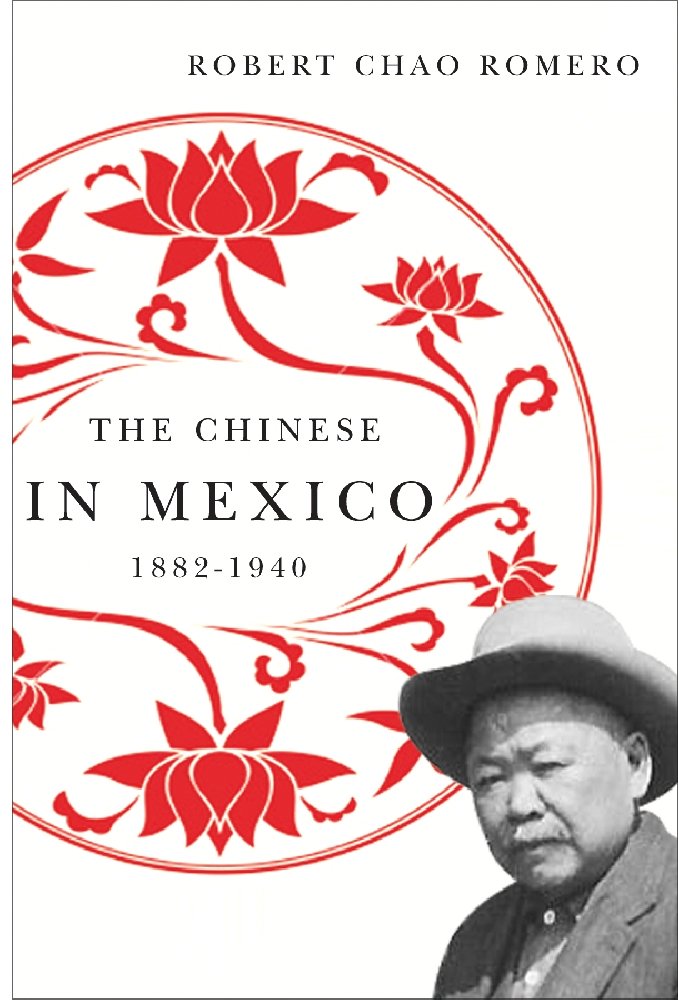
The Chinese in Mexico, 1882-1940

Posted in Asian Diaspora, Books, Caribbean/Latin America, History, Media Archive, Mexico, Monographs on 2012-01-21 04:48Z by Steven

The Chinese in Mexico, 1882-1940

University of Arizona Press
2010-07-22
272 pages
6.00 in x 9.00
Paper (978-0-8165-1460-1)
Cloth (978-0-8165-2772-4)

Robert Chao Romero, Associate Professor of Chicana/o Studies and Asian American Studies
University of California, Los Angeles

An estimated 60,000 Chinese entered Mexico during the late nineteenth and early twentieth centuries, constituting Mexico’s second-largest foreign ethnic community at the time. The Chinese in Mexico provides a social history of Chinese immigration to and settlement in Mexico in the context of the global Chinese diaspora of the era.

Robert Romero argues that Chinese immigrants turned to Mexico as a new land of economic opportunity after the passage of the U.S. Chinese Exclusion Act of 1882. As a consequence of this legislation, Romero claims, Chinese immigrants journeyed to Mexico in order to gain illicit entry into the United States and in search of employment opportunities within Mexico’s developing economy. Romero details the development, after 1882, of the “Chinese transnational commercial orbit,” a network encompassing China, Latin America, Canada, and the Caribbean, shaped and traveled by entrepreneurial Chinese pursuing commercial opportunities in human smuggling, labor contracting, wholesale merchandising, and small-scale trade.

Romero’s study is based on a wide array of Mexican and U.S. archival sources. It draws from such quantitative and qualitative sources as oral histories, census records, consular reports, INS interviews, and legal documents. Two sources, used for the first time in this kind of study, provide a comprehensive sociological and historical window into the lives of Chinese immigrants in Mexico during these years: the Chinese Exclusion Act case files of the U.S. Immigration and Naturalization Service and the 1930 Mexican municipal census manuscripts. From these documents, Romero crafts a vividly personal and compelling story of individual lives caught in an extensive network of early transnationalism.

Tags: , , , , ,

A Stronger Kinship: One Town’s Extraordinary Story of Hope and Faith

Posted in Books, History, Media Archive, Monographs, United States on 2012-01-18 22:30Z by Steven

A Stronger Kinship: One Town’s Extraordinary Story of Hope and Faith

University of Nebraska Press
2007
296 pages
20 photos, 9 tables, appendix
Paperback ISBN: 978-0-8032-6018-4

Anna-Lisa Cox

In the heartland of the United States 150 years ago, where racism and hatred were common, a community decided there could be a different America. Here schools and churches were completely integrated, blacks and whites intermarried, and power and wealth were shared by both races. But for this to happen, the town’s citizens had to keep secrets, break the laws of the world outside, and sweep aside fear and embrace hope.

In a historical-detective feat, Anna-Lisa Cox uncovers the heartening story of this community that took the road untaken. Beginning in the 1860s, the people of Covert, Michigan, attempted to do what then seemed impossible: love one’s neighbor—regardless of skin color—as oneself. Drawing on diaries, oral histories, and contemporary records, Cox gives us intimate glimpses of Covert’s people, from William Conner, the Civil War veteran who went on to become Michigan’s first black justice of the peace, to Elizabeth Gillard, who, shipwrecked and washed onto Covert’s shores, ultimately came to love the unusual community she would call home. In bringing these and other stories of this small town to light, Cox presents a vision of what our nation might have been, and could be.

Table of Contents

  • Cast of Characters
  • Deerfield map
  • Colored population map
  • Introduction
  • 1: The Bleeding Heartland
  • 2: The Journey: 1860–1866
  • 3: Rights: 1866–1869
  • 4: Citizenship: 1870–1875
  • 5: Equality: 1875–1880
  • 6: Independence: 1880–1884
  • 7: Friendship: 1885–1889
  • 8: Justice: 1890–1896
  • Epilogue
  • Acknowledgments
  • Appendix
  • Notes
  • Bibliography
  • Index
Tags: , ,

The Forgotten Diaspora: Jewish Communities in West Africa and the Making of the Atlantic World

Posted in Africa, Anthropology, Books, History, Judaism, Media Archive, Monographs, Religion on 2012-01-16 04:01Z by Steven

The Forgotten Diaspora: Jewish Communities in West Africa and the Making of the Atlantic World

Cambridge University Press
March 2011
278 pages
8 b/w illus. 3 maps
228 x 152 mm
Hardback ISBN:9780521192866

Peter Mark, Professor of Art History
Wesleyan University, Connecticut

José da Silva Horta
Universidade de Lisboa

This book traces the history of early seventeenth-century Portuguese Sephardic traders who settled in two communities on Senegal’s Petite Côte. There, they lived as public Jews, under the spiritual guidance of a rabbi sent to them by the newly established Portuguese Jewish community in Amsterdam. In Senegal, the Jews were protected from agents of the Inquisition by local Muslim rulers. The Petite Côte communities included several Jews of mixed Portuguese-African heritage as well as African wives, offspring, and servants. The blade weapons trade was an important part of their commercial activities. These merchants participated marginally in the slave trade but fully in the arms trade, illegally supplying West African markets with swords. This blade weapons trade depended on artisans and merchants based in Morocco, Lisbon, and northern Europe and affected warfare in the Sahel and along the Upper Guinea Coast. After members of these communities moved to the United Provinces around 1620, they had a profound influence on relations between black and white Jews in Amsterdam. The study not only discovers previously unknown Jewish communities but by doing so offers a reinterpretation of the dynamics and processes of identity construction throughout the Atlantic world.

Table of Contents

  • Introduction
  • 1. Two Sephardic communities on Senegal’s Petite Côte
  • 2. Jewish identity in Senegambia
  • 3. Religious interaction: Catholics, Jews, and Muslims in early 17th-century Upper Guinea
  • 4. The blade weapons trade in seventeenth-century West Africa
  • 5. The Luso-African ivories as historical source for the weapons trade and for the Jewish presence in Guinea of Cape Verde
  • 6. The later years: merchant mobility and the evolution of identity
  • Conclusion
  • Appendix I
  • Appendix II
  • Index
Tags: , , , ,

The Harlem Renaissance in Black and White

Posted in Books, Literary/Artistic Criticism, Media Archive, Monographs, United States on 2012-01-13 04:56Z by Steven

The Harlem Renaissance in Black and White

Harvard University Press
January 1996
560 pages
6-3/8 x 9-1/4 inches
Hardcover ISBN: 9780674372627

George Hutchinson, Booth Tarkington Professor of Literary Studies; Adjunct Professor of African American and African Diaspora Studies;  Adjunct Professor of American Studies
Indiana University, Bloomington

It wasn’t all black or white. It wasn’t a vogue. It wasn’t a failure. By restoring interracial dimensions left out of accounts of the Harlem Renaissance—or blamed for corrupting it—George Hutchinson transforms our understanding of black (and white) literary modernism, interracial literary relations, and twentieth-century cultural nationalism in the United States. What has been missing from literary histories of the time is a broader sense of the intellectual context of the Harlem Renaissance, and Hutchinson supplies that here: Boas’s anthropology, Park’s sociology, various strands of pragmatism and cultural nationalism—ideas that shaped the New Negro movement and the literary field, where the movement flourished. Hutchinson tracks the resulting transformation of literary institutions and organizations in the 1920s, offering a detailed account of the journals and presses, black and white, that published the work of the “New Negroes.” This cultural excavation discredits bedrock assumptions about the motives of white interest in the renaissance, and about black relationships to white intellectuals of the period. It also allows a more careful investigation than ever before of the tensions among black intellectuals of the 1920s. Hutchinson’s analysis shows that the general expansion of literature and the vogue of writing cannot be divorced from the explosion of black literature often attributed to the vogue of the New Negro—any more than the growing sense of “Negro” national consciousness can be divorced from expanding articulations and permutations of American nationality. The book concludes with the first full-scale interpretation of the landmark anthology The New Negro.
 
A courageous work that exposes the oversimplifications and misrepresentations of popular readings of the Harlem Renaissance, this book reveals the truly composite nature of American literary culture.

Tags: , ,

Recovering History, Constructing Race: The Indian, Black, and White Roots of Mexican Americans

Posted in Anthropology, Books, Caribbean/Latin America, History, Latino Studies, Media Archive, Mexico, Monographs, Texas, United States on 2012-01-10 03:01Z by Steven

Recovering History, Constructing Race: The Indian, Black, and White Roots of Mexican Americans

University of Texas Press
2001
389 pages
6 x 9 in., 50 b&w illus., 4 maps
Paperback ISBN: ISBN: 978-0-292-75254-2

Martha Menchaca, Professor of Anthropolgy
University of Texas, Austin

The history of Mexican Americans is a history of the intermingling of races—Indian, White, and Black. This racial history underlies a legacy of racial discrimination against Mexican Americans and their Mexican ancestors that stretches from the Spanish conquest to current battles over ending affirmative action and other assistance programs for ethnic minorities. Asserting the centrality of race in Mexican American history, Martha Menchaca here offers the first interpretive racial history of Mexican Americans, focusing on racial foundations and race relations from prehispanic times to the present.

Menchaca uses the concept of racialization to describe the process through which Spanish, Mexican, and U.S. authorities constructed racial status hierarchies that marginalized Mexicans of color and restricted their rights of land ownership. She traces this process from the Spanish colonial period and the introduction of slavery through racial laws affecting Mexican Americans into the late twentieth-century. This re-viewing of familiar history through the lens of race recovers Blacks as important historical actors, links Indians and the mission system in the Southwest to the Mexican American present, and reveals the legal and illegal means by which Mexican Americans lost their land grants.

Table of Contents

  • Acknowledgments
  • Introduction
  • 1. Racial Foundations
  • 2. Racial Formation: Spain’s Racial Order
  • 3. The Move North: The Gran Chichimeca and New Mexico
  • 4. The Spanish Settlement of Texas and Arizona
  • 5. The Settlement of California and the Twilight of the Spanish Period
  • 6. Liberal Racial Legislation during the Mexican Period, 1821-1848
  • 7. Land, Race, and War, 1821-1848
  • 8. The Treaty of Guadalupe Hidalgo and the Racialization of the Mexican Population
  • 9. Racial Segregation and Liberal Policies Then and Now
  • Epilogue: Auto/ethnographic Observations of Race and History
  • Notes
  • Bibliography

Introduction

In this book it is my intent to write about the Mexican American people’s Indian, White, and Black racial history. In doing so, I offer an interpretive historical analysis of the experiences of the Mexican Americans’ancestors in Mexico and the United States. This analysis begins with the Mexican Americans’prehistoric foundations and continues into the late twentieth century. My focus, however, is on exploring the legacy of racial discrimination that was established in the aftermath of the Spanish conquest and was later intensified by the United States government when, in 1848, it conquered northern Mexico (presently the U.S. Southwest) and annexed it to the United States (Menchaca 1999:3). The central period of study ranges from 1570 to 1898.

Though my interpretive history revisits many well-known events, it differs from previous histories on Mexican Americans and on the American Southwest because the central thread of my analysis is race relations, an area of study that is often accorded only secondary significance and generally subsumed under economic or nation-based interpretations. It also differs because I include Blacks as important historical actors, rather than denying their presence in the history of the Mexican Americans. Finally, as part of this analysis I demonstrate that racial status hierarchies are often structured upon the ability of one racial group to deny those who are racially different access to owning land. This process leads to the low social prestige and impoverishment of the marginalized. I close my analysis with commentaries on contemporary United States race relations and auto/ethnographic observations of Mexican American indigenism. Auto/ethnography is used as a method to illustrate how historical events influence racial identity.

This form of intellectual inquiry emerged from my conversations with archaeologist Fred Valdez. In 1986 Fred and I were both hired as assistant professors in the Anthropology Department at the University of Texas at Austin. It was the first time that I had met a Mexican American archaeologist. We were both fascinated by the ethnohistory of the indigenous peoples of the Americas and shared the unconventional view that Mexican Americans were part of the indigenous peoples of the American Southwest. Following endless conversations on the indigenous heritage of the Mexican Americans, we decided to study the indigenous groups of the Southwest that had been conquered by Spain and Mexico. Our objective was to identify the groups that had become subjects of Spain and, later, citizens of Mexico. This research was used to prepare an undergraduate class on the “Indigenous Heritage of the Mexican Americans.” We were pleasantly surprised that our class became very popular, as evidenced by the large enrollments. In general, students were interested in knowing about their heritage, while many others were interested in seeking specific information about the mission Indians from whom they were descended.

For me, this academic endeavor converged with the publication of Michael Omi and Howard Winant’s classic book Racial Formation in the United States: From the 1960s to the 1980s (1986). Their work influenced me to reassess the significance of studying the racial heritage of the Mexican Americans, given that my interest until that point had been solely to outline their indigenous ancestry. According to Omi and Winant, the significance of studying race is not to analyze the biological aspect of a people’s heritage, but rather to understand the politics and processes of racial categorization. They urgently call upon social scientists to study race as a central source of societal organization, because in multiracial societies race has been used historically by those in power to share social and economic privileges with only those people who are racially similar to themselves. Omi and Winant do not urge scholars to explore the origins or psychology of this inclusive-exclusive behavior, but rather to provide a historical context, showing how those in power use race to rationalize the distribution of wealth…

Read the entire Introduction here.

Tags: , , , ,

White Metropolis: Race, Ethnicity, and Religion in Dallas, 1841-2001

Posted in Books, History, Law, Media Archive, Monographs, Religion, Slavery, Texas, United States on 2012-01-09 21:27Z by Steven

White Metropolis: Race, Ethnicity, and Religion in Dallas, 1841-2001

University of Texas Press
2005
299 pages
6 x 9 in., 20 halftones
Paperback ISBN: 978-0-292-71274-4

Michael Phillips, Historian

The first history of race relations in Dallas from its founding until today.

From the nineteenth century until today, the power brokers of Dallas have always portrayed their city as a progressive, pro-business, racially harmonious community that has avoided the racial, ethnic, and class strife that roiled other Southern cities. But does this image of Dallas match the historical reality? In this book, Michael Phillips delves deeply into Dallas’s racial and religious past and uncovers a complicated history of resistance, collaboration, and assimilation between the city’s African American, Mexican American, and Jewish communities and its white power elite.

Exploring more than 150 years of Dallas history, Phillips reveals how white business leaders created both a white racial identity and a Southwestern regional identity that excluded African Americans from power and required Mexican Americans and Jews to adopt Anglo-Saxon norms to achieve what limited positions of power they held. He also demonstrates how the concept of whiteness kept these groups from allying with each other, and with working- and middle-class whites, to build a greater power base and end elite control of the city. Comparing the Dallas racial experience with that of Houston and Atlanta, Phillips identifies how Dallas fits into regional patterns of race relations and illuminates the unique forces that have kept its racial history hidden until the publication of this book.

Table of Contents

  • Acknowledgments
  • Prologue: Through a Glass Darkly: Memory, Race, and Region in Dallas, Texas
  • 1. The Music of Cracking Necks: Dallas Civilization and Its Discontents
  • 2. True to Dixie and to Moses: Yankees, White Trash, Jews, and the Lost Cause
  • 3. The Great White Plague: Whiteness, Culture, and the Unmaking of the Dallas Working Class
  • 4. Consequences of Powerlessness: Whiteness as Class Politics
  • 5. Water Force: Resisting White Supremacy under Jim Crow
  • 6. White Like Me: Mexican Americans, Jews, and the Elusive Politics of Identity
  • 7. A Blight and a Sin: Segregation, the Kennedy Assassination, and the Wreckage of Whiteness
  • Afterword
  • Notes
  • Bibliography
  • Index

1. The Music of Cracking Necks: Dallas Civilization and Its Discontents

Toward the end of her life, Lizzie Atkins looked back on the days since Texas Emancipation and, despite the abolition of slavery, believed that the African American community had degenerated. The Federal Writers’ Project of the Works Progress Administration in the 1930s sent a host of interviewers across the South to collect anecdotes from former slaves. Interviewed at her home in Madisonville, Texas, 144 miles southeast of Dallas, Atkins insisted that something bad had happened to black Texans since the end of the Civil War. Blacks grew lazy, becoming liars and thieves, Atkins said, because “they are mixing with the white people too much, so many half-breeds, and this shows they are going backwards instead of forwards.”

Atkins, who grew up as a slave in Washington County, about 204 miles southeast of Dallas, believed that before the Civil War a solid color line existed between black and white. On one side, blackness equaled dignity, honesty, and thrift. On the other, whiteness meant degeneracy. Atkins could not hide her contempt for white people or their culture. In spite of the inequality it generated, Texas’ color line allowed a separate black society to develop in which African Americans judged the world and their peers on their own terms. Seven decades after slavery, Atkins saw this separation as natural and miscegenation violated this fundamental order.

Atkins’ comments reflect one basic truth. Much of East and North Central Texas before the Civil War had a simpler black-white racial structure. As this chapter will argue, soon after Anglo Texas’ separation from Mexico in the 1835-1836 revolution, white elites created a society rooted in the absolute legal separation of the white and black worlds. In order to prevent the development of a mulatto population that might inherit the political and economic wealth of the racial ruling class, white leaders promulgated harsh legal penalties in the 1840s and 1850s attached to blackness. Blacks faced slavery, the death penalty for many crimes punished less severely for whites, and laws defining the offspring of mixed-race parents as enslaved bastards ineligible for inheritance. Whiteness was defined simply as the absence of blackness, Indian blood, or other racial “pollution,” although many who were socially accepted as white had been polluted in this manner. Elites hoped that the social superiority all whites ostensibly enjoyed over blacks ameliorated disparities of power and wealth within the white community.

To the dismay of elites, however, frequently severe weather and a cash-strapped economy made life insecure for the non-slaveholding majority. In Dallas, divisions developed along economic and regional lines, leading to outbursts of violence that disturbed elite confidence and security. When a fire destroyed downtown Dallas in 1860, elite suspicions settled on white abolitionists born outside the South. The violence of 1860 created the terrain on which postwar racial ideology developed. Elites labeled those opposed to their notions of race and class hierarchy as uncivilized and therefore not fully white. After Reconstruction, the city leadership embraced a more fluid concept of race in which white status could be gained or lost based on acceptance of elite social norms. This more flexible definition of whiteness, which held dissent in check, shaped Dallas politics for more than 130 years afterward.

The legal division of Texas into completely separate white and black boxes purportedly meant that all white people were created equal. The poorest white Texans were at least not black slaves and could claim higher social status than their servile neighbors. It was just that some white Texans were more equal than others. Dallas’ wealthiest pioneer Anglo families saw no contradiction in creating a community in which a few families rapidly accumulated great wealth while simultaneously praising the principles of democracy. Men such as Frank M. Cockrell, son of the city’s first business magnates, Alexander and Sarah Cockrell, divorced the concept of aristocracy from anything so crass as monetary wealth. Dallas, Frank Cockrell insisted, developed as a racial aristocracy, with a white ruling class atop a permanent black underclass.

From the perspective of the 1930s, Cockrell admired the culture of 1850s Dallas, where “[t]here were among the women the refined, cultured and accomplished. Socially all on an equality. Merit the only distinction.” Cockrell, however, emphasized another distinction: “the adaptability and self-government of the Anglo-Saxon race, characteristic of the Southern people,” which made the average pioneer in early Dallas “a very superior immigrant.” Cockrell’s words carried a particular sting in the 1930s after many non-Anglo-Saxons from Europe made America their home and faced mixed assessments of their whiteness by their contemporaries. Early on, elites like Cockrell portrayed Anglo-Saxons as the sole creators of civilization, a vital first element of the city’s Origin Myth. The Anglo-Saxon majority participated, at least theoretically, in what sociologist Howard Winant calls a herrenvolk democracy, a nominally free society in which political participation depends on skin color or ethnicity.

William H. Wharton, pleading with Americans to support the 1835-1836 Texas Revolution, declared that God would prevent Texas from becoming “a howling wilderness, trod only by savages, or that it should be permanently benighted by the ignorance and superstition, the anarchy and rapine of Mexican misrule . . . the wilderness of Texas has been redeemed by Anglo-American blood and enterprise.” The founders of Anglo Texas envisioned a race-based society in which Indians would be driven out, blacks exploited as slaves, and Mexicans reduced to the role of surplus labor. The state’s white leadership shuddered at the thought of miscegenation. “[A]malgamation of the white with the black race, inevitably leads to disease, decline and death,” Galveston State Representative and later Dallas mayor John Henry Brown warned in 1857. The Constitution of the Texas Republic adopted in 1836 specifically denied citizenship to “Africans, the descendents of Africans, and Indians.” Interracial sex, particularly if it involved slaves, threatened this racial order. In 1837 the Texas Congress criminalized marriage between persons of European ancestry and African ancestry, even free blacks. The law denied black consorts’ claims to white lovers’ estates and reduced mulatto children to illegitimacy.

Hoping to discourage miscegenation, the Texas Legislature in August 1856 defined the children of mixed-race unions as persons “of color.” By law, anyone with at least “one eighth African blood” would be excluded from whiteness and defined as a slave. Such mixed-race persons immediately suffered the same social and political disabilities as African Americans. Both slave and free African Americans could suffer the death penalty, according to a December 1837 state law, not just for murder but also for insurrection or inciting insurrection, assaulting a free white person, attempting to rape a white woman, burglary, and arson…

Read the entire Introduction here.
Tags: , , ,

The Emperor’s New Clothes: Biological Theories of Race at the Millennium

Posted in Books, Health/Medicine/Genetics, Media Archive, Monographs, Politics/Public Policy, Social Science on 2012-01-09 06:53Z by Steven

The Emperor’s New Clothes: Biological Theories of Race at the Millennium

Rutgers University Press
2003-01-23
272 pages
14 figures, 24 tables
Cloth ISBN: 978-0-8135-2847-2
Paper ISBN: 978-0-8135-3302-5

Joseph L. Graves, Jr., Professor & Associate Dean for Research
Joint School of Nanoscience and Nanoengineering
North Carolina A&T State University & University of North Carolina, Greensboro

In this groundbreaking book, Joseph Graves traces the development of thought about human genetic diversity. He argues that racism has persisted in our society because adequate scientific reasoning has not entered into the equation. Graves champions the scientific method, and explains how we may properly ask questions about the nature of population differentiation and how (if at all) we may correlate that diversity to differences in human capacity and behavior. He also cautions us to think critically about scientific findings that have historically been misused in controversies over racial differences in intelligence heritability, criminal behavior, disease predisposition, and other traits. Greek philosophy, social Darwinism, New World colonialism, the eugenics movement, intelligence testing biases, and racial health fallacies are just a few of the topics he addresses.

According to Graves, this country cannot truly address its racial problems until people understand that separate human races do not exist empirically. With the biological basis for race removed, racism becomes an ideology, one that can and must be expunged.

Tags: , , , ,

The Race Myth: Why We Pretend Race Exists in America

Posted in Books, Health/Medicine/Genetics, Media Archive, Monographs, Social Science, United States on 2012-01-09 06:07Z by Steven

The Race Myth: Why We Pretend Race Exists in America

Plume an imprint of Penguin
June 2005
320 pages
5.35 x 7.99in
Paperback ISBN: 9780452286580

Joseph L. Graves, Professor & Associate Dean for Research
Joint School of Nanoscience and Nanoengineering
North Carolina A&T State University & University of North Carolina, Greensboro

Preeminent evolutionary biologist Joseph Graves proves once and for all that it doesn’t. Through accessible and compelling language, he makes the provocative argument that science cannot account for the radical categories used to classify people, and debunks ancient race-related fallacies that are still held as fact, from damaging medical profiles to misconceptions about sports. He explains why defining race according to skin tone or eye shape is woefully inaccurate, and how making assumptions based on these false categories regarding IQ, behavior, or predisposition to disease has devastating effects.

Demonstrating that racial distinctions are in fact social inventions, not biological truths, The Race Myth brings much-needed, sound science to one of America’s most emotionally charged debates.

Tags: , ,

Until Darwin, Science, Human Variety and the Origins of Race

Posted in Books, History, Media Archive, Monographs, Slavery on 2012-01-04 04:03Z by Steven

Until Darwin, Science, Human Variety and the Origins of Race

Pickering & Chatto Publishers
2010
224 pages
234 x 156 mm
Hardback ISBN: 978 1 84893 100 8
E-book ISBN: 978 1 84893 101 5

B. Ricardo Brown, Associate Professor of Cultural Studies
Pratt Institute, Brooklyn, New York

Until the publication of Charles Darwin’s On the Origin of Species, the prevailing theory on ‘the species question’ was that humans were made up of five separate species, created at different times and in different places. This view—known as the ‘polygenic theory’—was particularly favoured by naturalists of the early nineteenth-century ‘American School’ as it provided a scientific justification for slavery. Darwin’s Origin demolished this view.
 
This work fills a gap in recent studies on the history of race and science. Focusing on both the classification systems of human variety and the development of science as the arbiter of truth, Brown looks at the rise of the emerging sciences of life and society—biology and sociology—as well as the debate surrounding slavery and abolition.

Table of Contents

Tags: , ,

The Long Shadow of the British Empire: The Ongoing Legacies of Race and Class in Zambia

Posted in Africa, Anthropology, Books, History, Media Archive, Monographs on 2012-01-04 00:25Z by Steven

The Long Shadow of the British Empire: The Ongoing Legacies of Race and Class in Zambia

Palgrave Macmillan
2012-01-03
304 pges
13.800 x 8.250 inches, includes 10 pgs illus
ISBN: 978-0-230-34018-3, ISBN10: 0-230-34018-0

Juliette Bridgette Milner-Thornton, Adjunct Research Fellow
Griffith University, Brisbane, Australia

The Long Shadow of the British Empire explores the lived experiences of formerly colonized people in the privacy of their homes, communities, workplaces, and classrooms, and the associations they created from these social interactions and the enduring legacies of their relationships. It examines the centrality of gender and social identity in the formation of non-western people in the British Empire more generally and Northern Rhodesia specifically. Combining anthropological and autoethnographical historical methods, it describes the social, economic, political, and educational disadvantages Eurafricans—more commonly known as ‘Coloured’ in Zambia—were subjected to on account of their mixed heritage and the legacies of these racist practices in their present-day lives.

Table of Contents

  • White Men’s Visitations
  • The Long Shadow of the British Empire
  • Bodily Inscriptions and Colonial Legitimizations
  • The Half-Caste Education Debate
  • Imperial Networks in a Transnational Context
  • Coloreds’ Status in Northern Rhodesia
  • The Fault of Our European Fathers
  • To Be or Not to Be: Creating Coloredness in the 1950s
Tags: , , , , ,