Doubters and Dreamers

Posted in Autobiography, Books, Gay & Lesbian, Media Archive, Monographs, Native Americans/First Nation, Poetry on 2012-04-04 23:06Z by Steven

Doubters and Dreamers

University of Arizona Press
2011
96 pages
5.50 in x 8.50 in
Paper ISBN: 978-0-8165-2927-8

Janice Gould

Doubters and Dreamers opens with a question from a young girl faced with the spectacle of Indian effigies lynched and burned “in jest” before UC Berkeley’s annual Big Game against Stanford: “What’s a debacle, Mom?” This innocent but telling question marks the girl’s entrée into the complicated knowledge of her heritage as a mixed-blood Native American of Koyangk’auwi (Concow) Maidu descent. The girl is a young Janice Gould, and the poems and narrations that follow constitute a remarkable work of sustained and courageous self-revelation, retracing the precarious emotional terrain of an adolescence shaped by a mother’s tough love and a growing consciousness of an ancestral and familial past.

In the first half of the book, “Tribal History,” Gould ingeniously repurposes the sonnet form to preserve the stories of her mother and aunt, who grew up when “muleback was the customary mode / of transport” and the “spirit world was present”—stories of “old ways” and places claimed in memory but lost in time. Elsewhere, she remembers her mother’s “ferocious, upright anger” and her unexpected tenderness (“Like a miracle, I was still her child”), culminating in the profound expression of loss that is the poem “Our Mother’s Death.”

In the second half of the book, “It Was Raining,” Gould tells of the years of lonely self-making and “unfulfilled dreams” as she comes to terms with what she has been told are her “crazy longings” as a lesbian: “It’s been hammered into me / that I’ll be spurned / by a ‘real woman,’ / the only kind I like.” The writing here commemorates old loves and relationships in language that mingles hope and despair, doubt and devotion, veering at times into dreamlike moments of consciousness. One poem and vignette at a time, Doubters and Dreamers explores what it means to be a mixed-blood Native American who grew up urban, lesbian, and middle class in the West.

Read an excerpt here.

Tags: ,

The Ramapo Mountain People

Posted in Anthropology, Books, History, Media Archive, Monographs, Native Americans/First Nation, Tri-Racial Isolates, United States on 2012-04-03 20:59Z by Steven

The Ramapo Mountain People

Rutgers University Press
1974
306 pages
46 b&w illus.
Paper ISBN: 978-0-8135-1195-5

David Steven Cohen

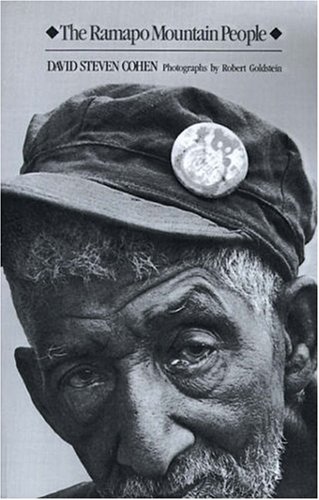
Northwest of Manhattan where the New YorkNew Jersey boundary crosses the tree-covered ridges and hollows ridges and hollows of the Ramapo Mountains there is a group of about 1,500 racially mixed people who have long been referred to by journalists and historians as the “Jackson Whites.”

In a study combining tee disciplines of anthropology, sociology, folklore, and history, David Cohen found that the old stories about these people were legends, not history.

He found no reliable evidence that their ancestors were Tuscarora Indians, Hessian deserters from the British army, escaped slaves, and British and West Indian prostitutes imported by a sea captain named Jackson for the pleasure of British soldiers occupying Manhattan during the War for Independence.

David Cohen lived among the Ramapo Mountain People for a year, conducting genealogical research into church records, deeds, wills, and inventories in county courthouses and libraries. He established that their ancestors included free black landowners in New York City and mulattoes with some Dutch ancestry who were among the first pioneers to settle in the Hackensack River Valley of New Jersey.

In describing his findings and his experiences, Professor Cohen shows how their racially mixed ancestry, their special family and kinship system, and their intergroup attitudes and folkways distinguish and socially isolate these people as a separate racial group today, despite modern communications and transportation and their proximity to New York City.

Tags: , , , ,

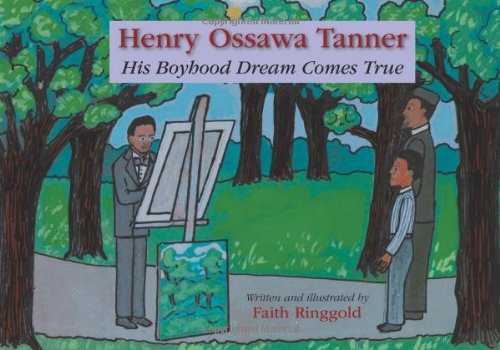
Henry Ossawa Tanner: His Boyhood Dream Comes True

Posted in Arts, Biography, Books, Media Archive, Monographs, United States on 2012-03-29 18:58Z by Steven

Henry Ossawa Tanner: His Boyhood Dream Comes True

Bunker Hill Publishing
2011-11-16
32 pages
7.3 x 10.3 x 0.4 inches
ISBN-10: 1593730926
ISBN-13: 978-1593730925

Faith Ringgold

Beautifully written and illustrated by Faith Ringgold, this children’s book accompanies the major exhibition Henry Ossawa Tanner: Modern Spirit.

This is the story of Henry Ossawa Tanner (1859-1937), the first African American painter to achieve fame in both Europe and America. An inspiration for the Harlem Renaissance artists and later generations of American painters, his story is retold by Faith Ringgold, one of today’s leading African American artists, to inspire another

Faith Ringgold’s depiction of Tanner’s struggle to achieve his dream and his success as a painter on the world stage will inspire and challenge young readers to look at the artist’s work and maybe go out and buy a few brushes and dry pigments (like Tanner did as a young boy in Philadelphia just 3 years after the Civil War) and set out to achieve their own dreams.

Tags: , , , ,

Firsting and Lasting: Writing Indians out of Existence in New England

Posted in Books, History, Media Archive, Monographs, Native Americans/First Nation, United States on 2012-03-28 15:35Z by Steven

Firsting and Lasting: Writing Indians out of Existence in New England

University of Minnesota Press
2010
296 pages
25 b&w photos, 2 tables
5 1/2 x 8 1/2
Paper ISBN: 978-0-8166-6578-5
Cloth ISBN: 978-0-8166-6577-8

Jean M. O’Brien, (White Earth Ojibwe) Professor of History
University of Minnesota

Across nineteenth-century New England, antiquarians and community leaders wrote hundreds of local histories about the founding and growth of their cities and towns. Ranging from pamphlets to multivolume treatments, these narratives shared a preoccupation with establishing the region as the cradle of an Anglo-Saxon nation and the center of a modern American culture. They also insisted, often in mournful tones, that New England’s original inhabitants, the Indians, had become extinct, even though many Indians still lived in the very towns being chronicled.

In Firsting and Lasting, Jean M. O’Brien argues that local histories became a primary means by which European Americans asserted their own modernity while denying it to Indian peoples. Erasing and then memorializing Indian peoples also served a more pragmatic colonial goal: refuting Indian claims to land and rights. Drawing on more than six hundred local histories from Massachusetts, Connecticut, and Rhode Island written between 1820 and 1880, as well as censuses, monuments, and accounts of historical pageants and commemorations, O’Brien explores how these narratives inculcated the myth of Indian extinction, a myth that has stubbornly remained in the American consciousness.

In order to convince themselves that the Indians had vanished despite their continued presence, O’Brien finds that local historians and their readers embraced notions of racial purity rooted in the century’s scientific racism and saw living Indians as “mixed” and therefore no longer truly Indian. Adaptation to modern life on the part of Indian peoples was used as further evidence of their demise. Indians did not—and have not—accepted this effacement, and O’Brien details how Indians have resisted their erasure through narratives of their own. These debates and the rich and surprising history uncovered in O’Brien’s work continue to have a profound influence on discourses about race and indigenous rights.

Tags: , , , , , ,

The Invisible Line: Three American Families and the Secret Journey from Black to White

Posted in Books, History, Law, Louisiana, Media Archive, Monographs, Passing, Slavery, United States on 2012-03-26 03:49Z by Steven

The Invisible Line: Three American Families and the Secret Journey from Black to White

The Penguin Press
2011-02-17
416 pages
6.14 x 9.25in
Hardcover ISBN: 9781594202827

Daniel J. Sharfstein, Professor of Law
Vanderbilt University, Nashville, Tennessee

Winner of the 2012 J. Anthony Lukas Book Prize

In America, race is a riddle. The stories we tell about our past have calcified into the fiction that we are neatly divided into black or white. It is only with the widespread availability of DNA testing and the boom in genealogical research that the frequency with which individuals and entire families crossed the color line has become clear.

In this sweeping history, Daniel J. Sharfstein unravels the stories of three families who represent the complexity of race in America and force us to rethink our basic assumptions about who we are. The Gibsons were wealthy landowners in the South Carolina backcountry who became white in the 1760s, ascending to the heights of the Southern elite and ultimately to the U.S. Senate. The Spencers were hardscrabble farmers in the hills of Eastern Kentucky, joining an isolated Appalachian community in the 1840s and for the better part of a century hovering on the line between white and black. The Walls were fixtures of the rising black middle class in post-Civil War Washington, D.C., only to give up everything they had fought for to become white at the dawn of the twentieth century. Together, their interwoven and intersecting stories uncover a forgotten America in which the rules of race were something to be believed but not necessarily obeyed.

Defining their identities first as people of color and later as whites, these families provide a lens for understanding how people thought about and experienced race and how these ideas and experiences evolved-how the very meaning of black and white changed-over time. Cutting through centuries of myth, amnesia, and poisonous racial politics, The Invisible Line will change the way we talk about race, racism, and civil rights.

Three American families’ stories…

The Gibsons
The Gibsons were among the first free people of color in seventeenth-century Virginia, most of whom were free because their mothers were English and by law slavery followed the status of the mother. In the early l700s, as Virginia’s laws made it increasingly difficult for free blacks to own property and earn a living, the Gibsons left the colony for the southern frontier. When the Gibsons reached South Carolina in the 1730s, the colonial assembly worried.that they had come to organize a slave revolt. But after personally interviewing the family, the colonial governor granted them hundreds of acres of land in a Welsh and Scots-Irish community. After one generation they were neither black nor white-they were planters. In the nineteenth century, they rose to the heights of the Southern aristocracy. They sent their sons to Yale and had vast holdings of land and slaves near Vicksburg, Mississippi, Lexington, Kentucky, and Terrebonne Parish, Louisiana. Gibsons were rebel officers, powerful opponents of Reconstruction, and leaders of the New South.’ One became a United States Senator from Louisiana.

The Spencers
The Spencers’ story begins in the Appalachian Mountains. In an area that had more slaves and more free blacks than anywhere else in eastern Kentucky-largely because of a bustling salt mining industry there in the early 1800s-two free men of color began having children with a pair of white sisters who had recently moved from South Carolina. Shortly before one man, George Freeman, was prosecuted for interracial sex, the other man, Jordan Spencer-possibly Freeman’s brother or son-moved with his family one hundred miles deeper into the mountains. Even though he was visibly dark-skinned, his new community in Johnson County, Kentucky, decided that he could be white. His family hovered on the line between black and white for the rest of the century, farming and logging in a mountain hollow before heading into the coal mines.

The Walls
The Walls trace their roots to a wealthy plantation owner in Rockingham, North Carolina. Stephen Wall never married, but he had children with three of his slaves, In the 1830s and 1 840s, he freed his children and sent them to Ohio to be raised by radical Quaker abolitionists. He bought land for them, generously supported their education at places like Oberlin College, and willed them a lot of money. No one knows why. He kept their mothers in bondage. The children became ardent abolitionists and served in the Union Army and Freedmen’s Bureau. After the War, several moved to Washington, D.C., where they fought for civil rights and women’s rights and raised their families to expect nothing less than equality. But as Reconstruction gave way to Jim Crow, their children disappeared into the white world.

Tags: , , , , , ,

Race under Reconstruction in German Cinema: Robert Stemmle’s Toxi

Posted in Books, Europe, Literary/Artistic Criticism, Media Archive, Monographs on 2012-03-16 21:17Z by Steven

Race under Reconstruction in German Cinema: Robert Stemmle’s Toxi

University of Toronto Press
June 2011
288 pages
Cloth ISBN: 9781442640085

Angelica Fenner, Associate Professor of German and Cinema Studies
University of Toronto

Race Under Reconstruction in German Cinema investigates postwar racial formations via a pivotal West German film by one of the most popular and prolific directors of the era. The release of Robert Stemmle’s Toxi (1952) coincided with the enrolment in West German schools of the first five hundred Afro-German children fathered by African-American occupation soldiers. The didactic plot traces the ideological conflicts that arise among members of a patrician family when they encounter an Afro-German child seeking adoption, herein broaching issues of integration at a time when the American civil rights movement was gaining momentum and encountering violent resistance.

Perceptions of ‘Blackness’ in Toxi demonstrate continuities with those prevailing in Wilhelmine Germany, but also signal the influence of American social science discourse and tropes originating in icons of American popular culture, such as Uncle Tom’s Cabin, Birth of a Nation, and several Shirley Temple films. By applying a Cultural Studies approach to individual film sequences, publicity photos, and press reviews, Angelica Fenner relates West German discourses around race and integration to emerging economic and political anxieties, class antagonism, and the reinstatement of conventional gender roles.

Tags: , , , , , ,

Paddling Her Own Canoe: The Times and Texts of E. Pauline Johnson (Tekahionwake)

Posted in Biography, Books, Canada, Literary/Artistic Criticism, Media Archive, Monographs, Native Americans/First Nation, Women on 2012-03-16 20:27Z by Steven

Paddling Her Own Canoe: The Times and Texts of E. Pauline Johnson (Tekahionwake)

University of Toronto Press
June 2000
354 pages
Paper ISBN: 9780802080240
Cloth ISBN: 9780802041623

Veronica Strong-Boag, Professor of Women’s History
University of British Columbia

Carole Gerson, Professor of English
Royal Society of Canada at Simon Fraser University

Winner of the Raymond Klibansky Prize, awarded by the Canadian Federation for the Humanities and Social Sciences

Frequently dismissed as a ‘nature poet’ and an ‘Indian Princess’ E. Pauline Johnson (1861-1913) was not only an accomplished thinker and writer but a contentious and passionate personality who ‘talked back’ to Euro-Canadian culture. “Paddling Her Own Canoe” is the only major scholarly study that examines Johnson’s diverse roles as a First Nations champion, New Woman, serious writer and performer, and Canadian nationalist.

A Native advocate of part-Mohawk ancestry, Johnson was also an independent, self-supporting, unmarried woman during the period of first-wave feminism. Her versatile writings range from extraordinarily erotic poetry to polemical statements about the rights of First Nations. Based on thorough research into archival and published sources, this volume probes the meaning of Johnson’s energetic career and addresses the complexities of her social, racial, and cultural position. While situating Johnson in the context of turn-of-the-century Canada, the authors also use current feminist and post-colonial perspectives to reframe her contribution. Included is the first full chronology ever compiled of Johnson’s writing.

Pauline Johnson was an extraordinary woman who crossed the racial and gendered lines of her time, and thereby confounded Canadian society. This study reclaims both her writings and her larger significance.

Tags: , , , , ,

Jarocho’s Soul: Cultural Identity and Afro-Mexican Dance

Posted in Anthropology, Arts, Books, Caribbean/Latin America, Media Archive, Mexico, Monographs on 2012-03-05 03:22Z by Steven

Jarocho’s Soul: Cultural Identity and Afro-Mexican Dance

University Press of America (an Imprint of Rowman & Littlefield)
February 2004
182 pages
Size: 5 1/2 x 7 3/4
Paperback ISBN: 978-0-7618-2775-7

Anita González, Associate Professor and Associate Chair of Theatre Arts
State University of New York, New Paltz

Brown-skinned men and women move across Mexico’s national stages dancing the folkloric jarocho, a symbolic blend of Spanish, Native American, and African cultures. Jarocho’s Soul: Cultural Identity and Afro-Mexican Dance traces the evolution and transformation of an Afro-Mexican dance form into a national cultural icon. It is an ethnographic study that compares and contrasts Mexican performance of national identity with Untied States dance styles. The book uses the image of the jarocho as a window to explore the phenomena of racial/cultural mixing that is endemic to Mexico and increasingly apparent in the politics and aesthetics of United States cultural performances.

Table of Contents

  • Chapter 1 List of Illustrations
  • Chapter 2 Preface
  • Chapter 3 Acknowledgments
  • Chapter 4 Introduction: Crafting Self; Frames of Reference; Locale and Methodology; Chapter Overviews
  • Chapter 5 Cultural Mixing and Mexican Performance: Mapping Art: Cultural Contexts; Studies in Revolutionary Nationalism: Manuel Ponce; Amalia Hernandez; Celestino Gorostiza; A Legacy of Performance Strategies; Provincial Identity
  • Chapter 6 Roots of Jarocho Dance
  • Chapter 7 Jarocho as Folkloric Dance: State Images Ballet Folklórico del la Universidad Veracruzana; Miguel Velez and the Authenticity Mission; Raices del Pueblo (The Peoples’ Roots)
  • Chapter 8 Jarocho as Theater: Company History, Veracruz, Veracruz Interprets Jarocho; Actors’ Interpretive (Re)Circulations in Veracruz, Veracruz; Implications and Interpretations
  • Chapter 9 Remembering and Transforming the Past: Fiesta de las Cruces; Rewriting Government Agendas
  • Chapter 10 Conclusion
  • Chapter 11 Glossary
  • Chapter 12 References
  • Chapter 13 Index
Tags: , , ,

Her Majesty’s Other Children: Sketches of Racism from a Neocolonial Age

Posted in Books, History, Literary/Artistic Criticism, Media Archive, Monographs, Philosophy on 2012-03-05 02:41Z by Steven

Her Majesty’s Other Children: Sketches of Racism from a Neocolonial Age

Rowman & Littlefield
288 pages
August 1997
Size: 6 1/4 x 9 1/4
Hardback ISBN: 978-0-8476-8447-2
eBook ISBN: 978-0-585-20172-6

Lewis R. Gordon, Laura H. Carnell Professor of Philosophy, Director of the Institute for the Study of Race and Social Thought and Director of the Center for Afro-Jewish Studies
Temple University

Winner of the Gustavus Myers Outstanding Book Award for the Study of Human Rights in North America.

In this exploration of race and racism, noted scholar Lewis R. Gordon offers a critique of recent scholarship in postcolonial Africana philosophy and critical race theory, and suggests alternative models that respond to what he calls our contemporary neocolonial age; an age in which cultural, intellectual, and economic forms of colonial domination persist. Through essays that address popular culture, the academy, literature, and politics, Gordon unsettles the notion of race and exposes the complexity of antiblack racism. An important book for philosophers, political theorists, sociologists, cultural critics, and anyone concerned with the overt and subtle ways of injustice.

Table of Contents

  • Chapter 1 Foreword
  • Chapter 2 Introduction: Her Majesty’s Other Children
  • Part 1
    • Chapter 3 Philosophy, Race, and Racism in a Neocolonial World
    • Chapter 4 Context: Ruminations on Violence and Anonymity
    • Chapter 5 Fanon, Philosophy, and Racism
    • Chapter 6 Race, Biraciality, and Mixed Race—in Theory
    • Chapter 7 Sex, Race, and Matrices of Desire in an Antiblack World
    • Chapter 8 Uses and Abuses of Blackness: Postmodernism, Conservatism, Ideology
    • Chapter 9 In a Black Antiblack Philosophy
    • Chapter 10 African Philosophy’s Search for Identity: Existential Considerations of a Recent Effort
  • Part 2
    • Chapter 11 The Intellectuals
    • Chapter 12 Lorraine Hansberry’s Tragic Search for Postcoloniality: Les Blancs
    • Chapter 13 Tragic Intellectuals on the Neocolonial—Postcolonial Divide
    • Chapter 14 Exilic “Amateur” Speaking Truth to Power: Edward Said
    • Chapter 15 Black Intellectuals and Academic Activism: Cornel West’s “Dilemmas of the Black Intellectual.” Right-Wing Celebration, Left-Wing Nightmare: Thoughts on the Centennial of Plessy v. Ferguson
  • Part 3
    • Chapter 16 Aisthesis Demokrate
    • Chapter 17 Sketches of Jazz
    • Chapter 18 Aesthetico-Political Reflections on the AMTRAK: Rap, Hip-Hop, and Isaac Julien’s Fanon along the Northeast Line
  • Chapter 19 Epilogue: The Lion and the Spider (An Anticolonial Tale)
Tags: , , ,

The Sweet Hell Inside: The Rise of an Elite Black Family in the Segregated South

Posted in Books, History, Monographs, United States on 2012-03-01 02:40Z by Steven

The Sweet Hell Inside: The Rise of an Elite Black Family in the Segregated South

Harper Perennial an imprint HarperCollins
2001-09-30
432 pages
5 5/16 x 8
ISBN: 9780060505905; ISBN10: 0060505907

Edward Ball, Lecturer in English
Yale University

From National Book Award winner ccomes The Sweet Hell Inside, the story of the fascinating Harleston family of South Carolina, the progeny of a Southern gentleman and his slave, who cast off their blemished roots and prospered despite racial barriers. Enhanced by recollections from the family’s archivist, eighty-four-year-old Edwina Harleston Whitlock—whose bloodline the author shares. The Sweet Hell Inside features a celebrated portrait artist whose subjects included industrialist Pierre du Pont; a black classical composer in the Lost Generation of 1920s Paris; and an orphanage founder who created the famous Jenkins Orphanage Band, a definitive force in the development of ragtime and jazz.

With evocative and engrossing storytelling, Edward Ball introduces a cast of historical characters rarely seen before: cultured, vain, imperfect, rich, and black—a family of eccentrics who defied social convention and flourished.

Tags: , ,