Representing the Race: The Creation of the Civil Rights Lawyer

Posted in Articles, Biography, Books, Law, Media Archive, Monographs, United States on 2012-06-01 01:54Z by Steven

Representing the Race: The Creation of the Civil Rights Lawyer

Harvard University Press
April 2012
352 pages
6-1/8 x 9-1/4 inches; 20 halftones
Hardcover ISBN: 9780674046870

Kenneth W. Mack, Professor of Law
Harvard University

Representing the Race tells the story of an enduring paradox of American race relations, through the prism of a collective biography of African American lawyers who worked in the era of segregation. Practicing the law and seeking justice for diverse clients, they confronted a tension between their racial identity as black men and women and their professional identity as lawyers. Both blacks and whites demanded that these attorneys stand apart from their racial community as members of the legal fraternity. Yet, at the same time, they were expected to be “authentic”—that is, in sympathy with the black masses. This conundrum, as Kenneth W. Mack shows, continues to reverberate through American politics today.

Mack reorients what we thought we knew about famous figures such as Thurgood Marshall, who rose to prominence by convincing local blacks and prominent whites that he was—as nearly as possible—one of them. But he also introduces a little-known cast of characters to the American racial narrative. These include Loren Miller, the biracial Los Angeles lawyer who, after learning in college that he was black, became a Marxist critic of his fellow black attorneys and ultimately a leading civil rights advocate; and Pauli Murray, a black woman who seemed neither black nor white, neither man nor woman, who helped invent sex discrimination as a category of law. The stories of these lawyers pose the unsettling question: what, ultimately, does it mean to “represent” a minority group in the give-and-take of American law and politics?

Table of Contents

  • Introduction
  • 1. The Idea of the Representative Negro
  • 2. Racial Identity and the Marketplace for Lawyers
  • 3. The Role of the Courtroom in an Era of Segregation
  • 4. A Shifting Racial Identity in a Southern Courtroom
  • 5. Young Thurgood Marshall Joins the Brotherhood of the Bar
  • 6. A Woman in a Fraternity of Lawyers
  • 7. Things Fall Apart
  • 8. The Strange Journey of Loren Miller
  • 9. The Trials of Pauli Murray
  • 10. A Lawyer as the Face of Integration in Postwar America
  • Conclusion: Race and Representation in a New Century
  • Notes
  • Acknowledgments
  • Index

Tags: , ,

This Is All I Choose to Tell: History and Hybridity in Vietnamese American Literature

Posted in Asian Diaspora, Books, Literary/Artistic Criticism, Media Archive, Monographs, United States on 2012-05-30 21:07Z by Steven

This Is All I Choose to Tell: History and Hybridity in Vietnamese American Literature

Temple University Press
November 2010
216 pages
5.5 x 8.5
1 halftone
paper ISBN: 978-1-43990-217-2
cloth ISBN: 978-1-43990-216-5
eBook ISBN: 978-1-43990-218-9

Isabelle Thuy Pelaud, Associate Professor of Asian American Studies (founder of the Diasporic Vietnamese Artists Network (DVAN).)
San Francisco State University

An introduction to the themes of a still-evolving American ethnic literature

In the first book-length study of Vietnamese American literature, Isabelle Thuy Pelaud probes the complexities of Vietnamese American identity and politics. She provides an analytical introduction to the literature, showing how generational differences play out in genre and text. In addition, she asks, can the term Vietnamese American be disassociated from representations of the war without erasing its legacy?

Pelaud delineates the historical, social, and cultural terrains of the writing as well as the critical receptions and responses to them. She moves beyond the common focus on the Vietnam war to develop an interpretive framework that integrates post-colonialism with the multi-generational refugee, immigrant, and transnational experiences at the center of Vietnamese American narratives.

Her readings of key works, such as Andrew Pham’s Catfish and Mandala and Lan Cao’s Monkey Bridge show how trauma, race, class and gender play a role in shaping the identities of Vietnamese American characters and narrators.

Contents

  • Preface
  • Acknowledgments
  • Introduction
  • Part I: Inclusion
    • 1. History
    • 2. Overview
    • 3. Hybridity
  • Part II: Interpretation
    • 4. Survival
    • 5. Hope and Despair
    • 6. Reception
  • Conclusion
  • Notes
  • Bibliography
  • Index
Tags: , , ,

The Great Seducer: writings on Gilberto Freyre, from 1945 until today (O Grande Sedutor: escritos sobre Gilberto Freyre de 1945 até hoje)

Posted in Biography, Books, Brazil, Caribbean/Latin America, Media Archive, Monographs, Social Science on 2012-05-30 18:55Z by Steven

The Great Seducer: writings on Gilberto Freyre, from 1945 until today (O Grande Sedutor: escritos sobre Gilberto Freyre de 1945 até hoje)

Cassará Publishing House (Blog)
2011
724 pages
16 X 23 cm
ISBN: 978-85-64892-01-9

Edson Nery da Fonseca, Professor Emeritus
University of Brasilia

The book is the result of more than sixty years of study and research and offers a unique and intimate not only on the thought of Freyre, but also about his personal life. Over 135 papers that comprise the collection of articles and essays, Nery da Fonseca presents the genesis of the thought of Gilberto Freyre, identifying intellectuals and artists in a variety of chains, with which Freyre dialogued lifelong and tells stories and curious details . In addition, summarizes the main features, but also sheds new perspectives and points out aspects little or nothing known about the author’s thought of Casa-Grande & Senzala. The work is aimed at all interested in the work of Freyre, but also to all those who appreciate the art of writing.

Tags: , ,

Black White & Jewish: Autobiography of a Shifting Self

Posted in Autobiography, Books, Media Archive, Monographs, Religion on 2012-05-27 22:06Z by Steven

Black White & Jewish: Autobiography of a Shifting Self

Riverhead Press (an imprint of Penguin Press)
2002-01-08
336 pages
5.23 x 8.03in
ISBN 9781573229074

Rebecca Walker

ALA Best Book for Young Adults

The Civil Rights movement brought author Alice Walker and lawyer Mel Leventhal together, and in 1969 their daughter, Rebecca, was born. Some saw this unusual copper-colored girl as an outrage or an oddity; others viewed her as a symbol of harmony, a triumph of love over hate. But after her parents divorced, leaving her a lonely only child ferrying between two worlds that only seemed to grow further apart, Rebecca was no longer sure what she represented. In this book, Rebecca Leventhal Walker attempts to define herself as a soul instead of a symbol—and offers a new look at the challenge of personal identity, in a story at once strikingly unique and truly universal.

Tags: , ,

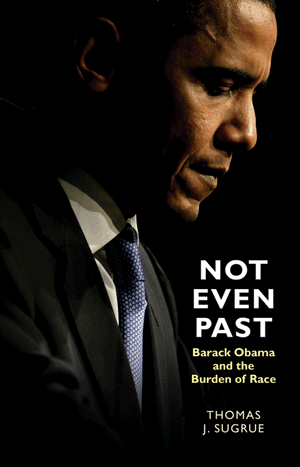
Not Even Past: Barack Obama and the Burden of Race

Posted in Barack Obama, Biography, Books, History, Media Archive, Monographs, Politics/Public Policy, United States on 2012-05-26 23:07Z by Steven

Not Even Past: Barack Obama and the Burden of Race

Princeton University Press
2010
178 pages
5 1/2 x 8 1/2
Cloth ISBN: 9780691137308
eBook ISBN: 9781400834198

Thomas J. Sugrue, David Boies Professor of History and Professor of Sociology
University of Pennsylvania

Finalist, The 2010 Benjamin L. Hooks Institute for Social Change National Book Award, The University of Memphis

Barack Obama, in his acclaimed campaign speech discussing the troubling complexities of race in America today, quoted William Faulkner’s famous remark “The past isn’t dead and buried. In fact, it isn’t even past.” In Not Even Past, award-winning historian Thomas Sugrue examines the paradox of race in Obama’s America and how President Obama intends to deal with it.

Obama’s journey to the White House undoubtedly marks a watershed in the history of race in America. Yet even in what is being hailed as the post-civil rights era, racial divisions–particularly between blacks and whites—remain deeply entrenched in American life. Sugrue traces Obama’s evolving understanding of race and racial inequality throughout his career, from his early days as a community organizer in Chicago, to his time as an attorney and scholar, to his spectacular rise to power as a charismatic and savvy politician, to his dramatic presidential campaign. Sugrue looks at Obama’s place in the contested history of the civil rights struggle; his views about the root causes of black poverty in America; and the incredible challenges confronting his historic presidency.

Does Obama’s presidency signal the end of race in American life? In Not Even Past, a leading historian of civil rights, race, and urban America offers a revealing and unflinchingly honest assessment of the culture and politics of race in the age of Obama, and of our prospects for a postracial America.

Table of Contents

  • Introduction
  • CHAPTER I: “This Is My Story”: Obama, Civil Rights, and Memory
  • CHAPTER II: Obama and the Truly Disadvantaged: The Politics of Race and Class
  • CHAPTER III: “A More Perfect Union”? The Burden of Race in Obama’s America
  • Acknowledgments
  • Notes

Introduction

It is now a commonplace that the election of Barack Obama marks the opening of a new period in America’s long racial history. The unlikely rise of a black man to the nation’s highest office—someone who was a mostly unknown state senator only five years before he was inaugurated president—confirms the view of many, especially whites, that the United States is a postracial society. At last, the shackles of discrimination have been broken and individual merit is rewarded, regardless of skin color. In this view, blackness—once the clearest marker of difference in American society—has lost some or all of its stigma. Barack Obama, in the most common formulation, transcends race; his ancestry fuses African and European into a new hybrid; his political vision of unity discredits those who cling bitterly to notions of racial superiority and, at the same time, rebukes those who harbor a divisive identity politics fueled by an exaggerated sense of racial grievance.

As with all interpretations of the relationship between the past and the present, the notion that Obama’s election marks an epochal change in racial dynamics is not without its critics. Obama himself offers a tempered view, suggesting that even if America has advanced considerably over the last forty years, some racial prejudices remain in place and some racial discrimination still exists. In his view, we have realized much, but not all, of the dream of racial equality. Other commentators, like Berkeley historian David Hollinger, suggest that Obama heralds the emergence of a new, multihued racial order, a majority-minority society where static notions of race are losing their purchase, and where race-specific remedies like affirmative action have outlived their usefulness. Many scholars and pundits further to the left, by contrast, are skeptical that much has changed at all. They point to the angry denunciations of Obama during his campaign and since his inauguration (Obama as Muslim, Obama as black man in whiteface, Obama as witch doctor, Obama as noncitizen) as evidence of a deep-seated racism that is inflamed by the discomfiting presence of a brown-hued man in the White House.

In the most dystopian vision, offered by Duke sociologist Eduardo Bonilla-Silva, the symbolism of an African-descended president obscures a deeper, more troubling reality: the “Latin Americanization” of the United States, namely, the emergence of a society where a tripartite system of color gradation will supplant the “one-drop rule” of racial classification, but where the darkest-skinned racial minorities remain concentrated at the bottom…

…To understand Obama’s life and times requires an examination of race and racial politics. It is safe to say that few domestic issues have been more controversial in late twentieth- and early twenty-first-century America. And few issues have generated more passion among scholars and journalists. Debates about civil rights, black power, race consciousness, and inequality are often couched in predictable and analytically problematic formulations that reflect the moral dualism that still shapes our understandings of race. The first binary—“race versus class”—inflects much scholarship and liberal journalism about race. Either race matters as a dominant force or it is a screen—or a form of false consciousness—that masks far deeper inequalities of class. This is a simplistic formulation that downplays the ways that racial and economic disadvantages are fundamentally intertwined, and fails to address how the American economy generates inequalities that affect people regardless of their background but are still disproportionatelyborne by people of color. A second binary—with special hold in public discourse—is “racism versus color blindness.” This contrasts a pathology and a principle, a flawed reality and an ideal. But it, too, does not stand up to close scrutiny. As legal scholar Richard Thompson Ford has argued, to hurl the invective “racist” loosely is to put too much weight on individual beliefs or values. And conversely, to proclaim color blindness is to overlook the ways that racial inequalities persist and sometimes harden regardless of the good intentions or the benign disposition of any single actor. There are stone-cold racists in America, and there are people who believe that they are wholly free of prejudice. Ultimately, the most enduring racial inequalities in the United States today are not the consequence of conspiracy or intention, or even the unconscious prejudice that neuropsychologists argue exists in the amygdala; rather they stem from the long-term institutional legacies of economic and public policies that have systematically disadvantaged African Americans and, when left unaltered, continue to do so in key realms of American life today. The third binary is “pessimism versus optimism.” Either America is still a profoundly racist society, or we have mostly overcome past racial injustices. Any clear-eyed examination of race in modern America must recognize the changes that have transformed the life chances of African Americans in the United States since the mid-twentieth century, and that enabled Barack Obama’s remarkable ascent through some of America’s most prestigious institutions and ultimately to the White House—most of them the result of grassroots activism, litigation, and public policy innovation. And it must also account for what even a cursory review of census data, opinion surveys, and health, educational, and housing statistics reveals: namely, that racial gaps are deep and persistent in American life. Those statistics, the way that Obama understands and interprets them, and the ways that Americans in general make sense of them, are at the heart of this book…

Read the entire Introduction here.

Tags: , ,

The Black Seminoles: History of a Freedom-Seeking People

Posted in Books, History, Media Archive, Monographs, Native Americans/First Nation, United States on 2012-05-22 02:11Z by Steven

The Black Seminoles: History of a Freedom-Seeking People

University Press of Florida
1996-09-14
352 pages
6 x 9
Cloth ISBN 13: 978-0-8130-1451-7

Kenneth W. Porter, Professor of History Emeritus
University of Oregon

Edited by:

Alcione M. Amos, Librarian

Thomas P. Senter, M.D.

This story of a remarkable people, the Black Seminoles, and their charismatic leader, Chief John Horse, chronicles their heroic struggle for freedom.

Beginning with the early 1800s, small groups of fugitive slaves living in Florida joined the Seminole Indians (an association that thrived for decades on reciprocal respect and affection). Kenneth Porter traces their fortunes and exploits as they moved across the country and attempted to live first beyond the law, then as loyal servants of it.

He examines the Black Seminole role in the bloody Second Seminole War, when John Horse and his men distinguished themselves as fierce warriors, and their forced removal to the Oklahoma Indian Territory in the 1840s, where John’s leadership ability emerged.

The account includes the Black Seminole exodus in the 1850s to Mexico, their service as border troops for the Mexican government, and their return to Texas in the 1870s, where many of the men scouted for the U.S. Army. Members of their combat-tested unit, never numbering more than 50 men at a time, were awarded four of the sixteen Medals of Honor received by the several thousand Indian scouts in the West.

Porter’s interviews with John Horse’s descendants and acquaintances in the 1940s and 1950s provide eyewitness accounts. When Alcione Amos and Thomas Senter took up the project in the 1980s, they incorporated new information that had since come to light about John Horse and his people.

A powerful and stirring story, The Black Seminoles will appeal especially to readers interested in black history, Indian history, Florida history, and U.S. military history.

Tags: , , , , , , , ,

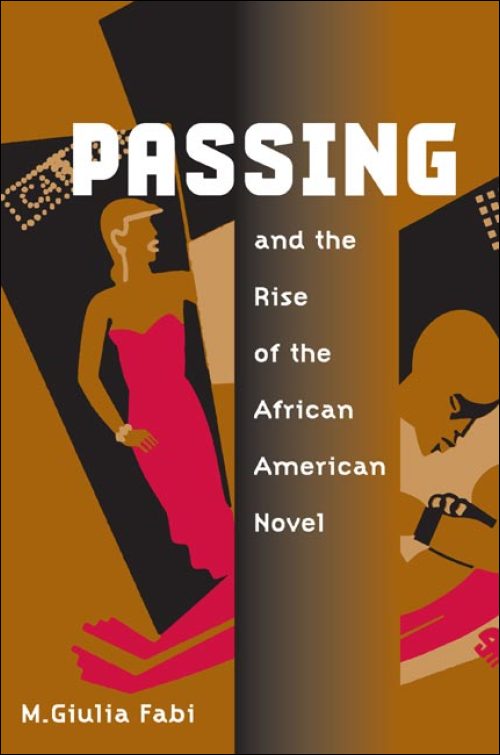
Passing and the Rise of the African American Novel

Posted in Books, Literary/Artistic Criticism, Media Archive, Monographs, Passing on 2012-05-18 21:04Z by Steven

Passing and the Rise of the African American Novel

University of Illinois Press
2001
208 pages
6 x 9 in.
Paper ISBN: 978-0-252-07248-2

M. Giulia Fabi, Associate professor of American literature
University of Ferrara, Italy

Revealing the role of light-skinned black characters passing for white in African American literature

A CHOICE Outstanding Academic Title, 2003

Passing and the Rise of the African American Novel restores to its rightful place a body of American literature that has long been overlooked, dismissed, or misjudged. This insightful reconsideration of nineteenth-century African American fiction uncovers the literary artistry and ideological complexity of a body of work that laid the foundation for the Harlem Renaissance and changed the course of American letters.

Focusing on the trope of passing—black characters lightskinned enough to pass for white—M. Giulia Fabi shows how early African American authors such as William Wells Brown, Frank J. Webb, Charles W. Chesnutt, Sutton E. Griggs, Frances E. W. Harper, Edward A. Johnson, and James Weldon Johnson transformed traditional representations of blackness and moved beyond the tragic mulatto motif. Challenging the myths of racial purity and the color line, these authors used passing to celebrate a distinctive, African American history, culture, and worldview.

Fabi examines how early black writers adapted existing literary forms, including the sentimental romance, the domestic novel, and the utopian novel, to express their convictions and concerns about slavery, segregation, and racism. Chesnutt used passing as both a structural and a thematic element, while James Weldon Johnson innovated by parodying the earlier novels of passing and presenting the decision to pass as the result, rather than the cause, of cultural alienation. Fabi also gives a historical overview of the canon-making enterprises of African American critics from the 1850s to the 1990s and considers how their concerns about promoting the canonization of African American literature affected their perceptions of nineteenth-century black fiction.

Tags: , , , , , , , , , , ,

Race Decoded: The Genomic Fight for Social Justice

Posted in Books, Health/Medicine/Genetics, Media Archive, Monographs, Politics/Public Policy on 2012-05-17 02:22Z by Steven

Race Decoded: The Genomic Fight for Social Justice

Stanford University Press
April 2012
280 pages
Cloth ISBN: 9780804774079
Paper ISBN: 9780804774086
E-book: ISBN: 9780804782050

Catherine Bliss, Assistant Professor of Sociology
University of California, San Francisco

Winner of the 2014 Oliver Cromwell Cox Award, sponsored by the ASA Section on Racial and Ethnic Minorities.

In 2000, with the success of the Human Genome Project, scientists declared the death of race in biology and medicine. But within five years, many of these same scientists had reversed course and embarked upon a new hunt for the biological meaning of race. Drawing on personal interviews and life stories, Race Decoded takes us into the world of elite genome scientists—including Francis Collins, director of the NIH; Craig Venter, the first person to create a synthetic genome; and Spencer Wells, National Geographic Society explorer-in-residence, among others—to show how and why they are formulating new ways of thinking about race.

In this original exploration, Catherine Bliss reveals a paradigm shift, both at the level of science and society, from colorblindness to racial consciousness. Scientists have been fighting older understandings of race in biology while simultaneously promoting a new grand-scale program of minority inclusion. In selecting research topics or considering research design, scientists routinely draw upon personal experience of race to push the public to think about race as a biosocial entity, and even those of the most privileged racial and social backgrounds incorporate identity politics in the scientific process. Though individual scientists may view their positions differently—whether as a black civil rights activist or a white bench scientist—all stakeholders in the scientific debates are drawing on memories of racial discrimination to fashion a science-based activism to fight for social justice.

Table of Contents

  • Acknowledgments
  • Introduction
  • 1. The New Science of Race
  • 2. Making Science Racial
  • 3. The Sociogenomic Paradigm
  • 4. Making Sense of Race with Values
  • 5. Everyday Race-Positive
  • 6. Activism and Expertise
  • 7. The Enduring Trouble with Race
  • Notes
  • Index
Tags: , , , , ,

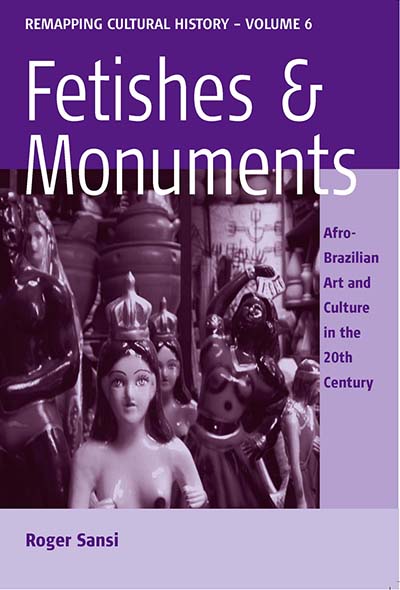
Fetishes and Monuments: Afro-Brazilian Art and Culture in the 20th Century

Posted in Anthropology, Books, Brazil, Caribbean/Latin America, Media Archive, Monographs, Religion on 2012-05-16 16:01Z by Steven

Fetishes and Monuments: Afro-Brazilian Art and Culture in the 20th Century

Berghahn Books
2007
224 pages
Hardback ISBN: 978-1-84545-363-3
Paberback ISBN: ISBN 978-1-84545-711-2

Roger Sansi, Senior Lecturer in Anthropology
Goldsmith’s College, London

One hundred years ago in Brazil the rituals of Candomblé were feared as sorcery and persecuted as crime. Its cult objects were fearsome fetishes. Nowadays, they are Afro-Brazilian cultural works of art, objects of museum display and public monuments. Focusing on the particular histories of objects, images, spaces and persons who embodied it, this book portrays the historical journey from weapons of sorcery looted by the police, to hidden living stones, to public works of art attacked by religious fanatics that see them as images of the Devil, former sorcerers who have become artists, writers, and philosophers. Addressing this history as a journey of objectification and appropriation, the author offers a fresh, unconventional, and illuminating look at questions of syncretism, hybridity and cultural resistance in Brazil and in the Black Atlantic in general.

Contents

  • List of Illustrations
  • Acknowledgements
  • Introduction
  • Culture and Objectification in the Black Rome
  • 1. ‘Making the Saint’: Spirits, Shrines and Syncretism in Candomblé
  • 2. From Sorcery to Civilisation: The Objectification of Afro-Brazilian Culture
  • 3. From Informants to Scholars: Appropriating Afro-Brazilian Culture
  • 4. From Weapons of Crime to Jewels of the Crown: Candomblé in Museums
  • 5. From the Shanties to the Mansions: Candomblé as National Heritage
  • 6. Modern Art and Afro-Brazilian Culture in Bahia
  • 7. Authenticity and Commodification in Afro-Brazilian Art
  • 8. Candomblé as Public Art: The Orixás of Tororó
  • 9. Re-appropriations of Afro-Brazilian Culture
  • Bibliography
  • Index

Introduction

Salvador da Bahia, once the colonial capital of Brazil, is nowadays the capital of Afro-Brazilian culture. Some tourist brochures call it the ‘Black Rome’, ‘the biggest inheritor of African traditions out of Africa’, and ‘Cradle and home of African descendent traditions (including samba, capoeira and Candomblé)’. Candomblé in particular is often presented as the heart of this Afro-Brazilian culture.

The origin of the term ‘Candomblé is unknown, it seems to have appeared in Bahia in the first half of the nineteenth century in reference to parties of slaves and freed slaves (sometimes in the plural, Candomblés), and also in connection with the practice of sorcery (feitigaria). Some sources presumed that these activities had an African origin; the newspapers often complained about the noise of drums at Candomblé parties, and the charlatanism of the sorcerers; but from very early on, people of all social groups, origins and races came to the parties and made use of sorcery. For the editor of a newspaper in 1868, ‘these absurd Candomblés are so rooted, that I do no longer admire seeing Black people involved, when White people are the more passionate devotees of the cause’.

Of course, few among the white or almost white upper classes would publicly acknowledge their participation: to do so would be an embarrassment. Now and then the police disbanded the Candomblés and the sorcerers were put on trial, their instruments confiscated as ‘weapons of sorcery’. Nonetheless, it seems that Candomblé was never just an exclusive, secretive and resistant African affair: the sorcerers often had powerful patrons, people from across Bahian society took part in it. In fact, the sorcery of Candomblé was seen by many as the hidden force dominating the city, and writers like Marques or Joao do Rio affirm that ‘we are all ruled by the sorcerer’.

But when newspapers today talk about Candomblé, they do not denounce evil sorcery and outrageous parties. Instead, Candomblé is praised as African religion and cultural heritage. The objects of Candomblé are presented in museums as works of art. Participating in Candomblé is not an indignity, but something to be proud of. Intellectuals and politicians make their attendance at and even their participation in its rituals, both public and official. Gilberto Gil, musician and Minister of Culture, is also a ‘lord’ (ogan) in a Candomblé house.

How did Candomblé go from Sorcery to National Heritage? How did Candomblé become ‘Culture’? This question has not been properly addressed until now. Since its very origin, the literature on Candomblé has been obsessed with demonstrating the African origins and continuities of its rituals and myths. This tradition of studies, what I will call ‘Afro-Brazilianism’, has built an image of Candomblé as a ‘microcosmic Africa’ (Bastide 1978c), where the philosophical and artistic essences of the continent are preserved.

In recent decades Afro-Brazilianism has been severely criticised by social scientists interested in racial politics, who have argued that Afro-Brazilian culture is an ‘invented tradition’, and Afro-Brazilianist discourse a form of domination by the Brazilian elites over the black populations of Brazil. In transforming Candomblé into folklore, Afro-Brazilianism has imposed a ‘culturalism1 more concerned with the protection of an objectified cultural heritage than with racial politics. In Hanchard’s terms Afro-Brazilian culture has been ‘reified’: ‘culture becomes a thing, not a deeply political process.’

This book starts trom a different point: the question is not if this culture is ‘authentic’ or a ‘fiction’, but how Candomblé has become Afro-Brazilian culture. Encompassing these two discourses, we will see how Afro-Brazilian culture is neither a repressed essence nor an invention, but the outcome of a dialectical process of exchange between the leaders of Candomblé and a cultural elite of writers, artists and anthropologists in Bahia. In this dialectical process the cultural and artistic values of national and international anthropologists, intellectuals and artists have been synthesised with the religious values of Candomblé, generating an unprecedented objectification: ‘Afro-Brazilian culture’. At the same time, the leaders of Candomblé have recognised their own practice as ‘Culture’, and have become the subjects of their own objectification.

The impasse between affirmative and critical views on Afro-Brazilian culture is a result of their rigid and incompatible notions of ‘culture’. For the Afro-Brazilianist tradition, African culture is an original, unchanging ‘system of representations’ that has resisted slavery, and which is ritually re-enacted in Candomblé. For its critics, this notion of ‘culture’ is a fixed image, a false projection of imperialist reason: Afro-Brazilian culture is just a masquerade that hides the racial inequalities of Brazil.

But a culture is neither a fixed ‘system of representations’ nor a rigid ideological projection. Cultures are always in construction: they are not immanent and self-contained, but transient and relative historical formations. And yet, this does not mean that they are just artificial and false constructions. After all, what is the problem with ‘culture becoming a thing’? Cultures are indeed the result of histories of objectification—processes of recognition of identity and alterity. But processes of objectification cannot be reduced to reification. Objectification does not preclude politics, but in many ways it is the precondition of any meaningful social action: it is precisely because culture is objectified that it can be discussed, used and appropriated by social actors.

This book will describe this process neither as resistance nor masquerade, but as a historical transformation of practices, values and discourses: a cultural history. On the one hand, it is unquestionable that many African traditions are present in Candomblé; nevertheless it is also true that its ritual practices have incorporated the history of Brazil in what has been called ‘syncretism’. On the other hand, intellectuals have objectified Candomblé as Afro-Brazilian culture. But this objectification is not just an ideological fixed image, a reification: it has been actively appropriated by the people of Candomblé, who have assumed the discourses and practices of Afro-Brazilian culture as their own. This process of appropriation can be understood in very similar terms to religious syncretism; in a way it has been a ‘syncretism of Culture’.

Before going any further, I will explain in more detail what I mean by ‘Culture’ and ‘objectification’, and how the Afro-Brazilian case can offer a particular perspective on a more universal cultural process of our time: the appropriation of ‘Culture’…

…The solution to the ‘Negro problem’ for this elite was the ‘whitening’ of Brazil (Skidmore 1995). Deploying in a very particular way the eugenic theories of their time, they thought that by increasing European immigration Brazil would progressively eliminate its majority of Black people (Moritz-Schwartz 1993). Blacks and mulattos, as degenerate races, would inevitably die out, unless they improved their ‘weak’ blood with the powerful new ‘stocks’ of Europeans that were arriving en masse in Brazil. But in Bahia there was no significant influx of European immigrants. There was no work for them: nourishing agriculture, and later industry, were concentrated in the south, around Sao Paulo. Bahia remained poor and Black, lost in its past, with a dormant economy, a provincial life and a small population until the 1940s. This is the period that Gil and Riserio (1988) have called a ‘hundred years of solitude’, beginning with the end of the slave trade. In this ‘decadent’ context, after three brilliant centuries of international exchange of people and things, Bahians were left to themselves: there was no substantial immigration or change in Bahia’s population, and a very specific local culture progressively took hold. Bahian society was extremely traditional, and marked by the cultural history of its overwhelming majority of African descendants…

Read the entire Introduction here.

Tags: , , , ,

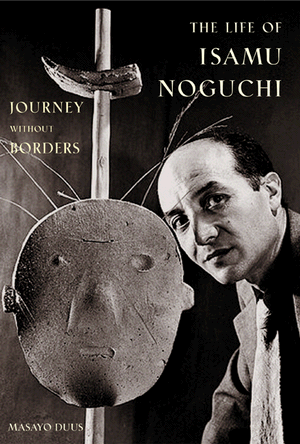
The Life of Isamu Noguchi: Journey without Borders

Posted in Arts, Asian Diaspora, Biography, Books, Media Archive, Monographs on 2012-05-15 17:48Z by Steven

The Life of Isamu Noguchi: Journey without Borders

Princeton University Press
2004
440 pages
6 x 9
36 halftones
Paper ISBN: 9780691127828

Masayo Duus
Translated by Peter Duus

  • 2005 Non-fiction Finalist for the Kiriyama Prize, Pacific Rim Voices
  • One of Choice’s Outstanding Academic Titles for 2005

Isamu Noguchi, born in Los Angeles as the illegitimate son of an American mother and a Japanese poet father, was one of the most prolific yet enigmatic figures in the history of twentieth-century American art. Throughout his life, Noguchi (1904-1988) grappled with the ambiguity of his identity as an artist caught up in two cultures.

His personal struggles—as well as his many personal triumphs—are vividly chronicled in The Life of Isamu Noguchi, the first full-length biography of this remarkable artist. Published in connection with the centennial of the artist’s birth, the book draws on Noguchi’s letters, his reminiscences, and interviews with his friends and colleagues to cast new light on his youth, his creativity, and his relationships.

During his sixty-year career, there was hardly a genre that Noguchi failed to explore. He produced more than 2,500 works of sculpture, designed furniture, lamps, and stage sets, created dramatic public gardens all over the world, and pioneered the development of environmental art. After studying in Paris, where he befriended Alexander Calder and worked as an assistant to Constantin Brancusi, he became an ardent advocate for abstract sculpture.

Noguchi’s private life was no less passionate than his artistic career. The book describes his romances with many women, among them the dancer Ruth Page, the painter Frida Kahlo, and the writer Anaïs Nin.

Despite his fame, Noguchi always felt himself an outsider. “With my double nationality and my double upbringing, where was my home?” he once wrote. “Where were my affections? Where my identity?” Never entirely comfortable in the New York art world, he inevitably returned to his father’s homeland, where he had spent a troubled childhood. This prize-winning biography, first published in Japanese, traces Isamu Noguchi’s lifelong journey across these artistic and cultural borders in search of his personal identity.

Table of Contents

  • Prologue
  • Chapter One: Yone and Leonie
  • Chapter Two: His Mother’s Child
  • Chapter Three: All-American Boy
  • Chapter Four: Journey of Self-Discovery
  • Chapter Five: Becoming a Nisei
  • Chapter Six: The Song of a Small
  • Chapter Seven: Honeymoon with Japan
  • Chapter Eight: The World of Dreams
  • Chapter Nine: The Universe in a Garden
  • Chapter Ten: Encounter with a Stonecutter
  • Chapter Eleven: Farewell to s Dreamer
  • Epilogue
  • Notes
  • Bibliography
  • Acknowledgments
  • Index
  • Photgraphy Credits
Tags: , , ,