Unbecoming Blackness: The Diaspora Cultures of Afro-Cuban America

Posted in Books, Caribbean/Latin America, Gay & Lesbian, Latino Studies, Literary/Artistic Criticism, Media Archive, Monographs, United States on 2012-07-18 04:15Z by Steven

Unbecoming Blackness: The Diaspora Cultures of Afro-Cuban America

New York University Press
November 2012
272 pages
10 halftones
Cloth ISBN: 9780814765463
Paper ISBN: 9780814765470

Antonio López, Assistant Professor of English
George Washington University

In Unbecoming Blackness, Antonio López uncovers an important, otherwise unrecognized century-long archive of literature and performance that reveals Cuban America as a space of overlapping Cuban and African diasporic experiences.

López shows how Afro-Cuban writers and performers in the U.S. align Cuban black and mulatto identities, often subsumed in the mixed-race and postracial Cuban national imaginaries, with the material and symbolic blackness of African Americans and other Afro-Latinas/os. In the works of Alberto O’Farrill, Eusebia Cosme, Rómulo Lachatañeré, and others, Afro-Cubanness articulates the African diasporic experience in ways that deprive negro and mulato configurations of an exclusive link with Cuban nationalism. Instead, what is invoked is an “unbecoming” relationship between Afro-Cubans in the U.S and their domestic black counterparts. The transformations in Cuban racial identity across the hemisphere, represented powerfully in the literary and performance cultures of Afro-Cubans in the U.S., provide the fullest account of a transnational Cuba, one in which the Cuban American emerges as Afro-Cuban-American, and the Latino as Afro-Latino.

Tags: , , , , ,

Embodying Belonging: Racializing Okinawan Diaspora in Bolivia and Japan

Posted in Anthropology, Asian Diaspora, Books, Caribbean/Latin America, Live Events, Media Archive, Monographs on 2012-07-16 18:22Z by Steven

Embodying Belonging: Racializing Okinawan Diaspora in Bolivia and Japan

University Of Hawai‘i Press
May 2010
272 pages
Cloth ISBN: 978-0-8248-3344-2

Taku Suzuki, Assistant Professor of International Studies
Denison University, Granville, Ohio

Embodying Belonging is the first full-length study of a Okinawan diasporic community in South America and Japan. Under extraordinary conditions throughout the twentieth century (Imperial Japanese rule, the brutal Battle of Okinawa at the end of World War II, U.S. military occupation), Okinawans left their homeland and created various diasporic communities around the world. Colonia Okinawa, a farming settlement in the tropical plains of eastern Bolivia, is one such community that was established in the 1950s under the guidance of the U.S. military administration. Although they have flourished as farm owners in Bolivia, thanks to generous support from the Japanese government since Okinawa’s reversion to Japan in 1972, hundreds of Bolivian-born ethnic Okinawans have left the Colonia in the last two decades and moved to Japanese cities, such as Yokohama, to become manual laborers in construction and manufacturing industries.

Based on the author’s multisited field research on the work, education, and community lives of Okinawans in the Colonia and Yokohama, this ethnography challenges the unidirectional model of assimilation and acculturation commonly found in immigration studies. In its vivid depiction of the transnational experiences of Okinawan-Bolivians, it argues that transnational Okinawan-Bolivians underwent the various racialization processes—in which they were portrayed by non-Okinawan Bolivians living in the Colonia and native-born Japanese mainlanders in Yokohama and self-represented by Okinawan-Bolivians themselves—as the physical embodiment of a generalized and naturalized “culture” of Japan, Okinawa, or Bolivia. Racializing narratives and performances ideologically serve as both a cause and result of Okinawan-Bolivians’ social and economic status as successful large-scale farm owners in rural Bolivia and struggling manual laborers in urban Japan.
 
As the most comprehensive work available on Okinawan immigrants in Latin America and ethnic Okinawan “return” migrants in Japan, Embodying Belongingis at once a critical examination of the contradictory class and cultural identity (trans)formations of transmigrants; a rich qualitative study of colonial and postcolonial subjects in diaspora, and a bold attempt to theorize racialization as a social process of belonging within local and global schemes.

Table of Contents

  • Acknowledgments
  • Introduction: Racializing Culture and Class in a Transnational Field
  • 1. Modern Okinawan Transnationality: Colonialism, Diaspora, and “Return”
  • 2. The Making of Patrones Japonesas and Dekasegi Migrants
  • 3. From Patrón to Nikkei-jin Rodosha: Class Transformations
  • 4. Educating “Good” Nikkei and Okinawan Subjects
  • 5. Gendering Transnationality: Marriage, Family, and Dekasegi
  • Conclusion: Embodiment of Local Belonging
  • Notes
  • Glossary
  • References
  • Index
Tags: , , ,

Double Native: A moving memoir about living across two cultures

Posted in Arts, Autobiography, Books, Media Archive, Monographs, Oceania, Women on 2012-07-15 00:31Z by Steven

Double Native: A moving memoir about living across two cultures

University of Queensland Press
2012-01-03
304 pages
ISBN: 978 0 7022 3917 5

Fiona Wirrer-George Oochunyung

Growing up ‘on country’ on the west coast of Queensland’s Cape York Peninsula in the 1970s and ’80s, Fiona Wirrer-George Oochunyung had an idyllic traditional life. At the age of 16, she decided to pursue her dream of performing and moved to Sydney to attend the NAISDA Dance College. There she studied with the legendary Page brothers before they founded Bangarra Dance Theatre and met her future husband and father of her three daughters.

But the missing piece of her life was her father. As a young woman, she finds her father and carves out a fragile relationship with him. This inspires her to better understand her Austrian ancestry and how it meshes with her Indigenous identity.

Fiona Wirrer-George Oochunyung is the model of a modern woman: mother and professional; performer and creator; teacher and student, urban dweller and remote community inhabitant. As such she shares the joys and challenges that come with growing up in a divided community and carving out a career as a solo parent.

Double Native is a powerful and candid memoir that offers a rare insight into the burgeoning years of the contemporary Indigenous dance movement and what it means to straddle two cultures.

Tags: , , , ,

The Cultivation of Whiteness: Science, Health and Racial Destiny in Australia

Posted in Books, Health/Medicine/Genetics, History, Media Archive, Monographs, Oceania, Politics/Public Policy on 2012-07-13 17:26Z by Steven

The Cultivation of Whiteness: Science, Health and Racial Destiny in Australia

Melbourne University Publishing
March 2002
364 pages
235 x 154 mm, 25 b/w illustrations & 4 maps
Paperback ISBN-13: 978-0-522-84989-9

Warwick Anderson, Research Professor of History
University of Sydney

Winner of the Australian Historical Association W.K. Hancock Prize 2004

In this lucid and original book, Warwick Anderson offers the first comprehensive history of Australian medical and scientific ideas about race and place.

In nineteenth-century Australia, the main commentators on race and biological differences were doctors. The medical profession entertained serious anxieties about ‘racial degeneration’ of the white population in the new land. They feared non-white races as reservoirs of disease, and they held firm beliefs on the baneful influence of the tropics on the health of Europeans.

Gradually these matters became the province of public health and biological science. In the 1930s anthropologists claimed ‘race’ as their special interest, until eventually the edifice of racial classification collapsed under its own proliferating contradictions.

The Cultivation of Whiteness examines the notion of ‘whiteness’ as a flexible category in scientific and public debates. This is the first time such an analytic framework has been used anywhere in the history of medicine or of science. Anderson also provides the first full account of experimentation in the 1920s and 1930s on Aboriginal people in the central deserts.

This very readable book draws on European and American work on the development of racial thought and on the history of representations of the body. As the first extensive (and entertaining) historical survey of ideas about the peopling of Australia, it will help to reshape debate on race, ethnicity, citizenship and environment.

Table of Contents

  • Acknowledgements
  • Introduction
  • The Temperate South
    • 1. Antipodean Britons
    • 2. A Cultivated Society
  • The Northern Tropics
    • 3. No Place for a White Man
    • 4. The Making of the Tropical White Man
    • 5. White Triumph in the Tropics?
    • 6. Whitening the Nation
  • Aboriginal Australia
    • 7. From Deserts the Prophets Come
    • 8. The Reproductive Frontier
  • Conclusion: Biology and Nation
  • Notes
  • Bibliography of Works Cited
  • Index
Tags: , , ,

The Arab and the Brit: The Last of the Welcome Immigrants

Posted in Biography, Books, Canada, History, Media Archive, Monographs, United Kingdom, United States on 2012-07-13 00:34Z by Steven

The Arab and the Brit: The Last of the Welcome Immigrants

Syracuse University Press
2012
248 pages
6 x 9; 12 black-and-white illustrations
Cloth ISBN: 978-0-8156-0974-2

Bill Rezak, Former President
Alfred State College, Alfred, New York

Born of a Palestinian father and a British mother, Rezak has always been intrigued by the different worlds from which his parents came. His father’s ancestors were highwaymen on the Arabian Peninsula in the eighteenth century. They sparred unsuccessfully with ruling Ottoman Turks and escaped with their families to America. His mother’s parents were sent separately from Great Britain into indentured servitude in Canada, alone at the ages of ten and sixteen. They worked off their servitude, met, married, and moved to New York State. In The Arab and the Brit, a memoir that spans multiple generations and countries, Rezak traces the remarkable lives of his ancestors. Narrating their experiences against the backdrop of two world wars and an emerging modern Middle East, the author gives readers a textured and vivid immigrant story.

Rezak recalls his paternal grandmother apprehending would-be Russian saboteurs during World War I, his grandfather’s time at Dr. Bernardo’s home, a shelter for destitute children, and his father’s work with the United Nations Relief and Rehabilitation Association following World War II. Told with humor and captivating detail, The Arab and the Brit chronicles the trials and triumphs of one family’s struggle to succeed in the New World.

Tags: , ,

Articulate While Black: Barack Obama, Language, and Race in the U.S.

Posted in Barack Obama, Books, Communications/Media Studies, Media Archive, Monographs, Politics/Public Policy, Social Science, United States on 2012-07-10 18:12Z by Steven

Articulate While Black: Barack Obama, Language, and Race in the U.S.

Oxford University Press
September 2012
224 pages
Hardback ISBN13: 9780199812967; ISBN10: 0199812969
Paperback ISBN13: 9780199812981; ISBN10: 0199812985

H. Samy Alim, Associate Professor of Education and (by courtesy) Anthropology and Linguistics
Stanford University

Geneva Smitherman, University Distinguished Professor Emerita of English and African American and African Studies
Michigan State University

Forward by:

Michael Eric Dyson, Professor of Sociology
Georgetown University, Washington, D.C.

Barack Obama is widely considered one of the most powerful and charismatic speakers of our age. Without missing a beat, he often moves between Washington insider talk and culturally Black ways of speaking—as shown in a famous YouTube clip, where Obama declined the change offered to him by a Black cashier in a Washington, D.C. restaurant with the phrase, “Nah, we straight.”

In Articulate While Black, two renowned scholars of Black Language address language and racial politics in the U.S. through an insightful examination of President Barack Obama’s language use—and America’s response to it. In this eloquently written and powerfully argued book, H. Samy Alim and Geneva Smitherman provide new insights about President Obama and the relationship between language and race in contemporary society. Throughout, they analyze several racially loaded, cultural-linguistic controversies involving the President—from his use of Black Language and his “articulateness” to his “Race Speech,” the so-called “fist-bump,” and his relationship to Hip Hop Culture.

Using their analysis of Barack Obama as a point of departure, Alim and Smitherman reveal how major debates about language, race, and educational inequality erupt into moments of racial crisis in America. In challenging American ideas about language, race, education, and power, they help take the national dialogue on race to the next level. In much the same way that Cornel West revealed nearly two decades ago that “race matters,” Alim and Smitherman in this groundbreaking book show how deeply “language matters” to the national conversation on race—and in our daily lives.

Features

  • The first book-length analysis of Barack Obama’s rhetoric in relation to race
  • Uses a sociolinguistic analysis of Barack Obama’s language and speeches to both reveal and challenge American ideas about language, race, education, and power
  • A lively and engaging read from two renowned scholars of language, race, and education

Table of Contents

  • Foreword
  • Showin Love
  • 1. “Nah, We Straight”: Black Language and America’s First Black President
  • 2. A.W.B. (Articulate While Black): Language and Racial Politics in the U.S.
  • 3. Makin A Way Outta No Way: The Race Speech and Obama’s Rhetorical Remix
  • 4. “The Fist Bump Heard ’round the World”: How Black Communication Becomes Controversial
  • 5. “My President’s Black, My Lambo’s Blue”: Hip Hop, Race, and the Culture Wars
  • 6. Change the Game: Language, Education, and the Cruel Fallout of Racism
  • Index
Tags: , , ,

The Paper Bag Principle: Class, Colorism, and Rumor and the Case of Black Washington, D.C.

Posted in Books, History, Media Archive, Monographs, Passing, Social Science, United States on 2012-07-10 02:24Z by Steven

The Paper Bag Principle: Class, Colorism, and Rumor and the Case of Black Washington, D.C.

University of Tennessee Press
2006-07-15
136 pages
9.2 x 6.3 x 0.7 inches
Cloth ISBN: 1-57233-462-2
Cloth ISBN-13: 978-1572334625

Audrey Elisa Kerr, Professor of English and Women Studies
Southern Connecticut State University

The Paper Bag Principle: Class, Colorism, and Rumor in the Case of Black Washington, D.C. considers the function of oral history in shaping community dynamics among African American residents of the nation’s capitol. The only attempt to document rumor and legends relating to complexion in black communities, The Paper Bag Principle looks at the divide that has existed between the black elite and the black “folk.”

While a few studies have dealt with complexion consciousness in black communities, there has, to date, been no study that has catalogued how the belief systems of members of a black community have influenced the shaping of its institutions, organizations, and neighborhoods. Audrey Kerr examines how these folk beliefs—exemplified by the infamous “paper bag tests”—inform color discrimination intraracially.

Kerr argues that proximity to whiteness (in hue) and wealth have helped create two black Washingtons and that the black community, at various times in history, replicated “Jim Crowism” internally to create some standard of exceptionalism in education and social organization. Kerr further contends that within the nomenclature of African Americans, folklore represents a complex negotiation of racism written in ritual, legend, myth, folk poetry, and folk song that captures “boundary building” within African American communities.

The Paper Bag Principle focuses on three objectives: to record lore related to the “paper bag principle” (the set of attitudes that granted blacks with light skin higher status in black communities); to investigate the impact that this “principle” has had on the development of black community consciousness; and to link this material to power that results from proximity to whiteness. The Paper Bag Principle is sure to appeal to scholars and historians interested in African American studies, cultural studies, oral history, folklore, and ethnic and urban studies.

Table of Contents

  • Acknowledgments
  • Introduction
  • 1. Traditions and Complexion Lore
  • 2. A National Perspective on Complextion Lore
  • 3. Washington Society
  • 4. Social Organization in Washington
  • 5. School Lore: Beliefe and Practice in the Education of Black Washington
  • 6. Complexion and Worship
  • 7. One Drop of Black Blood, a Conclusion
  • Notes
  • Bibliography
  • Index
Tags: , , , , ,

The White African American Body

Posted in Books, Literary/Artistic Criticism, Media Archive, Monographs, United States on 2012-07-09 23:57Z by Steven

The White African American Body

Rutgers University Press
March 2002
240 pages
30 b&w illus.
Paper ISBN: 978-0-8135-3032-1
Cloth ISBN: 978-0-8135-3031-4

Charles D. Martin

Explores the image of the white Negro in American popular culture from the late eighteenth century to the present.

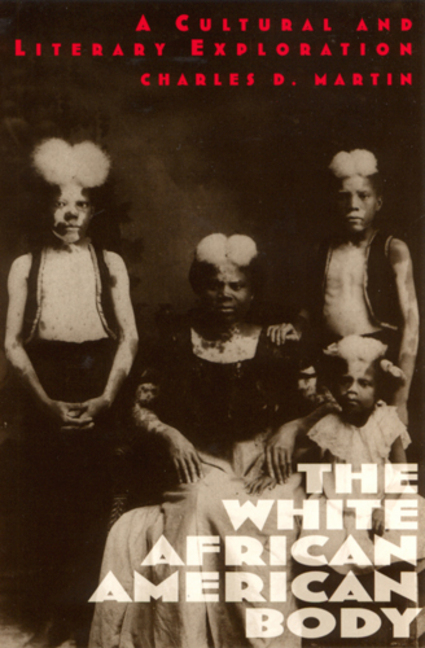
Blacks with white skin. Since colonial times, showmen have exhibited the bodies of African Americans with white or gradually whitening skin in taverns, dime museums, and circus sideshows. The term “white Negro” has served to describe an individual born with albinism as well as those who have vitiligo, a disorder that robs the skin of its pigment in ever-growing patches. In The White African American Body, Charles D. Martin examines the proliferation of the image of the white Negro in American popular culture, from the late eighteenth century to the present day.

This enigmatic figure highlights the folly of the belief in immutable racial differences. If skin is a race marker, what does it mean for blacks literally to be white? What does this say not only about blacks but also about whites? Scientists have probed this mystery, philosophers have pondered its meaning, and artists have profited from the sale of images of these puzzling figures.

Lavishly illustrated with many rarely seen photographs, The White African American Body shows how the white Negro occupied, and still occupies, the precarious position between white and black, and how this figure remains resilient in American culture.

Table of Contents

  • Illustrations
  • Acknowledgments
  • Introduction: A Ballyhoo for the Exhibition
  • The White Negro in the Early Republic
  • Barnum’s Leopard Boy: The Reign of the Piebald Parliament
  • The Double Bind of the Albino: “Less Nigger and More Nigger at the Same Time”
  • A Better Skin: Scenes from the Exhibition
  • White Negroes, Leopard Boys, and the King of Pop
  • Afterword: Requiem for a Wigger
  • Notes
  • Index

Tags: , ,

The Meaning of White: Race, Class, and the ‘Domiciled Community’ in British India 1858-1930

Posted in Asian Diaspora, Books, History, Media Archive, Monographs on 2012-07-05 22:44Z by Steven

The Meaning of White: Race, Class, and the ‘Domiciled Community’ in British India 1858-1930

Oxford University Press
January 2012
288 pages
Hardback ISBN13: 9780199697700; ISBN10: 0199697701

Satoshi Mizutani

From 1858 to 1930 the concept of whiteness in British India was complex and contradictory. Under the Raj, the spread of racial ideologies was pervasive, but whiteness was never taken as self-evident. It was constantly called into question and its boundaries were disciplined and policed through socio-cultural and institutional practices.

Only those whites with social status, cultural refinement, and the right level of education were able to command the respect and awe of colonized subjects. Among those who straddled the boundaries of whiteness were the ‘domiciled community’, made up of mixed-descent ‘Eurasians’ and racially unmixed ‘Domiciled Europeans’, both of whom lived in India on a permanent basis. Members of this community, or those who were categorized as such under the Raj, unwittingly rendered the meaning of whiteness ambiguous in fundamental ways.

The colonial authorities quickly identified the domiciled community as a particularly malign source of political instability and social disorder, and were constantly urged to furnish various institutional measures—predominantly philanthropic and educational by character—that specifically targeted its degraded conditions. The Meaning of White reveals the precise ways in which the existence of this community was identified as a problem (the ‘Eurasian Question’) and examines the deeper historical meanings of this categorization. Dr Mizutani demystifies the ideology of whiteness, situating it within the concrete social realities of colonial history.

Table of Contents

  • Introduction
  • 1. British prestige and fears of colonial degeneration
  • 2. The origins and emergence of the ‘domiciled community’
  • 3. The ‘Eurasian Question’: the domiciled poor and urban social control
  • 4. ‘European schools’: illiteracy, unemployment, and educational uplifting
  • 5. Towards a solution to the Eurasian Question: child removal and juvenile emigration
  • 6. Disputing the domiciliary divide: civil-service employment and the claim for equivalence
  • 7. Conclusion: Race, class, and the contours of whiteness in late British India
Tags: , , ,

Bound Lives: Africans, Indians, and the Making of Race in Colonial Peru

Posted in Books, Caribbean/Latin America, History, Media Archive, Monographs, Native Americans/First Nation, Slavery on 2012-06-30 02:06Z by Steven

Bound Lives: Africans, Indians, and the Making of Race in Colonial Peru

University of Pittsburgh Press
April 2012
272 pages
6 x 9
Paper  ISBN: 9780822961932

Rachel Sarah O’Toole, Associate Professor of History
University of California, Irvine

Bound Lives chronicles the lived experience of race relations in northern coastal Peru during the colonial era. Rachel Sarah O’Toole examines how Andeans and Africans negotiated and employed casta, and in doing so, constructed these racial categories. Royal and viceregal authorities separated “Indians” from “blacks” by defining each to specific labor demands. Casta categories did the work of race, yet, not all casta categories did the same type of work since Andeans, Africans, and their descendants were bound by their locations within colonialism and slavery. The secular colonial legal system clearly favored indigenous populations. Andeans were afforded greater protections as “threatened” native vassals. Despite this, in the 1640s during the rise of sugar production, Andeans were driven from their assigned colonial towns and communal property by a land privatization program. Andeans did not disappear, however; they worked as artisans, muleteers, and laborers for hire. By the late seventeenth and early eighteenth centuries, Andeans employed their legal status as Indians to defend their prerogatives to political representation that included the policing of Africans. As rural slaves, Africans often found themselves outside the bounds of secular law and subject to the judgments of local slaveholding authorities. Africans therefore developed a rhetoric of valuation within the market and claimed new kinships to protect themselves in disputes with their captors and in slave-trading negotiations. Africans countered slaveholders’ claims on their time, overt supervision of their labor, and control of their rest moments by invoking customary practices. Bound Lives offers an entirely new perspective on racial identities in colonial Peru. It highlights the tenuous interactions of colonial authorities, indigenous communities, and enslaved populations and shows how the interplay between colonial law and daily practice shaped the nature of colonialism and slavery.

Contents

  • acknowledgments
  • introduction: Constructing Casta on Peru’s Northern Coast
  • chapter 1. Between Black and Indian: Labor Demands and the Crown’s Casta
  • chapter 2. Working Slavery’s Value, Making Diaspora Kinships
  • chapter 3. Acting as a Legal Indian: Natural Vassals and Worrisome Natives
  • chapter 4. Market Exchanges and Meeting the Indians Elsewhere
  • chapter 5. Justice within Slavery
  • conclusion. The Laws of Casta, the Making of Race
  • appendix 1. Origin of Slaves Sold in Trujillo over Time by Percentage (1640–1730)
  • appendix 2. Price Trends of Slaves Sold in Trujillo (1640–1730)
  • explanation of Appendix Data
  • notes
  • glossary
  • bibliography
  • index
Tags: , , , ,