Bengali Harlem and the Lost Histories of South Asian America

Posted in Asian Diaspora, Books, History, Media Archive, Monographs, Social Science, United States on 2012-09-25 21:08Z by Steven

Bengali Harlem and the Lost Histories of South Asian America

Harvard University Press
2012-11-19
320 pages
6-1/8 x 9-1/4 inches
15 halftones, 2 maps, 4 tables
Hardcover ISBN: 9780674066663

Vivek Bald, Assistant Professor of Writing and Digital Media
Massachusetts Institute of Technology

In the final years of the nineteenth century, small groups of Muslim peddlers arrived at Ellis Island every summer, bags heavy with embroidered silks from their home villages in Bengal. The American demand for “Oriental goods” took these migrants on a curious path, from New Jersey’s beach boardwalks into the heart of the segregated South. Two decades later, hundreds of Indian Muslim seamen began jumping ship in New York and Baltimore, escaping the engine rooms of British steamers to find less brutal work onshore. As factory owners sought their labor and anti-Asian immigration laws closed in around them, these men built clandestine networks that stretched from the northeastern waterfront across the industrial Midwest.

The stories of these early working-class migrants vividly contrast with our typical understanding of immigration. Vivek Bald’s meticulous reconstruction reveals a lost history of South Asian sojourning and life-making in the United States. At a time when Asian immigrants were vilified and criminalized, Bengali Muslims quietly became part of some of America’s most iconic neighborhoods of color, from Tremé in New Orleans to Detroit’s Black Bottom, from West Baltimore to Harlem. Many started families with Creole, Puerto Rican, and African American women.

As steel and auto workers in the Midwest, as traders in the South, and as halal hot dog vendors on 125th Street, these immigrants created lives as remarkable as they are unknown. Their stories of ingenuity and intermixture challenge assumptions about assimilation and reveal cross-racial affinities beneath the surface of early twentieth-century America.

For more information, visit the Bengali Harlem website here.

Table of Contents

  • Author’s Note
  • Introduction: Lost in Migration
  • 1. Out of the East and into the South
  • 2. Between Hindoo and Negro
  • 3. From Ships’ Holds to Factory Floors
  • 4. The Travels and Transformations of Amir Haider Khan
  • 5. Bengali Harlem
  • 6. The Life and Times of a Multiracial Community
  • Conclusion: Lost Futures
  • List of Abbreviations
  • Notes
  • Acknowledgments
  • Index
Tags: , ,

The Eurasian Face

Posted in Arts, Asian Diaspora, Books, Media Archive, Monographs on 2012-09-24 20:57Z by Steven

The Eurasian Face

Blacksmith Books
November 2010
140 pages
70+ b/w images
Bilingual: English/Chinese
20.5 x 31 cm
Hardcover ISBN: 978-988-99799-9-7

Kirsteen Zimmern

No one represents diversity better than Eurasians—those individuals with a mix of Caucasian and Asian heritage. Once a source of shame, the Eurasian face has become the face that sells. It is the face with which everyone can identify. In an ever-shrinking world, the search is on for a one-size-fits-all global image. Eurasians have become the world’s poster boys and girls, much sought after as actors and models.

Taking advantage of increasingly tolerant times and the growing commercial and cultural exchanges between East and West, Eurasians have gained prominence as entrepreneurs, professionals and athletes. This book of interviews and black-and-white portraits reveals how seventy Eurasians of diverse backgrounds see their place in the world today.

Kirsteen Zimmern is a photographer of Chinese and Scottish ancestry. She has always been fascinated by the tell-tale signs of East and West in the faces of fellow Eurasians, and has found this fascination to be widespread: few days go by without strangers examining her appearance to discern her ethnicity. She lives in Hong Kong.

View pages 48-59 here.

Tags: , ,

Subgenation: The Theory of the Normal Relation of the Races; an Answer to “Miscegenation”

Posted in Books, Media Archive, Monographs, United States on 2012-09-24 02:03Z by Steven

Subgenation: The Theory of the Normal Relation of the Races; an Answer to “Miscegenation”

John Bradburn Publishing
1864
72 pages
Classification Number: CAGE E185.62.V24 1864

John H. Van Evrie (1814-1896)

TABLE OF CONTENTS

  • I.—The Diversity of the Races.
  • II.—Miscegenation; or, the Mixture of the Races.
  • III.—The Future of the Races.
  • IV.—The Effect of Subgenation Upon the White Race.
  • V.—Subgenation, the Basis of Democracy.
  • VI.—Women and Subgenation.
  • VII.—Subgenation and the Presidential Election.
  • VIII.— The Recognition of the Confederate States.
  • IX.—The Millennium Solved.
  • X.—An Omen.

Introduction

Scaliger quaintly observes “that nothing will sell better than a scurrile pamphlet,” and the extensive sale of a recent brochure, entitled “Miscegenation,” in which the most indecent doctrines are seductively inculcated under the garb of philosophy, seems to prove the assertion. While there is no excuse for the gross violation of natural instincts which that author recommends, yet there is probably some good reason why there is a want of a popular knowledge as to the true relation of the races. The juxtaposition of the Caucasian, Indian, and Negro races on this continent, in considerable numbers, has no parallel in history. If we except the Egyptians and the Carthagenians, there were no ancient nations which had other than a homogeneous population. A negro was a curiosity in Greece and Rome.   All modern Europe, from which we derive our language, is composed of one race or the varieties of it. The question, as to the proper relation of distinct races, is, therefore, a new one, and has been committed to this country for solution.

The writer to whom allusion has been made offers a solution, and it is no less a proposition than the annihilation of all the existing races and the formation of a new one! He proposes to bring this about by mingling the races, and has invented the word Miscegenation to express his idea (miscere, to mix; genus, a race). The suggestion of the word is a good one. The necessity of new terms to express the proper, as well as the improper, relation of the races on this continent has long been felt by thoughtful minds. The words slavery and slave are derived from Sclavi—Sclavonians, who were conquered by the Germans and reduced to abject bondage. The word, therefore, expresses a relation existing between persons of the same race, and not between those of different races. Hence it is a misnomer as applied to the American form of society. The present writer proposes to profit by the suggestion of the author of of “Miscegenation” and coin another word, long needed.  It is subgenation, from sub, lower, and generatus and genus, a race born or created lower than another; i.e., the natural or normal relation of an inferior to a superior race. The invention of new words has the high authority of Horace:

“Si forte necesse est
Indiciis monstrare recentribus abdita rerum.”

They were never so much needed as now. The simple truths—There is no slavery in this country; there are no slaves in the Southern States. We are fighting about a myth. For three centuries the Christian world was deluged in blood upon the assumption that there was a Holy Sepulchre at Jerusalem. There was no Holy Sepulchre there. The world was fighting on a false premise. This country is now repeating the same insensate folly.  In the following pages the writer proposes to show how and why this is so, to expose the errors and absurdities of the author of “Miscegenation,” and to give such a solution to the question of the proper relation of the races as shall commend itself to the conscience 0f every intelligent friend of Humanity…

Read the entire book here.

Tags: , ,

The Victorian Reinvention of Race: New Racisms and the Problem of Grouping in the Human Sciences

Posted in Books, History, Literary/Artistic Criticism, Media Archive, Monographs, United Kingdom on 2012-09-23 18:04Z by Steven

The Victorian Reinvention of Race: New Racisms and the Problem of Grouping in the Human Sciences

Routledge
2010-06-23
248 pages
Paperback ISBN: 978-0-415-65278-0
Hardback ISBN: 978-0-415-88125-8
eBook ISBN: 978-0-203-84498-4

Edward Beasley, Associate Professor of History
San Diego State University

In mid-Victorian England there were new racial categories based upon skin colour. The ‘races’ familiar to those in the modern west were invented and elaborated after the decline of faith in Biblical monogenesis in the early nineteenth century, and before the maturity of modern genetics in the middle of the twentieth. Not until the early nineteenth century would polygenetic and racialist theories win many adherents. But by the middle of the nineteenth century in England, racial categories were imposed upon humanity. How the idea of ‘race’ gained popularity in England at that time is the central focus of The Victorian Reinvention of Race: New Racisms and the Problem of Grouping in the Human Sciences.

Scholars have linked this new racism to some very dodgy thinkers. The Victorian Reinvention of Race examines a more influential set of the era’s writers and colonial officials, some French but most of them British. Attempting to do serious social analysis, these men oversimplified humanity into biologically-heritable, mentally and morally unequal, colour-based ‘races’. Thinkers giving in to this racist temptation included Alexis de Tocqueville when he was writing on Algeria; Arthur de Gobineau (who influenced the Nazis); Walter Bagehot of The Economist; and Charles Darwin (whose Descent of Man was influenced by Bagehot). Victorians on Race also examines officials and thinkers (such as Tocqueville in Democracy in America, the Duke of Argyll, and Governor Gordon of Fiji) who exercised methodological care, doing the hard work of testing their categories against the evidence. They analyzed human groups without slipping into racial categorization. Author Edward Beasley examines the extent to which the Gobineau-Bagehot-Darwin way of thinking about race penetrated the minds of certain key colonial governors. He further explores the hardening of the rhetoric of race-prejudice in some quarters in England in the nineteenth century – the processes by which racism was first formed.

Contents

  1. Introduction – Reinventing Racism
  2. Tocqueville and Race
  3. Gobineau, Bagehot’s Precursor
  4. The Common Sense of Walter Bagehot
  5. Bagehot Rewrites Gobineau
  6. Darwin and Race
  7. Argyll, Race, and Degeneration
  8. Frederick Weld and the Unnamed Neighbours
  9. By Way of a Conclusion – Arthur Gordon
Tags: , , , , ,

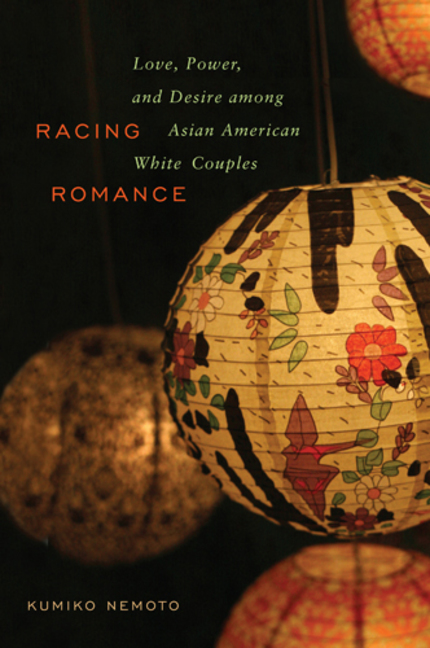
Racing Romance: Love, Power, and Desire Among Asian American/ White Couples

Posted in Asian Diaspora, Books, Media Archive, Monographs, Social Science, United States on 2012-09-23 03:06Z by Steven

Racing Romance: Love, Power, and Desire Among Asian American/ White Couples

Rutgers University Press
June 2009
208 pages
6 x 9
Paper ISBN: 978-0-8135-4533-2
Cloth ISBN: 978-0-8135-4532-5
Web PDF ISBN: 978-0-8135-4852-4

Kumiko Nemoto, Associate Professor of Sociology
Western Kentucky University

Despite being far from the norm, interracial relationships are more popular than ever. Racing Romance sheds special light on the bonds between whites and Asian Americans, an important topic that has not garnered well-deserved attention until now. Incorporating life-history narratives and interviews with those currently or previously involved with an interracial partner, Kumiko Nemoto addresses the contradictions and tensions—a result of race, class, and gender—that Asian Americans and whites experience.

Similar to black/white relationships, stereotypes have long played crucial roles in AsianAmerican/white encounters. Partners grapple with media representations of Asian women as submissive or hypersexual and Asian men are often portrayed as weak laborers or powerful martial artists. Racing Romance reveals how allegedly progressive interracial relationships remain firmly shaped by the logic of patriarchy and gender inherent to the ideal of marriage, family, and nation in America, even as this ideal is juxtaposed with discourses of multiculturalism and color blindness.

Tags: ,

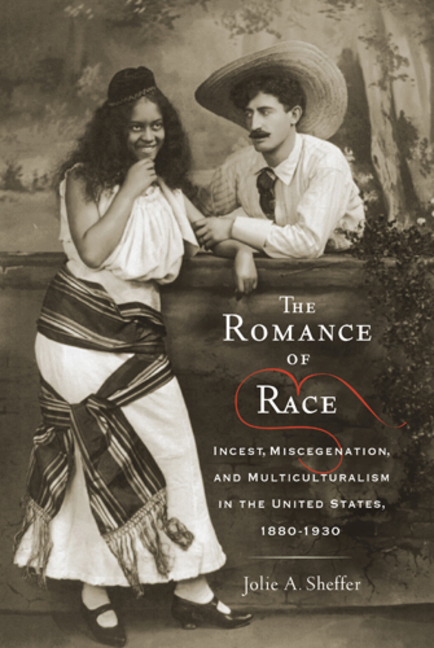
The Romance of Race: Incest, Miscegenation, and Multiculturalism in the United States, 1880-1930

Posted in Books, Literary/Artistic Criticism, Media Archive, Monographs, United States, Women on 2012-09-23 02:44Z by Steven

The Romance of Race: Incest, Miscegenation, and Multiculturalism in the United States, 1880-1930

Rutgers University Press
January 2013
240 pages
Paper ISBN: 978-0-8135-5462-4
Cloth ISBN: 978-0-8135-5463-1
eBook ISBN: 978-0-8135-5464-8

Jolie A. Sheffer, Associate Professor, English and American Culture Studies
Bowling Green State University, Bowling Green, Ohio

In the United States miscegenation is not merely a subject of literature and popular culture. It is in many ways the foundation of contemporary imaginary community. The Romance of Race examines the role of minority women writers and reformers in the creation of our modern American multiculturalism.

The national identity of the United States was transformed between 1880 and 1930 due to mass immigration, imperial expansion, the rise of Jim Crow, and the beginning of the suffrage movement. A generation of women writers and reformers—particularly women of color—contributed to these debates by imagining new national narratives that put minorities at the center of American identity. Jane Addams, Pauline Hopkins, Onoto Watanna (Winnifred Eaton), María Cristina Mena, and Mourning Dove (Christine Quintasket) embraced the images of the United States—and increasingly the world—as an interracial nuclear family. They also reframed public debates through narratives depicting interracial encounters as longstanding, unacknowledged liaisons between white men and racialized women that produced an incestuous, mixed-race nation.

By mobilizing the sexual taboos of incest and miscegenation, these women writers created political allegories of kinship and community. Through their criticisms of the nation’s history of exploitation and colonization, they also imagined a more inclusive future. As Jolie A. Sheffer identifies the contemporary template for American multiculturalism in the works of turn-of-the century minority writers, she uncovers a much more radical history than has previously been considered.

Tags: , , , , , , , , ,

Intimate: An American Family Photo Album

Posted in Asian Diaspora, Autobiography, Books, Media Archive, Monographs, Poetry, United States, Women on 2012-09-21 03:11Z by Steven

Intimate: An American Family Photo Album

Tupelo Press
April 2012
300 pages
Paperback ISBN: 978-1-932195-96-5
Clothbound ISBN: 978-1-936797-08-0

Paisley Rekdal, Professor of English
University of Utah

Intimate is a hybrid memoir and “photo album” that blends personal essay, historical documentary, and poetry to examine the tense relationship between self, society, and familial legacy in contemporary America. Typographically innovative, Intimate creates parallel streams, narrating the stories of Rekdal’s Norwegian-American father and his mixed-race marriage, the photographer Edward S. Curtis, and Curtis’s murdered Apsaroke guide, Alexander Upshaw. The result is panoramic, a completely original literary encounter with intimacy, identity, family relations, and race.

Tags: , , ,

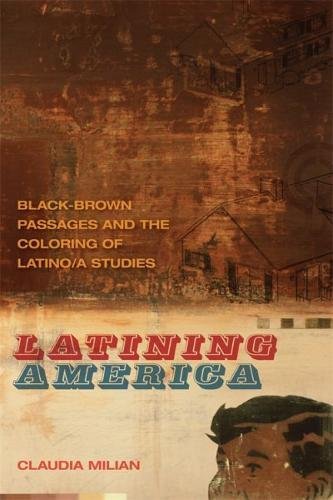
Latining America: Black-Brown Passages and the Coloring of Latino/a Studies

Posted in Anthropology, Books, Latino Studies, Literary/Artistic Criticism, Media Archive, Monographs, Social Science on 2012-09-18 22:02Z by Steven

Latining America: Black-Brown Passages and the Coloring of Latino/a Studies

University of Georgia Press
2013-02-01
288 pages
5 b&w photos
Trim size: 6 x 9
Cloth ISBN: 978-0-8203-4435-5
Paper ISBN: 978-0-8203-4436-2
Ebook ISBN: 978-0-8203-4479-9

Claudia Milian, Associate Professor of Spanish & Latin American Studies
Duke University

With Latining America, Claudia Milian proposes that the economies of blackness, brownness, and dark brownness summon a new grammar for Latino/a studies that she names “Latinities.” Milian’s innovative study argues that this ensnared economy of meaning startles the typical reading practices deployed for brown Latino/a embodiment.

Latining America keeps company with and challenges existent models of Latinidad, demanding a distinct paradigm that puts into question what is understood as Latino and Latina today. Milian conceptually considers how underexplored “Latin” participants—the southern, the black, the dark brown, the Central American—have ushered in a new world of “Latined” signification from the 1920s to the present.

Examining not who but what constitutes the Latino and Latina, Milian’s new critical Latinities disentangle the brown logic that marks “Latino/a” subjects. She expands on and deepens insights in transamerican discourses, narratives of passing, popular culture, and contemporary art. This daring and original project uncovers previously ignored and unremarked upon cultural connections and global crossings whereby African Americans and Latinos traverse and reconfigure their racialized classifications.

Tags: ,

Jemmy Jock Bird: Marginal Man on the Blackfoot Frontier

Posted in Biography, Books, Canada, Media Archive, Monographs, Native Americans/First Nation on 2012-09-16 21:52Z by Steven

Jemmy Jock Bird: Marginal Man on the Blackfoot Frontier

University of Calgary Press
2004
205 pages
16 b/w illustrations, 1 b/w photo, index
Paperback ISBN: 978-1-55238-111-3

John C. Jackson

Jemmy Jock Bird, the son of a Cree woman and a mixed-blood trader employed by the Hudson’s Bay Company, has become part of the mythology of the mountain man era. In this creative non-fiction account, Jackson meticulously reconstructs the life of this intriguing individual who was caught between opposing sides of a dual Métis heritage. Closely identified with the Cree and the Peigan, Bird’s trading activities and undercover work as a “confidential servant” of the Hudson’s Bay Company during the competitive period of the fur trade are explored using materials from the Hudson’s Bay Company Archives, the Montana Historical Society, and Bird’s descendants living on the American Blackfeet Reserve in Browning. As an interpreter, Bird was later instrumental in negotiating the 1855 Blackfoot peace treaty and the 1877 Canadian Treaty 7. Jackson steeps himself in the sparse documentation of the fur trade era to shed some much-needed light on Jemmy Jock Bird’s adventurous career – one that straddled the international borders of the northern plains and mountain west and touched upon many aspects of western development.

Tags: , ,

I’m Chocolate, You’re Vanilla: Raising Healthy Black and Biracial Children in a Race-Conscious World

Posted in Books, Family/Parenting, Identity Development/Psychology, Media Archive, Monographs on 2012-09-07 21:18Z by Steven

I’m Chocolate, You’re Vanilla: Raising Healthy Black and Biracial Children in a Race-Conscious World

Jossey-Bass
May 2000
304 pages
Paperback ISBN: 978-0-7879-5234-1

Marguerite A. Wright

A child’s concept of race is quite different from that of an adult. Young children perceive skin color as magical—even changeable—and unlike adults, are incapable of understanding adult predjudices surrounding race and racism. Just as children learn to walk and talk, they likewise come to understand race in a series of predictable stages.

Based on Marguerite A. Wright’s research and clinical experience, I’m Chocolate, You’re Vanilla teaches us that the color-blindness of early childhood can, and must, be taken advantage of in order to guide the positive development of a child’s self-esteem.

Wright answers some fundamental questions about children and race including:

  • What do children know and understand about the color of their skin?
  • When do children understand the concept of race?
  • Are there warning signs that a child is being adversely affected by racial prejudice?
  • How can adults avoid instilling in children their own negative perceptions and prejudices?
  • What can parents do to prepare their children to overcome the racism they are likely to encounter?
  • How can schools lessen the impact of racism?
  • With wisdom and compassion, I’m Chocolate, You’re Vanilla spells out how to educate black and biracial children about race, while preserving their innate resilience and optimism—the birthright of all children.

Table of Contents

  • THAT MAGICAL PLACE: RACE AWARENESS IN THE PRESCHOOL YEARS
    • Chocolate and Vanilla: How Preschoolers See Color and Race
    • How Preschoolers Begin to Learn Racial Attitudes
    • When to Be Concerned That Race Is a Problem for Preschoolers
    • Raising the Racially Healthy Preschooler
  • THE WANING OF RACIAL INNOCENCE: THE EARLY SCHOOL YEARS
    • Shades of Brown and Black: How Early Grade-Schoolers See Color and Race
    • Black Children’s Self-Esteem: The Real Deal
    • How School Influences Children’s Awareness of Color and Race
  • REALITY BITES: RACE AWARENESS IN MIDDLE CHILDHOOD AND ADOLESCENCE
    • Fading to Black and White: How Children in the Middle Years See Race
    • How School Influences Older Children’s Ideas About Race
    • Preparing for Adolescence: The Lines are Drawn
    • A Healthy High School Experience: You Can Make the Difference
  • Epilogue
  • Appendix: Stages of Race Awareness
  • Notes
  • About the Author
  • Index
Tags: , ,