Paint the White House Black: Barack Obama and the Meaning of Race in America

Posted in Barack Obama, Books, Media Archive, Monographs, Politics/Public Policy, Social Science, United States on 2013-01-24 01:54Z by Steven

Paint the White House Black: Barack Obama and the Meaning of Race in America

Stanford University Press
2013
224 pages
2 tables
Cloth ISBN: 9780804780957
Paper ISBN: 9780804780964
E-book ISBN: 9780804785570

Michael P. Jeffries, Sidney R. Knafel Assistant Professor of American Studies
Wellesley College, Wellesley, Massachusetts

Barack Obama’s election as the first black president in American history forced a reconsideration of racial reality and possibility. It also incited an outpouring of discussion and analysis of Obama’s personal and political exploits. Paint the White House Black fills a significant void in Obama-themed debate, shifting the emphasis from the details of Obama’s political career to an understanding of how race works in America. In this groundbreaking book, race, rather than Obama, is the central focus.

Michael P. Jeffries approaches Obama’s election and administration as common cultural ground for thinking about race. He uncovers contemporary stereotypes and anxieties by examining historically rooted conceptions of race and nationhood, discourses of “biracialism” and Obama’s mixed heritage, the purported emergence of a “post-racial society,” and popular symbols of Michelle Obama as a modern black woman. In so doing, Jeffries casts new light on how we think about race and enables us to see how race, in turn, operates within our daily lives.

Race is a difficult concept to grasp, with outbursts and silences that disguise its relationships with a host of other phenomena. Using Barack Obama as its point of departure, Paint the White House Black boldly aims to understand race by tracing the web of interactions that bind it to other social and historical forces.

Contents

  • Acknowledgments
  • CHAPTER 1: THROUGH THE FOG
  • CHAPTER 2: MY (FOUNDING) FATHER’S SON: Race, Nation, and the Politics of Inheritance
  • CHAPTER 3: “MUTTS LIKE Me”: Barack Obama, Tragic Mulattos, and Cool Mixed-Race Millennial
  • CHAPTER 4: POSTRACIALISM RECONSIDERED: Class, the Black Counterpublic, and the End of Black Politics
  • CHAPTER 5: THE PERILS OF BEING SUPERWOMAN: Michelle Obama’s Public Image
  • CHAPTER 6: A PLACE CALLED “OBAMA”
  • Appendix I. A Discussion of Racial Inequality
  • Appendix II. Interviewing Multiracial Students
  • Notes
  • Index
Tags: , , ,

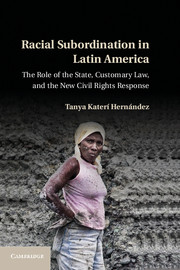
Racial Subordination in Latin America: The Role of the State, Customary Law, and the New Civil Rights Response

Posted in Books, Brazil, Caribbean/Latin America, Law, Media Archive, Monographs, Social Science on 2013-01-14 18:56Z by Steven

Racial Subordination in Latin America: The Role of the State, Customary Law, and the New Civil Rights Response

Cambridge University Press
October 2012
254 pages
2 maps; 1 table
228 x 152 mm
Hardback ISBN: 9781107024861
Paperback: 9781107695436
Adobe Ebook Reader ISBN: 9781139786676

Tanya Katerí Hernández, Professor of Law
Fordham University, New York

There are approximately 150 million people of African descent in Latin America yet Afro-descendants have been consistently marginalized as undesirable elements of the society. Latin America has nevertheless long prided itself on its absence of U.S.-styled state-mandated Jim Crow racial segregation laws. This book disrupts the traditional narrative of Latin America’s legally benign racial past by comprehensively examining the existence of customary laws of racial regulation and the historic complicity of Latin American states in erecting and sustaining racial hierarchies. Tanya Katerí Hernández is the first author to consider the salience of the customary law of race regulation for the contemporary development of racial equality laws across the region. Therefore, the book has a particular relevance for the contemporary U.S. racial context in which Jim Crow laws have long been abolished and a “post-racial” rhetoric undermines the commitment to racial equality laws and policies amidst a backdrop of continued inequality.

Features

  • Provides a comprehensive examination of the entire Latin American region with regard to racial inequality
  • Hernández is the first author to thoroughly consider the role of customary law in erecting and sustaining racial hierarchies
  • Offers a comprehensive examination of development of racial equality laws across the region

Contents

  • Maps
  • 1. Racial Innocence and the Customary Law of Race Regulation
  • 2. Spanish America Whitening the Race – the Un(written) Laws of Blanqueamiento and Mestizaje
  • 3. Brazilian “Jim Crow”: The Immigration Law Whitening Project and the Customary Law of Racial Segregation – a Case Study
  • 4. The Social Exclusion of Afro-Descendants in Latin America Today
  • 5. Afro-Descendant Social Justice Movements and the New Antidiscrimination Laws
  • 6. Brazil: At the Forefront of Latin American Race-Based Affirmative Action Policies and Census Racial Data Collection
  • 7. Conclusion: The United States–Latin America
  • Connections
  • Appendix A: Afro-Descendant Organizations in Latin America
  • Appendix B: Typology of Latin American Racial Antidiscrimination Measures
  • Bibliography
  • Index

I don’t think there is much racism in [Latin] America because we are a mix of races of all kinds of Europeans, Africans, Asians, and other races that were or will be; but I understand that in many other parts there is racism, above all in the United States and Europe, is where there is the most racism.1

There are approximately 150 million people of African descent in Latin America, representing about one-third of the total population (see Maps 1 and 2). Yet, these are considered conservative demographic figures given the histories of undercounting the number of persons of African descent on Latin American national censuses and often completely omitting a racial/ethnic origin census question. At the same time, persons of African descent make up more than 40 percent of the poor in Latin America and have been consistently marginalized and denigrated as undesirable elements of the society since the abolition of slavery across the Americas. Yet, the view that “racism does not exist” is pervasive in Latin America despite the advent of social justice movements and social science researchers demonstrating the contrary. When the BBC surveyed Latin Americans in 2005 regarding the existence of racism, a significant number of respondents emphatically denied the existence of racism. Many, for instance, made statements such as “Ibero-Americans are not racist,” and “Ibero-America is not a racist region, for the simple fact that the majority of the population is either indigenous, creole, or mixed.”

Thus the denial of racism is rooted in what many scholars have critiqued as the “myth of racial democracy” – the notion that the racial mixture (mestizaje/mestiçagem) in a population is emblematic of racial harmony and insulated from racial discord and inequality. Academic scholarship has in the last twenty years critiqued Latin American “mestizaje” theories of racial mixture as emblematic of racial harmony. Yet, Latin Americans still very much adhere to the notion that racial mixture and the absence of Jim Crow racial segregation are such a marked contrast to the U.S. racial history that the region views itself as what I term “racially innocent.” Indeed, the extensive survey data from the Latin American Public Opinion Project’s “Americas Barometer 2010” demonstrates that biased Latin American racial ideologies have not completely evolved despite the existing scholarly critiques of mestizaje as a trope of racial innocence. For instance, in the Americas Barometer 2010 survey of Bolivia, Brazil, Colombia, Dominican Republic, Ecuador, Guatemala, Mexico, and Peru, the vast majority of the country populations (of all races) agreed with the mestizaje notion that “racial mixture is good for the country.” In fact, more than 75 percent of all respondents agreed with the statement and largely endorsed the idea of interracial marriages. Yet, the Americas Barometer data also show that for those Latin Americans who did express disagreement with the idea of their children marrying black partners, the opposition level was dramatically greater from white respondents in contrast to black respondents. Specifically, in those countries where the Americas Barometer asked whether there was disagreement with one’s own children marrying a black person, such as Brazil, Colombia, the Dominican Republic, and Ecuador, the opposition by whites to interracial black marriages was on average 60 percent greater than the opposition of blacks to such marriages. (Other countries were asked about marriage to a person of indigenous descent.) These results thus accord with the long-standing data that marriage patterns in Latin America are generally racially endogamous.

The Americas Barometer 2010 data also indicate that white respondents in several Latin American countries are considerably more likely than other groups to state a preference for lighter skin. For instance, in Colombia, Ecuador, and the Dominican Republic, on average 26 percent of white respondents agreed that they would prefer lighter skin, in contrast to the 13 percent average of black respondents who prefer lighter skin. In Mexico and Peru, blacks on average had greater rates of preference for lighter skin (37%) than whites (26%). In Brazil the rate of white preference for lighter skin closely approximated blacks’ lighter-skin preference rate. Even socialist Cuba continues to manifest a preference for whiteness and a white opposition to interracial marriage. Moreover, in a 2004 comparison of implicit and explicit racial bias in the United States, Cuba, the Dominican Republic, and Puerto Rico, the rates of both implicit and explicit racial bias were higher in all three Latin American contexts as compared to the United States. Thus despite the overwhelming articulation of mestizaje as an indicator of racial harmony across much of Latin America and the different ways that it is articulated within each country, attitudes of racial distinction and superiority persist beneath the celebration of racial mixture. In part, the absence of a legal critique of the Latin American comparisons to the Jim Crow United States has enabled the Latin American “racial innocence” stance to remain. This book seeks to fill in that gap in the literature and provide the legal critique.

Specifically, this book is about the ways in which the Latin American denial of racism operating in conjunction with the notion that true racism can only be found in the racial segregation of the United States veils the actual manifestations of racism in Latin America. I will argue that an examination of the role of the state after the abolition of slavery in regulating race through immigration law and customary law disrupts this picture of Latin America as “racially innocent.” I will then assess the ways in which the contemporary Latin American antidiscrimination laws seek to eradicate the legacy of racial inequality wrought by the historic racism of the state. Finally, I will conclude the book with insights as to how the examination of the Latin American context may be helpful to the U.S. racial justice movement today, given the growing denial of the existence of racism in the United Sates. In doing so, I shall adopt the term “Afro-descendants,” which Latin American race scholars and social justice movement actors use to encompass all persons of African descent in Latin America who are affected by antiblack sentiment whether or not they personally identify as “black” or adopt a mixed-race identity such as mulatto or mestizo. This book will not focus upon the racial inequality issues of indigenous groups in Latin America given the extensive literature that already exists regarding that topic. Instead the analysis will focus upon the particular history of Afro-descendants’ relationship to the state as formerly enslaved subjects seeking visibility as citizens and full participants in the national identity despite the societal denial of racism…

Tags: , , ,

Love Against the Law: The autobiographies of Tex and Nelly Camfoo

Posted in Autobiography, Books, Media Archive, Monographs, Oceania, Social Science on 2013-01-14 17:41Z by Steven

Love Against the Law: The autobiographies of Tex and Nelly Camfoo

Aboriginal Studies Press
2000
120 pages
240×170 mm
ISBN 9780855753481

Tex Camfoo

Nelly Camfoo

Edited by:

Gillian Cowlishaw

During his life, Tex Camfoo has been classified as Aboriginal, half-caste and European. As a half-caste he could not legally associate with or marry an Aboriginal woman. As an Aboriginal, he was not allowed to visit the pub with his European work mates.

Nelly Camfoo was always considered Aboriginal. From childhood she has taken part in ceremonial life. She finds white people both frustrating and foolish – ‘they can’t understand because they can’t listen’.

The stories of Tex and Nelly Camfoo intermingle to highlight the ambiguous social position of Aboriginals living in the Northern Territory during this century. They provide insight into race relations, the contradictory attitudes of missionaries and police, they reflect morality and religion as well as recent political developments.

Tags: , , , ,

In Every Tongue: The Racial & Ethnic Diversity of the Jewish People

Posted in Books, Judaism, Media Archive, Monographs, Religion on 2013-01-10 22:34Z by Steven

In Every Tongue: The Racial & Ethnic Diversity of the Jewish People

Institute for Jewish & Community Research
September 2005
272 pages
ISBN-10: 1893671011; ISBN-13: 978-1893671010

Gary A. Tobin

Diane Tobin

Scott Rubin

Foreword by:

Lewis Gordon, Laura H. Carnell Professor of Philosophy, Director of the Institute for the Study of Race and Social Thought and Director of the Center for Afro-Jewish Studies
Temple University

2006 Independent Publisher Book Award Finalist for the category “Multicultural Non-Fiction Adult.”

A groundbreaking look at the changing faces of the Jewish people and the implications for the world Jewish community

Jews have always resembled the peoples among whom they live, whether in Africa, Asia, or Europe. Why should American Jews be an exception? In a land where racial and ethnic boundaries are becoming increasingly blurred, the American Jewish community is also shifting. In Every Tongue is both a groundbreaking look at the changing faces of the Jewish people and an examination of the timelessness of those changes. Ranging from distinct communities of African American Jews and adopted children of color in white Jewish families to the growing number of religious seekers of all races who hope to find a home in Judaism, In Every Tongue explores the origins, traditions, challenges, and joys of diverse Jews in America.

This book explodes the myth of a single authentic Judaism and shines a bright light on the thousands of ethnically and racially diverse Jews in the United States who live full and rich Jewish lives. It is impossible to read In Every Tongue without coming away with a deeper respect for and a broader understanding of the Jewish people today. In a time when Jewish community leaders decry the shrinking of the Jewish population, In Every Tongue imagines a vibrant and daring future for the Jewish people: becoming who they have always been.

Table of Contents

  • Foreword
  • A Synonym for Jewish
  • Describing the Tapestry
  • Racial and Religious Change in America
  • Jewish Diversity in America and the Politics of Race
  • The Last Taboo: Interracial Marriage
  • Feet in Many Rivers: Navigating Multiple Identities
  • Jews Have Always Been Diverse
  • Who Is a Jew? Ideology and Bloodlines
  • By Choice or by Destiny
  • And for Those Too Young to Ask: Transracial Adoption
  • Patches of Color, Patches of White
  • Toward a More Inclusive Future
  • Who Is a Jew, Really?
  • Be’chol Lashon: A Visual Journey
  • Methodology
  • Notes
  • Glossary
  • Index
  • Selected Bibliography
Tags: , , , , , ,

Family of Freedom: Presidents and African Americans in the White House

Posted in Barack Obama, Books, History, Media Archive, Monographs, Politics/Public Policy, Slavery, United States on 2013-01-10 22:02Z by Steven

Family of Freedom: Presidents and African Americans in the White House

Paradigm Publishers
February 2011
288 pages
6″ x 9″
Hardcover ISBN: 978-1-59451-833-1
EBook ISBN: 978-1-61205-000-3

Kenneth T. Walsh

This book examines the intertwined relationships between the presidents and the African Americans who have been an integral part of the White House since the beginning of the Republic. The book discusses the racial attitudes and policies of the presidents and shows how African Americans helped to shape those attitudes and policies over the years. The analysis starts with the early presidents who had slaves and tells the compelling stories of their interactions, with an emphasis on how these slaves dealt with bondage in the supposed citadel of American freedom and independence. The book moves through the era of Abraham Lincoln, whose views on emancipation were greatly influenced by the African Americans around him, especially by White House seamstress Elizabeth Keckley and valet William Slade. The book covers the Jim Crow era and proceeds through the political and cultural breakthroughs on civil rights accomplished by Lyndon Johnson in partnership with the Rev. Martin Luther King, Jr. The book ends with an insightful analysis of the rise, election, and administration of Barack Obama, the first African American president, including an exclusive interview with Obama.

Tags: , , , ,

Tragic No More: Mixed Race Women and the Nexus of Sex and Celebrity

Posted in Books, Literary/Artistic Criticism, Media Archive, Monographs, United States, Women on 2013-01-10 01:38Z by Steven

Tragic No More: Mixed Race Women and the Nexus of Sex and Celebrity

University of Massachusetts Press
December 2012
176 pages
6 x9; 6 illustrations
ISBN (paper): 978-1-55849-985-0
ISBN (cloth): 978-1-55849-984-3

Caroline A. Streeter, Associate Professor of English
University of California, Los Angeles

A timely exploration of gender and mixed race in American culture

This book examines popular representations of biracial women of black and white descent in the United States, focusing on novels, television, music, and film. Although the emphasis is on the 1990s, the historical arc of the study begins in the 1930s. Caroline A. Streeter explores the encounter between what she sees as two dominant narratives that frame the perception of mixed race in America. The first is based on the long-standing historical experience of white supremacy and black subjugation. The second is more recent and involves the post–Civil Rights expansion of interracial marriage and mixed race identities. Streeter analyzes the collision of these two narratives, the cultural anxieties they have triggered, and the role of black/white women in the simultaneous creation and undoing of racial categories—a charged, ambiguous cycle in American culture.

Streeter’s subjects include concert pianist Philippa Schuyler, Dorothy West’s novel The Wedding (in print and on screen), Danzy Senna’s novels Caucasia and Symptomatic, and celebrity performing artists Mariah Carey, Alicia Keys, and Halle Berry. She opens with a chapter that examines the layered media response to Essie Mae Washington-Williams, Senator Strom Thurmond’s biracial daughter. Throughout the book, Streeter engages the work of feminist critics and others who have written on interracial sexuality and marriage, biracial identity, the multiracial movement, and mixed race in cultural studies.

Table of Contents

  • Acknowledgments
  • Introduction
  • 1. Essie Mae Washington-Williams’s Secrets and Strom Thurmond’s Lies
  • 2. The Wedding’s Black/White Women in Prime Time
  • 3. Sex and Femininity in Danzy Senna’s Novels
  • 4. Faking the Funk? Mariah Carey, Alicia Keys, and the Politics of Passing
  • 5. From Tragedy to Triumph: Dorothy Dandridge, Halle Berry, and the Search for a Black Screen Goddess
  • 6. High (Mulatto) Hopes: The Rise and Fall of Philippa Schuyler
  • Afterword
  • Notes
  • Index
Tags: , , , , , , , , ,

A Hideous Monster of the Mind: American Race Theory in the Early Republic

Posted in Books, History, Literary/Artistic Criticism, Media Archive, Monographs, United States on 2013-01-09 04:40Z by Steven

A Hideous Monster of the Mind: American Race Theory in the Early Republic

Harvard University Press
February 2003
334 pages
6 x 9-15/16 inches
Hardcove ISBN: 9780674009462

Bruce Dain, Associate Professor of History
University of Utah

The intellectual history of race, one of the most pernicious and enduring ideas in American history, has remained segregated into studies of black or white traditions. Bruce Dain breaks this separatist pattern with an integrated account of the emergence of modern racial consciousness in the United States from the Revolution to the Civil War. A Hideous Monster of the Mind reveals that ideas on race crossed racial boundaries in a process that produced not only well-known theories of biological racism but also countertheories that were early expressions of cultural relativism, cultural pluralism, and latter-day Afrocentrism.

From 1800 to 1830 in particular, race took on a new reality as Americans, black and white, reacted to postrevolutionary disillusionment, the events of the Haitian Revolution, the rise of cotton culture, and the entrenchment of slavery. Dain examines not only major white figures like Thomas Jefferson and Samuel Stanhope Smith, but also the first self-consciously “black” African-American writers. These various thinkers transformed late-eighteenth-century European environmentalist “natural history” into race theories that combined culture and biology and set the terms for later controversies over slavery and abolition. In those debates, the ethnology of Samuel George Morton and Josiah Nott intertwined conceptually with important writing by black authors who have been largely forgotten, like Hosea Easton and James McCune Smith. Scientific racism and the idea of races as cultural constructions were thus interrelated aspects of the same effort to explain human differences.

In retrieving neglected African-American thinkers, reestablishing the European intellectual background to American racial theory, and demonstrating the deep confusion “race” caused for thinkers black and white, A Hideous Monster of the Mind offers an engaging and enlightening new perspective on modern American racial thought.

Table of Contents

  • Preface
  • 1. The Face of Nature
  • 2. Culture and the Persistence of Race
  • 3. The Horrors of St. Domingue
  • 4. The Mutability of Human Affairs
  • 5. Conceiving Universal Equality
  • 6. Black Immediatism
  • 7. The New Ethnology
Tags: , , , , , , , , , ,

Midnight at the Barrelhouse: The Johnny Otis Story

Posted in Arts, Biography, Books, Media Archive, Monographs, United States on 2013-01-07 19:48Z by Steven

Midnight at the Barrelhouse: The Johnny Otis Story

University of Minnesota Press
2010
272 pages
23 b&w plates, 6 x 9
cloth ISBN: 978-0-8166-6678-2

George Lipsitz, Professor of Black Studies and Sociology
University of California, Santa Barbara

Considered by many to be the godfather of R&B, Johnny Otis—musician, producer, artist, entrepreneur, pastor, disc jockey, writer, and tireless fighter for racial equality—has had a remarkable life by any measure. In this first biography of Otis, George Lipsitz tells the largely unknown story of a towering figure in the history of African American music and culture who was, by his own description, “black by persuasion.”

Born to Greek immigrant parents in Vallejo, California, in 1921, Otis grew up in an integrated neighborhood and identified deeply with black music and culture from an early age. He moved to Los Angeles as a young man and submerged himself in the city’s vibrant African American cultural life, centered on Central Avenue and its thriving music scene. Otis began his six-decade career in music playing drums in territory swing bands in the 1930s. He went on to lead his own band in the 1940s and open the Barrelhouse nightclub in Watts. His R&B band had seventeen Top 40 hits between 1950 and 1969, including “Willie and the Hand Jive.” As a producer and A&R man, Otis discovered such legends as Etta James, Jackie Wilson, and Big Mama Thornton.

Otis also wrote a column for the Sentinel, one of L.A.’s leading black newspapers, became pastor of his own interracial church, hosted popular radio and television shows that introduced millions to music by African American artists, and was lauded as businessman of the year in a 1951 cover story in Negro Achievements magazine. Throughout his career Otis’s driving passion has been his fearless and unyielding opposition to racial injustice, whether protesting on the front lines, exposing racism and championing the accomplishments of black Americans, or promoting African American musicians.

Midnight at the Barrelhouse is a chronicle of a life rich in both incident and inspiration, as well as an exploration of the complicated nature of race relations in twentieth-century America. Otis’s total commitment to black culture and transcendence of racial boundaries, Lipsitz shows, teach important lessons about identity, race, and power while encapsulating the contradictions of racism in American society.

Tags: , , ,

The Family Flamboyant: Race Politics, Queer Families, Jewish Lives

Posted in Books, Family/Parenting, Gay & Lesbian, Judaism, Media Archive, Monographs, Religion, United States on 2013-01-01 20:35Z by Steven

The Family Flamboyant: Race Politics, Queer Families, Jewish Lives

SUNY Press
October 2006
244 pages
Hardback ISBN10: 0-7914-6893-3; ISBN13: 978-0-7914-6893-7
Paperback ISBN10: 0-7914-6894-1; ISBN13: 978-0-7914-6894-4
eBook ISBN10: 0-7914-8106-9; ISBN13: 978-0-7914-8106-6

Marla Brettschneider, Professor of Political Philosophy, Feminist Theory, Political Science & Women’s Studies
University of New Hampshire

Winner of a Bronze Medal in the Gay/Lesbian Category of the 2007 Independent Publisher Book Awards

Interrogates the normative heterosexual family from feminist, Jewish, and queer perspectives.

The Family Flamboyant is a graceful and lucid account of the many routes to family formation. Weaving together personal experience and political analysis in an examination of how race, gender, sexuality, class, and other hierarchies function in family politics, Marla Brettschneider draws on her own experience in a Jewish, multiracial, adoptive, queer family in order to theorize about the layered realities that characterize families in the United States today. Brettschneider uses critical race politics, feminist insight, class-based analysis, and queer theory to offer a distinct and distinctly Jewish contribution to both the family debates and the larger project of justice politics.

Table of Contents

  • Acknowledgments
  • Introduction: K-I-S-S-I-N-G
  • 1. Whitens Whites, Keeps Colors Bright: Jewish Families Queering the Race Project
  • 2. Jew Dykes Adopting Children: A Guide to the Perplexed
  • 3. Going Natural: The Family Has No Clothes
  • 4. Questing for Heart in a Heartless World: Jewish Feminist Ruminations on Monogamy and Marriage
  • Epilogue: Justice and La Vida Jew . . . in Technicolor Queer
  • Notes
  • Bibliography
  • Index
Tags: ,

The Myth of Race

Posted in Books, Media Archive, Monographs, Social Science on 2013-01-01 16:52Z by Steven

The Myth of Race

Argo-Navis
2012-11-27
154 pages
8.2 x 5.5 x 0.4 inches
Paperback ISBN-10: 0786754362; ISBN-13: 978-0786754366

Jefferson M. Fish, Professor Emeritus of Psychology
St. John’s University, New York City

The Myth of Race deals concisely with a wide range of topics, from how the concept of race differs in different cultures and race relations in the United States, to IQ tests and the census. It draws on scientific knowledge to topple a series of myths that pass as facts, correct false assumptions, and clarify cultural misunderstandings about the highly charged topic of race. The book demonstrates that the apparently straightforward concept of race is actually a confused mixture of two different concepts; and the confusion often leads to miscommunication. The first concept, biological race, simply doesn’t exist in the human species. Instead, what exists is gradual variation in what people look like (e.g., skin color and facial features) and in their genes, as you travel around the planet—with more distant populations appearing more different than closer ones. If you travel in different directions, the populations look different in different ways. The second concept, social race, is a set of cultural categories for labeling people based on how their ancestors were classified, selected aspects of what they look like, or various combinations of both. These sets of categories vary widely from one culture to another.

The book draws on scientific knowledge to topple a series of myths that pass as facts, correct false assumptions, and clarify cultural misunderstandings about the highly charged topic of race.

Here are some of those myths:

  • The myth that humans are divided into Caucasoid, Negroid, and Mongoloid races
  • The myth that people cannot change their race
  • The myth of the tragic mulatto
  • The myth of biologically based differences in intelligence among the races

Table of Contents

  • Introduction
  • 1. The Myth of Caucasoid, Negroid, and Mongoloid Races
  • 2. The Myth that a Persons Race Cannot Change
  • 3. Racial Myths and Cultural Misunderstandings
  • 4. Racial Myths in the Census
  • 5. Racial Myths and the Authors Family
  • 6. Myths about Race and Intelligence
  • 7. Dreams from My Daughter: Mixed Race Myths
  • 8. How the Myth of Race Took Hold
Tags: , ,