Crossing B(l)ack: Mixed-Race Identity in Modern American Fiction and Culture

Posted in Barack Obama, Books, Literary/Artistic Criticism, Media Archive, Monographs on 2013-02-07 00:30Z by Steven

Crossing B(l)ack: Mixed-Race Identity in Modern American Fiction and Culture

University of Tennessee Press
2013-01-11
150 pages
Cloth ISBN-10: 1572339322; ISBN-13: 978-1572339323

Sika A. Dagbovie-Mullins, Associate Professor of English
Florida Atlantic University
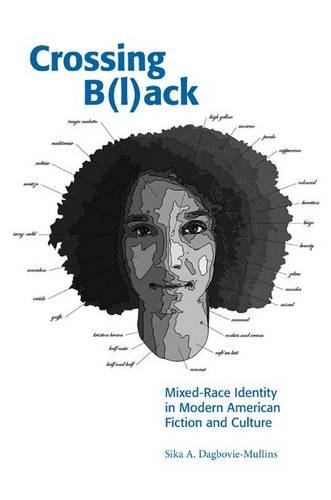
The past two decades have seen a growing influx of biracial discourse in fiction, memoir, and theory, and since the 2008 election of Barack Obama to the presidency, debates over whether America has entered a “post-racial” phase have set the media abuzz. In this penetrating and provocative study, Sika A. Dagbovie-Mullins adds a new dimension to this dialogue as she investigates the ways in which various mixed-race writers and public figures have redefined both “blackness” and “whiteness” by invoking multiple racial identities.

Focusing on several key novels—Nella Larsen’s Quicksand (1928), Lucinda Roy’s Lady Moses (1998), and Danzy Senna’s Caucasia (1998)—as well as memoirs by Obama, James McBride, and Rebecca Walker and the personae of singer Mariah Carey and actress Halle Berry, Dagbovie-Mullins challenges conventional claims about biracial identification with a concept she calls “black-sentient mixed-race identity.” Whereas some multiracial organizations can diminish blackness by, for example, championing the inclusion of multiple-race options on census forms and similar documents, a black-sentient consciousness stresses a perception rooted in blackness—“a connection to a black consciousness,” writes the author, “that does not overdetermine but still plays a large role in one’s racial identification.” By examining the nuances of this concept through close readings of fiction, memoir, and the public images of mixed-race celebrities, Dagbovie-Mullins demonstrates how a “black-sentient mixed-race identity reconciles the widening separation between black/white mixed race and blackness that has been encouraged by contemporary mixed-race politics and popular culture.”

A book that promises to spark new debate and thoughtful reconsiderations of an especially timely topic, Crossing B(l)ack recognizes and investigates assertions of a black-centered mixed-race identity that does not divorce a premodern racial identity from a postmodern racial fluidity.

Tags: , , , , , , , , , , , ,

Dear Senator: A Memoir by the Daughter of Strom Thurmond

Posted in Autobiography, Books, Media Archive, Monographs, United States, Women on 2013-02-05 23:00Z by Steven

Dear Senator: A Memoir by the Daughter of Strom Thurmond

HarperCollins
2005
240 pages
Trimsize: 6 x 9
Trade Paperback ISBN: 9780060761424; ISBN10: 0060761423

Essie Mae Washington-Williams and William Stadiem

Breaking nearly eight decades of silence, Essie Mae Washington-Williams comes forward with a story of unique historical magnitude and incredible human drama. Her father, the late Strom Thurmond, was once the nation’s leading voice for racial segregation (one of his signature political achievements was his 24-hour filibuster against the Civil Rights Act of 1957, done in the name of saving the South from “mongrelization”). Her mother, however, was a black teenager named Carrie Butler who worked as a maid on the Thurmond family’s South Carolina plantation.

Set against the explosively changing times of the civil rights movement, this poignant memoir recalls how she struggled with the discrepancy between the father she knew—one who was financially generous, supportive of her education, even affectionate—and the Old Southern politician, railing against greater racial equality, who refused to acknowledge her publicly. From her richly told narrative, as well as the letters she and Thurmond wrote to each other over the years, emerges a nuanced, fascinating portrait of a father who counseled his daughter about her dreams and goals, and supported her in reaching them–but who was unwilling to break with the values of his Dixiecrat constituents.

With elegance, dignity, and candor, Washington-Williams gives us a chapter of American history as it has never been written before—told in a voice that will be heard and cherished by future generations.

Tags: , , , ,

Amalgamation Schemes: Antiblackness and the Critique of Multiracialism

Posted in Books, Communications/Media Studies, Media Archive, Monographs, Politics/Public Policy, Social Justice, Social Science, United States on 2013-02-04 18:14Z by Steven

Amalgamation Schemes: Antiblackness and the Critique of Multiracialism

University of Minnesota Press
2008
328 pages
6 x 9
Paper ISBN: 978-0-8166-5105-4; ISBN-10: 0-8166-5105-1
Cloth ISBN: 978-0-8166-5104-7; ISBN-10: 0-8166-5104-3

Jared Sexton, Associate Professor of African American Studies and Film & Media Studies
University of California, Irvine

Questions the ramifications of multiracialism for progressive social change.

Despite being heralded as the answer to racial conflict in the post–civil rights United States, the principal political effect of multiracialism is neither a challenge to the ideology of white supremacy nor a defiance of sexual racism. More accurately, Jared Sexton argues in Amalgamation Schemes, multiracialism displaces both by evoking long-standing tenets of antiblackness and prescriptions for normative sexuality.

In this timely and penetrating analysis, Sexton pursues a critique of contemporary multiracialism, from the splintered political initiatives of the multiracial movement to the academic field of multiracial studies, to the melodramatic media declarations about “the browning of America.” He contests the rationales of colorblindness and multiracial exceptionalism and the promotion of a repackaged family values platform in order to demonstrate that the true target of multiracialism is the singularity of blackness as a social identity, a political organizing principle, and an object of desire. From this vantage, Sexton interrogates the trivialization of sexual violence under chattel slavery and the convoluted relationship between racial and sexual politics in the new multiracial consciousness.

An original and challenging intervention, Amalgamation Schemes posits that multiracialism stems from the conservative and reactionary forces determined to undo the gains of the modern civil rights movement and dismantle radical black and feminist politics.

Table of Contents

  • Introduction: On the Verge of Race
  • 1. Beyond the Event Horizon: The Multiracial Project
  • 2. Scales of Coercion and Consent: Sexual Violence, Antimiscegenation, and the Limits of Multiracial America
  • 3. There Is No (Interracial) Sexual Relationship
  • 4. The Consequence of Race Mixture
  • 5. The True Names of Race: Blackness and Antiblackness in Global Contexts
  • Notes
  • Works Cited
  • Index
Tags: ,

The Biracial and Multiracial Student Experience: A Journey to Racial Literacy

Posted in Books, Media Archive, Monographs, Teaching Resources, United States on 2013-02-03 19:18Z by Steven

The Biracial and Multiracial Student Experience: A Journey to Racial Literacy

SAGE Publications
2009-06-30
168 pages
Paperback ISBN: 9781412975063
Hardcover ISBN: 9781412975056

Bonnie M. Davis

What does it mean to be “in between”?

As more biracial and multiracial students enter the classroom, educators have begun to critically examine the concept of race. Through compelling student and teacher narratives, best-selling author Bonnie M. Davis gives voice to a frequently mislabeled and misunderstood segment of the population. Filled with research-based instructional strategies and reflective questions, the book supports readers in examining:

  • The meaning of race, difference, and ethnicity
  • How mixed-identity students develop racial identities
  • How to adjust instruction to demonstrate cultural proficiency
  • Complex questions to help deepen understanding of bi- and multiracial experiences, white privilege, and the history of race in the U.S.

This sensitively written yet practical guide fills a gap in the professional literature by examining the experiences of biracial/multiracial students in the context of today’s classrooms. The author calls upon readers to take a transformational journey toward racial literacy and, ultimately, become empowered by a real understanding of what it means to be biracial or multiracial and enable all students to experience increased self-confidence and believe in their ability to succeed.

Contents

  • Acknowledgments
  • About the Author
  • Prologue
  • 1. Beginning the Journey
  • 2. What Is Race?
  • 3. What Are You?
  • 4. What Are the Challenges for Multiracial Students?
  • 5. How Mixed Identity Students Develop Racial Identities
  • 6. Outside the School Walls
  • 7. The Impact of Skin Color
  • 8. Listening to Parents
  • 9. Taking It All to the Classroom: Culturally Proficient Instruction
  • 10. Future Voices
  • 11. The Journey’s End
  • References
  • Index
Tags: , ,

The Negro: A Menace to American Civilization

Posted in Anthropology, Books, Media Archive, Monographs, United States on 2013-02-03 07:20Z by Steven

The Negro: A Menace to American Civilization

The Gorham Press
1907
281 pages
Library of Congress: E185.61 .S38

R. W. Shufeldt, M.D. (1850-1934)

Contents

  • I. Man’s Place in Nature from a Biological Standpoint.
  • II. The Ethnological Status of the Negro.
  • III. The Introduction of the Negro into the United States.—The African Slave Trade.
  • IV. Biological Principles of Interbreeding in Man and Other Animals.
  • V. Halfbreeds, Hybridization, Atavism, Heredity, Mental and Physical Characters of Race Hybrids.
  • VI. The Effects of Fraternization between the Ethiopian and Anglo-Saxon Paces upon Morals, upon Ethics, and upon the Material Progress of Mankind.
  • VII. Passion and Criminality in the Negro: Lynch Law and other Questions.
  • APPENDIX

Read the entire book here.

Tags: , , , ,

The Relations of the Advanced and the Backward Races of Mankind

Posted in Anthropology, Books, Media Archive, Monographs on 2013-02-03 06:26Z by Steven

The Relations of the Advanced and the Backward Races of Mankind

Clarendon Press
1903
53 pages

James Bryce

From page 18:

Nothing really arrests intermarriage except physical repulsion, and physical repulsion exists only where there is a marked difference in physical aspect, and especially in colour. Roughly speaking (and subject to certain exceptions to be hereafter noted), we may say that while all the races of the same, or a similar, colour intermarry freely, those of one colour intermarry very little with those of another.

This is most marked as between the white and the black races. The various white races are, however, by no means equally averse to such unions. Among Arabs and Turks the sense of repulsion from negroes is weakest, partly no doubt owing to the influence of Islam, on which a word must be said hereafter. The South European races, though disinclined to such unions, do not wholly eschew them. In the ancient world we hear little of any repugnance in the Roman Empire to the dark-skinned Africans, for the contemptuous references to Egyptians seem to spring from dislike rather to the character and religion than to the colour of that singular people.   In modern times the Spanish settlers in the Antilles and South America, and the Portuguese in Brazil, as well as on the East and West coasts of Africa, have formed many unions with negro women, as the Spaniards have done with the Malayan Tagals in the Philippines, and the Portuguese with the Hindus in Malabar…

…Where two races stand in contact, and neither the barrier of Colour nor that of Religion keeps them apart, the natural tendency to union has its way, and there is formed by intermarriage a third race in which the component elements are undistinguishably blent and lost. Is this third race a new race? If one of the elements is greatly larger than the other, the resultant progeny will be only the more numerous race slightly altered. But even if the elements are numerically equal, the resultant product may not be an evidently new race, unlike either progenitor. There is a distinction to be drawn between the physical and the intellectual characteristics of the issue. The resultant race, being drawn in equal proportions from each blood, may as respects physical structure and aspect stand midway between the two sources whence it springs; as the average mulatto presents in colour, hair and feature some of the characteristics of each parent. But its mental type (including under that term notions and modes of thinking) may be, and often is, nearer to the type of the more advanced than it is to that of the more backward race. This may possibly be partly due to the fact that it is usually to the higher race that the male parent belongs. More white men have married coloured or Indian women than vice versa. But it is also ascribable to the fact that the higher race has more to give, and that the lower race wishes to receive. The ideas and habits of the white man tell upon and permeate the ofFspring of mixed marriages with all the greater force because that offspring seeks to resemble its higher rather than its inferior progenitor.   I must not, however, attempt to pursue this line of inquiry, significant as it is for the future of mixed races; nor can I stop to illustrate the power of a strong intellectual type to stamp itself upon other races from the two salient instances of the Hellenization of Asia after Alexander the Great, and the assimilation of new elements by the Anglo-American race in the United States during the last seventy years. But it is worth remarking that the present mixed population of Mexico, though doubtless drawn far more largely from native than from Spanish sources, conforms more to the Spanish than to the Indian type, even if it be less industrious and less trifty than the people of Old Spain…

Now and then a man of brilliant gifts appears in one of these mixed races. Alexandre Dumas, of whom one may say that if his imagination was not of the highest quality it was of almost unsurpassed fertility, was a mulatto or at least a quadroon. At this moment there is living in the United States the son of a white father and negro mother, himself born in slavery, who is one of the most remarkable personalities and perhaps the most moving and persuasive orator in that nation of eighty millions. Mexico has been ruled for a quarter of a century with equal vigour and wisdom by a man of mixed Indian and Spanish blood who ranks among the five or six foremost figures of our time…

Read the entire book here.

Tags: ,

Race Relations in Virginia & Miscegenation in the South, 1776-1860

Posted in Books, History, Media Archive, Monographs, Slavery, United States, Virginia on 2013-01-31 04:29Z by Steven

Race Relations in Virginia & Miscegenation in the South, 1776-1860

University of Massachusetts Press
1970
362 pages
ISBN-10: 0870230506; ISBN-13: 978-0870230509

James Hugo Johnston (1891-1974), Professor of History
University of Virginia

Contents

  • FOREWORD
  • PREFACE
  • PART I. THE RELATION OF THE NEGRO TO THE WHITE MAN IN VIRGINIA
    • 1. Friendly Relations
    • 2. Violent Relations
    • 3. Free Negro Relations
  • PART II. THE RELATION OF THE WHITE MAN TO THE NEGRO IN VIRGINIA
    • 4. The Humanitarians
    • 5. The Growth of Antislavery
    • 6. The Convention of 1829 and Nat Turner’s Insurrection
  • PART III. MISCEGENATION
    • 7. The Intermixture of Races in the Colonial Period
    • 8. The Problem of Racial Identity
    • 9. The White Man and His Negro Relations
    • 10. The Status of the White Woman in the Slave States
    • 11. Indian Relations
    • 12. Mulatto Life in the Slave Period
  • APPENDIX
  • BIBLIOGRAPHY
  • INDEX
Tags: ,

Machado de Assis: Multiracial Identity and the Brazilian Novelist

Posted in Biography, Books, Brazil, Caribbean/Latin America, Identity Development/Psychology, Literary/Artistic Criticism, Media Archive, Monographs, Slavery, Social Science on 2013-01-31 02:18Z by Steven

Machado de Assis: Multiracial Identity and the Brazilian Novelist

Penn State University Press
2012-05-19
336 pages
6 x 9, 1 illustration
Hardcover ISBN: 978-0-271-05246-5

G. Reginald Daniel, Professor of Sociology
University of California, Santa Barbara

Joaquim Maria Machado de Assis (1839–1908) was Brazil’s foremost novelist of the late nineteenth and early twentieth centuries. As a mulatto, Machado experienced the ambiguity of racial identity throughout his life. Literary critics first interpreted Machado as an embittered misanthrope uninterested in the plight of his fellow African Brazilians. By midcentury, however, a new generation of critics asserted that Machado’s writings did reveal his interest in slavery, race, and other contemporary social issues, but their interpretations went too far in the other direction. Reginald Daniel, whose expertise on Brazilian race relations gives him special insights, takes a fresh look at how Machado’s life—especially his experience of his own racial identity—was inflected in his writings. The result is a new interpretation that sees Machado as endeavoring to transcend his racial origins by universalizing the experience of racial ambiguity and duality into a fundamental mode of human existence.

Tags: , , ,

Yes We Can? White Racial Framing and the Obama Presidency, 2nd Edition

Posted in Barack Obama, Books, Media Archive, Monographs, Politics/Public Policy, Social Science, United States on 2013-01-29 02:00Z by Steven

Yes We Can? White Racial Framing and the Obama Presidency, 2nd Edition

Routledge
292 pages
2012-12-17
Pages: 296
Hardback ISBN: 978-0-415-64536-2
Paperback ISBN: 978-0-415-64538-6

Adia Harvey Wingfield, Assistant Professor of Sociology
Georgia State University

Joe Feagin, Ella C. McFadden Professor of Sociology
Texas A & M University

The first edition of this book offered one of the first social science analyses of Barack Obama’s historic electoral campaigns and early presidency. In this second edition the authors extend that analysis to Obama’s service in the presidency and to his second campaign to hold that presidency. Elaborating on the concept of the white racial frame, Harvey Wingfield and Feagin assess in detail the ways white racial framing was deployed by the principal characters in the electoral campaigns and during Obama’s presidency. With much relevant data, this book counters many commonsense assumptions about U.S. racial matters, politics, and institutions, particularly the notion that Obama’s presidency ushered in a major post-racial era. Readers will find this fully revised and updated book distinctively valuable because it relies on sound social science analysis to assess numerous events and aspects of this historic campaign.

Table of Contents

  • Chapter 1. White Racial Framing and Barack Obama’s First Campaign
  • Chapter 2. “Too Black?” Or “Not Black Enough?”
  • Chapter 3. From Susan B. Anthony to Hillary Clinton
  • Chapter 4. The Cool Black Man vs. The Fist-Bumping Socialist
  • Chapter 5. The Dr. Jeremiah Wright Controversy
  • Chapter 6. The 2008 Primaries and Voters of Color
  • Chapter 7. November 4, 2008 : A Dramatic Day in U.S. History
  • Chapter 8. “Post-Racial” America?
  • Chapter 9. President Obama’s 2009-2013 Term and the 2011-2012 Primaries
  • Chapter 10. The 2012 National Election
  • Endnotes
  • Index
Tags: , , ,

Sugar in the Blood: A Family’s Story of Slavery and Empire

Posted in Books, Caribbean/Latin America, History, Media Archive, Monographs, Slavery on 2013-01-25 03:07Z by Steven

Sugar in the Blood: A Family’s Story of Slavery and Empire

Knopf
2013-01-22
384 pages
Hardback ISBN: 978-0-307-27283-6
eBook ISBN: 978-0-307-96115-0

Andrea Stuart

In the late 1630s, lured by the promise of the New World, Andrea Stuart’s earliest known maternal ancestor, George Ashby, set sail from England to settle in Barbados. He fell into the life of a sugar plantation owner by mere chance, but by the time he harvested his first crop, a revolution was fully under way: the farming of sugar cane, and the swiftly increasing demands for sugar worldwide, would not only lift George Ashby from abject poverty and shape the lives of his descendants, but it would also bind together ambitious white entrepreneurs and enslaved black workers in a strangling embrace. Stuart uses her own family story—from the seventeenth century through the present—as the pivot for this epic tale of migration, settlement, survival, slavery and the making of the Americas.

 As it grew, the sugar trade enriched Europe as never before, financing the Industrial Revolution and fuelling the Enlightenment. And, as well, it became the basis of many economies in South America, played an important part in the evolution of the United States as a world power and transformed the Caribbean into an archipelago of riches. But this sweet and hugely profitable trade—“white gold,” as it was known—had profoundly less palatable consequences in its precipitation of the enslavement of Africans to work the fields on the islands and, ultimately, throughout the American continents. Interspersing the tectonic shifts of colonial history with her family’s experience, Stuart explores the interconnected themes of settlement, sugar and slavery with extraordinary subtlety and sensitivity. In examining how these forces shaped her own family—its genealogy, intimate relationships, circumstances of birth, varying hues of skin—she illuminates how her family, among millions of others like it, in turn transformed the society in which they lived, and how that interchange continues to this day. Shifting between personal and global history, Stuart gives us a deepened understanding of the connections between continents, between black and white, between men and women, between the free and the enslaved. It is a story brought to life with riveting and unparalleled immediacy, a story of fundamental importance to the making of our world.

Tags: , ,