Picturing Black New Orleans: A Creole Photographer’s View of the Early Twentieth Century

Posted in Arts, Biography, Books, History, Louisiana, Media Archive, Monographs, Passing, United States, Women on 2013-03-21 21:30Z by Steven

Picturing Black New Orleans: A Creole Photographer’s View of the Early Twentieth Century

University Press of Florida
2012-09-02
152 pages
7×10
Cloth ISBN 13: 978-0-8130-4187-2

Arthé A. Anthony, Professor of American Studies, Emeritus
Occidental College, Los Angeles, California
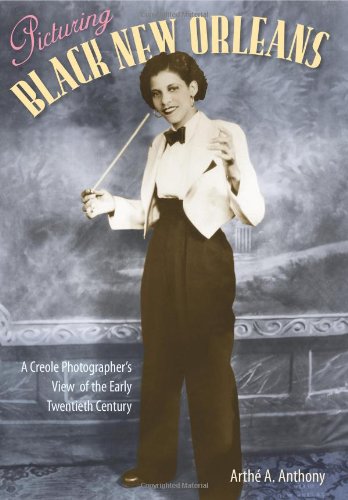
Florestine Perrault Collins (1895-1988) lived a fascinating and singular life. She came from a Creole family that had known privileges before the Civil War, privileges that largely disappeared in the Jim Crow South. She learned photographic techniques while passing for white. She opened her first studio in her home, and later moved her business to New Orleans’s black business district. Fiercely independent, she ignored convention by moving out of her parents’ house before marriage and, later, by divorcing her first husband.

Between 1920 and 1949, Collins documented African American life, capturing images of graduations, communions, and recitals, and allowing her subjects to help craft their images. She supported herself and her family throughout the Great Depression and in the process created an enduring pictorial record of her particular time and place. Collins left behind a visual legacy that taps into the social and cultural history of New Orleans and the South.

It is this legacy that Arthé Anthony, Collins’s great-niece, explores in Picturing Black New Orleans. Anthony blends Collins’s story with those of the individuals she photographed, documenting the profound changes in the lives of Louisiana Creoles and African Americans. Balancing art, social theory, and history and drawing from family records, oral histories, and photographs rescued from New Orleans in the wake of Hurricane Katrina, Anthony gives us a rich look at the cultural landscape of New Orleans nearly a century ago.
Tags: , , , , , , ,

Troubling the Family: The Promise of Personhood and the Rise of Multiracialism

Posted in Barack Obama, Books, Media Archive, Monographs, Passing, Politics/Public Policy, Social Science, United States on 2013-03-21 15:00Z by Steven

Troubling the Family: The Promise of Personhood and the Rise of Multiracialism

University of Minnesota Press
October 2012
256 pages
5 1/2 x 8 1/2
Paper ISBN: 978-0-8166-7918-8
Cloth ISBN: 978-0-8166-7917-1

Habiba Ibrahim, Associate Professor of English
University of Washington

Troubling the Family argues that the emergence of multiracialism during the 1990s was determined by underlying and unacknowledged gender norms. Opening with a germinal moment for multiracialism—the seemingly massive and instantaneous popular appearance of Tiger Woods in 1997—Habiba Ibrahim examines how the shifting status of racial hero for both black and multiracial communities makes sense only by means of an account of masculinity.

Ibrahim looks across historical events and memoirs (beginning with the Loving v. Virginia case in 1967 when miscegenation laws were struck down) to reveal that gender was the starting point of an analytics that made categorical multiracialism, and multiracial politics, possible. Producing a genealogy of multiracialism’s gendered basis allows Ibrahim to focus on a range of stakeholders whose interests often ran against the grain of what the multiracial movement of the 1990s often privileged—the sanctity of the heteronormative family, the labor of child rearing, and more precise forms of racial tabulation—all of which, when taken together, could form the basis for creating so-called neutral personhood.

Ibrahim concludes with a consideration of Barack Obama as a representation of the resurrection of the assurance that multiracialism extended into the 2000s: a version of personhood with no memory of its own gendered legacy, and with no self-account of how it became so masculine that it can at once fill the position of political leader and the promise of the end of politics.

Contents

  • Introduction: The Rising Son of Multiracialism
  • 1. Multiracial Timelines: A Genealogy of Personhood
  • 2. Legitimizing the Deviant Family: Loving vs. Virginia and the Moynihan Report
  • 3. The Whiteness of Maternal Memoirs: Politicizing the Multiracial Child
  • 4. Ambivalent Outcomes: Blackness and the Return of Racial Passing
  • Conclusion: Dreams of the Father and Potentials Lost
  • Acknowledgments
  • Notes
  • Index
Tags: , ,

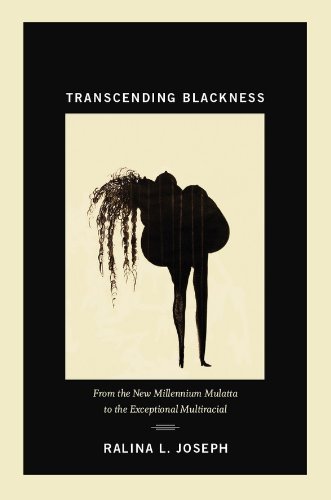
Transcending Blackness: From the New Millennium Mulatta to the Exceptional Multiracial

Posted in Books, Communications/Media Studies, Literary/Artistic Criticism, Media Archive, Monographs, United States, Women on 2013-03-21 14:59Z by Steven

Transcending Blackness: From the New Millennium Mulatta to the Exceptional Multiracial

Duke University Press
November 2012
256 pages
20 photographs
Cloth ISBN: 978-0-8223-5277-8
Paperback ISBN: 978-0-8223-5292-1

Ralina L. Joseph, Associate Professor of Communication
University of Washington

Representations of multiracial Americans, especially those with one black and one white parent, appear everywhere in contemporary culture, from reality shows to presidential politics. Some depict multiracial individuals as being mired in painful confusion; others equate them with progress, as the embodiment of a postracial utopia. In Transcending Blackness, Ralina L. Joseph critiques both depictions as being rooted in—and still defined by—the racist notion that Blackness is a deficit that must be overcome.

Analyzing emblematic representations of multiracial figures in popular culture—Jennifer Beals’s character in the The L Word; the protagonist in Danny Senza’s novel, Caucasia; the title character in the independent film, Mixing Nia; and contestants in a controversial episode of the reality show, America’s Next Top Model, who had to “switch ethnicities” for a photo shoot—Joseph identifies the persistance of two widespread stereotypes about mixed-race African Americans: “new millennium mulattas” and “exceptional multiracials.” The former inscribes the multiracial African American as a tragic figure whose Blackness predestines them for misfortune; the latter rewards mixed-race African Americans with success for erasing their Blackness. Addressing questions of authenticity, sexuality, and privilege, Transcending Blackness refutes that idea that in American society, race no longer matters.

Table of Contents

  • Preface. From Biracial to Multiracial to Mixed-Race to Critical Mixed-Race Studies
  • Introduction. Reading Mixed-Race African American Representations in the New Millennium
  • Part I: The New Millennium Mulatta
    • 1. The Bad Race Girl: Jennifer Beals on The L Word, the Race Card, and the Punishment of Mixed-Race Blackness
    • 2. The Sad Race Girl: Passing and the New Millennium Mulatta in Danzy Senna’s Caucasia
  • Part II: The Exceptional Multiracial
    • 3. Transitioning to the Exceptional Multiracial: Escaping Tragedy through Black Transcendence in Mixing Nia
    • 4. Recursive Racial Transformation: Selling the Exceptional Multiracial on America’s Next Top Model
  • Conclusion. Racist Jokes and the Exceptional Multiracial, or Why Transcending Blackness Is a Terrible Proposition
  • Notes
  • Bibliography
  • Index
Tags: , , ,

Fade to Black and White: Interracial Images in Popular Culture

Posted in Books, Communications/Media Studies, History, Literary/Artistic Criticism, Media Archive, Monographs, Social Science, United States on 2013-03-18 21:10Z by Steven

Fade to Black and White: Interracial Images in Popular Culture

Rowman & Littlefield
May 2009
250 pages
Cloth: 0-7425-6079-1 / 978-0-7425-6079-6
Paper: 0-7425-6080-5 / 978-0-7425-6080-2

Erica Chito Childs, Associate Professor of Sociology
Hunter College, City University of New York

There is no teasing apart what interracial couples think of themselves from what society shows them about themselves. Following on her earlier ground-breaking study of the social worlds of interracial couples, Erica Chito Childs considers the larger context of social messages, conveyed by the media, that inform how we think about love across the color line. Examining a range of media—from movies to music to the web—Fade to Black and White offers an informative and provocative account of how the perception of interracial sexuality as “deviant” has been transformed in the course of the 20th century and how race relations are understood today.

Table of Contents

  • Introduction: Fade to Black and White
  • 1. Historical Realities and Media Representations of Race and Sexuality
  • 2. The Prime-Time Color-Line: Interracial Couples and Television
  • 3. It’s a (White) Man’s World
  • 4. When Good Girls Go Bad
  • 5. Playing the Color-Blind Card: Seeing Black and White in News Media
  • 6. Multiracial Utopias: Youth, Sports and Music
  • Conclusion
Tags: ,

Mixed Bloods and Other Crosses: Rethinking American Literature from the Revolution to the Culture Wars

Posted in Books, Caribbean/Latin America, History, Literary/Artistic Criticism, Media Archive, Monographs, United States on 2013-03-16 19:42Z by Steven

Mixed Bloods and Other Crosses: Rethinking American Literature from the Revolution to the Culture Wars

University of Pennsylvania Press
2004
288 pages
6×9; 24 illustrations
Cloth: ISBN 978-0-8122-3844-0

Betsy Erkkilä, Henry Sanborn Noyes Professor of Literature
Northwestern University

In Mixed Bloods and Other Crosses, Betsy Erkkilä argues that it is through the historical and psychological dramas of blood as a marker of violence, or race, or sex, or kinship that Americans have struggled over the meanings of democracy, citizenship, culture, national belonging, and the idea of America itself as it was constituted and contested in its relations with others and the world. Whether blood is construed as setting up a boundary incapable of being crossed or is perceived as a site of mixing and hybridity, its imagery has saturated the literature of the American republic from the time of the founding. Erkkilä moves from a consideration of contests about territorial, sexual, racial, class, national, and aesthetic borders in the Revolutionary period and the nineteenth century to a discussion of recent contests about the boundaries of culture and the disciplines and the relation between aesthetics and politics, identity and difference, nationalism and cosmopolitanism, the local and the global.

Erkkilä’s American literature is a field of cultural and political struggle, one she examines in scenes of mixture and crossing, miscegenation and incest, doubling and hybridity that subvert, alter, or undo the boundary-building imperatives of American history. While she is concerned with the “crosses” of sex, race, class, and blood, she also looks at the ways history and “blood” impinge on the putatively pure realms of culture, literature, and aesthetics in the writings of Thomas Jefferson, Edgar Allan Poe, Emily Dickinson, Herman Melville, and the Caribbean writer C. L. R. James; she explores the ways the hybridity or mixture of social languages becomes a force for resistance and New World transformation in the writings of Phillis Wheatley and Abigail Adams, Walt Whitman and Harriet Jacobs; and she considers the ways modern subjectivity and the Freudian unconscious bear the markings of the dark, savage, sexual, and alien others that were expelled by the disciplinary logic of the Western Enlightenment and its legacy of blood in the Americas.

Table of Contents

  • Preface
  • 1. Blood, Sex, and Other American Crosses
  • 2. Mixed Bloods: Jefferson, Revolution, and the Boundaries of America
  • 3. Revolutionary Women
  • 4. The Poetics of Whiteness: Poe and the Racial Imaginary
  • 5. Whitman and the Homosexual Republic
  • 6. Emily Dickinson and Class
  • 7. Beyond the Boundaries: C.L.R. James to Herman Melville
  • Notes
  • Index
  • Acknowledgments

Read the Preface here.

Tags: , , , , , , , , , , ,

A Unique Slant of Light: The Bicentennial History of Art in Louisiana

Posted in Arts, Books, Louisiana, Monographs, United States on 2013-03-15 21:18Z by Steven

A Unique Slant of Light: The Bicentennial History of Art in Louisiana

University Press of Mississippi
2012-09-20
450 pages
9 1/2 x 11 7/8 inches,
400+ color illustrations, foreword, introduction, bibliography, index of artists
Cloth ISBN: 978-1-61703-690-3
 
Edited By:

Michael Sartisky, President
Louisiana Endowment for the Humanities

J. Richard Gruber, Director Emeritus
Ogden Museum of Southern Art

Associate Editor:

John R. Kemp, Former Deputy Director
Louisiana Endowment for the Humanities

A lushly illustrated celebration of two centuries of creative work from Louisiana

A Unique Slant of Light: The Bicentennial History of Art in Louisiana is a handsome, unprecedented, commemorative hardcover edition limited to approximately 3,000 copies. This large-format volume encompasses 450 color pages featuring approximately 275 artists and photographers. For art collectors and enthusiasts, for followers of Louisiana history, and for keepers of Louisiana pride, this dazzling book is testimony to the state’s vibrant artistic culture.

Coeditors are Michael Sartisky, PhD, president of the Louisiana Endowment for the Humanities, and J. Richard Gruber, PhD, director emeritus of the Ogden Museum of Southern Art; John R. Kemp, former deputy director of the LEH, is serving as associate editor. Written by scholars from around the country, the entries include all genres (painting, sculpture, photography, folk art, decorative art, furniture) and periods, from colonial to contemporary. Private collections and major archives such as the Ogden Museum of Southern Art, the Louisiana State Museum, the Historic New Orleans Collection, and the Louisiana State University Museum of Art, among others, contribute a comprehensive library of images.

Every entry in the book will be linked to fully articulated entries on each artist and genre in KnowLA: The Digital Encyclopedia of Louisiana History and Culture,which also will have the capacity to include a much more extensive image gallery for each artist and genre.

View A Unique Slant of Light in digital format here.

Tags: , , ,

Black and Blue: The Origins and Consequences of Medical Racism

Posted in Books, Health/Medicine/Genetics, Media Archive, Monographs, Politics/Public Policy, United States on 2013-03-15 20:24Z by Steven

Black and Blue: The Origins and Consequences of Medical Racism

University of California Press
April 2012
304 pages
Paperback ISBN: 9780520274013
Hardcover ISBN: 9780520248908

John Hoberman

Black & Blue is the first systematic description of how American doctors think about racial differences and how this kind of thinking affects the treatment of their black patients. The standard studies of medical racism examine past medical abuses of black people and do not address the racially motivated thinking and behaviors of physicians practicing medicine today.

Black & Blue penetrates the physician’s private sphere where racial fantasies and misinformation distort diagnoses and treatments. Doctors have always absorbed the racial stereotypes and folkloric beliefs about racial differences that permeate the general population. Within the world of medicine this racial folklore has infiltrated all of the medical sub-disciplines, from cardiology to gynecology to psychiatry. Doctors have thus imposed white or black racial identities upon every organ system of the human body, along with racial interpretations of black children, the black elderly, the black athlete, black musicality, black pain thresholds, and other aspects of black minds and bodies. The American medical establishment does not readily absorb either historical or current information about medical racism. For this reason, racial enlightenment will not reach medical schools until the current race-aversive curricula include new historical and sociological perspectives.

Contents

  • Acknowledgments
  • 1. THE NATURE OF MEDICAL RACISM: THE ORIGINS AND CONSEQUENCES OF MEDICAL RACISM
    • Introduction
    • “Avoidance and Evasion”
    • Judging How Physicians Behave
    • Judging Physician Conduct: Privacy and the “Halo Effect”
    • The Oral Tradition
    • Physicians Share the Racial Attitudes of Their Fellow Citizens
    • The Medical Liberals
  • 2. BLACK PATIENTS AND WHITE DOCTORS
    • The African American Health Calamity: The Silence
    • Medical Vulnerability and Racial Defamation
    • How Do (White) Physicians Think about Race?
    • Evidence or Medical Racism
    • Resistance to the Critique of Racial Bias in Medicine
    • Medical Liberalism and the Medical Literature
    • The Physician’s Private Sphere
    • Playing Anthropologist
    • From Racial Folklore to Racial Medicine
  • 3. MEDICAL CONSEQUENCES OF RACIALIZING THE HUMAN ORGANISM
    • Racial Interpretations of Human Types and Traits
      • Introduction
      • Racial Interpretations of Black Infants and Children
      • Racial Interpretations of the Black Elderly
      • Racial Interpretations of the Black Athlete
      • Racial Interpretations of Black Musical Aptitude
      • Racial Interpretations of Losing Consciousness
      • Racial Interpretations of the Nervous System
      • Racial Interpretations of Pain Sensitivity
      • Racial Interpretations of Heart Disease
    • Racial Interpretations of Human Organs and Disorders
      • Racial Interpretations of the Eyes
      • Racial Interpretations of Black Skin
      • Racial Interpretations of Human Teeth
      • Racial Interpretations of “While” and “Black” Disorders
      • Black “Hardiness”
      • Physical Hardiness
      • Emotional Hardiness
      • Conclusion: How Human Organ Systems Acquire Racial Identities
    • Racial Folklore in Medical Specialties
      • A Century of Racial Pharmacology: From Racial Folklore to Racial Genetics
      • The Role of Racial Folklore in Obstetrics and Gynecology during the Twentieth Century
  • 4. MEDICAL APARTHEID, INTERNAL COLONIALISM, AND THE TASK OF AMERICAN PSYCHIATRY
    • Introduction
    • “Africanizing” the Black Image
    • American Psychiatry as Racial Medicine
    • The Racial Primitive in American Psychiatry
    • The Task of Black Psychiatry
    • Colonial Medical Status
  • 5. A MEDICAL SCHOOL SYLLABUS ON RACE
    • Introduction
    • The Doctor-Patient Relationship
    • The Problem Patient
    • Medical Authors’ Aversion to Race
    • Race and Medical Education: The Search for “Cultural Competence”
    • Two Official Versions of “Cultural Competence”
    • Physicians’ Beliefs about Racial Differences: A (Belated) Study
    • A Medical Curriculum on Race
    • Practical Advice for Physicians
    • Social Class, Misdiagnoses, and Therapeutic Fatalism
    • “Cultural Competence” as Knowledge of Stereotype Systems
    • Raceless Humanism: “Medical Humanities” and the Evasion of Difference
    • Medical Curriculum Change Is Possible: The Case of Abortion Training
  • Notes
  • Index
Tags: ,

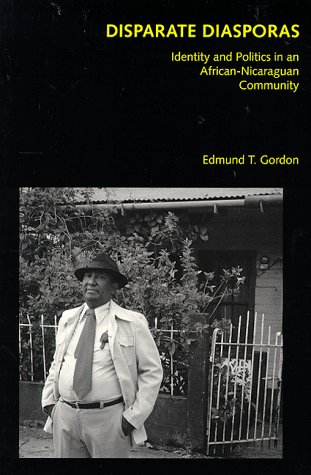
Disparate Diasporas: Identity and Politics in an African-Nicaraguan Community

Posted in Anthropology, Books, Caribbean/Latin America, Media Archive, Monographs on 2013-03-13 23:10Z by Steven

Disparate Diasporas: Identity and Politics in an African-Nicaraguan Community

University of Texas Press
August 1998
320 pages
ISBN-10: 0292728190; ISBN-13: 978-0292728196

Edmund Gordon, Associate Professor of Anthropology
University of Texas, Austin

This book is out of print.

Based on a decade the author spent among the African-Caribbean “Creole” people on Nicaragua’s southern Caribbean coast, Disparate Diasporas is a study of identity formation and politics in that community. Edmund Gordon lived in Bluefields, Nicaragua, during most of the 1980s, a turbulent period during which he participated in the community’s search for solutions to problems ranging from a crumbling economic base to the mutual mistrust and animosity between most Creole people and the Sandinista revolutionary government.

Disparate Diasporas is not a conventional ethnography. Rather than being just an observer, Gordon actively participated in the life of the community, intent on contributing to its political processes. A basic premise of his book is that engagement and activity can enhance ethnographic insights and sharpen theoretical understanding.

Disparate Diasporas shows how a particular “Black” community can evolve distinct types of diasporic consciousness, and, depending on the historical moment, how different types of memories, consciousness, and politics come to predominate. The author uses the Gramscian notion of “common sense” to understand the Creole community’s history of shifting politics and ideologies, focusing on the period of the 1970s and 1980s. His work explains the inability of the Sandinistas to come to terms with the racial and cultural challenge to the Nicaraguan nation posed by the Creole community.

Tags: , , , ,

James Douglas: Father of British Columbia

Posted in Biography, Books, Canada, History, Monographs on 2013-03-13 06:07Z by Steven

James Douglas: Father of British Columbia

Dundurn Press
October 2009
240 pages
5.5 in x 8.5 in
Paperback ISBN: 978-1-55488-409-4
eBook ISBN: 978-1-77070-564-7

Julia H. Ferguson

James Douglas’s story is one of high adventure in pre-Confederation Canada. It weaves through the heart of Canadian and Pacific Northwest history when British Columbia was a wild land, Vancouver didn’t exist, and Victoria was a muddy village. Part black and illegitimate, Douglas was born in British Guiana (now Guyana) in 1803 to a Scottish plantation owner and a mixed-race woman. After schooling in Scotland, the fifteen-year-old Douglas sailed to Canada in 1819 to join the fur trade. With roads non-existent, he travelled thousands of miles each year, using the rivers and lakes as his highways. He paddled canoes, drove dogsleds, and snowshoed to his destinations. Douglas became a hard-nosed fur trader, married a part-Cree wife, and nearly provoked a war between Britain and the United States over the San Juan Islands on the West Coast. When he was in his prime, he established Victoria and secured the western region of British North America from the Russian Empire and the expansionist Americans. Eventually, Douglas became the controversial governor of the Colonies of Vancouver Island and British Columbia and oversaw the frenzied Fraser and Cariboo gold rushes.

Tags: , , ,

Family Secrets: Crossing the Colour Line

Posted in Biography, Books, Canada, History, Monographs, Passing on 2013-03-13 04:23Z by Steven

Family Secrets: Crossing the Colour Line

Dundurn Publishing
February 2003
264 pages
6 x 9 in
Paperback ISBN: 978-1-89621-982-0
eBook (PDF) ISBN: 978-1-55488-161-1
eBook (EPUB) ISBN: 978-1-45971-478-6

Catherine Slaney

Foreword by:

Daniel G. Hill, III (1923-2003)

Catherine Slaney grew into womanhood unaware of her celebrated Black ancestors. An unanticipated meeting was to change her life. Her great-grandfather was Dr. Anderson Abbott, the first Canadian-born Black to graduate from medical school in Toronto in 1861. In Family Secrets Catherine Slaney narrates her journey along the trail of her family tree, back through the era of slavery and the plight of fugitive slaves, the Civil War, the Elgin settlement near Chatham, Ontario, and the Chicago years. Why did some of her family identify with the Black Community while others did not? What role did “passing” play? Personal anecdotes and excerpts from archival Abbott family papers enliven the historical context of this compelling account of a family dealing with an unknown past. A welcome addition to African-Canadian history, this moving and uplifting story demonstrates that understanding one’s identity requires first the embracing of the past.

Why did some of her family identify with the Black Community while others did not? What role did “passing” play? Personal anecdotes and excerpts from archival Abbott family papers enliven the historical context of this compelling account of a family dealing with an unknown past. A welcome addition to African-Canadian history, this moving and uplifting story demonstrates that understanding one’s identity requires first the embracing of the past.

Tags: , , , , , ,